
Access to Care Part 2
1/12/2023 | 26mVideo has Closed Captions
Access to Care Part 2
Rural areas face barriers to basic healthcare, but organizations are working to reduce those barriers. In this episode, learn more about how partnerships are bringing care to the people, and how future doctors are being trained to serve rural areas.
Problems playing video? | Closed Captioning Feedback
Problems playing video? | Closed Captioning Feedback
InFocus is a local public television program presented by WSIU
Support provided by:

Access to Care Part 2
1/12/2023 | 26mVideo has Closed Captions
Rural areas face barriers to basic healthcare, but organizations are working to reduce those barriers. In this episode, learn more about how partnerships are bringing care to the people, and how future doctors are being trained to serve rural areas.
Problems playing video? | Closed Captioning Feedback
How to Watch InFocus
InFocus is available to stream on pbs.org and the free PBS App, available on iPhone, Apple TV, Android TV, Android smartphones, Amazon Fire TV, Amazon Fire Tablet, Roku, Samsung Smart TV, and Vizio.
InFocus
Join our award-winning team of reporters as we explore the major issues effecting the region and beyond, and meet the people and organizations hoping to make an impact. The series is produced in partnership with Julie Staley of the Staley Family Foundation and sponsored locally.Providing Support for PBS.org
Learn Moreabout PBS online sponsorship(gentle music) (shutter beeps) (bright upbeat music) - Welcome to another edition of "InFocus" on WSIU.
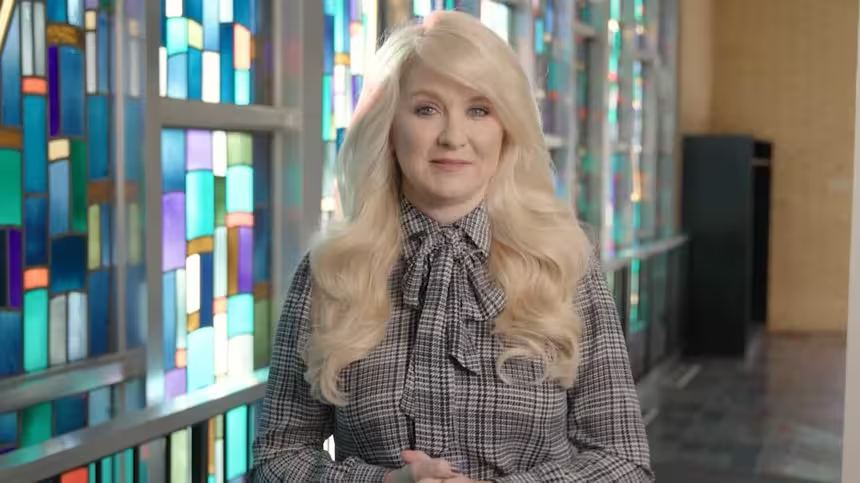
I'm Jennifer Fuller.
We continue our look at access to care in this episode, access that includes both specialists and primary care providers, and how students are trained to become those providers in the future.
One way that some organizations are coming together is by bringing those specialists and primary care providers to the patients themselves, rather than the patients having to travel long distances to see a provider for certain types of care.
WSIU's Benjy Jeffords caught up with a wellness mission through the Delta Regional Authority to take a look at how they provide that care and bring it to people most in need.
- [Benjy] Many communities are underserved when it comes to healthcare, but the Delta Regional Authority and the Department of Defense are trying to help.
The Southern Illinois Wellness Mission spent 12 days in Carbondale providing medical services at no cost to the patient.
Anyone that walked in the door could receive basic medical, dental, visual and mental health services.
Lieutenant Colonel Slade Lindquist with the 325th Field Hospital says even people with health insurance coverage can have difficulties meeting their medical needs.
- There are way too many stories where patients are not getting the care that they need and that's exactly what this is for, okay?
Patients, you know, they may have a high deductible insurance "So I'm not gonna go get this taken care of."
Then they finally come into the doctor and, "You should have been here two years ago," okay?
So our services, because it is no cost to the patients, they can come in and we can flag and let them know and say, "Hey, you need to go to the doctor and get this taken care of."
- [Benjy] Lieutenant Colonel Lindquist says they provide a wide variety of services for patients ages three and up.
- We're offering single vision glasses and exams to identify any health issues with their eyes.
Same with medical, wellness exams, high school physicals, school physicals for children, no age limits.
Dental if they have, you know, basically a dental wellness exam.
Cleanings to a limited extent, but more extractions and fillings.
And then, like I say again, mental health wellness and chaplain services available for patients as well.
- [Benjy] Leslie Durham with the Delta Regional Authority says a lot of planning takes place before a clinic like this can happen - From start to finish it's a two-year process.
We get these communities that want to participate have to make an application and we assist with the application and it's literally takes two years to do this.
It's not a overnight thing to be able to do the logistics for such a big, big mission like this, - [Benjy] Lieutenant Colonel Lindquist says he and the dozens of soldiers expect to stay busy during these missions.
- [Lindquist] I'm expecting at least 2 to 3000 patients to be flowing through here in the next 12 days.
- [Benjy] Durham says the community can take advantage of these services and save some money at the same time.
- [Durham] This is a great opportunity for folks to get glasses.
Oh my goodness, everything costs so much.
You can get glasses at no cost.
You can get your eyes checked, you can get extractions, you can get fillings in for your dental work.
Dental work is expensive even when you have insurance.
So this opportunity to come to this region is phenomenal.
It's just gonna be life changing.
- [Benjy] Durham says she's seen plenty of examples where they've helped patients overcome the obstacles preventing them from taking care of their health for a variety of reasons.
- Sometimes like Medicaid doesn't pay to have your teeth removed but they will pay for dentures but you have to have your teeth removed, right?
And it's really expensive.
So you can come here and have your teeth removed and then go get your dentures and that's something that they weren't able to do before.
So things like that.
I know that, you know, most of this is screenings, so they've been able to identify pre-cancer and life-changing things that folks just could not get before or just didn't live close to and have that opportunity.
- [Benjy] Sean Smith moved to Carbondale a few months ago and came to the clinic so his family could get caught up on their medical needs.
- Getting help that I need, well, that me and my family need so we can get back in into our medical stuff, getting going, getting the boys taken care of so they can get ready to start school next month.
- [Benjy] Not only are the soldiers helping the community but they're also getting to meet their yearly requirements for their military position including Lieutenant Colonel Lindquist who is also an optometrist.
This is a collaborative program with the Department of Defense and communities across the country called Innovative Readiness Training.
- Many of the soldiers, it is a volunteer, but there are certain requirements that they do need to do every year.
Like say, some of these are medics in the Army but they may not be necessarily be a medic out in their civilian life.
So this is a opportunity for them to come together for their two-week training to get the hands-on experience, to keep their skills up to date.
- [Benjy] Many of the soldiers are working together for the first time.
- This is not a one-unit mission, okay?
You've got units coming from Utah, you've got units coming from Massachusetts, you've got soldiers coming from Mississippi, basically, soldiers coming from across the United States to come provide this care.
So this is a massive undertaking and we are providing the best services that we can.
- [Benjy] Durham says this mission, like many others, can change people's lives and their region.
- A community may not really understand what it is at the beginning, but are really sad when they leave, you know, and ready for them to start making an application to come back.
They are excited to have this opportunity.
They may have insurance, but sometimes it, you know, you need that little extra, and right now times like this with the pandemic and then with inflation and money so short, it doesn't hurt to have a little extra help - [Benjy] For "InFocus," I'm Benjy Jeffords.
- Access to care is not an issue that really has a timeline so we thought we'd talk a little bit more about that with SIU School of Medicine Dean, Dr. Jerry Kruse.
Dr. Kruse, thanks for joining us.
- My pleasure.
Thank you.
- Rural access to care is something that the SIU School of Medicine focuses on quite well and does quite a bit of work on.
What do you see as the challenges when it comes to just basic access to care in rural areas across Illinois?
- Yeah, the challenges to access to care for rural Illinois and the rest of the rural parts of the United States actually pretty much remain the same over time.
They're the geographic challenges that occur.
There's the mismatch between the number of physicians and the population that occurs.
There's smaller numbers of people who are insured there.
There's a higher percentage of the population that's older.
The information technology does not reach the rural areas as well as it does in suburban and more, and in small cities as as well.
And so all of those things tend to always be there.
The School of Medicine was founded in 1970 to provide more physicians and more healthcare for Central and Southern Illinois, a total of 66 counties, producing physicians to provide the medical care and other health professionals to provide the healthcare there has been something that we have been doing vigorously over those last 50 years and have been trying, you know, to keep up with the demand, but we've still not solved all the problems.
So it's an ongoing issue to look at each one of the issues that rural Illinois has and to provide those types of programs and care in a changing healthcare system, and quite frankly, just a changing environment in the nation.
- In just scratching the surface of that, you also, it seems, have people in certain parts of rural areas who are reluctant to seek the care in part because perhaps they have to travel a distance in order to get to the care, or in just cultural ways, they don't want to see a doctor.
There's some reticence there.
How do you combat that in terms of getting into those communities where there may not be a provider full-time?
- Well, sure, so we have to combat the very specific issue that you mentioned, the issue of transportation, the issue of what's needed through technology for sure.
And then, quite frankly, we do need to address the trust issues.
And we have found that in most populations that don't receive the care that they need or don't have or who don't get the type of insurance or other assistance that they need for care is that over time some mistrust has developed with the healthcare system.
Actually, we've really been working hard on that in the past 10 years.
You know, starting with the establishment of our Federally Qualified Health Center in 2012, we've been doing much more outreach into communities where the trust levels are low, getting to understand those, really realizing that we have to engage the community and together come up with solutions for that.
So in some of our areas we have developed now a community health worker program which actually utilizes the talent of people in the community in a very certified type of way to help all of us understand the issues that would keep people from getting care that they need.
We've made some really big advances with that and really wanna generalize that program throughout the entire region to which we're accountable.
That's probably the biggest new step that we've taken to combat the very issue that you just mentioned.
- What about changes in healthcare overall over the last 50 years?
We see the increase in physician's assistants, nurse practitioners, and others who are qualified to do some of the things that used to be isolated only to someone with an MD.
Does that help in terms of spreading the care out to the areas that need it?
- It certainly does help, but even with the greater number of physician assistants, nurse practitioners, PharmDs and others, we've still just barely kept up, kept up with the demand for the healthcare workforce that we need.
I mean, we haven't really done that well enough to get to those problems.
And unfortunately, over the past almost 20 years now we've seen a continual decline in the percentage of physicians in the U.S. and in Illinois who are usual sources of comprehensive longitudinal care.
Now, I use that relatively complicated definition to describe people who are primary-care physicians and the rural areas historically have really depended upon that type of physician.
Most usually, general practitioners or family physicians, now, some of the other provider specialties as well, to provide the comprehensive type of care that's needed to be the glue that brings all of the elements that are needed for a good access to care in rural health areas.
Because of that decline, it's been very easy for family physicians just to fill their activities with office-based care and not reach into the hospitals or to the other areas that may need the care.
When that occurs, that that skillset tends to erode and you don't have the broad skillset that's needed to for rural areas.
So we are really trying to hone in on that problem and how we can accomplish it in a team-based care.
And in some ways, getting back to that comprehensive nature of care that we had in the past.
We have to put that together with the number of healthcare clinicians that we have in order to really solve that problem.
So that's the big issue of the day and one that the SIU School of Medicine is happy to take on and we are taking on.
- I imagine that comprehensive care also gets to the trust issue.
If you're told by your general physician, your family practice doctor, for example, that you need to go see a specialist, perhaps you're a little more trusting of that specialist if that person is recommended by the doctor that you see most often.
But as you're saying, if there's a shortage of family practice doctors or general practice doctors then you have people that are also missing out, not just on that initial point of care, but also the specialists that they might need.
- Sure.
I think that is really true.
And what you did is you just brought in the element of trust that we had des discussed before.
And certainly, you know, all of those things together go together to build that team and build that system and build those relationships that build that level of trust and build that level of knowledge to know what each person may need in their care.
It's a, yeah, you know, very, very, very complex issue.
Oh, you know what, to this point, we really haven't mentioned yet telemedicine and telemedicine is part of all of that too.
One of the great byproducts of the COVID-19 pandemic was that there became proper reimbursement for telemedicine services, pretty much across the board, all insurances, Medicare, Medicaid, everything.
All of those things have been extended for some time, the federal extension now through December 21st, 2014.
But those things have allowed us to reach more patients than we ever did before, and we are now becoming, you know, very good at that.
And that certainly will be part of the armamentarium that we need to get all of the services and all of the team together to provide access that's effective and efficient and builds those levels of trust.
- Still, as you mentioned earlier, though, those same issues and barriers to care that you see in rural areas can be a barrier even to telemedicine.
If someone doesn't have good internet access, access to broadband, do you still see challenges there with patients still not able to connect with their providers?
- Absolutely true.
The issue of excellent broadband access for rural areas is one of the big things that will really, really has the potential to improve the care in rural areas.
- Let's talk a little bit and change gears about the training of future doctors as that's yet another pillar of what the School of Medicine focuses on.
How's the training different when you're trying to make sure that these doctors or future physicians are well versed in the kind of care they'll need to provide in a rural area versus an area that has more access to those skilled providers and specialists?
- Yes, there are several aspects to that.
First, is one of the things that we call our SIU School of Medicine Field of Dreams.
"If you train them, they will stay."
So just three years ago we started a new program for the medical school where we accepted eight more medical students per year and they're doing all of their training in the Carbondale area and most of it with physicians and rural hospitals that surround the Carbondale area.
There are a few other medical schools in the United States that have done that and they're seeing some very excellent results about first, training the type of physician that's needed and then training them in the areas that's needed so that they become comfortable and understand what can be done there.
Generally speaking, a good percentage of them are attracted to that.
The other part of the answer to that question is just building training programs throughout the entire region of the 66 county area that the SIU School of Medicine serves.
We continue to support our programs in Carbondale and Quincy and Decatur and Alton and Springfield, all of which have reaches into rural areas and have a significant training in the areas where there are medically vulnerable populations.
And there are a lot of those in rural areas as well.
So we also make sure now that our medical students get training in the issue that I mentioned before, the trust issue.
And we do that through training programs now in hotspotting and community assessment and with our community health workers.
The students are very, very eager to learn that.
You know, I have a really, you know, a great faith in the future of what's gonna happen in healthcare because of this generation of of medical students that we see entering right now, you know, they have a heart for these problems and they eagerly, eagerly respond.
They eagerly build new programs as well.
So those three areas are probably the biggest ones in the way that we approach that problem.
- Certainly, still the challenge remains, and you mentioned this at the start, in terms of the access barrier to paying for that healthcare, the number of uninsured or underinsured Americans living in rural areas is higher than in some of their suburban and urban counterparts and there is a business aspect to medicine.
And so how do you prepare those students preparing to be providers in rural areas to look at the business aspect of this and say, you know, there are going to be people who struggle to pay but they still need this care.
- So for the medical students, that mainly is approached by having those students care for those populations.
Then the business aspects are more done in the residency training program which comes after medical school, you know, after they've done their work for licensure and while they're doing their work for their certification and their board specialty training.
So they very clearly do need the business aspects for that.
You know, I just also say that the issue of payment is a really big one for the solution of issues related to rural health.
Now, first of all, we've already mentioned that insurance, especially expanded Medicaid in Illinois and the marketplace insurance that came with Obamacare is not fully accessed in rural areas.
So we have a lot of, you know, a lot of work there to do as well.
But the other issue of payment is how we pay for medical services.
So when we are in a system that's based on payment for each encounter that a healthcare clinician has with a patient, it becomes very difficult to do all of the types of things that are needed to coordinate that type of care.
For primary care, for usual sources of comprehensive longitudinal care, a much more logical way to pay is a capitation, a payment for the number of patients that you care for, probably with a payment for some measures for quality as well.
But something that gives you, in essence, the financial freedom to do all the things that are necessary to pull the type of care together.
So payment reform on the way that it's paid and getting people to reach out and understand the type of insurance that they can have are both very important elements.
Now, before 2014, there were 50 million uninsured Americans.
Now, there are 21 million uninsured Americans.
So that's an improvement of 29 million.
Still the 21 million is a national disgrace, quite frankly, and we've gotta solve that problem somehow to extend that insurance to cover those other 21 million as well.
- You have communications with other deans of of schools of medicine and other healthcare providers and leaders as well as lawmakers across the country, is there a model that's in this country, or perhaps another country that has similar issues, that you look to that could solve some of those problems?
- Well, that's interesting that you say that, you know, we had one of the world's experts as our graduation speaker here a few years ago, T.R.
Reid, and, you know, he actually made the plea that the United States pick one healthcare system and that if we had that very high-level decision made that we had one healthcare system, you know, rather than four, that we might be able to solve that problem.
Now, those four things that he mentioned were, you know, one, the type of system that we have, well, the type of system we have now has four parts.
You know, one of them is the, what he would've called the truly socialized part, which is, you know, our care for veterans and the Indian Health Service, one is the German-type model where care for all is assured but it goes through a private insurance model.
One of them is he called the Canadian model which is much like our Medicare and Medicaid.
And then one is in essence no system at all.
Everybody fends for themself and there's no insurance at all.
So the discussions that we have are how does the United States move effectively to a system that is one of those that would be acceptable here.
And in this country, that one that he called the German system or the one that he called the Canadian system probably could be molded into a healthcare system that would be more efficient and more effective.
Now, you know, we move to any one of those step-by-step, it really doesn't happen at one time.
So those discussions are certainly abound, but, you know we would be much better off in this country if we would decide how we wanted to do healthcare for all.
- You mentioned earlier that you're very excited about the future of medicine because of the students that are making their way through the process now.
Does that change come from the ground up from those new physicians, or does it need to come through regulatory processes and things like that?
Or perhaps it's some combination?
- Well, both ways.
It is clearly from both sides of that.
So, you know, we are happy, again, the way that students approach problems here, no doubt about that.
There certainly need to be rules and regulations that help that.
And quite frankly, there needs to be an understanding by that on the part of leadership, both leadership in health professions institutions and leadership at the governmental level and at every other level in our society, you know, insurers and providers of care and those who benefit from that.
- Dr. Jerry Kruse is the Dean of the SIU School of Medicine.
Dr. Kruse, thanks for your time.
- You're very welcome.
- And thank you for joining us on "InFocus."
You can find more episodes at wsiu.org and at our YouTube channel.
I'm Jennifer Fuller.
We'll see you next time.
(bright upbeat music)

- News and Public Affairs

Top journalists deliver compelling original analysis of the hour's headlines.

- News and Public Affairs

FRONTLINE is investigative journalism that questions, explains and changes our world.












Support for PBS provided by:
InFocus is a local public television program presented by WSIU