
Ace Sign Company
8/12/2021 | 26m 37sVideo has Closed Captions
Mark McDonald re-visits the Ace Sign Company & Museum in Springfield.
Mark McDonald re-visits the Ace Sign Company in Springfield. It's become a Route 66 destination with an expanded sign museum inside.
Problems playing video? | Closed Captioning Feedback
Problems playing video? | Closed Captioning Feedback
Illinois Stories is a local public television program presented by WSIU
Illinois Stories is sponsored by CPB, Illinois Arts Council Agency, and Viewers like You. Illinois Stories is a production of WSIU Public Broadcasting.
Support provided by:


Ace Sign Company
8/12/2021 | 26m 37sVideo has Closed Captions
Mark McDonald re-visits the Ace Sign Company in Springfield. It's become a Route 66 destination with an expanded sign museum inside.
Problems playing video? | Closed Captioning Feedback
How to Watch Illinois Stories
Illinois Stories is available to stream on pbs.org and the free PBS App, available on iPhone, Apple TV, Android TV, Android smartphones, Amazon Fire TV, Amazon Fire Tablet, Roku, Samsung Smart TV, and Vizio.
Illinois Stories
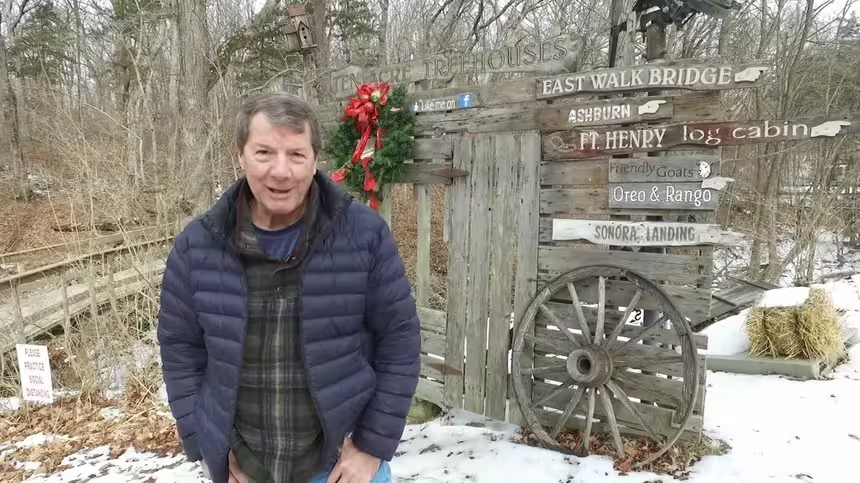
Join Mark McDonald as he explores the people, places, and events in Central Illinois. From the Decatur Celebration; from Lincoln’s footsteps in Springfield and New Salem to the historic barns of the Macomb area; from the river heritage of Quincy & Hannibal to the bounty of the richest farmland on earth.Providing Support for PBS.org
Learn Moreabout PBS online sponsorship(bright upbeat music) - [Announcer] Illinois Stories is brought to you by, The Corporation For Public Broadcasting, Illinois Arts Council Agency, and by the support of viewers like you.
(bright upbeat music) Thank you.
(bright upbeat music) - [Mark] Hello, welcome to Illinois Stories.
I'm Mark McDonald at the Ace Sign Company, in Springfield.
And as you can see, it's become a kind of a Route 66 destination, because inside this building, there's a Sign Museum.
Signs of course from streets and buildings, from decades passed.
We were here 10 years ago when Ace Sign, moved into this new location.
And they had a very small Sign Museum at the time.
And I thought, well when they expand that, I wanna come back.
Well, they expanded it.
And we're back.
When you walk into Ace Sign Company, you get into a reception area.
And Todd, when I was here some 10 years ago, we were doing a story about the company, 'cause you had recently moved to this facility.
Part of that was about the history of the company.
But this is where the Sign Museum was, in this part of it.
Boy, have you guys grown that Sign Museum?
(chuckles) - We have, we really have.
I remember seeing some videos of your past visit, and a lot of space in between, and well there's not as much space in between anymore.
We've really, really filled it in.
- Well, it was very impressive.
But when people, if they haven't seen it now, this entire production space that you have here is full of big sign and huge signs.
Signs that takes a big room to hold.
- Yeah.
- And that's what we're gonna see next.
But I wanted to stop here just for a minute.
Because what we do is we get a sense of the timeline of the company, from 1940.
And you go through the decades, here all the way up to the 2020s.
And it gives you a sense of history, and a sense of space and time.
And how the different members of the family were part of it.
And family is a big deal in the Ace Sign Company.
Isn't it?
- It is, it really is.
Yeah.
We've been enhancing that story as well to where there was a lot, even prior to 1940.
That was part of our family business.
The Horn Sign System prior to the inception of Ace Sign Company, back in 1887 starting.
Those were my third great-grandfather.
So our generation is the sixth generation of Sign makers here in Springfield- - Wow.
- And they started with carriage decoration, and custom signs.
And it's really expanded a lot over the years.
The depression was a rough time for the business, as it was for so many businesses.
And so that was our reset 1940, is my great-grandfather starting a Sign Company.
But yeah, it was a pretty incredible legacy there.
We've been bringing that Horn Sign System legacy back into the picture of the- - Yeah.
Do you think you could hand paint signs?
Like your ancestors did, do you think you could?
- I had a piece of glass in my parents' basement, and I used to practice hand washing.
- Is that right?
We're you any good at it?
- I was okay.
I, yeah, never had enough of that repetition.
You know, dad was of the last generation of full-time hand painters.
- But you got the gene apparently, right?
(chuckling) - We got the artistic gene, I guess.
- Let's go take a look at this area.
Because this is just, we gotta spend as much time as we can here.
And this is like the portal from the receptionary, to the to the Sign Museum.
- Yes.
- But you're first confronted with these beautiful old cars, and I have a feeling these were grandpa's.
And we're gonna get a chance to talk to him about that.
- Yes.
Yup, yup.
Yup, they had got to the model very reminiscent, for a lot of our Route 66 travelers of that era.
And then the international pickup truck here.
This was much like the one that grandpa Horn had, when he started this Sign Company in 1940 - [Mark] Oh, that's nice.
- [Todd] And it was a different technologies, but the pickup truck and a ladder and your brush kit.
And that was- - Yeah.
- [Todd] That was a bulk of what you needed for the Sign business.
- And people from center all around would get a kick out of this.
Because when they see these signs, most of them are from right around here.
And if they're old enough, they would have remembered these signs hanging up, wouldn't they?
- Yeah.
Yeah.
It's excellent to be able to create a legacy for more than just what Ace Sign Company has done here in Springfield.
But you know, all the clients that we have served over the years, it's just incredible.
The number of people whose parents, or some relative has been employed by someone like Reisch Brewery- - Yeah, and there's a good example of a beautiful sign right there, the Reisch Brewery Sign.
And of course now they're brewing beer again.
So that's kind of an interesting side to that too.
And then Paris Cleaners, of course from the early 19 hundreds.
They've been around for a long time, and their neon signs are, they're still visible.
- Yeah.
Yup.
Yeah.
The other Reisch family just hosted an event here in our museum.
Not so long ago.
- Is that right?
Well, we might mention that too because, if the possibility exists for all of these tables, and all of this equipment to roll out.
So if you wanna have an event here surrounded by all these neon and old signs, you can do it.
- We have so many great associations here in Springfield, nonprofits doing great work.
And so this is a really unique space for us to be able to connect with the community as well too.
We have trivia nights, and all kinds of folks doing fundraising events in here.
Yeah.
Dim all the house lights, and you kick on and all the neon, and that's a- - Oh, yeah.
It's a real mood, it's a real mood.
- Beautiful.
- Yeah.
Yeah.
But this is it.
Of course you can't help but notice the Steak 'n Shake guy.
Steak 'n Shake guy right up here.
- Yes.
- [Mark] And he was a Springfield fixture, wasn't he?
- [Todd] Yes.
That was the second Steak 'n Shake here in Springfield.
That was stick and ash.
And they, yeah, kind of fun.
You can see in the museum here.
You can see the evolution of the Steak 'n Shake guy.
We've got in the far opposing corner.
We've got the first one, which was on- - Let's go that way.
'Cause we got things to see on the way too.
This Pepsi-Cola cap.
- Yes.
- [Mark] It's too big to put almost anywhere else, except on that wall.
That's phenomenal.
Tell me about that.
- [Todd] It's a big size Pepsi-Cola.
It's about a 12 foot tall.
Pepsi bottle cap, it was a 1953 Pepsi bottle cap.
It was really back in the era where Pepsi was making the strong surge and a direction of this Hollywood style.
The CEO of Pepsi at the time had married a girl who was a big actress in Hollywood.
And so she had a major influence on Pepsi.
And really push in that direction.
And for a lot of people would see that Pepsi, coke bottle cap, that's really something that they can resonate with.
Because like all good things, those styles come back.
So we, you know, in the nineties, we've seen this style come back for Pepsi, and yeah.
- [Mark] Where was that?
Originally, do you have any idea?
- [Todd] It was on a temporary billboard structure.
- Wow.
- Here in Springfield.
It was made by Greeley Company and they had a, had headed up temporarily.
Took it down, put it into storage.
And it sat in storage in a warehouse on 11th Street, for about 65 years.
And we pulled that down.
Had about two thirds of the neon that needed to be replaced.
- Hmm.
Well that is a lot.
That is a lot of neon.
- Ruby red, Ruby red neon too.
A very rare neon that's hard to come by these days too.
- Now, if we just turn around a little bit, we see two huge signs.
The first is a Sputnik here.
It looks like a Sputnik anyway.
- Yes.
- [Mark] What was that thing?
- [Todd] Yeah, that was from the Bel-Aire Motel.
- [Mark] Oh, should have signs behind it.
Yeah.
- Yup.
The gentleman out of North Carolina actually invented those for a lot of diners and hotels back in Route 66 area.
He had a Christmas ornament.
That was the inspiration for these.
And he came up with this iteration that had these spikes on it.
And of course that was right before the time of the Space Race.
And they then connected the Sputnik satellite, and the spikes that come off of it with the style of that.
And the nickname Sputnik stuff.
In fact, we had a family that had come through traveling Route 66.
And they were touring.
Told a girl the story of the Sputnik, and her five-year-old daughter pointed up at it.
And she said, "Oh, that's cool then."
(Mark laughing) You know the relations that we have to all these things and the shapes and just the meaning of all that counts.
- Well another Illinois fixture.
I mean look, up there that the huge 'WATCH' sign.
Okay.
At one point Illinois Watch Company was one of the biggest watchmakers in the country.
They made railroad watches mostly.
But now look at that, this is before neon.
Those are like balls, aren't they?
- [Todd] Yeah, yup.
Those are six foot tall porcelain enamel letters.
They are on the outside of the Illinois Watch Company.
And spelled out, Illinois Watch Co. - [Mark] Yeah.
- [Todd] But yeah.
I mean, you could imagine the scale- - [Mark] Taking an immense building to hold that.
- [Todd] Yes.
- [Mark] And of course it was an immense building.
And the building is still there.
- Yup.
Yup.
- And speaking about men, a lot of people remember this too.
This Tropic sign over here.
Now the sign is back.
Glad you fixed it and put it back in place in Lincoln.
But this is the scale of it.
And this is what you actually used when you were fixing it, I guess.
And this was the face- - [Todd] This is the original face.
A lot of components of this we're not in a good enough condition to have the stability they needed to last another lifetime.
- [Mark] Yeah.
- [Todd] But in that refurbishing process, we saved these old faces.
So they could be appreciated on a couple levels.
- [Mark] And then just above it, Sunrise Donuts.
Now, when this was, I think this was on 9th Street in Springfield.
They'd been out of business for a long time, but the sign remained.
And it became real conversation piece, didn't it?
And so I guess you all fixed it up.
It's in mint condition now.
It's gorgeous.
- [Todd] Thank you.
Yeah, the Sunrise Donuts sign, that particular location was a Mexican restaurant.
While it had the Sunrise Donuts sign up for a long time.
And it just became this kind of landmark of Route 66.
And that piece of Springfield.
So the sign was saved and preserved by the Commission of Visitor Bureau.
And we donated the full restoration side of it.
And the removal on, and continued to find as many opportunities as we can to preserve Route 66 history.
- [Mark] Well, and now it's, you know it's still a tourist attraction.
'Cause people wanna come in here to see it.
- [Todd] Yep.
- [Mark] We talked about Steak 'n Shake guy.
And also Springfield people, also know the Cozy Dogs up there.
You can see the original sign.
And of course the Cozy Dogs themselves.
- [Todd] Yeah.
- [Mark] So another Springfield fixture.
- [Todd] Route 66 must stop.
- [Mark] Huh?
Yeah.
And I guess still is.
People still come for it, don't they?
- [Todd] Yeah.
We've had a tremendous amount.
You know, the tourism side and the course of impact of Abraham Lincoln here in Springfield.
But it is incredible.
The number of people that come through the museum.
From Germany, from France, and just making that Route 66 hall.
It's a big scene.
- You won't have time to run a company anymore.
You're gonna have to be a tour guide all the time.
- (chuckling) Oh wait.
We have family, and we've got family that have retired.
And so we've got a lot of really good, tour guides as well too.
We've got a history built in.
- I promised the folks in the reception area that we take a little tour of, this is the old series warehouse.
It's now the new Ace Sign Company.
But there are more signs back here, and you're making changes all the time.
So let's go back this way.
- Yeah, yeah.
- Yeah we can look up on this wall.
Here's your, this is your gas station alley here, ain't it?
- Yes, our auto wall.
- Wow.
(Todd laughing) - Yeah.
- Very impressive.
We have the, the collectible science course porcelain enamels, like really the hot ticket.
This Standard Oil sign here, is one of the original porcelain enamel Standard Oil signs.
In fact in the museum, you can also see the original white Opal glass flame that sat on top of that sign as well too, which is very- - [Mark] When you say the original, what sort of date are we talking about here?
- [Todd] Something like 1920s era.
- Wow.
- Yeah.
Yeah.
- [Mark] It's in a remarkable condition.
Really cleaned it up nicely.
- Yeah porcelain enamel, amazing production technique.
It will literally last for a hundred years.
Keeping the same color.
- These neon bars up here are these just for demonstration?
- Yeah these are a color sample chart, of your traditional glass neon.
Kind of an interesting test piece as well, too.
Where you can see the exposed bottoms of all of those bulbs as well too.
You see the blue and the red toggling back and forth.
- Yeah.
- And that's, the red is actually neon.
That's neon gas burns red.
The blue is actually argon gas.
So about half of what you see is neon, half is argon.
And combinations of different colors.
- [Mark] And that's your spectrum.
That's what's looking good.
You showed us a Ruby red earlier.
You can see it up there.
And it's hard to get that color.
- It is.
It's a glass that is no longer readily made and available.
So it is very hard to come by.
So when we see those preservation projects, we try to save those for the right job.
- Well, now we're gonna come back and look at more signs.
- Perfect.
- But first I'd like you to show me how you're changing this building because it's starting to look like almost like, the people that work here are members of a club.
It's starting to look like a work comfortable place.
So, let's go take a look.
- It's a big family.
Yeah.
- Well Todd, you know, this end of the building, it's starting to look all the world like a sports bar.
I mean.
(Todd chuckling) And of course there's still signs everywhere.
But I mean when you look around it, it's a very comfortable sort of almost like a party atmosphere.
- Yeah.
- [Mark] What do you use this room for?
- [Todd] Like any good family you know, you work hard and you play hard.
And it's important for us, that our employees feel like family.
This was actually at one time our stock room.
We did some flip-flopping here recently.
Just making it more of a fun space for the guys.
They spend a lot of time here.
And so we enjoy being able to spend time with them too, on that level.
- [Mark] So this is the Bringuet family.
- [Todd] This is, this is.
- [Mark] So this is the brain trust to the operation, yourself and your family, you all run it?
- Yes, absolutely.
Yep.
Yep.
We've got a sixth generation here.
Fifth generation, fourth generation.
- That's wonderful.
That's wonderful.
And of course you say, this is available for your employees to use as well.
So, and when you have events.
- [Todd] And events, so yes, absolutely.
- [Mark] You can have folks coming here.
- [Todd] Yeah, we're building.
Adding onto this, by the day.
And just a really cool space.
Invite the community and enjoy with us.
- You're also developing the outside, aren't you?
- Yes.
- Let's take a look.
- Yeah.
Yeah, we've got an old canopy, from the old Ramada Renaissance downtown, created a really cool space for us.
- Oh, that canopy there?
- Yeah.
- [Mark] Oh, that's from the Ramada Ren, okay.
- [Todd] Lights up.
Color changing RGBs and it does amazing show, fun space.
- [Mark] And of course, you got an old site- - [Todd] We got fresh ones coming in.
(Mark laughing) They're coming in left and right.
- [Mark] Is this gonna be repaired?
This car wash sign?
- [Todd] Yeah, this was a carwash on 6th Street.
Another piece of the Route 66 history.
And we've recently brought this in, to do some refurbishing of it.
It's gonna be a new piece for the museum.
So- - Nice.
So okay, in addition to your seating area up there, you've also built- - Yeah, we've got- - [Mark] I'm not even sure what to call this.
What would you say, the structure up there?
- [Todd] Yeah, new pylon structure.
It's gonna be housing some of our, signage that is complete and getting ready to go out, before it gets put on to a trailer.
And in addition to that practical use, it's also gonna be housing some large internally illuminated signs.
Much like what you see the Vegas sign graveyard and such, just again another cool place to be able to honor the history of the work that was done and all of the great businesses of Central Illinois.
- When you have to build really big signs, do you have to create structures like that to hold them so you can build them as that?
- Yeah that, that really, when you are seeing a large sign structure, post like that and loads of concrete, much like building a building.
That's what's underground takes a lot, to support a large sign structure like that.
There's a lot that goes into it.
- Well, I think your dad is here.
He spent his career building this business, and so did your grandpa.
And I think we're gonna talk to them next.
Thank you Todd.
- Yeah, thank you Mark.
- Joe Bringuet.
- Yes.
- We keep talking about grandpa, and how many generations there are, that makeup this Ace Sign Company.
- Oh my God.
- But you started in 1958, the age of 20.
And you are the grandfather of Todd, who we've been talking to.
Your son Dennis ran the company for some time, for several decades.
- Yep.
- And you did too.
- I did.
- [Mark] And when you started in 1950, you are pretty much hand lettering everything I guess, weren't you?
- We were absolutely.
It was a painted signs on plywood.
- Hmm.
- Everything.
And that was about because, we didn't have a room in them or anything like that because it was right after World War II.
- Are we sure?
'Cause everything was short, everything was short in supply.
- There was no metal or anything.
Even plywood, we had to make a deal with a plywood, with a lumberyard, to get a sheet.
- Hmm.
- So- - One of the first things you see when you come in to the Sign area, is this gorgeous, is it a model A?
- Yes sir.
- It's yours?
- It used to be.
I donated it to the museum.
(Mark chuckling) - But still you get to see it anytime you want, right?
- Oh yeah.
I can drive if I want to.
- Can you still drive?
- Oh yeah, sure.
- Good for you.
Good for you.
- Oh, yeah.
- And that thing will run, huh?
- I'm gonna be 92 at the end of this month.
- Yeah.
- And I'm gonna quit applying for driver's license.
And so after the end of that, I won't be able to drive it after that.
- Okay, well then you'd better get a good road trip behind you, huh?
- You're right.
- I wanna look at some of the signs you worked on.
- Okay, okay.
- Follow me if you would.
- Yeah.
- Mr. Bringuet we mentioned this earlier.
That Henry Welch sign?
- Yes.
- It's really striking.
And most people in Springfield know where that was.
- Yep.
- It was down on, I think it was 9th street, wasn't it?
- Yes, it was.
Yes 9th Street.
- [Mark] And tell me the story of working on that sign.
- [Joe] Well I worked on at nighttime, during after hours.
Because we were so busy.
And I just, it was a Bellaire sign that I was working on at nighttime.
And somebody was walking on the roof.
Scared the hell out of me.
- I bet.
- Yeah.
I was by myself down there at nighttime.
I thought, oh someone's gonna break in- - You wouldn't let your son do that?
- Someway.
(Mark laughing) Somebody's gonna break in here.
And I'm gonna get the hell out of here.
(Mark laughing) - Another one that I liked is Reisch sign up here.
- Oh yes.
- Now I didn't know this, but, and you hand paint signs.
Just like this one here.
- Yeah.
- [Mark] Turn around here, take a look at it for me.
That one, right there.
- Yes.
That's it.
- Is that on glass?
- Oh, yeah sure.
It's on the backside of glass, in reverse.
- [Mark] So when you made a sign like that, you would have to paint backwards.
The letters backwards.
- Yeah, yeah.
- [Mark] That sounds like a very difficult thing to do.
- [Joe] You can misspell a word pretty damn easy.
- (laughing) I bet you can.
And then you had to spray paint the white, the white paint on it.
- [Joe] That's what we did with that one.
But most of the time we had a stipple up paint.
And we would stipple it and model it.
And then it wouldn't have no brush marks left in it.
But I think that was sprayed with a can.
A can of spray white.
- [Mark] Did you ever have any regrets at all about being in the sign business?
- [Joe] Many times.
(Mark laughing) Especially when I made a mistake, and it was called to my attention.
I say, you know what?
Beer drivers can't drive, 'cause they drink a lot.
Some painters can't paint, because they don't know how to spell.
(Mark laughing) I think you survived the worst of it, didn't you?
- (chuckling) Yeah.
- Thank you, sir.
- Yes sir.
(laughing) - [Mark] There's a couple of local landmarks for Springfield, in Staab Funeral Home, and Illinois State Fair.
That Illinois State Fair, is probably a seventies vintage sign.
And Dennis Bringuet, (chuckles) that's why I wanna talk to you now.
'Cause you're a seventies vintage guy.
You got out of school, and came full time to the company in the seventies.
- That's right.
That's right.
- Yeah.
- Graduated in Springfield High in 72.
- 72, and then you had at least 20 years, where you were running the company before you retired and handed off to Todd.
- Yeah.
Yeah, we got a good family history there.
My two sons and my nephew, Corey have all been in the business since they grew up in it.
And my sister Joe Ellen worked in the office.
So truly blessed with a good family heritage, and a great team of employees, and great customers.
That's all it takes.
- I'll tell you what, you got a great museum too.
- Oh, thank you.
- And this, I asked you to bring me to one of your favorite things.
And you pointed to this old yellow cab.
And I don't know if anybody's ever seen a cab of this vintage.
But I don't know what is it like, make 35?
- 1331 Chevrolet.
- 31.
Okay, Chevrolet.
- Yeah.
- What do you like about it?
What is- - Well the thing is special to us is, if you look down here, real small it says 'Ace Sign Company'.
That was actually lettered by my grandfather, Frank Horn, who started the Ace Sign Company in 1940.
- Hmm.
- So that, and of course this is part of the lettering as well.
That's part of what he did as well.
So that's brings back a lot of memories.
I personally lettered a lot of Lincoln cabs, myself as well.
And dad lettered Lincoln cabs.
So that's when we put a pounce pattern on there, and get our brushes out, and do it to it.
- It's amazing what technology has done to this business, isn't it?
- It is, yeah.
- I mean, we're surrounded by vintage signs.
You know, neon's been around forever.
Painting, you know hand painting has been around forever.
But now, it's almost unheard of to use those things.
Now you're using everything sort of has been printed or scanned or, you know wrapped, or whatever.
- Yeah.
I truly, I am dinosaur you might say.
Being able to still paint by hand.
Dad, dad and I are probably the last of it.
But my grandfather, and my uncle, and you know, we go back.
The family goes back 134 years in the industry.
So- - Hand painting.
- Yes.
Right, right.
- Motor Inn Parking.
- Yes.
Now, you told me something I didn't know.
That parking wasn't always called parking.
And you found that out when you got this sign, you found out that behind parking, there was something else spelled there, it wasn't there.
- [Dennis] That's right.
It actually, used to use the word storage.
That was the term that was used rather than parking, back in the 1930s and forties.
Behind the P, you can barely make out a letter S. And you see the empty holes that were for the neon housing holes.
That's what kind of tipped us off on why are those there.
- [Mark] They had to be in different position, didn't they?
Yeah.
- That's right.
- [Mark] Yeah, to hold the different letters.
Ah, fascinating.
- But this was in downtown Springfield, on 4th and Monroe Street.
- Hmm.
- And it's a real icon.
- Yeah.
Yes it is.
Well, this has been very fascinating.
You know, I think some of our viewers would probably like Dennis, to be able to come in here and look around.
And in fact, you do encourage people to do that.
Don't they?
If they've got an afternoon or a morning without a lot going on, if they wanna look all through the museum, even though your folks might be working in here, then you can have somebody show 'em around.
- Yeah absolutely.
I retired about a year and a half ago.
And one of the things I enjoy doing, is just giving tours to individuals and groups.
I love to tell them a little history.
- Dennis, thank you to you and your dad, and your son.
It's been a lot of fun.
Thank you very much.
- Thank you Mark.
- Keep in mind, the Ace Company Sign Museum is open to the public.
And if you have a large group, they'd like you to call ahead, so they can accommodate you.
But if you wanna come in and wander around, and see if somebody's available to give you a tour of the of the Sign Museum, do that.
Also keep in mind that this venue is available for nonprofits.
If they have a fundraiser or some other event.
With another Illinois Story at the Ace Sign Company, Sign Museum in Springfield, I'm Mark McDonald.
Thanks for watching.
(bright upbeat music) - [Announcer] Illinois Stories is brought to you by, The Corporation For Public Broadcasting, Illinois Arts Council Agency, and by the support of viewers like you.
Thank you.
(bright upbeat music)


- Arts and Music
The Best of the Joy of Painting with Bob Ross
A pop icon, Bob Ross offers soothing words of wisdom as he paints captivating landscapes.












Support for PBS provided by:
Illinois Stories is a local public television program presented by WSIU
Illinois Stories is sponsored by CPB, Illinois Arts Council Agency, and Viewers like You. Illinois Stories is a production of WSIU Public Broadcasting.