Inside California Education
Achieving Financial Literacy
Season 5 Episode 3 | 26m 46sVideo has Closed Captions
Discover how these San Diego high schoolers are learning basics about managing money.
Discover how these San Diego high schoolers are learning basics about managing their money, meet a new generation of student journalists in Sacramento telling stories about their schools, visit a Los Angeles County school where “kinder readiness” is reaping rewards for these youngsters, and check out a JROTC program in the desert with a focus on the Space Force.
Problems playing video? | Closed Captioning Feedback
Problems playing video? | Closed Captioning Feedback
Inside California Education is a local public television program presented by KVIE
Funding for the Inside California Education series is made possible by the California Lottery, SchoolsFirst Federal Credit Union, Stuart Foundation, ScholarShare 529, and Foundation for the Los Angeles Community Colleges.
Inside California Education
Achieving Financial Literacy
Season 5 Episode 3 | 26m 46sVideo has Closed Captions
Discover how these San Diego high schoolers are learning basics about managing their money, meet a new generation of student journalists in Sacramento telling stories about their schools, visit a Los Angeles County school where “kinder readiness” is reaping rewards for these youngsters, and check out a JROTC program in the desert with a focus on the Space Force.
Problems playing video? | Closed Captioning Feedback
How to Watch Inside California Education
Inside California Education is available to stream on pbs.org and the free PBS App, available on iPhone, Apple TV, Android TV, Android smartphones, Amazon Fire TV, Amazon Fire Tablet, Roku, Samsung Smart TV, and Vizio.
Providing Support for PBS.org
Learn Moreabout PBS online sponsorshipNarrator: Coming up on Inside California Education: Discover how some San Diego high school students are learning essential basics about saving, investing, budgeting and managing their money.
It's called financial literacy, and it's becoming a popular academic option in schools throughout the state.
Josie: It's just like, you learn so many life skills like balancing a checkbook, learning to do your taxes, like what credit cards right for you.
Narr: There's a new generation of student journalists who want to tell stories about their own schools and communities.
See how a unique program in Sacramento partners established journalists with these avid learners to help hone their reporting skills.
Saffiya: When students go to look for work in actual journalism workplaces, they already know what's going to happen.
They already know the steps to take because of this experience that they have in high school right now.
Narr: For many kids, kindergarten is where their formal public school education begins.
But many studies show even earlier learning offers lifelong academic and even financial benefits.
We'll visit a school in Los Angeles County where kinder readiness is reaping rewards for these youngsters.
Monica: I can't tell you how many times my kinder colleagues come and thanked me and are amazed at how prepared their students are.
Narr: And, Space Force in the desert?
Check out this school in San Bernardino County, where an innovative JROTC program is preparing high schoolers for careers in space exploration, engineering, defense, and more beyond the final frontier.
>>: Ready, face.
Misaki: I have always been really mesmerized by space, as well as astronomy and just all the connections that we receive being part of Space Force is just stellar.
Narr: It's all coming up next on Inside California Education.
Annc: Funding for Inside California Education is made possible by: Annc: The California lottery has been reliably raising additional money for public education for decades, more than $41 billion since voters created the lottery in 1984.
And that's the reason why California lottery exists.
It's why we do what we do and work so hard to do it.
Thank you, California.
Our schools appreciate your support.
Annc: Imagine a credit union where school employees are treated like the heroes you are.
At SchoolFirst Federal Credit Union, everything we do starts with helping school employees and their families live better today and plan for tomorrow.
Learn more at schoolsfirstfcu.org.
Annc: The Stuart Foundation: Improving life outcomes for young people through education.
ScholarShare 529: Californias state-sponsored, tax-advantaged 529 college savings plan designed to help pay for the cost of higher education.
Annc: Additional funding for Inside California Education is made possible by these organizations supporting public education.
♪♪♪ Narr: At San Marcos High School in San Diego County, you may hear students talking about things you don't typically hear high schoolers talk about.
Josie: In San Francisco, sale tax is like 8%.
And here its only like 6% I believe.
Kareem: Like I dont really need the brand-new game straight when it comes out.
I dont need a brand-new shirt if mine is still like, okay.
Zach: Its really good to know about like, where your moneys coming from and like what to do with it and how to spend it.
These students are enrolled in ‘financial literacy, an elective available to juniors and seniors that has become one of the most popular classes at the school.
Students learn how to budget for an apartment, what food really costs, and how to prioritize their wants versus needs.
Josie: It's just like, you learn so many life skills, like balancing a checkbook, learning to do your taxes, like what credit cards right for you.
Tara: This is an example of one of the life budget projects that the students are working on right now.
So, they actually have to get a job, um, that they can get at the age of 18.
Narr: Students in this class are encouraged to get a job.
It makes the lesson in taxes a little more real.
They also learn how to budget for college, what a car, including gas and insurance, will cost them, and more.
You could say every day in this class is a lesson in real life.
Tara: Paying bills and managing your money and learning about credit and paying your taxes are not fun things to do for most people.
Um, but I do try to make it engaging and realistic and relevant.
What we're going to be doing is brand name, um, versus store brand taste testing.
Narr: This is Tara Razis second year teaching financial literacy, a class you might agree is surprisingly entertaining.
On this day a lesson in comparison shopping.
How you often can't tell the difference between generic brands and the more costly name brands.
Tara: I picked up 16 different products from some that you eat to condiments to, um, paper products.
And so they're going to have to see if they can tell the difference between the brand name and the store brand.
Narr: Razi says the name brand items cost almost twice what the generic brands did.
She also considers this a lesson in financial overconfidence.
Kareem: Im pretty confident, cuz for me personally, I do kind of get sometimes store brands, sometimes, um, like fa-- more famous brands.
Zach: Some of ‘em, its... its kind of easy to, um, distinguish but I feel like on the majority of them, um, they... they taste similar.
So...
I think-- Im pretty confident for what I did, but you know, you never know.
Tara: Number one, Kellogg's cornflakes.
Raise your hand if you think it's A... Raise your hand if you think its B...
The answer is A. Kareem: What, really?
Narr: Our confident interviewees got a bit of a reality check, but with it came a valuable lesson.
Kareem: You dont always have to get a name brand just cuz of its name that a store brand quality or another quality could be exactly the same and taste as good, but also be a little bit cheaper.
Tara: Raise your hand if you think its A.
Raise your hand if you think its B.
It was A. Zach: What?!
Andrew: These kids are screaming for real world, real life learning that's going to set them up for their future and that will help them navigate the adult world.
Narrator: Superintendent Andy Johnsen says there's huge demand for this class at both of the district's high schools.
In fact, they often have a wait list.
He says in recent years, students have made it clear they want more classes that teach skills they can use.
Andrew: They continually tell us, I want to know how to do my taxes.
I want to know how... how the credit card debt works.
I want to know, how do I understand whats on my paycheck and all those... all those withdrawals and those other things that are deducted from my paycheck, what is all that?
Josie: I'm a senior.
I'm about to go to college and live on my own.
Like, I'm not going to have my parents there to support me.
And it's like, I would have never known how to file taxes.
Narrator: At a time in life when most kids are thinking about what they want today, this class has them thinking about what they'll need for retirement.
Zach: I don't want to, like, retire and then I run out of money and then I need to start working again.
So, I feel like that was, like, my main take away from this.
Narrator: From creating a business and pitching it ‘Shark Tank style, to following the stock market, Tara Razi says her goal is for these students to leave with something they can use.
Tara: These life lessons are things that theyre gonna need and... and are they gonna remember every little thing I teach ‘em?
No, absolutely not.
Um, I want them to go be good people out in society and make wise decisions, and I guess thats... thats my goal when they leave my classroom.
Narrator: And if they happen to do well in the stock market or retire in comfort someday, there's little doubt that the lessons they learned in this classroom may have made a difference.
Narrator: Research shows students who have access to high-quality financial education have better outcomes as adults, resulting in less debt and a higher quality of life.
22 statesnow have laws requiring a financial literary course for high school graduation.
Right now, less than 30% of high schools across the Golden State offer those classes, but the California Department of Education partnered with a non-profit to provide teacher stipends and professional development to help educators teach financial literacy in high schools across the state.
♪♪♪ Lilah: I really like writing, and I've just always really liked words.
And so, having a new opportunity to like, try a new style of writing that I've never had experience with before, it was like, a really cool idea to me.
Narrator: For Lilah, writing is a career path she may want to pursue.
That's why she joined a countywide journalism training program, along with about 20 other students from high schools throughout the Sacramento region.
Steve: If you look at how the schools operating, then you can kind of connect that to what creates this situation.
They want to tell stories.
So, were... we're just facilitating what they already want to do.
Narr: Steve ODonoguhue runs the high school student journalism program called The California Scholastic Journalism Initiative.
It's funded by the Sacramento County Office of Education.
Steve: We teach the students standard journalism rigamarole, and we try to hold them to those standards.
And the idea was to offer a publication and journalism opportunities for students from schools that don't have those opportunities.
There's, uh, students from 14 separate high schools, all in Sacramento County that are represented in this program.
And we treat it as like an internship.
They get a $1200 stipend at the conclusion of the program.
Narr: The intensive program trains high school students during the summer to be education reporters for their school and district.
Then from August to May, the students produce at least one story each month throughout the academic year.
Steve: They can pick the topic and we guide them on how to develop the stories, how to make it-- realize the story.
Writing coach: Give us sort of a one minute elevator pitch synopsis of your December story.
Student: Were writing about, uh A.C.T.
and S.A.T., like the standardized testing in general.
Steve: We only, uh, critique how they do it.
We give them feedback on what's practical and what's-- what... what can be realized.
Steve: Saffiya.
Saffiya: Im writing about this youth academy under the district attorney in Sacramento.
Saffiya: It's kind of like those training wheels on a bike.
When students go to look for work in actual journalism workplaces, they already know what's going to happen.
They already know the steps to take because of this experience that they have in high school right now.
Narr: A majority of the training is done via Zoom, but Steve and two other writing coaches, all of whom are professional journalists or educators, occasionally meet with the student reporters in person to review each of their stories they're working on.
Lilah: Our schools debating going to block schedule next year And so, Im writing a story, kind of the different perspectives and pros and cons in that.
Narr: Block scheduling is an alternative method of scheduling, where each student has approximately four class periods per day instead of the traditional 6 to 8 daily classes.
Today, Lilah is interviewing Abigail, a fellow student considered to be one of the top performing students at their school to get her perspective on block scheduling.
Lilah: So, what are, like, some of the biggest cons or pros that you have with traditional schedule right now?
Abigail: I would get a whole semester to study for that AP test.
Lilah: I'd like to see how block schedule would affect her if she thinks she would still be as successful in the block schedule.
Steve: We know that high school students, while they may not be quite up to a professional standard yet, they can write and report journalism at a professional level if theyre given the opportunity and everyone benefits from that.
They learn skills that are transferable and the community learns stories that they might not have heard before.
Narr: The student stories are published on the program's website, sacschoolbeat.com.
Steve also shares their stories throughout the Sacramento region, inviting media outlets to republish them.
Steve: One of the reasons we started this program is because we can take what they produce and share that with a larger... larger audience and kind of put a... a dent in some of those news deserts.
So many journalists have been laid off and a lot of education news just doesn't get covered like it used to because there aren't the people who do it.
Saffiya: Honestly, I just want to be able to improve my writing skills and be able to use those skills to help others, to spread news, to make an impact in some way.
Because at the end of the day, I'm still a student and I still have a long way to go.
But this program allows me to take, you know, at least like some steps towards it.
Lilah: Ive really enjoyed the opportunity to really find a little more about myself and what I can do based on this program.
Steve: I'm hoping that they leave with skills that are... are useful to them, uh, whatever career they choose.
And they surprise us all the time.
Um, that's... that's the... the reinforcement.
There isn't enough money that you could pay someone to do this and... and... and to compensate.
It's...it's the reward of working with youth.
Narr: The California Scholastic Journalism Initiative is just one of several programs throughout the state preparing the next generation of journalists.
For example, in 1951, newspaper magnate William Randolph Hearst started what's now called the California Scholastic Press Association.
Hearst originally recruited boys to cover their high school sports teams.
Payment: meal money and a byline in Hearst's Los Angeles Examiner.
Girls joined the effort in 1965, and more than 70 years since its start, its still going strong, with graduates working at prestigious media outlets like the New York Times, LA Times, Washington Post, Wall Street Journal, CNN, NBC News, and the Associated Press.
Narr: Still ahead on Inside California Education: from the Air Force to the Space Force.
See how these junior ROTC students are discovering new career opportunities beyond the blue horizon.
But first, four-year-olds get a head start on learning a year before kindergarten.
And the results are amazing.
♪♪♪ (singing in Spanish) Narr: In Los Angeles County, the El Monte City School District is busy expanding its Transitional Kindergarten program.
Monica Ballardo, who teaches in the dual-language program at Durfee Elementary, loves teaching these youngsters.
Monica: Even though it might be a little chaotic in the classroom, the ability to just let the kids be kids theyre four.
Um, and I know sometimes we think like, oh, theres not a big difference between four and five, but when we think of age months-wise, the ability of what a 48-month old can do compared to a 60-month old.
Its big.
Narr: California plans to offer free Transitional Kindergarten, also called TK, for every 4-year-old by 2025.
Dr. Maribel: Transitional kindergarten is... is an opportunity for us.
Uh, were adding a grade level to the continuum, the educational continuum in our school system.
I mean, when was the last time that was done, right?
Narr: Transitional Kindergarten is not new in California.
First established with the Kinder Readiness Act in 2010 TK is designed to serve as a bridge between preschool and traditional kinder.
So far, it has only been available to relatively few children.
Monica: I tell parents all the time at back-to-school night, that kindergarten is not the same like when we were in kinder.
When we were in kinder, if we knew our ABCs off to first grade... thats no longer the case.
The rigor has increased and now the goal for the end of kinder is to read and write.
So with that new rigor, kinder was their first experience in school and were lacking fine motor skills, were lacking social emotional.
That caused, um, TK to come about.
TK was the answer for that.
Dr. Maribel: TK is not, uh, you know, a half step below kindergarten.
Its really a grade onto itself.
The magical years for kids are zero to five, right?
We know that the brain is just developing at maximum capacity during that time.
And so an opportunity to add a grade level that can really capture that time in a kids life is just so powerful.
♪♪♪ Narr: Monica used to be a Kindergarten teacher.
Now, instead of teaching 5-year-olds, she teaches 4-year-olds.
The difference, she says, is noticeable.
Monica: So, I love that we are targeting learning through... more of a play-based approach, center-based.
Were letting academics come in organically.
We slowly introduce the same standards that there will be exposed to the following year, but not expecting mastery, just practice, exposure.
Narr: California is the only state in the U.S. to commit to free universal TK.
Dr. Maribel: California has been very progressive when it comes to different measures.
You know, universal meals is one of them.
Universal TK is... is actually, you know, is... is the other, um, which makes California stand out, right?
And again, its this idea that, uh, you want to reach families, you wanna reach kids, uh, at an early age and provide them with the resources, the tools, the experiences, the magic, uh, from school systems early on.
Christina: I think right now there are a lot of programs available.
There are Head Start, early Head Start programs, state-run preschools, um, all of them with, um, income limits or different requirements, um...
Parochial schools offer, uh, similar programs.
Um, you know, theres private schools that are available too.
But for families, um, in my experience, who are right over the income limit, just a dollar over the income limit, theyre unable to access those resources and they still need them.
Narr: Adding a new grade level to the school system doesn't come easily.
Dr. Maribel: As we, you know, open up, uh, spaces for transitional kindergarten, you want to make sure that you have the right spaces and that you have the infrastructure to make sure that the classrooms are safe, inviting, welcoming and warm.
Narr: Monica has noticed a big difference in children who enter kindergarten, having gone through TK.
Monica: The biggest indicator of how successful students are now in kinder after completing TK is just my colleagues.
I cant tell you how many times my kinder colleagues come and thank me and are amazed at how prepared their students are because they had those foundations in... in... in TK.
Dr. Maribel: It just makes me very hopeful for the future because our kids are gonna be primed for success and we need them.
Theres a lot of issues out there, and I think our kids are gonna be ready to solve those issues.
(teacher and kids singing) ♪♪♪ All: One, two, three, four... Narr: At the Academy for Academic Excellence in Apple Valley, Junior ROTC is core to a cutting-edge education.
Now, it also represents a cutting-edge military service for the U.S. Space Force.
This is one of the first ten Space Force JROTC programs established nationwide.
It's the only one in California and the only one at a charter school.
The academy is operated by the Lewis Center for Educational Research.
Dr. Lisa: Were one of the inaugural units, one of the first ten ten to transition from Air Force Junior ROTC to Space Force.
Narr: The school is located in a steeped in military tradition.
And many of the students feel an old fashioned responsibility for that tradition, even in a routine inspection.
Caprice: Ready, face.
Caprice: We are a military unit.
We are modeling the military.
This is not just some uniform we put on every day or it's not just some uniform that we can just mess around with.
It's modeling those that are fighting for our country.
I definitely do have a sense of pride when I wear this uniform because I know I'm a part of something bigger.
-Ma'am?
Cadet specialist... ready for inspection, maam.
Narr: The Academy's previous Air Force Junior ROTC program won multiple awards.
But it still took a years-long application and review process - a process slowed by COVID - before the program finally transitioned from the Air Force to the Space Force in 2021.
Misaki: Honestly, the transition has been amazing.
I have always been really mesmerized by space as well as astronomy and just all the connections that we receive being part of Space Force is just stellar.
Tyler: Our school is actually partnered with NASA so it's really cool as we're able to go and visit Space Force bases.
And besides that, we're actually able to visit our local, uh, JPL, so, Jet Propulsion Laboratory.
And we're able to firsthand interact with scientists there, especially those that are seeking careers in space.
♪♪♪ Narr: Those careers aren't just in space, and they're not just in the military.
Half of the Space Force is civilian.
-Right now, the one on the right that you see up here is DSS-28.
Narr: And only 2% of this programs students will go on into some branch of the service.
That means the curriculum taught by the school's Air Force veterans must focus on preparing these kids for jobs that didn't exist a generation ago and weren't even conceived of when men first flew to the moon.
Col. George: I've been teaching Mercury, Gemini and Apollo because none of them were born when this happened.
And if you look at the mission of Space Force, you know, uh, its basically a hundred miles above, and above that theyre in charge.
So, were talking satellites, were talking, you know, spacecraft, were talking all the communications with all of those, um, computer-- all the computer security.
So, literally those are career fields that they, you know, my students can jump right into.
Master Sgt.
Harold: It prepares them to properly interview for jobs, learning how to write resumes.
You get to put down, I was in charge in finance, $50,000... handling $50,000 throughout the school year.
I mean, what teenager can say that.
Narr: And that, for the students, means reaching for dreams they may not have realized they even had.
Tyler: I feel like its gonna start sparking more of an interest in it instead of that childhood fever dream of, I want to grow up to be an astronaut.
People are gonna start seeking fields as scientists or astronomers.
♪♪♪ Narr: But this program doesn't just develop future titans of interstellar technology.
These kids are also developing a personal skill set that will help them lead their generation into the future.
For some of them, that's tougher than the academics.
Col. George: I think leadership is both a science and an art.
You know, you have people that are born leaders, but you have people that learn leadership.
And I think most of my students are learning how to be leaders as... as they go through the program.
>>: Thank you.
Take your position in flight.
>>: Yes, sir.
Misaki: I had never really had the opportunity during my earlier years of high school to allow myself to develop as a leader because I didn't really have the opportunities or I didn't - I was too shy.
I was too afraid of taking things head on and I was too afraid of just letting myself be out there.
But ROTC has taught me that it's okay to make mistakes.
Narr: For these young pioneers, Space Force is anything but the final frontier.
It is, in fact, only the first of many.
♪♪♪ That's it for this edition of Inside California Education.
If you'd like more information about the program, log on to our web site insidecaled.org We have videos from all of our shows and you can connect with us on social media.
Thanks for joining us.
We'll see you next time on Inside California Education.
Tara: Number one Kelloggs Cornflakes.
Raise your hand if you think its A... Raise your hand if you think its B...
The answers A. Kareem: What, really?!
Lilah: So, what are like, some of the biggest cons or pros that you have with traditional scheduling.
(singing in Spanish) All: one, two, three, four... Funding for Inside California Education is made possible by: The California lottery has been reliably raising additional money for public education for decades.
More than $41 billion since voters created the lottery in 1984.
And thats the reason why California Lottery exists.
Its why we do what we do and work so hard to do it.
Thank you, California.
Our schools appreciate your support.
Imagine a credit union where school employees are treated like the heroes you are.
At SchoolFirst Federal Credit Union, everything we do starts with helping school employees and their families live better today and plan for tomorrow.
Learn more at schoolsfirstfcu.org.
The Stuart Foundation: improving life outcomes for young people through education.
ScholarShare 529: Californias state-sponsored, tax advantaged 529 college savings plan designed to help pay for the cost of higher education.
Additional funding for Inside California Education is made possible by these organizations supporting public education.
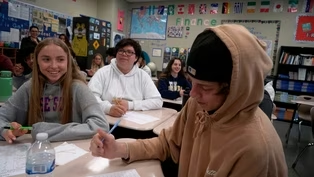
Video has Closed Captions
Clip: S5 Ep3 | 5m 30s | Discover how these San Diego high schoolers are learning basics about managing money. (5m 30s)
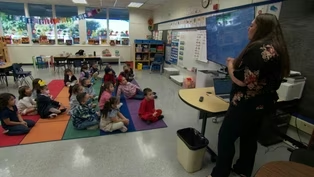
Video has Closed Captions
Clip: S5 Ep3 | 5m 9s | Visit a Los Angeles County school where “kinder readiness” is reaping rewards. (5m 9s)
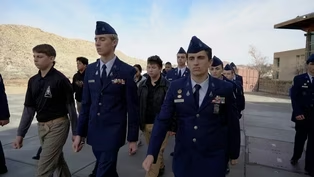
Video has Closed Captions
Clip: S5 Ep3 | 4m 43s | Check out a JROTC program in the desert with a focus on the Space Force. (4m 43s)
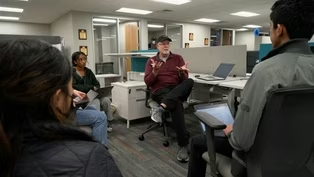
Video has Closed Captions
Clip: S5 Ep3 | 6m 13s | Meet a new generation of student journalists in Sacramento. (6m 13s)
Providing Support for PBS.org
Learn Moreabout PBS online sponsorship
- News and Public Affairs

Top journalists deliver compelling original analysis of the hour's headlines.

- News and Public Affairs

FRONTLINE is investigative journalism that questions, explains and changes our world.












Support for PBS provided by:
Inside California Education is a local public television program presented by KVIE
Funding for the Inside California Education series is made possible by the California Lottery, SchoolsFirst Federal Credit Union, Stuart Foundation, ScholarShare 529, and Foundation for the Los Angeles Community Colleges.