VPM News Focal Point
Activism | May 05, 2022
Season 1 Episode 10 | 26m 46sVideo has Closed Captions
Explore how activists create political and social change.
An activist makes history as the youngest democratic delegate in Virginia’s General Assembly. Black churches supported students who spurred school integration in the ‘50s and still develop young leaders today. A parent’s mission to stop gun violence.
Problems playing video? | Closed Captioning Feedback
Problems playing video? | Closed Captioning Feedback
VPM News Focal Point is a local public television program presented by VPM
The Estate of Mrs. Ann Lee Saunders Brown & Dominion Energy
VPM News Focal Point
Activism | May 05, 2022
Season 1 Episode 10 | 26m 46sVideo has Closed Captions
An activist makes history as the youngest democratic delegate in Virginia’s General Assembly. Black churches supported students who spurred school integration in the ‘50s and still develop young leaders today. A parent’s mission to stop gun violence.
Problems playing video? | Closed Captioning Feedback
How to Watch VPM News Focal Point
VPM News Focal Point is available to stream on pbs.org and the free PBS App, available on iPhone, Apple TV, Android TV, Android smartphones, Amazon Fire TV, Amazon Fire Tablet, Roku, Samsung Smart TV, and Vizio.
Providing Support for PBS.org
Learn Moreabout PBS online sponsorshipANGIE MILES: Leaked information about a possible Supreme Court decision on abortion has captivated the public.
We'll examine the impact of the possible overturning of Roe v. Wade and talk about how we got to this point.
Activism has fueled social and political change throughout history.
We'll hear from an activist who helped move mountains in the past and from young ones attempting to do the same today.
And how the agony of loss can become a clarion call for action.
This is VPM News Focal Point.
Production funding for VPM News Focal Point is provided by Dominion Energy, dedicated to reliably delivering clean and renewable energy throughout Virginia Dominion Energy Actions Speak Louder The estate of Mrs. Ann Lee Saunders Brown and by ♪ ♪ ANGIE MILES: Welcome to VPM News Focal Point.
I'm Angie Miles.
Americans are still reeling from news of a possible Supreme Court decision that could impact the future of abortion.
The leaked draft of a majority opinion that would overturn both 1973's Roe v. Wade and 1992's Planned Parenthood v. Casey has spurred action from both sides of the abortion debate.
(crowd chants) ANGIE MILES: Some are jubilant (crowd chants) ANGIE MILES: and some are concerned, ANGIE MILES: but democratic Virginia delegate, Sally Hudson, says her party is not surprised.
SALLY HUDSON: I think we knew this would be the last year with Roe in this country.
The first thing Virginians need to know is that their right to abortion is protected in our state laws.
So no matter what the Supreme Court does, abortion will remain legal in Virginia for now.
ANGIE MILES: Hudson says Democrats are more concerned the current Republican administration might try to roll back abortion access.
Governor Glenn Youngkin and Lieutenant Governor Winsome Earle-Sears, both hold pro-life positions.
Although in an interview with VPM News in December, the lieutenant governor said there must be exceptions, even if there are new limits placed on abortion.
WINSOME EARLE-SAERS: Life and health of the mother, life and health of the mother, we have to make sure.
ANGIE MILES: Governor Youngkin issued a statement that strongly condemns the leak of protected court documents.
He says the intention was to put pressure on justices and elected officials.
That is in fact, the same theory posed by Douglas Laycock, a constitutional law professor at the University of Virginia.
DOUGLAS LAYCOCK: I think, obviously I'm speculating, we don't know who did it, we don't know why they did it but maybe the most likely explanation is to create that kind of pressure now 'cause if that opinion is any weaker than the current draft, when it finally comes up, there will be cries of betrayal.
ANGIE MILES: Notably, the draft majority opinion would not outlaw abortion.
It would remove the presumption of constitutional protection for abortion and barring a law from Congress, it would put the issue back before lawmakers in each state.
Abortion is one of the most volatile social and political causes of the century.
We have a guest today to help bring into focus the very tactics used by pro-life and pro-choice activists to achieve their goals.
Derek Sweetman teaches courses in social movements at George Mason University.
And thank you for being with us today.
DEREK SWEETMAN: Thank you for having me.
ANGIE MILES: Now we're all looking at the legal issues now that this document has been leaked.
We have some watershed moments in the legal history of abortion in Virginia, all worth considering.
But at its heart, isn't this really an activist issue?
It's two social movements that clash on this one topic, correct?
DEREK SWEETMAN: I think you're right.
I think you could say both the decision in 1973 with Roe and this current decision were the product of activists working on opposite sides for this process.
ANGIE MILES: And using different tactics.
So in the past, the pro-choice, or the pro-life movement, sometimes resorted to violence.
We saw picketing, right?
We saw sometimes attacks on clinics or on physicians.
We don't see that so much anymore.
What's changed?
DEREK SWEETMAN: Well, there was a pretty concerted effort on the part of the pro-life movement to adopt a strategy that focused strongly on using the courts to overturn Roe v. Wade, and that involved bringing in judges, and getting them appointed, who would do that.
And in a sense, that's what makes what's going on right now somewhat inevitable.
This fight was won by the movement already and we're just seeing the results.
ANGIE MILES: And I think that those who are most active in the pro-choice movement recognize that as well.
It is still such a divisive issue.
It seems that the pro-life movement is winning at this point.
Is there any common ground or enough common ground that there could ever be a compromise on this?
DEREK SWEETMAN: Well, I think it's a difficult issue to compromise on if you believe in the extremes.
There is a lot of practical compromise that could be done because it could focus on reducing the demand for abortion.
And that will involve empowering young people, making sure everyone has the resources they need and the information that they need, to make good decisions.
ANGIE MILES: So sex education, which of course has been in schools for many years, contraception access, but that is objectionable to a lot of people, too.
Can you speak on that a little?
DEREK SWEETMAN: Well I think that's what makes this very difficult, is ultimately, although abortion has been the label under which people have been organizing, this goes beyond that to issues of which lives matter, who should have control over their own lives, and ultimately is a fight that's going to continue on both sides.
ANGIE MILES: It seems that if there could be more interest in reducing the desire or the need for abortion, less on whether there's access to abortion, both sides could be happy, but how to get there that's a tricky part, so.
DEREK SWEETMAN: Correct.
ANGIE MILES: Thank you for helping us to understand this a little better today, Derek Sweetman, our guest in the studio.
The VPM News team would like to hear what issues are important to you this election season.
We invite you to fill out our People's Agenda election survey.
You can find it on our website, vpm.org/electionsurvey.
ANGIE MILES: Anyone who believes the youth of today are apathetic about the world may not have a full picture of teens and young adults.
The Gen Z generation, born in the late 1990s, and millennials, born in the early 1980s to mid 1990s, are at the forefront of many social and political movements.
JOE BIDEN: In Virginia, I met a 13-year-old boy, the handsome young man standing up there, Joshua Davis.
(crowd cheering loudly) ANGIE MILES: Joshua Davis is the Chesterfield teen President Biden introduced at the 2022 State of the Union Address.
He's met with state and national leaders during his years of campaigning to make life-sustaining insulin more affordable for average Americans.
ELIJAH LEE: Your presence here loudly says that we will no longer sit silent to the oppression.
ANGIE MILES: In Midlothian, Elijah Lee has been organizing marches, collecting money and raising awareness to stop child abuse.
And in Charlottesville, University of Virginia student, Zyahna Bryant was a teenager when she helped lead a movement to take down the controversial Robert E. Lee statue.
Her effort put her on Teen Vogue's 21 Under 21 list of young people changing the world.
NANCY DEUTSCH: Different slots you don't- ANGIE MILES: Nancy Deutsch leads Youth-Nex, a UVA center that focuses on leadership development among adolescents.
She says, under most circumstances, young people taking on leadership roles with causes that matter to them is healthy for youth and good for community.
NANCY DEUTSCH: So young people will be getting that practice of engaging civically, engaging politically, engaging in their communities.
They're exercising that muscle, that muscle is getting stronger and stronger, and they're much more likely to continue that practice as they grow into adulthood.
So that's good for our communities 'cause that means we have more engaged citizens moving forward.
ANGIE MILES: Lawrence Mason was inspired to take his service in the Navy and as a volunteer firefighter, and get on the ballot to become state delegate for the 79th District.
LAWRENCE MASON: I am sick and tired of the party politics.
I'm sick and tired of the fat cat donors who pump millions into elections in order to say they have a politician in their pocket.
ANGIE MILES: The 28-year-old, Mason, won 44% of the vote, not enough to win the seat, but his opponent, who did win with 56% of ballots cast, is even younger.
Nadarius Clark became the youngest delegate ever elected to Virginia's General Assembly.
Clark was only 26 years old when he took office January, 2022.
He reflects on the campaign between two 20 somethings.
NADARIUS CLARK: We actually agreed on a lot of things.
We definitely had some things we disagreed on but we understood the calling was to make sure that we better serve our community than the person prior to.
ANGIE MILES: The Delegate says, it was activism that brought him to this place at such a young age.
NADARIUS CLARK: So I got involved in the political scene because of my love for social justice and activism.
While I was at Virginia Union University, me and another one of my great friends co-founded a social justice organization called Generation Now Network, which was faith-based activism.
So we learned how to lobby, how to rally, how to protest.
ANGIE MILES: Clark says he was also spurred to action when the Ku Klux Klan came to Richmond during the debates over Confederate statues.
NADARIUS CLARK: And you know, I'm at a HBCU right up the street.
So it's like, this is really happening.
Like, are we back in a different decade or a different time?
Like, this is happening in our time now.
And the gravity of reality weighed in, it's like we have to do something.
ANGIE MILES: The Delegate meets regularly with young people, like these students from his former high school, I.C.
Norcom.
He says they need to know that they have something to offer right now.
He says, the voices of youth belong at tables where decisions are made.
Apparently, he's not alone in his thinking.
ANGIE MILES: Experts on this topic point to the Children's Crusade during the Civil Rights Movement as one example of young people having been activists for a long time.
But with access to the internet, it has become easier for younger people to organize and take action.
KEYRIS MANZANARES: In this week's People of Virginia segment, we asked, "Have you ever participated in a demonstration or a protest?
And if so, why?
Is there ever a time when activism does more harm than good?"
Here's how some of you replied.
I've witnessed plenty of demonstrations, but I have never marched.
Well, I absolutely think that activism can only do good.
I believe, you know, you just got to live and let live, but sometimes you just have to, you know, stand up for something.
And sometimes it just becomes absolutely necessary.
KEYRIS MANZANARES: Your input is important to us.
Please share your thoughts and ideas for future segments on our website, at vpm.org/focalpoint.
ANGIE MILES: On April 23rd, 1951, 16-year-old Barbara Johns led a student strike that disrupted segregated public education in Prince Edward County.
Black students had lost five years of learning when schools shut down rather than integrate.
Ultimately, these students' activism spurred the integration of schools nationwide.
Several houses of worship supported young leaders then and still do now.
Meet them in the fourth and final part of our Black church series reported by Samantha Willis.
(keys clattering) (door squeaks) MEGAN CLARK: Sharon Baptist Church was organized at Old Toll House in 1868.
This is it.
So we have come a long way.
I stand on the shoulders of greatness.
When people see me and they say, "Wow, you've accomplished so much," I said, we've accomplished so much.
It's not me, it's nothing that I have done.
This is all the Lord, first of all, but it's all the people who have poured into me through the years.
I'm nothing without any of that.
(car engine revving) I want to be clear that we've never had a woman as Commonwealth's Attorney period, and is distinct from first African American.
And I make that distinction because you think, "Wow, never even had a woman serve in this role."
It has always been white men.
There is a woman who sits in our courtroom and is a part of our custodial staff.
And I was setting up for court Wednesday.
And she said, "Megan, I just don't know if you understand what you mean to the community."
And I said, well, thank you.
And she said, "It just does my heart so good to see you come in here and you're the person who's in here calling the shots and doing things."
And she said, "I go home and I tell my granddaughter about you, I tell my grandson about you.
And I tell them they can be anything.
Don't let anything limit you."
(winds howling) So, growing up here, you know, it's a very rural area.
I'm a country girl at heart.
(car engine revving) We often joke that if you can drive on a back road you can drive on any interstate.
And I love that.
I love being able to be versatile, specifically with church.
I don't remember a time when I was not in church learning about the Lord.
And seeing faith in action from other people is something that is very necessary for me.
That's perfect.
There's not one without the other, especially when I'm going into major cases.
I will take a pause and I'll just pray and say, Lord, your will be done.
And that is what I carry with me no matter what I'm doing.
And I have to in order to stay sane.
(car engine) Typically my family would sit along like these two pews.
Our churches have been the place of not just worship, but a sanctuary.
And it is a place where we build each other up and that's all of our churches around here.
That's just what they do.
This is me in the Sunbeam Choir.
I don't know life without the Lord.
And so when things get rough, pray.
When you're happy and grateful pray, and He truly directs you if you believe.
(car engine revving) JOY SPEAKS: We are in the auditorium of the Robert Russa Moton Museum.
This used to be the Robert Russa Moton High School where the strike was on April 23rd, 1951.
(footsteps thud) Barbara Rose Johns, she was the one who was the leader and influential in the strike.
This is a picture of myself and this is a picture of Joan Johns, Barbara's sister.
Barbara sent notes to all the teachers signed with the initials B. J. and B. J., Barbara Johns, was the same initials as Boyd Jones.
So the teachers thought that Boyd Jones was summoning everyone to the auditorium.
When we came into the auditorium and the curtains open, we were looking for Principal Jones and Barbara was standing on the stage.
And then she gave her iconic speech about that we didn't need to take any more crumbs from the table and we should go on strike and stay until we get a larger building.
And that she spoke from the Bible that the Bible said that a child should lead, and it was time for a child to lead.
Barbara said, "You must follow us now."
And all of the students began to leave and everyone left out.
And I felt that was divine intervention.
My church, Triumph Baptist Church, there were so many influential leaders from that church that supported the students strike and going forward.
We felt that God was on our side, that God would take us through there.
I don't think that it would be the same if we didn't have the foundation of the church.
Barbara had it instilled in her, I had it instilled in me, and that was very important to us.
I think we were excited and everything, but we were all young and you didn't know what to expect.
But we were happy that the lawyers had taken the case and assured us that we would be able to go to integrated schools, and here I am.
When we went on strike, we had no idea of the impact that we would have, the impact that changed everything in America.
But it just go to show what a difference your voice can make.
(car engines revving) A.D. "CHUCKIE" REID: First Baptist Church was always my church.
When school closed for instance, that was our hub for meetings and fellowship, preparing for demonstrations or whatever, 'cause that's where we would meet in the basement of the church.
Reverend Griffin had us in there and he would talk to us and bringing us all up through the community.
So if you did wrong in the church, you'll know it because the older ones would let you know.
(car engine revving) I think my inspiration came from Reverend Griffin, the pastor then.
He was always talking to the young.
He always give us the the right direction on what to do.
He always told, he said, "You know, you can be someone."
I think that's what really, really encouraged me.
(car engine revving) We're on Main Street.
(car engines revving) (car hooting) This book is is done by the Moton Museum and Longwood College.
It's called "Their Voices: Our History, Stories of Prince Edward County, Virginia."
This is about different people in Prince Edward County.
And that's me in my younger days.
And this is when we walked out of the school.
We marched all way from high school all the way down to the Moton Museums, where I was one of the organizers.
After all I had been through, school closing five years, and then sometime it was that hate there, but then as you move on, you say, you know what?
I got this.
I think it just made me stronger.
(car engine revving) As the years went on it made you realize, this is what I want to do.
I want to represent the people.
I'm going to bring it up again.
>>Yes.
>>When I came out of the military, I met with some community leaders and they said they needed someone to run for town counsel, and been there ever since.
I'm going to bring it up again.
30 years of my life was spent carrying the mail.
I came in contact with a lot of people through the mail route, through the town council, through the church.
My life was always filled with meeting people.
(car engines revving) I've been around a while and I try to be the same person all the time.
I respect folks.
We might not agree with them, but I can definitely work with people.
So that's me.
(car engine revving) MEGAN CLARK: So this is my dad's New Testament that he got when he lived at 40 Eli Street.
Eli Street has been renamed Griffin Boulevard after Reverend Griffin.
I'm 38 and I am on the younger side of my congregation.
The one thing that I would like to see our churches do is to have a church beyond our walls.
We have to go into the community.
If you know where the youth are in the community, meet them where they are.
(car engine revving) JOY SPEAKS: Well, I feel that they can keep it relevant by emphasizing to the members how the world is changing, how different it is, how you can build on your faith and not be fearful, but make changes.
(car engine revving) A.D. "CHUCKIE" REID: The younger generation have their own minds to do what they want to do.
I don't know what's leading them to that, but if they get more involved in the church and see what they could do, they'd be surprised.
Come on back, we can do this.
(ambient air) ANGIE MILES: The living legacy of Prince Edward County's Black churches continues.
Learn more about Black church culture in Virginia on our website, vpm.org/focalpoint.
ANGIE MILES: Firearms are the leading cause of death for Virginia's youth.
2021 was the second highest year on record for gun sales in America.
As we recall the Virginia Tech tragedy of 15 years ago when 32 people lost their lives in the deadliest mass shooting in state history, one parent whose son was shot four times that day has turned his pain into activism.
ANDREW GODDARD: It was a Monday morning.
My mother-in-law was visiting and she had the news on because she was concerned about the weather.
She was going to be traveling back to New Jersey.
And she called me into the room and said, "There's been a shooting at Virginia Tech."
And I was quite concerned because obviously, my son was down at Virginia Tech.
This is Colin graduating high school in front of the pyramids in Egypt.
Colin is a really good kid.
He was never any trouble when he was growing up.
He was always into sports.
He's a real team player.
And I began to think, well, if this is happening at Tech, he would call and tell me that he's okay.
The not telling is that my son didn't know anything about it, so he went to class.
He'd been shot four times.
One of them was a through the body.
It had gone across his chest, into his armpit, and out of his shoulder.
The other three were bullets were still inside, as they are today.
And I remember thinking, it could've been so much worse.
We could be looking for a funeral home, for buying a coffin and finding a plot and asking for a headstone.
It changed me because when I was sitting looking at him in the hospital and thinking about his injuries, I wasn't sure how much it was going to change his life.
But I kind of said, "Well, if he gets through this and he can walk and it doesn't ruin his life for him, then I'll try my damnedest to make sure that another parent doesn't have to sit by their son's bedside in the same circumstances."
At that point, I'd already realized that there were many things that could've been done to have prevented that tragedy.
And I began to realize that, well, somebody needs to speak up about that.
Guns don't protect people.
They should and they could, but in practice, they don't.
And the people don't get that.
We tried public demonstrations, marches.
We, at one point, did a lot of lie-ins.
Then there is demonstrations outside the NRA headquarters, which get a lot of press.
The idea is to get people to understand that what they think they know about guns is not necessarily the truth, and what they don't know about guns is probably what's going to get 'em killed.
I spent 12 years speaking out and getting no luck, no results, but in '20 and '21, we did get, people had been listening, and we got the stars aligned so that we could get legislation passed.
And now, people say, "Well, why don't you stop now?
You've gotten some legislation."
We didn't get enough passed.
There's still lots of things that need to be tidied up and cleaned up to make us safer.
Activism is taking your passion and turning it into change.
ANGIE MILES: We hope today's stories have shed new light on how activism can galvanize the gears of democracy and lead to real change.
Thank you for watching.
We'll see you soon.
Production funding for VPM News Focal Point is provided by Dominion Energy, dedicated to reliably delivering clean and renewable energy throughout Virginia Dominion Energy Actions Speak Louder The estate of Mrs. Ann Lee Saunders Brown and by ♪ ♪ ♪
Video has Closed Captions
Clip: S1 Ep10 | 48s | Listen to Virginian's thoughts on participating in social or political activism. (48s)

How a Virginia Tech father became a gun control activist
Video has Closed Captions
Clip: S1 Ep10 | 3m 8s | Andrew Goddard vowed to change gun laws after almost lost his son during the VT shooting (3m 8s)
Millennials and Gen Z youth are ready to lead the way
Video has Closed Captions
Clip: S1 Ep10 | 3m 58s | Being an activist is increasingly popular and possible for young people. (3m 58s)
Understanding the issue of abortion as a social movement
Video has Closed Captions
Clip: S1 Ep10 | 2m 59s | Derek Sweetman discusses the tactics abortion activists use to achieve their goals. (2m 59s)
Va. lawmakers respond to possible overturning of Roe v. Wade
Video has Closed Captions
Clip: S1 Ep10 | 2m 17s | Landmark SCOTUS ruling Roe v. Wade could be overturned; what’s that mean for Virginia? (2m 17s)
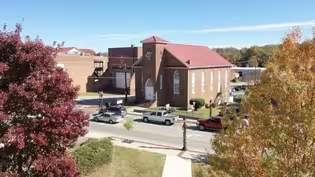
Virginia’s Black churches develop young leaders
Video has Closed Captions
Clip: S1 Ep10 | 9m 4s | Churches supported student activism in the 1950s and still develop young leaders today. (9m 4s)
Providing Support for PBS.org
Learn Moreabout PBS online sponsorship
- News and Public Affairs

Top journalists deliver compelling original analysis of the hour's headlines.

- News and Public Affairs

FRONTLINE is investigative journalism that questions, explains and changes our world.












Support for PBS provided by:
VPM News Focal Point is a local public television program presented by VPM
The Estate of Mrs. Ann Lee Saunders Brown & Dominion Energy