Traverse Talks with Sueann Ramella
Activist Sandra Williams
1/8/2022 | 1h 3m 47sVideo has Closed Captions
Activist Sandra Williams On The Black Experience In The Inland Northwest.
Sandra shares her life story growing up in the predominantly white Inland Northwest as a Black woman, her work ethic and what she is doing to insure future generations have a place that feels like community in Spokane. Sandra created The Black Lens in January 2015, a local newspaper that focuses on news, events, people, issues and information of importance to the African American community.
Problems playing video? | Closed Captioning Feedback
Problems playing video? | Closed Captioning Feedback
Traverse Talks with Sueann Ramella is a local public television program presented by NWPB
Traverse Talks with Sueann Ramella
Activist Sandra Williams
1/8/2022 | 1h 3m 47sVideo has Closed Captions
Sandra shares her life story growing up in the predominantly white Inland Northwest as a Black woman, her work ethic and what she is doing to insure future generations have a place that feels like community in Spokane. Sandra created The Black Lens in January 2015, a local newspaper that focuses on news, events, people, issues and information of importance to the African American community.
Problems playing video? | Closed Captioning Feedback
How to Watch Traverse Talks with Sueann Ramella
Traverse Talks with Sueann Ramella is available to stream on pbs.org and the free PBS App, available on iPhone, Apple TV, Android TV, Android smartphones, Amazon Fire TV, Amazon Fire Tablet, Roku, Samsung Smart TV, and Vizio.
Providing Support for PBS.org
Learn Moreabout PBS online sponsorship(jazzy music) - What is it like to be a black person in Spokane?
There are about 5,000 African-Americans in the city, a number that made Sandy Williams, the editor and creator of the Black Lens ask, that many?
You'll learn so much from Sandy about why she started the paper, why subscriptions are up, when she feels safe as a black woman, and where the color of her eyes may have come from.
(jazzy music) All right, we're gonna have a conversation with each other, and I just want to tell you, I feel like you are way out of my league.
(laughs happily) Well, you have done so much for the community, for African-Americans in Spokane, for Washington state.
You were invited by the governor to be a part of discussions on the board.
I mean, first of all, I wanna know what was it like venturing into politics on that level?
- I don't like politics at all, but the reason that I decided to take that on frankly, was because I was in a meeting with some community members, older community members, and they were really frustrated.
They were expressing concerns and they were talking about how they had tried to get people to listen to them, and nobody was listening to them.
And I just felt like they needed somebody to advocate on their behalf.
And so what I realized was, we could go into a room and nobody pay you any attention.
But if he put that governor seal behind your name.
If I send an email to somebody just as me, then they don't care.
But if I send an email to somebody with the governor seal attached to it, then all of a sudden doors open.
That's why I decided to do it was so that I could use the power of that office to advocate on behalf of people in the community that didn't have anybody speaking up for them.
So that was specifically why.
But I still hate politics.
I still hate the political system.
I don't think it's really invested in helping people much.
It's really invested in protecting the status quo.
I mean, either side of the spectrum doesn't really matter.
So I don't care for it much, but in that instance, it helped me be able to make some things happen that I don't think would have happened otherwise.
- What is the difference between activism and being political?
- Well, I'm not talking about political, 'cause politics is the system.
But being political, being a political activist, everything that I do is political.
Even when I try not to be political, I'm political.
So I was like, at this point, I don't even try not to be political.
It's like, I don't pretend that I'm not political 'cause it's all political.
- Oh, Sandy, please forgive me if I say anything that may come off really terribly, I'm honestly curious about you and your life.
So being a black woman, is that automatically when you walk into a room a political statement.
- Yes, it is.
And it's interesting because as I've gotten older I talk less, I have a desire to talk less and don't always want to be the one in the room that's going okay, you didn't talk about this or you didn't talk about that and it's gotten old to do that.
And so I even go into rooms now where I don't say anything and then they'll go, "So Sandy, what do you think about this issue?"
This is like...
I'm just listening, can I just sit here as a black woman and just listen and not have anything to say about something?
And so... - No, Sandy has as black woman, you have to solve all of our problems.
- Exactly.
So anyway it feels like just breathing is political.
- That's exhausting.
- It is.
And you don't really get the luxury of just being like other people just get to be, and that is exhausting.
- Are there places where you can just be in Spokane.
- In my house.
(laughs happily) In my house.
I have a very small group of people that I connect with.
And when we are amongst ourselves away from other folks, then that feels good.
But my daughter just left town, my daughter, her fiance.
So family close friends, but it really is about being away from folks, away from stuff in a space where you can just sort of, kinda just let your guard down.
'Cause it's about always being on guard, never knowing at what point I'm gonna have to be in a position of having to correct something or advocate on behalf of something.
So to be in a space where that doesn't have to happen is very rare, but really important.
And I have created spaces here with people that I'm connected to, where I get to do that, and that's important.
And I tell people when folks come to Spokane, typically people of color that I talk to, black people, like, how do you survive Spokane?
Well, you better find some people that are safe for you and develop those relationships and keep them close 'cause that's really the only way you make it here.
- Wow!
Sandy, I read the Black Lens, a newspaper that you write and have been the force behind for many years.
And I just read recently that you got a grant, so you could pay a part-time person, I mean... (cheering) Feeding the beast of media is exhausting in itself, but you have shouldered the Black Lens.
How do you find the energy to keep doing it?
- You know, every month I'm about to quit so... (laughs happily) Every deadline, I'm ready to quit.
And then I'll talk to my daughter and she'll say, "Well, you said that last month."
It's like, yeah, whatever.
So she just kind of blows me off.
But I think it is exhausting, but it's amazing at the same time.
I will be tired of it and then I'll bump into somebody who read something and it was important to them or somebody who submitted something that was important to them that they wanted included, like wanted me to publish it.
And that was important to them.
And so when those moments happen, it's like that's... And they typically happen just when I need 'em to, like just at the point where I'm like... And then somebody will show up or I'll get a phone call, or I'll get an email or something like that.
And so that's what keeps me going.
It's really important.
It's not important because I'm doing it.
It's important because the voice is important and the community is important.
And I believe that because of its presence, that things have changed here a little bit.
People have felt a little bit more emboldened, a little bit more impassioned to speak up, and that is important.
And that's the part that matters the most.
- Yeah.
Well, in one of the papers you wrote about a poem, an autobiography of inclusion in five not so easy chapters.
- Yeah.
- It was incredibly enlightening for me to read.
And as I read it, I'm just gonna read a couple of the chapters.
And it's not a long poem, but it is significant.
Chapter one, I walked down the street, there is a deep hole in the sidewalk.
I fall in, I am lost, I am helpless.
It isn't my fault, it takes forever to find the way out.
Then it progressively goes until like chapter four.
I walked down the same street.
There is a deep hole in the sidewalk.
I walk around it.
Chapter five, I walk down a different street.
I mean, the progression of this poem is essentially the experience of blacks in Spokane.
And then here you say, I share this poem because I feel Spokane is stuck in chapter one, which is, there's a hole in the street we fall in, we can't get out, it's not my fault.
And it's just the way that it is.
But you want and hope to be in chapter five.
Walk down a different street.
And the Black Lens is helping Spokane as wide as it is to try to acknowledge their different streets to walk down.
- Yeah.
I hope so, that's the intention.
- But a lot of white folks are stuck in chapter one.
- Well, that point for me, that was gifted to me by a friend decades ago.
It really changed my life, that's why I use it.
I take it out, like sometimes I'll go out to Airway Heights Correctional Facility and I've taken that poem out there and talk to the guys out there.
I said, look, this is the point that changed my life.
If you really pay attention to this thing, it changes things.
Because you kinda go, dang, same street, same street.
And I think that's what happened for me with all of the activism work I was doing.
I mean, I've been doing activism work since I was a teenager.
And at almost 60...
I'll be 60 years old this year.
And it's like, all of a sudden I started realizing these are the same conversations.
Different people, same conversations, going round and around and around.
It's like, why am I so frustrated?
And I just decided, and this was where the Maxey Center came from, Carl Maxey Center, was I just decided to pivot.
It's like, I don't want this street anymore.
I don't want these conversations anymore.
I don't wanna beg people for stuff anymore.
I don't wanna try to convince anybody of anything anymore.
I don't wanna do that anymore, that's the same street.
So I'm gonna step over here and walk over here.
And so when we decided to do that, it was like people felt lighter, I felt lighter, and we all felt lighter because the focus was at last on something that felt like it mattered and that was substantive, and that was actually gonna make a difference.
And so it really has...
I mean, it was life-changing for me, that poem.
And so that's why I offered to share it.
And then I included the one that I wrote about the autobiography of inclusion, because people always ask me about inclusion, and it's sort of a same thing.
We're all the same, we're all the same, we're all the same, we're all the same.
Well, no, we're not.
- No.
- We're not all the same.
And if you can't ever get there, then you're wasting my time.
So let's have that conversation at some point.
So yeah, I've gotten a lot of feedback about that more than I expected to, but that makes me happy.
People are paying attention.
- Because it's incredible powerful poem and you shared that power.
And I just wanna read your chapter five.
Yes, there are differences, lots of them.
It's important that I notice them, honor them, learn about them, seek them out and celebrate them because we are not all the same.
I recognize that our differences are actually strength, and I think that is exciting.
- Yeah.
And not fearful because we're taught in this country to be afraid of differences, that difference is scary.
- Why are we like that, Sandy?
- I think it's power.
I mean, I think everything traces back to power, who's got power differences.
If you can get folks to shy away from that which doesn't feed into the traditional sort of system, then you prevent anything from disrupting that system.
That's what I think, that's just my personal opinion.
But little kids celebrate differences, they do.
It's when we get older that we sort of start backing away from that.
So that's the part and it's messy.
Differences, celebrating and embracing it's messy.
And so if you really are trying to embrace equity and diversity, and all that kinda stuff, and what you're doing is not messy, you're not doing it right.
This whole everybody's got to stay comfortable stuff, is not truthful.
- Yeah, it's so fake.
- It is.
- We had a man recently, a paraplegic who helped lay the groundwork for the ADA and one of his quotes was it, "When you're comfortable, you're not doing it right."
- Exactly.
And I would say, if you're comfortable, you're not doing anything.
Because you can't be doing this work and have it be comfortable, it just can't be.
And even, I am not comfortable in some of the situations I get into and I haven't been doing this for decades.
And then something comes up into your face and like, oops, hadn't seen that, hadn't noticed that.
If you're not experiencing anything that you just noticed, or that is ruffling your feathers or giving you a perspective that wasn't yours.
If you're not encountering any of that stuff, then you're really not doing anything.
And so that's the part is that people are uncomfortable with discomfort.
And so we have this sort of... We have all these platitudes and nice-nesses and stuff, and I just have grown too old for that.
My daughter says, I'm cranky.
She says, "You're cranky mom."
And I was like, "Yeah, I am.
"I just am really tired of that, I want the real stuff."
The real stuff where you get in there and you just kind of slosh around in it.
- Well, being in that with you is giving people permission to screw up with each other.
- Yes, exactly.
- But then still like, I like you and honor you and respect you, we're gonna mess up together.
- Exactly.
And open to being, I guess, being... - Wrong.
- Yes - Yeah.
- Oh my gosh.
- And that's the part.
And I can tell if somebody's heart is right, you can feel that and if they screw up, but their heart is good, then I'm good with that.
One of the things that I'm uncomfortable with right now is there's, and this is not all people, some people they're weaponizing equity, so I'll say that, they're weaponizing it.
And I'm not talking about folks who don't care about people, 'cause they're a system people that are specifically trying to maintain systems, I'm not talking about those people.
But there are people, good hearted people who have not had experiences that would educate them about things.
And so they get in there and their intentions are good and they screw up and they make mistakes.
And folks pounce on them.
They pounce on them, kinda like this thing that just happened with Cher, where she made this comment about George Floyd and she just got attacked for it.
Now, I don't know Cher personally, but I know Cher's history and my perception of her is that she's been a person who's spoken up on issues frequently.
So because of that history I personally would be willing to give her the benefit of the doubt and say, "Hey, maybe you didn't say that the best way, "or maybe you could rephrase it differently."
But certainly wouldn't have attacked her.
And I see some of that happening and I don't think that's better, I think that's part of the same system.
I think that's part of the same thing is just sort of a different facet of.
- It's a similar spirit.
- Exactly.
- And then would this be cancel culture.
- People call it cancel culture, I don't like that term because that's also being used-- - As a weapon.
- As a weapon to dismiss what are valid concerns and valid issues.
And I think they're intentionally doing that, and came up with this coined phrase or whatnot so that people who don't even know what they're talking about, just sort of throw that around.
So I don't like the term, but I do think there are instances where folks whose intentions are good, have been slammed by people who are doing the exact same thing that they're supposed to be fighting against, and that bothers me.
- The hypocrisy is definitely out there.
- Yes.
- I'm just wondering, because you have an extensive background in spirituality, you had a podcast for years that really dove into some really interesting topics.
How about the word grace?
What if we allowed some grace?
- Yes.
And I think it's about...
I think if people really acknowledge that we all have biases, we are all inadvertently or on purpose, doing things that injure and impact other people.
If we all can just own our own stuff, I think then you get to grace.
Is like, so if I know that I'm doing it too, even though I've been doing this work for decades, I still screw up sometimes.
And if I'm able to own that, then I own that other people can do the same thing and still be a good person, 'cause I consider myself a good person and I screw up.
So if I can be a good person and screw up, they can be a good person and screw up, and we can find some middle ground in there.
So that's what I see grace as.
That doesn't let systems off the hook, so that I just always throw that in there because you're looking at stuff both from an individual perspective.
So that's an individual perspective.
I can work with individuals, but systems is a whole different thing, and systems need to be dismantled.
The systems that are oppressing people need to be dismantled in.
If you're a person who is trying to perpetuate those systems and hold them in place, that's a whole different conversation versus us being two individuals trying to work through some stuff.
Does that make sense?
- Oh, absolutely.
And on the individual level, I always seem to think that growth is painful and I feel...
I always say Americans, but I assume it's probably all humans try to avoid pain.
- Yes.
- It's that pain where you're exercising to get stronger.
And so you're in pain but better for you tomorrow.
Yeah.
And exposing yourself to different ways of thinking and being.
When I was young, I remember, I grew up very Judeo-Christian, so they're rules and the world was very black and white, but there came a time in my life where I noticed more grays and it actually hurt.
It hurt my brain.
And until I was like, you know there are people halfway across this world who don't even know this religion, and they're doing fine.
- And they're doing just fine.
Exactly.
That was one of the...
I did that show, Revolutionary Spirituality, was super duper fun to do that show.
I only stopped because I was exhausted.
It was so much work to do it well.
It was a lot of work, and I had a full-time job at the time.
So to try to do that around, was hard.
But what I learned from that experience was how similar to the good parts of religion, how similar they are.
It was really fascinating.
And even the ones that I thought were so strikingly different really weren't, not at their core anyway.
- Golden rule.
- Yeah.
And I asked a guy one time, he actually was... And it was fun, 'cause I would just call people out of the blue.
Somebody who's a national author and would you come on my little show?
And most of them said, yes.
But this guy was a national author, and he had written a book, something about different religions, which I thought was fascinating because he identified as Hindu, I think, if I remember right, 'cause it's been a long time.
But I asked him now, I said, "So you wrote this book that talked about "the similarities between religions, "so why do you identify as one?
"Like why?
"I'm curious about that" And so he said, "Well, because," he said, "You can be five foot deep and 50 feet wide, "or you can be 50 feet deep."
You know what I mean?
So you can go down deep on one religion and sort of focus there, or you can be shallow on many religions and stretch wide.
And he just said, "It just worked better for me to go deep on one.
"So it doesn't mean I discount any of the other ones."
He just said, "That's just what worked for me."
And I just found that fascinating.
So it was really just about what worked for him.
He said, "So I just believe people "need to find whatever it is that works for them."
And this was sort of a theological guy.
And so I expected it to be something more profound than that, but that actually was pretty profound.
It's just, you find what works for you 'cause fundamentally he felt like they were all the same.
- But don't tell them that.
- Well that's power too, it's all power.
Everything really comes back to power because it really is about... And I talked to a Christian person who told me... 'Cause one of my favorite questions that I asked people was, what was your dark night of the soul?
And so I had this person tell me that their dark night of the soul was they went to, this a Christian person, went to theology school and in school realized that everything they have been taught in church up to that point was not true.
It was fundamentally not true.
And how hard was that?
And I said, "Well then what do you do with that?"
What do you do with that information then?
Because you have two choices, what they tried to get folks to do, and what this person did for a short period of time was sort of ignore the fact that you just realized that all the stuff that you just learned, wasn't true, and you go into a church and you teach people that which you know is not true.
How deep is that?
Or you let it go and you go down a different path.
And so this person tried to do the former for a while, went into a church and all that, and then it just ate away at their soul until they finally had to release that and go a different path.
But that was fascinating.
That was a really, really fascinating conversation.
And so that's what religions do is that, those who have power know that, they know that a good chunk of that information is not accurate, they know it.
But it doesn't matter because getting people to believe that perpetuates the power system.
So that's why they do it.
It fascinating stuff.
So it all comes back to the same thing.
So like every area that I go in, that I focused in over the years in terms of activism around different issues, it eventually seems like it traces back to the same thing all the time.
- Power.
- Power and privilege.
- Power and privilege.
- Yeah.
(upbeat music) - This podcast like so many programs on NWPB is brought to you courtesy of donors.
People who watch and listen to NWPB for thought provoking programs like Traverse Talks.
People who give what they can to pay for current programs and the technology for future programs.
You can join them.
Donate any amount that is right for you at nwpb.org.
Thank you.
(upbeat music) - Hey, so I wanted to ask you about the Carl Maxey Center.
I had heard about Carl Maxey before, Spokane man, lawyer, orphanage.
Can you give a brief overview of Carl Maxey and why you chose the name for the center?
- Well, Carl...
I actually, to be honest, don't think that the black community still has survived.
I won't say survived, but hasn't quite recovered, that's the word I was trying to find.
I don't think the black community in Spokane still has recovered from Carl's death.
Carl was more than an attorney, he was sort the soul of our community I believe.
He was a champion for racial and social justice.
He was a larger than life figure.
He was the first attorney that graduated from Gonzaga Law School in Spokane, and could have done a lot with that.
And what he chose to do is stay in here and help black people.
He helped everybody, but in particular helped black people.
And so he was foundational for this community in terms of the work that he did, the impact that he made on lives here.
And I was young at the time.
So I knew of him, but I didn't know him.
I wish I had, had the opportunity to meet him.
I was gone, I had moved by the time he passed away.
So when we were deciding to do a center, initially what we were planning to do was to create a small nonprofit, it was supposed to be a small thing.
And it was really just gonna support the work that the Black Lens was doing in Spokane.
So in addition to publishing the paper, I was doing events and bringing in speakers and that kinda stuff.
And so it was hard to do that and the paper.
And so initially we were gonna put a nonprofit in place that was gonna take over some of those community things and then let the paper be the paper.
So the nonprofit initially was called, Friends of the Black Lands, kinda like they have Friends of the Symphony or something like that.
So that was our initial idea.
Five of us sitting down in my backyard eating barbecue.
And so pretty quick, I mean, almost in the blink of an eye, we figured out that that was not big enough.
Like the need was so much bigger than that.
There was a building that was vacant in the neighborhood, the area of east central that has a significance for black people.
And what we figured out was missing was a place, like you need to have a space, you need to have... Like you were asking earlier about where do you go to be safe?
There's not a lot of that here.
And so we figured that we needed that.
We need to create a place that's specifically safe for black people.
It's not that other people can't come, but the intention of it is to be a safe space for black people.
So we set out on that journey to do that, and so we were trying to figure out, what do we call this place?
And so the traditional names always come up that black people have of famous black people and that kind of stuff.
So I was talking to a friend of mine who lives back east.
And so I was telling her, we're trying to figure out what to name this center.
And she said, "I really love Martin Luther king "and Malcolm X," and our other sort of famous black people that things are always named after.
She said, "I really loved them."
She said, "But they didn't live in Spokane."
She said, "Don't you have somebody in Spokane "that embodies what you all are trying to do."
And it was like a lightning bolt.
It was like, of course we do.
Like, of course we do.
And it was just that fast, it was instant.
As soon as she said that Carl's name came up, everybody was in agreement immediately.
We talked to the family.
And so it was like there was never another option when she said that, because it's true.
It feels like we're sort of picking back up his work.
That's what it feels like.
Like he would have been all over the stuff that we're doing.
So I hope it honors his legacy.
That's our hope is that we're honoring Carl's legacy, that we're kinda picking back up the mantle if you will, and taking it forward into the next generation to do some more of the work that he started, so that's our intention.
- Nice.
So there's like 5,000, as of 2019, 5,000 black people in Spokane.
- Is there (laughs happily) so many?
- Supposedly, there's that many.
(laughs happily) There's that many.
- There's that many?
Yeah.
- Well, that was one of the stats that I've pulled up on Google, but I was...
I'm sorry for...
It is funny 'cause east of the cascades, you don't see many brown and black people and if you do, they're like over there, you go over there.
And I'm laughing too because even like the Asian stores, they're relegated, I think that's the right word over there.
Put them over there.
And I guess I giggle because it's just sometimes so sad and painful.
- And it really hasn't changed over time.
If you look statistically at the percentage of the population of Spokane over the years, it's really sat right there at just under 2%.
And it's that now our challenges with retention.
So we get people here, they stay for a little while they get frustrated and they leave.
And so we're having a really hard time keeping people here.
So that's one of the things that we're working on.
I mean, I did it.
I left immediately when I graduated from college.
I tell people I was reaching out for my diploma with one hand and I was packing my suitcase with the other 'cause I wanted out of here.
My brother did the same thing.
My daughter who was born in Spokane did the same thing.
So we're losing smart, talented people, black people who have an option to be anywhere else, leave immediately most of them.
And so that's a problem and we have to figure out how to address that.
- And I don't wanna burden you too much with this question cause I know it could be very complicated, is it because there aren't many safe places for you to be black in Spokane?
Can maybe the aggressiveness of authorities being ignored?
All these things combined with where are your stores, where are your barbershops?
- Well, I mean, part of it is you can't get a job.
I mean, it's fundamentally down to that.
You have really smart, bright, talented black people graduating from here and they can't get a job competitive to where they can get somewhere else.
So that's a big part of it.
I think the other part would come, like it would be great to have stores and shops and all that kinds stuff.
I think people could put up with that if they were getting paid well.
And so it's hard to crack those again, why go with systems.
We have systems in Spokane who hire folks that look and act like them.
And so if you're in a city that's 90% white, most of the people that look and act like the folks who were in positions of power are white.
And so to be able to crack that is really hard.
And I did a couple of stories with folks, who've come back here.
Like, I'll say younger because they're younger relative to me, but sort of older, younger adults.
But two of the stories that I talked about, these are business owners.
Both of them talked about having left here because they couldn't find work here.
And they eventually came back 'cause they were older or their family was here or whatever, which is what I did.
I came back because my family was here, but I left before opportunities.
Like you want opportunities.
And also a part of it is you want more diversity.
It gets old.
It was like when I moved back here this last time, I'm just standing there.
I had just come back from Los Angeles, so very diverse.
And I'm standing in the bank and I just kinda started glancing around and like every single person in the bank was white.
So the people behind the desk, the people behind the counters, the people in the offices, everybody in line.
I even looked through the window to the drive-through and everybody in every car, so everybody.
And that starts to... And they're nice people, so it's not a criticism of...
I mean, Spokane has some really nice folks, they wave at you and they let you cut through in traffic, really polite kind folks, so it's not about that, but it starts to weigh on you after a while.
And my daughter moved to Atlanta to go to college.
So I helped her move there and oh my goodness, what a different experience.
And it's like, you don't even realize it until you're experiencing it.
So here we are, the pizza delivery guy was black.
The guy that came in and hooked up the cable was black.
The mailman was black.
We went to the drive through, the drive through people were black.
We went to the mall, the security guards were...
So it's like everybody, and what a different experience that was.
And we were kinda like going, wow, this feels kind of cool.
And so one of the reasons that people leave in addition to not be able to find work, but the other piece of it is you just wanna be in a position where you don't stick out all the time.
- I was gonna ask you about that.
- Yeah.
Like I don't want people to always know who I am, always, and feel like they know me or they recognize me or whatever.
Sometimes you just wanna blend in a little bit.
My family comes from South Carolina and we have a family reunion every year, every other year.
We didn't get to do it this last year 'cause of COVID, but every other year.
So I go to South Carolina and for a week, - You blend.
- I get to blend in.
And you get to exhale kinda like that movie "Waiting to Exhale".
You get to exhale for a minute, and relax, and your guard doesn't have to be up.
And so to be able to be in a situation where you get to live in that, that's what some of our young people craved.
My daughter craved going to a historically black college.
She said, "I just wanna be in the majority one time "in my life.
"I wanna know what that feels like."
- It feels good.
- It feels really good.
- It feels really good.
- And you need to sort of to be lifted up.
She was lifted up.
It felt like family for her.
So that's some of it.
So I think it's a combination of those things.
We're trying to create community with the center.
We're trying to create family with the center.
We're trying to give people some grounding so that when they come here and they're new, they have a place to connect to.
And I think if we can do some of that stuff... A friend of mine lives in California, she donates to the center, but she said to me, she said, "If there had been a Carl Maxey Center in Spokane, "when I was growing up, I would not have left."
So my hope is that we can create some of that and we can help folks find a way to stay here longer, that's our hope.
- So Sandy, I read something about this area in Spokane that they were looking to, I can't recall, renovate it or create more of a black district, is that what I read?
- Yeah.
So East Central is the part of Spokane that the Carl Maxey Center is in, it's called the East Central Community, which is actually a very huge... One of the largest, I don't know if you call it area, district, whatever in Spokane, but it has lots of areas.
So it's got one area that's called the Perry District, which is fairly white.
One area that's called a University District, which is fairly white.
The part that's the most diverse is around the 5th Avenue Corridor is what we're calling it, the 5th Avenue Corridor.
The Maxey Center sits on the 5th Avenue Corridor.
The Martin Luther king centers on 5th Avenue, Larry's barbershop, Fresh Soul Restaurant.
There's a new African focused nonprofit on that corridor.
So that's sort of the place where folks seem to be gravitating to.
And part of that is because of redlining.
So redlining made that area very diverse because that's where you had to live.
And so that's home, but it feels like home to us.
So we're talking about it being international district, certainly a multicultural district, but having it be an area that feels like home for us, and it's already starting, the businesses are starting.
When Fresh Soul Restaurant started up, our board all went down on their opening day 'cause they were having...
This was before COVID.
They were able to have folks come in and they had outdoor seats, so myself and some of my board members were sitting there in the outdoor seats and people were walking by and it was much fun.
It's like, oh, there's so-and-so who we haven't seen in six months or whatever.
And everybody was seeing each other and talking to each other.
And it was like that community feeling that you feel like when you're in Harlem or when you're in places in larger cities that have larger black populations, you have sort of a center where you go hang out and you see people.
It was like that and it was just so uplifting.
We left there feeling so good and so full.
And so we wanna create more of that.
We're talking about doing a Fresh Soul Restaurant ourself, a couple of the businesses around.
And they were talking about doing a street fair there, like on that 5th Avenue Corridor, sort of lifting that corridor up and having it be community like, creating community there and I can't wait for that.
- That's gonna be great.
Sandy, you mentioned earlier that you get your energy when deadline comes with the Black Lens and you're feeling like I'm gonna quit this, but you have inspired somebody or educated someone, and change their lives, and the direction of their thinking.
So other than those moments and family, do you pray for energy or are you vegan and... (laughs happily) - Where do I get my energy from?
I don't know.
No, I'm not vegan.
I do pray in my own way.
I'm probably not as healthy as I should be.
Do I exercise?
No, I need to.
All of those things you're supposed to do 'cause I'm usually at my desk working.
Between the center and the paper, there's not a lot of time for that.
But I think... And I was having this conversation with a friend of mine who's a pastor and we were talking about how it's not really a choice because wanting to quit, and he says the same thing, wanting to quit sort of presumes you have the choice to quit something.
And even though I threaten to quit every month, that sort of presumes that I feel internally like I have the choice to do that, and I really don't.
It just sort of feels like that's what I'm here to do.
Somebody's gotta do it for some reason that's my thing, I'm good at it.
And that's it.
You know what I mean?
So I was like I don't know, what keeps me going, except that's what you do.
It's like, I hear the stories of my family.
My dad joined the military when he was 15 years old because his family were sharecroppers and he had to get out of there.
And the only exit out was to lie about his age and get in the army, so that's what he did.
My mom, her only escape route was to be a nurse, a registered nurse.
And she was in a segregated nursing system that did everything it could to break her.
So that's the stock that I come from.
So you do what you need to do.
And so that's what I have told my daughter is like, that's the stock that you come from, where it doesn't matter what's going on in the world.
You figure out what that path is for you and you get on it and you keep going because we have some things that we need to accomplish in this life.
So that my desire is so that my grandkids don't have to do this stuff.
- Oh, Sandy, that's great.
- Yeah.
The native American their philosophy is seven generations.
You do what you do for seven generations behind you.
And I heard that and that really spoke to my spirit.
It's like, my dad did that for us.
My dad and my mom who were fighting segregation and prejudice in the South Carolina, that's just some hardcore prejudice and segregation.
They were doing that not for themselves, they were doing that for us, for their kids and for their grandkids and they succeeded in that.
And my brother and I are doing the same thing for our kids and our grandkids.
So that's why it's like I don't know what else it is except that in those moments, it's like, I remember that what I'm going through is nothing, nothing compared to what my parents and my grandparents and my great-grandparents went through.
- Sandy, I like hearing this conversation because I personally feel we don't talk enough about our ancestors and what they have done to allow us to be where we are today.
- Exactly.
And when you said, my mother's struggles are nothing.
I mean, no, her struggles were intense.
- Exactly.
- Mine are nothing because she laid the groundwork for me to have a better life.
- I believe that.
- And then you share that.
And you share that with your kids.
And I would like more of us to share the stories of our grandparents, great grandparents and what they did yeah to have a better life.
- Yeah.
That's one of the valuable things about the family reunion that we do.
I take my daughter to it so she gets to meet folks because they're not gonna be around much longer, we've lost many of them.
But to be able to sit at their feet and hear them tell the stories of what it was like for them growing up, I think is critically important to not only just knowing history, but sort of getting in touch with that part of us, where it doesn't make any difference what we're told about who we are, that's who we are.
But you don't connect to that unless you have an opportunity to connect to that.
And I think too many of us don't have that connection, too many of us meaning people in the black community don't have that connection.
One of the things that we're doing, we have some students who we were approached by Whitworth University here in Spokane, and we have some students that are doing a history of black Spokane project, where they are doing sort of an overview of the history of black people in the United States, but then they're connecting that to what was happening in Spokane.
Really powerful.
And then they're gonna create educational units for school kids.
- Excellent.
- 'Cause it's important.
And so it comes from that same thing as like, if we can't have an expectation of a system, that's devaluing us to give us what we need to feel valuable, we're gonna have to start doing that ourselves.
So that's one of the things that we're trying to do is to figure out all those ways we can do it ourselves and just start creating those opportunities and stop waiting for other folks to sort of figure it out.
They'll figure it out eventually, but by the time they do, we're gonna be way down the road having created some things that were important.
- It's telling the stories that haven't been told enough.
- Exactly.
And the stories that we don't know.
So it isn't even about the system telling the stories out there.
It's like, even within our own circles, there's stuff that we don't know about and that's our responsibility.
- You know, that is so crazy to me because in this era of constant information, social media, people expressing their opinions all the time, we're still not telling the stories of ourselves enough.
- Exactly.
And that's our responsibility, we have responsibility for that.
- Just to put that out there.
But sometimes those stories can be painful, but they're valuable.
(jazzy music) - Stay connected with NWPB by following us on Facebook, Twitter, and Instagram.
Just search NWP Broadcasting and press the follow button.
Again, that's NWP Broadcasting on Facebook, Twitter, and Instagram, and you'll never miss a post from us.
(jazzy music) - I wanted to ask you what it was like being a little girl in Spokane and being black.
- Spokane wasn't so bad, to be honest.
My dad was in the army.
When we first moved here, we lived in military housing, which is more diverse than sort of your traditional stuff, it tends to be more diverse 'cause a lot of people of color in the military, - I grew up on McChord.
Did you?
- Yeah, military was good life.
They take care of you.
I was actually just sharing this with somebody, the school that we went to certainly was overwhelmingly white, but I don't have a single memory of anything negative happening there.
It was Cine High School, which in Spokane is sort of farm community.
And so I don't know if it was because it was farmer's kids that they were more accepting and stuff, I don't know what it was.
There was certainly military folks mixed up in there and all that stuff.
So my experience of Spokane was good as a younger person.
Now, when we got older, my parents moved us into the city, so into Spokane proper.
So prior to that, we lived in military housing and we were supposed to go to one of the city high schools.
My friend, a good friend of mine who was black, had already gone to that school.
Her dad had retired and she had gone to that school and they were having some issues with race there.
And so she said, "Don't come here."
She said, "You don't wanna come here."
And so my parents actually went to the school district and petitioned the school district for us to be able to go back out to the school that we were at.
And they said, "As long as we provided "our own transportation, "we could continue going to the school where we were at."
So we never had to experience any of that because my parents were advocating on behalf of us.
And in fact, she ended up leaving that school and coming back out to where we were.
So I know that there were issues happening.
I feel really fortunate that we were shielded from that a lot in terms of growing up here.
But I do remember feeling hyper-visible, like, I remember like people just always knowing who you were.
I remember sometimes I would play sports.
I play sports a lot and sometimes we would go visit outlying areas like Clarkston and Pullman and places like that, like little places, and I remember people staring at me.
I remember how uncomfortable that felt.
Very seldom would anybody say anything?
But a couple of times people made some snide remarks.
For the most part, it was just being looked at like I was a weirdo.
- That kinda look.
- Yeah.
So I remember that and that came from like the outside areas.
But for the most part, Spokane is home, and has always felt like home, and I've always felt embraced by Spokane, even though the systems need some help.
So I feel fortunate, I really do.
- Good, I'm glad to hear that.
So I grew up on McChord Air Force base and didn't dawn on me that... How do I say this?
We moved from McChord to a, "better school district" 'cause my mother who's Asian very much cared that I went to a high income area school district, which equals very white.
- So we went to Puyallup.
And I went from, I mean, Filipinos, Mexicans, Asians, Japanese, blacks, all the way to Puyallup and two brown dots in the audience.
That's all there was.
And not until I was an adult that I realized that the impact it had on me was I could blend.
But I'm more comfortable with the air force brats than I was with the white Puyallup.
The Puyallup people too had a totally different economic status than my military family did.
So like, I did not fit because I did not have that money, but at least my skin tone allowed me to blend.
So I didn't receive any problems that way.
So then I come to college and then here at WSU, get involved with the Asian communities and students here.
And all of a sudden, all these questions I had as a teenager that I didn't have others like me to bounce off on.
I had all these college friends who were like, dude, of course you think this way 'cause your mother's Korean or yeah, that is the way you should feel because of your background.
And I finally felt myself.
- Exactly.
Yeah, it happens a lot in college.
It was interesting... Like I said, my daughter wanted to go to a HBCU and have that experience.
And so it was both positive and negative for her.
It was positive because she was surrounded by black people and the faculty was black and she had never experienced that before.
So it was heaven.
But at the same time, she was a as a black kid who had grown up around white people, her whole life.
And so trying to fit in, she felt like an outsider there too.
So not only did she feel like an outsider in the white community, but then she also felt like an outsider in the black community.
And that was really, really challenging for her to try to work through that.
And I've heard from a lot of people who have like left Spokane, where their kids have left Spokane and specifically wanted to go to a school that was more diverse and got there and tried to figure out how to fit in struggled and some of them came back.
- Sandy is this because essentially you have this home culture, but then you're surrounded by the greater culture that impacts you.
This is interesting 'cause just the other day I was chatting with some friends online about the fact that, the recent violence against Asians in America and how some of us, particularly us that our half struggle with feeling conflicted, saddened, but guilty because we have escape this, we're safe because of this color.
And yet we have to advocate for our mothers or fathers but then we are also able to be strange ambassadors from this white culture to this Asian side, and helping the two sides see, well actually what you do is super annoying and here's why.
And yeah, you do annoying too and here's why.
'Cause in a strange way we were doing that with our parents.
Like for me, my white dad and my Korean mother, there are many times where I was in the middle of it.
- Yes.
- And trying to be this interpreter of both worlds.
So your daughter is like that?
- So she's like that, even though she's not biracial, but she certainly is bicultural, I would say, and trying to figure out what does blackness mean?
Do you know what I'm saying?
Because you hear you're not black enough.
- Oh, that's so sad.
- And so that's the internal work that we have to do and when we're planning to do.
'Cause she was pushed from our family, you have to take API classes, you need to be working hard and college was just sort of expected as it was for us too.
But then getting pushed back from her friends because she's the only black kid in the-- - AP class.
Yeah.
And then that's so sad that intelligence and that education is not black.
- Exactly.
And then again, that's power, but trying to walk that middle ground between I want my friends, because I don't wanna be the only black person.
I want to connect with this group over here, but I also have my family's culture and expectations that I need to live into.
So it was interesting sort of watching that process for her.
I didn't have as much of that because I had the military upbringing in the family, and so my upbringing was a little bit different than hers was.
So I was sheltered a bit.
- What would she say?
What would she say about like... What's her takeaway?
What is she gonna tell her kids about this?
- That's interesting and she's engaged.
So she's almost at that place where she's gonna have children.
So she talks about how hard it was.
She talks about trying to find her way and that she's still in some ways is trying to find her way.
In the whole I call it sort of the black awakening, this most recent one that that's happened.
There've been others, but this most recent one, post George Floyd.
One of the most interesting things that happened because of COVID and her being trapped in her apartment, we had a lot of conversations about hair, which is a big, big, big thing in the black community is hair and who value what kind of hair.
And so my daughter has always done sort of a European hair, whatever that looked like, whether it was straightened or whatever.
But when COVID happened and she was sort of trapped in her apartment, she decided to let her hair go natural because nobody was gonna see it.
But it started this whole internal kind of process of figuring out who she was and how to connect with her blackness.
It was a fascinating thing for me to be on the outside, sort of listening to her, talking through that and discovering that it felt beautiful.
Like she would never allow herself to be seen in her natural hair because of all the images about what's beauty.
But post George Floyd and post sort of being captured in your apartment for awhile, she started seeing a beauty in her natural hair.
And now she's doing sort of a combination of the two.
So I think her... One of the things she said about that in terms of her daughter, she said, "I don't ever want my daughter to feel like her natural hair "is not beautiful."
- Yes.
- So that's a step, that's a step.
- Well, that's a big one really.
- Very big, yeah.
- 'Cause it's very visual.
- It's very visual and it's very much attached to your identity.
So I think the conversations are gonna be richer now because sort of, there's been more of an awakening and a reflection of how have these things impacted my life.
I remember... Gosh, I think she must've been a junior maybe.
And one summer we did what I thought were these just beautiful twists, like natural twists, and I thought she was stunningly beautiful, I did.
And she kept it over the summer and everywhere she would go, she would get compliments.
And then she went back to school first day, first day, it was the black girls.
It was the black girls that came at her about why is your hair like that?
'Cause it wasn't straight, it was kind of nappy twists.
And there were so beautiful, I thought.
But so much so that by the end of the day she wanted them gone.
And so it's that internal, there's this internalized message that we've been given about what makes us valuable and what makes us beautiful.
And so you gotta deal with that on top of all the other stuff.
You know what I mean.
In addition to trying to get good grades in school, so you can go to college, you gotta deal with that stuff too.
- It's a layer cake.
- It really is.
And so I keep kinda coming back to the Carl Maxey Center so that Carl Maxey Centers specifically, I want that to be a place where we address all this stuff, because it's critically important if we want our young people to be successful, that we are addressing these things that are hindering their success, and that's one of them.
- The whole package, the whole you.
- Exactly.
- I find the imagery...
This is so on my Pinterest board.
(laughs happily) On my Pinterest feed I started...
Okay, lemme back up a little bit.
I'm so thankful and I think I've mentioned that like Netflix has been starting to be very diverse in their character choosing for actors and roles.
So it's like finally, an African American man who is totally hot that I would really have a crush on if I was in this, and then this hot Asian guy.
So then on my Pinterest feed, I realized inside myself that the message I got as a kid, Sandy was, marry white.
You have to marry white.
And I don't think, I need to explain to why my mother who's Korean would tell me to marry white.
And so it was never even thought of to find any other man of any other color attractive, because that just was pushed.
And to the point where she even implored me to have children with blue eyes.
- Yes.
- Okay, so that's our internal work my mom and I have to...
But lately on my Pinterest board, I'm finding all these incredibly attractive male models of different colors and then the women, and the style and the hair and everything.
Even the Asian women who I have been fed as, this is the beautiful Korean woman.
But when I go through and find the real ethnic Koreans or ethnic Japanese, they have different style and hair and I love it.
And then when we're discussing hair with your daughter, I remember my mother hated it when I asked her to cut me straight bangs and a bob.
And she would say, now how's this for internal hate, "You look too Asian.
"And I don't want you to look to Asian."
- And I was sharing...
I was in a workshop one time and there was a younger person who was in the workshop and she was lamenting older people, people of color, but particularly older black people and how she felt they weren't speaking up or speaking out and were kinda passive.
And so what I shared with her is I said, I get that and I think there's some truth to that.
But the reality is that these folks came through it through a time, which we don't because of them that they're being quiet was a survival mechanism.
You know what I'm saying that was survival for them, you speak up you're dead.
So it wasn't about somebody not liking what you had to say or making a negative comment about you on Facebook.
We're talking about somebody, you being dead.
And so I said, I think you need to look at that through the lens of that, that's a generational thing that got passed down and when they are making those comments about us not shaking the boat or...
I can't remember the phrase I'm trying to say, but, you know what I'm talking about.
About don't rock the boat, keep quiet, that kinda stuff, what that's springing from is that internalized thing that I think gets in your DNA, - I agree.
- About trying to be safe.
And so I think in some ways with your mom as well, that was really that sort of ingrained in us.
Particularly if you look at the black community, the lighter the kids were, the greater their odds of survival, that was survival.
And so it those are the ones that didn't get sold away.
Those are the ones that got to work in the big house, so they didn't die in the fields.
So... - They had an easier life.
- Exactly.
- And that's what my mom wanted, have an easier life.
- Exactly.
And so I think... And again, it goes back to history.
I think, as we're able to know our own history, share on history, talk about where those things came from.
I think we're better able to sort of see them and reconcile them and then move forward and appreciate where everybody was coming from.
So anyway, that's what I was thinking about is that too, is I know that for me, 'cause I'm fair skin, I have green eyes, I have gotten many, many comments from people within the black community about how beautiful my eyes are and stuff.
And that's great and all, but I say, "Well you got to think about where that came from?
"Somebody got raped back there."
- Oh, Sandy!
And so the legacy of that is right here.
- Oh, Sandy.
- So you see beauty, you meaning other people, you see beauty, I see, that didn't necessarily come from.
I mean, maybe it did somebody that got married, I don't think so, but potentially that came from what happened when someone was a slave too, and so all of us have to sort of be able to, - Examine it.
- examine all of that, and that all of that is the history, and all of that is a part of us moving forward.
- And now I'm like examining, all the ajummas and Asian aunties who would tell me how beautiful I was, because I didn't look too Korean, what that meant for them.
- Yes.
- The white culture is so dominant.
(laughs happily) - It is and it seeps in so many ways that we don't even realize it.
It's just so in there for us.
And in some instances, I think too painful for older folks to even examine it, it's like it's too much.
And I get that and I don't think it's always necessary, but I do think it is.
As we're trying to create a better society for ourselves and for me, for my kids and my grandkids, that I think it's important for us to look at and examine it and-- - Pick up that mantle.
- Exactly.
And as much as we may criticize or not be happy with some of the things that the older generation is doing, my thing is they survived.
And if it was not for that, we wouldn't be here.
And so I think sort of lifting that up, - And honoring that.
- and honoring that is really critically important as we create new ways of doing things.
'Cause I do believe young people have great ideas and all that kind of stuff, and I think that's important, but I think they have to happen simultaneously because there would be no young people if the older people had not been able to make it through, however they needed to do that.
- Sandy, thank you so much for your time and this really insightful conversation.
Lots to think about...
I mean the more...
Isn't it fun Sandy, that when you meet and talk with other people you learn about yourself.
- Yeah, it is, that's the best part, it really is.
- Yeah.
Well, I hope you have a great weekend and when things are safer, I can't wait to come down to 5th Avenue, it is - Please do, yes.
- and see what's happening.
- Yes I hope you will.
We intend for it to be a joyous celebratory place.
So I look forward to it and it was a wonderful conversation.
Thank you for making the time to speak with me, I appreciate it very much.
- Oh, the honor was all mine.
Thank you.
Wow, I can't wait to go home and tell my husband all about this.
It's good stuff.
(vibrant music) he wise creator and editor of the Black Lens, Sandy Williams.
This podcast, Traverse Talks, is about metaphorically walking together over terrain.
Now sometimes that terrain is rough, and difficult, and awkward.
That's what you and I need to keep doing.
We need to be uncomfortable and vulnerable to explore, empathize, understand the experiences of people, to acknowledge what we don't know to learn, and to grow as a society.
Thank you for listening to Traverse Talks.
I'm Sueann Ramella.
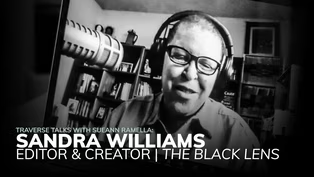
Activist Sandra Williams - Conversation Highlights
Video has Closed Captions
Clip: 1/8/2022 | 3m 50s | Conversation highlights from activist and "The Black Lens" editor Sandra Williams. (3m 50s)
Providing Support for PBS.org
Learn Moreabout PBS online sponsorship













Support for PBS provided by:
Traverse Talks with Sueann Ramella is a local public television program presented by NWPB