
Actor and filmmaker Bruce Campbell returns to Michigan with new film “Ernie & Emma”
Clip: Season 10 Episode 52 | 9m 49sVideo has Closed Captions
He showed his new film at the Redford Theater in Detroit where “The Evil Dead” premiered in 1981.
Actor and filmmaker Bruce Campbell grew up in Metro Detroit and returned to Michigan to show his new film "Ernie & Emma" at the Redford Theater in Detroit earlier this month. One Detroit’s Chris Jordan spoke to him about the film, the process of producing it independently and the homecoming screening.
Problems playing video? | Closed Captioning Feedback
Problems playing video? | Closed Captioning Feedback
One Detroit is a local public television program presented by Detroit PBS
Actor and filmmaker Bruce Campbell returns to Michigan with new film “Ernie & Emma”
Clip: Season 10 Episode 52 | 9m 49sVideo has Closed Captions
Actor and filmmaker Bruce Campbell grew up in Metro Detroit and returned to Michigan to show his new film "Ernie & Emma" at the Redford Theater in Detroit earlier this month. One Detroit’s Chris Jordan spoke to him about the film, the process of producing it independently and the homecoming screening.
Problems playing video? | Closed Captioning Feedback
Where to Watch One Detroit
One Detroit is available to stream on pbs.org and the PBS app.
Providing Support for PBS.org
Learn Moreabout PBS online sponsorship(soft music) - [Chris] So just tell me a bit about the film and about this homecoming for it.
- Well, the Redford, of course, is the mother theater for us.
It is still one of the great remaining monoliths of motion picture history.
Almost a hundred years old now.
We must support these places because they will tear them down.
You know, it was old when we premiered "The Evil Dead" in '81.
You know what I mean?
So that's how old this place is.
Nothing has changed.
Volunteers have done an amazing job.
That was the key importance to go back to the Redford with a movie that frankly is off the grid.
No studios we're allowed to interfere or intervene.
And I'll tell you, it's really fun to do a movie with no notes.
And I say that flippantly, but it's everything to me because as an artistic person, the only reason you have to listen to Paramount's notes is because they put up the money, even if it's kind of a lousy note.
But that's the weird relationship the arts and commerce have.
You know, it was a good chance now finally, my wife and I, we put up the money.
We're like, let's do an age appropriate movie that it's sort of like it's hallmark with drugs, alcohol, swearing, and infidelity.
- [Emma] My final wish is for you to spread my ashes.
The letters will guide you to each place.
Basically, I want one last hurrah with you.
- You went too soon.
- [Emma] This might be a good way to finally spend some quality time together and maybe even resolve a few issues along the way.
- You know, it's funny, Emma made me promise her that I wouldn't punch you in the face.
- Now what's funny about that?
- She's dead.
She'll never know.
It's the story of Ernie Tyler.
He is the Rogue Valley's number one pear salesman three years in a row.
He's the pear guy.
It's on his license.
And you know, he is a rear view mirror guy.
He drives a 20-year-old car.
'cause that's kind of when things were hopping in his little valley.
And his wife dies and he is one of these guys who is probably one of the least prepared humans to have a spouse leave.
So drop a bomb on a guy who doesn't like bombs dropped on him, and just see what happens.
See if he makes it through.
See if he crawls from the wreckage.
- The people who've been following your career know you for horror and slapstick comedy.
There's a bit of a physical comedy in there too, but it's a very different sorta film for you or really see a different side of you as an actor.
And I'm curious how you came to this project and this story?
- It's a pivot.
I'll admit that.
You know, a lot of it was just yearning for a good part.
It's all an actor ever wants.
I tell writers, man, you wanna get an actor, write a big fat juicy part.
The monologues, the speeches, the single tear, you know, the highs, the lows.
I would've jumped all over the script like a cheap suit because, you know, a lot of what I'll get these days, and any actor gets, you get a script where the lines could be interchangeable.
And they're hospital procedures, police procedurals.
That doesn't get me excited.
You know what I mean?
And shotguns and boomsticks and quippy one-liners and fake blood doesn't get me excited anymore either.
You know, I've sort of hung it up 'cause I'm just, I'm too old for that.
It really is that simple.
And now where's my brain?
I want to do stuff that tells a story of loss and heartache and renewal.
Because when I was 21 doing Evil Dead, I hadn't experienced that much of life now.
Now that I'm 68, yeah, now some has happen.
I've been married for 35 years.
So if you're married that long, not every one of those years is gonna be, you know, of one for the ages.
You might have some real stinkers in there.
And I have.
And so why not write about it?
Because everybody, you know, I was almost gonna start my Q&A this way saying, raise your hand in the audience if you've lost a loved one.
You know, everybody has.
So it's a story hopefully people can relate to.
You know, and you wanna take a character on the journey.
Ernie, hopefully is a better man by the end of the movie.
So I like journeys.
Look, I like redemption because I do want the audience to root for Ernie, you know, he can be an idiot, but he's the idiot you got.
- You and your wife made this one completely outside Hollywood, outside studios.
Probably the most independent thing you've done since the original "Evil Dead."
What inspired you to like totally break off from the system like that and how was that experience?
- It's the only way to be a free little bird that flies around, you know?
It was a glorious experience that I will never go back.
And I'll be honest with you, because I'm an adult, I'm a professional.
I've done my 10,000 hours, I've laid a lot of bricks.
I know how to do this.
Most people in the film business now are 25 years old, and God bless every single one of them.
But I don't wanna be in the learning world of a director or a writer.
Part of the beauty is, over the years, you know when to tap out.
You know when to go, that's not gonna work.
So what we tried to do is the movie takes place in Oregon.
It did not originally, it was Detroit.
My dad was a Detroit madman, '50s, '60s, '70s for you know, MacManus, John and Adams.
Campbell Ewald, my dad would introduce himself, "Hi, Chuck Campbell," Campbell Ewald, even though he had no relation to the guy who ran the company, but he had fun with that.
But my wife said, Hey buddy boy, we're putting up the money for this.
Wouldn't you like to sleep in your own bed?
And it really hit me.
I was like, I've never slept in my own bed in the last 25 years.
So I went, you know, you could, you could.
So he's just a sales guy and our area is the home of Harry and David, and it's on the arches.
You see a lot of these fellow pear orchards everywhere.
But I've been watching the pear industry die like I watched the auto industry die in Detroit.
I find it very poignant and very just, I mean, they used to do pears in our valley for decades and decades.
And now it's a lot of wine.
They just put wine in.
I think they can make more money.
So those things really resonated with me.
The other thing that we did was, let's shoot when you should really shoot this movie.
Not in January and not in Bulgaria.
I've done a lot of things in places that just should have never been in that place at that time, because it's for the convenience of the people, again, who are putting up the money.
You want to air it on TV at this time, you gotta make it at this time.
You don't care if it's good for the movie or not.
So we shot in June.
I mean we caught the Applegate Reservoir, one of these beautiful reservoirs near us.
I mean, 95% full.
You look at the thing, you go, wow, what is that?
And the air is clear.
There's no wildfire smoke.
The grass is green, the valley's, everything is just lovely.
So, you know, that's the stuff you can do when you're running the show.
And as a result, the movie looks exactly how it should look.
- While you wound up changing the setting from Detroit to Oregon, there's obviously still some little Detroit references peppered in there.
And of course, a lot of your, you know, collaborators on it are longtime collaborators going back to "Evil Dead."
I saw on the credits that Joe LoDuca score was recorded in Ferndale here.
- You know, when I knew this was happening, I blew the "Evil Dead" dog whistle.
I really did.
I mean, Kurt Roff who shot the movie, was a crew member on "Evil Dead."
You know, Mike Ditz, who photographed the poster for the movie was our set photographer.
You know, I mean, and what that does, that gives you familiarity.
When I worked with Joe LoDuca we watched the movie together, we don't have to beat it to death.
Joe goes, yeah, I get it.
I know what you need.
It was a great chance to surround myself.
Kaye Davis, she edited the movie.
She cut "Evil Dead" too.
But so they have the same skills, you're just telling 'em to light a human, not a monster.
You can, I want filmmakers to know it's easier now than it was.
The equipment's smaller, it's cheaper.
The lights are about this big now.
A little little microphone you can clip on your shirt, editing software, music software.
I wanna encourage filmmakers from Michigan, Detroit, Indiana, all the parts where they think they don't make movies here.
I can't do it here.
Yeah, you can.
Yeah, you can.
Get a couple of buddies together, pool your resources, make a movie.
Doesn't have to be a horror movie.
Whatever you want.
I want filmmakers to feel empowered.
People go, well, you're Bruce Campbell, you could just make a phone call.
Well, took a while to get to the point where I could do that, but I'm doing the same thing that I'm asking you to do.
Just get a bunch of friends together and make a movie.
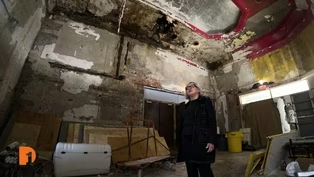
Local independent movie theaters finding new ways to stay open
Video has Closed Captions
Clip: S10 Ep52 | 13m 34s | One Detroit’s Chris Jordan and Bill Kubota visit some of metro Detroit’s remaining movie theaters. (13m 34s)
Providing Support for PBS.org
Learn Moreabout PBS online sponsorship New Episode
- News and Public Affairs

Top journalists deliver compelling original analysis of the hour's headlines.
 New Episode
- News and Public Affairs

Today's top journalists discuss Washington's current political events and public affairs.


 New Episode
 New Episode
 New Episode
 New Episode
 New Episode
 New Episode

 New Episode
Support for PBS provided by:
One Detroit is a local public television program presented by Detroit PBS