
VPM News Focal Point
Addiction | April 14, 2022
Season 1 Episode 7 | 26m 46sVideo has Closed Captions
Explore the different ways Virginians are helping those who struggle with addiction.
From Blacksburg to Richmond, advocates offer hope and healing to people on the road to recovery from opioid addiction. Meet a Richmond police officer whose foundation facilitates substance abuse treatment and boosts addiction awareness.
Problems playing video? | Closed Captioning Feedback
Problems playing video? | Closed Captioning Feedback
VPM News Focal Point is a local public television program presented by VPM
The Estate of Mrs. Ann Lee Saunders Brown & Dominion Energy
VPM News Focal Point
Addiction | April 14, 2022
Season 1 Episode 7 | 26m 46sVideo has Closed Captions
From Blacksburg to Richmond, advocates offer hope and healing to people on the road to recovery from opioid addiction. Meet a Richmond police officer whose foundation facilitates substance abuse treatment and boosts addiction awareness.
Problems playing video? | Closed Captioning Feedback
Where to Watch VPM News Focal Point
VPM News Focal Point is available to stream on pbs.org and the PBS app.
Providing Support for PBS.org
Learn Moreabout PBS online sponsorshipANGIE MILES: Opioid abuse has been a public health crisis in Virginia for years and addiction problems have worsened during the pandemic.
Today's program will introduce you to people on the front lines in the fight against addiction.
And we'll meet people who have used and abused opioids, but are now finding a new way forward to a better life.
Also, we'll meet a police officer who has chosen to become a champion for those battling addiction.
This is VPM News Focal Point.
Production funding for VPM News Focal Point is provided by Dominion Energy, dedicated to reliably delivering clean and renewable energy throughout Virginia Dominion Energy Actions Speak Louder The estate of Mrs. Ann Lee Saunders Brown and by ♪ ♪ ANGIE MILES: Thank you for joining us for VPM News Focal Point.
I'm Angie Miles.
Our program today is about recovery, what that looks like for individuals and communities working to rebound from opioid addiction.
First here's a quick snapshot of news from around Virginia.
In the nation's capital, Judge Ketanji Brown Jackson has made American history becoming the first ever Black woman Supreme Court justice.
Both Virginia Senators Mark Warner and Tim Kaine voted to confirm Jackson.
Statewide public transit systems are now on the fast track for upgrades.
That overhaul will be funded by 232 million in federal dollars from President Joe Biden's bipartisan infrastructure law.
In Richmond, Governor Glenn Youngkin has signed more than 100 bills into law.
He also rescinded a 2021 executive order banning single-use plastics from state agencies, colleges, and universities.
In Southwest Virginia, Suboxone is in short supply as some pharmacies decline to carry the medication despite federal mandates.
The drug helps people overcome opioid addiction.
From Fairfax to Lynchburg, Virginia police officers are finding new ways to save lives by donating bulletproof vests to Ukrainians who are fending off deadly Russian attacks.
The protective gear and supplies drive organized by Richmond nonprofit Lift Up Ukraine continues.
ANGIE MILES: During the pandemic, fatal drug overdoses skyrocketed in Virginia.
Officials say the rate increased 42% from 2019 to 2020.
The state is on track this year for another record-breaking number of drug deaths according to a report by the state's medical examiner's office.
Virginians from the Blue Ridge mountains to the Piedmont region continue the fight against addiction.
We hear from them now.
KEYRIS MANZANARES: Virginia's struggles with opioids were shown in the hit Hulu miniseries, "Dopesick."
The docudrama focuses on how federal prosecutors went after Purdue Pharma for using deceptive marketing to get Appalachian communities hooked on OxyContin in the late 1990s.
One of those relentless prosecutors was Rick Mountcastle.
RICK MOUNTCASTLE: I saw pretty early on that the way Purdue Pharma had marketed that drug was wrong.
They lied about it.
KEYRIS MANZANARES: Mountcastle says he was determined to hold OxyContin's maker accountable because of his obligation to his community.
RICK MOUNTCASTLE: A lot of young people were addicted to OxyContin.
A lot of young people were committing crimes to get money to buy OxyContin off the street.
KEYRIS MANZANARES: In 2007, Purdue Pharma and three of its top executives pleaded guilty to criminal charges that they misled the public, doctors, and regulators about the addictiveness of Oxy.
RICK MOUNTCASTLE: People who are addicted to opioids, they will do just about anything to avoid withdrawal, or dope sickness, as it's called.
KEYRIS MANZANARES: While Mountcastle fought in the courtroom, John Shinholser fights addiction in the recovery room.
JOHN SHINHOLSER: We're recovering people, trying to help people recover.
KEYRIS MANZANZRES: Based in Richmond, the McShin Foundation uses a peer-to-peer approach to substance use recovery.
Most of the staff, including Shinholser, are in long-term recovery.
He says they're hope dealers.
JOHN SHINHOLSER: Recovering people all have a purpose.
And if you can find that purpose, and live your purpose, you never have to look back on active addiction.
KEYRIS MANZANARES: McShin has had tremendous impact, not only in Virginia, but across the nation.
JOHN SHINHOLSER: We just trained a powerful group of people in West Virginia for the whole state.
We have technical assistant contracts with the State of Arkansas.
Our model, our curriculum is accepted in Connecticut and New York.
KEYRIS MANZANARES: Justin Lewis is facing his drug addiction at McShin.
He's part of their 28 day recovery program.
JUSTIN LEWIS: What is addiction?
A nasty disease.
Like it's toxic.
I've been dealing with it my whole life.
I started using when I was like 10 or 11, and got out juvie at 13, I started using harder drugs.
By age of 17, I was a heroin addict, and didn't even realize I was using heroin.
KEYRIS MANZANARES: Lewis says this is the first time he's been open about his struggles.
JUSTIN LEWIS: I felt like there was a stigma.
Like, if I was honest about my addiction, or things I've seen, or been through in my mental health, like they would just judge me, or with legal stuff, like probation, I felt like if I was honest about mental health, and my drug addiction, that they'd keep me on longer.
Or for court, you know, I'd get more time.
KEYRIS MANZANARES: Shinholser and Lewis go way back.
They met when Lewis was 13.
JOHN SHINHOLSER: He's he's doing the long program.
See, I knew Justin before he had a tattoo.
JUSTIN LEWIS: Yeah.
(John laughing) JUSTIN LEWIS: He's always been there for me.
And the fact that he's known me this long, and he's still willing to offer me a hand, and help me is just, he really does care.
And you know, people need to realize that addiction affects all wakes of life.
It doesn't matter what color you are, what your religion is, if you grew up in a poor neighborhood, or grew up a million dollar home, it can affect anyone.
At the end of the day, we're all people.
KEYRIS MANZANARES: Lewis wants to become a hope dealer, joining those who came before him in the fight against addiction.
JUSTIN LEWIS: I would like to be here or somewhere else helping someone else get clean.
Like if I can just keep one person from doing heroin, or meth, or crack, whatever it is, if I can get one kid, or a person to either not use or get clean, then I'd be happy.
KEYRIS MANZANARES: Reporting for VPM News Focal Point, I'm Keyris Manzanares.
ANGIE MILES: Data shows that people who complete the McShin 28 day program have a significantly better chance at sustained recovery over the next three years.
The Foundation hosts a number of events each year, including the Recovery Fest in September celebrating national recovery month.
ANGIE MILES: Opioid abuse is a national health crisis.
Virginia is far from immune, but there are people working to help the country, to help Virginia, to confront the crisis and begin to heal.
One of those people is Dr. Carlin Rafie.
She is a Virginia Tech researcher, whose work takes her statewide.
Much of her effort has centered on Southwest Virginia which has been devastated by opioid abuse.
Dr. Rafie joins us in the studio today.
Welcome Dr. Rafie.
CARLIN RAFIE: Thank you for having me.
ANGIE MILES: So you actually worked formerly at VCU and a colleague there, Emily Zimmerman and yourself have been working in Martinsville CARLIN RAFIE: Correct.
ANGIE MILES: Now we know in Martinsville, they had the unfortunate distinction of being rated the number one place in the country for opioid prescriptions per capita, almost 400 per 100,000 people in 2017.
That's high.
Talk about the resilience that you see there and other places and people wanting to really take charge of this situation.
CARLIN RAFIE: They've really taken the bull by the horns, if I might say so, but I think this is happening in communities all over Virginia.
There are many coalitions that have come together to address the issue to seek help.
So once Martinsville realized the extent of the problem they had with opioids they formed a task force and that task force invited Engaging Martinsville, our community academic partnership there to help them evaluate the issue systematically and develop strategies to address the issue.
ANGIE MILES: Okay.
So with your expertise and $200,000 in federal funding through AmeriCorps, you set out to help the community craft its response, four pivotal points, goals that they chose they wanted to focus on, what are those?
CARLIN RAFIE: The first was to set up a continuum of care for individuals coming into the emergency rooms in the hospitals that serve that area, get those individuals into the hands of peer counselors who then would link them and connect them back to the Community Services Board where they would receive ongoing care for their substance use problem.
ANGIE MILES: And when you say peer counselors we're talking about people who have themselves battled opioid addiction.
CARLIN RAFIE: Correct.
ANGIE MILES: And they are in recovery and they're there to help the next person who needs a hand.
CARLIN RAFIE: Absolutely.
ANGIE MILES: Okay.
Drug courts, that's a second one, right?
CARLIN RAFIE: Right.
So the community had been thinking about bringing a drug court for some time, that court opened this year.
ANGIE MILES: And drug courts which help people to move towards treatment rather than moving towards incarceration.
CARLIN RAFIE: Absolutely, very important.
ANGIE MILES: Okay.
And then the final two things deal with prevention efforts, what are those?
CARLIN RAFIE: So they have established now within their school systems a prevention education program that now is being taught in all of the schools in Martinsville and in Henry County, and in addition to that they needed to get the word out to the community for those who need help and were seeking help.
And so, they developed an awareness campaign that they implemented as well.
ANGIE Very good.
Thank you so much for joining us today.
That's Dr. Carlin Rafie, a Virginia Tech researcher who is specializing in helping communities to rebound from opioid addiction problems.
KEYRIS MANZANARES: Dr. Rafie updated us on efforts to help Virginians recover from opioid addiction.
In our People of Virginia segment, we asked individuals their opinion about what can be done to help those struggling with addiction.
First of all, understanding what rehabilitation is, what detoxing is, and understanding that that's a very big stage in people changing and it's a long, hard process.
You know, criminalization is the worst thing possible.
But whether or not we have the resources to do what's needed, I don't know, Maybe external help outside of those facilities where maybe people could check on them every now and then, maybe.
It ain't even got to be every day.
But I think just, yeah, just being able to help people would be the best thing I think for this area.
KEYRIS MANZANARES: We enjoy hearing Virginian's views on this topic and others.
We invite you to share your opinions on our website at vpm.org/focalpoint.
ANGIE MILIES: Since 2013, drug overdose has been the number one cause of unnatural death in Virginia and the problem has worsened each year.
One intervention that has made a quantifiable difference is the anti-opioid drug Naloxone, sometimes referred to by the brand name Narcan.
In places where first responders and family members have learned to use Naloxone, drug deaths have dropped precipitously, but there is much more happening to address Virginia's public health crisis.
Virginians are banding together and finding new answers.
CRYSTAL SONGER: I was prescribed it around 15 or 16 here at a local chiropractor's office.
Me and my dad were preparing for a softball game in the backyard and I broke this bone right here underneath my eye.
ANGIE MILES: Crystal Songer remembers her first prescription for opioids.
CRYSTAL SONGERS: And he prescribed me OxyContin 20s.
And I fell in love from there.
It was like a warm fuzzy blanket.
So, I kind of continued from there, from that doctor onto another right up 'til I was 18 and I just kept a constant prescription.
And when I finally hit my rock bottom, I had lost my home, I was living on a riverbank, my husband was being arrested, I was getting food from a food bank that was maybe expired, maybe not.
I was having to take showers in the river.
I was scared I was going to overdose and nobody was going to know where I was.
When I found out that I was going to have another baby, I decided, "This is it, you can't keep doing this.
You can't keep living this way.
You have lost so much money and so many people.
If you don't change now, you'll probably die."
I asked a friend to take me and drop me off at a rehab.
MONICA FLORA: The first intervention that is needed is to help someone get through the withdrawal period.
So we try to introduce individuals to Suboxone as quickly as possible.
Because at that point, they feel absolutely miserable.
It's like the flu on steroids.
They have diarrhea, they're throwing up.
They're aching.
Their bones sometimes feel like they're shattering.
They feel terrible.
If someone can get Suboxone about a half an hour, 45 minutes, they already start to feel better.
I don't think that the community was prepared and I don't know how you would prepare for so many people to be ill.
In 2020, we lost 56 people in Martinsville, Henry County area, and those are our neighbors.
Those are our loved ones.
The school system, because there are so many people that are in active use right now, the children need some extra care and attention, making sure that they are getting their needs met.
We also have folks that live in some tent communities where they've lost housing, they've lost their jobs, so they don't have any resources.
So we're trying to help folks that don't have shelter, don't have food, don't have clothing.
ANGIE MILES: Crystal Songer is there helping as well, now a peer recovery counselor advising people who might've arrested her in the past and sitting with people who are trying to get clean, as Crystal is today.
CRYSTAL SONGER: I know how bad they feel when they're waiting to talk to somebody, and if I can get them out of withdrawal so they don't walk out of our office and use, I'm changing lives every time I go into that ER and share my story or I'm sitting in that next room sharing my story and somebody says, "You know, I was going to use the other day, but I thought about you."
And I'm like, "Wow, that touches me."
ANGIE MILES: Stacy Hicks is living a changed life today as well.
Collecting litter and cleaning up at the courthouse are jobs she's thankful to be doing.
STACY HICKS: When I got in trouble with the law, I was worried about how much time I would get, if my family would be mad at me.
ANGIE MILES: She's one of hundreds of people in her county serving time for drug convictions by going to work instead of going to jail.
ZACK STOOTS: The Russell County Community Work Program allows nonviolent offenders to spend their incarceration on a work crew out working in the community instead of being incarcerated.
Well, it saves the county a ton of money on housing inmates.
It saves the county on work, like the trash sites, the animal shelter, paint buildings.
One year, it saved a million dollars in work costs.
When I first came here, I came from a county that didn't have a work program, and in the beginning, I'm like, "Well, I don't know about this."
But it changed the way I think about it, to be honest.
This program has changed the way I view drug abuse.
You get to know the people who are in the program and you look at them differently.
And it gives them a second chance to give back to our community, which to me, is a win-win.
MISSY CARTER: When we first started this program, it was hard to get people to buy into it.
People want you to be hard on crime.
And all I could say about that is, they need to be in the work program one day, because there's nothing easy about it.
Some of them still live at home in their bad situation.
I don't know how they do it, going right back out to that issue.
But they stay sober.
They do everything that we expect of them.
And they don't have an issue with it.
They're thankful to be home.
ANGIE MILES: Missy Carter coordinates Russell's work program, as well as the county's drug court, which emphasizes treatment over jail time.
Carter says she's learned that treatment and mental health care are both essential for every person dealing with drug abuse.
MISSY CARTER: I think in late 2017, we met with Wise County and helped them, gave them all the things that we had stumbled upon, and they started a program which has done great.
And since then, we've helped about seven other counties.
Most recently, Washington County just started a program, got their first people sentenced last month.
So it's pretty exciting.
ANGIE MILES: Wise County started its Wise Works Program in 2018 and reports that so far, they've saved nearly $3 million through decreased incarceration fees and increased help at work sites.
In Russell, Stacy says, STACY HICKS: Yes, I think every county should have a program like this.
I mean, it really helps people.
My family's proud of me.
I'm proud of myself.
I've been clean 17 months.
I have a better relationship with my daughters.
The program has changed my life because I'm around positive clean people.
I get to clean the courthouse.
I get to pick up trash every day, be outside.
And then I get to go home and be with my kids.
ANGIE MILES: Virginia's Department of Health says opioid overdose claimed the lives of four Virginians every day in 2020, and the pandemic has made abuse and overdose much worse.
Opioid abuse has become even more treacherous because of drugs being laced with deadlier fentanyl and some users transitioning to heroin or meth.
The state is just starting to receive funds generated by legal action against drug companies for the ways they manufactured, promoted, or distributed highly addictive and potentially lethal opioids.
JASON MIYARES: We got a half a billion dollar settlement that is coming to Virginia, one of the largest opioid settlements in the country.
That money is going to go to the localities.
So we're hearing from the localities, what are some areas we could put resources in?
We have the Opioid Abatement Authority that's headed up by Senator Pillion, which my office will be advising legally on.
So a lot of it is getting money to the localities, What are the best practices?
so they can actually do the best treatments.
Because at the end of the day, we all want the same goal.
We want people- ANGIE MILES: This abatement fund may total hundreds of millions of dollars for prevention, treatment, and recovery from opioids and the massive collateral damage they've caused throughout the state.
At Virginia Tech, researchers are hoping for a scientific way to limit opioid damage in the future.
MIKE ZHANG: Our vaccine obviously is against the different opioids.
Right now, we are working on vaccine against the oxycodone.
We hope we can extend that to the vaccine against the fentanyl.
That's the mostly overused drug on the market right now.
We have worked on the similar technology against nicotine.
We thought to use this approach can help the people that want to stop using the opioids.
That will help them to become sober.
ANGIE MILES: With innovations from science, law enforcement, and the treatment communities, as well as monetary infusions from government and legal settlements, Virginia communities are working hard to recover and to heal, one family, one person at a time.
CRYSTAL SONGERS: I would be lying if I didn't tell you I didn't have triggers or if I didn't think about using, but I know that that's not an option for me anymore.
I have an amazing life.
I have a home.
I have two vehicles, three beautiful kids that live in the home with me, and a relationship with my oldest that I'm trying to gain back one day.
I feel like I'm giving back and all the bad that I put out there in the world will eventually be erased.
(feet thumping) (children laughing) Next one, next one, all right, cross Sissy, cross Sissy, cross it.
(children laughing and screaming) ANGIE MILES: For those dealing with addiction related issues, Virginia's Revive program can connect you with resources related to the anti-overdose drug Naloxone.
Find links to helpful information on our website, vpm.org/focalpoint.
ANGIE MILES: Retired Richmond city police captain Mike Zohab spent almost 30 years policing drug dealers and abusers.
He says the experience changed his views on drug use.
Today, he leads the Virginia Recovery Foundation which offers free access to drug treatment programs statewide and provides scholarships for former users who want to pursue a degree and become recovery professionals.
MIKE ZOHAB: I started with the Richmond Police Department in 1988, I was doing a surveillance in a heroin area here in Jackson Ward.
I watched a young lady, she had to be in her late teens, and she went through the gutter, and was picking up needles to find a needle to use.
And she was at least seven months pregnant.
That was their life.
>>The thing that we're going to do next is, is we're going to look at the common themes and barriers and what resources don't exist that we could add.
MIKE ZOHAB: There was a movement in Boston.
It's a small town police chief who started letting people come in, knock, approach any policeman, and we'll help get you into treatment.
And I was like, well, why can't we do that?
And I got the Richmond Police Department, my cell phone number, my personal cell phone number, 24 hours a day, and we would send someone to an emergency room if they overdosed, or to a safe location, to see if we could interest someone into seeking treatment.
And the first year that we turned the lights on, we placed 72 people in drug treatment in a 12-month period of time.
ANTHONY GRIMES: We wouldn't take somebody that has cancer and was stealing and robbing in order to get their cancer medication.
We wouldn't look at them as society as being morally flawed.
We would look at them as having a deadly illness and they desperately need treatment.
So when you have somebody to like Mike Zohab, who comes from a background of being on the street, boots on the ground, and seeing that the issue is not with the individuals that live in our society.
The issue is is with how we get them connected to the proper resources.
MIKE ZOHAB: I do still help people seven days a week, 24 hours a day, navigate the system.
But we wanted to to have more of an impact.
And that's where the scholarship program evolved.
ROB FINNEGAN: One of the useful parts of recovery is having a counselor or a professional actually provide you psychological or psychiatric advice.
And it's especially powerful that person's had the experience of recovery.
So we like the idea of funding someone's education, so they don't have student loan debt when they go out into the workforce and support people in recovery.
THOMAS BANNARD: Most people don't argue with me when I say that college campuses are hostile environments or recovery hostile environments.
And one of the things that Virginia Recovery Foundation has supported throughout its time is collegiate recovery.
Especially when you have a space for people to gather, then people can kind of come into the space and realize I'm not alone.
I'm not the only person here that is struggling with this thing.
MIKE ZOHAB: All of my life experiences gave me a foundation to do this with the state.
Because I'm coming in with my eyes wide open and my ears open, and I'm asking questions, that "why" question.
And if I hear, "Well, that's the way we've always done it," I literally roll my eyes, shake my head, and go, "You got to be kidding me."
I do have a incredible passion for this.
I mean, it's tenacious.
ANGIE MILES: We appreciate everyone working to help halt the opioid addiction crisis.
We welcome your feedback on these and other stories and we invite you to share your story ideas at vpm.org/focalpoint.
Thanks for joining us for this episode.
And we look forward to seeing you next time.
Production funding for VPM News Focal Point is provided by Dominion Energy, dedicated to reliably delivering clean and renewable energy throughout Virginia Dominion Energy Actions Speak Louder The estate of Mrs. Ann Lee Saunders Brown and by ♪ ♪ ♪
Addiction | People of Virginia
Video has Closed Captions
Clip: S1 Ep7 | 36s | Virginians share their perspectives on how to help people overcome addiction. (36s)
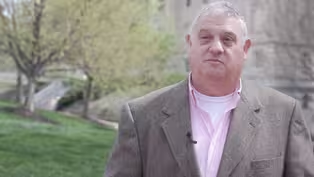
Retired police captain connects addicts to treatment
Video has Closed Captions
Clip: S1 Ep7 | 3m 6s | Former police captain Mike Zohab leads foundation advocating for drug treatment over jail. (3m 6s)
Video has Closed Captions
Clip: S1 Ep7 | 3m 52s | Meet three Virginians who are fighting addiction in their own way. (3m 52s)
Virginians work together on opioid recovery
Video has Closed Captions
Clip: S1 Ep7 | 9m 7s | Counseling, research and law enforcement innovation address the public health crisis (9m 7s)
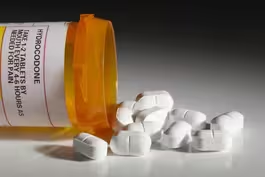
Virginia’s opioid addiction crisis
Video has Closed Captions
Clip: S1 Ep7 | 3m 10s | Drug overdose is the #1 cause of unnatural death in Virginia. (3m 10s)
Providing Support for PBS.org
Learn Moreabout PBS online sponsorship New Episode
- News and Public Affairs

Top journalists deliver compelling original analysis of the hour's headlines.
 New Episode
- News and Public Affairs

Today's top journalists discuss Washington's current political events and public affairs.
 New Episode

 New Episode
 New Episode
 New Episode
 New Episode
 New Episode
 New Episode

Support for PBS provided by:
VPM News Focal Point is a local public television program presented by VPM
The Estate of Mrs. Ann Lee Saunders Brown & Dominion Energy