One-on-One
Addressing "Book Poverty" in Less Affluent Neighborhoods
Clip: Season 2024 Episode 2681 | 10m 36sVideo has Closed Captions
Addressing "Book Poverty" in Less Affluent Neighborhoods
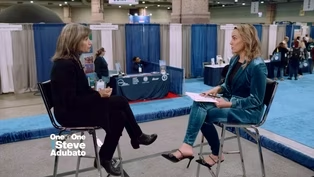
Steve Adubato speaks with Larry Abrams at the NJEA Convention, Founder of BookSmiles, about his organization’s efforts to recycle gently used children’s books to address the issue of “book poverty” in less affluent neighborhoods.
Problems playing video? | Closed Captioning Feedback
Problems playing video? | Closed Captioning Feedback
One-on-One is a local public television program presented by NJ PBS
One-on-One
Addressing "Book Poverty" in Less Affluent Neighborhoods
Clip: Season 2024 Episode 2681 | 10m 36sVideo has Closed Captions
Steve Adubato speaks with Larry Abrams at the NJEA Convention, Founder of BookSmiles, about his organization’s efforts to recycle gently used children’s books to address the issue of “book poverty” in less affluent neighborhoods.
Problems playing video? | Closed Captioning Feedback
How to Watch One-on-One
One-on-One is available to stream on pbs.org and the free PBS App, available on iPhone, Apple TV, Android TV, Android smartphones, Amazon Fire TV, Amazon Fire Tablet, Roku, Samsung Smart TV, and Vizio.
Providing Support for PBS.org
Learn Moreabout PBS online sponsorship(upbeat music) All right, Jacqui wasn't the only one down in Atlantic City doing interviews.
I was able to sit down with Larry Abrams.
I've talked to Larry before, he's been on with us before.
Larry Abrams is the executive director and founder of a great organization called Book Smiles.
Jacqui, we've had him on before, Larry Abrams.
What strikes you about Book Smiles that's so significant?
- Yeah, Larry is actually a past Russ Berrie Making a Difference Award winner.
That's how we first got connected with him.
- That's right.
- With our partners over there at the Russ Berry Foundation.
And he came up with this idea that as an educator, he is teaching right around the Camden area.
It came to his attention that kids, some kids at home don't have books.
And he couldn't believe that.
And he said, "You know, I need to do something about this."
And he started Book Smiles, very, very small and has grown significantly over the past couple of years.
Now, they've donated and distributed over 2.5 million books.
- Oh, and mine says two.
Is it 2.5?
- I mean, sorry, 1.5.
I lied, 1.5.
1.5, I thought they moved another million books in the last few days.
- No, but you know what?
I think we're gonna get to 2.5 not too far away from now, because he is so passionate.
- Really?
- He's driving, he, you know, he's driving this.
He retired from teaching and this is his full-time job now.
He is driving this initiative.
He has a team behind him now in the communities working to get those books out there and get books donated to them that they can distribute to the kids in and around New Jersey.
- Well, by the way, we did the interview, Jacqui.
We did it in November, I did this interview.
- Yeah, maybe they're at 2.5.
- Yeah, we're taping this at the end of January.
They may be at 2.5 billion.
And real quick, as you're watching the interview with Larry Abrams from Book Smiles, one of the things that I know I asked him about is how people can be helpful.
Because it's funny, I realize that we bring used books there's a used bookstore in our hometown here in Montclair.
But Larry makes it clear that there are other ways that you can get books to Book Smiles, which people don't realize, Jacqui.
We can all be a part of this and should be right?
- Yeah, yeah, and you can log onto the website that'll be up.
You can hold a book drive of your own.
You can become an ambassador.
You can hold a Facebook fundraiser.
So, you could do it right from your home.
Like we know everybody loves to remote and get things done.
So, you can do that.
So, a lot of different ways that you can get involved to help with this initiative and get those books in the hands of kids everywhere.
- And for those of us who have books all around us, we're fortunate, blessed, our kids have books.
That's not every kid, that's not every family.
Let's not forget that.
And that's what Larry Abrams lives every day with his colleagues over at the Book Smiles.
Let's check it out from Atlantic City.
- Hi, everyone, Steve Adubato here in Atlantic City at the NJEA Convention with Larry Abrams.
Larry, good to see you again.
- It is great to be back, Steve.
- I should tell everyone that in 2018, as part of our work with the Making A Difference Awards, the Russ Berrie Foundation's Making a Difference Award, Larry Abrams won one of the 2018 awards.
He was one of the winners.
He's executive director and founder of a great organization called BookSmiles, which is?
- We are a nonprofit that obsessively harvests gently used children's books, diverting them from the trash and landfill.
We sort them and then we give them to teachers and children in need.
- And we should also say that Larry was a 2022 CNN Hero, one of the CNN Heroes.
You know, when I met you, I'm thinking it was about a, now you started with how many books?
'cause I know right now you're about 1.7 million.
- 1.7 million.
And I think when we met, we'd done a few 100,000.
- Yes.
- This thing is really beginning to snowball.
- What's the thing, where do you get the books?
- We get them from a lot of places.
One, upscale a middle school districts to book drives.
We have individual children doing book drives.
We have book bins all throughout New Jersey where people put, deposit their gently used children's books.
But we're now beginning to purchase books by the tractor trailer load from Goodwill, from Thrift Books, from partners who harvest books on an industrial level.
Nobody else is really doing this in America.
This is kind of new for us.
- So now you taught, now you were teaching in Morristown?
- In Morristown, I started my teaching career in Morristown.
- Morristown.
- And then transferred to Lindenwold.
- Down by Camden?
- Exactly.
- So the whole concept of book poverty, right?
Different communities.
I live in Montclair, born and raised in Newark.
But trust me, I know the difference between Newark and Montclair, and other communities as it relates to resources.
- Right.
- So when it comes to resources and books, book poverty is very real in communities like Camden.
Define it.
- Oh, absolutely.
Well, book poverty exists in places called book deserts.
A book desert is a lot like a food desert.
A book desert is a place where huge swaths of neighborhoods will have children who own maybe one or two, or no books at all.
There are kids in New Jersey growing up with no books.
And what we do is we are ending that by making sure that kids have books in their hands and homes.
- How do you get to them?
- We use teachers.
I'm able to speak TeacherEase, 'cause I'm a recently retired teacher.
- Right.
- So we have hundreds of teachers visiting the book bank every quarter.
We also have a bunch of non-profit partners who take books by the truckload, food banks, other do-gooders will come to the book banks, and distribute free books to these kids.
- There's the BookSmiles van?
- That's right.
- Right here in the convention.
- [Larry] Right here in the convention center.
- [Steve] I wanna know how you got that in here.
- It was not easy.
I had to learn how to drive a van, use a liftgate.
I'm a teacher, but I learned all this stuff on YouTube, how to drive a box truck and use- - What's going on in that van?
- What's going on in the van is we use it for two reasons.
One, to go to affluent upschool school districts, upscale school districts.
And we pick up books by the thousands, beautiful books, which we then take back to the book bank, sort them.
And from there, we distribute them.
We, for example, we're just up in Newark.
So inversely, we'll use the book truck to deliver thousands of books to places that really need them, places that can distribute books.
And they're free.
- They're free?
- Yeah.
- Let's make it sure as the website goes up again, if you have books to donate, and they're just sitting around because there's book wealth.
Trust me, in our home with our daughter who is still in grade school, there are a lot of books.
- That's, yeah.
- And a lot of those books are not being read these days, because she's 13 now.
The point I'm making is we're not alone.
There are a lot of people out there.
People need to connect with BookSmiles to give to others.
What is the impact for those young people who live in book deserts and disproportionately urban communities, but others as well.
What's the impact on them in terms of their learning, their development, and their future?
- I'll give you a real anecdote, Steve, as somebody who taught in an underserved district for a long time.
My ninth graders, most of them read at a fourth and fifth grade reading level, and they were in ninth grade.
And I asked them why.
Where you read to when you were young?
Did you own books when you were young?
All of the kids who were failing my class, who were at third, fourth, and fifth grade reading levels, didn't have books growing up.
The honor students, on the other hand, the kids doing well, told me, flat out, "Mr.
Abrams."
"Yeah."
"My mother read to me, we went to the library."
So you can be in an impoverished area or in a very working class area and still do well in school, but that is key.
Getting books into the homes and hands of children who otherwise might not ever have them, compelling parents to read to these precious children is even more important.
- By the way, I'm sorry for interrupting.
I'm looking at the logo under BookSmiles.
It's got on your logo, on your shirt.
It's read it, love it, donate it.
- [Larry] That's right.
- [Steve] Read it.
- So read the book, love reading it.
Read it, love it.
Love the book, but after a while, the books will sit there on the shelf.
And when the kid isn't loving the book anymore, that's when children of means, children who have a lot of books need to practice the kind of philanthropy.
And it's looking out and making sure that kids who may not have the books that they have received them.
- So hold on one second.
Someone right now, they go on the website, they've got books that are sitting on the shelf.
How again, do they donate them?
- Well, they go and they take a look at our collection stations.
Most of our collection stations are in South Jersey, but we do now have collection stations in Short Hills.
We are all the way up in Norwood, across from Yonkers.
So we have a number of other communities- - The website has that information.
- Absolutely.
And if anyone wants to collect books in mass, in their garage, I will empower them to create their own book collection station right in their garage and we will clear them out with our book truck.
- Larry Abrams, executive director, founder of a great organization called BookSmiles.
- Steve, it has been such a pleasure and that's who we are, yes.
- Yeah, you're making a difference.
Thank you my friend.
- I really appreciate your time.
- We appreciate you.
- Yep.
- Well done.
- [Narrator] One-On-One with Steve Adubato is a production of the Caucus Educational Corporation.
Celebrating 30 years in public broadcasting.
Funding has been provided by The New Jersey Education Association.
The Russell Berrie Foundation.
NJ Best, New Jersey’s five-two-nine college savings plan.
Holy Name.
Seton Hall University.
Wells Fargo.
New Jersey Sharing Network.
PSEG Foundation.
And by NJM Insurance Group.
Promotional support provided by Northjersey.com and Local IQ.
And by BestofNJ.com.
- (Inspirational Music) - (Narrator) Great drive fuels the leaders of tomorrow and today.
Great vision paves the way for a brighter future.
Great ambition goes places, moving onward and upward.
Great empathy finds strength in kindness and in each other, working together to create something bigger than they ever imagined.
Great minds can change the world and great minds start at Seton Hall.
This Non-Profit Uplifts Underserved Women in Atlantic City
Video has Closed Captions
Clip: S2024 Ep2681 | 14m 41s | This Non-Profit Uplifts Underserved Women in Atlantic City (14m 41s)
Providing Support for PBS.org
Learn Moreabout PBS online sponsorship
- News and Public Affairs

Top journalists deliver compelling original analysis of the hour's headlines.

- News and Public Affairs

FRONTLINE is investigative journalism that questions, explains and changes our world.












Support for PBS provided by:
One-on-One is a local public television program presented by NJ PBS