VPM News Focal Point
Addressing growing rates of Alzheimer’s disease
Clip: Season 2 Episode 10 | 5m 4sVideo has Closed Captions
Alzheimer’s diagnoses are expected to increase in Virginia by 12% in 2025.
The Alzheimer’s Association estimates a 12% increase in the disease in Virginia by 2025. Learn about your options if you or a loved one is struggling with the disease.
Problems playing video? | Closed Captioning Feedback
Problems playing video? | Closed Captioning Feedback
VPM News Focal Point is a local public television program presented by VPM
The Estate of Mrs. Ann Lee Saunders Brown
VPM News Focal Point
Addressing growing rates of Alzheimer’s disease
Clip: Season 2 Episode 10 | 5m 4sVideo has Closed Captions
The Alzheimer’s Association estimates a 12% increase in the disease in Virginia by 2025. Learn about your options if you or a loved one is struggling with the disease.
Problems playing video? | Closed Captioning Feedback
How to Watch VPM News Focal Point
VPM News Focal Point is available to stream on pbs.org and the free PBS App, available on iPhone, Apple TV, Android TV, Android smartphones, Amazon Fire TV, Amazon Fire Tablet, Roku, Samsung Smart TV, and Vizio.
Providing Support for PBS.org
Learn Moreabout PBS online sponsorshipANGIE MILES: I'm with Sharon Napper, who is a nurse and professional trainer with the Alzheimer's Association.
You're assigned to the Richmond Chapter, but you work all over the state.
Tell us about what you do.
SHARON NAPPER: I am a professional trainer for the Alzheimer's Association, so I go out the state of Virginia and train facilities and first responders and people that want information about Alzheimer's and dementia.
And for the healthcare providers, I provide the certificates that they need from Department of Social Services to be able to work and provide care in a memory care setting.
ANGIE MILES: That's important.
Why is it so important?
SHARON NAPPER: It's important because over 6.5 million Americans have Alzheimer's.
In the next three years, the United States will see an increase of up to 20 to 25% of people with Alzheimer's and dementia and this state alone will see anywhere from 12 to 15% by the year 2025.
ANGIE MILES: Alzheimer's and dementia disproportionately impact communities of color, right?
SHARON NAPPER: Yeah, so African-Americans are twice as likely to have the higher risk for Alzheimer's and dementia.
Hispanics about one in five and Caucasians not as much.
And some of that disparity deals with health equity.
It's also access to healthcare and access to actual nutritious food and education.
And so, therefore, we try to get out into the rural communities and talk to churches and to other civic organizations, so that people are aware that you do not have to have mild cognitive decline.
It's based on your lifestyle.
Understanding the head and the heart connection.
What you do for your heart also helps your brain.
We have to get out into the community and let everybody know that you don't have to have this at all.
ANGIE MILES: If someone suspects a loved one may have Alzheimer's or dementia, what can they do?
SHARON NAPPER: There's usually 10 warning signs and we go over them in our various classes and educational features and... Well, the number one thing that I notice is, like I said there are 10, so one is misplacing things without being able to retrace your steps.
You're withdrawing from people.
Not being able to do your normal activities such as pay your bills, organize your closet.
It could be as simple as baking cookies and forgetting the ingredients.
But the number one thing that people always notice before the problems with memory is behavior changes.
We as adults, we make accommodations for our loved ones, our coworkers, they're stressed, they're having a hard time, but we notice when someone treats us differently and so sometimes that is the things that we see and especially with loved ones, people know that they're missing time and they're having some problems with memory, so they try to hide it before they ever go into their primary care provider.
And then that leads to another problem 'cause a lot of rural areas, they don't have a lot of neurologist.
You would go to your primary care, then you would be referred to a neurologist to see, but in rural areas you don't have access to a neurologist.
And then you have older adults that are not able to drive and get that transportation to get the diagnosis.
On our website at alz.org, we have a community resource finder.
You put in your zip code and it will then, you can click a box for physicians, community resources, and it will tell you the physicians that you can go to, how far they are from your zip code.
We also have in ALZ it's called a navigator, so you can also go in there based on your zip code and point and click and decide what you need for your plan and what your family needs to provide support for you.
ANGIE MILES: Many years ago, I served on an Alzheimer's board and I know at that time respite care was a really big need and request for support.
What is the status of respite care support today?
SHARON NAPPER: It is a huge concern because caregiving for someone with any type of chronic illness, especially dementia and Alzheimer's is very stressful.
So the state has respite dollars.
They're not based on income or anything like that and so we refer people out to several different nonprofits and entities that provide that.
ANGIE MILES: We hear often about a cure, lots of breakthroughs, but we are not there yet.
How close are we to a cure?
What's promising?
SHARON NAPPER: Well, we have some two new medicines that we're looking at but we're very upset with CMS because they will not approve those for the people that need it.
So, make sure that everybody's talking to their congressman, their senator, and people that will listen about getting those drugs to the populations that actually need them.
ANGIE MILES: If someone is looking for support, assistance with a loved one who may be suffering or if someone wants to be a support and give help to the organization, what do you suggest they do?
SHARON NAPPER: I would suggest that they would call the 1800 number for Alzheimer's or they can go on our website at alz.org.
We can do care consultations.
We can send someone out to help them get the proper diagnosis.
We can refer them to different access points in their community.
ANGIE MILES: Sharon Napper- SHARON NAPPER: Yes.
ANGIE MILES: with the Alzheimer's Association, thank you so much for joining us.
SHARON NAPPER: Thank you.
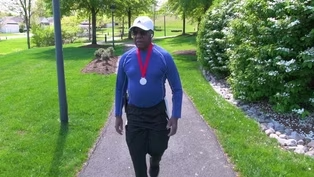
81-year-old trains for the Northern Virginia Senior Olympics
Video has Closed Captions
Clip: S2 Ep10 | 3m 39s | 81-year-old athlete Al Lamb says, “I want to win gold before I leave this world.” (3m 39s)

Aging Well | People of Virginia
Video has Closed Captions
Clip: S2 Ep10 | 1m 13s | We asked the people of Virginia to share their thoughts on what it takes to age well. (1m 13s)

Baby boomers breaking the mold in retirement
Video has Closed Captions
Clip: S2 Ep10 | 1m 48s | The Baby Boomer generation faces retirement, but not all are ready to leave the workforce. (1m 48s)

Making connections after retirement
Video has Closed Captions
Clip: S2 Ep10 | 4m 2s | Keeping older adults active and connected as they age. (4m 2s)

Video has Closed Captions
Clip: S2 Ep10 | 3m 45s | The coronavirus still poses significant dangers, especially for older adults. (3m 45s)

Relying on science to open minds and create beauty
Video has Closed Captions
Clip: S2 Ep10 | 7m 43s | Art for the Journey has more than a million dollars available to serve more seniors (7m 43s)
Providing Support for PBS.org
Learn Moreabout PBS online sponsorship
- News and Public Affairs

Top journalists deliver compelling original analysis of the hour's headlines.

- News and Public Affairs

FRONTLINE is investigative journalism that questions, explains and changes our world.











Support for PBS provided by:
VPM News Focal Point is a local public television program presented by VPM
The Estate of Mrs. Ann Lee Saunders Brown