State of Affairs with Steve Adubato
Advocates Talk About Giving & Receiving A Life-Saving Kidney
Clip: Season 8 Episode 16 | 11m 36sVideo has Closed Captions
Advocates Talk About Giving & Receiving A Life-Saving Kidney
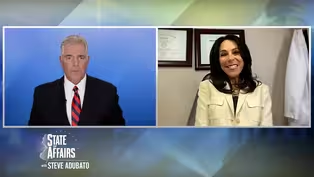
Senior Correspondent Jacqui Tricarico goes on-location to the NJ Sharing Network 5K Celebration of Life event to speak with Leslie Pooser Osei-Tutu, MD, and Omari Pooser-Bennett about their unique story of donating and receiving a life-saving kidney.
Problems playing video? | Closed Captioning Feedback
Problems playing video? | Closed Captioning Feedback
State of Affairs with Steve Adubato is a local public television program presented by NJ PBS
State of Affairs with Steve Adubato
Advocates Talk About Giving & Receiving A Life-Saving Kidney
Clip: Season 8 Episode 16 | 11m 36sVideo has Closed Captions
Senior Correspondent Jacqui Tricarico goes on-location to the NJ Sharing Network 5K Celebration of Life event to speak with Leslie Pooser Osei-Tutu, MD, and Omari Pooser-Bennett about their unique story of donating and receiving a life-saving kidney.
Problems playing video? | Closed Captioning Feedback
How to Watch State of Affairs with Steve Adubato
State of Affairs with Steve Adubato is available to stream on pbs.org and the free PBS App, available on iPhone, Apple TV, Android TV, Android smartphones, Amazon Fire TV, Amazon Fire Tablet, Roku, Samsung Smart TV, and Vizio.
Providing Support for PBS.org
Learn Moreabout PBS online sponsorship[INSPRATIONAL MUSIC STING] - Folks, I'm here with my colleague, Jacqui Tricarico, who joined me at the annual 5K race, the "Celebration of Life" with the New Jersey Sharing Network back on June 9th in New Province, New Jersey.
Jacqui, tee up the interview people are about to see with a mother and son who tell a compelling story, a powerful story.
- Mother and son, Dr. Leslie, her son Omari, had to deal with some really serious health issues, Omari.
Was put on dialysis for many years because of a kidney disease he was dealing with and Dr. Leslie and Omari came to the realization that Omari really needed a kidney to save his life and Dr. Leslie is an organ donor and Omari is an organ recipient, kidneys, but you would think being they're mother and son that Dr. Leslie gave Omari her kidney.
It's not really how everything worked out.
So this next interview, you'll hear them talk about a kidney donor, being a kidney donor and really about this paired kidney exchange, what that is and how they were able to use that as a tool to give Omari his lifesaving kidney.
- The rest of the story, I think Charles Osgood used to say that, the rest of the story told by Jacqui Tricarico in this compelling interview.
Let's check it out.
- Hi, I am Jacqui Tricarico, on location at the New Jersey Sharing Network's 5K event here at New Providence, New Jersey.
I am so pleased to be joined by Dr. Leslie Pooser Osei-Tutu, and her son Omari Pooser-Bennet, mother, son, kidney donor, kidney recipient.
But when you hear that, you think, "Oh, you donated your kidney to your son," but that's not how the story unfolded, right?
So first Omari, tell me about your diagnosis in 2010, and how that changed your life significantly.
- Well, yeah, I was diagnosed in 2010 with a rare kidney disease, and it was projected that I would be on dialysis in about 20, 30 years.
And you know, life threw its deck of cards at me, and that was... That actually happened in 10 years, and I went septic and had to go on dialysis immediately.
And like I said, 20, 30 years turned into a few years, and yeah, it's been a journey from dialysis to the kidney, just the process of looking for a kidney donation.
- When people hear about dialysis, I don't think they really understand how like, life changing that is, and what you have to go through on a week to week basis.
You're receiving dialysis three times a week for six years, is that right?
- Seven.
- Seven years, so how were you able to mentally and physically get through that time in your life?
- It's a lot of quote unquote soul searching, and just finding your inner strength.
But I'd say one of the biggest parts is the community in terms of looking for help and assistance, and just strength, but most importantly, looking for that kidney, for the kidney donation.
The communities is a very important.
Family, friends, the community as a whole.
- Yeah, I was gonna say family, obviously mom, I'm a mother.
- Yeah.
- I can't imagine what that was like for you too, to see your son go through such a time.
Were you automatically like, "Let me see if I can donate my kidney to my son."
Was that part of the process right away, or how did that happen?
- Actually, it didn't come up until a little bit later.
We got him listed pretty early, and we didn't expect that the wait would be so long.
So I really only started looking to be a donor myself probably five years in.
What was interesting that you said, because I did not donate my kidney to my son, because early on I found out that I was not a match for him.
So we have different blood types.
- Yep.
- What I also wanna say though, Jacqui, is that you mentioned and asked Omari about the emotional part of being on dialysis as a young person for such a long time, as a physician myself, knowing and seeing patients on dialysis, there was no way for me to really understand the emotional toll that such a thing would take on a patient.
- So how did that change the work, you're an anesthesiologist, right?
- I am, I am.
- And you've seen firsthand a little bit of the process of organ and tissue donation, is that right, through your job?
- Absolutely, absolutely.
- So how did this change your entire perspective of those patients that you work with?
- Well, initially what I would say to Omari is, "What's the big deal?
Just go to dialysis three times a week, and then live your life," not realizing that he was often the youngest person there, he's sitting among people who are much older and more ill.
So it was very difficult.
On the other side, on my professional side, it took an emotional toll for me, because I would actually be the anesthesiologist at times on organ procurement.
And knowing that my son was at home needing a kidney, and I'm seeing someone's kidneys being transferred through the Sharing Network, and through the organizations going to other patients, it was very difficult.
- Yeah, like, when was it gonna be Omari's turn, right?
- Exactly.
There was one particular instance where I asked a colleague to come in and step in for me, while I stepped out to gather myself.
- It became a more emotional process for you?
- Absolutely, absolutely.
- So Omari, when did it come to the point where you said, and your team of doctors, and your mom, "Let's try to figure out how we can have a living donor help with this situation," because that wait list can take so long, so many people are waiting on this list to get organs donated to them to save their lives.
So when did everything happen that you were looking for a living donor?
- Well, it was a lot at once, or a lot in retrospect, but we weren't even looking for a living donor, but we were actually looking for, well, anything available to us, to be honest.
But living donors were the first through family and friends.
But then seeing that nobody was a match, we were going through deceased donors, I'm blanking the term, but for donors that were unfortunately passed.
And most of those were younger guys, and we were faced with a lot of decisions with the quality of the kidney, in terms of the patient, how they died, their condition when they died.
So we had a lot of options to weigh.
Thankfully the six person swap option was presented to us.
- So the six person swap, it's called a paired-kidney exchange.
- Exactly, and many people- - Can you describe it for us?
- Many people don't realize what that is.
So if you have a loved one, or if you just wanna be a donor without a directed recipient, you actually enter a pool where they can match people of different blood types, and secondary blood types, so that I actually donated to a stranger, and a stranger donated to Omari.
So there were three donors in our case, and three recipients.
And it all happens at the same time, so all six of us are in the hospital at the same time.
- Were you meeting each other?
- Omari and I actually, (laughing) the recipients are on one side of the transplant floor for obvious reasons, and the donors are on another.
So we would get together in the break room, and sit together and what have you.
But it was a little known thing that's becoming more and more popular.
Many of the medical centers now do the paired swaps, but you have to be at a center where someone would suggest it.
- Yeah, it's a great option.
- You asked Omari about receiving a live donation, but I gotta tell you, I did not tell Omari that I was going through the testing.
- You didn't, okay.
- I did not tell him, because I didn't want him to be disappointed if I wasn't a match, or if it didn't go through.
So I went through about 4 1/2 months of testing before I told Omari, "I got news for you, are you sitting down?"
- So how was your reaction?
Were you nervous for your mom, were you excited?
- It was a big surprise, but I mean, it is my mom.
I mean, she's my mother- - She's gonna do anything to help you.
- Yeah, I've had many examples of that.
She is, you know, there's nothing like your mother.
But yeah, I was speechless, and it was just a game changer, and it opened up a whole new option for me.
- And how are you both feeling today?
This is in 2021.
- Amazing.
- You're both feeling great?
- Amazing, three years in.
- The new kidney's doing great for you?
- Yeah.
- That's awesome.
And New Jersey Sharing Network, how did they come into your lives?
- Yeah, they were pivotal.
Well, I mean this organization brings light, and like what we're doing here brings light to the possibilities of, I mean, let alone the six-person swapping, 'cause that's amazing, I didn't even know about it.
But just the options that people that need kidneys have, and healthy humans have for people that need donations.
We can live with one, we're born with two, so we can walk around given the gift of life, and still living.
- Leslie, what would you say to people who are nervous about being a a living donor?
- Well, what I'd like to say about the New Jersey Sharing Network is that they're with you at the very beginning on both the recipient side and the donor side.
So they're very big on education.
As a physician, I think that education is really the biggest part of it, because people don't realize what options are available, and they don't know that it's as simple as checking off a box on their driver's license.
New Jersey Sharing Network's theme this year is, "Say yes, save lives."
They cannot save lives unless they're educated enough that all you have to say is, "Yes."
And then you become part of the Sharing Network team and family to save lives in the future going forward.
- Thank you both for sharing your stories, and it's such an inspiration here today at the 5K.
Enjoy the rest of the day.
- Thank you, thank you.
- Thank you so much.
- All right.
- [Narrator] State of Affairs with Steve Adubato is a production of the Caucus Educational Corporation.
Celebrating 30 years in public broadcasting.
Funding has been provided by Hackensack Meridian Health.
New Jersey Sharing Network.
Valley Bank.
Newark Board of Education.
Delta Dental of New Jersey.
Johnson & Johnson.
The Turrell Fund, a foundation serving children.
The New Jersey Education Association.
And by The Fidelco Group.
Promotional support provided by Meadowlands Media.
And by Insider NJ.
- Are you looking to be a part of a dynamic, forward-thinking business service organization?
At Meadowlands Chamber, every day we connect, collaborate and innovate, helping to drive business and economic growth in the greater Meadowlands and New Jersey.
I invite you to visit our Meadowlands Chamber headquarters, an open office facility with access to resources for our members' businesses and networking needs.
Together, we will build the chamber of the future, and the next generation of leaders.
Restoring Public Trust in the US Supreme Court
Video has Closed Captions
Clip: S8 Ep16 | 15m 43s | Restoring Public Trust in the US Supreme Court (15m 43s)
Providing Support for PBS.org
Learn Moreabout PBS online sponsorship
- News and Public Affairs

Top journalists deliver compelling original analysis of the hour's headlines.

- News and Public Affairs

FRONTLINE is investigative journalism that questions, explains and changes our world.












Support for PBS provided by:
State of Affairs with Steve Adubato is a local public television program presented by NJ PBS