
The Cross and The Crescent | Hour Two
Henry Louis Gates, Jr. charts the rise and impact of Christianity and Islam across Africa.
From
Africa's Great Civilizations
The Cross and The Crescent | Hour Two
Episode 2 | 52m 31sVideo has Closed Captions
Henry Louis Gates, Jr. charts the rise and impact of Christianity and Islam across Africa.
Professor Henry Louis Gates, Jr. charts the ancient rise of Christianity & Islam, whose economic & cultural influence stretched from Egypt to Ethiopia. Learn of African religious figures like King Lalibela, an Ethiopian saint, and Menelik, bringer of the Ark of the Covenant.
From
Problems playing video? | Closed Captioning Feedback
Problems playing video? | Closed Captioning Feedback
Major corporate support for Africa's Great Civilizations is provided by Bank of America, Johnson & Johnson, and Ancestry. Major funding is also provided by The Andrew W. Mellon Foundation, the...
Africa's Great Civilizations
The Cross and The Crescent | Hour Two
Episode 2 | 52m 31sVideo has Closed Captions
Professor Henry Louis Gates, Jr. charts the ancient rise of Christianity & Islam, whose economic & cultural influence stretched from Egypt to Ethiopia. Learn of African religious figures like King Lalibela, an Ethiopian saint, and Menelik, bringer of the Ark of the Covenant.
From
Problems playing video? | Closed Captioning Feedback
Where to Watch Africa's Great Civilizations
Africa's Great Civilizations is available to stream on pbs.org and the PBS app.
Explore Our Shared Histories
Stream more from Professor Henry Louis Gates, Jr. through iconic series like Making Black America, Finding Your Roots, and The Black Church. Discover the ancestry of diverse, influential people and delve into the rich history and culture of Black America.Providing Support for PBS.org
Learn Moreabout PBS online sponsorshipHost: Between the first and the 12th centuries A.D., extraordinary events happened in Africa, events that transformed not just the history of the continent, but the history of the world.
A great kingdom arose that grew into a powerful empire, an empire that stretched all the way into Arabia.
But the historical course of this empire, and that of much of the continent, would be altered by the emergence of two powerful forces of global change-- Christianity and Islam-- both of which would have profound effects on the people of Africa.
Offering new ways to worship god, these great religions also provided ambitious people the chance to increase power and influence, drawing the continent into clashes, in bloody conflicts.
Yet from their beginnings, these two world religions would be shaped by Africans, spiritually and institutionally, and both would deeply affect key aspects of African history for millennia to come.
The Horn of Africa, where the Red Sea meets the Arabian Sea.
Here, a bridge of salt water connects the African continent with the middle east.
The ancient Egyptians sailed down this inlet to trade with their southern neighbors in the kingdoms of Punt and Kush.
Greeks and Romans, Persians and Byzantines would follow, eager to acquire the luxury goods that had fired the imagination of Egyptian pharaohs.
Africans and Europeans have been trading on the east coast of Africa for at least 2,000 years.
This book, written in Greek in the first century A.D.
And called "The Periplus of the Erythraean Sea," describes a key African port on the Red Sea, and it's called Adulis.
"The Periplus of the Erythraean Sea" is one of the most remarkable texts surviving from the Roman Empire, a TripAdvisor guide written by an enterprising Greek merchant.
It describes the ports and trading partners he encountered along the Red Sea.
Adulis was the maritime gateway to an African kingdom that would become one of the most powerful in the ancient world--Axum.
The great Persian religious leader Mani described Axum as one of the 4 great empires, a peer with Rome, Persia, and China.
At its height, it dominated the whole of the Horn of Africa and stretched across the Red Sea deep into southern Arabia.
Imports flowed into Adulis.
Copper and bronze goods, silver, gold, olive oil, and wine, with ivory, rhinoceros horn, and even turtle shell going the other way.
This control over Adulis makes Axum rich, providing a gateway between the interior of Africa and ports on the Red Sea and the Indian Ocean.
"The Periplus" includes a colorful account of one Axumite king, Zoskales, who reigned in the middle of the first century A.D.
His Greek trading partner describes him somewhat enviously as miserly in his ways, but otherwise upright.
Axum grew wealthy through stiff tariffs on trade through its port at Adulis, while inland, fertile soil nourished by two rainy seasons yielded bumper crops annually.
In the center of the city of Axum, once the capital of this stunning empire, stand some of the most remarkable monuments of the ancient world.
These large vertical phallic symbols were erected in honor of the glory of the king.
Under solid block of syenite, the King's body was laid to rest.
This park is a memorial ground of a civilization.
Over 100 steles, erected between the third and fourth centuries A.D.
As grave markers for Axum's elite.
They're taller than any other monoliths crafted in the ancient world.
I asked Dr.
Abebaw Gela to explain to me how architecture on this scale could have been created back then.
Abebaw, how in the world did they move this huge slab here from another place?
They brought these stones from a distance of 5 kilometers from the west.
As one big unit?
As one big unit.
Host: this fragmented column, estimated to weigh 700 tons, is one of the largest single pieces of stone ever carved by sculptors.
Scholars believe that it buckled as it was being erected.
The carving process, they definitely used chiseling.
Mm-hmm.
So, err, they must have used iron chisels.
So, the artwork took place right where it... Right here, yeah.
...Would be erected.
So, the carving might have taken probably 10 years, 9 years.
10 years?
Yeah.
How long did it take to move it from the quarry?
Probably they can drag it a distance of 10 yards or 15 yards a day.
That might have also taken them about 3 years.
Do we know for whom this stele was created?
We don't know certainly, but if we see fragmentary historical sources, and then some evidences from archaeological excavations that are made at different times in this area, this stele seems to be made for Ella Amida.
Ella Amida the first.
And when did he live?
The second half of the third century.
Host: King Ella Amida-- also known as Ousanas-- ruled during the golden age of Axum.
Gold coins embossed with his face and name and inscribed in Greek were recently unearthed in India, 2,000 miles away.
We think that Ousanas' son Ezana, who would become one of the most famous kings of Axum, was memorialized by the other great stele on this site.
A network of chambers lie buried beneath these towers.
Abebaw, that's amazing.
Look at those shafts of light.
Yeah.
Now, what was in the chambers on the right as opposed to the chambers on the left?
These are tombs of kings.
So, on this side, they deposit the body of the king, and then on this side they deposit the valuables of the kings.
Ah, not like in Egyptian pyramids when they would bury the king with his possessions.
Here they put the possessions here and the body there.
Yeah, the body and the possessions in different directions.
Host: 90% of ancient Axum remains unexcavated beneath the city's modern buildings, but sculptural reliefs on the stele are signs of its grandeur.
Woman: As you look up the stele, you see story after story of windows.
There's even door frames with handles which you could open if you had the right kind of power.
Host: This was a city of 20,000 people.
At its heart stood a monumental palace adorned with bronze statues, and its grand processional ways were lined with granite victory thrones.
Axum's power was founded on its wealth, and its wealth on the rich resources of its unique position on the Horn of Africa.
But one of its many extraordinary resources was paramount--frankincense.
Woman: Frankincense was an international commodity and bought a lot of religious prestige because incense has magical powers.
Host: An aromatic gum resin produced from the bark of a tree that grows in the highlands of Ethiopia, Somalia, and southern Arabia, frankincense was as valuable at the height of the Roman Empire, pound for pound, as gold.
Mire: It grows very high up, on a very harsh environment.
It's very hard to access it.
People will almost, um, go on a pilgrimage, if you like, to get this as a very sought-after commodity.
This led to long-distance trade.
By the fifth century A.D., through expansive trade and war, Axum had established itself as not just one of the great African empires, but one of the great empires of the entire ancient world.
But the roots of this kingdom lie in an equally remarkable civilization that thrived in the Horn of Africa 1,000 years earlier.
A civilization associated with one of the Old Testament's most iconic figures, the legendarily beautiful Queen of Sheba.
30 miles north of Axum, Dr.
Iris Gerlach is excavating artifacts from an ancient royal palace in a city called Yeha.
Host: Yeha was the capital of the ancient kingdom of D'mt, and this is thought to have been the luxurious palace of its rulers.
Host: The ruins suggest that D'mt shared a culture with a neighboring kingdom called Saba, just across the Red Sea in southern Arabia.
Host: Known in English as Sheba, the kingdom is famous for his legendary queen.
Iris Gerlach believes that Sabaeans bought their culture here from across the sea.
Host: While some scholars see Yeha as an offshoot of Saba, others argue that D'mt's kings actually hired or imported Sabaean architects to build their palaces, and in fact ruled Saba at the time.
For centuries, these kingdoms had a symbiotic relationship, sharing religious beliefs and culture.
Near the palace stands one of the oldest stone structures in Africa, the great Temple of the Moon.
Built in the fifth century B.C., about the same time as the Parthenon in ancient Greece, it's the most enduring testimony we have of pre-Christian beliefs in the Horn of Africa.
Windmuller-Luna: We know a little bit about what happened in the Temple of Yeha because of fragments of altars and inscriptions that archaeologists have found in the temple.
These include small basins with carved-out tops that we believe incense was burnt in, as well as stylized carvings of ibexes, which are a kind of horned animal.
Host: These engravings of the crescent moon carved in stone are symbols of the god Almouqah.
The main inscription at the Temple of the Moon in Yeha does say it's dedicated to the god Almouqah who's the chief god of the Kingdom of Saba in Yemen.
So, there obviously is a shared worship.
Host: Over time, the gods worshipped at Yeha migrated, becoming the gods worshipped in Axum.
But in the early fourth century A.D., Axum itself was about to be transformed by a revolutionary force sweeping through much of the ancient world.
A new religion was fundamentally changing established forms of worship throughout the northeast of the African continent, and it was changing the course of world history in the process.
The religion would be known as Christianity.
Today, there are some 500 million practicing Christians in Africa, and many of us would assume that Christianity came to the continent with European colonialism.
Nothing could be further from the truth.
Christianity took root on the African continent as quickly as it did in the Middle East.
Many people associate Christianity in Africa with the arrival of European missionaries in the 19th century.
But here in the northeastern corner of Africa, Christianity is as ancient as it is anywhere in the world.
Africa's in the foundations.
Host: Barely a decade after the time of Jesus, Christian communities had established themselves in Alexandria in northern Egypt.
Man: Alexandria was an economic focal point.
It was bustling.
A lot of the cultural and religious innovations lived in these towns like Alexandria rather than in Jerusalem.
Host: Christianity quickly gained a foothold in Africa and many of its doctrines would be formulated here.
[People singing in native language] in many ways, Africa in the Mediterranean world was incredibly important for theology.
So, the main theologians weren't sitting in Rome.
The majority of them were either sitting in Alexandria or in Tunisia or Algeria.
Host: It's also in Northeast Africa that another Christian tradition developed: Monasticism.
In one of the world's oldest monasteries, in Egypt's eastern desert, pilgrims still worship at the site of the cave of the man many credit as the founder of this global tradition-- Saint Anthony.
Egypt is the cradle of Monasticism in many ways.
The idea that you go into solitude and that you stay there and that you form your community around this experience, this is a very early development by these people who moved in the desert and it is sort of a movement that wants to recapture this early Christian life of feeding the poor, of being self-sufficient, of working to make that part of Christian life and not just this educated learned liturgical Christianity.
This comes from Egypt.
Woman: The monastery becomes a kind of wellspring for teaching, for thinking, for religious engagement, but also for holding and preserving the key tenets of the faith.
Host: By the beginning of the fourth century, the new faith had grown from a small, persecuted sect to one of the most dominant religions within the Roman Empire.
And now in what is today Ethiopia, the powerful kingdom of Axum itself was about to undergo a profound religious conversion.
And this momentous transformation began not as it usually does, among the people, but at the very apex of Axum society, because one of the first converts in the entire kingdom would be the king.
King Ezana would become one of the most celebrated leaders in African history, not only for his imperial adventures but because of a personal decision that would change the course of Ethiopia's history, and in some ways the history of Christianity itself.
Gela: Ezana became popular after his reign, and most of the people in Axum and other places, they give Ezana a special place in Axumite history because of his conversion to Christianity.
Host: In King Ezana's conversion story, history and myth collide.
So, the conversion of Axum, we have a legend of two boys.
Frumentius and Edesius are their names.
They traveled with their father, a Christian merchant going down the Red Sea, and they are subjected to piracy.
The father was killed and next we find these boys in the court of Axum, and they're taken in by the king and they are the ones educating his son Ezana.
Host: According to one recounting, Frumentius and his brother were Syrian Christians traveling back from India in the early fourth century A.D.
His passion for his religion was so compelling, the story goes, that young King Ezana decided to embrace this new religion as his own.
In the story, we have a lot of truths embedded.
The first one being Axum wasn't on the outskirts of the world.
It was right along the trade routes toward India, toward Oman.
So, the father who goes out to trade reflects the connections that Axum actually had.
Host: No matter how it originated, Ezana's conversion is no myth.
These Axumite coins reveal that a momentous change occurred in the kingdom in the fourth century.
Dr.
Abebaw Gela explains.
These coins, more than their economic importance, they tell a lot of history.
There are two kinds of religious symbols on Axumite coins.
The earlier ones, they have a symbol of a crescent and a disc.
So, the crescent, it symbolizes the moon god Almouqah, and then the disc symbolizes the sun god Shamash.
Host: These gods had been piously worshipped in the great Temple of Yeha and across the Horn of Africa and southern Arabia for over 1,000 years.
But during Ezana's reign, around 350 A.D., the design of Axum's coinage dramatically changed, becoming the first coins in the world to bear a Christian symbol.
Gela: Those coins of Ezana that were minted after, err, his conversion to Christianity, they have the symbol of the cross.
A coin is a very good medium to tell people also that we are Christians.
Host: Seeing the kingdom's religion featured on its currency shows us two things--the power of its spiritual belief and its extensive commercial ties with Christendom.
The dominant European power at that time was Rome, whose Emperor Constantine had himself converted to Christianity in 325 A.D.
Thornton: It's worth noting that King Ezana accepted Christianity just really a few decades after Constantine did.
He did a lot of business with the eastern end of the Roman Empire.
It could very well be that his decision to become a Christian was connected to geopolitics of the day or commercial politics of the day.
Host: And just like Constantine, Ezana had territorial ambitions.
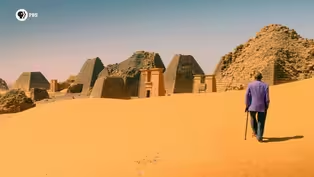
In the middle of the fourth century, Axumite armies forged their way inland along the Nile Valley, invading new territories and heading for the great city of Meroe, the third and last capital of the ancient kingdom of Kush.
For hundreds of years, the kings and queens of Kush, from their capital at Meroe, had dominated the southern end of Nile Valley civilization... Rich from trade and sharing religious beliefs and culture with its millennia-old rival, Egypt.
But by the fourth century, eclipsed by Axum's rise, Kush was in decline.
It started when, uh, Axum appeared as a powerful, uh, kingdom, and because Meroe economy was based on trade along the Nile to control all trade and all the route coming from Africa, towards the Red Sea and with the Mediterranean.
And then Axum appeared with its power control of these goods.
Host: An inscription on a throne uncovered at Meroe describes an assault on the city by King Ezana's conquering army.
Now in the remains of what are Meroe's temples, Mahmoud Bashir believes he's found physical evidence of the violent destruction resulting from Axum's attack.
All the evidence shows that it's being destroyed and buried.
All the statues are smashed into very small pieces.
So, we have a real evidence for something happened there, like people came, they destroyed everything with the attack of Ezana's.
Axum conquers Meroe.
King Ezana, who, by this time is Christian... That's what I believe.
Host: Ezana died around 360 A.D.
Over the next 150 years, the Axumite Empire, extending from the Horn of Africa into southern Arabia, would become solidly Christian.
In Nubia, the successor to Kush, it would take another century for Christianity to establish itself through peaceful means.
Here in Khartoum at the National Museum of Sudan is housed an extraordinary collection of Christian artworks.
In the sixth century, Christian missionaries from Constantinople traveled up the Nile and began the conversion of the 3 Nubian kingdoms that had arisen after the fall of Kush.
Haustein: Part of Christianity has a lot to do with establishing connections.
So, if you have missionaries coming from the north, you're not just interested in the text they bring.
You want to do trade, you want to be able to travel there yourself and have people who will sponsor these travels.
You want to establish various connections.
Host: The people of Nubia readily embraced the new faith and within a generation had created a vibrant and distinctly Nubian Christian culture.
Christianity thrived in the 3 Nubian kingdoms for almost 1,000 years.
Dozens of these beautiful Christian murals have survived.
This one depicts the Virgin Mary and the baby Jesus protecting the queen, whose name was Martha.
Curiously, Queen Martha is depicted as a brown woman, while Mary and Jesus are white.
Little was known of this medieval Christian civilization until archaeologists made an extraordinary discovery.
Buried in the Nubian desert were the remains of a seventh-century Christian cathedral in Faras, once the capital of the Kingdom of Nobatia.
The cathedral is now submerged Under The Flood Waters Of Lake Nasser, but this series of exquisite frescoes created during the earliest era of Christian Nubia was saved.
Haustein: This find of these frescoes and the churches in Faras is significant because it's the only extant art that we really have from this early Nubian Christianity... And it dates back to the seventh and end of the sixth century, so, very, very early art.
Host: This nativity scene once covered the eastern wall at Faras Cathedral.
It shows the Virgin Mary in repose and crowned like a Nubian princess.
Watching over her are the archangels Michael and Gabriel.
In the crib, the infant Jesus lies warmed by the breath of the animals, and in the corner stands a figure of a Nubian king.
The Christian kingdoms of Nubia would flourish along the southern reaches of the Nile, from these rich beginnings to the 15th century.
But just as Christianity was taking root in Nubia, a new religion--Islam-- was about to transform the spiritual landscape of Africa.
[Man chanting prayer] Host: From the deserts and oases of Arabia, a conquering force powered by faith was on the move.
Through the spread of Islam, they were about to transform the cultural and political fabric of Africa both above and below the desert.
This contact remains one of the most significant events in the history of Islam-- a first emigration of Muslims, not to Medina but to Africa.
So, here's Muhammad sending part of his family and some friends to find refuge, um, with the Christian king because he's under pressure in Mecca.
They were received by the emperor in Axum, and so, you have a very close relationship very early on.
And again, this goes to show how much of a regional hegemon Axum was.
Host: Soon after the prophet's death in 632 A.D., Islamic armies marched west out of Arabia into North Africa.
By 642, they had deposed the unpopular Byzantine rulers of Egypt and controlled the bread basket of the Mediterranean.
Man: A lot of people refer to them as the Muslim conquests.
I refer to them as the Arab conquest.
There wasn't the establishment of a forced conversion under a kind of military rule.
What was established was Islamic rule of law.
Conversion wasn't required amongst subject populations.
Woman: Islam comes to the African continent pretty early, in places like the Horn of Africa.
It goes into Egypt and in most places, it comes through trade.
You can't force anyone to believe in a religion.
It's sort of people have to adopt it and make it their own, and that's really what happens with Islam in Africa and the places that it truly takes root, it's through people's own initiative and their own valuing of this.
Ware: What happens in North Africa is you have the establishment of a kind of Islamic political rule that isn't necessarily all that Islamic, you know, for... [Laughs] from a religious standpoint, but you know, in... In important parts of, uh, its history, but is nonetheless, it's a rule by Muslims.
Host: From Egypt, Arab armies pushed west.
By the beginning of the eighth century, they had taken control of all of the Christian provinces of Byzantium, across present-day Libya, Tunisia, Algeria, and Morocco.
Then in the year 711, from their base in Tangier, the armies looked north towards a new frontier--Europe.
At the mouth of the Mediterranean, 12,000 soldiers assembled.
A vast invasion force from the African continent seeking to conquer a European kingdom.
Their leader, a warrior and brilliant military strategist, would become a legend.
His name was Tariq ibn Ziyad.
It's said he was born a slave but rose to become a fierce fighter and general.
So impressive were his military feats in helping to capture the North African city of Tangier that he was made its governor.
But Tariq wasn't an Arab... Tariq was a Berber.
Man: The people known as Berbers are actually calling themselves in their own language Amazigh.
It was the Romans who actually coined the word Berbers.
It started becoming a kind of a derogatory reference to those people amongst the Berber communities who would not want to indulge with the Romans into doing business and being liable to them.
Host: The Berber people have inhabited North Africa from present-day Morocco in the west to Tunisia in the east from at least the third millennium B.C.
During the centuries of Roman and Byzantine rule, many Berbers migrated away from the rich coastal cities.
Inland, they resisted foreign colonial rule, preserving over centuries their own distinctive and diverse culture and traditions, deeply rooted in the mountains and fertile plains of North Africa.
Elazkem: Berbers were tough fighters.
It comes from the toughness of their life at first.
It's also the difficulties in which they live.
The fact that they had actually to fight to live made them actually excellent warriors.
Host: Though the Berbers made a strong stand, one by one their chiefdoms fell to the Arab conquerors.
By the time Tariq gathered his army in Tangier, thousands of Berbers had not only converted to Islam, they had also joined its sweeping armies.
Ware: There'a a long history of African conquests of southern Europe, especially Iberia.
We can see Berbers playing a particular role side-by-side with Arabs as well.
Host: On the 29th of April, in the year 711, Tariq's force set off from Tangier.
Just 9 miles separate Africa and Europe at the mouth of the Mediterranean, and on a fine day from Tangiers, you can even see the place where Tariq's army landed, a great rock that marks the southernmost tip of the Iberian Peninsula and the site of a legendary African victory.
It was named Jabal Tariq after the conquering general.
We know it in English today as the Rock of Gibraltar.
From Gibraltar, Tariq advanced onto the Iberian Peninsula at the head of a phalanx 5,000 strong.
One of his soldiers is said to have asked him, "Sir, when shall we return?"
He answered, "we haven't come here to return.
"Either we shall conquer and establish ourselves, or we shall perish."
Reinforced by some 18,000 Berber and Arab soldiers, the Muslim armies of North Africa within a year had conquered most of present-day Spain, and established outposts as far as southern France.
Recalled to Damascus, Tariq would be dead within 10 years.
But his conquests helped establish a new Islamic civilization stretching across North Africa and much of Spain, which would endure for over 800 years and create a cultural bond between two continents.
So, instead of seeing them as we do now, as the break between Europe and Africa, during this period they were a bridge between two very interconnected areas where people traveled backwards and forwards as soldiers, as political advisors, as craftsmen, architects, scholars.
So, enormous amount of movement between the two sides of the Straits of Gibraltar.
Host: The spread of Islam across North Africa and the Middle East had profound effects on other parts of Africa.
Trade to the east that had once passed through the Red Sea now shifted north toward the new Islamic centers of power in Damascus, Baghdad, and the Persian Gulf.
Christian Axum became isolated and vulnerable to attack.
Particularly vulnerable was the Port of Adulis, the kingdom's economic lifeline.
With the rise of Islam, they locked their eyes on Adulis because of its economic importance.
They invaded Adulis and then Adulis was totally burnt and destroyed in [indistinct].
Beginning from that time, Axum started a long period of decline.
Host: But in the 11th century, a new dynasty would revive the fortunes of Ethiopia's once-great Christian kingdom and create one of the most spectacular of all religious sites in Africa and in the world-- Lalibela.
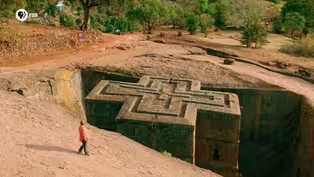
12 extraordinary churches carved out of the living rock in the Ethiopian highlands.
One of the most extraordinary architectural achievements that the world has ever seen.
The churches were built during the Zagwe Dynasty, which arose from the ashes of Axum, reviving the Red Sea trade routes in Christian Ethiopia.
Built before many of the great cathedrals of Europe, they are an astonishing feat of construction, design, and imagination.
Being able to see this church buried in this block of stone, it's a bit like Michelangelo seeing David buried in that block of marble.
The most celebrated king was Lalibela, and according to legend, he was instructed by god to build a new Jerusalem in Ethiopia.
According to the saint's biography of King Lalibela, it was said that he had a vision, and during that vision, he made a pact with god.
God told him that, if you build these churches I'm showing you, I will make you king.
Angels were said to have transmitted the plans to him and to have assisted him night and day, as he dug for 24 years to build all of these churches.
Woman: Lalibela is one of the very few Ethiopian kings who was ever made a saint.
King Lalibela built these extraordinary cathedrals.
They had literature, they had all sort of things that were happening during that period.
So, it was clearly a very vibrant time.
Host: Carved in the shape of a cross, the church of St.
George is the most celebrated of all the magnificent buildings in Lalibela's sacred complex.
But deeper within this complex is a church that contains replicas of the tombs of Christ and Adam and is considered the holiest part of Lalibela.
It's the church of Biete Golgotha.
Historian Solomon Getaneh is an expert on the history of the churches.
[Indistinct] Lalibela, you see.
Look at here.
Oh, look at the altar.
Oh, there's King Lalibela.
And the holy Virgin Mary.
When they painted, they make-- the head is big, the eye also is big.
Yeah, the eyes.
They've got to show the excellence of the brain.
And he had insight.
Exactly.
Inside here, the same.
Lalibela also is buried.
So, it's the body of the King?
Exactly.
But it's in the holy [indistinct], so, it's not allowed.
Host: Scholars believe that Lalibela's complex of churches was built as a symbolic representation of Jerusalem.
Belcher: The Ethiopians became Christians very early on and within a couple of decades of that, they had set up a monastery in the heart of Jerusalem.
So, they had had a deep connection to it and a journey to Jerusalem is the longing of any pious person in Ethiopia.
Every single thing in this [Indistinct] church is symbolized.
Lalibela symbolizes everything to Jerusalem.
Golgotha is a place where our lord Jesus Christ was buried... Yes.
So, this place was called Golgotha.
There are 12 pillars.
12 pillars.
One for each... Symbolizing-- uh, apostle.
Exactly.
All of Lalibela is a 3-dimensional biblical allegory.
Exactly.
You can easily read it.
Host: In fact, it's now thought that the churches at Lalibela were built between the seventh and 13th centuries... And that some were originally palaces and even fortresses.
It was only later that they became churches, which remain places of pilgrimage to this day.
Windmuller-Luna: These are not buildings in the sense that you take bricks or stones and put them one on top of the other.
These are massive sculptures that have been carved out of living rock.
Lalibela is like no other place on earth.
Preston Blier: You get a sense of the creation of kind of an ideal paradisiacal setting because it's hewn of living rock, and much like other African architecture, it is sculpture in its own right, but sculpture one can walk into and move around, and what is particularly remarkable there is how one experiences religion and the personal pilgrimages one has to take to get there that are an essential part of this whole tradition.
Host: 12 churches carved out of the ground.
Each structure unique, each ingeniously designed, and each chiseled by skilled artisans from a master plan.
The churches of Lalibela stand as more than just a symbolic Jerusalem on Ethiopian soil.
This was a new Jerusalem in Africa.
[Clanking] 120 miles from Lalibela sits a sacred site that binds the Old Testament to the heart of Ethiopia's story-- Lake Tana in the Ethiopian highlands.
The source of the Blue Nile, which for many conjures the sacred River Gihon that flowed out of the Garden of Eden.
On its islands nestle 20 ancient monasteries dating from the eighth to the 18th centuries, each one a paragon of Ethiopian art.
Lake Tana is one of the most important places for both the orthodox religion and for orthodox art.
It's a location in which monasteries and churches were able to really flourish and to remain protected, even in moments of peril.
Host: In churches and monasteries such as these, the Ethiopian Orthodox Church developed its signature style of painting, still visible here today.
Preston Blier: There's that visual complexity, the kind of sensual power that these works offer that make you want to look very carefully.
This is a painting of Saint Mary.
Mary is very important.
She's the mother of Jesus Christ.
Like an intermediary between man and god.
So, uh, we respect Mary.
You see these enormous staring eyes.
There's something about the one-on-one engagement between the figures depicted both in the murals and the manuscripts, and a means to connect individually with the worshipper.
What you can also see is this bold set of colors, the rich reds, blues, and greens, often with carefully delineated marks that frame one particular element from another.
Host: But according to Ethiopian tradition, a monastery on Lake Tana, Tana Kirkos, once housed a different kind of treasure, an object of immense power that would shape the country's history and its national identity to this day, connecting Ethiopia once again to the Queen of Sheba-- the Ark of the Covenant.
At least since the tenth century A.D., Ethiopians have claimed that the original Ark containing Moses' stone tablets inscribed with the 10 commandments has been housed in their country.
According to the national epic, the Kebra Nagast, when the Queen of Sheba visited King Solomon in Jerusalem, they conceived a son--Menelik.
Menelik years later, returning from a visit to meet his father, brought the Ark from the temple in Jerusalem to its new resting place.
In 1270 A.D., this powerful myth was used to justify a violent coup that bought a new dynasty to power in Ethiopia.
When a ruling Zagwe king was overthrown by a rival--yekuno Amlak-- the new king drew on this mystical connection to the bible to validate his claim.
The new king claimed direct descent from King Solomon and the Queen of Sheba through their son Menelik, who was born in Ethiopia after his mother's stay in Jerusalem.
Menelik was the legendary founder of the Axumite Dynasty.
By claiming this lineage, the King could argue that his seizure of the throne was actually a restoration, a restoration of the true line of Ethiopian monarchs.
The Solomonic Dynasty, founded as an extension of this extraordinary lineage, descending from King Solomon and the Queen of Sheba, would rule Ethiopia for the next 700 years.
They are claiming descent from a holy family.
Host: Mm-hmm.
Christ was born from David's family.
So, this meant the dynasty more legitimate, more acceptable.
The audacity is breathtaking to say not only are we legitimate but we are descended from King David through Solomon, fused blood lines through our queen, our Axumite queen... Yeah.
And beyond that to god himself.
To god himself.
It's the ultimate genealogical chart.
[Laughs] Belcher: It is an extraordinary way of legitimating the kings of Ethiopia by taking the power of the bible, the power of the Israelites, and accruing it to themselves.
It is probably the most powerful national myth that has ever been invented.
Host: To this day, the Ark of the Covenant plays a profound role in the religious life of Ethiopia.
Every church hosts a tabot, its own sacred replica of the Ark.
Belcher: In Ethiopia, the Ark of the Covenant is often called Zion, or Zeon, and this is where God lives.
Each one of them is a sign that God is here, God is dwelling with us and protecting us.
Host: And Ethiopians celebrate their deep-rooted connection to the Ark every year at the festival of Timkat, the Ethiopian Orthodox Church's celebration of the baptism of Jesus in the River Jordan.
[Cheering] Host: Over centuries, the deep roots of Ethiopian Christianity and its unique traditions would be a powerful unifying force for the kingdom.
Preston Blier: The bond and the solidarity of the Ethiopian population framed around Christianity was something that gave them a real strength and a real, um, sort of political hold on that area that made this one of the only places in Africa, indeed the only place that never was colonized.
The whole sort of population of Ethiopia was able to come together to safeguard its traditions, and certainly Christianity plays an important role in that.
Host: Ethiopian Christians still believe that the Ark of the Covenant resides in Ethiopia, hidden from view in a small church in Axum, the city where one of the ancient world's greatest civilizations was born.
The myth of the King's descent from King Solomon and the Queen of Sheba, and the legendary presence of the Ark of the Covenant here at St.
Mary's church in Axum, are the cornerstones of the Ethiopian Orthodox Church.
These stories assert Ethiopia's direct historical link to the wider Christian world, of course, but also the nation's special duty as guardian of the Christian faith.
From their earliest days, two of the world's great religions-- Christianity and Islam-- put down roots in Africa.
These revolutionary new faiths not only transformed the history of Africans, they were shaped in turn by Africans, who created and bequeathed to the world some of our most profound cultural legacies.
Salaam alaikum.
Connections forged by Christianity and Islam would lead not only to the exchange of beliefs and ideas, they would help lay the foundations of new networks of commerce and trade that would place Africa and its riches at the heart of the medieval world.
"Africa's Great Civilizations" is available on Blu-ray and DVD.
To order visit shoppbs.org or call 1-800-Play-PBS.
This series is also available for download from iTunes.
Video has Closed Captions
Clip: Ep2 | 2m 31s | Explore the Great City of Meroe, third and last capital of the Ancient Kingdom of Kush. (2m 31s)
Video has Closed Captions
Clip: Ep2 | 2m 58s | Explore 12 churches that were carved out of rock in the ancient Ethiopian highlands. (2m 58s)
Providing Support for PBS.org
Learn Moreabout PBS online sponsorship








Support for PBS provided by:
Major corporate support for Africa's Great Civilizations is provided by Bank of America, Johnson & Johnson, and Ancestry. Major funding is also provided by The Andrew W. Mellon Foundation, the...