Africa's Great Civilizations
Empires of Gold | Hour Three
Episode 3 | 52m 31sVideo has Closed Captions
Uncover complex trade networks & educational institutions in north and west Africa.
Henry Louis Gates, Jr. uncovers the complex trade networks and advanced educational institutions that transformed early north and west Africa from deserted lands into the continent’s wealthiest kingdoms and learning epicentres.
From
Problems playing video? | Closed Captioning Feedback
Problems playing video? | Closed Captioning Feedback
Major corporate support for Africa's Great Civilizations is provided by Bank of America, Johnson & Johnson, and Ancestry. Major funding is also provided by The Andrew W. Mellon Foundation, the...
Africa's Great Civilizations
Empires of Gold | Hour Three
Episode 3 | 52m 31sVideo has Closed Captions
Henry Louis Gates, Jr. uncovers the complex trade networks and advanced educational institutions that transformed early north and west Africa from deserted lands into the continent’s wealthiest kingdoms and learning epicentres.
From
Problems playing video? | Closed Captioning Feedback
How to Watch Africa's Great Civilizations
Africa's Great Civilizations is available to stream on pbs.org and the free PBS App, available on iPhone, Apple TV, Android TV, Android smartphones, Amazon Fire TV, Amazon Fire Tablet, Roku, Samsung Smart TV, and Vizio.
Explore Our Shared Histories
Stream more from Professor Henry Louis Gates, Jr. through iconic series like Making Black America, Finding Your Roots, and The Black Church. Discover the ancestry of diverse, influential people and delve into the rich history and culture of Black America.Providing Support for PBS.org
Learn Moreabout PBS online sponsorshipHost: From the tenth to the 15th century, North and West Africa underwent a dramatic transformation.
Celebrated cities arose, including Timbuktu... Marrakesh... And Ile Ife.
Great scholars wrote books that filled libraries.
Wealth from trans-Saharan trade grew on a spectacular scale... Drawing attention from afar to the wonders of the African continent.
This is the incredible story of how farmers, traders, and nomads from the barren fringes of the Sahara Desert would build some of the most advanced civilizations in history.
By 1000 A.D., Islam, a religion born on the Arabian Peninsula, had become established along the whole North African coast and deep into the Iberian Peninsula.
The western extremity of Islamic civilization, what's called the Maghreb, meaning land of the setting sun.
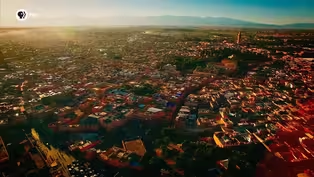
This is where our story begins, in the city of Marrakesh.
When it was founded in the year 1070, Marrakesh was a center of politics and law.
But it soon began to attract merchants and craftsmen from the surrounding regions.
For centuries since, luxury goods have been traded here.
Spices, gold, and textiles.
In just 50 years, Marrakesh had been transformed from a collection of mud-brick huts to a sophisticated metropolis.
The ancient walled city, the medina, is a maze of narrow laneways.
It's easy to get lost.
Seemingly around every corner, one encounters a fine palace, a great mosque, or a lush garden.
The origins of much of this splendor can be traced to the influence of one charismatic Islamic theologian-- Abdallah Ibn Yasin.
Woman: Ibn Yasin actually originated from what's now southern Morocco.
He was obviously someone who was interested in religious learning because he made the very difficult journey north across the high Atlas Mountains into Spain to study in Cordoba.
He seems to have had aspirations to religiously lead a group of tribes, but then lead them on to greater things in a political sense as well.
Host: Ibn Yasin was a Berber.
His tribe, the Judala, was part of the Sanhaja, a group living in the Sahara Desert.
In 1046, Ibn Yasin was invited to give the Sanhaja instruction in the true principles of Islam.
When they rebelled against this harsh interpretation of the law, he withdrew and founded a movement to convert them.
In 1055, he launched a campaign to spread his reformist ideas among the urban centers of Morocco and Ghana.
Bennison: At that point, the tribes of the Sahara were fairly superficially islamized, so, they were Muslim, but they didn't have a deep knowledge of the rites and rituals that came with being Muslim... Nor were they very familiar with Islamic law.
Host: Ibn Yasin's solution was to go back to basics and promote a literal and puritanical form of Islam.
He wanted to bring worshippers back in line with what he believed was the true Islamic faith.
Man: Ibn Yasin talked about people converting, but what he actually meant was changing the way they'd been practicing Islam to the way he thought it should be practiced.
And he decided that they were effectively deep sinners, and so, they should give up 1/3 of all their goods to him.
And he was really fond of flogging people.
People left out a word while they were praying, they got some lashes for that.
If they didn't stand in the right position, they got lashes for that.
Those joining the movement would be whipped and scourged for the prayers they hadn't performed in their past life.
They were in a sense literally being whipped into a frenzy, and the zeal for the movement was being inculcated in them through this very intense phase of initiation.
Host: Deep in the desert, among the Sanhaja Berbers, his revolutionary message attracted a fervent following.
His followers were called the Almoravids, which can be interpreted as "People of the frontier fortress."
Man: This is one of many movements where people come along and say, you know, "you're doing it wrong, and I know the way to do it right."
Bennison: And it's at that point in the 1050s that the Almoravids begin to coalesce as a significant army, as a significant military force, and began to emerge from their desert territories, moving northwards, first of all towards the great caravan city of Sijilmasa.
[Men shouting indistinctly] Host: Sijilmasa was an important trading center on the edge of the Sahara.
Ibn Yasin demanded that Sijilmasa submit because of its sins.
When it refused, he attacked.
At the caravan city of Sijilmasa, the Almoravid army smashed musical instruments and shut down the wine shops.
Everywhere they conquered, the Almoravids imposed a fundamentalist regime.
Those who failed to comply risked execution.
Bennison: Ibn Yasin was motivated by a number of different factors.
There was obviously the religious factor, but at the same time, there were commercial and political motives underpinning his actions.
When they were successful, they believed that meant that they were religiously right in their approach.
They saw victory as a mark of God's favor.
Host: Taking Sijilmasa brought Ibn Yasin and his army one step closer to a major goal-- control of the trans-Saharan caravan trade, especially the trade in gold.
To complete that mission, Ibn Yasin set off on the arduous, thousand-mile journey across one of the largest deserts on the planet-- the Sahara.
The great expanse of the Sahara Desert was an ocean to cross.
It was a barrier that divided Africa from north to south, and attempts to navigate it were treacherous.
Long journeys from one oasis to the next oasis could be quite dangerous, even life-threatening.
The Sahara covers 3 1/2 million formidable square miles.
The Sanhaja lived across the whole of the Sahara, from Ghana and Takrur on one side to Sijilmasa on the other.
So, Berbers like them had been criss-crossing the desert to trade for more than 1,000 years.
Around the second century, they adopted a new mode of transportation which made crossing easier-- the camel.
As trans-Saharan trade routes opened up, demand for West African gold increased dramatically.
The domestication of the camel would allow traders to conquer the unforgiving heat and vast distances through seas of sand with far greater efficiency than ever before.
On the southern end of the trans-Saharan caravan route was a resource-rich land called the Sahel, meaning "shore."
It contained merchant cities that were gateways to the principal source of gold for medieval Europe.
One of the largest of these cities was in modern-day Mauritania-- Awdaghust.
Seize it, and the Almoravids could control the gold trade.
That meant confronting a large sub-Saharan state-- the Empire of Ghana.
Man: Ghana emerges as a kind of middleman state that is going to tap into West Africa mercantile activity and especially going to control the gold trade across the desert from sub-Saharan Africa.
Host: Ghana's roots date back to the very first civilizations in sub-Saharan West Africa.
Around 1500 B.C., a rich culture arose in the region of Dhar Tichitt, in today's Mauritania.
Eventually, this civilization spread south and founded new settlements along the Niger River, where it grew into a powerful empire.
Ghana is located right in the middle between the Senegal River system and the Niger River system, and it's in a position strategically where it can control access to both of those, at least potentially it can.
Control of the gold trade generated enormous wealth, wealth that built empires.
And the Kingdom of Ghana was poised to exploit its perfect location.
Ghana's legendary wealth and strength would lead the gold coast colony in 1957 to adopt "Ghana" as the name of its modern-day nation.
Ware: There's an 11th-century source that says the ruler of the Empire of Ghana can put 200,000 soldiers in the field, 40,000 of them archers.
He's the biggest, baddest guy on the block and you're not messing with him.
[Laughs] Thornton: Ghana had a very strong equestrian tradition and cavalry that would have allowed it to dominate other regions around it.
Host: In the tenth century, Ghana's army had captured Awdaghust from the Sanhaja.
So, in 1055, Ibn Yasin arrived to seize it back in a brutal takeover.
Writing in 1068 A.D., the Andalusian Muslim geographer and historian Al-Bakri had this to say.
Man as Al-Bakri: They violated the women and declared everything they found there to be the property of the Muslim community.
Host: following the loss of Awdaghust, Ghana began to decline, ultimately falling in 1076.
Its traditional religions first coexisted with, but then eventually gave way to, the force of Islam.
Thornton: The Almoravids may very well have converted Ghana by conquest or it may have been a voluntary conquest or an alliance or some other kind of thing.
We know that by 1100, that region had been converted to Islam.
[Horse whinnies] Host: By the late 1050s, the Almoravid army, initially comprised mostly of North African Sanhaja Berbers, now included vast ranks of sub-Saharan Africans.
Senegalese, you know, soldiers, not slaves, free Senegalese soldiers that participated, at least 4,000 of them.
So, then it's not surprising that instead of an adversarial relationship, the Saharan and sub-Saharan, you know, populations were working in, you know, in concert.
Host: In 1059, while the Almoravids were campaigning in the desert, Ibn Yasin was killed in battle.
But his movement continued to grow.
One of its new leaders was a general-- Yusuf ibn Tashfin.
Ibn Tashfin marched the Almoravid army across the high Atlas Mountains and seized control of the North African coast.
In the year 1070, Ibn Tashfin founded a new city to be his Almoravid capital.
It was called Marrakesh.
Bennison: They settled on a territory which is described as being very arid, very barren, quite desert-like.
Not an area that one might think of as immediately being the place to found a city, but nonetheless an environment which was quite akin to the environment which they had come from.
Bloom: What the Almoravids did was replace the old town of Sijilmasa, which was on the other side of the high Atlas Mountains, with their new center, their new city, Marrakesh, which became much greater than Sijilmasa ever had been before.
Host: Marrakesh became such a rich commercial city for one reason--its location.
It was the terminus of one of the great commercial trade routes on the African continent.
Situated halfway between the Sahara and the Mediterranean, Marrakesh was a junction for goods moving across Africa into Europe and Asia.
Textiles... Leatherwork... And, above all, gold.
Bloom: You know, war is wonderful.
I mean, I guess, theoretically, if you-- but it doesn't-- it doesn't provide the steady means of-- of support, and so, building a city, a trading city is a much better way.
Host: As the city grew in wealth and reputation, Marrakesh became a showcase for the ingenuity and artistry of architects and artisans.
[Hammering] Bloom: I think that the Almoravids had bad press.
Probably the people who wrote about them had suffered under their rule, and so, they didn't have anything good to say to them.
One of the things that's great about art and culture, I mean, is it's sort of silent testimony to what happens during a period.
Host: In 1947, archaeologists uncovered something here that shed new light on its Almoravid period.
This tower--the Koubba.
Bennison: One of the most notable features of the Koubba is the contrast between the exterior, which is quite plain and simple, and what you see when you go inside.
It's a real revelation.
Compared to the austerity of the exterior, once you get inside and you look upward, you see this fantastic, deeply carved, plaster dome which has vegetal designs, conch shell, which in some ways reminds you of the interior of the domes in the great mosque of Cordoba.
So, in the day, it would probably have been even more of a surprise, because the plasterwork would probably have been painted.
Host: One theory holds that the Koubba was an ablutions pavilion for a great Almoravid mosque, which no longer exists.
Another is that it was a monument in a public park.
Bennison: We can't really say exactly what the Koubba was designed for originally, but it is part of the monumental infrastructure of early Marrakesh, and it was certainly designed to be a project which the public would see and which they would identify with the Almoravids and which would celebrate the Almoravid empire in its wider sense.
Bloom: The architecture of the Koubba is a product of the interaction between Andalusian builders and techniques and North African patrons.
The Almoravids have this reputation of not being attuned to aesthetic things.
Clearly were interested, because they must have brought very talented artisans to build these structures from Spain to Morocco, and of course, the artisans were happy to come, because this is where the money was.
Host: By the end of the 11th century, Marrakesh had become a place of affluence, wealth, and luxury, a far cry from the Berbers' nomadic existence in the remote Atlas Mountains.
The Berbers had gone from being mercenaries for hire to empire builders.
In 1085, war broke out in Al Andalus, the patchwork of Muslim-ruled kingdoms in the Iberian Peninsula.
A Christian king, Alfonso VI of Leon, seized the central Spanish city of Toledo from the Muslims.
Across the Straits of Gibraltar in North Africa, Yusuf ibn Tashfin was now the supreme Almoravid leader.
Bennison: The Muslim rulers of the peninsula desperately needed military assistance, and they began to send messages down to Yusuf ibn Tashfin in North Africa, saying, you know, you're an important Muslim ruler.
You have a good army.
We need military support.
Host: With Ibn Tashfin's help, the Andalusian army halted Alfonso's advance at the bloody Battle of Zallaqa.
Then, Ibn Tashfin decided to seize the Andalusian territories for himself.
Bennison: The only way to hold the peninsula was to actually conquer it and bring it into his empire.
He felt that the kings of Al Andalus were too weak, too likely to pay tribute and join with Christians in alliances to hold the territory.
Host: By the time of his death in 1106, Ibn Tashfin's empire stretched from central Spain to southern Mauritania, and from Lisbon to Algiers.
[Sheep baa-ing] A flourishing world of art, science, commerce, and religion.
Bennison: The Iberian Peninsula and North Africa were seen as the two shores of a single political entity, the Almoravid Empire, and there was enormous movement backwards and forwards across the Straits of Gibraltar, which are very much a bridge rather than a barrier at this time.
Host: The Almoravid Empire had rapidly expanded, but it would prove to be short-lived.
In the 1120s, a new Berber religious movement arose in remote valleys of the Atlas Mountains.
They were known as the Almohads, a term derived from the Arabic word for the monotheists.
In 1147, they overthrew the Almoravids and founded their own empire.
The Almohads used literacy as a vital tool to spread the word of Islam.
In the city of Fez, northeast of Marrakesh, Islamic scholarship would reach new heights.
Fez has been a center of learning since it was founded in the year 789 A.D.
But under Almohad rule, in the 12th century, it became a truly global hub for knowledge.
Woman: Fez is just a remarkable city and such an important center.
It was always the intellectual capital in a certain sense.
The scholars' capital within Morocco.
Fez stood among the greatest centers of education, not only on the African continent but throughout the medieval world.
Home to astonishing breakthroughs in science, mathematics, and astronomy.
Fez, during Europe's middle ages, was a city of more than 200,000 people crammed into a maze of more than 9,000 twisting streets.
Today, the Fez el Bali walled medina is the largest urban pedestrian precinct in the world.
Bloom: You go inside these great gateways and suddenly, there are no more cars.
There are no more wheeled vehicles except for, like, little trolleys or hand carts to move things.
It's all beasts of burden-- donkeys-- or humans of burden, porters carrying it, and everyone's screaming at you, "Belak, belak," "watch out, watch out, watch out," and they're coming up behind you.
And it's, like, total chaos.
Host: In the middle of this bustling city sits a mosque begun in the year 859 A.D.-- the Kairaouine.
It's arguably the world's oldest institution of higher learning.
Two centuries before European universities like Oxford and Bologna even existed, the Kairaouine was issuing medical degrees.
Bloom: The Kairaouine was founded in the ninth century, supposedly by one of two sisters who came from Kairouan, which was the capital of Tunisia.
And so, it was called the Kairaouine, meaning "the mosque for the people of Kairouan."
This was the most important mosque in the city, and the reason was because it was the center of Muslim scholarship, Muslim learning for the whole region.
Host: In 1349, the Kairaouine was endowed with a library, home to more than 5,600 priceless Arabic manuscripts.
Professor Said Ennahid is an expert on its history.
Said, what are some of the great literary treasures held in this library?
One good example is volume 5 of Ibn Khaldun's book.
Ibn Khaldun was a very famous scholar.
We think of him as the father of-- of--of sociology.
And he wrote this masterpiece, universal history, in late 14th century, and we have this volume number 5 with his signature on it saying that this copy should stay here at--at the library.
He was a student here.
He had this strong connection with Fez.
Maybe as a student but maybe also as a--as a teacher, or at least as someone who had connections with the elite of Fez.
We know that he was here, maybe in this very spot.
Wow.
Amazing.
Some of the most important intellectuals of the middle ages did their finest work here in Fez, and in the almohad empire more generally.
Bloom: These are cultural figures who flourished and they became, in effect, the gateway for the transfer of classical knowledge to the west.
Host: One especially brilliant scholar was ibn rushd, also known by his latinized name--Averroes.
Averroes was considered the greatest interpreter of Aristotle.
So, when Europeans started wanting to study Aristotle, they turned to the Arabic writings, which they then translated into Latin.
Host: Another noted scholar at the Kairaouine was Hasan Wazzan, also known as Leo Africanus.
Thornton: Leo Africanus was a North African legal scholar who was actually captured by Christian pirates and became a slave of the pope for a while.
While he was a slave of the pope, he wrote a description of basically all of North and West Africa.
Host: Beyond the walls of Fez's Kairaouine, instruction took place in a network of residential schools called madrassas.
The madrassas, or Islamic schools, were structured like the medieval colleges of Oxford and Cambridge.
Students could deepen their understanding of the Koran and study the most important developments in the sciences and humanities.
By the 14th century, 7 great madrassas thrived in Fez, the most famous of which was the Bou Inania, founded in the year 1350.
[Man calling in Arabic] Preston Blier: The repetition of design, on the one hand, there is a sort of mathematical quality in it, of multiples of geometries, of that play of forms, but there's also something that takes on an element of meditation as you begin to explore a form and it merges into another form and it separates from one into another.
You can't really go away from these without just being in awe of the incredible artisans and architects who created them.
Host: When Fez was reaching its peak, a new center of scholarship emerged 1,200 miles away, on the southern shore of the Sahara Desert.
It became a kind of sister city to Fez, and no less legendary-- the fabled city of Timbuktu.
Since the 14th century, Timbuktu has been a place of mystery in the imagination of the west, a metaphor for the remotest place on earth.
But Timbuktu was to become one of the great cities of the medieval world, an unparalleled center of scholarship, learning, and trade.
Timbuktu had its own counterpart to Fez's Kairaouine-- the Sankore mosque.
Thornton: Timbuktu really attracted a lot of very learned scholars, and the Sankore mosque in particular became, really, the university of West Africa for Muslims.
So, if you were an Islamic scholar and you were living in a village in the Gambia, let's say, one of your aspirations would be if you--if you really studied hard and you did well, you might go up to Timbuktu, and that was like the Ph.D.
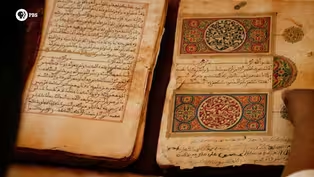
Host: The heart of Timbuktu's intellectual life was its libraries.
Between the 14th and the 17th centuries, they acquired hundreds of thousands of books, mostly written by African authors working in the city.
The first time I visited Timbuktu and saw those astonishing libraries with their wealth of scholarly text, I wanted to cry.
I grew up being told that Africans never wrote books, yet here was this astonishing treasure trove of extraordinary, hand-written manuscripts.
Many of them were religious, but there were also books about math, astronomy, philosophy.
I felt incredible pride and vindication.
Books produced in Timbuktu became valuable objects in themselves, prized all over Africa and beyond.
Thornton: Leo Africanus, he talks about Timbuktu and he mentions how it's such an important center for the book trade, and how books are sold and sold for very high prices and--and so on.
Ware: There's a manual that has everything that a learned scholar in the bend of the Niger River in the 1400s needs to know-- how to keep your wife happy, how to get in and out of a canoe, how to help a woman who isn't producing enough milk to nurse her--her child.
It's a window onto all of the concerns and preoccupations of an African Muslim society in the 1400s.
Host: Timbuktu became one of the principal cities of a rising new power in West Africa-- the Empire of Mali.
Mali was founded around the year 1240 by a legendary warrior king called Sundiata who grew his small provincial kingdom into the largest state that has ever existed in West Africa.
When King Sundiata assembled his army, he ordered his local chiefs to surrender their titles.
Such was the reverence accorded to the king that his subjects were said to approach him on their knees.
Mali would become a great empire, with political, military, and religious power concentrated in the figure of the emperor.
Ware: The empire of Mali takes the mantle from the Empire of Ghana, insofar as it comes to control the gold trade from West Africa, but it doesn't just take over, it expands.
So, this is the time when the gold trade really reaches its height, and when the kind of wealth and opulence of the West African imperial states are--are greatest.
Host: Through its control of the gold trade, Mali became the superpower of the medieval world.
But gold was just one of its products, exchanged through a complex commercial network that transversed the desert.
Thornton: Even though the Sahara Desert looks empty, it's actually--they have got trading communities located within the desert, and there are stages of trade that go back and forth.
When we talk about the trans-Saharan trade, it gives the sense or the impression that goods were transiting through the Sahara to get to markets to the north.
But the sense in which the Sahara was a world in its own, and a very integrated world.
Host: One of the most valuable items of the trade originated within the desert itself--salt.
Salt is the refrigeration of the ancient world, right?
So that you can't, you know, have meat or fish or any kind of, you know, protein products last more than a couple of days unless you salt them and smoke them.
Salt is almost impossible to find in sub-Saharan West Africa, except when people are making sea salt.
Akyeampong: In the Sahara, salt was mined, and mined in forms that were like slabs.
It could be carried for hundreds of miles on the back of camels.
[Camel grunts] Host: Another commonly-traded commodity made salt mining even more profitable--slaves.
Slaves were captured as a result of military action, such as war or sometimes raids, then sold to Berber traders.
Ware: There were some slaves that were incorporated in the trans-Saharan trade in the early period.
There's actually not just an export of trade-- of slaves from sub-Saharan Africa in small numbers, but there's also an import of slaves into sub-Saharan Africa from North Africa and Europe, also in small numbers.
Akyeampong: They would settle the slaves around oases to grow cereals and other crops.
Slaves also worked in gold mines.
Much of the surplus that went into long-distance trade was actually production based on slavery.
Host: It wasn't only commodities like gold, salt, or slaves that moved across the desert.
Traders also carried with them treasured personal possessions.
The British library in London holds one such object-- a saddlebag Koran.
Gus, what's a saddlebag Koran?
A saddlebag Koran is, it's loose-leafed Koran that would fit into a bag so that it could be-- it could be carried with you wherever you went.
Who would've produced this, created this beautiful edition of the Koran?
Well, this is by one hand.
These are breaks to particular bits in the Koran, and so, they have illustrations in them, so, it's someone who understood that this had to be not just accurate but also incredibly beautiful, because it's about uplifting people, not just through words but also aesthetically.
So, this was for families, for people who would travel abroad, um, and they wanted to have a Koran, but they also wanted something where they could take leaves out, they could refer to it, they could look at it.
And share them.
And share them.
Exactly.
This would be something that through its accumulated use could become more important.
So, like the gates family bible, which was started by my great-grandmother.
Exactly.
Host: Merchants could afford such luxury objects in part because of the ever-increasing global demand for Mali's gold.
[Camel grunts] probably something like 3/4 of the gold that's going into North African and European markets in the medieval period is coming out of the Empire of Mali.
Throughout most of the middle ages, Europe was on the gold standard, and without African gold, the whole currency of Europe basically would fall.
They were already melting down roman coins in this period to try to make up in part for this lack.
Host: Mali's role in global commerce brought it recognition, respect, and envy from afar.
This is the Catalan Atlas, a map dating from 1375, probably owned by King Charles V of France.
On its southern edge is Mali, personified by its greatest ruler, the legendary emperor Mansa Musa.
Gus, it's such a surprise to see a black man on a map from the 14th century.
How did Mansa Musa get on this atlas?
This was a known figure in Europe.
This was someone who had influence, not just within Africa but beyond.
And he was interested himself in seeing beyond his own kingdom.
And he's represented with his-- the gold orb, gold crown, gold scepter.
Yes.
Yes.
And it's a fantastically wealthy kingdom.
It has some of the biggest gold mines in the region.
It also has copper.
It also has salt.
If you look at this map, it gives a sense of how it's right at the center of a nexus of trade routes that link it right across the continent.
It's not just the cont-- it's beyond.
Host: Mali's control of a large share of the world's gold supply, especially Europe's, gave Mansa Musa wealth beyond compare.
It's often claimed that Mansa Musa is the richest man who has ever lived.
Ware: Newspapers constructing top 10 lists of the wealthiest people of all time, they almost always put Mansa Musa first, and some of them, you know, will--will say that his net worth adjusted for inflation is something like $400 billion in today's money.
Host: In 1324, Mansa Musa's notoriety grew exponentially, thanks to reports of his largesse and generosity during his hajj, the pilgrimage to the Muslim holy city of Mecca.
Ware: His pilgrimage that he makes in 1324, 1325, you know, there are different accounts, but the usual account is something like 300 camels laden with gold in addition to all the people that are traveling with him.
Host: Ibn Khaldun, the great author working at Fez's Kairaouine library, wrote an account of a person in Mansa Musa's entourage.
Man as Ibn Khaldun: "We used to keep the sultan company "During his progress "And converse to his enjoyment.
"At each halt, he would regale us "With rare foods and confectionery.
"His equipment and furnishings "Were carried by 12,000 private slave women wearing gowns of brocade and Yemeni silk."
Host: Mansa Musa and his retinue stopped at every town between Mali and Mecca.
It was said that Mansa Musa's largesse knew no bounds.
As he made his way to mecca, he handed out extravagant amounts of gold, to high-ranking officials and working people alike.
And according to legend, his generosity inadvertently destabilized the economy of Cairo.
He distributed so much gold that its market value collapsed and took years to recover.
As he traveled, he purchased camel-loads of books and recruited respected scholars to bring back home.
Ware: When he comes back is when he begins to invest, especially in the construction of mosques and schools in the town of Timbuktu.
Mansa Musa, he's trying to invest in learning and schooling and knowledge in order to diversify the economic and social basis for what he was trying to do in the Empire of Mali.
Host: 1,000 miles along the Niger River in modern-day Nigeria, another great civilization traded with the Empire of Mali.
It was called Ife, and it was the site of a remarkable explosion of creativity at about the same time as Mali's rise.
The national museum of Nigeria in Lagos houses an extensive collection of Ife art.
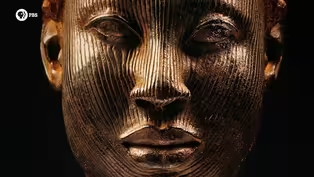
This astonishing sculpture is the mask of the Ooni-- Obalufon the Second, monarch of one of the most important kingdoms in all of West Africa in the middle ages-- the Kingdom of Ife.
This is one of 40 or so brass and copper sculptures, executed with dazzling naturalism under the King's patronage.
Preston Blier: They are technically among the most truly remarkable works of art created any place in the world.
These are striking heads that are quite naturalistic, but they're also this idealized naturalism, so that none of the warts and wrinkles of the face are shown.
If you look at them, there's almost this serenity and calmness in them, and give a sense of-- of timelessness, which are really, really beautiful.
While European artists were still grappling with perspective, and often struggling with the human form, these African artists were making magnificent, life-like sculptures.
It's not just the technical achievement of these sculptures that's so impressive.
It's also their sheer artistry, their capacity to capture the human spirit.
These classic masterworks of world art date from the late 13th and early 14th centuries.
The artists that produced them lived in a powerful and handsome city-state.
Preston Blier: It just must have been an amazingly thrilling city to live in, a city of great hierarchy.
The king and others in the court being very distinguished by the kinds of attire that they would wear, crowns of glass beads and--and other things that--that would have made it a really remarkable place.
Host: Ife, or Ile Ife as it's properly known, had paved courtyards and a flourishing trade in high-value manufactured goods, like textiles and glass beads, which were a symbol of authority throughout the world at that time.
Preston Blier: I would say if there's one place in the world that I would love to be able to visit, circa 1300, it would be Ife.
Host: Ife's role is so important in West African history that today, the Yoruba, a 40-million-strong ethnic group in the region, regard Ife as their spiritual capital.
The Nobel laureate for literature, Wole Soyinka, is an expert on Yoruba culture and art.
What is the role of Ile Ife historically for the Yoruba people?
Ife is acknowledged universally as the origin of the black peoples.
Mm-mm.
The white people, the yellow peoples, they can decide which is their own origin.
We have decided that Ile Ife is where we all came from.
That's our spiritual home.
It's--it's where-- those who believe in reincarnation, or revitalization, they believe that they will come back to Ife.
[Chuckles] and that's enough for us.
Host: This origin myth lies at the heart of Yoruba culture.
After death, the Oonis were worshipped as gods, and the artworks that we call Ife heads were probably used as icons of power.
Ife sculptures are so naturalistic, so...humanlike.
And those who encounter it for the first time, you know, it's mind-blowing that--with that kind of complexity in the use of the material, which is-- and yet, what comes out is so, um, it's just so beautiful, just so beautiful.
Host: Ife's greatest Ooni was Obalufon the Second, who came to power following a brutal civil war.
He rebuilt the city and sponsored the renaissance that produced the Ife heads within a single generation.
Obalufon the Second is one of those remarkable figures in world history who came into power under really quite unfortunate circumstances.
His father had died in--in a civil war that had hit the city, but Obalufon seemed to have had the support of the population to come back onto the throne to really create a center that--that would stand on its own as a remarkable place for centuries to come.
Host: Until the 20th century, most of the world had little idea that the Ife heads even existed.
Several were found accidentally in 1938 by builders remodeling a house, but the first European to unearth these heads was a German ethnographer called Leo Frobenius.
In fact, he took these photographs.
Preston Blier: When Leo Frobenius fell upon these works, not only was he stunned by them but he tried to reference them with his--his own sense of the history of the world.
At that point, they had assumed that Africa, really, there was no complexity, no wealth.
This was the high era of the introduction of colonialism.
Host: Incredibly, Frobenius found it easier to believe that they came from the lost city of Atlantis than that black people could have created them.
Preston Blier: He wanted to make himself famous and claimed he'd found the lost Atlantis and telegraphed this off to the "New York Times."
The only thing that he could think about was that they must have been made by some kind of lost colony of Greeks who somehow had made their way here.
Host: Frobenius' theory of Atlantis was quickly challenged by other scholars, who understood that the Ife heads could only have been made by Africans.
The rediscovery of the Ife heads in the 20th century changed how many people throughout the world regarded both African art and the African people themselves.
Preston Blier: You really can't know African history unless you look closely at the art, because they complicate, enrich, and--and inform in new ways so much of what we know about the past.
Host: The national museum of Nigeria's collection of Ife art gives us some insight into Obalufon the Second's royal court.
Woman: Normally, you do not see the face of an Ooni, and they use beads, stringed beads to cover the mouth as well as part of the face.
So, that's why you have the holes all there.
This is a mask that can be worn, and it has a slit.
When it was brought out of Ife, we had gold dusting by the eyes and red pigments all over it.
This one is that of the king.
You see the crown, the beaded crown on the head.
Host: One of the most difficult crafts that Ife artisans mastered was metalwork.
Was there a class of artists working for the king who made these pieces?
Well, if you look at this time, it's like they are from a common artist.
Who the artist was, how they were grouped, we do not know.
The conception of Africans that, um, we are not that intelligent.
It shows the ingenuity of the Africans.
It shows genius.
Genius.
Host: From Ile Ife to Timbuktu to Marrakesh, this was an extraordinarily rich period when merchants and rulers and artisans and scholars thrived.
And knowledge of their riches and cultural treasures spread across the world.
The great Sahara Desert was, for millennia, a vast ocean, a seemingly impassable barrier, but really, for those who mastered it, it was a conduit between lands to its south and lands to its north.
On the shores of this desert, great cities arose to prominence, driven by trade, religious devotion, and a love of learning.
Kingdoms were linked for centuries to each other by trading networks across vast regions of Africa, reminding us that this continent has always been dynamic, interconnected, and an integral part of world history.
As Europe's Middle Ages progress, key regions in Africa enter a golden age.
In the east, the Swahili coast will blossom as a new cosmopolitan center of Islamic culture.
In the west, the kingdom of Benin will take art and royal authority to ever-greater heights.
And in the south, great Zimbabwe will grow fabulously wealthy through trade.
While these key African civilizations would experience unprecedented growth and prosperity, they would also encounter new conflict-- with each other and, increasingly, with the outside world.
[Indistinct shouting] "Africa's Great Civilizations" is available on Blu-ray and DVD.
To order visit shoppbs.org or call 1-800-Play-PBS.
This series is also available for download from iTunes.
Video has Closed Captions
Clip: Ep3 | 2m 13s | Explore ancient African civilizations and the origin story of Ile Ife. (2m 13s)
Video has Closed Captions
Clip: Ep3 | 2m 44s | When it was founded in the year 1070, Marrakesh was a center of politics and law. (2m 44s)
Video has Closed Captions
Clip: Ep3 | 1m 41s | The heart of ancient Timbuktu’s intellectual life was its libraries. (1m 41s)
Providing Support for PBS.org
Learn Moreabout PBS online sponsorship








Support for PBS provided by:
Major corporate support for Africa's Great Civilizations is provided by Bank of America, Johnson & Johnson, and Ancestry. Major funding is also provided by The Andrew W. Mellon Foundation, the...