Chicago Stories
The Aftermath of the Fire
Clip: 10/9/2020 | 3m 50sVideo has Closed Captions
After rain helps to extinguish the flames, Chicagoans take in the destruction.
After rain helps to extinguish the Great Chicago Fire, Chicagoans take in the sheer scale of the destruction. Nearly a third of the city is now homeless.
Problems playing video? | Closed Captioning Feedback
Problems playing video? | Closed Captioning Feedback
Chicago Stories is a local public television program presented by WTTW
Lead support for CHICAGO STORIES is provided by The Negaunee Foundation. Major support is provided by the Abra Prentice Foundation, Inc. and the TAWANI Foundation.
Chicago Stories
The Aftermath of the Fire
Clip: 10/9/2020 | 3m 50sVideo has Closed Captions
After rain helps to extinguish the Great Chicago Fire, Chicagoans take in the sheer scale of the destruction. Nearly a third of the city is now homeless.
Problems playing video? | Closed Captioning Feedback
Where to Watch Chicago Stories
Chicago Stories is available to stream on pbs.org and the PBS app.
Chicago Stories - New Season!
Season 6 includes: The World’s Fair of 1893, Toy Town, Skyscrapers, and Home of the Irish.Providing Support for PBS.org
Learn Moreabout PBS online sponsorship- [Narrator] The fire had burned a path of destruction four miles long and almost a mile wide.
It had mowed down most everything in its way, creating an open vista from the north side all the way to the south.
- [Sarah] The city was a landscape of utter devastation, really total carnage.
So much of the city had burned away and turned into ash and to dust and was gone.
So, it was this flat leveled, frightening landscape.
- You're seeing rubble in the ground.
You're seeing remnants of things that are melted in perverse and weird ways.
- And now you don't have a street address.
There's no street signs in the city.
It's a strange place.
People wandered around.
They didn't know where they were in the ruins.
It's ghost city, you know.
There's no landmarks.
It was an awful thing - [Narrator] A third of Chicago's 300,000 citizens were homeless.
Survivors, desperate for a blanket and a meal, took shelter in churches and schools.
For families who'd been separated during the fire, a frantic search began for lost loved ones.
- So, people found each other by going to landmarks.
People find each other by putting ads in the newspapers.
Or maybe you never find them because they're dead.
Not everybody gets reunited.
- [Narrator] 120 bodies were recovered, but an estimated 300 relatives, friends, and neighbors had died.
- I think they under counted.
Because a lot of people were just vaporized by the fire or fell off the bridge into the water or drowned in the lake, or people just disappeared.
- [Narrator] Fewer than a dozen buildings survived the path of the inferno between the river and Lincoln Park.
While the fire had destroyed pumps and engines inside the waterworks, the hulking exteriors were undamaged.
They would become enduring symbols of civic pride.
A few north side homes were filled with smoke but otherwise unscathed.
Officer Richard Bellinger was one of the lucky few.
- Was it saved by the extraordinary means of cider?
Probably not.
But I think a good deal of enterprise and possibly the luck of winds and circumstance saved the house.
- [Narrator] On the south side, the cottage that Joseph Hudlin had built with his own hands was spared.
He and his wife, Anna Elizabeth, opened their home to five families who had lost theirs.
- They looked out and saw Blacks and whites in need of help.
And the color of one's skin didn't affect them.
This colored family, which was proving itself to be heroes of the Great Fire.
And they were recognized as such by the white population.
- [Narrator] William Bross' "Tribune" called Anna Elizabeth an "angel of the fire."
Joseph's employers hung his portrait at the Board of Trade in gratitude for saving those crucial documents.
11 Buildings that Survived the Fire
Video has Closed Captions
Explore some of the buildings that survived the Great Chicago Fire. (6m 5s)
11 Objects that Survived the Fire
Video has Closed Captions
Explore some of the objects that survived the Great Chicago Fire. (4m 54s)
Video has Closed Captions
The Great Chicago Fire quickly burns out of control. (3m 14s)
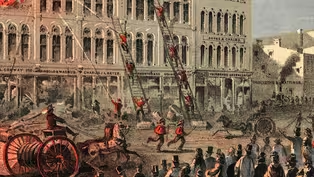
Video has Closed Captions
Chicagoans do what they can to save their homes, their possessions, and their lives. (7m 47s)
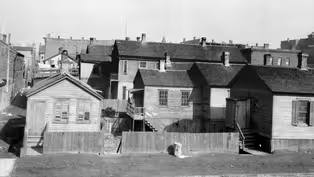
Video has Closed Captions
Chicago’s rapid growth is part of what made it so vulnerable to fire. (2m 37s)
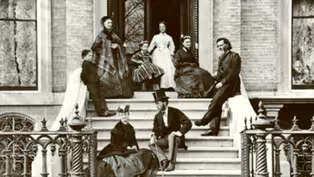
Video has Closed Captions
There was a stark contrast between how Chicago’s wealthy and its working poor lived. (6m 43s)
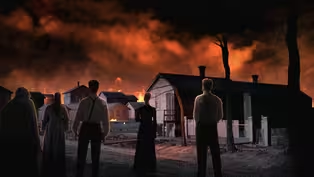
Video has Closed Captions
The Great Chicago Fire begins in Catherine O’Leary’s barn. (4m 52s)
Video has Closed Captions
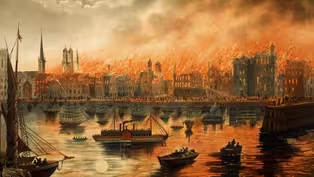
After hours of battling the fire, many Chicagoans see that there is no hope. (5m 11s)

The Great Chicago Fire: Introduction by Sandra Cordova Micek
Sandra Cordova Micek provides an introduction to The Great Chicago Fire. (1m 27s)
Investigating the Cause of the Fire
Video has Closed Captions
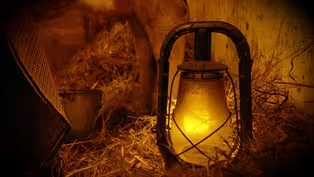
An official inquiry finds that Catherine O’Leary was not at fault for the fire. (4m 14s)
Video has Closed Captions
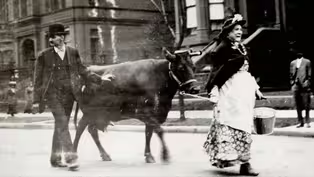
The myth of Catherine O’Leary and her cow becomes widespread. (7m 28s)
Video has Closed Captions
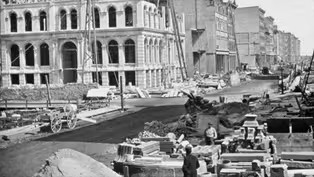
After the Great Chicago Fire, the city quickly rebuilds. (7m 3s)
Providing Support for PBS.org
Learn Moreabout PBS online sponsorship











Support for PBS provided by:
Chicago Stories is a local public television program presented by WTTW
Lead support for CHICAGO STORIES is provided by The Negaunee Foundation. Major support is provided by the Abra Prentice Foundation, Inc. and the TAWANI Foundation.