Inside California Education
Agua Caliente
Season 6 Episode 6 | 26m 46sVideo has Closed Captions
A third grade class journeys to the ancestral lands of the Agua Caliente Band of Cahuilla Indians.
Journey to the ancestral lands of the Agua Caliente Band of Cahuilla Indians on a field trip. Look inside Fresno City College's new campus in West Fresno. It's expanding career training in a historically disadvantaged area. Former Head Start parents are stepping up to become early childhood educators. Plus, high schoolers in Mountain House are engaging in democracy with civic action projects.
Problems playing video? | Closed Captioning Feedback
Problems playing video? | Closed Captioning Feedback
Inside California Education is a local public television program presented by KVIE
Funding for the Inside California Education series is made possible by the California Lottery, SchoolsFirst Federal Credit Union, Stuart Foundation, ScholarShare 529, and Foundation for the Los Angeles Community Colleges.
Inside California Education
Agua Caliente
Season 6 Episode 6 | 26m 46sVideo has Closed Captions
Journey to the ancestral lands of the Agua Caliente Band of Cahuilla Indians on a field trip. Look inside Fresno City College's new campus in West Fresno. It's expanding career training in a historically disadvantaged area. Former Head Start parents are stepping up to become early childhood educators. Plus, high schoolers in Mountain House are engaging in democracy with civic action projects.
Problems playing video? | Closed Captioning Feedback
How to Watch Inside California Education
Inside California Education is available to stream on pbs.org and the free PBS App, available on iPhone, Apple TV, Android TV, Android smartphones, Amazon Fire TV, Amazon Fire Tablet, Roku, Samsung Smart TV, and Vizio.
Providing Support for PBS.org
Learn Moreabout PBS online sponsorshipComing up on Inside California Education, journey to the ancestral lands of the Agua Caliente Band of Cahuilla Indians on a field trip.
It's a partnership between the tribe and Palm Springs Unified to help students understand the region's Native American history.
Go inside Fresno City College's new campus in West Fresno.
It's expanding opportunities for new career training and college degrees in a historically disadvantaged area in central California.
-Every family deserves to live in a safe neighborhood where they can go to school, and West Fresno is finally going in that path.
In Los Angeles County, see how former Head Start parents are transforming their careers and lives through a program that trains them to become early childhood educators.
Plus, discover how Mountain House High School is boosting civics education.
Students engage directly in democracy through a variety of projects, all designed to contribute to their community and become better and more informed citizens.
These are our high school students, but they are going to be our citizens.
They are our citizens, but they are going to be our future leaders.
It's all coming up next on Inside California Education.
Funding for Inside California Education is made possible by... The California Lottery is turning 40, and together with players, retail partners and our staff, we're celebrating decades of raising extra money for public education.
More than $46 billion in four decades of having fun.
Thank you, from the California Lottery.
Imagine a credit union where school employees are treated like the heroes you are.
At Schools First Federal Credit Union, everything we do starts with helping school employees and their families live better today and plan for tomorrow.
Learn more at schoolsfirstfcu.org.
The Stuart Foundation, improving life outcomes for young people through education.
College Board, helping all students own their future.
Additional funding for Inside California Education is made possible by these organizations supporting public education.
Meet the third grade class from Cahuilla Elementary School in Palm Springs.
They've spent months learning about the Agua Caliente Band of Cahuilla Indians.
Today, they're visiting Indian Canyons, ancestral lands of the tribe where those lessons are about to come to life.
-Today I'm going to speak to you in a language that's in excess of 8000 years old, even older.
This field trip, led by Tribal Ranger Wade, is part of a collaboration between the Palm Springs Unified School District and the Agua Caliente Band of Cahuilla Indians.
-The most important, aspect for these kids to come out and is just to learn who we are, to know that we are still here, that we're we dress the same, we go to the same schools, and we shop at the same grocery stores, that we don't live in the canyons or in, in areas outside that we live in homes just like everybody else.
It's a partnership that began about a decade ago as a way to dispel misconceptions and help students understand the region's Native American history.
Tribal leaders came together with school district officials to create a curriculum for local schools.
It is a unit of study of ten individual lessons that teach students things from who the Cahuilla people are to how the water resources are in the valley and how they're used, what trading looked like, little bit about their history.
And artifacts is a big piece of it as well.
-We can eat the fruit from the palm.
And the fruit tastes like dates.
-Ooh, I love dates!
-Good, good.
The program has since earned widespread recognition for one distinctive quality.
It fulfills California state history standards for 3rd, 8th, and 11th grades.
-And that was something that was really important as we were moving forward, because we didn't want teachers to have to teach something additional in the classroom.
We wanted to teach something that was required but unique to our area.
This is soap.
-Oh!
-Thats right, they even had soap back then.
For students, this field trip makes a connection to the tribe.
Their school is named after.
-Instead of just a little picture in a book.
I can actually see it in my eye pictures.
It's wonderful.
I love how, there's so many plants that could help us survive.
Assembly Member James Ramos, the first California Native American in the state legislature, spearheaded an effort in 2024 to require all public schools to teach accurate Native American history.
It was signed into law by Governor Newsom, creating new opportunities for models like this one to reach classrooms across California.
-When you have these kids that come out and they say, oh, that's a that's a quail right there.
That's, that's, lizard right there.
And I know the Cahuilla word for that one or you know, calling out different things and actually comprehending what they're being taught in the classroom.
It's just an incredible experience.
-It's important because, so it's like, you have to know about the past to know about the future.
For some kids, like Vivian, who has roots in the Cahuilla tribe, this trip is even more personal.
-It just feels good.
It feels nice to know that at.
You're originally from here.
-Obviously this is going to turn into a memory, a memory that they get to live.
It's going to be inside of them.
being out here in nature, they're actually getting that tactile experience, calling you all your five senses.
And there's that mystery of what are they going to really see in real life that is not in a book or in a video.
-Well, I've seen all these palm trees, and I learned in the classroom, all these palm trees are called an oasis.
-I always like seeing the reaction of the kids, their eyes just light up.
Their faces are genuine smiles because they're actually interacting.
And so that's very rewarding.
-I also learned that if you see palm trees, there's a good chance of water nearby because you know they need water to grow.
-As the students explore the canyon, they carry more than new knowledge.
They carry understanding.
The Agua Caliente Band of Cahuilla Indians and Palm Springs schools say they're teaching more than history.
They're building a future where Native American heritage is honored, understood, and alive.
California has passed laws addressing Native American education in recent years.
One law encourages school districts to work with local tribes to develop curriculum that reflects tribal history and culture.
Another law requires schools to include instruction about the mistreatment and contributions of Native Americans during Spanish colonization and the Gold rush.
California is home to 109 federally recognized tribes.
-That's why I show up for work every day.
-For almost three decades, Marty Kamimoto has taught thousands of students how to repair everything from gas powered, hydrogen, hybrid and electric cars to diesel and even zero emission big rigs.
And since 2023, he and his fellow instructors have been helping these men and women build careers inside one of the biggest community college automotive training facilities anywhere.
-To be able to take a student, give them the skill sets, the training, the certification, send them out to the workforce, and then they're able to support not only themselves, but they can support a family and make an impact on our local economy.
-Impacting the local economy, uplifting a disadvantaged community.
That's what this Fresno City College West campus is all about.
Across town, Fresno's original City College, still welcoming students, was built in 1910.
It's the oldest in California and the second oldest in the U.S.
This campus on Fresno's Southwest side is one of the newest, and it is unique.
-What I got a chance to see was a city, the college, the district and the county coming together to create something that's beautiful.
Fresno City College interim president Doctor Kim Armstrong says this beautiful creation was the result of a decade long campaign by an incredibly diverse group of supporters all united in their belief that southwest Fresno had been ignored and neglected too long.
This area has one of California's highest poverty rates and suffered from decades of industrial pollution.
Many students had to travel miles to access any college opportunities.
-And so the intention of this project was to lead the effort in reversing the de-investment of this region and the ultra-pollution of this region by building a massive, public investment -That investment began with dozens of meetings with community leaders and a coordinated effort to identify priorities and raise money.
Major funds came from a 2016 bond measure supporting the State Center Community College District.
The city of Fresno pitched in, as did the state of California.
Two local philanthropists donated a combined 40 acres.
All told, more than $86 million made this idea a reality for residents in West Fresno and other South Valley rural communities.
-It's like a jewel on top of a hill.
It's like a shining light.
This is a gift, and I want people to accept it and enjoy it and use it.
-You know, everything changes when you get access to education and training.
And once a person has that access and has that skill, that certificate or that credential, that is something that no one can ever take away from them for the rest of their lives.
-Every family deserves to live in a safe neighborhood where they can shop, go to work, and go to school, And West Fresno is finally going in that path.
-I think it's fitting that California's first community college has this campus, as its next prodigal child.
-Height and weight first.
And then it's TPR.
Temperature, pulse, respiration, then blood pressure.
So you know where the thermometers are.
-Besides the new Automotive Technology Center, the West campus also has a robust medical assistant training program.
Many of these 1000 West campus students are the first in their families to attend college.
-Me coming into the medical field have brought me out, brought my communication out, brought my, my skills out and what I had deep down inside me that I know I could bring out and I can help other people.
-I live, like down the street and especially for like a lot of people are here.
It's like walking distance and anybody can come.
-The community needs these students out there, because they're going to bring more to the community by getting this education and sharing it with other people.
-So you got service info here... -Back at the Automotive Technology Center, Instructor Wyatt Jones has a particular point of pride.
He started his career at Fresno City College.
-It's very fun to come full circle and to tell the students, guys, I've been in your shoes before.
It makes it all that much more sweeter to help reinvest into a community that probably needs a little assistance every now and then.
And that's what we do at the community college level.
That's what we're here for.
-I think it's, a great opportunity, you know, for people like me, just for them, putting it right in the heart of West Fresno, I think is helps a lot for those out there.
So now they see the opportunities.
-Being able to give resources to people that just don't have them I definitely think it encourages people to look forward in their future and gives hope, a lot of hope.
-Looking ahead, leaders hope to offer more vocational opportunities including teacher training, business, finance, food and childcare services.
For the physical campus, already environmentally friendly, there will be walking trails, a community park and soon more retail businesses and housing nearby.
-The effort that we have spent for a decade and building this facility are going to pay off for generations to come.
-When you walk on this campus, it feels innovative.
It feels historic.
It feels like a legacy is starting to be born here.
-And that's what this place represents, not just the physical, but the intentionality of a culture.
This commitment to this community says, yes, you can.
We see you here.
Still ahead on Inside California Education, these students in Mountain House aim to create positive change in their community through civic action projects.
They work with local leaders to find solutions to issues within their school and beyond.
But first, see how Los Angeles County parents are stepping up to fill a need for early childhood educators.
-We are voting that this was the baby inside the eggs.
Erin Barnease and Marimar Pulido were once parents of children enrolled in Head Start, a federal program providing early childhood education and resources for low income families.
Now they've returned to the classroom, but as educators in a Los Angeles County Head Start classroom.
Their new careers are possible because of an initiative that trains Head Start parents for jobs in early childhood education.
-What is that?
-Thats a blueberry.
They eat fruits and grass.
- I wanted to be that person for someone my son to this day, loves his teachers.
And so I wanted to be that for someone else, for a different child.
The program is a partnership between the LA County Office of Education, or LACOE, and West LA College.
It's addressing LA county's early educator shortage.
-We have a shortage in teachers.
We have these parents who are really interested in going to school and having a career serving children.
So it seemed like the obvious solution would be to engage with our parents and offer them a pathway so that they could eventually become teachers assistants or teachers or and move on further in education.
-When we started this back in 2022, we were dealing with over 500 vacancies, throughout all of our programs at LACOE and then through our delegate agencies.
That number, I believe, is now, you know, well below 200.
Erin and Marimar graduated from the Assistant Teacher Pathway, which offers college coursework and hands on classroom experience to obtain an associate teacher permit.
Best of all, it's completely free.
-I mean, ding a ling a ling jackpot to get a free, education, completely free books, classes, tutoring, support, everything that we needed.
I believe that they've, provided laptops and tablets, for people that didn't have those.
And, also resources and spaces.
-At the time, my husband was the only one working, so I didn't have any, you know, I didn't have any income coming in from my part.
And so to us, it was a great help.
You know, I get to have this amazing career One of the things that we always think about in Head Start as we're serving the whole family, is how to lift the family out of poverty, how to empower the family, how to encourage parents to continue with their education or helping them in terms of what their goals and objectives are, if you have happy parents, you know, you're more likely to have happy, confident children.
-What is it you told me about?
Oh, theres duckies?
-One way the program supports the whole family is by being flexible.
Students can complete the four college courses in the assistant teacher pathway online.
-They have many, many different things that are happening in their life that they have to juggle.
So school sometimes, sadly, would always take a backseat.
But because it's online, they have the availability to do parenting stuff and then still be able to come -It's very flexible.
I was just a stay at home mom taking care of my kids, it just it felt perfectly for me.
I was working from home, in the mortgage industry and kind of post-pandemic looking for, a new job opportunity.
It's not just for the for the parent, for becoming a teacher to satisfy themselves is bringing this family into a stable job.
And giving them opportunity to grow.
So right now I am a teacher assistant.
And I am looking forward to, just expand and, you know, get a lead teacher position.
I love everything, starting from the children.
You know, the smiles that they come in, they just look forward to, coming in and talking and learning and playing and I love that, I get to, show them so much support.
The program graduated 41 new assistant teachers in 2023.
That number nearly tripled to 111 new assistant teachers in 2025.
Four other pathways have launched since the start of the initiative: associate teacher, teacher, transitional kindergarten teacher, and family development credential.
since then, I've been able to build, onto the LACOE teacher pathway.
And I'm now a lead teacher for a Head Start agency, which is where my kids went to school.
So it's been really, really satisfying, -It's so wonderful to see that they know what it is to be a teacher.
A teacher is not just a little silo.
No, no, no, no.
It's community outreach.
It's creating pathways not only for themselves but for others.
And so we don't want them just to stop at just this part.
We want them to strive to go get their masters.
We want them to even get doctorates.
The possibility is up to them.
-A lot of us, high school students feel that, you know, they feel disconnected with politics and government and civics education is a great way to bridge that gap.
-Surekha D'Souza's Law and Society class is focusing today on civic action projects.
The goal is to encourage students to find solutions to real issues they're passionate about, like making clothing drives more accessible.
-Our mission statement is that we wish to encourage the residents of Mountain House to donate their old clothing and shoes to a good cause, and work towards finding a convenient way for them to do so.
-While one semester of government is required for all high school seniors, not all schools provide civics education.
D'Souzas class at Mountain House High School is part of a growing effort to change that.
The curriculum is influenced by Teach Democracy, a Los Angeles based nonprofit that provides civics education resources to encourage students to engage in democracy.
For most of the year, students strengthen their public speaking and legal skills through mock trial competitions.
The class then transitions to civic action projects.
-I wanted it to be more of an engagement class where students could use the skills that they picked up in mock trial and put those public speaking skills and those civic knowledge skills that they acquired about, you know, case law on the Supreme Court, and then put that into action by getting involved in issues that they feel strongly about.
So for a little bit of background... I know a lot of people have concerns and comments to make, but not a lot of people actually step outside of their comfort zones to make these, efforts.
So I think it's really important to be both informed and engaged in civics -This is Devikas third time taking law and society.
Fitting for someone who wants to pursue a career in law.
Her group's project aims to increase student participation in city council, school board and student leadership meetings.
-We found is that people really care about what's going on aroun whats going on around them.
-Students surprise me every day with their creativity.
The projects are so, so different, and such a variety.
So I would never have thought of think, coming up with something.
But they did.
-Our presentation is, to summarize it, is basically giving high school students an opportunity to get paid or unpaid internships or in high school to help them, get jobs or get into colleges.
-Our presentation was that we wanted to open our middle school, curriculum, and the curriculum was for, was for mock trial.
After brainstorming, students conduct research on their topics and reach out to city and school leaders to see how they can implement their vision.
-And, what we did is that we emailed the teachers because we wanted to persuade them if they would be interested... -The schools principal, Doctor Adam Auerbach, encourages students to think deeply about who their projects impact.
This means there will be some disagreements.
That's what happened when Doctor Auerbach met with a group who wanted to bring back food delivery privileges to campus.
-So a couple of projects and in my dialog with them, when we met one on one, was how does this better the rest of the community?
So, yeah, some of those examples, a DoorDash program project that said, how does that impact the broader community?
Are there DoorDashers out of work because we don't have DoorDash in the high school, you know, at, so you have to consider those different constraints, and they don't get that unless they engage in this process.
-And like opening up the campus to any delivery driver just poses a security risk, because who could say a random person is a DoorDash driver?
There is no way to verify that.
-Conversations don't just happen with the higher ups.
Today's presentations are peer reviewed.
Students get the chance to ask questions and even challenge their classmates.
-I don't understand like why we would need AI because schools and just colleges have been teaching us without AI for years.
-Over time, humans have always made it their goal to become more and more efficient.
-I think civics is important just to be educated, because I think education is the first step to any type of problem or any type of awareness.
and it gets your brain thinking about real world problems.
-Mountain House High School encourages students to earn a State Seal of Civic Engagement, a recognition on their diploma for Excellence in Civics Education.
Completing a civic action project is just one way students can earn the seal.
-We are very proud, that this year, and Im especially proud of my seniors this year, five of my seniors will be earning on their diplomas, the state seal of civic engagement.
I believe that investing in civic education is investing in the future of American democracy.
-Civics is important because it's not only learning about government, but also helping the community.
-I'd say schools that are looking to engage in that same civic mindedness simply need to look at how they afford the time of the day.
To meet the needs of kids as they go out in the real world.
-And it doesn't matter how big those actions are.
It's a small action, and that lights up a spark and it leads to civic, engagement in the long run.
These are, high school students, but they are going to be our citizens.
They are our citizens, but they are going to be our future leaders.
That's it for this edition of Inside California Education.
If you'd like more information about the program, log on to our website insidecaled.org We have stories from all of our shows and you can connect with us on social media.
Thanks for joining us.
We'll see you next time on Inside California Education.
We can eat the fruit from the palm.
And the fruit tastes like dates.
-Ooh, I love dates!
-Height and weight first.
And then it's TPR.
Temperature, pulse, respiration, then blood pressure.
(children talking) -Do you guys remember elbows?
So for a little bit of background.
AI has been transforming rapidly in the last one year.
Funding for Inside California Education is made possible by... The California Lottery is turning 40, and together with players, retail partners and our staff, we're celebrating decades of raising extra money for public education.
More than $46 billion in four decades of having fun.
Thank you, from the California Lottery.
Imagine a credit union where school employees are treated like the heroes you are.
At Schools First Federal Credit Union, everything we do starts with helping school employees and their families live better today and plan for tomorrow.
Learn more at schoolsfirstfcu.org.
The Stuart Foundation, improving life outcomes for young people through education.
College Board, helping all students own their future.
Additional funding for Inside California Education is made possible by these organizations supporting public education.

Agua Caliente: Lessons on Ancestral Lands
Video has Closed Captions
Clip: S6 Ep6 | 5m 13s | Journey to the ancestral lands of the Agua Caliente Band of Cahuilla Indians on a field trip. (5m 13s)

A Head Start in Teaching in Los Angeles County
Video has Closed Captions
Clip: S6 Ep6 | 5m 24s | Former Head Start parents are stepping up to become early childhood educators. (5m 24s)
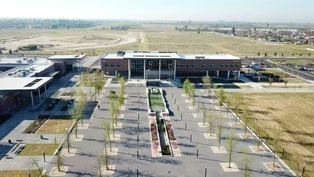
New Campus, New Hope in West Fresno
Video has Closed Captions
Clip: S6 Ep6 | 6m | Look inside Fresno City College's new campus in West Fresno. It's expanding career training in a his (6m)

Teaching Democracy: A Hands-On Approach to Civics
Video has Closed Captions
Clip: S6 Ep6 | 5m 46s | High schoolers in Mountain House are engaging in democracy with civic action projects. (5m 46s)
Providing Support for PBS.org
Learn Moreabout PBS online sponsorship
- News and Public Affairs

Top journalists deliver compelling original analysis of the hour's headlines.

- News and Public Affairs

FRONTLINE is investigative journalism that questions, explains and changes our world.












Support for PBS provided by:
Inside California Education is a local public television program presented by KVIE
Funding for the Inside California Education series is made possible by the California Lottery, SchoolsFirst Federal Credit Union, Stuart Foundation, ScholarShare 529, and Foundation for the Los Angeles Community Colleges.