
AHA! | 627
Season 6 Episode 27 | 29m 29sVideo has Closed Captions
Multi-medium artist, Empire State Youth Orchestra, & in-studio performance by Rick Bolton.
Artist Heather Layton's body of work includes sculpture, installation, painting, drawing, & more. Producer Matt Rogowicz visits her studio in Chestertown, NY. Lara Ayad's interview with Carlos Agreda, the Music Director of the Empire State Youth Orchestra, to see how ESYO has managed to resume in-person rehearsals during the pandemic. Hear a lovely performance of "Sharon's Song" by Rick Bolton.
Problems playing video? | Closed Captioning Feedback
Problems playing video? | Closed Captioning Feedback
AHA! A House for Arts is a local public television program presented by WMHT
Support provided by M&T Bank, the Leo Cox Beach Philanthropic Foundation, and is also provided by contributors to the WMHT Venture Fund including Chet and Karen Opalka, Robert & Doris...
AHA! | 627
Season 6 Episode 27 | 29m 29sVideo has Closed Captions
Artist Heather Layton's body of work includes sculpture, installation, painting, drawing, & more. Producer Matt Rogowicz visits her studio in Chestertown, NY. Lara Ayad's interview with Carlos Agreda, the Music Director of the Empire State Youth Orchestra, to see how ESYO has managed to resume in-person rehearsals during the pandemic. Hear a lovely performance of "Sharon's Song" by Rick Bolton.
Problems playing video? | Closed Captioning Feedback
How to Watch AHA! A House for Arts
AHA! A House for Arts is available to stream on pbs.org and the free PBS App, available on iPhone, Apple TV, Android TV, Android smartphones, Amazon Fire TV, Amazon Fire Tablet, Roku, Samsung Smart TV, and Vizio.
Providing Support for PBS.org
Learn Moreabout PBS online sponsorship(light upbeat music) (upbeat orchestral music) - Discover the mixed media art of Heather Layton.
Learn how the Empire State Youth Orchestra is empowering young musicians.
And catch a performance by Rick Bolton.
It's all ahead on this episode of AHA, A House for Arts.
- [Announcer] Funding for AHA has been provided by your contribution, and by contributions to the WMHT Venture Fund.
Contributors include Chet and Karen Opalka, Robert and Doris Fischer Malesardi, The Alexander and Marjorie Hover Foundation, and The Robison Family Foundation.
- At M&T Bank we understand that the vitality of our communities is crucial to our continued success.
That's why we take an active role in our community.
M&T Bank is pleased to support WMHT programming that highlights the arts, and we invite you to do the same.
(upbeat orchestral music) (upbeat orchestral music) - Hi, I'm Lara Ayad, and this is AHA, A House for Arts, a place for all things creative.
Let's send it over to Matt Rogawitz for today's field segment.
(gentle piano music) - Artist Heather Layton splits her time between Chicago, Rochester, and the Adirondack Mountains.
We found her right here in Chestertown, New York on this very cold winter day.
Let's head inside and see what she's up to.
- If I made a piece of art and it didn't have a story to it, or a place to start a discussion, it wouldn't mean anything to me.
The beauty isn't in the art itself, it's in what happens when somebody looks at it.
My practice always has three parts to it, it's the making where I'm making sculpture installation, painting and drawing, and then I have the teaching part, where I teach at the University of Rochester, and then I have the relationship building part, and all, each one of those three parts can't exist without the other.
The relationship building, that has been really developing relationships with people who are living in different countries, different cultures, different religions.
I've been so lucky to participate, or be a volunteer in a State Department program called the International Visitor Leadership Program, and through that I've been able to host creative people from all over the world at our house for dinner, and also then go to travel to their homes, and their communities.
So all the positive stories about Saudi Arabia that we never hear, and all the positive stories about Pakistan, and all the stories about Nagaland that I would have had preconceptions or fear in going to these places before I went, and then you get there and people are people everywhere, and so you have these incredible relationships with other artists, and community organizers, and administrators.
I couldn't make art if I didn't have this ongoing exchange with others who are also interested in building bridges between communities, and cultures, and nations, religions, I couldn't make art and I couldn't teach without making art, and I design all of the projects in all of my classes, I'm thinking through sculpture and through performance when I'm designing the projects.
I think I work like I'm writing novels.
So there is a conceptual theme throughout my entire, last 25 years of work, but once the series is done that novel's done, and I don't really often come back to the imagery or to the material, or to the story.
In 2020 and before, so the four years leading up until very recently, I worked on a project called Coping Mechanisms, and I feel at the time it was something that I really needed.
The last four years have been difficult for a lot of people, for a lot of different reasons.
Imagine if there were an unlimited selection of machines, tools, and mechanisms that had the ability to repair relationships, rebuild trust, and correct the record in turbulent political times, if all things were possible what would people ask for?
What would people need?
The following are physical manifestations of the hopes and dreams of American citizens.
For example, there's the two prawn stethoscope that allows users to consider what the other is feeling before judging what the other is saying.
There are earbuds, that fact-check speeches in real time, shoulder pads with inflatable helium pouches to lift that heavy feeling, and elastic guard that helps prevent damage from excessive tongue biting, a GPS navigation system to steer parents through the process of explaining politics to children, and shoes that keep us from jumping to conclusions.
It always starts in writing, and it always starts in thinking.
I'll think about a project and do research on a project for a full year before I start making in many situations.
And then I have to visualize, okay, how can this story best be told?
My husband Brian had done a lot of research into drone warfare, and we had been told that it is clean technology, that people aren't hurt, until you go to Pakistan.
That's where we really learned about it, was on that trip.
Then you go back home and you're like, how is this not, how is this not a major issue?
This is before it came out in the news, people are being tormented.
Their lives just torn apart.
So we built this replica of a Predator drone, and I wanted it to be diamond studded, like jewelry.
So when you'd walk into the gallery space it would just glitter.
So you just wanted to be next to it when it was so beautiful.
But the idea was, if you spent a little more time with it you would see that it was pointed at a wall size map of Massachusetts which is the state where the exhibition took place.
And we took the first 341 drone strikes in Northern Pakistan and plotted them on a map of that region.
And then we just picked up, as if you kept that pattern the same, you pick it up and you swap out a map of Massachusetts underneath and drop the pins again.
And then we drove to each one of those sites, a lot of them, and photographed who and what would have been destroyed had a drone strike happened in the United States on that day.
And you can see the people who you're about to hit look like you.
The current series that I'm working on, I don't have a title for it yet, but it just started in 2021.
The theme now is work.
It's gonna take a lot of work to bring compassion.
It takes a lot of work to, to make things beautiful.
It's not a passive, it's never a passive act.
So the project I'm currently working on, they are groups of women in particular this time, and they are stitching and mending and pulling and pushing and climbing in this particular painting series.
Everybody will be at work.
Art is a really fast form of communication.
I can be idealistic and optimistic that I'm not always able to do in words.
And so a lot of the work I make is saturated in idealism and optimism.
And I think part of that, it's not saying that the violence doesn't exist.
It's assuming that the violence is everywhere.
The danger is everywhere.
The destruction is everywhere.
And so the work I make is, okay, how can we imagine something different?
And that I think is where all of the work that I make starts is in that desire to think that things don't have to be the way they are.
There's always a way to live differently, and to set up societies differently.
The war heroes, the presidents, the CEOs, that's what has been valued, but just as easily you could be in a society that values compassion and collaboration, that's possible if you make it so.
- Orchestras all over the world are innovating during these times to maintain a connection with their audiences as concerts.
And indeed entire seasons have been sidelined.
Carlos Agreda, the music director of the Empire State Youth Orchestra joins me in studio to discuss his career in music, and to tell us how the youth orchestra has managed to resume in person rehearsals during the pandemic.
Carlos, welcome to A House for Arts, it's a pleasure to have you.
- Thank you, it's an honor to be here.
- So, I was so curious to know so many things about the Empire State Youth Orchestra, and your work, but let's begin with some of your work experiences and your background.
I know that you've done a lot of work not only in the United States, but also in Colombia and Great Britain; can you tell us a bit about what your experiences were like there, and in particular, how does your work in the orchestra compare in all of these three different places, or countries?
- Well, yeah, that's very interesting, because to me, it's very interesting because I have known musicians from all nationalities, and the more nationalities I interact with, with musicians, I realize that music is its own nationality, kind of.
It's kind of this universality thing.
But of course you can pinpoint some differences.
In England, for example, they have, the musicians are so professional, orchestras are incredibly efficient, site reading is absolutely phenomenal, you can put a, sheet music, a fresh piece, right in front of them for the first time, and in the first rehearsal, first run through, everything will be perfect.
- It's all just discipline, and knowing.
- Yeah, it's so effective.
So to me, being that, of course orchestras there have three or four programs a week, which is a huge amount, so being trained there as a conductor was amazing, because I, it was like a real training for me to be really efficient.
Whereas in other countries you have more time for rehearsal, and to go in other depths.
But I think the most interesting thing I feel is the concept of authority.
Sometimes in the United States I feel like, oh, that's the conductor, and it's a lot of respect for that.
- So you feel that the hierarchy is a little more pronounced in the United States versus in other places?
- Yeah, I don't know, there's a point that needs to be made about that person being the conductor, as opposed to being a human.
Oh, that's another human, and oh, he happens to be our leader in this rehearsal.
So those things, but I think in general there's this transversal, universal thing of music that is actually when we are there, when you start making music, it doesn't, you don't see any nationality, you don't see anything other than humans giving their best for beauty.
- I mean, music has always been around since humans have ever existed, right?
- Yes, yes.
- If you're talking about a universal language of music that we all share, are there also any universal myths or misconceptions that people in America, as well as other countries, tend to have about orchestra music in particular?
- Yeah, well, I mean this world is full of misconceptions, but I think the biggest misconception about classical music, or symphonic music, is that, it's elitist, or it doesn't belong to me, to you, it's not popular.
And actually that's something that I've been trying to think about all my life, and for example I remember one of my friends, a cousin who came with me, if I can tell you this story, I came with my cousin to a concert, and my cousin doesn't know anything about music, first time being in a symphony, he came with me because I was so excited about this concert, and he said, "Oh, you look so excited, can I come with you?"
And he came for the first time, he loved it so much.
- It feels like a full sensory experience, almost like if you go to see a movie, or if you go to see a live theatrical performance.
- Yes.
- It's engaging all of your senses, right?
- Of course, I mean, it's also his understanding of this story, the narrative, all the emotions, everything, I mean, the symphonic world is absolutely vast, and he clapped after the first movement of the symphony.
And everybody around us bullied him, "shh", shushing him, why do you clap at the first movement?
You're not supposed to clap between movements.
And my cousin felt, I don't belong here, then.
And I said, no, you do belong here.
Maybe the bullies don't belong here.
This elitism about that classical music is this thing that only certain people have access to, or you need to be educated in order to enjoy.
That's not the case.
- It almost seems like there's this cultural resistance, like call and response, or responding vocally to something within that realm, but what you're trying to tell me Carlos, at least what I'm hearing, is that you're telling us that it shouldn't be that way, and that's actually a big misconception, even among some audience members of orchestra.
- Yes, of course, yeah, that's a big misconception, that classical music is this thing over there.
Actually it's everything.
And for example the difference between classical music and other kinds of music is also something that, - What other kinds of music?
- Everything, like salsa, tango, Queen, rock, Lady Gaga, Justin Bieber.
- You're seeing that relationship between all those things, is this something that you teach your students in the Empire State Youth Orchestra?
How do you, what's its mission, the youth orchestra?
And how do you maybe inform your students about these connections between what we tend to call classical versus pop music, say?
- Well in education it's interesting because there's so much that the orchestra, the comparison that I was making with language, is that orchestra is not a European thing, it's also part of our culture now, and to the point that for example my first piece that I did with the, in Paris, did orchestra, youth orchestra, was (speaking foreign language), Silvestre Revueltas that, it's a piece, he's a Mexican composer based on a poem, about this Cuban poet, Nicholas Guillen, about the African, and also indigenous ways to kill a snake, it's a very interesting story, but it was written for an orchestra, a symphonic orchestra, a European thing, but it's absolutely Latin American.
So that's what I mean talking about the misconception, that's another misconception.
And so talking with the orchestra about the differences between classical and all of that, I recognized that Haydn, Mozart, Beethoven, Tchaikovsky, started writing music for orchestra, and designed orchestration in a way that is very educational, pedagogical, for the kids.
So I really encouraged them to revisit this traditional repertoire, because it's going to help them in their learning process, however I always introduce something that is also breaking that concept that classical music is this thing that... - Right, it's something in the past, it's only something belonging to one culture, one race, and that's not true, as you're showing.
- Exactly, and to the point of pop music, and all of that, for example, I encourage them so much to improvise.
To me it is difficult to believe that musicians have an instrument in their hands everyday of their lives, but they don't improvise.
And every time I tell somebody to improvise they would say, "Oh no, I am classical trained musician, I don't improvise," and I said, why?
Why to put all this barriers in ourselves?
And when people start, musicians start improvising, they just realize that, the possibilities of their instrument, the possibilities of expression, the possibilities of performance are so vast.
- Right, and it doesn't have to be one thing, and when you start exploring other avenues you start seeing the richness in the nuance.
- Oh yeah, of course.
- Of the music.
- And it has to do with tearing apart those barriers.
- Right; I'm wondering too, just the tearing apart all these barriers that you're doing, which is amazing, during this pandemic, I'd imagine that, I'm thinking about orchestra, and I'm like, oh my God, wind instruments, how you wear a mask, what are the complications of that, I'm wondering what innovative ways has the Empire State Youth Orchestra been dealing with the pandemic?
Are young musicians able to practice and perform right now?
- Yes, yes, I mean, we, well many things.
Well, first, the first lockdown that we could not leave our houses, we needed to get really creative about how to keep our mission alive, which our mission is to challenge and inspire musicians to achieve excellence through music.
And we were able to do it with amazing projects, we did this VR, virtual reality 360 performance that everybody recorded from their homes, it was a beautiful project to see how it actually, from home we could do so much.
It was a lot of work, so we wanted to come back to rehearse in person, 'cause that exchange of energy means a lot, we are an orchestra because we play in an ensemble.
So we were able to start rehearsals with social distancing.
It was interesting you mentioned the instruments, because we have flutes, we have clarinets.
- Right, it's blowing air out, into the room.
(laughing) - It was a huge, huge concern that we had, but we were very privileged to have a space that has the best filtration possible, also we doubled the social distance as possible, and the most important thing, we used PPE for the... - [Lara] What's PPE?
- Personal protection equipment, like the mask, basically, masks for the instruments.
So it was kind of funny to see a bassoon with a mask around it.
(Lara laughing) - With a big hairnet on it, yeah.
- Yes, (chuckling) so the musicians needed to be protecting the air that comes out of their instruments so it doesn't go around.
And after our entire concert cycle we had so many rehearsals, more than 300 musicians in different ensembles, not one got infected with COVID.
- [Lara] That's amazing.
- And of course we had so many strategies, quarantine, so we had to livestream every rehearsal in case a musician was rehearsing from home because they couldn't leave because of quarantine, so we would livestream the rehearsals for two, or three weeks, if they needed to be away.
- Were audiences able to watch any of these livestreams?
- Yes, so we had this, the first time that we had a virtual, a concert for virtual audience, so we recorded all our ensembles, 13 ensembles, in person, of course, social distanced, with all the mask, with all the filtration, everything, and recorded it and presented it to a virtual audience through our own virtual concert hall.
It was an absolute success, I am so thrilled, I was so nervous because we had never done this.
- Well, where can folks look for more recordings of more audiences, or more performances, excuse me, moving forward?
- Well, everything is now in our website, ESYO.org, you can find there our virtual concert hall that is hosting things from the past, from even this pandemic, the virtual situations that we did, and also feature performances.
So we're so proud that we now have a virtual concert hall, we never thought about having a virtual concert hall.
- That all sounds fantastic, Carlos, thank you so much for being on A House for Arts.
- Thank you very much, it is my pleasure, yeah, it's very nice to meet you.
- Please welcome Rick Bolton.
- Good evening everyone, I'd like to start with a song that I wrote for my wife.
(strumming guitar music) ♪ You were just the one I wanted ♪ ♪ Long before we ever met ♪ ♪ I saw your eyes on the horizon ♪ ♪ And your angel silhouette ♪ ♪ You touched me in the tavern ♪ ♪ And I swore I saw some light ♪ ♪ You put your hand in my hand ♪ ♪ Such a mighty sight ♪ ♪ And I was looking for my roadmap ♪ ♪ And on one I could depend ♪ ♪ Been down a couple major highways ♪ ♪ Been down more than one dead end ♪ ♪ And you touched me in the tavern ♪ ♪ And I swore I saw some light ♪ ♪ You put your hand in my hand ♪ ♪ Such a mighty sight ♪ ♪ And it's a simple song to tell you ♪ ♪ This old heart has taken flight ♪ ♪ You shed me from my sorrow ♪ ♪ You're a candle in the night ♪ ♪ When you lay yourself beside me ♪ ♪ Well I've never seen such light ♪ ♪ You put your hand in my hand ♪ ♪ Such a mighty sight ♪ ♪ It makes all things right ♪ ♪ What's right is right ♪ ♪ Such a mighty sight ♪ All right, well this is a song about my hometown, Hague, New York, a town of 700 in the winter months, and 7,000 in the summer, and the perils of fall, and what happens when everybody leaves.
(upbeat strumming guitar music) ♪ It's a good God almighty summer ♪ ♪ Hallelujah night ♪ ♪ Fill your cup to the brim ♪ ♪ With a tonic and gin ♪ ♪ With your heart set out of sight ♪ ♪ And oh, there were summers ♪ ♪ Of sin and champaign ♪ ♪ Howling all night at the moon ♪ ♪ We danced, how we danced ♪ ♪ To the rhythm of the night ♪ ♪ Take the silver ♪ ♪ Right off your spoon ♪ ♪ And it's a good God almighty summer ♪ ♪ Hallelujah night ♪ ♪ Fill your cup to the brim ♪ ♪ With a tonic and gin ♪ ♪ With your heart set out of sight ♪ ♪ How you doing ♪ ♪ How you been ♪ ♪ Well it's good to see you back again ♪ ♪ How's your love ♪ ♪ Have a drink ♪ ♪ Don't make no difference what I think ♪ ♪ Summer's short ♪ ♪ And it's sweet ♪ ♪ It'll knock you off your feet ♪ ♪ But it's the only time ♪ ♪ I hear this old heart beat ♪ ♪ And it's a good God almighty summer ♪ ♪ Hallelujah night ♪ ♪ Fill your cup to the brim ♪ ♪ With a tonic and gin ♪ ♪ With your heart set out of sight ♪ ♪ My guitar's out of tune ♪ ♪ I've spilled my third drink ♪ ♪ The crowd, well they've all ♪ ♪ They gone home ♪ ♪ Still I'd give anything ♪ ♪ To see you again ♪ ♪ In the light of that old August moon ♪ ♪ And it's a good God almighty summer ♪ ♪ Hallelujah night ♪ ♪ Fill your cup to the brim ♪ ♪ With a tonic and gin ♪ ♪ With your heart set out of sight ♪ ♪ With your heart, heart, heart, heart ♪ ♪ Your heart set out of sight ♪ ♪ With your heart, heart, heart, heart ♪ ♪ Your heart set out of sight ♪ ♪ With your heart, heart, heart, heart, ♪ ♪ Your heart set out of sight ♪ (upbeat music) - Thanks for joining us.
For more arts, visit WMHT.org/AHA, and be sure to connect with WMHT on social.
I'm Lara Ayad, thanks for watching.
- [Announcer] Funding for AHA has been provided by your contribution, and by contributions to the WMHT Venture Fund.
Contributors include Chet and Karen Opalka, Robert and Doris Fischer Malesardi, the Alexander and Marjorie Hover Foundation, and The Robison Family Foundation.
- At M&T Bank, we understand that the vitality of our communities is crucial to our continued success.
That's why we take an active role in our community.
M&T Bank is pleased to support WMHT programming that highlights the arts, and we invite you to do the same.
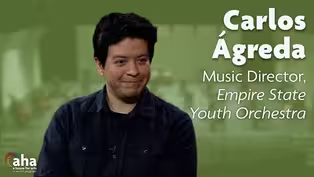
AHA! 627 | Carlos Agreda, Empire State Youth Orchestra
Video has Closed Captions
Clip: S6 Ep27 | 11m 32s | Don't miss Lara Ayad's interview with Carlos Agreda. (11m 32s)
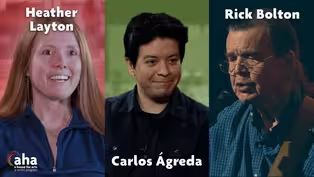
Video has Closed Captions
Preview: S6 Ep27 | 30s | Multi-medium artist, Empire State Youth Orchestra, & in-studio performance by Rick Bolton. (30s)
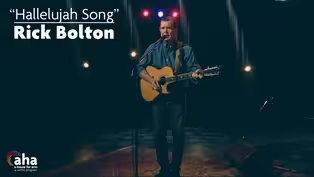
AHA! 627 | Rick Bolton: Halleluia Nights
Video has Closed Captions
Clip: S6 Ep27 | 2m 47s | Hear singer/songwriter Rick Bolton perform "Halleluia Nights" at WMHT Studios. (2m 47s)
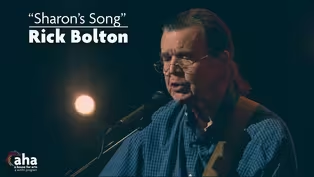
AHA! 627 | Rick Bolton: Sharon's Song
Video has Closed Captions
Clip: S6 Ep27 | 4m 15s | Hear a lovely performance of "Sharon's Song" by Rick Bolton performed at WMHT Studios. (4m 15s)
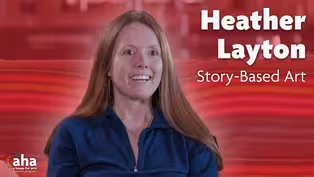
AHA! 627 | Story-Based Art with Heather Layton
Video has Closed Captions
Clip: S6 Ep27 | 7m 51s | Reflect on the work of multimedia artist Heather Layton. (7m 51s)
Providing Support for PBS.org
Learn Moreabout PBS online sponsorship

- Arts and Music
The Best of the Joy of Painting with Bob Ross
A pop icon, Bob Ross offers soothing words of wisdom as he paints captivating landscapes.












Support for PBS provided by:
AHA! A House for Arts is a local public television program presented by WMHT
Support provided by M&T Bank, the Leo Cox Beach Philanthropic Foundation, and is also provided by contributors to the WMHT Venture Fund including Chet and Karen Opalka, Robert & Doris...