
AHA! | 628
Season 6 Episode 28 | 27m 45sVideo has Closed Captions
Wood panel painting, Black female empowerment, & Jacob Shipley performs.
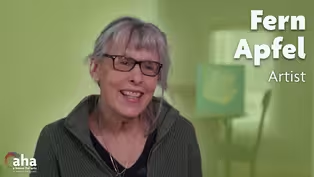
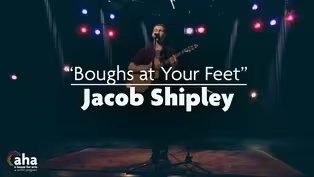
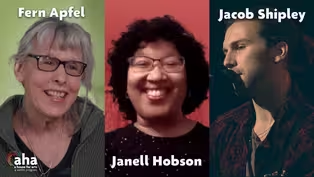
Artist Fern Apfel loves collecting old envelopes, letters, and diaries - and painting them on wood panels. What do black women, 19th-century French paintings, and Beyonce's music videos have in common? Janell Hobson, Professor and Chair of the Department of Women's, Gender, and Sexuality Studies at the University at Albany discusses. Don't miss Jacob Shipley perform "Boughs at Your Feet" and more.
Problems playing video? | Closed Captioning Feedback
Problems playing video? | Closed Captioning Feedback
AHA! A House for Arts is a local public television program presented by WMHT
Support provided by M&T Bank, the Leo Cox Beach Philanthropic Foundation, and is also provided by contributors to the WMHT Venture Fund including Chet and Karen Opalka, Robert & Doris...
AHA! | 628
Season 6 Episode 28 | 27m 45sVideo has Closed Captions
Artist Fern Apfel loves collecting old envelopes, letters, and diaries - and painting them on wood panels. What do black women, 19th-century French paintings, and Beyonce's music videos have in common? Janell Hobson, Professor and Chair of the Department of Women's, Gender, and Sexuality Studies at the University at Albany discusses. Don't miss Jacob Shipley perform "Boughs at Your Feet" and more.
Problems playing video? | Closed Captioning Feedback
How to Watch AHA! A House for Arts
AHA! A House for Arts is available to stream on pbs.org and the free PBS App, available on iPhone, Apple TV, Android TV, Android smartphones, Amazon Fire TV, Amazon Fire Tablet, Roku, Samsung Smart TV, and Vizio.
Providing Support for PBS.org
Learn Moreabout PBS online sponsorship(gentle bright music) (gentle upbeat music) - [Lara] Track The Days Of Or Lives with Fern Apfel.
Discuss black women in the arts with UAlbany professor Janell Hobson, and enjoy performance by Jacob Shipley.
It's all ahead on this episode of aha, A House for Arts.
(gentle upbeat music) - [Announcer] Funding for aha has been provided by your contribution and by contributions to the WMHT venture fund.
Contributors include Chet and Karen Opalka, Robert and Doris Fischer Malesardi, The Alexander and Marjorie Hover Foundation and the Robison Family Foundation.
- At M and T bank, we understand that the vitality of our communities is crucial to our continued success.
That's why we take an active role in our community.
M and T bank is pleased to support WMHT programming that highlights the arts, and we invite you to do the same.
(upbeat music) - Hi, I'm Lara Ayad, and this is AHA, a house for arts.
A place for all things creative.
We join Matt Rogowicz in Kinderhook New York for our field segment.
(gentle upbeat music) - I'm here in Kinderhook New York to track The Days of Our Lives with artist Fern Apfel, one letter at a time.
Let's go.
(dramatic music) - I collect kind of well loved and beaten up things.
I work on wood panels and I paint old letters, old envelopes.
(gentle dramatic music continues) I use coral paint and because I tape the edges, the coral paint stays, you know, kind of collects along the edges.
And so it gives it this very slight three dimensional look.
(dramatic music continues) People think I collage it.
So I have taken to when I'm in shows or have to write a statement or talk about my work, I'm always saying it's not collage, it's all hand done.
I always work from an actual thing, an actual letter an actual diary.
(soft music) I would, you know, hone old bookstores and antique shops or flea markets and just start picking up all this old stuff.
I gradually started painting it.
And then I did go through a stage where I was taking very old books and cutting out words and collaging it, okay?
And actually creating my own stories from words.
(soft music continues) When I was collaging things, I was very...
I was trapped by the color of the paper or the type of type.
And so when I started doing this work, it was enormous amount of freedom.
(soft music continues) At the background could be anything I wanted it to be.
The type and the lettering could be anything I wanted it to be.
So, it was just like an enormous freedom.
(soft music continues) (gentle upbeat music) I do all the lettering freehand.
I use this nichy bond tape.
It's this very thin tape from Japan and I mark the top and the bottom of the line, you know, make it even, and it'll stay straight.
(gentle music continues) During COVID, I have happily discovered, you know, eBay and Etsy and I'm actually getting things from all over the world.
I just got a pack of old cards from Lithuania.
I've got things from Russia.
I've gotten things from Yugoslavia and Croatia and France.
(gentle music continues) COVID has transformed some of what I'm thinking about too because particularly when COVID started last, almost a year ago now, that people were putting, like counting the days.
So they were saying day one of lockdown and I did this and day two and literally counting the days.
And I start thinking about how the days have become very precious and how the diaries, whether it's during COVID now or whether some of the diaries, like a hundred years ago, people were doing the same things.
(soft music) This are old...
It was a booklet of hand written music.
I was a student and they were studying music.
I had a letter from a mom to her son and it was, it was in, I don't know, late 18 hundreds.
And she's saying to her son, you know, "Oh I haven't seen you in a while.
"why don't you come over for dinner?"
Things like that and it's the same exact thing that a mom today would maybe instead they texted (chuckles) or you know email it but it's the same, it's very timeless.
And I find that very poignant.
(soft music continues) There's a letter.
It was a young woman who was studying dance in New York city.
And she was writing home to her mom.
She talks about, you know, building the new Lincoln Center and she talks about her dancing classes in her toe shoes and what she had for breakfast, I mean.
(laughs) I get amazingly emotionally it falls into what, this letter is saying.
But the other thing that I have to always remember is that they also, I'm making a painting.
And so you can fall too much in love with the material and you can't forget that you making a painting and it needs to work visually.
I always like to think that in this digital age when emails are quickly read and deleted that these paper keepsakes have lasted through time.
And they're, they're actually, you know, they're actual written records of life.
And I don't know if we'll have that from this time.
- Janell Hobson is the department chair of women's gender and sexuality studies at UAlbany.
What do black women 19th century French paintings and Beyonce's music videos have in common?
Let's find out, Janell Hobson, thank you so much for being on A house for Arts, it's a pleasure to have you.
- Yes, hello, thank you for having me.
- [Lara] So I'm so excited to talk with you Janell about some of your research in your work.
And so just to kind of give our viewers a little bit of like a brief overview, if that's even possible of all of the work you've done.
You have done years of research and work on media and media culture, pop culture, representations of black people but particularly representations of black women.
And some of the titles for the books that you've published over the years are fascinating, like "Venus In The Dark" and "Body as Evidence."
I mean, these all sounds so great.
I know that you're editing a volume right now on cultural histories of black women in the US as well as your own book that you've penned yourself about Z... about black women's imagination and American history.
Can you tell us particularly about this book that you're writing right now?
What is the title of it?
What does the title mean?
And what story does this book tell us in general about black women and American history?
- Yes.
So the full title of the new book is "When God Lost Her Tongue, Historical Consciousness "And The Black Feminist Imagination."
And this is more than just American history.
It actually explores the African diaspora.
So I look at different historical scenarios from the Caribbean to North America to the African continent, to Europe.
And I am interested in exploring or rather, I'm interested in placing black women's histories at the center and repositioning black women so that they occupy significant space when we think about different elements of world histories.
So from the Haitian revolution in the Caribbean, to black women in art in terms of European paintings, to the iconic history of Harriet Tubman here in the US as well as African goddesses from various cultures throughout the diaspora as well as how they are manifest in our present day popular culture.
- So tell me a little more about that Janell cause you talked about spirituality and religion and some of the visual culture that comes with that as well as French painting and pop culture.
I know that you've also written as well for online venues like Ms. Magazine about Beyonce music videos, right?
So I'm kind of curious to know, like maybe give one or two examples of like a 19th century French painting that shows black women as well as what is the relationship between that and Beyonce's music videos.
Tell us more about that.
- Sure.
Well, with, you mentioned French painting, one that comes to mind immediately is Marie Binwass, portrait doing the grass.
And that features a black woman as a sole subject in portraiture.
It hangs at the louvre, it came out, it made its prowess debut in 1800 and it has become an iconic image.
And it certainly was featured in Beyonce and Jay-Z music video.
The one that they base in the louvre and that came out in 2018.
What's interesting about that particular painting is the way that it reframes and refocuses our aesthetic eye towards black female beauty and black femininity.
Oftentimes in European paintings, you would see black women positioned in various elements of servitude or slavery.
And with this particular painting which came out right around the time when France had abolished slavery, a few years before, and just before someone like Napoleon reinstates it within the French colony.
So we have a subject matter here where the black woman who is featured is neither slave nor is she fully free.
So there's a certain kind of ambiguity around what is her status.
We know that her name is actually Madeline and her name was used for the first time in a special exhibit at the back Musee d'Orsay back in 2019, it opened the black models, special exhibit curated by the African-American art historian, Denise Morrell.
And we've also seen various contemporary black women artists from Ayana V. Jackson to the late Matt Sulter to Elizabeth Columba who of all kind of signified on that image.
And then of course we can add Beyonce to that list because of the way that she frames that painting.
- [Lara] So...
Right.
- Yeah.
- How so, what does Beyonce do with these images now that's different?
I mean, you talked about the ambiguity of the black female subject in this earlier French painting.
What does Beyonce do with that that's new and why is that important?
- What Beyonce does, which I think is fascinating is that she actually crops the painting so that, you know the full painting shows she's partially nude in terms of the art subject, she's, you know, has her, her headscarf which is like an iconic look for many black women in these kinds of paintings.
And what's interesting in the Beyonce and Jay-Z video is that the painting is actually close crop so that we actually get a focus on that particular woman's gaze.
And so, I see in the way she's framed in the music video, she is actually given a certain kind of subjectivity that is different, it's new.
She gets to, you basically stare back she... We get to see her gaze and in a very interesting way.
And she's the only art subject in that music video from the louvre that is actually given a gaze where she can actually look back at her viewers.
And I think that's a really important image to see of a dark skinned black woman who is shown for aesthetic appreciation and beauty to actually be able to have her own gaze and to actually be some, something beyond just an object and art - [Lara] Right.
- In actual-- - So I'm wondering Janell, this is really fascinating.
How did you first get inspiration to write about these kinds of subjects and write about that kind of shifting meaning of black female subject over time and art and pop culture and visual culture?
Where did that first spark ignite for you?
- Well, I know that when I was an undergraduate at the university of Georgia, I was a major in English and I was preoccupied with trying to complete all of my various major requirements.
But it was pointed out to me by an advisor that there was a new course, called 19th Century Black Women's Literature taught by professor Barbara McCaskill.
And that changed everything for me because it was the first time that I actually took a course as an English major where black women's voices were at the center.
And so I was exposed to various African-American women who I didn't even know existed at that time who were writing their own works.
Poetry, memoirs, letters, slave narratives.
- [Lara] It was like this whole world was opened up to you with this class.
- Absolutely, absolutely.
- Yeah.
I'm kind of wondering, you're talking about different subjects and these music videos and these paintings and literature too, right?
Cause it's all the arts kind of combined into one to sort of provide this whole Panorama and this kaleidoscope of black women's voices.
I'm sure that viewers who are watching this can't help but think too of your work and its importance in the context of the current political moment.
Particularly I'm thinking of the Black Lives Matter Movement and the Me Too Movement as well.
I know that writing your books has been a long and rewarding journey for you and you started this even several years prior but maybe you could help us put your work into this current political context.
Why is it important in particular now for us to understand the importance of black women's voices in art and popular culture in this moment right now?
- Well, in this moment, I actually think of this moment as a historical moment.
Because of everything that's happened from the global pandemic to this kind of political unrest that we're dealing within our own culture, within our own country.
And it's an important time for us to think of, you know, where is our place in history?
Where is our place as black women in the larger histories in particular?
And with regards to the forthcoming book, "When God Lost Her Tongue" which is coming out later this year, I should at least mention that the book's title comes from a particular story.
It's part of popular national folklore of Haiti in which the love goddess Erzulie from Haitian voodoo, she is believed to be the spirit who ignites that Haitian Revolution in 1791 in which she is able to inspire the people to rise up against their enslavers and seize their freedom through bloodshed.
- [Lara] And I understand that this is the first and one of the only successful slave rebellions in history, right?
It's the one that took place in Haiti in 1790s.
- Absolutely.
- [Lara] At the 1791.
Yeah.
- Exactly.
- [Lara] Yeah.
- And what is interesting about the story and the lore is that later on during the years of the Haitian war of independence, this same goddess has her tongue cut out from her.
And which is interesting cause that's a recurring motif actually in many world histories, world literatures and patriarchal religions in particular, this maiming and disfigurement of the goddess.
So for me, titling this new book "When God Lost Her Tongue" is an apt metaphor I think for black women's histories and black women's representation, because it represents this kind of historical silence in that has happened in which, we expect black women to exist in some kind of void.
But what is amazing about the lore as the spirit Erzulie is that even though her tongue is cut out, she still insists on speaking.
So we know in terms of voodoo ceremonies, we know her presence, not by the word she speaks, but by the sound she makes.
And so there to me is, I think that is such a wonderful driving powerful force about what it means to still insist on making noise.
- [Lara] Right.
- Just like someone taking your words from you.
And with regards to history, we may not find black women's histories in the actual words that are recorded in official histories but we can find them through our historical consciousness and the black feminist imagination through whether it's visual arts or literature or even within our own popular culture where we make the histories manifest.
- Well it sounds like your new book, "When God Lost Her Tongue" is certainly making a lot of noise and a lot of good noise too, right?
- [Janell] I don't know.
- And it really is, yeah.
I mean, it sounds like your research really helps people to reclaim a history that's been lost, right?
- Yes.
- I mean this is really kind of a reclamation at a reckoning.
Thank you for being on A House for Arts.
It's a pleasure to have you.
- Yes, absolutely.
Thanks again for having me - Please welcome Jacob Shipley.
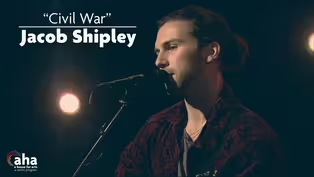
- This next song I'm gonna play is a song called I wrote called Civil War.
I wrote this a little over a year ago after I was walking around of town and I saw my ex.
(laughs) And she went up to me and she goes, "Oh my God, I forgot you existed."
That was fun.
Yeah.
(gentle guitar music) ♪ The calm before the storm ♪ ♪ Is just before you walk in ♪ ♪ The moment when my weapons are all prime ♪ ♪ Prepping for some battle I never win ♪ ♪ Against the inside of my mind ♪ (gentle guitar music continues) ♪ I've been in a good place lately ♪ ♪ Now that you can see or care ♪ ♪ Cause after all this time you just showed up there ♪ ♪ To mess with my mind and to shake my core ♪ ♪ And the Armies inside start to rage again ♪ ♪ Bring me to the brink of my civil war ♪ (gentle guitar music continues) ♪ And here I fight ♪ ♪ And there I clash the walls of dust around me ♪ ♪ Burning deep to us ♪ ♪ And somehow I still want more ♪ ♪ Reaped into and so I crave ♪ ♪ The civil war ♪ (gentle guitar music continues) ♪ And really it's kind of funny ♪ ♪ The way I leap at your call ♪ ♪ The way you say you haven't thought of me at all ♪ ♪ And so I smile hide behind my charms ♪ ♪ While my insides are sounding the alarm ♪ ♪ They call to arms ♪ ♪ And here I fight ♪ ♪ And there I clash the worlds of dust around me ♪ ♪ Burning deep to us ♪ ♪ And somehow I still want more ♪ ♪ Reaped into and so I crave ♪ ♪ The civil war ♪ (gentle guitar music continues) ♪ Civil war ♪ (gentle guitar music continues) ♪ Civil war ♪ (gentle guitar music continues) All right.
This next song I'm gonna play is a song I actually wrote like a month ago on my birthday.
I'm really bad at having birthdays.
Ever since I was a little kid, I would, you know, melt down.
I would have a meltdown every single year.
I just could not handle the pressure.
And it happened again this year, as it does.
And I wrote this song about feeling like I'm not good enough and recognizing, you know the moments when I'm toxic to the people around me and I'm toxic to myself and not wanting to be that way.
This is a tentatively called Boughs At Your Feet.
B-O-U-G-H-S. Like deck the halls with boughs except it's not a Christmas song, you know.
(gentle guitar music) ♪ I've been trying ♪ ♪ To figure out why I run around ♪ ♪ In the same old circles ♪ ♪ With the same peer of house fire ♪ (gentle guitar music continues) ♪ With different times ♪ ♪ And I hear the remains of my childhood lies ♪ (gentle guitar music continues) ♪ You'd think by now out of something to show free ♪ (gentle guitar music continues) ♪ For all the time I put into myself ♪ (gentle guitar music continues) ♪ For all the time I put my own dreams back on the shelf ♪ (gentle guitar music continues) ♪ But let the rains wash away the sins of my divines ♪ (gentle guitar music continues) ♪ And let the light shine in all the places that I hide ♪ ♪ Maybe then I'll find the rose colored glasses ♪ ♪ The welcome settled passes ♪ ♪ Those eye bottom lashes were still out there ♪ ♪ In my furnace stone at your feet ♪ (gentle guitar music continues) ♪ It doesn't need sweet ♪ (gentle guitar music continues) ♪ Still I'm wondering where I'm going ♪ (gentle guitar music continues) ♪ And I'm looking behind ♪ ♪ And I can't see you where I'm coming from ♪ (gentle guitar music continues) ♪ I guess it's hidden in what they all said I'd become ♪ (gentle guitar music continues) ♪ So let the rains wash away the times that I tried ♪ ♪ And let the light shine on all the people I denied ♪ ♪ Maybe then I'll find the answer that's calling ♪ ♪ With all this crystal balling ♪ ♪ But the leaves they keep on falling ♪ ♪ And still I lay my furnace boughs at your feet ♪ (gentle guitar music continues) ♪ And won't it be sweet ♪ (upbeat music) - Thanks for joining us.
For more arts visit wmht.org/aha and be sure to connect with WMHT on social.
I'm Lara Ayad, thanks for watching.
(upbeat music continues) - [Announcer] Funding for aha has been provided by your contribution and by contributions to the WMHT venture fund.
Contributors include Chet and Karen Opalka, Robert and Doris Fischer Malesardi, the Alexander and Marjorie Hover Foundation and The Robison Family Foundation.
- At M and T bank, We understand that the vitality of our communities is crucial to our continued success.
That's why we take an active role in our community.
M and T bank is pleased to support WMHT programming that highlights the arts, and we invite you to do the same.
Video has Closed Captions
Clip: S6 Ep28 | 5m 18s | Fern Apfel loves to collect old envelopes, letters, diaries and paint them on wood panels. (5m 18s)
AHA! 628 | Jacob Shipley: Boughs at Your Feet
Video has Closed Captions
Clip: S6 Ep28 | 3m 59s | Don't miss Jacob Shipley perform "Boughs at Your Feet". (3m 59s)
AHA! 628 | Jacob Shipley: Civil War
Video has Closed Captions
Clip: S6 Ep28 | 3m 30s | Watch singer/songwriter Jacob Shipley perform "Civil War" at WMHT Studios. (3m 30s)
Video has Closed Captions
Preview: S6 Ep28 | 30s | Wood panel painting, Black female empowerment, & Jacob Shipley performs. (30s)
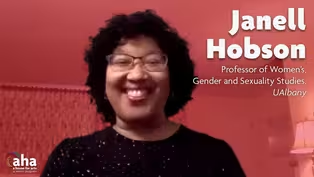
AHA! 628 | Professor Janell Hobson
Video has Closed Captions
Clip: S6 Ep28 | 12m 2s | What do black women, 19th-century French paintings, & Beyonce have in common? (12m 2s)
Providing Support for PBS.org
Learn Moreabout PBS online sponsorship

- Arts and Music
The Best of the Joy of Painting with Bob Ross
A pop icon, Bob Ross offers soothing words of wisdom as he paints captivating landscapes.













Support for PBS provided by:
AHA! A House for Arts is a local public television program presented by WMHT
Support provided by M&T Bank, the Leo Cox Beach Philanthropic Foundation, and is also provided by contributors to the WMHT Venture Fund including Chet and Karen Opalka, Robert & Doris...