
AHA! | 630
Season 6 Episode 30 | 28m 45sVideo has Closed Captions
Celtic roots-inspired paintings, 19th century "VR", & Ireland-inspired music.
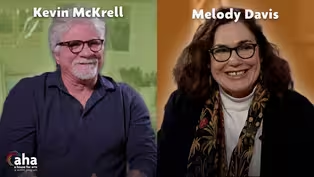
Find out how Kevin McKrell's Celtic roots inspire his portrait paintings. Melody Davis, Associate Professor of Art History at Russell Sage College, discusses her writing and 19th century "virtual reality." Don't miss Kevin McKrell perform songs from his newest album "In Quarantine."
Problems playing video? | Closed Captioning Feedback
Problems playing video? | Closed Captioning Feedback
AHA! A House for Arts is a local public television program presented by WMHT
Support provided by M&T Bank, the Leo Cox Beach Philanthropic Foundation, and is also provided by contributors to the WMHT Venture Fund including Chet and Karen Opalka, Robert & Doris...
AHA! | 630
Season 6 Episode 30 | 28m 45sVideo has Closed Captions
Find out how Kevin McKrell's Celtic roots inspire his portrait paintings. Melody Davis, Associate Professor of Art History at Russell Sage College, discusses her writing and 19th century "virtual reality." Don't miss Kevin McKrell perform songs from his newest album "In Quarantine."
Problems playing video? | Closed Captioning Feedback
How to Watch AHA! A House for Arts
AHA! A House for Arts is available to stream on pbs.org and the free PBS App, available on iPhone, Apple TV, Android TV, Android smartphones, Amazon Fire TV, Amazon Fire Tablet, Roku, Samsung Smart TV, and Vizio.
Providing Support for PBS.org
Learn Moreabout PBS online sponsorship(energetic music) (upbeat music) - [Narrator] Find out how an artist's Celtic roots inspired his portrait painting.
Start seeing doubles with Melody Davis and hear performance by Kevin McKrell.
It's all ahead.
On this episode of AHA, a house for arts.
- [Narrator] Funding for AHA has been provided by your contribution and by contributions to the WMHT venture fund.
Contributors include Chet and Karen Opalka, Robert and Doris Fischer Malisardi, The Alexander & Marjorie Hover Foundation and The Robison Family Foundation.
- At M & T Bank we understand that the vitality of our community is crucial to our continued success.
That is why we take an active role in our community.
M & T Bank is pleased to support WMHT programming that highlights the arts, and we invite you to do the same.
(upbeat music) - Hi, I'm Lara Ayad And this is AHA.
A house for arts.
A place for all things creative.
Let's send it over to Matt Rogowicz for today's field segment.
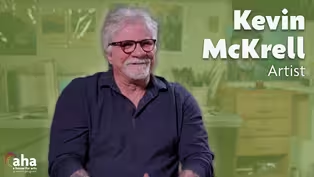
- Many of you may know Kevin McKrell the musician from The McKrells.
But did you know that he is also an oil painter and he's pretty good at it too.
We're here in Saratoga Springs to look at the oil paintings of Kevin McKrell.
Follow me.
♪ Dublin Town, Dublin Town lights come up, sun goes down.
♪ ♪ Shadows are dancing round ♪ ♪ And round with all the lights of Dublin town ♪ ♪ Dublin Town Dublin Town, ♪ - [Kevin] Donnybrook Fair, The McKrells, Carnegie Hall, Lincoln Center, I think that's where people basically know me from, is doing gigs like that.
I've always been able to draw.
It's just one of the things that I did but it didn't really pay any attention to it.
But I'm in my thirties, I got asthma.
um pretty bad and well they also throw me a smoke three packs a day and touring and everything.
My lungs just went, okay, you can't do this anymore.
And gave up on me for awhile.
And while I was recouping, I, I started to because I couldn't do anything.
I started using the Christmas presents that people had been buying me for years that were stacked up in the closet and Ballston Spa the town of Ballston Spa had an art show that you could go and put your stuff out.
And I went and I sold everything.
Of course, I didn't know that you should charge more than 10 bucks for them but they still sold.
People bought them.
And it just kept going from there.
(soulful flute music) - Faces, faces, mostly old guys with hats.
(soulful flute music) - My preference would be to just fill the entire canvas with face.
(soulful flute music) I mean, it's in the eyes really, I suppose.
And I, I that's, that's I can't do a landscape to save my life.
I have tried and I've tried and it just I will do a landscape and then freak out and put big face in the middle of the landscape.
(lively flute music) I like to think of, of, of a painting almost like when I'm writing a song, a story, a story develops.
Um, and, and, what I would like to, I like to do is look at my paintings as if they're just a moment.
What I want people to think of what happened before and what happened after.
So I'll get photo, a photo.
I took an Island or a picture I copped off the internet.
It's just an interesting face.
And I will um, this is part of the thing that, that that I didn't learn in school, is how to get the likeness and exact likeness on the canvas.
There's a grid thing that people do.
And I, I, I just dive in.
(somber country music) - I'll cover the painting with one color And I'll have at it with a rag, which is a constant companion.
Sort of block in some, some, some basic shapes.
And then I dive in and um, unless I'm doing a, a, um, a job of, of of a portrait of someone, which I do, and I'm not real fond of, but you kind of have to.
I just am free with it.
Like as Phil I'm doing now, his mouth wasn't the way it was but I'm looking at the face and going, wow, if I crinkle up his face and do it like that he's gonna look like something's going on.
Like these do like, to me, the two boys in that painting there are having a little private joke.
I've seen it in Irish bars a thousand times where some tourist walks in or somebody walks in and the two fellows at the bar will start making fun of them to themselves.
Look at this one.
(Kevin grunts) the guys in bars all over the world I guess.
I will paint away at it until, I know this is a little weird, but till they talk to me.
When they talk to me, I'm done.
And not until.
(brooding flute music) (upbeat guitar music) - March 17th of last year, we did a show at Caffe Lena And, I had the best year I've had in, well, a very long time coming up.
I had gigs.
Um, theater gigs.
I had the uh, I have two gigs at The Egg coming up.
Um, um, probably the best year I've had since the doing Carnegie Hall, Lincoln Center with, with the old McKrells.
And then everything in the space of, a week went down.
Everything stopped.
So my way of making a living became non-existent.
It didn't become okay, you might not be able to do that but I don't know when performances are going to come back.
Some people say we can do outdoor performances but which I do a lot of festivals and stuff but is that really viable?
(forlon guitar music) - Thank God for, for painting, because I was, I have been able to, I, I used to sell prints on a, on a website, so that works.
I love being able to get up in the morning paint until like two in the morning, sleep get up and do it again over and over again.
It's just, it's a joy.
Um, not really good for any kind of social thing, but I'm, I'm okay with that.
But to be able to perform again, to be able to go out in front of an audience again, would be absolutely wonderful.
I miss it incredibly.
I mean, you look at to try to go glass half full, half empty that I get to spend this much time on my artwork is great but I'd rather, I'd rather be performing.
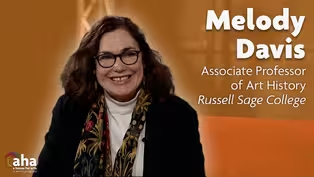
- Melody Davis is an associate professor of art history at Russell Sage college in Troy, New York.
She's also a prolific poet and an expert on virtual reality of the 19th century.
Melody joins me in studio to discuss her work.
Melody, welcome to a house for arts.
It's a pleasure to have you on the show.
- And thanks for having me.
It's a pleasure to be here.
- You have such an eclectic career Melody.
You're a poet and you write books of poetry.
And I understand you teach courses on history of photography and art at Russell Sage college.
- That's correct.
- Tell me a little bit about your newest book Ghost Writer because I understand that it opens up with a personal story about your aging mother but it's ultimately kind of a larger story about the ghosts that we all live with.
Do I have that right?
- I think you have it that exactly right.
- So, so tell us a little bit then about Ghost Writer.
- Of course.
I mean, ghosts, I don't believe in spectral bodies floating around saying boo, but memory.
We all work with memory, right?
And in times of stress, some times haunting memories can visit us.
And that's what happened with me.
My mother died of Alzheimer's in 2019, and the last four years were particularly difficult.
Anyone who has been a caretaker for someone with Alzheimer's knows how horrible the disease is.
And as I, I'm an only child, I was an only child.
And so I really didn't, you know, my family were supportive but nobody really knew what it was like because the past comes and sits with you literally sits with you - Like ghosts do.
- Like ghosts do.
So for me, that past was myself at age eight.
And right after she had had an operation, it was a very difficult time, very difficult.
I saw myself now I'm not psychotic, but I projected myself.
I kind of fictional me at age eight, sitting there right beside me And holding my hand.
So that was obviously a comfort for me.
It was kind of doubling up myself because who else would know?
- Yeah I mean, but - Yeah, I was an only child.
- Right.
- And then , it was so difficult that I um, just the poems just flowed out of me.
And then the little girl I call her the little girl, she emerged as character.
So the first part of the book is a three-way conversation between the little girl, my mom and myself.
Sometimes mom dictates all the poems.
Sometimes I do.
Sometimes a little girl comes in.
Now it really wasn't myself.
As I was at age eight, it was the way per perhaps I wanted to be.
I projected back.
So she was much smarter, wiser and way snarkier than I ever was.
(Melody laughs) - Well, we all do this right?
When we deal, especially when we deal with really big challenges or difficult situations we have to kind of imagine a part of ourselves as something that can kind of be our inner companion and sort of help us step through these difficult situations.
- So you have your own little girl?
- Oh, I think we all have our own little girls or little, little boys, right?
No, I mean, that's absolutely true.
- A psychologist told me that.
He said that that's a, a, a form of therapy - Right - Is to imagine yourself at an earlier time and you're sitting with yourself and that person is kind of coaching you through.
- Absolutely.
I think many of us can relate to that and, you know kind of stemming a bit from that very difficult story that difficult experience that you shared with us.
There's also a poem in particular in that book too called Hor d'Oeuvrerie.
I'm so sorry for my pronunciation but I understand that this is about the ghosts of nine 11, - Yes it is.
- Right?
- I want to move a little forward too in time in history and think about, do you think Melody that this viral pandemic we're all living through right now do you think it brings about its own set of ghosts both on literal and symbolic levels?
- Sure.
It has.
And I'm sure it will.
I just found out this week two days ago that my own daughter has COVID.
She's okay.
She's being well taken care of, but yes I'm worried.
Who wouldn't be?
Right.
So many people are dying.
It's heartbreaking.
So many people are missing their loved ones.
It's horrible.
I think all of us are in a state of mourning.
And even if we haven't lost someone.
I think we feel like we are in mourning.
You wake up and say, why am I so sad today?
What's gon on that I should be so sad.
It's mourning.
- Yeah.
- So yes, a sense of loss brings a kind of reflection and a reflection brings a kind of distillation of the experience.
So when I talk about ghosting I'm I'm talking about memories that haunt, that, that reoccur.
So for me, at least as a writer there has to be a bit of space.
A bit of time as that distillation process happens.
It's very akin to say writing history in a way there's certain moments that come out and that repeat themselves in your memory.
And you can't forget about this moment or that moment.
We have certain photographs, in our collective consciousness that seem to distill or encapsulate a particular moment to those that are haunting to us.
- Right?
I want to come back actually to this idea of memory and, and thinking about art more widely because if poetry helps you sort of distill a memory and then make it alive again by revisiting it and having that sort of inner companion beside you like you were mentioning before, do you think that visual art also gives us a language to do that?
Like, do you see connection at all between what you do as a poet and what you teach in terms of the history of art and photography in the classroom or what you write about?
- Absolutely.
I mean, that's one of the functions of art to distill memory, to commemorate to be a form where collective consciousness can settle.
So that even if it is a fictitious form say in painting, for instance, before we had photography that's how people would record, recollect things.
How we would come into a kind of collective agreement of yes, that is how it was so, right?
So these forms are of course imagined with painting but they're also crystallizations of what a society wishes to believe had happened.
Photography does that too.
Although we often mistake photography for the real but it's still very much it seems more real because it, it has real details but it's just a con construct that crystallizes a moment.
- So let's talk a little bit of then about photography and about these still images.
I understand you also brought some, some different sort of tools and implements for us to look at - Artifacts - Which is fantastic.
Yeah, artifacts.
So I know you've also written a book earlier on, called Women's Views and it's all about this the 19th century stereograph.
So I understand here you have a stereoscope, right?
- I have a stereoscope.
- Okay.
So what is this?
Because it shows a double image on a card, right?
And you've got the sort of implement that you look into and you can move the card back and forth.
Melody, is this, is this like the infamous early version of the selfie.
Like what are we looking at?
(Melody laughs) - What is a stereoscope?
- A selfie, no, it's not a selfie, A selfie is a self portrait and it got to be really popular once cell phones became a bit quintus and we could just do like this and commemorate ourselves everywhere, right?
Make artifacts of our own face constantly.
This is not a selfie.
These are two photographs that are taken from a distance separation of 2.5 inches.
And that mimics the inter ocular distance.
That is the distance between the pupils of the eyes.
So it works as our eyes do.
And what happens when you put it in the stereoscope or if you're just free viewed, by the way free viewing is simply crossing your eyes.
You can see these in 3D, this is 3D photography.
- So who would have used this in the 19th century?
Like where would these have been used or displayed like what's going on?
- It would have been in homes.
- Okay.
- This was a product for the home.
And what I write about is a particular type of stereograph.
I call it the narrative stereograph, but you might call it a genre scene, a Tableau Revault, comics and sentimentals.
They tell a story, they show a scene, like a theatrical scene.
And I write about these works from an America from 1870 to 1910.
Is the operative dates.
And these were products for the home.
They were commercial photographs produced by companies and they were big companies and they were sold to the home.
- So, this is making me think, you know we're inundated nowadays with photographs and video clips on Instagram and social media, of people, you know they're like taking videos of themselves going, you know trying a new recipe or a new makeup look or is, you know, what can, what can scrolling through somebody's Instagram feed today, tell us about, say how people want to be seen by others like this presentation you're talking about or maybe even the role of women in society today.
- Well, I'm rarely on Instagram, so I'm not gonna answer to that, but I do get on Facebook and yes it's an entertainment.
It's a release.
It's, it's a laugh.
These were comical.
They were sentimental.
They were scenes that sold well.
And when they sold, well, they would make new, more titles and the same type in the same genre, right and the same kind and the company's proliferated.
So they knew very, very well what people wanted to look at at who to sell to and how sell to them.
- And that's what advertisers do today.
- Yes, they were.
These were marketed and the target market was women at home.
They did sell to men too.
I don't want to say that men never bought these.
Of course they did.
I always sell to anybody who wanted to buy them but their target market was women at home.
So they knew what women wanted to see and they knew how to place the product in the home so that it could be interesting, exciting, lively and still remain with the family.
So there are, there's a whole genre of erotic scenes.
For instance, Don't get too excited, Rodek's got all the clothes on (Lara laughs) but, it's coded, it's coded.
So the kids won't know what was happening but you know, as an adult by reading the title and being able to read the signs, Oh I see what's happening, right.
So it's fascinating.
It was definitely a measure of women's tastes and acceptability and desires and how they wanted to see themselves.
So, - Do you think that, do you think that some social media feeds kind of indicate that too, that it shows maybe women's tastes today?
- Oh, yes.
I'm sure.
- And about themselves?
- That's not my area.
So I don't want to say anymore, but you know, absolutely.
I mean, isn't that what social media does?
I mean, that's, it's kind of purpose is to show us ourselves and variations of ourselves and how we settle into groups.
And then, then we have the dangers of that too.
- Right.
- As we have recently seen this last month when misinformation becomes like a cult - And becomes a part of that kind of personality, - Becomes a cult - And personality online, - We only want information from one source - Right - And that's a terrible danger, as we have seen.
- And it sounds like your research has a lot of cultural and political relevance today.
Melody.
Thank you so much for being on house for arts.
It was a real pleasure.
- Thank you for having me, it's been a pleasure to be here.
- Please welcome, Kevin Mckrell.
- Hi out there.
My name is Kevin Mckrell.
These songs I'm gonna do for ya, are of my newest CD, CD called In Quarantine.
First one is a song I wrote while wandering Dublin city, at, just as the night was falling.
And I was walking.
I was missing home and um, walked through down along the Liffey up to Christ church and down through Grafton street.
And then back to my hotel.
And this song came to me as I was wandering around.
It's called Dublin Town.
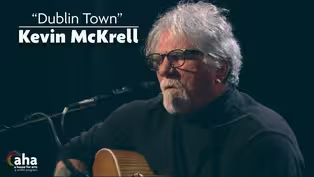
(guitar music) ♪ Dublin Town, Dublin Town lights come up, sun goes down.
♪ ♪ Shadows are dancing round and round ♪ ♪ With all the lights of Dublin town ♪ ♪ Dublin Town Dublin Town my head is spinning round ♪ ♪ And round.
♪ ♪ I'm staggering up, staggering down ♪ ♪ Through the lights of Dublin town.
♪ ♪ Oh oh oh ♪ ♪ Oh oh oh ♪ ♪ All the lights of Dublin town they sparkle like the stars.
♪ ♪ Reflecting off the Liffey as I wonder where you are.
♪ ♪ My only friends are whiskey, this beat, ♪ ♪ This beat old guitar.
♪ ♪ And the lights of Dublin town that sparkle like the stars ♪ ♪ Dublin Town, Dublin Town lights come up, sun goes down.
♪ ♪ Shadows are dancing round and round with all the lights ♪ ♪ Of Dublin town ♪ ♪ Dublin Town Dublin Town my head is spinning round ♪ ♪ And round.
♪ ♪ I'm staggering up, staggering down, ♪ ♪ With the lights of Dublin town ♪ ♪ Oh oh oh ♪ ♪ Oh oh oh ♪ ♪ All the lights of Dublin Town they shimmer gold and blue ♪ ♪ I wander up by Christ Church, my only thoughts are of you.
♪ ♪ On Grafton Street a busker draws me from my solitude ♪ ♪ As the lights of Dublin town they shimmer gold and blue ♪ ♪ Dublin Town, Dublin Town lights come up, sun goes down.
♪ ♪ Shadows are dancing round and round, ♪ ♪ With all the lights of Dublin town ♪ ♪ Dublin Town Dublin Town my head is spinning round ♪ ♪ And round.
♪ ♪ I'm staggering up, ♪ ♪ Staggering down through the lights of Dublin town ♪ ♪ Oh oh oh ♪ ♪ Oh oh oh ♪ ♪ All the lights of Dublin town tell me to go home.
♪ ♪ Not to seek my fortune across the broad Atlantic foam.
♪ ♪ But to find some peace in the arms ♪ ♪ Of the only, only love I've ever known.
♪ ♪ As the lights of Dublin town they tell me to go home ♪ ♪ Dublin Town, Dublin Town lights come up, sun goes down.
♪ ♪ Shadows are dancing round and round with all the lights ♪ ♪ Of Dublin town ♪ ♪ Dublin Town Dublin Town my head is spinning round ♪ ♪ And round.
♪ ♪ I'm staggering up, ♪ ♪ Staggering down through the lights of Dublin town ♪ ♪ Oh, Oh, Oh, ♪ ♪ Oh oh oh ♪ - This next tune am gonna do for you is a song called Home in Donegal I love going to Donegal.
It's it's just one of my favorite places in the world.
And I wrote this with a thought in mind of a of an Irish fellow coming over to the US to, just to, you know, young fellow to come over to, to have a bit of adventure bit of craic, which for those of you who don't know is Irish term for fun.
It's spelled c-r-a-i-c, it's not any, any other crack but as I said, it's called a Home in Donegal (soulful guitar music) ♪ Wished that I was home in Donegal ♪ ♪ To be with you beside the sea ♪ ♪ To hear your sweet voice calling me ♪ ♪ Back to my home in Donegal ♪ ♪ He walks upon the streets of New Orleans, ♪ ♪ There is a strange and ♪ ♪ Unfamiliar look to every face he sees, ♪ ♪ He came here for the money, the adventure, and a craic.
♪ ♪ Now all he ever thinks about, ♪ ♪ Someday going back, ♪ ♪ Wish that I was home in Donegal ♪ ♪ To be with you beside the sea ♪ ♪ To hear your sweet voice calling me ♪ ♪ Back to my home in Donegal ♪ ♪ Well he misses all his family and friends.
♪ ♪ There are times he'd give all he has, ♪ ♪ just to be with them again, ♪ ♪ be farney young ones, move away.
♪ ♪ Before the old ones are all gone ♪ ♪ For in his heart he realizes, he's been away too long ♪ ♪ I wish that I was home in Donegal ♪ ♪ To be with you beside the sea, ♪ ♪ To hear your sweet voice calling me ♪ ♪ Back to my home in Donegal ♪ ♪ Sometimes he's there he's dreaming.
♪ ♪ In the night ♪ ♪ He'll get a job of extra work.
♪ ♪ He'll save the money for the flight ♪ ♪ But lonely dreams and darkness disappear before the dark ♪ ♪ Familiar faces fade away, ♪ ♪ All the dreams are gone ♪ ♪ Wish that I was home in Donegal ♪ ♪ To be with you beside the sea.
♪ ♪ To hear you sweet voice, calling me, ♪ ♪ Back to my home in Donegal ♪ ♪ Wish that I was home in Donegal ♪ ♪ To be with you beside the sea ♪ ♪ To hear your sweet voice calling me ♪ ♪ Back to my home in Donegal ♪ ♪ Back to my home in Donegal ♪ (upbeat music) - Thanks for joining us.
For more arts visit wmht.org/aha and be sure to connect with WMHT on social.
I'm Lara Ayad Thanks for watching (soft bluesy music) (soft orchestral music) - [Narrator] Funding for AHA has been provided by your contribution and by contributions to the WMHT venture fund.
Contributors include Chet and Karen Opalka, Robert and Doris Fischer Malisardi, The Alexander & Marjorie Hover Foundation and The Robison Family Foundation.
- At M & T Bank we understand that the vitality of our community is crucial to our continued success.
That is why we take an active role in our community.
M & T Bank is pleased to support WMHT programming, that highlights the arts, and we invite you to do the same.
AHA! 630 | Artist Kevin McKrell
Video has Closed Captions
Clip: S6 Ep30 | 6m 5s | Join producer Matt Rogowicz on a trip to Kevin McKrell's studio in Saratoga Springs. (6m 5s)
AHA! 630 | Kevin McKrell "Dublin Town"
Video has Closed Captions
Clip: S6 Ep30 | 4m 27s | Don't miss Kevin McKrell perform "Dublin Town" from his newest album "In Quarantine." (4m 27s)
AHA! 630 | Kevin McKrell "Home In Donegal"
Video has Closed Captions
Clip: S6 Ep30 | 4m 16s | Don't miss Kevin McKrell perform "Home In Donegal" from his newest album "In Quarantine." (4m 16s)
Video has Closed Captions
Clip: S6 Ep30 | 11m 5s | Start seeing double with Melody Davis. (11m 5s)
Video has Closed Captions
Preview: S6 Ep30 | 30s | Celtic roots-inspired paintings, 19th century "VR", & Ireland-inspired music. (30s)
Providing Support for PBS.org
Learn Moreabout PBS online sponsorship

- Arts and Music
The Best of the Joy of Painting with Bob Ross
A pop icon, Bob Ross offers soothing words of wisdom as he paints captivating landscapes.












Support for PBS provided by:
AHA! A House for Arts is a local public television program presented by WMHT
Support provided by M&T Bank, the Leo Cox Beach Philanthropic Foundation, and is also provided by contributors to the WMHT Venture Fund including Chet and Karen Opalka, Robert & Doris...