
AHA! | 704
Season 7 Episode 4 | 26m 46sVideo has Closed Captions
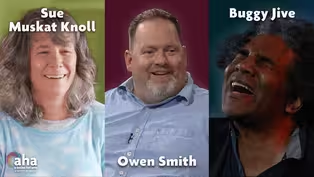
Sue Muskat Knoll's colorful layers. Owen Smith on quality theater. A song by Buggy Jive.
Artist Sue Knoll bathes iconic imagery in colorful layers. Park Playhouse's Owen Smith talks about making theater accessible to all. And enjoy a performance from Buggy Jive.
Problems playing video? | Closed Captioning Feedback
Problems playing video? | Closed Captioning Feedback
AHA! A House for Arts is a local public television program presented by WMHT
Support provided by M&T Bank, the Leo Cox Beach Philanthropic Foundation, and is also provided by contributors to the WMHT Venture Fund including Chet and Karen Opalka, Robert & Doris...
AHA! | 704
Season 7 Episode 4 | 26m 46sVideo has Closed Captions
Artist Sue Knoll bathes iconic imagery in colorful layers. Park Playhouse's Owen Smith talks about making theater accessible to all. And enjoy a performance from Buggy Jive.
Problems playing video? | Closed Captioning Feedback
How to Watch AHA! A House for Arts
AHA! A House for Arts is available to stream on pbs.org and the free PBS App, available on iPhone, Apple TV, Android TV, Android smartphones, Amazon Fire TV, Amazon Fire Tablet, Roku, Samsung Smart TV, and Vizio.
Providing Support for PBS.org
Learn Moreabout PBS online sponsorship(gentle music) (bright music) - [Lara] Sue Knoll, baits iconic imagery in colorful new layers.
Park Playhouse director, Owen Smith, makes quality theater accessible to all.
And catch a performance from Buggy Jive.
It's all ahead on this episode of AHA, A House for Arts.
- [Narrator] Funding for AHA has been provided by your contribution and by contributions to the WMHT venture fund.
Contributors include the Leo Cox Beach Philanthropic Foundation, Chet and Karen Opalka, Robert and Doris Fisher Malesardi, the Alexander & Marjorie Hover Foundation, and the Robison Family Foundation.
- At M&T Bank, we understand that the vitality of our communities is crucial to our continued success.
That's why we take an active role in our community.
M&T Bank is pleased to support WMHT programming that highlights the arts, and we invite you to do the same.
(bright music) - Hi, I'm Laura Ayad and this is AHA, A House for Arts.
A place for all things creative.
Here's Matt Rogowicz with today's Field Segment.
(gentle calming music) - I'm here at Stevens Pond in Monterrey, Massachusetts, to look at the studio of painter, Sue Muskat Knoll.
Follow me.
Sue?
- Hi there.
- Hi, nice to meet you.
- So nice to meet you.
- Wow, look at this.
(gentle soothing music) - I realized at a very young age that I love making things.
And I studied art in college, but it wasn't until I moved to Italy that I met this guy who got a Fulbright to go to Florence and started an art center.
And there, he gave me a job and he also mentored me, showed me how to find the best pigments and how to grind oil paint.
I lived there for a few years and I really studied art.
And I came back to the States as an artist.
I moved here from lower Manhattan with a baby.
So there was a lot of sewing going on for the first seven years.
And then I started working in gouache on paper, just small things that I could execute.
(playful music) Gouache is a highly-pigmented water-based paint.
It can be a little bit tricky because it can crack and it doesn't have the plasticity of acrylic, but it's velvety.
So there is that seductive quality to gouache.
Holbein came out with a new product, maybe like, I don't know how many years ago, where it's acrylic wash, where they add just enough acrylic into the gouache to create a paint that's a little bit more durable, less cracky, a little bit more plastic, but still retain some of that velvet quality.
And it's highly opaque, which is great.
(bright music) - I think the very first one I did was a space capsule, and then the second one was R2D2 and that was really fun.
It's such an iconic image and an ingrained part of our culture, and it's something that everyone recognizes.
And it was just nice to play with it in terms of the colors I would choose and how I presented.
Sometimes it's an homage or a dedication to a great design or just something that catches my imagination.
(dramatic music) There's an Assyrian relief that I recently did, I think it was last year, of the Chaos Monster being hunted down by the Sun God.
And I really liked that when I was over in New Haven, I was really looking at some of their earliest Syrian.
They've got a couple of earliest Syrian reliefs, and they're just incredible.
They're so amazing.
Right now, I'm working on a series that I just started that's a little bit more organic and nature-based, but I'm also coupling that with text-based works where I'm finding phrases that interest me and repeating them.
(jazz music) Well, the text work, it started right when the pandemic hit.
And then I was like, oh, beep.
Sorry.
And so I just started writing house, house, house, house, house, house, house, house, and I was thinking a little bit of, you know, James Sienna did a series of work using typewriters and just, I don't know, it was somewhere in the back of my mind.
And then from there I was like, hey, you know, that's kind of cool.
It's like this new structure, a system, a way that I can just feel free to experiment with shapes and colors and wordplay.
I make my own grain, yeah.
With very sharp pencil (laughing).
And it takes me pretty much all day to make the grid.
I'll go 1/16 of an inch across and then down.
And I know basically for most pieces, it's gonna be just a little bit longer than it is wide, but I'm just basically guessing.
And then I'll figure out the lettering and how many letters will it be across, or how many 1/16 of an inch spaces will it require in order for me to start my phrase and then end it with the first letter of the phrase so that I start with the second letter so that it reads down as well.
I don't find it tedious at all.
I find it very relaxing and meditative.
(gentle soothing music) I had started with these kind of, you know, I don't know what they are, bubbly.
They're based on the skin of a chameleon.
There's a certain way that the light hits the cells and creates this incredible color.
And the patterns are just so astounding.
It started with that, and then I started thinking more like structurally, like I was getting into volume for the first time, which I hadn't been addressing in these earlier paintings.
It's kind of like a tail.
And the whole Fibonacci golden ratio aspect of it appealed to me and just the challenge of getting through it, and that's something that's bigger.
It requires a little bit more dedication stick to it.
It's the color, the tone, and the shapes that create the volume.
You'll see that things bend around, and the way that they're drawn and then using the tones from light to dark, that will create another element to the volume of it, and then the color.
I am so deeply appreciative of the creative process.
It's just so fun.
I love the challenge.
It's so challenging.
It's like pieces of the puzzle, you just got to keep putting them together and putting them together until it works.
And I won't stop until I feel like it's as good as I can make it.
- Owen Smith is the producing artistic director of the Playhouse Stage Company.
Against a backdrop of rising ticket prices at theaters across New York, Park Playhouse helped reopen the Historic Cohoes Musical and produces summer shows in Albany that are free for everyone to enjoy.
I sat down with Owen to find out what challenges theater companies are facing in the wake of COVID and to learn more about their upcoming production of "Matilda."
Owen, welcome to A House for Arts.
It's a pleasure to have you.
- It's a pleasure to be here, thanks so much.
- I know you've spent over 15 years working behind the scenes at theaters across New York such as Clockwork and Theater for a New Audience, and now you're celebrating over 11 years as producing artistic director of Park Playhouse in the capital region.
- Yeah.
- Congratulations.
- Thank you.
It's exciting to have been at it for this long and to still feel like we're making progress and making new and exciting things happen.
But you know for me coming back, it was really a homecoming.
When I returned to the area from my work in New York city and other places, I grew up in the Park Playhouse program.
It was 24 years ago that I entered the student program in the summer.
And so to be able to do what I love in a region that I love, and that really was my hometown is just so gratifying.
- So it's like you have your roots at this place.
- [Owen] Absolutely.
- So besides that, and we can kind of come back to that too, and what Park Playhouse is doing, what makes it so remarkable as a theater venue?
- The Park Playhouse venue, we now refer to ourselves as Playhouse Stage Company because we're in the park, we're at the Historical Cohoes Musical that we manage, we're in schools throughout the region.
But that venue, the first thing is that it's outdoors.
Of course it comes with some trouble, what should I say?
(both laughing) You take the good with the bad.
- Some challenges.
Right, right, right.
- When you're dealing with the weather and then that, but on a picturesque night, there's nothing like sitting out under the stars and seeing a show.
But I think what makes it truly special is that it is so accessible.
We have our entire lawn seating offered for free.
We've done that for 33 years, of course that- - And that's at the Washington Park location in Albany, right?
- That's correct.
The amphitheater lawn seating is free.
We can accommodate up to 1500 people for free.
What that means is that the barrier to access is completely broken down.
Anyone, regardless of the money they have in their pocket can come and enjoy a piece of live performing arts entertainment on a beautiful summer night.
And it's just such a great thing.
- This is amazing.
I mean, how does that compare to some other theater venues in the area, including Broadway and off-Broadway, I know sometimes there are Broadway shows that tour around parts of like downstate and upstate New York.
How does Playhouse compare to that?
- Well, when it was founded the tagline was, Broadway in Albany's backyard.
And we try to live up to that.
We really try despite the fact that the majority of people are sitting there for free, we really try to produce a quality product that matches or meets that Broadway standard.
And the differences is that if you go down to New York, at this point, you're looking at an average ticket price on Broadway hovering like that $130 range.
Even the touring shows that come to Proctors or The Palace or any of the other touring venues in the area, you're still looking at paying 75, $100 to go see a show, and that's understandable.
Theater is expensive to produce.
My concern is, do we price out part of the population with ticket prices going so sky-high?
You look at something like Hamilton and the theaters having this wonderful Renaissance of popularity, but are we leaving people behind because it's become such a high value ticket price?
- And it's one thing for one person to pay $75, but if you wanna bring a small family, if you wanna bring your partner or some friends, it becomes really prohibitive, right?
- Absolutely.
The nice thing at our venue, you do see a lot of families coming in.
A family of four, a family of six, whatever it might be.
And for those kids, it's very likely the first exposure that they're gonna have to the live theater, and for some folks who may not have the disposable income to even go to other community theaters and pay 30 bucks or whatever the case may be.
It may be the only piece of live theater that they see all year round.
So we think it's just tremendously important to keep that mission going to make sure that we have that free accessible seating and we're gonna keep it up.
- That's amazing.
I know Owen that you have a degree in theater from SUNY New Paltz, right?
How did you know that you wanted to work in theater?
Was there like a particular moment for you where you just knew?
- Yeah.
To a certain extent, it was kind of deemed by the gods when I broke one knee playing soccer, and then after seven months of rehabbing, broke the same bone on the other knee.
- [Lara] They were trying to tell you something.
- Yeah, athletics was not gonna be for me.
I was lucky enough to get exposed to theater in high school.
I had some really great teachers.
Of course, then I joined the Park Playhouse youth theater program.
And what I found is just that there's a sense of community, there's a sense of acceptance, there's a sense of collaboration that exists in the arts that it's just not as present in athletics or at least it wasn't for me.
And so I felt that I had found a home and I decided to go to school for it and study it.
I'm just so lucky that it's been my life's work.
And in returning to Park Playhouse to run the organization, that's a big part of the reason why I've tried to really focus on the educational programming.
It's the biggest piece of our budget.
We do multiple productions for students throughout the years, we bring shows to schools in all eight counties of the capital region, professional touring musicals, to give kids that exposure in their classrooms.
- So in addition to being free at the Washington Park location, you also bring it over to kids when they're at school, they're in the middle of the school day.
It's like you're just kind of like really breaking down these barriers to access.
- Yeah, absolutely.
- Which is amazing.
- And I 'll meet them where they live.
These kids are in school.
And again, especially in some of the more rural communities, there may not be any exposure to the theater arts.
And you never know what kid is going to be watching your stuff, if it's in their school auditorium, whatever the case may be, and get bit by that bug, and all of a sudden they are finding a passion, a hobby, and maybe even a career path that they didn't know about beforehand.
- Yeah.
What do you think are some challenges that theater venues are facing right now, especially in the wake of COVID-19?
- The financial piece is very challenging coming back from COVID-19.
We've all been in the industry going after whatever funding we can get.
The Small Business Administration has been slowly but surely getting the shuttered venue operators grant funding out there.
But being able to reopen under the circumstances we've all faced has been really challenging, but I think more globally and in the longterm, folks spent a year inside watching Netflix, watching Hulu, watching Prime, whatever.
- I kinda still do.
- Yeah, me too.
(Lara laughing) Me too.
And there's nothing against it, but there's also nothing like the dynamism of the connection between performer and audience when you're live.
And so it's the challenge of getting people back out of the house, retraining them to go to the theater, to feel safe going to the theater.
I think it's gonna be interesting to see what audience dynamics look like for a while.
And again, I go back to, it's expensive to produce theater, and so you try to make as much money on your ticket sales as you can, but you wanna make sure you're not pricing out any population.
And so that's why all of us in the arts are always out there trying to raise money and get support for our work so that we can have contributed support to support that earned revenue.
- What do you think are some institutions or larger corporate bodies that... Could they play a role in helping sort of alleviate this tension?
Because that sounds really difficult when you're trying to make the arts accessible, but you're also trying to make sure that you can pay your staff and feed yourself and your family.
What can individuals and what can companies do to really help this?
- I think it's natural for people to be focused on food insecurity, it's natural for people to be focused on health and human services causes.
I encourage folks to also remember that the arts need their support as well.
And that it's part of what makes our community vibrant.
And it also has a significant impact on economic development.
We are very lucky in this region that we have a number of corporations that really do step up and support the arts.
Whether it's Albany Medical Center who's our lead sponsor, KeyBank, M&T bank.
I could go on and on, National Grid.
And you see these companies' names on artistic ventures and it goes a long way.
It's really meaningful to have their support.
And I hope that folks remember when they're supporting the arts, they're not just supporting community development, they're supporting economic development.
We see it at the Cohoes Music Hall, Remsen Street in Cohoes has just seen this- - 'Cause you're managing the music hall now since 2017?
- We are, we've been doing shows there since actually the end of 2016, and now as of this past August, we became the official management entity.
And we've seen over that period of time that we've been doing shows there, this incredible growth and redevelopment of Remsen Street, because the music hall is really this anchor that brings people into town.
So there's all these good restaurants- - People go to see shows, they go out to eat.
It's not this trickle down effect where you fund and then maybe it'll get to the arts.
It's more that the arts are actually generating money from the ground up.
- Absolutely, they are a sort of catalyst, they are.
Every dollar spent on tickets at my venue is going to spur dollars being spent in small businesses, restaurants all around the venue.
- That's amazing.
I'm kind of wondering what...
I know you have some famous productions and shows that have just taken place or are coming up such as, "Sweeney Todd," "Matilda", "Alice in Wonderland."
Tell us a little bit about what we can expect, any important shows or programs that are coming up at Playhouse.
- Yeah.
At the music hall, the thing we really want audiences to know is that even though we're a theater company at heart, they can still expect to see concerts, comedy events, of diverse array of artistic programming at that hall.
And our fall calendar is getting really busy, but we're very excited at this point because our next show to open at Park Playhouse, running August 3rd to the 14th is "Matilda the Musical," and it's of course based on the very famous Roald Dahl children's novel.
I just feel right now after this last year, it was such a contentious election and more and more on social media.
Kids have to navigate a really tough world when it comes to bullying.
- And they're stuck online too because of COVID, they couldn't even meet together in person.
So they literally could only interact with each other online, right?
- That's right.
And so this show really tells a story that's about overcoming bullying, accepting who you are, building the people around you up as opposed to breaking them down.
And so I think it's a great message for kids.
And again, at a price that you can't beat, it's free.
Parents can bring their kids to this show knowing that it's a really wholesome entertaining evening and you can't beat the price.
- And who's playing in "Matilda?"
Tell me a little bit about some of these performers and actors.
- We have some professionals that are up there.
There's a wonderful actor named Chris Frazier, who was in our production of "Sweeney Todd," he was in our production of "Damn Yankees," and he's gotten great reviews throughout his time with us.
He's playing Miss Trunchbull, the headmistress or the head of the school.
But what's really special about it is that the cast is made up mostly of students, students in our program.
Some of these kids are nine and 10 years old playing the children in "Matilda," who are gonna get out there in front of an audience of 1500, 1600, sometimes even 2000 people.
- [Lara] Incredible.
- What an incredible opportunity for them.
But we feel blessed because they're so gifted.
We have such youth talent in this region.
We see it as our mission and purpose to steward that talent along.
And we've seen kids go on to great success from our program.
The kids in the audience have the opportunity to see themselves on our stage by way of our students.
That's just the most exciting thing to me.
- That sounds like it.
It really sounds amazing.
Where can people learn more about the upcoming programs and buy tickets for shows like "Matilda?"
- Sure, they can visit us online at playhousestage.org.
They can also get us at thecohoesmusichall.org.
- Sounds amazing.
Again, thank you so much, Owen, for being on AHA.
It was such a pleasure to have you.
- My pleasure, thanks so much.
- Please welcome Buggy Jive.
♪ He can do this no more ♪ ♪ Broken chords and melodies scattered on the floor ♪ ♪ The brother used to be a hit machine ♪ ♪ All he got left is one last chorus with a silly metaphor ♪ ♪ In a singles market all sales are final ♪ ♪ He's been wasting his time trying to download vinyl ♪ ♪ He's on the wrong side of 45 ♪ ♪ He's on the B-side ♪ ♪ Nine times five at the nine to five ♪ ♪ He is much less alive ♪ ♪ The brother wish he had a time machine ♪ ♪ But the truth is he was singing ♪ ♪ About exactly the little same thing when he was 29 ♪ ♪ In a singles market all sales are final ♪ ♪ He's been wasting his time trying to download vinyl ♪ ♪ He's on the wrong side of 45 ♪ ♪ He's on the B-side ♪ ♪ Tick tock, tick tock, tick tock, tick tock ♪ ♪ Most days he is out of his element ♪ ♪ Most days he is wishing he was still relevant ♪ ♪ Most days a brother just wanna scream ♪ ♪ What's the use of screaming out melody ♪ ♪ If you ain't got means to be selling it ♪ ♪ In a singles market all sales are final ♪ ♪ He's been wasting his time trying to download vinyl ♪ ♪ He's on the wrong side of 45 ♪ ♪ He's on the wrong side of 45 ♪ ♪ He's on the wrong side of 45 ♪ ♪ He's on the B-side ♪ ♪ Round and round turntable deejay spin ♪ ♪ Hot songs in the key of life and Francis Scott ♪ ♪ But if a mic drops in a tight spot ♪ ♪ Can I make it online with my hip-hop rock ♪ ♪ Can I get a B-side to the top of the pops ♪ ♪ Like Bill Haley did with "Rock Around the Clock" ♪ ♪ Like the Righteous Brothers with "Unchained Melody" ♪ ♪ Like "Green Onions" for Booker T. And the M.G.s ♪ ♪ Like, Sly Stone "Wanna Take You Higher" ♪ ♪ Or the Rolling Stones with "Play with Fire" ♪ ♪ Or the Stones again with "Ruby Tuesday" ♪ ♪ Oh God, like Rod with "Maggie May" ♪ ♪ Or the Beach Boys with "God Only Knows" ♪ ♪ And I know, I know, I know, I know, I know ♪ ♪ Like, Bill Withers, "Ain't No Sunshine" ♪ ♪ Credence, "Bad Moon on the Rise" ♪ ♪ All B-sides, no lie ♪ ♪ They was all B-sides, no lie ♪ ♪ They was all B-sides ♪ ♪ Believe it or not, Mr Lafayette hard rock like Lancelot ♪ ♪ See you can swing in the wings at a fixed rate ♪ ♪ Or you can blow a Broadway with a mixtape ♪ ♪ I could stay at home and sit on it ♪ ♪ Or crack Albany's egg and make a omelet ♪ ♪ That's what a brother pray for ♪ ♪ See that's what a brother pray for ♪ ♪ To flip night into day and like Gloria Gaynor survive ♪ ♪ On the B-side ♪ ♪ So I'm gonna survive, yeah ♪ ♪ I'm gonna survive, yeah ♪ ♪ I'm gonna survive, yeah ♪ ♪ I'm gonna survive ♪ ♪ Hey, hey ♪ (bright music) - Thanks for joining us.
For more arts, visit wmht.org/aha and be sure to connect with WMHT on social.
I'm Lara Ayad.
Thanks for watching.
(gentle soothing music) - [Narrator] Funding for AHA has been provided by your contribution and by contributions to the WMHT venture fund.
Contributors include The Leo Cox Beach Philanthropic Foundation, Chet and Karen Opalka, Robert and Doris Fischer Malisardi, The Alexander & Marjorie Hover Foundation, and The Robison Family Foundation.
- At M&T Bank we understand that the vitality of our community is crucial to our continued success.
That's why we take an active role in our community.
M&T Bank is pleased to support WMHT programming that highlights the arts, and we invite you to do the same.
Video has Closed Captions
Preview: S7 Ep4 | 30s | Sue Muskat Knoll's colorful layers. Owen Smith on quality theater. A song by Buggy Jive. (30s)
AHA! 704 | Sue Muskat Knoll's Iconic Imagery
Video has Closed Captions
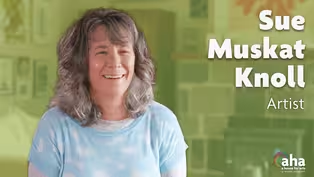
Clip: S7 Ep4 | 6m 50s | Sue Muskat Knoll bathes iconic imagery, like R2D2, in colorful new layers. (6m 50s)
Providing Support for PBS.org
Learn Moreabout PBS online sponsorship

- Arts and Music
The Best of the Joy of Painting with Bob Ross
A pop icon, Bob Ross offers soothing words of wisdom as he paints captivating landscapes.












Support for PBS provided by:
AHA! A House for Arts is a local public television program presented by WMHT
Support provided by M&T Bank, the Leo Cox Beach Philanthropic Foundation, and is also provided by contributors to the WMHT Venture Fund including Chet and Karen Opalka, Robert & Doris...