
AHA! | 718
Season 7 Episode 18 | 26m 46sVideo has Closed Captions
Watercolor artist DiAnne Tracy, author JPV Oliver, Gent, performance by Justin Friello.
Artist DiAnne Tracy started using watercolors after she was diagnosed with psoriatic arthritis. Check out her paintings of Adirondack landscapes and flowers. Saratoga Springs resident JPV Oliver, Gent, just finished a memoir entitled I Know This Looks Bad: Error and Graces in a Louche Life. What compelled Oliver to dish about his past? Justin Friello performs "Jack & Jill" and "Mr. Frog".
Problems playing video? | Closed Captioning Feedback
Problems playing video? | Closed Captioning Feedback
AHA! A House for Arts is a local public television program presented by WMHT
Support provided by M&T Bank, the Leo Cox Beach Philanthropic Foundation, and is also provided by contributors to the WMHT Venture Fund including Chet and Karen Opalka, Robert & Doris...
AHA! | 718
Season 7 Episode 18 | 26m 46sVideo has Closed Captions
Artist DiAnne Tracy started using watercolors after she was diagnosed with psoriatic arthritis. Check out her paintings of Adirondack landscapes and flowers. Saratoga Springs resident JPV Oliver, Gent, just finished a memoir entitled I Know This Looks Bad: Error and Graces in a Louche Life. What compelled Oliver to dish about his past? Justin Friello performs "Jack & Jill" and "Mr. Frog".
Problems playing video? | Closed Captioning Feedback
How to Watch AHA! A House for Arts
AHA! A House for Arts is available to stream on pbs.org and the free PBS App, available on iPhone, Apple TV, Android TV, Android smartphones, Amazon Fire TV, Amazon Fire Tablet, Roku, Samsung Smart TV, and Vizio.
Providing Support for PBS.org
Learn Moreabout PBS online sponsorship(gentle music) - Get lost in the beautiful landscapes of watercolor artist, Diane Tracy.
Author John Oliver recounts his infamous misadventures.
And catch a performance from Justin Friello.
It's all ahead on this episode of AHA, A House for Arts.
- [Narrator] Funding for AHA has been provided by your contribution and by contributions to the WMHT venture fund.
Contributors include the Leo Cox Beach Philanthropic Foundation, Chet and Karen Opalka, Robert and Doris Fischer Malesardi, the Alexander and Marjorie Hover Foundation, and the Robison Family Foundation.
- At M&T Bank we understand that the vitality of our communities is crucial to our continued success.
That's why we take an active role in our community.
M&T Bank is pleased to support WMHT programming that highlights the arts, and we invite you to do the same.
(gentle inspiring music) - Hi, I'm Laura Ayad, and this is AHA, A House for Arts, a place for all things creative.
Here's Matt Rogowicz with today's field segment.
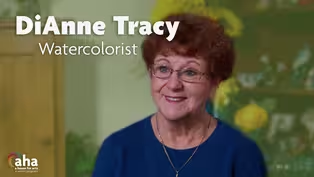
- I'm here in Glenville, New York at the studio of veteran watercolor painter, Diane Tracy.
Let's see what she's working on.
(gentle playful music) - I am a restless person.
I always have to be doing something.
And yet I can spend all day painting, sitting in a chair, forgetting to get up and have a drink of water, just getting lost in the painting, because my mind is going, how do I want this to look, how do I want that to look?
(gentle playful music continues) When I was probably, I want to say maybe eight or nine, my brother was given a John Naggy Learn To Draw kit.
And my brother is not, this is my younger brother, he was not interested in it.
And I was given something that I didn't want.
So we swapped.
I practiced the shadows, the shapes, for instance, a ball with light on it, and I learned a lot from that.
So that's really where I got it.
But I've only been painting watercolors since around 1984.
(gentle playful music continues) My hands and my toes got all swollen and sore, and I was diagnosed with psoriatic arthritis.
Very, very painful, so much so that picking up a cup to have coffee, I couldn't really hold it well.
Walking was extremely painful.
I wore slippers, open-toed slippers.
So I went through a lot of years struggling, but I found that I could do water colors, because it's water you're painting with, tinted water.
So it was easy for me.
And my very first show, I sold half my inventory.
When the lady who bought my first painting saw my face, and I was, I had a hanger mouth, she said, "What, this is your first, don't tell me, this is your first painting?"
And I said, "Yes."
She goes, "Well, my dear, it won't be your last.
You are great."
I didn't walk on the ground for months.
(Diane laughs) (upbeat inspiring music) Well, I love landscapes and flowers.
I did animals for awhile.
But I found that I was drawn to the beauty of New York State.
So much of the Adirondacks colored my childhood, summer and winter.
My parents came from there, I had cousins, my father's one of nine, my mother's one of six.
So I had a lot of cousins living up there.
I've been to the Catskills, I've been to the Rocky Mountains, I've been to South Africa mountains, I've been to Costa Rican mountains, and the Adirondacks is where my heart lives.
So, they inspire me always.
(soft piano music) I have books of reference, what I call, inspiration.
Things that I'll go through, pages and pages of, oh, I like that technique, I want to use that, and I'll think about it.
And I'll mull around doing things.
And then it'll come to me.
This whole painting would come to me in my head, and then I start.
(soft piano music continues) I just finished a bunch of hydrangeas.
They're very difficult to capture, in that there's so many of them, and each one is a little different.
Getting the lighting right, and the highlights of the nuances of the petals, and they come together.
And most people would just see a blue blob.
And I try to get it with all the special things, that I see the veins, I see the light, I see the edges, I see the shadows underneath.
And it's tedious, but it's also very relaxing.
I don't even listen to music, I just go into the painting.
And there's a tickle in my heart, there's joy.
I've been very blessed to have sales from the very beginning, and the compliments, and the fact that I didn't think I was worthy to show my work, and I think a lot of artists are insecure about their work.
It may satisfy us personally, but if you want to sell, you have to satisfy the client.
So when you get somebody who wants to pay you money for what you've created, I can't tell you the high that gives you.
(Diane laughs) Especially when you have children to feed, it makes you very happy.
I just met so many interesting people from all over the world.
One time there was, I was in Saratoga, and there was somebody from New Zealand was gonna take one of my paintings back.
And he said, you know, New Zealand isn't that different from upstate New York.
Really?
(Diane laughs) I was surprised.
My paintings are all over the world.
They've even had paintings in Japan and China and Russia.
It sparks such joy in me that that's a drug to me.
I never did drugs or smoked or anything.
I didn't need it.
I had art.
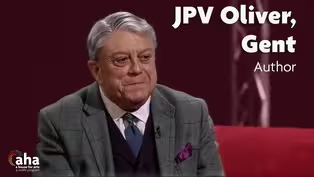
(Diane laughs) - Saratoga Springs resident, John Oliver, is a former speech writer for Seagram and GE.
He's just finished a memoir entitled, "I Know This Looks Bad: Errors and Graces in a Louche Life."
This book is a collection of 365 epigrams recounting dodgy foreign entanglements, and academic disasters.
What compelled John to dish about his past?
I sat down with him to find out.
John, welcome to A House For Arts.
It's such a pleasure to have you.
- Thank you, thank you.
I'm so tickled to be on your show, I really am.
- Oh my gosh, you're tickled?
That's a very British thing to say, right?
- Yes, I have a lot of affectations- - Wonderful, wonderful.
Well, we'll talk a little more about that in a minute, but I did want to give kind of a more formal opening for you and this book that you've written, "I Know This Looks Bad."
So here it is.
So in his new book, "I Know This Looks Bad," Albany native and Saratoga Springs resident, JPV Oliver Gent, recounts academic disaster and dodgy foreign entanglements, tales of long-held secrets, hobnobs with his Royal Highness Prince Phillip, describes hilarious corporate misadventures, and delivers a few poignant family tributes along the way.
This sounds like an incredible opening for your book.
Tell us a little bit about, "I Know This Looks Bad."
- There, it's in the biography businesses, is what's called a modular memoir, which means there's 365 entries that are epigrams- - And epigrams, they're sort of like pithy sayings?
- Well, they're short, right?
So Errodedus, and Catalyst, and Washington Irving, all wrote in epigrams, because it's a few words to make a big point.
Now you're an art person, right?
So think of the Chuck Close federal realist guy, right?
So when you're up close to Chuck Close's work, you see a little cube, but you step back six feet, and oh my God, there's Chuck Close's face.
And so this book is a little bit, well, the readers get to decide whether I succeeded, but that's the idea.
- So it's a literary form of something like that painted portrait, made up of these little parts, and you pan out to look at something much larger.
- [John] Exactly right.
- Would you mind reading from one of these epigrams?
- Sure, happy to do that.
I'm pretty familiar with this copy, I've got to be honest.
- Just pretty familiar.
That's good.
- Not entirely.
All right, so this is called "A Lake George October."
In their 60 years in Lake George, New York, my relatives owned three big resorts, three restaurants, two bars, and a bookshop.
If you've been to that village, and who hasn't, you know the word resort has an imprecise term, is an imprecise term.
These places feature wooden Adirondack chairs, each a gaudy green, and each heavier than the Great Pyramid of Giza.
They had arms you could land a plane on.
When I was eight, my cousin Vincent, gutted a newly caught trout on just such a platform, his beer and ham sandwich undisturbed on the other arm.
One sunny October Sunday, we played touch football, just like a famous family at that time.
A month later in the TV room, we watched a dignified military funeral for the murdered leader of that family.
For a little boy, it was all magical.
- Amazing.
I love this.
And you know what I'm paying attention to as I'm hearing you read this epigram is the importance of tone and voice in creating a story.
So tell us a bit about how you came up with the voice for this, for you, or for this character, that is telling the story.
- The purpose of the writing is to, is to look at the world in a kind of a wry way, and with humor that pierces, but does not wound, right?
- Tell us a bit about that.
What does that mean to pierce, but not wound?
- There's a great novelist people may have heard of called Peter DeVries, and he wrote these novels which gently mocked Westchester County and Fairfield County and the pretensions and the expectations.
But it was said of him, his humor pierced, but not wounded.
So it's funny and it mocks, but gently.
It's not being, it's not mean-spirited to anybody.
And so the reader can come away with, yeah, that's not a bad idea.
That's not a bad way to think of this for that.
- Why is it so important to kind of have that wry approach to telling something about life or a story without necessarily really hurting people or hurting readers?
- Yeah.
'Cause I think everybody appreciates on one level that our existence is absurd in some way, right?
And so to get through it, we adapt humor and we find ways to cope, and I've always found that this sort of gentle amused look at the world is not the worst way to go.
- Right.
And giving it in these sort of smaller soundbites, if you are, the smaller epigrams, what gave you the idea to use that kind of format rather than saying like long-form prose for a memoir?
- Yeah.
I don't have the powers of invention to be a novelist.
So I had to find something easier.
I don't have much of an attention span, so this works really- - Does anybody now have an attention span?
- Well, yes.
Your viewers do I'm sure.
And they will lose they, by the way, they will lose IQ points reading this book, but they have so many of them that they won't even notice.
It'll be fine.
- So, tell us then about the photographs that you have interspersed in the book.
- The photographs act as the anchor to these little stories, right?
So they enhance, or in some place contradict, the point of the story.
Let me give you an example.
The April 2nd entry is about Charlemagne, right?
And so the here's this picture of Charlemagne, and he's got his grand scepter and he's got his crown.
- Great king or the great leader, right, Charlemagne, yes.
- And he's medieval, brought Christianity to the medieval world, and he's got his robes on and he's dignified, but his eyes are like, what are we doing, fellows?
What is this?
And so, it's a little poke in the ribs from Charlemagne.
- Right.
Taking something that you would expect, and then sort of twisting it or giving a little surprise at the end, right.
- That's right.
So you also have a background too as a speech writer for Seagram and GE.
And I'm curious to know, and I'm guessing these are some of the corporate misadventures that you talk about in the book, but do you think that that ever had an impact on your inspiration or your method of writing "I Know This Looks Bad" later on?
- Absolutely.
Because what you learn early on is, if you're not able to entertain an audience, forget the content, I mean if you can't hold their attention, than Mr. or Ms. Beg for whom you've written the speech is gonna be very, very unhappy, and you're going to be out of work very quickly.
So you have to have a prose that's compelling, and you have to tell a story that people can connect to, right?
The best bit of advice I ever got about writing was make sure you're able to connect with the reader.
If your stuff is wonderful, that's great, but if it doesn't people don't connect to it, then they won't stay with you.
- And by connecting, John, do you mean that people should be able to see something of themselves in the character that you write?
- I gave an interview to a Connecticut paper a couple of weeks ago, and the first words out of the reporter's mouth were, well, tell me about your process as a writer.
And I was like, look, my what?
Oh, my process, well.
But there really is one and it is this.
Everybody was a child.
Everybody knows the feeling of being sort of not sure in the world, and the joys and fears that come with being a child.
So a lot of, some of these pieces tap into that concept.
- Right.
And you write about being a child in this.
Do these go in chronological order?
I'm just curious.
- No, it's all over the place.
- All over the place.
But 365 to make sure you have one for every day of the year.
- Exactly right.
- Yeah.
What's a story or a memory from your childhood that you think is really memorable from from your book?
(John laughs) - My... One time we lived in a house in West Albany, New York, and that was the Oliver ancestral home, and one day my father came in and said, we're getting aluminum siding.
And I said, oh great.
It's a bright Pepto-Bismol pink siding.
My father had a beer distributorship, and he gave the guy 300 cases of cheap beer to get siding for free.
- [Laura] Amazing.
- And forever after we called that house, The Pink Palace.
And it had more kitchen, it had a player piano, and had an above ground pool, and it was a palace to him.
And it really was.
It was charming the way he loved that place.
- Right.
And you would never forget which one was your home.
- No, indeed, right, right.
- [Laura] That's really good too.
- Yeah.
And planes used to navigate, when they landed Albany airport, they would navigate on that house.
- Based on the aluminum siding?
- [John] Exactly right.
- Yeah, yeah, that's...
So what other pieces of advice would you have for emerging writers who really want to create, not just a great memoir, but a really great story?
- What I've seen over the years is people, and I'm guilty of this myself, assume that the reader is as blown away and beguiled by what you've written as you are.
And that's not fair.
Your job as a writer is to entertain the reader.
Let me put it this way.
If you're reading a book, and you feel like you're in harness, right, and you're dragging a plow through rocky soil, that's the author's problem, not yours.
The author's problem- The author's job is to entertain you and hold you, and then whatever the hell content it is, that's fine.
But his or her first job is to hold your attention.
- Right, to really pull you in, and to make the reader feel like this is relatable.
This is something that really hooks me in.
- [John] Exactly right.
- Amazing.
Well, John, thank you so much for sharing about, "I Know This Looks Bad," and I can't wait to have a look at "I Know This Looks Bad" very soon.
- Thank you.
I do want to say, if, for your viewers, if they think that you're charming and accomplished and wonderful on air, they should meet you in person.
You're an extraordinarily gifted person.
So it was a great pleasure.
(John claps) - Thank you very much, John.
Likewise, thank you so much.
- Cheers.
Cheers.
Please welcome Justin Friello.
- This song is called "Jack and Jill."
It's based on a true story of an experience that I had about five years ago at a concert.
And I was playing, and I saw this girl in the audience, and we made eye contact, and we had a little moment on stage, which is always nice as a performer.
And then my mind just kind of ran with it.
(guitar playing) ♪ Always want what I can't have ♪ ♪ But I continue to climb that hill ♪ ♪ And I promise that I'll find my way back ♪ ♪ If you'll be my Jill ♪ ♪ It's me you haunt with your smile, your laugh ♪ ♪ Whatever is in you, I'll find it, I will ♪ ♪ And I promise that I'll be your Jack ♪ ♪ If you'll be my Jill ♪ ♪ You wore my hat, and with your hand on my back ♪ ♪ You said, I'm going home ♪ ♪ So I'll pretend that I'll see you again ♪ ♪ Your picture, my company when I am alone ♪ ♪ My setting sun, what have you done ♪ ♪ Your glance, it gave me a thrill ♪ ♪ If you only knew I'm mad over you ♪ ♪ You might be my Jill ♪ ♪ You said goodnight with your smile bright ♪ ♪ And gave me only your name ♪ ♪ It's dumb, I know, to think of you so ♪ ♪ But I hold on to the fantasy that you feel the same ♪ ♪ Memory will be the death of me ♪ ♪ But I can't seem to get my fill ♪ ♪ A panic attack, I want to be your Jack ♪ ♪ Would you be my Jill ♪ This song is called Mr. Frog, and I know I've said in performances past that I don't want to say why that song is called that, but this is about my friend who's waiting at home for me.
(guitar playing) ♪ You wanna sleep all day ♪ ♪ You wanna sleep all night ♪ ♪ You can't see another way ♪ ♪ But that doesn't make it right ♪ ♪ Doesn't work like that ♪ ♪ Ignoring problems like you do ♪ ♪ It doesn't work like that ♪ ♪ Even though I still love you ♪ ♪ To me it's not some big surprise ♪ ♪ It's why I picked you off the shelf ♪ ♪ I knew the sadness in your eyes ♪ ♪ It was the same that's in myself ♪ ♪ But it doesn't work like that ♪ ♪ Mistaking love for tears in our eyes ♪ ♪ Hurt in our hearts, we are born with the same ♪ ♪ It doesn't like that ♪ ♪ When your problems are mine and mine are yours ♪ ♪ Rolling around and being round is what caught my eye ♪ ♪ So I keep you mine ♪ ♪ If you wanna sleep all day ♪ ♪ Then I wanna climb in your bed ♪ ♪ If this the only way ♪ ♪ I'll break up with the world instead ♪ ♪ But it doesn't work like that ♪ ♪ Hoping you will change if I just love you enough ♪ ♪ Look at us, still the same ♪ ♪ It doesn't work like that ♪ ♪ Mistaking you for my life, life for the friends ♪ ♪ Friends for the work, working for what ♪ ♪ What is my life, round and around and around and around ♪ ♪ And around and around and around, and around ♪ ♪ It doesn't work like that ♪ ♪ It doesn't work like that ♪ ♪ It doesn't work like that ♪ ♪ It doesn't work like that ♪ ♪ It doesn't work like that, oh no ♪ ♪ Doesn't work like that ♪ ♪ Doesn't work like that ♪ ♪ Doesn't work like that ♪ ♪ It doesn't work like that ♪ - Thanks for joining us.
For more arts, visit wmht.org/aha, and be sure to connect with WMHT on social.
I'm Laura Ayad.
Thanks for watching.
(gentle upbeat music) - [Narrator] Funding for AHA has been provided by your contribution and by contributions to the WMHT venture fund.
Contributors include the Leo Cox Beach Philanthropic Foundation, Chet and Karen Opalka, Robert and Dorie Fischer Malesardi, the Alexander and Marjorie Hover Foundation, and the Robison Family Foundation.
- At M&T Bank, we understand that the vitality of our communities is crucial to our continued success.
That's why we take an active role in our community.
M&T Bank is pleased to support WMHT programming that highlights the arts, and we invite you to do the same.

Video has Closed Captions
Preview: S7 Ep18 | 30s | Watercolor artist DiAnne Tracy, author JPV Oliver, Gent, performance by Justin Friello. (30s)
Interview with Author JPV Oliver, Gent
Video has Closed Captions
Clip: S7 Ep18 | 9m 45s | Author John Oliver recounts his infamous misadventures. (9m 45s)

Video has Closed Captions
Clip: S7 Ep18 | 3m 37s | And catch a performance from Justin Friello. (3m 37s)

Video has Closed Captions
Clip: S7 Ep18 | 4m 44s | Catch a performance from Justin Friello. (4m 44s)
Watercolor Painting with DiAnne Tracy
Video has Closed Captions
Clip: S7 Ep18 | 5m 18s | Get lost in the beautiful landscapes of watercolor artist, DiAnne Tracy. (5m 18s)
Providing Support for PBS.org
Learn Moreabout PBS online sponsorship

- Arts and Music
The Best of the Joy of Painting with Bob Ross
A pop icon, Bob Ross offers soothing words of wisdom as he paints captivating landscapes.













Support for PBS provided by:
AHA! A House for Arts is a local public television program presented by WMHT
Support provided by M&T Bank, the Leo Cox Beach Philanthropic Foundation, and is also provided by contributors to the WMHT Venture Fund including Chet and Karen Opalka, Robert & Doris...