
AHA! | 803
Season 8 Episode 3 | 28m 29sVideo has Closed Captions
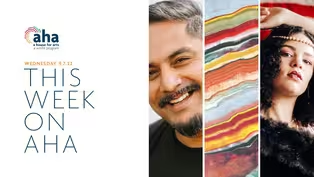
Pigmented beeswax, filmmaking with area youth, and a performance from Darian Rodriguez.
Get a buzz from Laura Moriarty's art made with pigmented beeswax. Bhawin Suchak shares his love of filmmaking with area youth. And catch a performance from Darian Rodriguez.
Problems playing video? | Closed Captioning Feedback
Problems playing video? | Closed Captioning Feedback
AHA! A House for Arts is a local public television program presented by WMHT
Support provided by M&T Bank, the Leo Cox Beach Philanthropic Foundation, and is also provided by contributors to the WMHT Venture Fund including Chet and Karen Opalka, Robert & Doris...
AHA! | 803
Season 8 Episode 3 | 28m 29sVideo has Closed Captions
Get a buzz from Laura Moriarty's art made with pigmented beeswax. Bhawin Suchak shares his love of filmmaking with area youth. And catch a performance from Darian Rodriguez.
Problems playing video? | Closed Captioning Feedback
How to Watch AHA! A House for Arts
AHA! A House for Arts is available to stream on pbs.org and the free PBS App, available on iPhone, Apple TV, Android TV, Android smartphones, Amazon Fire TV, Amazon Fire Tablet, Roku, Samsung Smart TV, and Vizio.
Providing Support for PBS.org
Learn Moreabout PBS online sponsorship(bright electronic music) - [Jade] Get a buzz from Laura Moriarty's pigmented beeswax art.
Bhawin Suchak shares his love of filmmaking with the area youth.
And catch a performance from Darien Rodriguez.
It's all ahead on this episode of "Aha, a House for Arts".
- [Announcer] Funding for "Aha" has been provided by your contribution, and by contributions to the WMHT Venture Fund.
Contributors include the Leo Cox Beach Philanthropic Foundation, Chet and Karen Opalka, Robert and Doris Fischer Malesardi, the Alexander and Marjorie Hover Foundation, and the Robison Family Foundation.
- At M&T Bank, we understand that the vitality of our communities is crucial to our continued success.
That's why we take an active role in our community.
M&T Bank is pleased to support WMHT programming that highlights the arts, and we invite you to do the same.
(bright upbeat music) (scene whooshing) - Hi, I'm Jade Warrick, and this is "Aha, a House for Arts", a place for all things creative.
Here's Matt with today's field segment.
- I'm here in Rosendale, New York, to meet with artist Laura Moriarty, and to learn more about her beautiful art made with pigmented beeswax, follow me.
(bright lively music) - I make sculptures and works on paper out of pigmented beeswax.
it's sort of a form of naturalism for me.
It's a way of investigating the processes of nature, using just this one material.
(bright lively music continues) Beeswax has been used in art for a really long time.
Like the Fayum mummy portraits, they're ancient.
There's oil paint, which is oil based.
There's watercolor, which is water based.
There's acrylic, which is acrylic based, And there's encaustic, which is wax based, yeah.
- And this is it right here.
- Yeah, now this is just the beeswax and the resin.
It would be just the raw medium that you're working with.
These are milled paints.
So these are the beeswax and the resin, and then they're milling pigment into it.
They just come in a- - Hockey pucks.
- Yeah.
(bright upbeat music) I had been experimenting with beeswax as a way of giving my work on paper more heft, more physicality.
So I just kind of transitioned over to just working with the wax.
It starts off like a traditional painting.
I'm on a panel, I'm using a brush, I'm melting the color and I'm just painting it on the panel.
(bright upbeat music) So letting this cobalt blue melt out into a puddle.
The qualities of the medium are that it, well first of all, it goes from solid to liquid.
You have all these opportunities between the fluidity and the solidity to do different things with it.
And you see how it's always moving when it's hot, when it's fluid.
(bright lively music) And I make layers.
So I'm building up layers of color.
(music scratching) - Cooling off the panel.
- I'm cooling this off because it's not settling.
- Must be all the hot film lights.
- And I just pile colors on top of each other.
Then at a certain point, I push the paint off the panel to just, this is gonna be very thin.
But you know, just pushing it up off the panel.
And you can imagine if I had a lot of paint on there, that this would be- - Different layers.
- It would be like this.
Imagine that it's this much paint, but I mean, this object was made absolutely, exactly this way.
(bright flourish music) I'm using the poetics of geology very deliberately, the subsuming and enfolding erosion.
There was a point when I was literal about like looking at geology textbooks, looking at those diagrams of cross sections.
And I was kind of evaluating like, what are these illustrating, and how can I illustrate that in a parallel way?
Over the years, I've just gotten looser and looser and looser with it.
And now I make these very strange objects that, you know to me, they're never finished.
They're incomplete, they're always in process, and I think of myself the same way.
Like I'm in this process too, and we're always gonna be in this process.
(laughing) The work on paper started off as a byproduct of the sculptural work.
You know, I have this ecological kind of mandate in the studio where I really try not to waste anything.
So when I was making the sculptural pieces, I would do a lot of eroding on a hot palate, where I'm dragging the form along a hot palate and it's melting.
So I started picking those things up on paper, almost like a monotype or a monoprint.
You know in a way, the works on paper were almost like cross sections in microscopy where you're seeing the thinnest slice of a rock.
And now, I actually do more work on paper than sculpture.
Well, why don't you give it a try now?
(bright anticipatory music) - I don't know what I'm doing.
(Laura laughing) I have a good teacher, okay.
(gentle soothing music) It's my first one, it's not going to be as perfect as you know, it's a student's piece.
(gentle soothing music continues) Ooh, oh looks nice on paper, yeah.
(gentle soothing music continues) - I don't know, it's kinda beautiful.
- [Michael] It's not bad, yeah, you know.
- And I like this side of this one.
It's really smooth, and it kinda reminds me of a Gerhard Richter.
(laughing) - A Gerhard Richter.
- I think of my practices as a form of spiritual practice.
You know, it is the most important thing to me.
It's the way I try to reflect back out at my culture.
Naturalism has always been really important to me.
You know, I'm committed to nature, to living in harmony with it, and to accepting my place in it.
And I reject a lot of philosophy that places humans in the center of everything.
I don't believe that, I believe we're just one of the many species on the Earth, and there's all forms of matter.
And I really go very deep into thinking about how this is sort of a way of thinking about oblivion, of thinking about how nothing goes anywhere.
Nothing goes away, everything is here and it's constantly shifting shape, shifting form.
These objects are my way of investigating that, and giving people an opportunity to have that experience for themselves.
- Bhawin Suchak is the co-founder and co-executive director of Youth FX.
Founded in 2008, Youth FX introduces young people of color to the power of digital media.
Films produced by Youth FX have won awards and have been screened at major film festivals, such as Tribeca and Sundance.
So what inspired Bhawin to start Youth FX, and what impact does it have on the community?
Let's find out.
Welcome to "Aha" Bhawin, it's nice to have you today.
- Yeah, it's so good to be here to be in conversation with you.
- So you're known as the film guru and jack of all trades in the Upstate area.
So I wanted to get a little bit of history of how you got into filmmaking, why do you have such a strong passion for this industry?
- Yeah you know, so I guess like I would say, my start in filmmaking came after college.
I decided to pursue journalism, but it was really hard to find a job in journalism.
And so I started getting interested in documentary.
And then at the time I was actually teaching at a alternative school called the Free School, which still exists in the south end of Albany.
I taught there for 16 years.
And during that time, a friend of mine was making a documentary about the Free School, and actually asked me to be a part of it as a teacher in the building who was filming kinda the daily activities.
So that's how I got into it.
So I was really self-taught and mentored by him.
And then we made this film, which actually ended up being a feature-length documentary.
And the cool thing was, we had all this equipment afterwards and essentially I started, you know, teaching the students at the Free School filmmaking.
And you know, we're talking about 2004, 2005, like YouTube is just a thing.
But really the biggest thing is there's not a lot of access to this type of teaching and this type of programming.
So I realized that you know, I was self taught, how do I convey this, and kinda share this passion that I've developed for film with young people?
And so it was really cool because the Free School, you're allowed to kinda create your own classes, and kids can pursue their own interests.
So we started a little film program there, and that kinda built to 2008 when a local filmmaking organization partnered with Grant Street Community Arts, and had a small fund to start a filmmaking program.
And so they reached out to me, 'cause they knew I was teaching at the Free School, and I was teaching film.
And yeah, and that's how youth FX was born.
And really for me, what I loved about that opportunity was that it enabled me to take my passion for teaching and mentorship, and combine it with filmmaking into a singular endeavor, which ended up being Youth FX.
And the amazing thing that I'm really proud of is that Youth FX was co-founded by three young people that I was already working with at the Free School, and in other community settings teaching film, and that's Darian Henry, Rashid Howell and Majestic Tillman, and Rashid and Darian are still now actually, directors at Youth FX, and Majestic is a very successful local actor, director and screenwriter.
- That's beautiful.
So you got mentored, you mentored them, and now they're able to mentor others.
- [Bhawin] Absolutely, yeah.
- That's a beautiful story, really.
So speaking of Youth FX, you're the co-founder and the executive director of Youth FX.
So why don't you give us a little bit of background?
What is Youth FX?
- Yeah, so you know, Youth FX essentially is a program that's designed to help build community, build space for creative expression, and empower young people to really be able to be in control of their stories, and therefore have agency in the direction of their lives, you know?
And I think that, you know, filmmaking today is such an incredible tool for all sorts of different things, whether it's something that you wanna do for entertainment or for fun, or to get like a perspective or a point of view across.
But I think to me the most powerful part about filmmaking is that it's a collaborative process.
And so what it does is it enables young people to really work together in a way that they can kind of build something together, and then at the end of the process, they can kinda look back and realize that without the collaborative nature of the process, without the teamwork, without the relationships that they built, that project would never happen.
- [Jade] Exactly.
- And what I think it does, is it really reveals also that I think we put so many restrictions on young people, and we put them in so many boxes, and have a lot of, kind of negative to me tropes about youth and teenagers.
And I think when you see and witness young people be in a space where they get to co-create something that they have ownership over, it all of a sudden like, kinda flips these stereotypes of these kind of assumptions we make about them.
And I've just been incredibly, you know, to be honest, just blessed to be part of the program.
Myself, even as the co-creator, I always, you know, really consider it to be really a privilege to be around so many young people who are incredibly talented, and also coming from a place where I think a lot of times they haven't been afforded the space to just kinda think about, what stories would you wanna tell?
Like, who are you as a person, and how does that get expressed with this creative form of filmmaking?
And I think that, you know, once you start looking at that, actually what you're doing is you're building leaders.
You're building people to have a voice.
You're building people that kinda create, essentially their own micro, like centers of gravity, where they can draw other young people to what they're doing, and have an impact.
And the one thing I'll say about Youth FX, is we're not the type of organization that's like, necessarily gonna serve like thousands of kids every year, or 500 kids every year.
It's a little bit of a smaller group of people, because filmmaking requires like a lot more, you know, sort of attention, requires equipment.
And so what I always say is that we're building, we work really deeply with a small group of young people so that they can kinda build community with other young people.
- That's amazing, and I know personally that Youth FX has done some amazing things for the youth in the area.
I've had youth from my program, Amplify Voices, actually be like, "You know what?
We don't like painting, but we really love film."
- Love film.
And I've actually had a couple of my students go over to Youth FX, and really be involved in your program.
One is Zaire, I think he wanted to become an actor.
He's like, "I'm not a muralist, but I really love acting and being front of the camera."
And I saw him not too long ago and he's like, "Oh my God, Youth FX, like that is what I'm about."
So it's really amazing that you're providing this platform- - [Bhawin] Thank you.
- For youth to just be able to explore themselves and amplify themselves unapologetically.
- Appreciate that.
- So what are some impacts on the community that you've seen that Youth FX has had on a broader scale?
So once folks leave Youth FX, or they're able to graduate and move on, what are some impacts on the community?
It could be parents, it could be local organizations, private, anything that you wanna share with us?
- Yeah I mean I think, you know, I'll start with kinda the internal impacts.
It's like, I look at our staff, for example.
It's like we have, you know, a staff that's, all have come up through the program.
And one of the things that I love about that is, you know, Albany, I think as an artistic space, has been challenged.
You know, there's so many different incredible things that are going on, in the work that you're doing, so many incredible musicians and artists, but at the end of the day, there isn't a strong, kind of like infrastructure to support that.
And I think what ends up happening is a lot of artists will leave the city of Albany to pursue, you know, opportunities in other larger markets, which I don't blame them.
But what we're trying to do is say, how do you keep young people also engaged in their own communities, and think about how they can build something here.
And so, you know just as an example, our staff.
You know, that to me is a huge impact.
Someone like my co-executive director, Darian Henry, who's just like this incredibly brilliant thinker and organizer and leader and filmmaker.
You know, the reason she stayed in Albany is to be a part of Youth FX and to build that, and kind of be able to see her vision, you know, kind of expand, and see Youth FX grow into these other places that I would've never conceived of, but because of who she was and where she came from and her ideas, she's kinda helped to build that.
You know on a broader scale, just the filmmakers that have kinda come out of it.
You know, I hear from students every once in a while, just will randomly be like, "Oh, I'm going to film school."
Or, "I just graduated from the School of Visual Arts," or, "I just graduated from Ithaca College," or other places.
You know, U Albany students will go locally and nationally.
And to me, what I'm actually the most proud of is the students that come back and have this level of groundedness and confidence in who they are as a person.
And to me, that's above what you end up doing as a filmmaker, as a career is like, who are you as a person?
You know, and I think that that, I have to say, is a testament to the staff and the community that we've created, and people like you in our broader community that have also been able to come in and drop in and out of programs, and partner with us and also give young folks the idea that they have, like a meaning in their life and a purpose, and that they're valued as young people.
You know, and so- - Yes, and as artists.
- As artists, exactly.
- They're artists.
- And I think that's the kinda thing that I just feel like you can't, there's no shortcut to that.
Like, you have to have some form where you're able to have interaction with the public and the community at large, you know?
And so I think the impacts have been so broad.
And then I'll just say also the impacts of the films that we've made, to hear from like young people in other cities that are watching our films, or other you know small, like youth groups or organizations that are like, "Oh, we watched a Youth FX film."
Or like randomly, I'll be like somewhere else in the country and people know about Youth FX, you know?
- That's amazing.
- And it's really incredible to kind of realize the reach that we've had with the program, without us even kinda sometimes, you know- - It's natural.
- Recognizing it, yeah.
And I think again, that's the power of the films and the work that we do, and I think young folks when given that opportunity are really creating powerful, impactful films, that also have a really deep message about where they're at, and you know, their state of mind, they're like, kinda perceptions of their communities around them.
- That's amazing, and I know for a fact you are definitely bridging the communities here, and you're definitely helping the youth in the area.
Because not only as you said, it's artistic, they're able to express themselves, but I've seen some of the students' films and you can see some of the pain and trauma just being expressed in such a healthy way.
Like they're able to really take these deep parts of them and just put it out into film for everyone to watch, and truly understand what that person is feeling.
I just love the films the students make, that are just like, their soul and their art's in it.
And you're just like, "Wow, I would've never like, thought about this, about this person."
- [Bhawin] No, it's amazing.
- But now I'm seeing visual poetry about their life, which is such an amazing, accessible- - Absolutely.
- Accessible, beautiful thing to me.
So real quick, do you have any projects coming up that you wanna share?
- Yeah so I mean, I'll mention that you know, aside from my primary work with Youth FX, you know I'm also a filmmaker, and I just finished my third feature documentary with my co-director Ira McKinley.
It's called "Out of the Muck", and it's very exciting 'cause it's a very personal project for Ira.
It's about his family in this small town in rural South, in Pahokee, Florida.
And it talks about him reconnecting with his family and you know, building sort of a connectivity to his own personal history, through the process of making the film.
And we're really proud to say, it's gonna air on "Independent Lens", you know PBS, in February of '23.
And the great thing about that project is, also as just as an example, you know, we made a lot of connections, we were funded.
This is the first time I ever had a film funded.
So Ira and I got funding from Sundance and Ford Foundation, and Southern Documentary Fund and ITVS.
And for me it's like, how do I help bring the knowledge that I learned in that process back to the young folks that we're working with?
You know, and it's- - And that's the key, right?
- Yeah, and then you go back to the, you know, the top of the conversation about mentorship, and it's like, you know I have mentors, I try to mentor people, and they mentor me too.
I mean, there's a lot of reciprocity in the whole, you know, kinda construct of what we've created.
Because it's not just about like, kind of experts or like professionals, you know, dropping information on young folks.
It's also young people kind of expressing their ideas.
And I'm gonna tell you, I learn a lot about the creative process from young people and watching them.
You'll always have opportunities to kind of give back, and kind of share that knowledge with other people.
- Well thank you, Bhawin.
Wise words to listen to, folks.
Well thank you, I appreciate you coming on "Aha" today.
- Yeah, thank you.
- It was nice speaking to you.
Please welcome Darian Rodriguez.
- Sometimes the bravest thing we can do is do it scared, do it crying.
This song is called "Whispered Yes", and it's all about just trying.
♪ If I tell you my secrets ♪ ♪ Would you try and write them down ♪ ♪ You ask where my whole hope comes from ♪ ♪ You can find it for yourself ♪ ♪ 'Cause I don't share stories, mm ♪ ♪ Unless somebody asks ♪ ♪ The past is in the past ♪ ♪ Sometimes the boldest answer is a whispered yes ♪ ♪ So I'll be called lying ♪ ♪ When I've had too much to drink ♪ ♪ I can get so restless ♪ ♪ That I care what people think ♪ ♪ And it could be nothing, mm ♪ ♪ Names or numbers, oh so small ♪ ♪ You'd never even notice if I've told you at all ♪ ♪ And sometimes my feelings ♪ ♪ Are so real in my mind ♪ ♪ That I've lived life over and over ♪ ♪ Just to find a way to write ♪ ♪ Away all this boring, mm ♪ ♪ I feel so deep inside ♪ ♪ Yet anything but truth will loose my mind ♪ ♪ And oh, truth has never planned to change ♪ ♪ As much as me ♪ ♪ It sets me free ♪ ♪ And oh, truth has never planned to change ♪ ♪ As much as me ♪ ♪ It sets me free ♪ I think we see people stuck in bad relationships sometimes, and we wonder why on Earth they're still in it.
And I think we forget sometimes that it didn't always start that way.
This song is called "Bruises".
♪ I'm in your head, in your heart ♪ ♪ You wear me like a sleeve ♪ ♪ When your day is down ♪ ♪ I'm the one who sets you free ♪ ♪ And I know right now you think I'm all you need ♪ ♪ But I got bruises where kisses should be ♪ ♪ Gone for hours, mo reply ♪ ♪ Baby, no I don't mind ♪ ♪ Have your fun, just stay safe ♪ ♪ I know we're well defined ♪ ♪ Don't you worry as I roam ♪ ♪ You won't get left behind ♪ ♪ 'Cause I got bruises where kisses should be ♪ ♪ On our first date by the docks ♪ ♪ You asked to hold my hand ♪ ♪ I met your buddies two weeks later ♪ ♪ And they said now you're the man ♪ ♪ And when I kiss you anytime ♪ ♪ I feel my heart skips beats ♪ ♪ You heal my bruises where kisses should be ♪ ♪ I stay out late with a friend ♪ ♪ And you blow up my phone ♪ ♪ It's like you're scared at any time ♪ ♪ I'll choose to turn and go ♪ ♪ If I found the door I'd leave you ♪ ♪ But I cannot see ♪ ♪ That you got bruises where kisses should be ♪ ♪ Late one night we start to fight ♪ ♪ And then you raise a hand ♪ ♪ I sit and cry you say you're sorry ♪ ♪ And ask, I understand ♪ ♪ You say your love is overwhelming ♪ ♪ And our hearts don't plan ♪ ♪ To find such beauty in our intimacy ♪ ♪ I'm in your head, in your heart ♪ ♪ You wear me like a sleeve ♪ ♪ When your day is down ♪ ♪ I'm the one who sets you free ♪ ♪ And I know right now you think I'm all you need ♪ ♪ But you got bruises where kisses should be ♪ (soft ambient music) - Thanks for joining us.
For more art, visit wmht.org/aha, and be sure to connect with us on social.
I'm Jade Warrick, and thanks for watching.
(energetic thoughtful electronic music) - [Announcer] Funding for "Aha" has been provided by your contribution, and by contributions to the WMTT Venture Fund.
Contributors include the Leo Cox Beach Philanthropic Foundation, Chet and Karen Opalka, Robert and Do Fischer Malesardi, the Alexander and Marjorie Hover Foundation, and the Robison Family Foundation.
- At M&T Bank, we understand that the vitality of our communities is crucial to our continued success.
That's why we take an active role in our community.
M&T Bank is pleased to support WMHT programming that highlights the arts, and we invite you to do the same.
Video has Closed Captions
Preview: S8 Ep3 | 30s | Pigmented beeswax, youth filmmaking and a performance. (30s)
Beeswax Artwork with Laura Moriarty
Video has Closed Captions
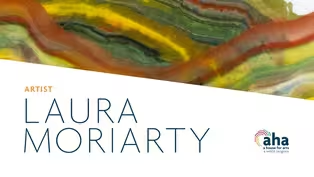
Clip: S8 Ep3 | 7m 58s | Laura Moriarty creates sculptures and works on paper with pigmented beeswax. (7m 58s)
Video has Closed Captions
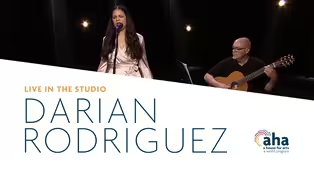
Clip: S8 Ep3 | 3m 32s | Darian Rodriquez performs "Bruises." (3m 32s)
Darian Rodriguez "Whispered Yes"
Video has Closed Captions
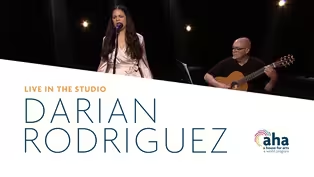
Clip: S8 Ep3 | 2m 36s | Darian Rodriguez performs "Whispered Yes." (2m 36s)
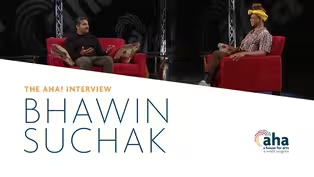
Introducing Youth to Filmmaking with Bhawin Suchak
Video has Closed Captions
Clip: S8 Ep3 | 11m 13s | Bhawin Suchak is the Co-Founder and Co-Executive Director of Youth FX. (11m 13s)
Providing Support for PBS.org
Learn Moreabout PBS online sponsorship

- Arts and Music
The Best of the Joy of Painting with Bob Ross
A pop icon, Bob Ross offers soothing words of wisdom as he paints captivating landscapes.













Support for PBS provided by:
AHA! A House for Arts is a local public television program presented by WMHT
Support provided by M&T Bank, the Leo Cox Beach Philanthropic Foundation, and is also provided by contributors to the WMHT Venture Fund including Chet and Karen Opalka, Robert & Doris...