
AHA! | 808
Season 8 Episode 8 | 28m 45sVideo has Closed Captions
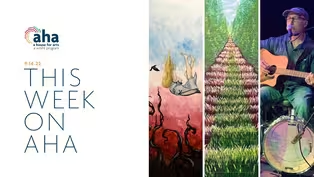
A storytelling exhibition on coping and caring. Lexi Hannah talks art. As Iz performs.
Step inside Universal Preservation Hall to see Beyond My Battle's annual art show, Art with Heart and Hope. Lexi Hannah is a full-time artist working in a variety of mediums. What advice does she have for other creatives? And how does she define success? As Iz performs "Pocketful of Souls" from his 2021 album, Children of the Cathode Ray .
Problems playing video? | Closed Captioning Feedback
Problems playing video? | Closed Captioning Feedback
AHA! A House for Arts is a local public television program presented by WMHT
Support provided by M&T Bank, the Leo Cox Beach Philanthropic Foundation, and is also provided by contributors to the WMHT Venture Fund including Chet and Karen Opalka, Robert & Doris...
AHA! | 808
Season 8 Episode 8 | 28m 45sVideo has Closed Captions
Step inside Universal Preservation Hall to see Beyond My Battle's annual art show, Art with Heart and Hope. Lexi Hannah is a full-time artist working in a variety of mediums. What advice does she have for other creatives? And how does she define success? As Iz performs "Pocketful of Souls" from his 2021 album, Children of the Cathode Ray .
Problems playing video? | Closed Captioning Feedback
How to Watch AHA! A House for Arts
AHA! A House for Arts is available to stream on pbs.org and the free PBS App, available on iPhone, Apple TV, Android TV, Android smartphones, Amazon Fire TV, Amazon Fire Tablet, Roku, Samsung Smart TV, and Vizio.
Providing Support for PBS.org
Learn Moreabout PBS online sponsorship(energetic music) (upbeat music) - [Jade] Visit a storytelling exhibition on coping and caring.
Talk art with Lexi Hannah.
And catch a performance by As Iz.
it's all ahead on this episode of "AHA!
A House for Arts."
(relaxing music) - [Voiceover] Funding for "AHA" has been provided by your contribution, and by contributions to the WMHT Venture Fund.
Contributors include the Leo Cox Beach Philanthropic Foundation, Chet and Karen Opalka, Robert and Doris Fischer Malesardi, the Alexander and Marjorie Hover Foundation, and the Robison Family Foundation.
- At M&T Bank, we understand that the vitality of our communities is crucial to our continued success.
That's why we take an active role in our community.
M&T Bank is pleased to support WMHT programming that highlights the arts, and we invite you to do the same.
(upbeat music) - Hi, I'm Jade Warrick, and this is "AHA!
A House for Art," a place for all things creative.
Here's Matt with today's field segment.
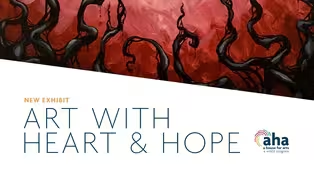
- I'm here in Saratoga Springs at Universal Preservation Hall to get a peek at Beyond My Battle's exhibition, "Art with Heart & Hope."
Follow me.
(soothing music) - Beyond My Battle is a nonprofit that helps patients and caregivers cultivate resilience, and reduce the stress of any kind of illness or disability.
Very much towards the beginning of starting the organization, we realized that A, there was a lot of creative energy, and B, that if we were gonna do something about stress management, we had to look towards the arts.
So we created the art show.
We solicited the artworks from local patients and caregivers.
And now in our fourth year, we are having the show at a much bigger venue with many more artists.
And it serves as a space for not only sharing the creations of the patients and the caregivers in our community, but also an opportunity for them to share their story.
Every artwork is accompanied by the artist's story about how they personally use art to reduce the stress of illness, disability, or caregiving.
(slow guitar) - The spirit of all of my art is actually to offer a healing way for others.
It's first and foremost, an act of healing for myself, but by sharing it, I'm able to offer people that as well.
I'm a poet, music curator producer and host of a monthly podcast called "Brian's Poetry Oasis."
I'm also a pastel artist, as well as a photographer.
And I like to throw in there, a father, 'cause that is quite an act of creativity as well.
I began writing poetry at the age of 12, and that was in-sync with the onset of clinical depression.
Of course, I didn't know anything about that, or understood what was going on, nor did my family.
And back then, there really wasn't even any kind of concept of that, or how it might be treated.
And I immediately began writing poetry, and that was my way, to this day, to bear witness to and get me through what I'm experiencing.
I do do pastels, they're right on Post-It notes, beautifully framed in a special way.
Well, I came up with the idea that if I had a QR code next to it, I could actually have folks hold their phone over it, and they'd be able to hear my poem set to music.
When I'm in a funk and my emotions are stalled, I quickly grow tired of my cheery facade.
That's when a love song, a vista, the perfect poem that describes what I feel, release all those tears that have pent up inside.
- My story has some simplicity to it, yet a lot of people hear it and it's life changing.
Lupus was systemically attacking my kidneys, it was attacking my brain, I was having brain lesions, and full renal failure.
I went into the hospital and was there for almost two months to save my life.
I was also 14 years old, so as a teenager, we can have a couple different responses, and mine was in a super positive way.
My life was saved medically, and I went on with things after that.
I ended up having an epilepsy diagnosis at age 18 because of the brain damage.
And still, controlled by medication, life to me was just pursuing things of success.
I became successful in business, I started companies, I was an executive level.
In late 2016, seizures returned.
I was losing memory, personality was changing, and it was told to me by neurology that a brain surgery was gonna be needed to save my life.
That was a pivotal moment in life, to question everything of, what is success?
And what's my purpose to even live?
That right there led to two life-saving brain surgeries that removed a peach-size of my actual brain.
Post brain surgery, I all of a sudden can paint, write poetry, and have these artistic abilities that I never had before.
(soothing music) We all experience some loss, and some hurt, and some pain.
And we can choose to look to the goodness and the grace in our life.
Doing things like I now do with Beyond My Battle, and leading a watercolor class monthly, with people who are truly hurting from the hurts and the pains that these medical disabilities, and diagnosis, or even caregiving has caused, is remarkable.
And it's been a gift to me, and a gift that I can now give back for.
- We use art at Beyond My Battle as a way of managing the stress of illness and disability.
We also talk a lot about mindfulness practices and meditation, and I always encourage people that when those things start to feel like a chore to take a step back, or to find a new avenue towards them.
You know, if meditation isn't the thing that's serving you in that moment, try gardening, or going for a walk and listening to the sounds.
If painting is no longer appealing to you, try writing poetry, even if you don't think you're any good at it.
These are the things that, they're there for us, they're available to us when times get really hard.
- Lexi Hannah is a mixed-media artist who chooses to focus on work that is joyous, fun, and even a little bit silly.
Her work serves one purpose: to make connections with others.
Let's chat with Lexi to learn more.
Hello, Lexi, welcome to "AHA!"
today.
- Hi, Jade, thanks for having me.
- Of course, I'm ready to talk about art and all things that bring you joy, and all your passions today.
So what type of art do you dish out into this beautiful world?
- So I'm a full-time artist, and I primarily do commissioned work.
So to do that, I'm doing all kinds of different things, right, out in the community, or for private places, businesses, so I'll do painting.
So someone might be like, "Paint my dog, paint my wife, paint my kids, paint my house," you know?
Might be something like that, and for that, I'll kind of adjust the medium to what kind of fits what the painting's gonna be.
I also do murals, so, you know, murals, big, you know?
I do a lot of that for all kinds of different people.
I also do illustration, which is a lot of fun.
I know you do that, too, it's very fun.
And I also do live-event painting.
So I'll bring my easel to say, a wedding, a market.
I recently did it at Fandom Fest at Proctor.
- [Jade] Wow.
- So that was really fun, yeah, so that's a lot of fun actually.
And I also give lessons.
And I also am a tattoo apprentice, so- - [Jade] Wowee.
- A lot of different avenues, yeah.
- Jade of all trades, as you could say.
- Yes, yes, yes.
(laughs) - For Fandom Fest, what was your costume?
Did you- - Okay, I know you know, and I had a lot of fun with it, and I've been having a hard time taking the costume off.
I was Bob Ross, and it was very fun.
- It was amazing, I saw it.
You folks gotta check out her Instagram to look at the Bob Ross costume, it's amazing.
- There's something about painting with that big beard, you know, it was a good time.
- It's amazing.
So when did art really become present in your life?
Like when did you realize like, "Huh, I may be an artist, I may be a painter"?
- I can't think of a time in my life, like way far back, when I wasn't obsessively drawing something.
Like when I was a little kid, piles of paper, and I would just, like, one after the next, just keep going all day.
Like I just, it wasn't so much even anything I was trying to do with an outcome, it was more, I felt so compelled to do it, that I would just keep doing it.
And that was, like, pretty much most of my life as far back as I can remember.
I do think I started seeing it more as something like, "Oh, I might have something going here," when I was...
I would always take classes through high school, and I didn't major in art in college or anything, but I always, I just needed to do it because it just made me feel good.
And my first semester in college, I had a really encouraging professor named Tom McPherson, and I love him, yeah.
And I remember it was like one of my first days, and I had my piece out.
And he gave me one of these where like, they look at it, and they're like... - [Jade] Approval.
- Yeah, and I was like... And ever since then, you know, it kind of, a lot of things came out of that.
And yeah, that's when I really felt like, "Ooh."
- That's amazing, so kind of in the high school area.
- Like high school and college, more so.
- Is when you kind of really got into it?
- Yeah.
- And really taking it seriously.
- Yeah, I felt like in college, the energy was a little more encouraging.
- [Jade] Yes.
- Yeah.
- I think our artists will probably agree, college is where we were set free to kind of just, like, explore and spread our wings and things like that.
- Yeah, 100%.
- So another question I have for you is a lot of artists tend to use art as an outlet, whether it's an emotional outlet, physical outlet, or so forth.
Do you utilize art as an outlet for yourself?
And if so, how would you define that, or how would you do that?
- 100%, oh my gosh- - [Jade] Most artists do, yeah.
- Yeah, man, when I was growing up, you know, like things were really chaotic, and I was sad a lot.
And it was, like, art making, whether it was art or things like also like music, or write, like something creative, you know, it was like the one place where you're not anxious about the future, you're not all depressed about the past.
You're not, your head's not chattering so much.
And, like, you're just present with something, and, like, in the moment and in your body.
And I think now that I'm an adult, and I can look back on that, I was like, "Oh, that's why it was so important to me and I had to do it."
It's really a practice in mindfulness, and I do it all the time.
So after many, many, many, many years of that, now it's just like, I feel, like, really at peace with it.
And it's something that just makes me feel really good.
So 100% an outlet and, like, need it.
- So you would say that it's more, do you find art is like a healing mechanism for you?
- Yeah, definitely, and I can notice when I haven't done it in a while, 'cause I'll be kind of like... - Like, "Oh, I gotta get back on it."
- You know, so yeah, definitely.
- And what are some ways that art feels healing, or it is healing for you?
- Part of what I do, because it's full-time, I have to pay my bills, right?
- [Jade] Yes.
- So there's a lot of stress to having to basically build my own salary, and always be looking for work.
And there have been a few times where, oh man, in the past few years, like I'm freaking out.
I'm like, "Where's my money gonna come from, man?"
You know, I'm freaking out.
- [Jade] Seriously.
- Yeah, and I do get anxious, but it's almost as if, like, someone can hear me, and the next day someone's like, "Will you paint my cat?"
And I'm like, "Oh my God, yeah," you know?
- About $100,000, please.
- Yeah, oh my God, if only.
Yeah, so, in that way, especially too, it's not just, like, a personal thing.
I think from doing commissioned work as well, it gives me, like, connection to people in bringing their visions to life, and collaborating with them.
And there's something about that.
When I was younger, I felt a little lonely with my work, even as I was, like, having success with it, I was getting, like, features by, like, Instagram, and Insider, which was, like, really cool.
But I was also, like, not fully feeling it so much.
And I think it was once I more tapped into community-based work, or work that's for other people and more, like, serving them, is when I got a mix of my own creativity and being with other people.
And I felt like that's when I was, like, "Wow, this feels really good," yeah.
Is that where you started to feel more successful within your work as well?
- 100%, I think that was the key distinction for me, between when I was younger and having some success, burned out spectacularly, took a break, came on back feeling a lot better.
And I think that is the key thing, is that connectedness with other people and being in the community.
And I also got a studio at Albany Barn, which you know Albany Barn.
- [Jade] Yes.
- And being around other creatives and being able to, you know, take a look at what they're working at, and, like, share and collaborate.
That's made it so much more joyous, you know?
- That's amazing.
- Yeah.
- So speaking of success, how would you define success for yourself as an artist?
It probably goes with a little bit of that, the collaboration, the community pieces.
- [Lexi] Yeah.
- But is there any other way you would define your own personal success?
- So when I was younger, yeah, I definitely thought like, and I still think this, you know, to be able to support yourself with your art, it's really cool because I, honestly, if I could choose anything, whether it was money or not, I just wanna make art all day; that's all I wanna do, man.
Just me and my paints, I'll be fine, you know?
But I thought, "Okay, if I can set these goals, and reach them, support myself with my art, that's great."
But again, it still felt a little lonely, disconnected.
But yeah, to be able to connect with your community through it is great, but also where you're in a place where you can create authentically, you know?
It's like authentic to you, and it's like feeding you.
And that doesn't only have to be personal work to me, because I can feel really good and authentic about sitting with someone, discussing this vision they have, and helping them get to it, you know?
To me, that's, like, I love that, it's amazing.
But also, I think, the real success, or feeling of success, for me, is that now I, like, really can pause at the end of a project and, like, enjoy it and feel good, feel good about it.
- It's a big one.
- Yeah, 'cause I'd just always be on this, like, hamster wheel of like, "I just need to keep accomplishing things," and like, you never stop and be like, "Wait, I just painted the biggest wall of my life."
Like I didn't stop and, like, celebrate it, you know?
And yeah, I think being able to be really centered and present and feel good while doing those things is, to me, that's all I ever wanted, to just, like, feel good, you know?
So to me, that's what feels successful.
'Cause you gotta enjoy it, you know?
- [Jade] Exactly.
- We started it 'cause we liked it.
- Exactly, you gotta remember to give yourself some pats on the back for all the hard work you do.
Like that's something I personally struggle with is, like, "How do I make sure that I give myself the accolades and the pats on the back?-" - Oh my gosh.
- "I deserve."
'Cause, you know, all the artists out here, we're doing amazing things, and we need to recognize ourselves that we are doing great work, and that we need to make sure that we recognize that.
And really, I don't know, just realize that with our souls.
- Yeah, no, 100%.
- And let it bring us joy.
(laughs) - Yeah, no, definitely.
Well you get it, you know?
It's like, 'cause it's so exciting to, like, get the work, but yeah, like, taking...
It's like a muscle, you have to exercise, like, that gratitude in pausing.
And, like, it's okay and not arrogant to be, like, "Way to go, me."
- Right, exactly.
- That was us, yeah, 'cause I would never let myself do that.
I was so afraid of, like, arrogance or something, but, like, it's okay to- - Or pompous.
- Yeah, but it's okay to, like, be proud of yourself, you gotta be, man, 'cause, like, it's hard out there.
And to carry yourself through the world, it's good to have some confidence and believe in yourself.
- [Jade] It really is.
- And that's key.
- So let's talk about those strategies too.
- Okay.
- So we got, like, what are some strategies that actually helped you support you in this success and this feeling that you've reached?
- Shameless self-promotion.
(laughs) - [Jade] Shameless self- - Listen, a lot of people, I think, they're afraid of...
I think it's like the fear of rejection maybe, like, you don't wanna put yourself out there, "What will people think?"
Or you don't wanna pitch this idea, someone might say "no."
I think for me from, I think I really leaned into this in college where I was, like, I've been embarrassed a lot in my life, but I always survived and it passed.
- [Jade] Yeah.
- And leaning into that and being like, "Okay, I have these ideas, I have these businesses I wanna work with, I wanna do these things.
What if I just, like, ask for it?"
And to be honest, that's, like, built a huge part of my career.
And it's just, like, daring to be, like...
I literally I've gotten so many jobs this way, I'll walk into a place and be like, "I can't help but notice you have some blank walls in here, I make murals, here's my card," you know?
And, like, sometimes people are like, "Okay, lady," you know?
But sometimes people call me back, and you know, that builds up my portfolio.
- [Jade] That's amazing.
- Yeah, and that does take a little bit of, I guess confidence, and yeah, not caring about too much about getting embarrassed.
- [Jade] Yeah.
- But yeah, self-promotion, also portfolio is really key.
What I tell my students a lot is, "Listen, it's okay that you can't go to, like, some amazing art school, or that, like, your background, you feel like it's not, I don't know, like refined enough or something.
Really your work is gonna speak for itself."
So if you want people to commission you, say, to get a certain type of work, put that type of work out there.
Like, you don't have to even necessarily have professionally been commissioned yet to get the work, right, you have to start somewhere.
- [Jade] Yeah.
- Find a wall and paint it.
Or like, if you wanna start pet-portrait commissions, which is, like, pretty lucrative, you know, just start doing it.
Put it out there and make it be known that you're available, because there are a bunch of great artists out there- - [Jade] Yeah.
- but they don't understand people aren't just gonna knock on your door, and be like, "I hear there's art in here," you know?
Like, you've really gotta let it be known.
"Not only am I an artist, but I'm available, and you can hire me, and I can do this for you," you know?
- Yeah, "Here, check out my work."
- Yeah, right, and, like, just consistently doing that is key.
And I know that social media can be, like, really frustrating with the shifting algorithms and stuff like that.
But just realizing, you know, it's a business tool, and kind of like a free storefront, almost, if you, like, dodge how much it makes you wanna pay for ads, right?
- [Jade] Yeah.
(chuckles) - And it's a good way to just show what you've got and what you can do.
So definitely leaning into that, yeah.
- [Jade] Well, thank you for that advice.
- Of course.
- It was great talking to you today, Lexi, and I appreciate you sitting down, and giving us your time today.
- Always a pleasure, thank you for having me.
- No problem.
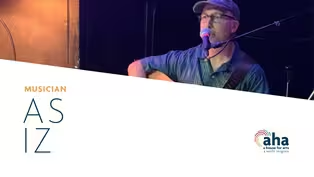
Please welcome As Iz.
- Okay, this first song is a little bit of a rocker from my 2019 album, and this one's called, "Save That Rock N' Roll."
- A 1, a 2, a 1, 2, 3, 4.
(upbeat electric guitar) ♪ When rock and roll dies, it ain't gonna be my fault ♪ ♪ When rock and roll dies, it ain't going to be my fault ♪ ♪ But I've done all I can ♪ ♪ To support my special cause ♪ ♪ Won't know who I'll be to dance that rock and roll ♪ ♪ Never go out and dance through that rock and roll ♪ ♪ Well, I do believe you lost your rockin' soul ♪ ♪ You gotta help me save that rock and roll ♪ ♪ Gotta help me save that rock and roll ♪ ♪ Please lend a hand and resuscitate that rock and roll ♪ (upbeat funky guitar) ♪ All you do is stay home Saturday night ♪ ♪ Used to go out and rock those city lights ♪ ♪ Please take my hand and don't put up the fight ♪ ♪ You gotta help me save that rock and roll ♪ ♪ Gotta help me save that rock and roll ♪ ♪ Please lend a hand and resuscitate rock and roll ♪ ♪ All right ♪ (upbeat funky guitar) ♪ Can't you feel the beating heart of rock is here ♪ ♪ Knockin' those shoes and boogie in your side ♪ ♪ Soon you'll feel that rocking down the block ♪ ♪ You gotta me save that rock and roll ♪ ♪ Come on ♪ ♪ Gotta help me save that rock and roll ♪ ♪ Please lend a hand to resuscitate rock and roll ♪ ♪ Please lend a hand to resuscitate rock and roll ♪ ♪ Please lend a hand to resuscitate rock and roll ♪ Thank you.
Okay, this next song is from my most recent album, the name of that album is Children of the Cathode Ray.
And this song is called "Pocketful of Souls," a song I wrote during the heart of the pandemic.
So it addresses some of those issues and fears regarding that time, actually this time, so, you know, or any time for that matter.
"Pocketful of Souls," hope you like it.
(mellow guitar) ♪ Took a walk outside today ♪ ♪ To shake my isolation ♪ ♪ To my surprise I can't escape humiliation ♪ ♪ An hour or so passes by ♪ ♪ And I don't see that much change ♪ ♪ It might seem awful strange ♪ ♪ For the world to be this way ♪ ♪ Don't despair on your own ♪ ♪ You may find an open door ♪ ♪ We all reap what we sow ♪ ♪ As we prepare for what's in store ♪ ♪ Out on the fringes of my mind ♪ ♪ Rest a pocketful of souls ♪ ♪ Only yesterday it seemed like they were bold ♪ ♪ - Turns out a precious fine ♪ ♪ Exceeds our expectations ♪ ♪ Kind of like a fractured nation ♪ ♪ That comes in from the cold ♪ ♪ Don't despair on your own ♪ ♪ We may find an open goal ♪ ♪ We all reap what we sow ♪ ♪ As we prepare for what's in store ♪ (lively guitar) ♪ Got to leave right away ♪ ♪ And wait another hour ♪ ♪ For the air to clear ♪ ♪ All we hold dear is in decay ♪ ♪ I'll be seeing you on that day ♪ ♪ When it's all sorted out ♪ ♪ When we know what we're about ♪ ♪ Pocketful of souls, come what may ♪ ♪ Don't despair on your own ♪ ♪ You may find an open door ♪ ♪ We all reap what we sow ♪ ♪ As we prepare for what's in store ♪ ♪ Don't despair on your own ♪ ♪ You may find an open door ♪ ♪ We all reap what we sow ♪ ♪ As we prepare for what's in store ♪ ♪ For what's in store ♪ (energetic music) - Thanks for joining us.
For more arts, visit wmht.org/aha, and be sure to connect with us on social media.
I'm Jade Warrick, and thanks for watching.
(upbeat music) - [Voiceover] Funding for "AHA!"
has been provided by your contribution, and by contributions to the WMHT Venture Fund.
Contributors include the Leo Cox Beach Philanthropic Foundation, Chad and Karen Opalka, Robert and Doris Fischer Malesardi, the Alexander and Marjorie Hover Foundation, and the Robison Family Foundation.
- At M&T Bank, we understand that the vitality of our communities is crucial to our continued success.
That's why we take an active role in our community.
M&T Bank is pleased to support WMHT programming that highlights the arts, and we invite you to do the same.
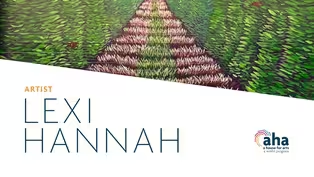
Advice for Creatives YOU Need To Hear
Video has Closed Captions
Clip: S8 Ep8 | 12m 23s | Talk art with Lexi Hannah. (12m 23s)
Video has Closed Captions
Clip: S8 Ep8 | 30s | A storytelling exhibition on coping and caring. Lexi Hannah talks art. As Iz performs. (30s)
Video has Closed Captions
Clip: S8 Ep8 | 6m 31s | Visit a storytelling exhibition on coping and caring. (6m 31s)
Video has Closed Captions
Clip: S8 Ep8 | 3m 48s | Catch a performance by As Iz. (3m 48s)
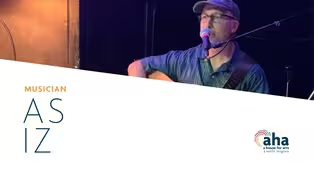
As Iz "Save That Rock 'N' Roll"
Video has Closed Captions
Clip: S8 Ep8 | 2m 48s | Catch a performance by As Iz. (2m 48s)
Providing Support for PBS.org
Learn Moreabout PBS online sponsorship

- Arts and Music
The Best of the Joy of Painting with Bob Ross
A pop icon, Bob Ross offers soothing words of wisdom as he paints captivating landscapes.













Support for PBS provided by:
AHA! A House for Arts is a local public television program presented by WMHT
Support provided by M&T Bank, the Leo Cox Beach Philanthropic Foundation, and is also provided by contributors to the WMHT Venture Fund including Chet and Karen Opalka, Robert & Doris...