
AHA! | 812
Season 8 Episode 12 | 27m 45sVideo has Closed Captions
Tune in Wednesday night at 7:30pm or anytime online: wmht.org/aha
Visit the studio of poet and illustrator James Christopher Carroll in Chatham, NY to learn how he creates his enchanting picture books. Elizabeth Dubben is the Executive Director of Collar Works, a non-profit contemporary art gallery focusing on inclusiveness and equity in Troy, NY. Folk-pop singer Sabrina Trueheart performs "Sad Smile" and songs from her 2022 debut EP, Holding Onto Something Good
Problems playing video? | Closed Captioning Feedback
Problems playing video? | Closed Captioning Feedback
AHA! A House for Arts is a local public television program presented by WMHT
Support provided by M&T Bank, the Leo Cox Beach Philanthropic Foundation, and is also provided by contributors to the WMHT Venture Fund including Chet and Karen Opalka, Robert & Doris...
AHA! | 812
Season 8 Episode 12 | 27m 45sVideo has Closed Captions
Visit the studio of poet and illustrator James Christopher Carroll in Chatham, NY to learn how he creates his enchanting picture books. Elizabeth Dubben is the Executive Director of Collar Works, a non-profit contemporary art gallery focusing on inclusiveness and equity in Troy, NY. Folk-pop singer Sabrina Trueheart performs "Sad Smile" and songs from her 2022 debut EP, Holding Onto Something Good
Problems playing video? | Closed Captioning Feedback
How to Watch AHA! A House for Arts
AHA! A House for Arts is available to stream on pbs.org and the free PBS App, available on iPhone, Apple TV, Android TV, Android smartphones, Amazon Fire TV, Amazon Fire Tablet, Roku, Samsung Smart TV, and Vizio.
Providing Support for PBS.org
Learn Moreabout PBS online sponsorship(uplifting music) (uplifting music) - [Narrator] Step into the enchanting world of writer and illustrator James Christopher Carroll.
Chat with arts administrator and educator Elizabeth Dubben, and see a performance from Sabrina Trueheart.
It's all ahead on this episode of "AHA, A House for Arts."
- [Announcer] Funding for AHA has been provided by your contribution and by contributions to the WMHT Venture Fund.
Contributors include the Leo Cox Beach Philanthropic Foundation, Chet and Karen Opalka, Robert and Doris Fisher Fischer Malesardi, and the Robison Family Foundation.
- At M&T Bank, we understand that the vitality of our communities is crucial to our continued success.
That's why we take an active role in our community.
M&T Bank is pleased to support WMHT programming that highlights the arts and we invite you to do the same.
(uplifting music) (uplifting music continues) - Hi, I'm Jade Warrick, and this is "AHA - A House for Arts," a place for all things creative.
Here's Matt with today's fill segment.
(suspenseful music) - I'm here in Chatham, New York to speak with poet and illustrator James Christopher Carroll.
Let's go.
(suspenseful music) (suspenseful music) - What I mostly do is picture books for children.
I have, I think, six or seven books now.
"Sister Spring" will be coming out in spring, and the one that's out now is "Mother Winter."
I do the text, mostly it's poems, and I write the poem first maybe, or I do the illustrations first and see what the illustrations say regarding what the word should be.
So it's kind of a dance back and forth.
It's about rhythm.
It's about a pulse or the breathing, waves, and if you can tap into that, that rhythm, that staccato or that calm, that's where it works best.
(suspenseful music) I got into it not because I wanted to write and illustrate for children, to tell you the truth.
I got in it because I wanted to create these worlds.
I want all ages to be interested.
I align more with illustrators because most of my work is done to illustrate some words.
And I recently said in an artist's statement that I love the slow dance across the page of the words and the pictures.
It's just terrific when it works right.
I have better results when I let myself stay out of control and not know what I'm doing.
I don't do a sketch where this is here and this is here and this is here, and then I start coloring in.
I don't do that.
I've got like this weird thing over here that I sketched in the morning three weeks ago that has nothing to do with maybe what I was asked to do for a book, maybe, about Edgar Allen Poe that I'm thinking about working on.
But that crosspollination adds something special.
'Cause once you're in control, you're working with the knowledge you already have.
You know, it's just like not being open to what you have to say.
You might say to me, Jim, ever consider blah, blah, blah doing this?
And I'd be like, no, I already know.
If I already know, then nothing new happens, so I try to stay open to what might be suggested.
So the process is traditional stuff: ink, paper, paints, gouaches, pastels.
I bring them into the computer and then I go, "Oh my God, now what am I gonna do?"
Because it is open-ended.
Look what the possibilities are.
It's not only this, but it's this and then this, and then, there's just so much.
Fortunately, my brain has been rewired to be able to deal with that, like, chess, three dimensional chess game of having this texture and this color and this shape, and combining it all together and having it be beautiful.
(tranquil music) I have "Mother Winter" here.
(suspenseful music) "If you're awake on the longest cold night when the wind curls and frost holds time, you'll hear her bells and smell the first snow when mother Winter goes walking.
Go out and find her.
She's waiting for you.
Go out and ride on her long coattails.
Wander this eve, dark and deep, when Mother Winter goes walking.
So if you are awake on the longest cold night, when the wind curls and frost holds time, you'll hear her bells and smell the first snow when Mother Winter goes walking.
In a night kissed with quiet color, she wanders a world already dreaming.
Go out and find her."
(tranquil music) - Elizabeth Dubben is the director of Collar Works, a nonprofit contemporary art gallery focusing on inclusiveness and equity in Troy, New York.
Let's chat with Elizabeth to learn more.
Hi Liz, welcome to "AHA" Today.
- Thank you for having me.
- Super excited to talk to you about Collar Works and how it has inclusive and equitable approaches to the arts community for being an art space.
So what is Collar Works?
And give us a little bit of background.
- Collar Works, we are a contemporary arts organization located in Troy, New York, primarily working with emerging and underrepresented artists, supporting them in both the creation and exhibition of their works through our gallery programming.
We run an artist residency program where we bring in artists from across the nation and globe.
Really, what is at the heart of our organization is the fact that we are an artist led, artist run, for artists, by artists organization.
- And how does being an artist for artists by artists, how is that a strength?
- Well, we were founded in 2009 by a cohort of emerging artists right out of grad school.
And they were looking around the region and noticed that there really wasn't spaces that were supporting artists like them, young, early career, emerging, underrepresented artists making conceptually provocative, spirited, challenging works.
It was often time, like, you'd have to travel to New York City or Boston or Philly to experience the kind of works that they were making, so they wanted to stay in the area and they wanted to fill that void.
And at that time, Troy had a lot of vacant properties, a lot of the historic collar factories were vacant, and so Collar Works was birthed out of one of the historic collar factories, and really had that grassroots artist collective culture where it was artists working together to support one another, show their work, champion, you know, their efforts and value the role art is playing.
- That's amazing 'cause we shouldn't have to go to New York, to Philly, Boston, all those other big cities that are known for arts.
Like, we have the same people here.
Like, those people sometimes move to those places, so it's like, why not just make our own space here?
We already have the artists, we already have the people.
Why not just make this our New York City, our Philly and et cetera?
- Right, exactly, I think that's a big part of our sort of visioning, constantly, for the organization is how do we create a pipeline or opportunities that are truly supportive of young artists, early-career artists so that they stay.
- Yes, getting them to stay is the key point as well.
- Right.
- So with that, you hear the phrase "artist centered and artist first" thrown around a lot in the art world.
What does that phrase or approach mean to you and to Collar Works?
- It's a little bit of a loaded question.
- I know, right?
- But primarily, you know, for many years, decades, really, artists have had that stereotype of like starving artists, right?
Or don't pursue the arts.
You're not going to be able to make a viable career out of it.
And under that is really the reality that artists haven't been valued, they haven't been paid fairly for their work, and at Collar Works, that's a big part of who we are.
So from the very moment we were founded, we were founded as a non-commissioned art space with 100% of the proceeds going directly back to artists.
- Which is rare.
- So rare.
- Yes, love that.
- It's still rare and it should not be.
And so we have actively tried to make sure that financial barriers were not preventing emerging and underrepresented artists from participating in gallery exhibitions or in residency programs.
So we've tried to make it very accessible to all artists, and truly have it be an opportunity to be a professional springboard.
- What are some approaches and strategies you use to help support local emerging artists?
I know you said nationally, but I know a lot of local artists are very aware and into Collar Works, so what are some approaches that you use to really support those artists and make it accessible for them to succeed within the arts world?
- Right, emerging artists, underrepresented artists are a part of every sort of aspect of the organization.
We have majority artists on our board of directors, we employ artists, we have artists and arts professionals in the community playing roles in our, like, advisory panels or selection panels.
But beyond that, we really provide sort of a safe space, and wherever that space is, be it at the gallery or at the residency, for creative risk taking.
And so we really encourage young artists, emerging artists to put on the hat as curator to not be afraid of taking risks and putting out work that is challenging.
I really feel like artists hold up a mirror to society, and we've been an organization that has been unapologetic in not being afraid to have shows that challenge society, you know?
Where we really embrace supporting artists who are making culturally, socially, politically relevant works, and the conversations that that work sparks is where the impact truly is.
- That's true, I will say, a lot of art orgs in the area, not even in the area but a lot of art orgs in general, within society, nationally, all over the place, tend to be a little bit whitewashed.
Sometimes they only want a little bit of gallery-level things, but, like, very specific, like, let me get another watercolor or another water painting of, like, some rocks and a creek.
And I like the fact that Collar Works does put out provocative work and put out work that you may not see in a typical kind of whitewashed gallery space.
You really see very community, very different, very colorful pieces of work that you, honestly, would see in like Philadelphia and New York, and all those other larger cities that are known for their art hubs, so that's something that's very appreciated.
- Thank you.
- Now I wanna talk a little bit about community.
So community input within art spaces is supposed to be very important, it's something that's sought after, but sometimes it's a little bit overshadowed within the art world, unfortunately.
What are some approaches that yourself and Collar Works take to make sure that the community is brought into the conversation and that they have a voice within this art space?
- I think the most important part of bringing in the community is being a good listener and having respect.
You know, we are engaging many communities- - Yes.
- Within our organization, so it's not specific to one, you know, geographic area per se, but the fact that we integrate our artist community within many aspects of our organization, especially since we're very grassroots, very volunteer-driven, we need to listen to their voices and what they're saying and what they're bringing from their communities to the table.
And so I would say that's one thing that I appreciate most about Collar Works is that we're not afraid to have hard conversations, we're not afraid to have deep self-reflection, and to be good listeners, and then to have that impact the decision making and- - This is really important.
- And how we grow and move forward.
- Yes 'cause you can't grow if you're just listening to yourself in an echo chamber, right?
- Yeah, no, not at all.
I think we've done a pretty good job of always trying to keep our fingertips on the pulse of, like, what artists need.
It helps that we are artists ourselves.
- That's true.
- And can understand, but we're always trying to fill voids in the region and meet communities where they're at.
It's something that, for me as a person, I've always been that kind of person, scanning kind of the area and saying, like, what's not here?
How can I contribute to creating opportunities?
So it's been something that I think is just a part of my DNA.
- Yeah, you're just like, I was born with this.
- Yeah, I love bringing people together, especially around the arts.
And we've done it through our dinner and dialogues where we've had a series called Collard Greens Dinner and Dialogue in the gallery, where we're bringing artists and curators and members of the community together to talk art, life, and everything in between.
- There are actually Collard greens involved?
- There was in the first one that we did, there definitely was some Collard greens that were grown by the Collard City Growers, just- - Full circle.
- Yeah.
But, you know, we really try to kind of create some, like, fresh and innovative programming.
One program that I'm really excited about that we're adopting this fall is FLOCKart.
- Yeah.
- Yeah, and it's a mobile gallery program and artist residency program in a renovated 40-foot shipping container.
- So cool.
- So it's a climate controlled gallery that's going to be moving into urban and rural communities, connecting artists, you know, and their works with communities like hosting workshops and things like that, so we're really excited about that initiative.
- Yeah, the fact that it's mobile is really cool.
It makes it pretty accessible as well.
- Definitely.
- Well, thank you, Liz.
I appreciate you coming here today and talking.
- Thank you, Jade, thanks for having me.
- Please welcome Sabrina Trueheart.
(gentle guitar music) ♪ I am the bearer of a sad, sad smile ♪ ♪ And my wings have needed patching for a while ♪ ♪ I'm hopeless at best, flirting with death ♪ ♪ I am waiting for life while I hold my breath ♪ ♪ I am waiting for life while I hold my breath ♪ ♪ I'll be long gone before my stars align ♪ ♪ If I'm heading where I should ♪ ♪ Then give me a sign ♪ ♪ Spring bleeds into summer, then into fall ♪ ♪ And I can't seem to find the meaning of it all ♪ ♪ I am the bearer of a sad, sad smile ♪ ♪ And I can't help but feel that nothing's worth my while ♪ ♪ I'm hopeless at best, flirting with death ♪ ♪ I am waiting for life while I hold my breath ♪ ♪ I am waiting for life while I hold my breath ♪ ♪ I live between a thousand dreams ♪ ♪ The world it's turning and I'm standing still, it seems ♪ ♪ Letting precious time pass ♪ ♪ Like sands through the hourglass ♪ ♪ I am the bear of a sad, sad smile ♪ ♪ But please don't ask me questions 'cause I don't know ♪ ♪ I am hopeless at best, flirting with death ♪ ♪ I am waiting for life while I hold my breath ♪ ♪ I am waiting for life while I hold my breath ♪ ♪ I am waiting for life while I hold my ♪ (lively guitar music) ♪ Younger times ♪ ♪ They are forgettable ♪ ♪ They are forgettable, they are forgettable ♪ ♪ Younger lives, we can't go back to ♪ ♪ They are forgettable, they are forgettable ♪ ♪ We're always in trouble ♪ ♪ But I've got this great feeling ♪ ♪ Cinemascope eyes with an urge to see ♪ ♪ That he always called me his honey bee ♪ ♪ Oh, he called me his honey bee ♪ ♪ And your friends all acted like they knew me ♪ ♪ But did they really ♪ ♪ I was known as his honey bee ♪ ♪ 'Cause I was so green ♪ ♪ They say ♪ ♪ He'll be forgettable ♪ ♪ He'll be forgetful, you'll feel unlovable ♪ ♪ Every man you ever meet ♪ ♪ Will do his time ♪ ♪ They are forgettable, my daddy says so ♪ ♪ But I've got this great feeling ♪ ♪ Cinemascope eyes with an urge to see ♪ ♪ That he always called me his honey bee ♪ ♪ Oh, he called me his honey bee ♪ ♪ And your friends all acted like they knew me ♪ ♪ But did they really ♪ ♪ I was known as his honey bee ♪ ♪ 'Cause I was so green ♪ ♪ But I've got this great feeling ♪ ♪ Cinemascope eyes with an urge to see ♪ ♪ That he always called me his honey bee ♪ ♪ Oh, he called me his honey bee ♪ ♪ And your friends all acted like they knew me ♪ ♪ But did they really ♪ ♪ I was known as his honey bee ♪ (gentle guitar music) (gentle guitar music) ♪ Life's good when it's two of us, but ♪ ♪ I know the wet clothes aren't hung ♪ ♪ And the dishes need to be done ♪ ♪ Forget a happy home is a clean home ♪ ♪ I just can't bring myself to do it ♪ ♪ And neither can you, Hon ♪ ♪ The burden of everyday hangs over us both ♪ ♪ But we can't let them know ♪ ♪ We just sweep it under the rug ♪ ♪ And hope that it doesn't show ♪ ♪ Life's good when it's the two of us ♪ ♪ But I spilled wine on the carpet ♪ ♪ And I never got it off ♪ ♪ Forget a happy home is a clean home ♪ ♪ I just can't bring myself to clean it ♪ ♪ And neither can you, Hon ♪ ♪ But this is why we work so well together ♪ ♪ The perfect blend of love and inner turmoil ♪ ♪ Asking each other "Is that all there really is" ♪ ♪ And assuring one another we can make it ♪ ♪ We can make it ♪ ♪ Life's good when it's the two of us ♪ ♪ But I'm still me and you're still you ♪ (dramatic music) - Thanks for joining us.
For more arts, visit wmht.org/aha, and be sure to connect with us on social.
I'm Jade Warrick, and thanks for watching.
(upbeat music) - [Announcer] Funding for AHA has been provided by your contribution and by contributions to the WMHT Venture Fund.
Contributors include the Leo Cox Beach Philanthropic Foundation, Chet and Karen El Opalka, Robert and Doris Fischer Malesardi, and the Robison Family Foundation.
- At M&T Bank, we understand that the vitality of our communities is crucial to our continued success.
That's why we take an active role in our community.
M&T Bank is pleased to support WMHT programming that highlights the arts, and we invite you to do the same.
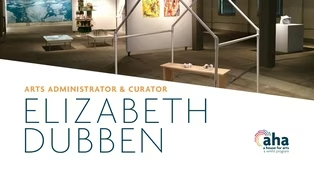
Jade Warrick Interviews Collar Works' Elizabeth Dubben
Video has Closed Captions
Clip: S8 Ep12 | 10m 41s | Jade Warrick Interviews Collar Works' Elizabeth Dubben (10m 41s)

Poet and Illustrator James Christopher Carroll
Video has Closed Captions
Clip: S8 Ep12 | 5m 21s | Visit the studio of poet and illustrator James Christopher Carroll in Chatham, NY. (5m 21s)
Providing Support for PBS.org
Learn Moreabout PBS online sponsorship

- Arts and Music
The Best of the Joy of Painting with Bob Ross
A pop icon, Bob Ross offers soothing words of wisdom as he paints captivating landscapes.












Support for PBS provided by:
AHA! A House for Arts is a local public television program presented by WMHT
Support provided by M&T Bank, the Leo Cox Beach Philanthropic Foundation, and is also provided by contributors to the WMHT Venture Fund including Chet and Karen Opalka, Robert & Doris...