
AHA! | 814
Season 8 Episode 14 | 28m 45sVideo has Closed Captions
Don’t miss this chance to learn more about art, music, and education!
First, meet artist Naomi Lewis, who brings order out of chaos through her artwork. Then be inspired by Thomasina Winslow, a professional blues musician, and teacher. She performs some of her favorite blues tunes and shares her passion for the craft. Don’t miss this chance to learn more about art, music, and education!
Problems playing video? | Closed Captioning Feedback
Problems playing video? | Closed Captioning Feedback
AHA! A House for Arts is a local public television program presented by WMHT
Support provided by M&T Bank, the Leo Cox Beach Philanthropic Foundation, and is also provided by contributors to the WMHT Venture Fund including Chet and Karen Opalka, Robert & Doris...
AHA! | 814
Season 8 Episode 14 | 28m 45sVideo has Closed Captions
First, meet artist Naomi Lewis, who brings order out of chaos through her artwork. Then be inspired by Thomasina Winslow, a professional blues musician, and teacher. She performs some of her favorite blues tunes and shares her passion for the craft. Don’t miss this chance to learn more about art, music, and education!
Problems playing video? | Closed Captioning Feedback
How to Watch AHA! A House for Arts
AHA! A House for Arts is available to stream on pbs.org and the free PBS App, available on iPhone, Apple TV, Android TV, Android smartphones, Amazon Fire TV, Amazon Fire Tablet, Roku, Samsung Smart TV, and Vizio.
Providing Support for PBS.org
Learn Moreabout PBS online sponsorship(bright music) - [Jade] Artist Naomi Lewis arranges small patterns to create larger organic-like images, and renowned acoustic blues musician, Thomasina Winslow discusses her career and performs some music.
It's all ahead on this episode of AHA!
A House For Arts.
- [Narrator] Funding for AHA!
has been provided by your contribution, and by contributions to the WMHT venture fund, contributors include The Leo Cox Beach Philanthropic Foundation, Chet and Karen Opalka, Robert and Doris Fischer Malesardi, and The Robison Family Foundation.
- At M & T Bank we understand that the vitality of our community is crucial to our continued success.
That is why we take an active role in our community.
M & T is pleased to support WMHT programming that highlights the arts, and we invite you to do the same.
(bright music) - Hi, I'm Jade Warrick, and this is AHA!
A House For Arts, a place for all things creative.
Here's Matt with today's fill segment.
- I'm in downtown Albany to get a look at the very detailed work of artist Naomi Lewis, let's go.
(acoustic music) - I respond to bringing order out of the chaos of the world.
In my art, I feel that that's one way I am able to do it.
I slow down my world by creating these pieces that are about bringing new light to the ordinary.
There are collections of materials that I have, that I use and refer to, to build networks of small elements that are then growing into a larger whole.
Objects of coral, of stones, insect wings, and then abstracting that to reenvision the ordinary.
So each little element is repeated and dealt with as individually, but also part of a growing network, which in some ways reflects how individuals are in a larger society.
I start by lightly sketching the shapes without a total plan, and then I do layers of building on that graphite, and slowly building up the surface to give it more contour, to create little nooks and, hopefully, create a surface that has room for the eye to move around and explore.
As I gathered more and more references, I could shuffle through one and combine it with another, and going back and forth, farther and farther towards pattern, and then moving in towards texture, moving out towards a macro view, and moving in towards a micro perspective too.
I came upon the idea of taking some of the archived materials that I have in my possession, in my collections, and using those to create large wallpaper prints.
I did work for a short time in a wallpaper production facility when I was younger and realized that the process of repeating and tiling an original is the way that wallpaper is created.
I started with a piece that I found in my drawer of a cheat sheet that my son was able to bring into his calculus final exam.
And it looked like a beautiful object to me of all of these elements that were combined, and I, literally, scanned it to scale and used it as the background and then created a drawn element that I added to the surface to contrast, to juxtapose, and to flesh out the concept of what you might want on your wall.
I also work in cut paper.
I began when the insects of the wallpaper appeared, the spiders, thinking that maybe I would use an accumulation of spiders as my organic element, and did some cut paper pieces that arranged the spiders in a circular pattern that created a web.
What I do is draw the positive space and cut out the negative space.
So it is a tedious process.
It's very slow.
I use an exacto knife on Mulberry paper and I work on this process that I find slows down time for me, and is very meditative, and counters the frenetic pace of our contemporary life.
The process of working is the important part for me.
The finished product doesn't matter as much as getting in here and continuing the journey, not knowing where it will take me.
- Thomasina Winslow is a professional blues musician from Albany, New York.
Not only does she perform her music for audiences worldwide, she also strives to pass on the tradition of the blues to the next generation.
She does this through her educational program called STEAM.
Let's learn more from Thomasina.
Hi Thomasina, welcome to AHA!
Today.
I'm so happy to talk to you.
- [Thomasina] My pleasure.
- To begin, I want to let the audience know a little bit of the genre of music you play.
A lot of people may say blues, folks, roots, but personally, what do you think?
What genre do you fall into?
- I play acoustic blues, which is really delta blues, which is really country blues, you know, so, acoustic blues, kind of, keeps the confusion down as to what it is.
When I talk about the styles of music or anything, and you know, you look at my website, it's acoustic blues and more.
- [Jade] Hmm.
- And that was the easiest way for me to open the door for people to understand that there's, you know, more that I do.
But acoustic blues is where I'm most at home.
And then I work with the band.
I play classical, I study classical and have a degree in it, so, and I really like heavy metal too.
- [Jade] Same here.
Woo.
- Yes.
- Amazing, and you use the guitar with the acoustic blues too?
- And the guitar, yes, yes.
- Do you play any other instruments?
- I do.
I play piano, other plucked instruments, ukulele, and mandolin.
- Mandolin.
Nice.
- I bought a mandolin because I wanted to learn this one Led Zeppelin song and- and a little bit on the banjo.
I don't, I don't own one, but a little bit of banjo work, but guitar is my first, first love there.
- That's beautiful.
- Thank you.
- And does being able to play all these types of instruments or, you mentioned metal and Led Zeppelin being- - Yeah.
- And being able to dive into all these different genres, how does that feel fulfilling as an artist?
It must be.
- It is, very much so, and it really, kind of, gives you a confidence as a musician to say, "I know how this one works, and I know how to learn how the other ones work."
- Yeah, and be able to collaborate with other musicians as well, you know?
- [Thomasina] Yes, yes.
- Soon we'll see you in a metal band, who knows?
- [Thomasina] Yeah.
- So how did you get married to the blues?
How did you, how did you find peace and fulfillment with this artistic musical craft?
- I grew up with it with a musical family, but I became attached to it with a combination of things.
My parents were both from North Carolina, so.
The southern culture is full of music, that's where a lot of what I do, Americana roots, where that came from.
And I really like the combination of, of the culture singing with my family, and I just wanted to keep doing it.
And Odetta was one of my influences.
So I met her, and I said I want to do that, you know, I wanna do that.
And I was working with my family too, so it was part of our livelihood, but it also really, I really gravitated to it.
- And did any like, family stories, like just, I'm a blues fan myself and you hear so much about, oh, so much sung about what is seen through daily life- - [Thomasina] Yes.
- Like your family's daily life, or any type of, like, did that inspire you at all?
That's a great question.
What the blues were called before they were called the blues, were called, "reals."
R-E-A-L-S. - [Jade] Oh okay.
- And that's a part of the history, my great-grandfather played in the barrelhouses.
So he was a musician in the barrelhouses and that's when they, what they call reals, but they played all of the music at the time, like Stephen Foster, and that sort of thing.
So that story about him, one of the big hits that people loved to hear him sing was, "I Dream of Jeannie with the Light Brown Hair", that's, that's not necessarily a blues- but the reals were songs that were about real life.
So it was soap opera in song, you know, so different things.
I wrote a little song about, "See them trees growing in the breeze", you know, and where we were living in the, in the country, so.
All of that together really helped to build songs with the blues.
And the blues helps you put it into a song form, and that it's user friendly in that way.
- Oh, I love that.
And that's why I love the blues too, there's just something soulful about it, and connecting about it personally.
- Yeah.
You can say ♪ This pillow has a round circle ♪ - See there you go, anything, anything.
- Anything, anything, yes.
- So blues seems like it's very connecting, and very community-driven in a sense, I would say.
- [Thomasina] Yes.
- I know you do an educational program.
- Yes.
- STEAM.
- Yes.
- And I know that also has to do with connecting and educational pieces.
So would you like to give us a little bit of background about your educational program that you run, so folks know?
- Yes, yes, STEAM.
That acronym worked out so well because I worked with Children at Risk and it is- Really, strength-based programs are very important, as you know, when you're talking about teaching children life skills through music, which can be done through the arts, which can be done because it is life skills.
You have to learn how to listen, you have to learn how to communicate.
So when I left the classroom setting and decided to have my own independent education program, I thought to myself, "I want a strength-based program."
I want it to be a mentoring program, not just teaching program, but a mentoring in the expressive arts- STEAM.
Strength Through Expressive Arts Mentoring.
It just, it just- - Just worked out.
- It just worked out.
It's like writing a song where you're taking dictation.
You know, I created the program and presented it to the Office of Children and Family Services, and started working with secure facilities.
So incarcerated youth.
So I was like, I wanna do more.
Well that certainly was more, from being in an unsecure facility to the secure facilities, and, generally with any youth, if their energy- When that energy and that talent is directed, you get some amazing results.
- Yes.
- And I have so many stories that I could regale you with for the next couple of of programs, but one of the things I did is to record.
So I recorded them and their reaction when they hear their own voice.
It's just, some were in tears, some were, like, laughing and couldn't stop laughing and I didn't, you know, get that, 'cause to me that's feedback.
But for them it was feedback, they've never heard their own voice.
So that's why I wanted to keep that going and have it be an expressive arts mentoring, because it's life skills as well as music.
- And what type of skills do you teach them?
Just like how to play, how to sing.
- Yes.
How to play and sing all of the instruments that are in a band.
So your bass, piano, or keyboard, drums, and vocal, and even where it concerns with what they're doing with rap, guitar also, I know how we left that out.
And the idea is to have them all have some competency in all of those instruments.
So we are at a point where I can say, "Can someone do bass today?
", "Yeah, I'll do bass", "Someone do guitar today?
", "Yeah, I'll do guitar."
You know, and they feel so proud of themselves.
- They love it, probably.
- Yes.
- And why do you think this type of accessible programming for at-risk youth is valuable for the community?
'Cause it seems very valuable, but why do you find it valuable?
Well, I can answer that with one quick story.
One of the students that I have, or that I had, was able to be discharged without any further, because of good behavior and that, and got a job in the same system and created her own, her own STEAM-type program.
She didn't call it STEAM, but she created her own recording and producing program for kids that she was responsible for as a staff.
- That's amazing, teach one, reach one and continue on.
Yes.
- That's beautiful.
Yes.
So it builds, I believe, and I've seen that more than once, yeah.
- Well thank you, Thomasina, and thanks for coming by today and talking with us.
- Thank you.
- Please welcome Thomasina Winslow.
- So the songs that I'm going to do are some of the most exciting I find, enjoyable that I play and this first one got a lot of attention on YouTube as a featured video, over 350,000 views, and it's called "Rowdy Blues".
(acoustic plucking) ♪ Ain't gonna marry, neither settle down ♪ ♪ I'm going to stay right here ♪ ♪ 'til they tear this barrelhouse down ♪ ♪ Oh, I love you babe, now tell the world I do ♪ ♪ Oh, I love you babe, ♪ ♪ Tell the world I do love you ♪ ♪ I don't love nobody whole in this round world but you ♪ ♪ Ain't no use to weeping, ain't no need to crying ♪ ♪ Ain't no use to weeping, ain't no need to crying ♪ ♪ 'Cause you've got a home just as long as I got mine ♪ ♪ Oh, I love you baby, you so nice and brown, yeah ♪ ♪ Oh, I love you baby, you so nice and brown ♪ ♪ 'Cause you put up solid, won't come tumblin' down ♪ ♪ Now did you get that letter I mailed in your back yard ♪ ♪ Did you get that letter I mailed in your back yard ♪ ♪ It's a sad word to say ♪ ♪ But the best of friends have to part, yeah ♪ This song is a- Well, let's go to the club song from, like, 1927 written by, or sung by, Tommy McClellan.
And again, another really exciting piece.
You can, kind of, hear how the blues influenced funk when you hear this one.
So listen up for those cues, those bass cues.
(acoustic plucking) ♪ Bring your night shirt and my gown ♪ ♪ Let's get together now ♪ ♪ Shake 'em on down ♪ ♪ Oh, must I holler ♪ ♪ Yeah, must I shake 'em on down ♪ ♪ Tell me must I holler baby ♪ ♪ Must I shake 'em on down.
♪ ♪ Tell me baby, don't you know it's true.
♪ ♪ Shakin' that thing is good for you.
♪ ♪ Oh, must I holler.
♪ ♪ Yeah, must I shake 'em on down.
♪ ♪ Tell me, must I holler baby ♪ ♪ Must I shake 'em on down.
♪ ♪ Tell me baby.
♪ ♪ Can't you see ♪ ♪ Shakin' that thing is good for me.
♪ ♪ Oh must I holler ♪ ♪ Yeah, must I shake 'em on down.
♪ ♪ Tell me, must I holler, baby ♪ ♪ Must I shake 'em on down ♪ ♪ Shake it on down ♪ ♪ Tell me, must I holler baby ♪ ♪ Must I shake 'em on down ♪ ♪ If you ain't good lookin', it's not the clothes you wear ♪ ♪ Good, kind, street men will take you anywhere.
♪ ♪ Oh, must I holler ♪ ♪ Must I shake 'em on down ♪ ♪ Tell me, must I holler baby ♪ ♪ Must I shake 'em on down ♪ ♪ One more time ♪ ♪ Tell me, must I holler baby ♪ ♪ Must I shake 'em on down ♪ ♪ ♪ Tell me, must I holler baby ♪ ♪ Must I shake 'em on down ♪ This song is one of the classics by the master of Delta Blues called the "Grandfather of Delta Blues", Charlie Patton.
And it is another really exciting piece.
I'm really into those exciting pieces and you can hear the influence on funk, R & B, and everything in this one.
This is called "Moon's Going Down", one of my favorites.
(acoustic strumming) ♪ Ah, the moon is going down baby, sun's about to shine ♪ ♪ Ah, the moon is going down baby, sun's about to shine ♪ ♪ Well, Johnny Henry told me this morning, ♪ ♪ "I don't want you hangin' round."
♪ ♪ Oh well where were you now baby, ♪ ♪ Clarksdale mill burned down ♪ ♪ Oh well where were you now baby, ♪ ♪ Clarksdale mill burned down ♪ ♪ I was way down'n Sunflower with my face all full of frown ♪ ♪ And there's a house over yonder, painted all over green ♪ ♪ And there's a house over yonder, painted all over green ♪ ♪ Some of the finest young men Lord, you have ever seen ♪ ♪ Lord I think I heard that Helena whistle, ♪ ♪ Helena whistle, Helena whistle blow ♪ ♪ Well, I think I heard that Helena whistle blow ♪ ♪ I ain't gonna stop walkin' ♪ ♪ 'til I'm in my rider's door ♪ ♪ Lord the smokestack is black, ♪ ♪ And the bell it shines like the ♪ ♪ Bell it shine like the ♪ ♪ Bell it shine like the ♪ ♪ Bell it shines like gold ♪ ♪ Well, the smokestack is black ♪ ♪ And the bell it shine like gold ♪ ♪ I ain't gonna work here, no Terry Brown no more ♪ (synthesizer music) Thanks for joining us.
For more arts, visit wmht.org/aha and be sure to connect with us on social.
I'm Jade Warrick and thanks for watching.
(upbeat music) - [Announcer] Funding for AHA has been provided by your contribution and by contributions to the WMHT venture fund, contributors include The Leo Cox Beach Philanthropic Foundation, Chet and Karen Opalka, Robert and Doris Fischer Malesardi, and The Robison Family Foundation.
- At M & T Bank we understand that the vitality of our community is crucial to our continued success.
That is why we take an active role in our community.
M & T is pleased to support WMHT programming that highlights the arts, and we invite you to do the same.

Discover the Amazing Patterns of Artist Naomi Lewis
Video has Closed Captions
Clip: S8 Ep14 | 5m 10s | Explore the creative mind of artist Naomi Lewis in AHA! A House for Arts' studio visit! (5m 10s)
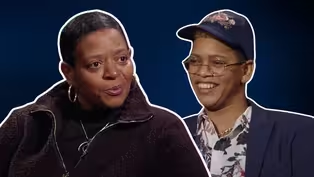
Go Inside the Life of Blues Musician Thomasina Winslow
Video has Closed Captions
Clip: S8 Ep14 | 10m | Get a unique glimpse into a blues musician's life and craft. (10m)
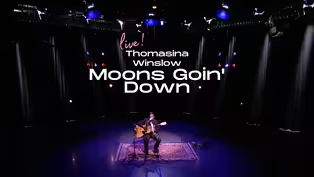
Thomasina Winslow Performs "Moons Goin' Down"
Video has Closed Captions
Clip: S8 Ep14 | 3m 2s | Don't miss Thomasina Winslow's performance of "Moons Goin' Down" on AHA! A House for Arts! (3m 2s)

Thomasina Winslow Performs "Rowdy Blues"
Video has Closed Captions
Clip: S8 Ep14 | 2m 53s | Don't miss Thomasina Winslow's performance of "Rowdy Blues" on AHA! A House for Arts! (2m 53s)
Providing Support for PBS.org
Learn Moreabout PBS online sponsorship

- Arts and Music
The Best of the Joy of Painting with Bob Ross
A pop icon, Bob Ross offers soothing words of wisdom as he paints captivating landscapes.













Support for PBS provided by:
AHA! A House for Arts is a local public television program presented by WMHT
Support provided by M&T Bank, the Leo Cox Beach Philanthropic Foundation, and is also provided by contributors to the WMHT Venture Fund including Chet and Karen Opalka, Robert & Doris...