
AHA! | 817
Season 8 Episode 17 | 26m 46sVideo has Closed Captions
Exploring the Art of Alicia Mikles, We Are Instrumental & Conor Walsh.
We'll explore the incredible art of Alicia Mikles, a painter & fiber sculptor creating beautiful work using biomorphic imagery. Then, we'll learn more about Evan Mack, the founder of We Are Instrumental, an organization dedicated to bringing quality instruments to students in Northern New York. Finally, we'll rock out with Conor Walsh as he performs songs from his upcoming album "Always & Forever"
Problems playing video? | Closed Captioning Feedback
Problems playing video? | Closed Captioning Feedback
AHA! A House for Arts is a local public television program presented by WMHT
Support provided by M&T Bank, the Leo Cox Beach Philanthropic Foundation, and is also provided by contributors to the WMHT Venture Fund including Chet and Karen Opalka, Robert & Doris...
AHA! | 817
Season 8 Episode 17 | 26m 46sVideo has Closed Captions
We'll explore the incredible art of Alicia Mikles, a painter & fiber sculptor creating beautiful work using biomorphic imagery. Then, we'll learn more about Evan Mack, the founder of We Are Instrumental, an organization dedicated to bringing quality instruments to students in Northern New York. Finally, we'll rock out with Conor Walsh as he performs songs from his upcoming album "Always & Forever"
Problems playing video? | Closed Captioning Feedback
How to Watch AHA! A House for Arts
AHA! A House for Arts is available to stream on pbs.org and the free PBS App, available on iPhone, Apple TV, Android TV, Android smartphones, Amazon Fire TV, Amazon Fire Tablet, Roku, Samsung Smart TV, and Vizio.
Providing Support for PBS.org
Learn Moreabout PBS online sponsorship(upbeat music) (upbeat music) - [Jade] Visit the studio of artist Alicia Mikles.
Spread the gift of music with We Are Instrumental founder Evan Mack.
And catch a performance from Conor Walsh.
That's all ahead on this episode of "AHA!
A House for Arts."
(upbeat music) - [Narrator] Funding for "AHA!
has been provided by your contribution and by contributions to the WMHT Venture Fund.
Contributors include the Leo Cox Beach Philanthropic Foundation, Chad and Karen Opalka, Robert and Doris Fischer Malesardi, and The Robison Family Foundation.
- At M&T Bank, we understand that the vitality of our communities is crucial to our continued success.
That's why we take an active role in our community.
M&T Bank is pleased to support WMHT programming that highlights the arts, and we invite you to do the same.
(upbeat music) (air whooshes) - Hi, I'm Jade Warrick, and this is "AHA!
A House for Arts," a place for all things creative.
Here's Matt with today's film segment.
- I'm here in West Hurley, New York to get a look into the studio of artist Alicia Mikles.
Follow me.
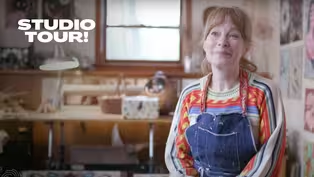
(upbeat music) - I am a visual artist, and I work in painting and fiber sculpture.
I try to create a sense of beauty in them that is not prettiness, but it can be a bit hard to look at in some ways or challenging.
But ultimately, I'd like it to be something that brings you a sense of discovery and awareness.
(upbeat music) Since the pandemic, I've really gotten back into my daily artistic practice.
Before that, it was kind of touch and go, sporadic.
There would be many lulls.
But during the pandemic, I made a commitment with an accountability partner, a really good friend, to check in with each other and really keep each other going and boosting each other up and saying, "Your art is worth it.
You need to express yourself."
In my paintings, I've always used biomorphic shapes, meaning like organic shapes that can refer to the body or parts of roots or branches.
Lately, I've been really getting into pattern.
And pattern, for me, brings up so much nostalgia.
I collect vintage clothes, and that was born out of necessity of growing up with not much money and working class and wanting to express my creativity in what I was wearing.
So I was studying these patterns, and I started using them in my work and just simply, you know, playing with brushstrokes and color, and deciding how I wanted those to translate into my larger paintings.
(upbeat music) During the pandemic I did a series called "Emissaries from Corona."
And, you know, we weren't going around and going to galleries and out to dinner and seeing friends.
We were all home.
And I really missed my friends.
So I decided to sort of make a group of friends for myself.
And it was a nostalgic exercise, and I was looking at a lot of like, little golden books from the 50s and 60s and 70s and the sweetness of the animals.
So I had this book.
I would start a painting.
So there's a hole in this book all the way through, with a hole in the center, and then just kind of see it was the eye of the animal or the nose.
(upbeat music) And I do think I have an attraction to things that might be slightly creepy or odd or unsettling, and I'm interested in checking that space out.
(upbeat music) I think that the black hole is something, you know, that we all have to look at within ourselves.
Like, we all have this shadow self, and we all have things that we don't like to look at about ourselves or about the world.
And I think it's important to take a look.
(gentle music) I started to do the wall pieces.
And they started with thinking about the woman's work of these vintage crocheted doilies, this kind of devaluing of craft or women's work and art.
That's the kind of thing like, that my great-grandmothers did.
The forms I was thinking of, again, that kind of bodily examination and a little bit of fear.
You know, my father died of cancer in 2013 at only age 60.
So I was was thinking about forms in the body, and how they can really embody our life force and our experience.
And instead of being afraid of bodily organs or squeamish about them or disgusted by them, to hold them up and and see their beauty.
It ties into looking at what can be a difficult to face and sitting with that discomfort and experiencing it, and also realizing it can be something that brings you joy in some way.
(reflective music) For many years I did not really allow myself to do art because I was a mother and working and had so many other things drawing my attention away.
But then I really had to, especially during the pandemic, do something that brought me joy.
I think we all have practices, whether you're an artist or a writer or a runner or a dog walker.
We all have practices that connect us with ourselves.
The actual making of the work feels like you've come home to yourself with a renewed sense of awareness and calm and of having spent time doing something valuable.
It is valuable.
(upbeat music) - We Are Instrumental is an organization dedicated to providing instruments to students throughout Northern New York.
Evan Mack, an opera composer and music professor at Skidmore, founded the organization in 2020.
So what prompted Evan to start We Are Instrumental?
Let's find out.
Hello, Evan, welcome to "AHA!"
today.
- So great to be here.
- I'm excited to talk to you about all things musical.
So how do you define yourself as an artist?
- I'm an opera composer.
Mostly composer, voice, opera, theater.
I'm a pianist by trade, but lately you'll find my works done on stages across the United States.
- Oh, that's amazing.
And what type of like, things do you have like, going on like, with your composing?
Like, what are some things you focus on as like theater, opera, et cetera?
- Yeah, usually a lot of stories I try and tell are both timely and timeless.
You know, and so you're dealing with things, whether they're current events or some entity that happened, whether it's a biopic opera.
My first one was "Angel of the Amazon" about Sister Dorothy Stang, who was a nun in Ohio, who worked with the poor in Brazil.
That goes to things where I have a new musical comedy called "Yeltsin in Texas!"
which is about when Boris Yeltsin visited a Texas grocery store and renounced communism in the parking lot in 1989.
So it goes all over- - Oh my God.
- but these stories that kind of look at us and what we're doing today, but also told in a lens of something that happened in the past.
- So do you do a lot of focus within opera and theater?
- Yes, so I've been very blessed in writing a lot, a collaborative process which I love in terms of working with singers and directors and lighting designers, costume designers.
And so I was very lucky because I fell into it.
You know, I always composed.
Being a pianist, there are a lot of lonely hours in a practice room, and I think secretly I craved to work with a lot of people.
And so I would write for my friends.
And so often in college it was chamber stuff.
And then I worked with a choir, and so I had a lot of coral stuff.
And then I stumbled upon this story of Sister Dorothy Stang while I was finishing up my doctoral studies at the conservatory in Cincinnati and wrote my first opera.
You know, operas usually take five, six, seven, eight years to write.
And I remember I wrote my first one, I was very lucky it ran in New York, and they said, "So what's next?"
And I said, "What's next?"
I just spent six years of my entire life.
What are you talking..." And then I was like, "Oh, hey, there's something here."
So I started with a writing partner, Josh McGuire, as my librettist, and we've written seven operas that have been done all over the place.
- Any favorites of yours so far?
- There's a few.
So one near and dear to my heart is "Roscoe," which is an adaptation of William Kennedy's novel.
And William Kennedy is the Charles Dickens of the Capital Region here.
And that had a premiere at the Seagle Music Colony in 2016, and then a huge concert performance with the Albany Symphony and Deborah Voigt at the Palace Theatre.
So that's a real favorite one 'cause it was just this massive entity that, you know, lifted off.
- Wow.
- And then on the more intimate side, we wrote a children's opera called "Lucinda."
It's a Christmas opera based on the folktale of the poinsettia.
And that's been seen by 25,000 kids across the United States in, you know, schools, churches, colleges, opera houses.
And it's mostly in underserved areas, kids who have never seen an opera.
And what I love about that is that they could care less who wrote the show.
You know, it's just they're there, they're taking in the story, taking in the theater, and being swept up by it.
And you see, you know, these kids interacting with the performers.
And there's no boundaries either.
You know, we have things in the show where, you know, there's a heel kind of... And they'll fight right back, or they'll cheer for the good guy and, you know, boo the bad guy.
I love that stuff.
And so that's a real special piece of mine that keeps getting done each year.
- Yeah, that's one thing I love with working with kids, is that their imagination is so vast that they really won't see the people behind the scenes.
They will truly just see the purity of your work.
- They're in the moment and they're honest, which is great.
So, you know, I always tell people when they're mounting, make sure this is the most rehearsed piece you've ever done because if you lose focus, the kids will lose focus, then they'll tell you about it.
So, you know, you have to, they keep you honest, and yet the reward is tenfold.
- That's amazing.
Well, speaking of youth and music, like, tell us a little bit about your program We Are Instrumental.
- Yeah, We Are Instrumental, it started in 2020.
I moved to the Adirondack region with my wife and two kids.
And my son came home, and he was 10 at the time, and he said, "Dad, some of the instruments the kids are playing on are mangled and bandaged with duct tape."
And I said, "Oh, get out of here.
You're telling tales, you know."
And then I learned quickly that many students in the area cannot afford to rent their own instruments.
And it's not just to where we live in Ticonderoga, but the entire Adirondack region.
And therefore the schools have to own all of the instruments to provide a musical education.
That's required by the state.
And you can imagine the years of wear and tear on instruments.
So we started with an instrument drive at Skidmore College where I'm a professor in 2020 and collected 70 instruments, most of them ready to go.
I mean, you know, anywhere from drum sets, the trumpet, saxophones all got to Ticonderoga schools, and that transformed their entire inventory.
And then we looked outside our community and realized that it's an an issue in the entire Adirondacks.
And so that is how We Are Instrumental was born.
As first a concerned parent, and then became our own 501c3 this past year in 2022.
- Ah, that's amazing.
With the students who are involved in this, 'cause this is a big deal to be able to have access to something that is a passion of yours, and to be able to have that access be of high quality as well, what are some of the impacts you've seen with the students?
- You watch their whole way of thinking get transformed.
It gives them a greater sense of belonging.
They're happy to take this thing out of the case.
And most importantly, there's never a hurdle.
So can you imagine if you're in fifth grade and you go and start, and your instrument breaks, and now that instrument has to be sent away for six weeks to get repaired because there's really not a repair shop for two hours.
All you've done is lost that enthusiasm for the first month they've learned.
So in addition to giving them a new instrument that would work and to avoid that problem, the other thing we've addressed is trying to make things more sustainable.
So we create, with Bill Cole's Woodwind Shop, and Bill Cole comes up to Ticonderoga three times a year, we have instrument repair clinics for band directors to get New York State continuing education credit, and it keeps problems small.
So it makes things sustainable in the sense that, you know, if a flute loses a pad, it doesn't become a six-week send-out, it becomes a one-day fix.
And so that kid can keep practicing and keep making music.
And so that potential is just limitless once you break down that barrier.
- Ah, that's so amazing.
Just being able to give youth the opportunity to succeed within their passions, especially as artists, is priceless.
You know, I would've loved seeing something like that myself as like a young high schooler or elementary student, or heck, any age, to be honest.
So where do you run this program exactly?
- So we're based out of Ticonderoga, New York, and we service all six counties now in the Adirondacks.
So it's in one capacity or another.
So some schools will get, you know, instruments, others take advantage, teachers will take advantage of the repair class.
We have enrichment opportunities as well because that's another barrier to access where students haven't been on an arts field trip since 2008.
And so we remedied that a little bit this year and brought seven different schools to come see Ensemble Connect at Skidmore College for a special performance.
Rolled out the red carpet for them, fed them a boxed lunch, you know, and had just a great time where they could, you know, see kids in other schools do that.
So we're just growing more and more as the need is there.
You know, I find that it's, any little bit of access goes a long way.
So can you imagine if you are so excited to play the flute, but your school doesn't have a flute ready for you?
So now you have to pick your second choice or your third choice.
So even from that moment, that might create a different pathway or a relationship to your music.
And we're trying to break that down and just say, "Nope, that kid's gonna have a flute.
They want to play that instrument as their first choice.
That's what they're gonna learn on, right?"
And if they don't like it after a month, they're gonna have a second or third choice because everything should be working and easy for them.
- There we go.
Exactly.
That's a great philosophy to have.
So I know the communities have to have an amazing reaction to this.
Any highlights from the community's reaction that have stuck in your heart?
- Yeah, there's two that come to mind.
One is actually the other day, I was downtown, and someone, a woman pulled me aside and said, "Are you the instrument guy?"
I said, "I think so.
Yes."
You know, and she said, "My daughter went on that trip you organized to New York City."
My opera was running off off-Broadway, and We Are Instrumental chartered a bus for 50 students.
Probably a third to a half of them had never been to New York City.
I could guarantee no one on that bus had seen an opera.
And so they saw my show, and their grandmother said, "My teenage daughter, their teenager, which they don't talk, "said, had not stopped talking about the show for the last week, you know, and the whole trip."
So that felt a lot.
And then to me, my biggest highlight, we got a thank you letter from a fourth grader in Wellsboro, New York, and he said, "Thank you for the alto sax.
I'm now the coolest person in the world."
- Everyone loves a saxophone player.
They're cool.
- Everyone wants to be the coolest person in the world, you know?
- That's true.
Oh.
- So yeah, those things, they, you know, really, I cherish those, you know.
- That's such a wonderful program.
If folks who are watching this, they're like, "Well, I wanna donate some instruments that I have," how do they do that?
- Right, so if you go to weareinstrumentalny.org, you have the ability to contact us about that old instrument that's hanging out in your closet.
If you want to give small donations to help us with repairs or sponsor a student for enrichment activity, all of those are possible, and you can really get some details and interactive pictures.
We also can be followed on Facebook and Instagram.
We do some fun things with kids on videos playing things.
So opening, the unveiling of the instruments, all of those things to kind of see how that impact happens.
Because what's nice about the work is it's these one-on-one relationships that we're building with students and teachers in the school districts.
And you see the impact right away.
I mean, you see what they've been playing on, and then poof, they have something brand new, shiny, working, ready to go, and you can see the joy in their eye.
And those are things you can follow on the website and social media.
- Awesome, well, thank you for taking the time to talk with us, and keep spreading the joy, Evan.
- Thank you.
- I appreciate you.
- Thank you for having me.
This is wonderful.
- Please welcome Conor Walsh.
♪ It begins with that first step ♪ ♪ Don't you worry about the rest ♪ ♪ Leave your fears all behind you as you walk on your way ♪ ♪ Lift the weight off your shoulders ♪ ♪ On the road that you pave ♪ ♪ All it takes is that first step ♪ (upbeat music) ♪ Do you ever get that sense ♪ ♪ Or feeling you were born for so much more ♪ ♪ Like the life you live ♪ ♪ And what you want are constantly at war ♪ ♪ The river seems to have an endless stream ♪ ♪ But to where does it flow ♪ ♪ Does the sun shine anywhere else but here ♪ ♪ Or is this all there is to know ♪ ♪ Now after all the seasons, I hear the future call ♪ ♪ There must be more to life; no way I've seen it all ♪ ♪ I'm getting homesick for places unknown ♪ ♪ I gotta see what's out there if I am to ever grow ♪ (upbeat music) ♪ It begins with that first step ♪ ♪ Don't you worry about the rest ♪ ♪ Leave your fears all behind you as you walk on your way ♪ ♪ Lift the weight off your shoulders ♪ ♪ On the road that you pave ♪ ♪ All it takes is that first step ♪ (upbeat music) ♪ I'd rather regret doing something than nothing at all ♪ ♪ I can't learn to fly without a few falls ♪ ♪ I'm getting sick and tired of feeling sorry for myself ♪ ♪ It's time to turn some pages, take that book off the shelf ♪ ♪ It begins with that first step ♪ ♪ Don't you worry about the rest ♪ ♪ Leave your fears all behind you as you walk on your way ♪ ♪ Lift the weight off your shoulders ♪ ♪ On the road that you pave ♪ ♪ All it takes, all it takes is that first step ♪ ♪ Do you ever get that sense ♪ ♪ Or feeling you were born for so much more ♪ ♪ It's that first step ♪ ♪ Do you ever get that sense ♪ ♪ Or feeling you were born for so much more ♪ ♪ It's that first step ♪ ♪ Do you ever get that sense ♪ ♪ Or feeling you were born for so much more ♪ ♪ It's that first step ♪ ♪ When we first said hello ♪ ♪ We never thought of all these goodbyes ♪ ♪ Every time on the road leaving a part of my heart behind ♪ ♪ Well it sure feels good with you by me at night ♪ ♪ I'm in a king-sized bed with my queen far from sight ♪ ♪ It's one more hour that's not ours ♪ ♪ How can we live out this way ♪ ♪ We're chasing our dreams but at what price to pay ♪ ♪ It's one more day away ♪ ♪ Last week we talked about all the adventures we'd have ♪ ♪ But all that we've seen is from living ♪ ♪ As two separate halves ♪ ♪ When I hold your hand, right there becomes my home ♪ ♪ But my hands get full with this guitar I own ♪ ♪ It's one more hour that's not ours ♪ ♪ How can we live out this way ♪ ♪ We're chasing our dreams but at what price to pay ♪ ♪ It's one more day away ♪ ♪ We cross the days off slowly ♪ ♪ You tell me to come home soon ♪ ♪ It breaks my heart not to spend some time ♪ ♪ We survive the day to day ♪ ♪ And we outrun all the pain ♪ ♪ And tomorrow, I'll be there by your side ♪ ♪ It's one more day away ♪ ♪ Yeah, it's one more day ♪ ♪ One more day away ♪ ♪ Yeah, it's one more day away ♪ ♪ It's one more hour that's not ours ♪ ♪ How can we live out this way ♪ ♪ But tomorrow I hold you, and I can hardly wait ♪ ♪ It's one more day away ♪ ♪ Yeah, it's one more day away ♪ ♪ Darling, you're one more day away ♪ (ethereal music) - Thanks for joining us.
For more arts, visit wmht.org/aha.
And be sure to connect with us on social.
I'm Jade Warrick, and thanks for watching.
(upbeat music) - [Narrator] Funding for "AHA!
has been provided by your contribution and by contributions to the WMHT Venture Fund.
Contributors include the Leo Cox Beach Philanthropic Foundation, Chad and Karen Opalka, Robert and Doris Fischer Malesardi, and The Robison Family Foundation.
- At M&T Bank, we understand that the vitality of our communities is crucial to our continued success.
That's why we take an active role in our community.
M&T Bank is pleased to support WMHT programming that highlights the arts, and we invite you to do the same.
Video has Closed Captions
Preview: S8 Ep17 | 30s | Exploring the Art of Alicia Mikles, We Are Instrumental & Conor Walsh. (30s)
Alicia Mikles Uses THIS to Create a Sense of Awareness
Video has Closed Captions
Clip: S8 Ep17 | 6m 18s | Alicia creates beautiful biomorphic art and shares her passion with the world. (6m 18s)
Conor Walsh Performs "One More Day Away"
Video has Closed Captions
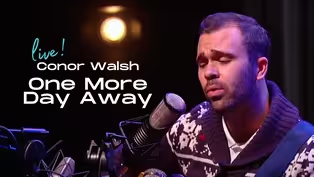
Clip: S8 Ep17 | 3m | Rock out with Conor Walsh as he performs his hit song "One More Day Away". (3m)
Conor Walsh Performs "That First Step"
Video has Closed Captions
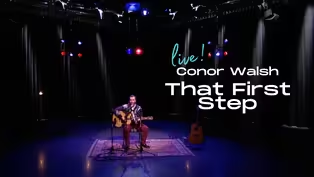
Clip: S8 Ep17 | 3m 19s | Rock out with Conor Walsh as he performs his hit song "That First Step". (3m 19s)
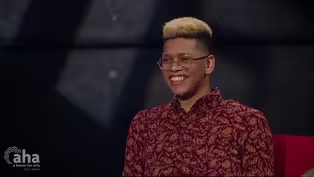
Evan Mack: The Inspiration Behind We Are Instrumental
Video has Closed Captions
Clip: S8 Ep17 | 11m 3s | Learn more about Evan's mission with We Are Instrumental, his passion for music, and more. (11m 3s)
Providing Support for PBS.org
Learn Moreabout PBS online sponsorship












Support for PBS provided by:
AHA! A House for Arts is a local public television program presented by WMHT
Support provided by M&T Bank, the Leo Cox Beach Philanthropic Foundation, and is also provided by contributors to the WMHT Venture Fund including Chet and Karen Opalka, Robert & Doris...