
AHA! | 828
Season 8 Episode 28 | 27m 45sVideo has Closed Captions
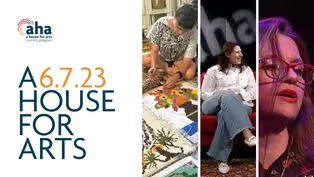
Explore connections in arts: latch hook rugs, opera direction & blues music.
From creative rug projects to the opera house and onto the blues stage, this episode of AHA! A House for Arts celebrates the diversity and interconnectedness of art. Jacinta Bunnell's latch hook rugs connect latchkey kids, Mary Birnbaum rejuvenates Opera Saratoga and Mark and Jill Sing the Blues deliver a fiery performance of 'She's On Top'.
Problems playing video? | Closed Captioning Feedback
Problems playing video? | Closed Captioning Feedback
AHA! A House for Arts is a local public television program presented by WMHT
Support provided by the New York State Council on the Arts (NYSCA), M&T Bank, the Leo Cox Beach Philanthropic Foundation, and is also provided by contributors to the WMHT Venture...
AHA! | 828
Season 8 Episode 28 | 27m 45sVideo has Closed Captions
From creative rug projects to the opera house and onto the blues stage, this episode of AHA! A House for Arts celebrates the diversity and interconnectedness of art. Jacinta Bunnell's latch hook rugs connect latchkey kids, Mary Birnbaum rejuvenates Opera Saratoga and Mark and Jill Sing the Blues deliver a fiery performance of 'She's On Top'.
Problems playing video? | Closed Captioning Feedback
How to Watch AHA! A House for Arts
AHA! A House for Arts is available to stream on pbs.org and the free PBS App, available on iPhone, Apple TV, Android TV, Android smartphones, Amazon Fire TV, Amazon Fire Tablet, Roku, Samsung Smart TV, and Vizio.
Providing Support for PBS.org
Learn Moreabout PBS online sponsorship(upbeat chiming music) - Jacinta Bunnel's latch hook rugs connect latch key kids.
Chat with Opera Saratoga's new General and Artistic Director, Mary Birnbaum.
And catch a performance from Mark and Jill.
It's all ahead on this episode of AHA, A House for Arts.
- [Narrator] Funding for AHA has been provided by your contribution and by contributions to the WMHT Venture Fund.
Contributors include the Leo Cox Beach Philanthropic Foundation, Chet and Karen Opalka, Robert and Doris Fischer Malesardi and the Robison Family Foundation.
- At M & T Bank, we understand that the vitality of our communities is crucial to our continued success.
That's why we take an active role in our community.
M & T Bank is pleased to support WMHT programming that highlights the arts and we invite you to do the same.
(upbeat jazz music) - Hi, I'm Jade Warrick, and this is AHA.
A House for Arts, a place for all things created.
Let's visit it right over to Matt Rogowicz with today's studio visit.
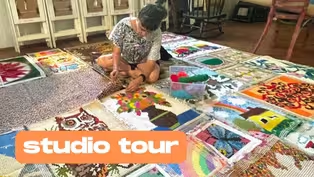
- I'm in Stone Ridge, New York to visit with artist, Jacinta Bunnel.
Let's go.
- I grew up in a working class rural town in Pennsylvania.
My mother and my stepfather worked long hours and so I spent a lot of time at home alone making homemade bookmarks and making latch hook rugs, learning different crafts.
And it was the solitariness that actually pushed me to keep creating because it kept my mind active.
But I never thought of myself as an artist or even considered going to art school or taking an art class at all.
(upbeat pop music) It really wasn't until I moved to the Hudson Valley when I was 22 and was immersed in just a sea of creative people and artists and musicians that people started noting that some of my creations were actually art.
I've worked with everything from paint to found paper and collage, to fiber arts, and I also have a few children's books that I have written.
For the longest time, I really was profoundly interested in found paper, vintage antique receipts and musical notes and calendars and finding ways to incorporate them into mixed media work.
One project that I worked on was I collected drawings by children that I knew, and then I replicated their drawing style and then added my own flair.
I had a show at a gallery where I showed my art side by side with theirs.
That was also part of me learning how to be an artist.
I loved how free children were and how unencumbered by rules, so I watched them and learned from them and their art making.
(whimsical chiming music) It wasn't until the pandemic that I started working with latch hook rugs.
It felt like I was a latchkey kid again, which I was when I was a child.
A latch hook rug was popularized in the seventies and eighties through kits that you would buy in five and dime stores, often with patterns already printed on them like little deer or mushrooms or owls were very popular.
It was a way to bring an art form to everyone.
I started by collecting vintage latch hook rugs from thrift stores and yard sales and then I put a call out to everybody I knew and I started receiving old latch hook rugs in the mail.
I probably had built a collection of about 50 or more when I started sewing them together to be one giant mosaic rug.
One of the things that this project has really done for me was to really help me through one of the more challenging times in my life because I was diagnosed with a brain tumor and then an immune disorder, and so I had to spend many years at home lying down.
I couldn't do what I had normally been doing which was sitting up and making art.
So doing fiber arts again while seated helped me push through to a place where I could start feeling better in my body.
I kind of say that latch hook saved my life.
And then when I added the component for a show that I recently had of collecting stories from other latchkey kids, I felt like there was this group healing that was going on because there was so much loneliness for so many people who were left alone as children.
And we sort of collected our stories together and it was like a little rag tag community of partially parented kids.
In 2001, I was doing a lot of childcare and I had also just left a job as a health educator at Planned Parenthood.
I had founded a group for LGBTQ students in Newburg at the Planned Parenthood there and I was working a lot with young people.
What I saw was a real lack of information and stories about people who were queer or who had queer parents, who were trans, who were non-binary.
So in 2001, I got together with another artist and activist named Irit Reinheimer and we created a photocopied coloring book with found images, but that we changed the words to the images that we found in a psychology textbook or a children's book, and we turned them into dismantling the gender norms.
And it became so much more popular than we expected.
I found a publisher in Brooklyn.
They took that book and we redid it, we redid all the illustrations and that was called, "Girls Will Be Boys will Be Girls Will Be Boys".
And from there I found that I loved that work.
I'm not an illustrator.
I may be an artist, but I'm not an illustrator.
So I continued to make books like, "Sometimes The Spoon Runs Away with Another Spoon", and, "The Big Gay Alphabet", and all along I collaborated with an illustrator who could bring my vision to life.
After working on the coloring books, I decided the direction I wanted to take was to write my first children's book and I called that, "A More Graceful Shaboom".
And in that book I wanted there to be a non-binary character who uses they and them pronouns, who is just having an adventure like in every other children's book.
And there is no part of the book that is pointing out who this person is or who their parents are or why it's important to treat them kindly.
They're just being a regular kid.
Art is a place where I can get lost and I can wash away the worries.
Really, it's an, like people talk about being in the zone or a state of flow and that's really how I feel when I am making art.
I would like people to come away from my work feeling joy and feeling connected to other humans.
(upbeat pop music) - Opera Saratoga has been producing world-class performances every summer since 1962.
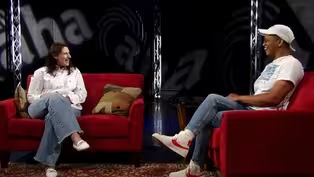
This season the company is welcoming its new General and Artistic Director, Mary Birnbaum.
I sat down with Mary to learn more about where she came from and what we can look forward to at Opera Saratoga.
Hi Mary, welcome to A House For Arts today.
- Hi Jade.
Thanks so much for having me here.
- Now I'm super pumped to talk to you about all things that bring you joy.
So one of the first things I wanted to ask you is why opera?
What's your history with opera?
How did you get into it?
- It's a very common story for people who love opera but I always loved to sing and I always thought that singing a story was a very unique path to emotional truth.
And as I kind of grew up as a theater artist, I found my way back to opera, working with singers who view their work a little bit more athletically than actors do.
And so when a director, I'm an opera director mostly, and when a director works with singers they have a lot more to contribute, I think, because you're reminding them that this technical act they're doing, singing, is serving a story.
What I love about opera is its epic scale, its wildness, its riskiness, and I love that it lies at the intersection of all the fine arts, the visual arts, music, theater, it can have dance in it.
So it's really a catchall, even though we sort of view it as, or hear opera and we think, "Oh it's an elitist or it's a foreign word."
What it actually can be for us is a center of community and a place where all of the arts organizations in the community can meet.
- So it's a very collaborative art?
- Yeah, in its nature.
So in an opera rehearsal room, which I'm inviting you to and invite all of the viewers to come witness an opera rehearsal because it's a really exciting event and in a way that we're talking about non hierarchy in the arts and space sharing and everybody having their own voice, you have in one corner a director who's sort of guiding the room and helping us tell the story and facilitating the communication of the text through music.
And then in another part of the room you have the conductor who's facilitating the music as another language, and then the singers are working to sort of parse information between the two languages and maybe a third language if it's not the language they speak, and stage management.
So it's really like the maximal collaboration.
And then of course what you usually don't have during the process is the orchestra and they join in the last two weeks and elevate the whole project to something beyond any one person's contribution.
- Wow, that's beautiful.
- It's really exciting.
It's like a big machine.
- So what about when you say have this passion for the collaborativeness and the spreading the joy, do you do anything within education or teaching because that aligns a little bit, just spreading that passion to others?
- Yeah, well my personal mission is that I want to help people access their real selves.
And so I teach acting at Julliard.
I teach the opera singers how to act and I currently work with the masters in music and graduate diploma students and I coach them in their repertoire but I also work on monologues with them and scenes and arias and the shows we do there.
And at Opera Saratoga, one of the parts of it that I'm most excited for is we have a program of festival artists who are artists at the beginnings of their career who are given these opportunities to shine on the main stage.
And we let them lead us, we have them guide us in terms of how we can support their journey as artists, of course with my feedback, but I want people who have something to say and who know where they wanna go and then I can help hold that vision with them.
- Yeah, so you said the artists are leading.
You don't really say that very much within institutions.
So what's the plus of letting the artist lead and then you support?
- Well so I just joined Opera Saratoga in March but in my own work, what I have found is that when someone owns a choice or owns a vision, they are much more likely to carry it through and to take risk and to be authentic at the end of the day.
And to connect with an audience really, truly, and to allow the audience to feel like they see themselves on stage because whatever the person has shared is so open and vulnerable.
- Yeah, and speaking of risk, I've spoken to some folks who work in orchestras, opera, symphony, choral music.
I've heard the similar thought of taking risk now, being risky within this field or within this artistic craft is important so it can spread out and be accessible.
Is that something that you agree with or see?
- Oh my gosh, I so agree with that.
I think it's interesting because I think a lot of people view accessibility and risk as totally different, right?
Like if something's too sort of edgy, will it be accessible?
But I think that we find sports are the most audience friendly events in America because you go into each event with a buy-in.
Is this team gonna win or lose?
You can tell I watch a lot of sports.
Is this team gonna win or lose?
We don't go, when we go to the opera, we don't necessarily go with the same kind of question about the event.
And I think that we all need to, in the live performing arts, embrace this idea of the question of the what will happen?
Will they come out on top?
Is it too big to fail?
That kind of thing is a real hook for audiences and it can be the thing that allows them to get off their couches and stop streaming shows and join us in a space for a night of art making.
So yes, I think yes to risk and also yes to inclusion and yes to bringing people into the opera who may never have been in a theater before and seeing what they make of it and also how they can connect it to stuff that they have experienced.
'Cause I think the thing that is most commonly heard when people go to the opera the first time is like, "Oh, I know what this is.
I've heard this on TV, I've heard this - Yeah.
- In soundtracks", you know?
I actually have way more experience than I thought.
But the barrier to entry is so big.
- So how, with this new position as you were saying, how do you bring artists in?
How do you make sure that they feel this collaborative feeling and they feel that they're accepted into the art of opera?
- I plan the seasons, I program the seasons, I raise the money to, along with a really wonderful staff, to have the seasons up in the summer in Saratoga but we also are looking to expand to the fall, winter and spring to have offerings around the capital region.
One of the things that we did that I thought was really lovely and we'll definitely do again next year, this year, and we'll see how it works.
I mean, I'm really beta testing this year for the future, is we handed out on day one a sheet of core values.
And these core values included things like mutual respect, transparency, joy, boundaries.
And we invited the artists to tell us and ask us questions and say if this day's schedule looks unfeasible for any reason, they would connect with us and tell us like, "No, we're not actually going to do that."
So we're just inviting them into the infrastructure and trying to be as transparent as possible with why decisions are made.
I find that as an artist, I don't know if you share this, I would like to hear whether you do, the question as a young artist is, "Am I good enough?"
- Oh, all the time.
- Right?
- Every day.
(laughing) - And it's, I think, a pervasive one in our culture in general because there's so much competition in the nature of capitalism and blah, blah blah.
But for artists, younger artists, I find that they're always thinking, "Do these people think that I'm good enough?"
And what I want to pass on to them is that that is not even part of the conversation.
You're valuable because you're here and we're having a conversation together so that the audience feels that acceptance in the space when they walk in.
- What kind of things does Opera Saratoga have coming up?
Any events?
- So yes, thank you so much for asking.
So we have a summer festival and we start our children's show, which is really actually a very sophisticated children's offering.
It's a 45 minute free opera that we're offering all around Saratoga Springs and one performance in Schenectady on the 11th called, "The Selfish Giant".
Female composer, female librettist, female director.
And then we have two main stages at UPH, Universal Preservation Hall, in downtown Saratoga Springs happening between June 29 and July 9, "A Gentleman's Guide to Love and Murder" at the Broadway Hit and, "Don Pasquale", which is an opera buffa, a comic opera from the 1800s by Donizetti.
So both are really fun pieces.
They're very charming and actor driven and subversive in their own ways.
Each one of them is about resource sharing amongst a generation who doesn't have it.
- Oh, perfect for us, perfect for us 2023.
- Exactly, exactly.
So I think that, and then you can check out our website for way more concerts and recital offerings along this in this festival period, in all of June.
- Awesome.
- But I'm so excited to welcome you there.
I hope you come to see us.
- I will definitely a hundred percent show up.
Well, thank you Mary, I'm super excited to visit Opera Saratoga and that was great to speak to you.
- Thank you so much, Jade.
Thanks for having me.
- Please welcome Mark and Jill.
(upbeat guitar music) ♪ Please don't carry every burden ♪ ♪ And the sun don't shine every day ♪ ♪ Blues falling down like rain ♪ ♪ As we're heading for the judgment day ♪ ♪ Oh but I don't mind if the sun don't shine ♪ ♪ It's always raining in my mind ♪ ♪ That's my heavy carry on down the line ♪ ♪ Why'd you have to be so foolish ♪ ♪ Oh and throw it all away ♪ ♪ Could have been so easy ♪ ♪ But now we're gonna have to pay ♪ ♪ Oh I don't mind if the sun don't shine ♪ ♪ It's always raining in my mind ♪ ♪ That's my heavy carry on down the line ♪ ♪ Everyone needs redemption ♪ ♪ From the heartache and disdain ♪ ♪ Some time to religion ♪ ♪ Some time to cocaine ♪ ♪ I don't mind if the sun don't shine ♪ ♪ It's always raining in my mind ♪ ♪ That's my heavy carry on down the line ♪ ♪ Please don't carry every burden ♪ ♪ And the sun don't shine every day ♪ ♪ Blues falling down like rain ♪ ♪ As we're heading for the judgment day ♪ ♪ Well I don't mind if the sun don't shine ♪ ♪ It's always raining in my mind ♪ ♪ That's my heavy carry on down the line ♪ ♪ I said I don't mind if the sun don't shine ♪ ♪ It's always raining in my mind ♪ ♪ That's my heavy carry on down the line ♪ (upbeat guitar music) ♪ I don't rock ♪ ♪ I don't drink ♪ ♪ I don't care what you think ♪ ♪ I don't roll ♪ ♪ What you know ♪ ♪ I don't care where you go ♪ ♪ So pour another glass of whiskey ♪ ♪ If you want you can have it with me ♪ ♪ If you don't you can go home ♪ ♪ Oh you can stay here and make me moan ♪ ♪ I don't mind the things you say ♪ ♪ I don't need much anyway ♪ ♪ But I like to see you at my door ♪ ♪ Come back baby ♪ ♪ Let's have some more ♪ ♪ So pour another glass of whiskey ♪ ♪ If you want you can have it with me ♪ ♪ If you don't you can go on home ♪ ♪ Or you can stay with me and make me moan ♪ (upbeat guitar music) ♪ Listen mister who you talking to ♪ ♪ Let's get a room with an ocean view ♪ ♪ Blow me a kiss pour me a drink ♪ ♪ I don't even care what people think ♪ ♪ So pour another glass of whiskey ♪ ♪ If you want you can have it with me ♪ ♪ If you don't you can go on home ♪ ♪ Or you can stay with me and make me moan ♪ ♪ Stay here and make me moan ♪ ♪ Stay here and make me moan ♪ ♪ Stay here and make me moan ♪ Thanks for joining us.
For more art, visit WMHT.org/AHA and be sure to connect with us on social.
I'm Jade Warrick and thanks for watching.
(gentle chiming music) - [Narrator] Funding for AHA has been provided by your contribution and by contributions to the WMHT venture fund.
Contributors include The Leo Cox Beach Philanthropic Foundation, Chet and Karen Opalka, Robert and Doris Fischer Malesardi, and The Robison Family Foundation.
- At M & T Bank we understand that the vitality of our community is crucial to our continued success.
That is why we take an active role in our community.
M & T is pleased to support WMHT programming that highlights the arts, and we invite you to do the same.
Video has Closed Captions
Preview: S8 Ep28 | 30s | Explore connections in arts: latch hook rugs, opera direction & blues music. (30s)
Jacinta Bunnell's Creative Projects
Video has Closed Captions
Clip: S8 Ep28 | 7m 51s | Jacinta Bunnell's creative projects are designed to bring joy and a sense of connection (7m 51s)
Opera Saratoga's New Artistic Director Mary Birnbaum
Video has Closed Captions
Clip: S8 Ep28 | 9m 15s | Get to know Opera Saratoga's new General and Artistic Director, Mary Birnbaum. (9m 15s)
Providing Support for PBS.org
Learn Moreabout PBS online sponsorship

- Arts and Music
The Best of the Joy of Painting with Bob Ross
A pop icon, Bob Ross offers soothing words of wisdom as he paints captivating landscapes.












Support for PBS provided by:
AHA! A House for Arts is a local public television program presented by WMHT
Support provided by the New York State Council on the Arts (NYSCA), M&T Bank, the Leo Cox Beach Philanthropic Foundation, and is also provided by contributors to the WMHT Venture...