
AI and Art
Clip: Season 3 Episode 156 | 4m 6sVideo has Closed Captions
How AI is reshaping the creative industries.
A leading expert in both the law and art and media production talks about how AI is reshaping the creative industries.
Problems playing video? | Closed Captioning Feedback
Problems playing video? | Closed Captioning Feedback
Kentucky Edition is a local public television program presented by KET
AI and Art
Clip: Season 3 Episode 156 | 4m 6sVideo has Closed Captions
A leading expert in both the law and art and media production talks about how AI is reshaping the creative industries.
Problems playing video? | Closed Captioning Feedback
How to Watch Kentucky Edition
Kentucky Edition is available to stream on pbs.org and the free PBS App, available on iPhone, Apple TV, Android TV, Android smartphones, Amazon Fire TV, Amazon Fire Tablet, Roku, Samsung Smart TV, and Vizio.
Providing Support for PBS.org
Learn Moreabout PBS online sponsorshipHow artificial intelligence is used and how to keep it from being misused has been the topic of much debate in recent years, including here in Kentucky, where a special legislative task force was created to study the issue and make recommendations to the Kentucky General Assembly.
While it's argued that I will never replace human creativity, a leading expert in the law and art and media production tells us it is reshaping the creative industries.
I wasn't planning to study this, but it just made sense to really try to understand the changing legal frameworks around AI and how that affects artists.
I think it disrupts both positive and negative positively.
It generates content so quickly, so easily.
And that's a good thing for a lot of people.
And also you can use it as almost like brainstorming to write.
I use that all the time for that.
But negatively though.
Like job displacement.
It's a weird thing, especially the jobs that can be done manually, that are repetitive and simple contact generation and things like that will be replaced if we are in that space.
In terms of your profession, then there are chances that there will be fewer jobs, but also there are opportunities where you can train yourself to use the tools better and be more competitive.
Like you hear this all the time, like I will not replace people, but people who use AI will replace people who don't use AI, right?
Artists use AI, some don't.
But even if you don't use it, it's affecting your work because you AI companies may use your work to train their models.
That's problematic.
And as artists, you can be pretty upset about that.
And I really understand their perspective.
Legally, though, we don't know if it's actually infringement on copyright or not because the courts haven't really decided.
So the current stance of it, of the Copyright Office, is that you have to separate what part is done by AI and what part is done by you as human.
Then we can copyright the part that you did as human.
It's complicated, right?
But I think there is this perception, right, that AI is creating something, but it's really not creating anything.
It's just generating output based on input.
And the in between this or data and relationships and patterns, it's learning all of those and then getting something out that's new.
A.I.
doesn't have any intent to create anything unless a person does that right.
So A.I.
is a kind of a tool.
The creativity as a distinctive human nature.
It's it's still there.
We're still be there for many years to come.
I don't think it's going to go away, but how we are thinking about creativity may be different because of the AI, right?
There are a lot of things that we used to do can be generative by AI.
Then maybe what we can do is more in a way like hyper creativity.
Jong's advice to those in the creative industries when it comes to I don't try to avoid it, she says.
Learn what AI is and try to use it.
Then you can decide whether to incorporate it into your work.
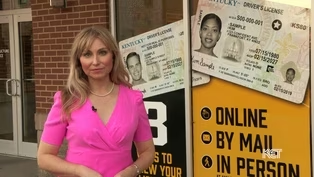
2025 Means New Laws in Kentucky
Video has Closed Captions
Clip: S3 Ep156 | 3m 26s | Ringing in the new year means these three laws are now in effect in Kentucky. (3m 26s)
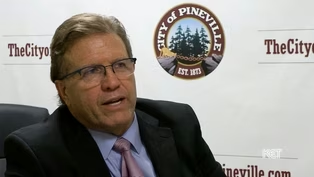
Sen. Scott Madon Looks Ahead to First Term in Frankfort
Video has Closed Captions
Clip: S3 Ep156 | 3m 46s | Pineville Mayor Scott Madon won his first term as a state senator following an 11-way write-in race. (3m 46s)
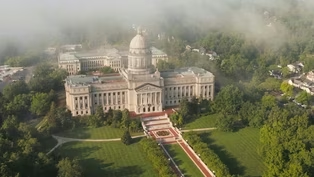
Sen. Wise Previews Upcoming Legislative Session
Video has Closed Captions
Clip: S3 Ep156 | 3m 31s | Incoming State Sen. Majority Floor Leader talks about the ideological shifts in the state Senate. (3m 31s)
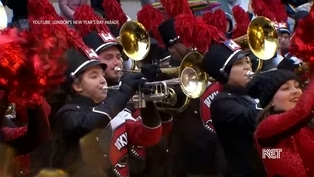
WKU Band Rings in New Year in London
Video has Closed Captions
Clip: S3 Ep156 | 40s | The WKU Big Red Marching Band played in the New Year's Day parade in London. (40s)
Providing Support for PBS.org
Learn Moreabout PBS online sponsorship
- News and Public Affairs

Top journalists deliver compelling original analysis of the hour's headlines.

- News and Public Affairs

FRONTLINE is investigative journalism that questions, explains and changes our world.












Support for PBS provided by:
Kentucky Edition is a local public television program presented by KET