One-on-One
Aisha Glover; Daniel Errico; Steve Edwards
Season 2025 Episode 2809 | 27m 38sVideo has Closed Captions
Aisha Glover; Daniel Errico; Steve Edwards
Aisha Glover, Global Head of Urban Innovation at Audible, discusses their initiatives that are driving growth in Newark. Daniel Errico, children's author & creator of Hulu's "The Bravest Knight," discusses how children's books can promote representation. Steve Edwards, Executive Producer of "Lucky Jack" and President of the NJ Hall of Fame, highlights the film that honors his father’s journey.
Problems playing video? | Closed Captioning Feedback
Problems playing video? | Closed Captioning Feedback
One-on-One is a local public television program presented by NJ PBS
One-on-One
Aisha Glover; Daniel Errico; Steve Edwards
Season 2025 Episode 2809 | 27m 38sVideo has Closed Captions
Aisha Glover, Global Head of Urban Innovation at Audible, discusses their initiatives that are driving growth in Newark. Daniel Errico, children's author & creator of Hulu's "The Bravest Knight," discusses how children's books can promote representation. Steve Edwards, Executive Producer of "Lucky Jack" and President of the NJ Hall of Fame, highlights the film that honors his father’s journey.
Problems playing video? | Closed Captioning Feedback
How to Watch One-on-One
One-on-One is available to stream on pbs.org and the free PBS App, available on iPhone, Apple TV, Android TV, Android smartphones, Amazon Fire TV, Amazon Fire Tablet, Roku, Samsung Smart TV, and Vizio.
Providing Support for PBS.org
Learn Moreabout PBS online sponsorship- [Narrator] Funding for this edition of One-On-One with Steve Adubato has been provided by The New Jersey Education Association.
The New Jersey Economic Development Authority.
Kean University.
Where Cougars climb higher.
Holy Name.
The Fidelco Group.
PSE&G.
Powering progress.
Horizon Blue Cross Blue Shield of New Jersey.
NJM Insurance Group.
Serving New Jersey’s drivers, homeowners and business owners for more than 100 years.
And by The North Ward Center.
Promotional support provided by NJ.Com.
Keeping communities informed and connected.
And by New Jersey Monthly.
The magazine of the Garden State, available at newsstands.
- This is One-On-One.
- I'm an equal American just like you are.
- The way we change Presidents in this country is by voting.
- A quartet is already a jawn, it’s just The New Jawn.
- January 6th was not some sort of violent, crazy outlier.
- I don't care how good you are or how good you think you are, there is always something to learn.
- I mean what other country sends comedians over to embedded military to make them feel better.
- People call me 'cause they feel nobody's paying attention.
_ It’s not all about memorizing and getting information, it’s what you do with that information.
- (slowly) Start talking right now.
- That's a good question, high five.
(upbeat music) - Hi, everyone.
Steve Adubato.
We kick off the program with a long time friend of the show, Aisha Glover, Global Head of Urban Innovation at Audible.
This is part of our "Urban Matters Series."
Good to see you, Aisha.
- Great to see you.
- Good.
We got the website up for Audible.
Let's do this.
The most significant urban economic development initiatives that Audible's engaged in right now would be?
- Our Business Attraction Program.
So, we're bringing startups and retail into Newark.
We've gotten over a dozen leases signed within the past year alone.
So, we're creating jobs.
We're not just building off of the momentum of us being headquartered here, but we're investing in that next generation of tech startups.
- You know, I'm driving downtown to a basketball game down at the Prudential Center.
You go down, for those who have had the good fortune, those of us born and raised in Newark, if you just drive down Bloomfield Avenue onto Broad Street and you see the big sign, Audible sign on the right hand side.
- That's right.
- It's significant on so many levels.
- Indeed.
- Why is Audible and Don Katz... Google Don Katz, who just was put into the New Jersey Hall of Fame.
Check out Don Katz, our longtime friend.
Why is it so significant?
Not just that that sign for Audible is there, but that Audible is there?
- Yeah, our founder Don Katz made that decision in 2007 really wanting to be part of the city's revitalization.
So, people are usually surprised when we say, "This is our global headquarters.
We moved here on purpose."
And I think was a real kind of vote of confidence, not just in the direction that the city was heading, but the role that a company like an Audible can play as the fastest growing private employer here.
So, it's critically important for us to be based in this city.
I think it really speaks to the infrastructure, the residents, the legacy of the city, but also the future on where it's heading.
- Future connect to the past.
Harriet Tubman.
By the way, look at our website, steveadubato.org.
The piece that Jacqui Tricarico and myself did on Harriet Tubman as part of our, "Remember Them Series."
Harriet Tubman Square is?
- It's our home.
It's our front yard.
You know, the Tubman Park is right across the street from our Innovation Cathedral, which is also right across the street from 33 Washington, where we're making a major investment and bringing more retail into the neighborhood.
You know, we raised our hand and told the city we wanted to add to the monument and we did just that.
So, there's an audio experience there as well.
That power of storytelling, you know?
Continues right in our front yard.
- P.S.
Google Harriet Tubman, The Underground Railroad and understand a part of American history that's incredibly important.
- That's right.
- Try this for, I'm curious about this.
Audible's Future Leaders Program.
As a student of leadership, I'm fascinated by how we develop the next generation of leaders.
What is the Audible Future Leaders Program?
- So, it's a pretty innovative internship program.
You know, every corporation or many corporations, I should say, run internship programs, and you probably have an idea of what that looks like.
In the summer, highly competitive, dare I say elite.
And typically for college students, we've done the opposite.
It is 100% local, so it is open to high school, Newark High School students.
We started offering it the year we moved here in 2007.
We're working with students and hiring them a year round and paying them, again, beginning in high school.
And they get a full kind of immersion experience.
So, we're focused on skills development.
They don't have to necessarily want to come into the industry, but getting this level of exposure this early on has shown to really benefit them in college, on their applications, with follow on internships, you name it.
And they're pretty impressive group of students every year.
- One of the things about doing anything in Newark or any urban community or any challenging initiative is collaboration is key.
There is a collaboration between Audible and a company we know well, Fidelco.
- That's right.
- And going all the way back to the late great Marc Berson who, what an innovator, what an entrepreneur- - He was.
- Who believed in Newark when a lot of other folks did not.
And Kerri his daughter leading the effort there as well.
But also the New Jersey Economic Development Authority.
Talk to us about collaboration because Audible cannot do it alone.
No one can.
Go ahead.
- That's right.
And we shouldn't want to, right?
We've been a tenant essentially of Fidelco since we moved here.
So, both of our locations, Innovation Cathedral and 1 Wash, Fidelco is the owner.
And so, we've been collaborating with them since 2007.
Now, what that looks like is more than the majority of the businesses that we've brought in have actually gone into 550 Broad, a Fidelco building right across the street from us.
So, we're focused on the entire Tubman Square.
We collaborate with all of the property owners, but Fidelco really does kind of stand apart carrying on Marc Berson's legacy, but really doubling down and they kinda just get it, right?
So, they're key collaborators with us and investors, as well as NJEDA investing in and supporting many of the businesses that we've brought in with lease subsidies and assistance.
Some of them are major recipients of the recent Art Fund Grant that came out.
- Yep.
- Such as Equal Space.
I know they've been on with you as well.
- Absolutely.
- So, I think it really matters to your point, like, this collaboration, we can't do it alone.
And so, sometimes it's funding, sometimes it's networking, exposure, ecosystem building, all of that kind of dot connecting and to have collaborators like a Fidelco, like NJEDA, like the City of Newark, that understand the value of investing in a very intentional way and supporting in that way.
You know, it's been, it's made my job a lot easier, and quite frankly, a lot more fun.
- Last question.
You call it a job, Aisha, but you've been with us a lot many times, and your passion, your personal, as well as your professional commitment to Newark, to helping rebuild and improve the city of Newark is very deep.
Why?
- That's right.
- Well, grew up in Brooklyn and as much as I love Jersey, I would have purchased and stayed in Brooklyn if I could have, right?
And so, you know, essentially I got priced out.
And when people talk about displacement or gentrification and talk about equity and access, that just, it's just, you know, it runs true to my core.
And so, if I can have any part in making sure that as the city develops, it develops equitably and that we're leveraging Audible's commitment and sense of purpose to this work, it kind of, you know, it's a bit of a dream job.
But I am where exactly I'm supposed to be and really looking out for the underdogs.
Marginalized people, underrepresented voices, and how do we make sure that as the city grows and as Audible grows everyone benefits.
- Aisha Glover making a difference every day in the city of Newark with her colleagues at Audible and others.
Thank you, Aisha, my friend.
- Appreciate it.
- Thank you.
Great to see you.
- See you again, very soon.
Stay with us.
We'll be right back.
- [Narrator] To watch more One on One with Steve Adubato find us online and follow us on Social media.
(majestic music) (thunder claps) - [Cedric] A not-yet-night never breaks their promise.
(fireball explodes) - I've never seen anything like that!
(horse neighs) - You are gonna be quite the night, Nia.
Do you understand now why you can't?
Nia?
- [Nia] Got it, Dad.
- Think you could give me a little help here?
- I'm not sure she got the right lesson.
- She'll get there.
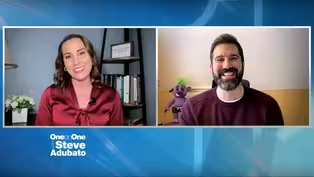
(majestic music) - Hi, I'm Jacqui Tricarico, Senior Correspondent for "One-on-One," and I am so pleased to be joined now by Daniel Errico.
He's a children's book author, and the creator of the Hulu series, "The Bravest Knight."
Daniel, so great to have you with us.
- Thanks so much for having me.
- Well, I wanna first talk about your career as a children's book author, because it didn't start out that way for you, you actually were a mechanical engineer.
So talk to us about that transition.
Was it something that you always knew you had a passion for, writing children's books?
And how did you transition out of being a mechanical engineer in that field, to this, to what you're doing now?
- It was kind of a latent passion, something I realized that I had always wanted to do, but never really allowed myself to pursue, so I went into something a little more practical, mechanical engineering.
And then I actually worked in New York at an investment bank brokerage firm, and neither one of them really gave me that sense of fulfillment that I wanted, so I decided to quit and work on writing kids' media full-time.
And I started with my website, freechildrenstories.com, and I was, at the time, writing and illustrating a book a week to just get better at it, and I was trying to study old children's books, and old fairy tales, and kind of learn the craft.
And I'd ended up going into schools, and reading in front of kids with my friends' illustrations, and seeing the kids' reactions, and just trying to get better at this.
- And a lot of your books, you have so many out now, but a lot of them do have that fairytale feel to them.
But I know that, in your stories, representation is so important.
I know you said, as a straight white male, as a child, you had that representation in the books that you were reading, so why was it so important for you to make sure, as you've been creating and developing these stories, to make sure that representation is seen throughout so many of the themes?
- Well, as you said, I mean, I had a ton of representation in my formative years, and that makes a big difference.
And I think every child deserves to see themself, to see their family on screen.
And the darker, more painful side of this is, when they don't, it sends a message to them about their family, about themselves when they get older.
And kids' media needs to be part of the solution there, of making sure every kid feels loved, has love for themself, and for others.
- So let's talk about "The Bravest Knight," one of the stories that you've written that Hulu picked up to create a children's show on.
First, let's talk about the story that you created.
Tell us about the themes and the messaging behind it.
- Yeah, "The Bravest Knight Who Ever Lived" is the book that we then turned into "The Bravest Knight" show.
And at its core, it's a real classic fairytale story of a young boy who's a pumpkin farmer, and wants to become this brave knight, and it's his journey to becoming a full-fledged knight.
And in the end, he saves a prince and a princess from the dragon, and he ends up with the prince in the end.
And hopefully people see that, you know, you don't really change anything about the story by changing who that person decides to be with.
And Hulu has been an amazing partner for us in making the show "The Bravest Knight," and we got to expand the story, bringing all sorts of new characters, including the one right here, Grunt, our purple troll who's voice by Bobby Moynihan.
And now we get to see what that happily ever after looks like for Sir Cedric and the Prince when they're raising their own daughter, Nia.
And they teach her how to become a knight herself.
And, you know, being a knight is really an allegory for being a good person, and a (chuckles softly) helpful member of society, and doing the right thing, and all that.
- And season two just dropped this past December.
We're taping this in January, but I know season two just dropped this past December on Hulu.
Talk about, for you though, that transition from being the author then to being involved in the creation of this show.
- It's been amazing to get to tell a longer-form story more than anything else.
Picture books are my first love in kids' media, the thing that I love doing the most, however, it also can be limiting in some ways, because you only have, you know, less than 1,000 words, sometimes less than half that, to tell your story.
And I've now gotten to tell this arc that goes from one season, to hopefully even more than two.
And that means I get to do character development, I get to have callbacks, I get to have all that fun with the storytelling, and also it means that I can hopefully create a deeper, stronger connection with the reader/viewer.
- Where are you getting the inspiration from for these characters, and the challenges that they're facing?
- I think a lot of it comes down to what I think I needed to hear as a kid, or that I think that we need to be telling kids more often that they're not hearing now.
And then from there, I get to create these fun contexts using different fairytale tropes, different fairytale characters.
Like in season two, we have, it's what the characters do after their fairy tale's over.
So we have Rumpelstiltskin after his fairy tale's over, what would he be doing?
In this case, he works at a adventure package company, where he sells packages like vacations.
And the Giant from "Jack in the Beanstalk" is now moving a Ferris Wheel around at his own fair that he owns.
So I get to kind of find all these fun ways to bring these characters back in a new way.
- We talked about representation.
I know another theme that you like to touch upon in your books is mental health issues.
And I know as a child, you dealt with OCD, how important is it to you, and how are you making sure that representation of things like OCD, anxiety, things that we're hearing so much that kids are dealing with today, are intertwined in your stories?
- I mean, it's been wonderful to see the change of the conversation around mental health issues.
OCD is one thing that wasn't talked about much when I was a kid.
No one really knew, my teachers didn't know what it was at the time, and it's not their fault.
But I live now in Pittsburgh, and Mr. Rogers teaches us that all these things that we feel are mentionable and manageable.
And it's another thing where, when you show kids, in a responsible, constructive way, it can make a big difference in their life.
And kids' media meant a lot to me growing up, in that I love these characters, and I love the stories, and it gave me comfort, but it also could help if the characters teach you something about yourself and how to deal with the things that you're dealing with directly.
- And I wanna touch upon one other book that I read to my kids recently, it's called, "Don't Hug the Quokka."
Talk about that book, and the theme behind it, and just how important it is to have discussions with kids about the topic of consent, really.
- Thank you so much for bringing that up, I love talking about "Don't Hug the Quokka."
It's published by Imagination Press, which is the publishing arm of the American Psychological Association, and they have this wonderful message in the back about consent from Dr. Karen Rayne, and how to address it with kids.
For me, I wanted the book to be about, your... a lot of books about consent say, "You have a right to say no."
And "Don't Hug the Quokka" is about, if you want to hug someone, it doesn't mean you get to, and it's meant to instruct kids and help them learn how to hear and accept "no" themselves.
And it's just a fun book to read to kids, 'cause they get to shout no a lot, (chuckles) and it centers around the Quokka, who's a very huggable animal, in my opinion.
And the Quokka lives in Australia, off the coast of Perth, on this island called Rottnest Island.
It's pretty much the only place where Quokka lives.
And they have a problem with people wanting to hug them and take pictures with them.
So it's also got the slight environmental theme of, you've gotta leave the wildlife alone.
- It's such an important message, and my kids love the book.
And really quick, one minute left, I know you're working with an important organization as well recently, it's called GLSEN.
Tell us about it.
- Yes so, from now until June, 2025, Pride Month 2025, partial proceeds of "The Bravest Knight Who Ever Lived" book will go to GLSEN, this incredible organization, LGBTQ+, focused on schools and education, and making sure every school is a safe place for every child.
- That's awesome.
I know we have the website that people can learn more about GLSEN, and that organization.
Daniel, thank you so much for joining us.
I know there's congratulations in order, you have a daughter on the way, and I'm sure you can't wait to start reading your books to her, that'll be such a special moment for you.
- Thank you so much, I appreciate that.
- Thank you for joining us.
We'll be right back after this.
- [Narrator] To watch more One on One with Steve Adubato find us online and follow us on Social media.
(children laughing) (upbeat music) - [Speaker 1] I want my daughters Shera and Naomi to know what their grandfather did.
I want them to know, no matter how daunting it is, that they should always chase their dreams.
(upbeat music) - Jack was the poorest guy of any guy I've ever known in my life.
- They were just very, very poor.
- [Speaker 1] He always wanted to be a doctor, but never really applied himself in school.
He thought somehow he could teach himself like Lincoln taught himself how to be a lawyer.
- [Speaker 2] That was Lucky Jack.
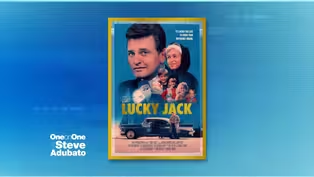
(upbeat music) - We are thrilled to be joined once again by our good friend and colleague, Steve Edwards, who's the president of New Jersey Hall of Fame, but also the producer of a terrific film you have to check out.
It's called "Lucky Jack."
Steve, how you doing, my friend?
- I'm doing well, Steve.
Thanks for having me on.
- Now, "Lucky Jack" wasn't any Jack, he was your dad.
- Lucky Jack was the nickname of my dad.
He was a great Newark native, like me, like yourself.
He grew up in the Seth Boyden housing projects in a very dysfunctional family back in the 1940s and '50s.
And his story, and really it's as much my mom's story as it is my dad, is quite remarkable I think.
He was a 30-year-old high school dropout.
He was unemployed, had a wife and two children at the time, and in 1966, he did what a lot of people in the '60s did.
He smoked a joint, he put on "Man of La Mancha's Impossible Dream."
He donned a surgeon smock that he wore when he drew blood at Barnabas years before that.
So he looks into the mirror and he sees not only a doctor staring back at him, but a brain surgeon and he resolves himself in that moment, July, August, 1966, that this unemployed high school dropout is going to become a brain surgeon.
Somehow he conned my mom into it.
He went to Rutgers in the late '60s, very turbulent, obviously, campus in the late '60s with the riots and so forth, and I'll make a long story short, nine years later, he was accepted into the neurosurgical program at Mount Sinai Hospital in Manhattan.
I think it's a tremendous story for anyone that's interested in understanding how powerful all of our wills are.
My dad always used to say, "We're a sum of all our thoughts and we could will so many of our dreams to happen".
And he's an example of it.
He didn't give up.
It's a complex story beyond that, but it's really remarkable.
- You know, Steve, you and I have had many offline conversations about our dads and talking about my dad inducted last year and the impact my dad had on my life.
Good, bad, and indifferent all kinds of ways.
You have said that you're not sure the Hall of Fame or at least your role in leading the Hall of Fame would've happened if it were not for your dad's motivation of you, inspiring of you.
Is that fair?
- There's no question about it.
When we first organized the New Jersey Hall of Fame, the mission was gonna be to help children around the world.
After my dad passed, I talked to state leaders and said, you know, here's an example of someone who followed the concept of Arete.
It's a ancient Greek wisdom that Plato, Aristotle and Socrates referred to as the essence of life.
Means the act of actualizing your highest and best sense of self for the greater good.
And my dad, that was the name of his boat, that was the principle that sort of guided him in life and I suggested, why don't we just focus on Jersey children and start there?
And that's what we did.
We went a different direction in terms of our charitable mission.
And I just think there's a lot of kids out there and a lot of adults for that matter, that can use that inspiration, that can need to be reminded that this world is, in my opinion, it's about the opportunity we have to realize our highest sense of self.
It's not about paying bills, it's not about sitting in traffic.
It's about getting up every day and fighting for your highest best sense of self.
So that's what the Hall of Fame message that we've been getting out really almost for 20 years now.
And hopefully we'll be doing that for many years to come.
- By the way, Steve comes to us from the Hall of Fame live late night studio, if you will.
It is at the American Dream and the website is up.
Make sure you go check it out.
Steve, lemme do this, talking about your dad.
He was not a great student growing up, right?
And he had many hardships, many hardships, but the title "Lucky Jack," why "Lucky Jack?"
- Yeah.
So he got that nickname back in the 1950s.
They used to go to the gambling places in Newark and he used to have the opposite of, actually, the story is that he won a lot of money one night with a group of his friends and they left and they were gonna go to the diner and celebrate.
He left his raincoat behind in the gambling place and he said, "Hold on one minute, I gotta get my rain jacket."
His friends begged him.
They said, "No, Jack, don't go back."
"No, it's my favorite rain jacket."
Make a long story short, about 25 minutes later, he came back out.
He had the rain jacket, but he lost every dollar that he had won and that was in his pocket.
So they gave him the nickname "Lucky Jack."
My dad really did have the opposite of good luck really his whole life.
That was just one example and that's why we named the film "Lucky Jack," because I think in the end, although he didn't get very lucky in medicine either, your viewers will have to see the film to find out.
In the end, I think he was lucky.
And more importantly, he considered himself lucky, had very few regrets at the end of his life.
- Last question, Steve, you made this film happen on a professional, but clearly on a personal level and you had wanted to do it for a long time.
What does this mean to you, the film?
- This film I think was a cathartic experience for me because my dad passed under very tragic circumstances.
- He was only 69 years of age.
- 69 years old - Terminal liver cancer?
- He contracted Hep C, I'll say, give away the ending, but he contracted Hep C in the operating room, which is an occupational hazard for surgeons.
But those last 28 days of his life, he wrote and said so many beautiful things for those around him that wanted to listen.
And essentially what he said is he had no regrets.
He was able to live his impossible dreams, do what he loved, and that he thought was the most important part of life.
And that's why we called it "Lucky Jack," because I'd like to think that he was a lucky guy.
- Thank you my friend.
The film is "Lucky Jack."
Check it out.
Our friend Steve Edwards made it happen.
We'll talk to you soon, buddy.
All the best.
- Steve, thank you so much for having me.
- You're a great partner.
I'm Steve Adubato.
That is a great filmmaker and the president of Hall of Fame, Steve Edwards.
We'll see you next time.
- [Narrator] One-On-One with Steve Adubato is a production of the Caucus Educational Corporation.
Funding has been provided by The New Jersey Education Association.
The New Jersey Economic Development Authority.
Kean University.
Holy Name.
The Fidelco Group.
PSE&G.
Horizon Blue Cross Blue Shield of New Jersey.
NJM Insurance Group.
And by The North Ward Center.
Promotional support provided by NJ.Com.
And by New Jersey Monthly.
- (Narrator) New Jersey is home to the best public schools in the nation, and that didn't happen by accident.
It's the result of parents, educators and communities working together year after year to give our students a world class education.
No matter the challenge, because parents and educators know that with a shared commitment to our public schools, our children can learn, grow and thrive.
And together, we can keep New Jersey's public schools the best in the nation.
How children's literature can teach important life lessons
Video has Closed Captions
Clip: S2025 Ep2809 | 10m 11s | How children's literature can teach important life lessons (10m 11s)
Initiatives at Audible that are driving growth in Newark
Video has Closed Captions
Clip: S2025 Ep2809 | 9m 21s | Advocating equal access to quality education for all students (9m 21s)
New Jersey Hall of Fame president highlights his new film
Video has Closed Captions
Clip: S2025 Ep2809 | 8m 38s | New Jersey Hall of Fame president highlights his new film (8m 38s)
Providing Support for PBS.org
Learn Moreabout PBS online sponsorship
- News and Public Affairs

Top journalists deliver compelling original analysis of the hour's headlines.

- News and Public Affairs

FRONTLINE is investigative journalism that questions, explains and changes our world.












Support for PBS provided by:
One-on-One is a local public television program presented by NJ PBS