
Akron
9/1/2023 | 26m 42sVideo has Closed Captions
Learn about a city with a rich history and a bright future.
Akron-centric individuals are Tony Troppe, economic developer; Jenn Kidd, executive director of The Nightlight movie theater; Tiffany Roper, CEO of Eat Speak Love and OH SNAP Photo Lab; Margo Sommerville, Akron City Council president; Curtis Minter Jr., director of operations at The Well CDC; and Bronlynn Thurman, philanthropic developer and artist.
Problems playing video? | Closed Captioning Feedback
Problems playing video? | Closed Captioning Feedback
City Centric is a local public television program presented by PBS Western Reserve
Akron
9/1/2023 | 26m 42sVideo has Closed Captions
Akron-centric individuals are Tony Troppe, economic developer; Jenn Kidd, executive director of The Nightlight movie theater; Tiffany Roper, CEO of Eat Speak Love and OH SNAP Photo Lab; Margo Sommerville, Akron City Council president; Curtis Minter Jr., director of operations at The Well CDC; and Bronlynn Thurman, philanthropic developer and artist.
Problems playing video? | Closed Captioning Feedback
How to Watch City Centric
City Centric is available to stream on pbs.org and the free PBS App, available on iPhone, Apple TV, Android TV, Android smartphones, Amazon Fire TV, Amazon Fire Tablet, Roku, Samsung Smart TV, and Vizio.
Providing Support for PBS.org
Learn Moreabout PBS online sponsorship- Hi there, I'm Stephanie Marie, and you have just tuned into a PBS Western Reserve "LuminUS: Stories About Us" special series called "City Centric."
That's right, this is Akron-centric.
So, have you ever had that one friend who gives so much of themselves that when they're in need you'll do anything to help them?
Well, in a lot of ways, Akron is that friend.
In the next half hour, you're going to hear from six people who would bend over backwards to shine a light, breathe some life, and pour their passions into the city they call home, starting with revitalizer, Tony Troppe, who says, "Akron needs me?
Count me in."
- I'm Tony Troppe, and I am a revitalizer, and chief revivalist at the crossroads of commerce and culture.
(soft jazz music) I grew up in downtown Akron.
I lived on Grant Street.
I'd ride my bike up and down the street and up and down Main Street.
The place was vibrant with storefronts.
And that memory of yesteryear was firmly planted to the point that when I came back years later and my city was gone I realized that the bones were still there.
So I realized that it needed some help and some love, much that it had shown and given me as I was growing up.
I rolled up my sleeves and said, count me in, I'm here.
People like to joke that, oh, that's Tony.
He owns half of downtown and I have to quickly correct them.
Oh no, no, I don't own half of downtown.
All of downtown owns me.
So a couple hundred thousand square feet is attributed to our restoration efforts.
We actually were instrumental in initially creating Akron's first federally designated historic district right here at Main and Market.
So that opened the door for a lot of economic incentives that would be taken advantage of in the future development of these places with that national recognition of place.
We're actually on a continental divide.
I mean, we are really on a watershed not only topographically, not only metaphysically, but really truly empirically.
So it's key to save your built legacy, your historic buildings because it's in those places that the stories not only are learned, but are retold to future generations.
In that sense, we're on a mission.
The first project was to my rear here.
Right behind us is the Academy of Music.
It was the old Academy of Music.
It was built in 1871.
It was a grand opera house.
Buffalo Bill performed there.
John Wilkes Booth's brother, Edwin, and the beautiful Parisian opera singer, Sarah Bernhardt, all performed right across the street right here.
They came up to this high point.
They came up to this center stage that was right at this crossroads of commerce and culture.
It was Main and Market Street.
I've been to enough Main and Markets around the country that I had an expectation of when you go to a Main and Market, what should be going on there?
Vibrancy and all of the energy of place at Main and Market.
The structure was there, but no one was here, just plywood and graffiti.
So I really took heart to that and said, I can do something about this.
And I think that's part of the story is that as you understand the past, you get directives on what had been so you understand what can be.
So from plywood graffiti to a Fortune 500 bank we actually lit the fuse by putting a clock on that building.
It was indication to the community that it was time for downtown.
That day we leased about 5,000 feet and a renewed sense of confidence began to set in in an area that had pretty much been the epicenter of blight.
I knew that the building was on the road to recovery, but I'm more of a revivalist now.
I think of a big tent and the opportunity to get people together for the right reasons and to reflect and shine the light.
So that's an ongoing mission that I'm on every day.
So an Akron-centric individual is one who's experienced, or pursuing invention and innovation, and that's really what Akron has always been about.
- Did you hear Tony say, historical buildings are not only places where our stories are learned, but are retold to future generations.
Don't you just love that?
Up next is entertainer, Jenn Kidd, who says that people connect over the stories they tell.
(soft music) - My name is Jenn Kidd.
I'm the executive director at The Nightlight.
(soft music) I grew up in Canton.
I graduated in the '90s and I moved to Akron.
It felt like the big city back then.
There was so much more going on.
I worked at a music venue doing booking and PR and marketing back before all of social media existed.
I ended up going into the beauty industry for 14 years and did hair and makeup on film.
Ended up leaving that, did some freelance wardrobe jobs up in Cleveland for Playhouse Square, and then COVID happened so we shut down.
During the pandemic Musica was shut down and I just took photos and made art, and ended up here in June of 2021 at The Nightlight right before they reopened.
The Nightlight opened in 2014, and since then there have been hundreds of films shown that maybe most of them wouldn't be seen around here in the theater.
You'd have to drive to, say, Cleveland or Columbus, or somewhere else to see them, you know, to experience other parts of the world.
Like to me, foreign films, international films, documentaries, like, help you realize that we're not so different and so far apart, and just help you explore the world while also not having to travel necessarily.
The Nightlight is a nonprofit, it's a 501(c)(3).
The goal is to sort of connect community through cinema experience.
So connecting audiences with this moviegoing experience, during COVID we were able to take it out of the theater and do some outdoor screenings called The Nightlight Under the Stars.
We're gonna keep doing that, but maybe in different settings.
I just wanna get as many people to have that experience.
It's just such a unique feeling that can't be captured at home on a sofa.
Cinema itself is an important art form.
We show films that maybe give you insight into different worldviews and experiences, and you will definitely leave talking about what you saw, but you'll meet other filmgoers here who are thinking the same thing, wondering the same thing.
And I've seen so many people just connect over just having that experience together, and sort of talking about what the film brought to that.
So during the pandemic, Downtown Akron Partnership I was on a weekly call with them, and with all of the other arts organizations downtown and just anybody who threw events.
And we all worked together during the pandemic to try to help each other and see what was going on.
And I'm still on that call once a month.
So we work with, like, the art museum, we work with all these different places and it's good to know, like, they have this going on, we have this going on how can we support you?
One of us is great, but all of us are even better.
It's just something different to do.
You can come in here for two hours and forget what's going on in the outside world, and go experience something different.
Go on, like, a journey through film, if you will, and just sort of leave everything behind, and go immerse yourself in the story and experience.
I would define an entertainer as somebody who helps people just think about something different, experience things maybe through a different perspective.
It helps you find beauty in places where you wouldn't normally look.
Just immersing yourself in art I think is super important.
My name is Jenn Kidd.
I am an entertainer.
(soft music) - Jenn Kidd said, "One of us is great but all of us are even better."
Really think about that.
Up next is an entrepreneur who says, "Akron is a small place with a big heart."
Meet Tiffany Roper.
(soft music) - My name is Tiffany Roper, and I am a serial entrepreneur right here in the heart of Akron.
(soft music) An entrepreneur to me is someone who has a passion and a purpose, and they move toward it every single day.
You put one foot in front of the other for the things that you love and the things that you believe in and you pour your energy into that.
So your values really come out in what you work on every single day, and that's real entrepreneurship to me.
So I was born in Akron in the '80s and my family moved West in the early '90s.
We lived in San Diego, California, and that was a completely different experience than what I was used to here.
It is definitely a melting pot of people and just background and it was an incredible place to grow up.
And when we moved back here, it was a huge culture shock, but there's no place like home.
It's really that over the rainbow kind of story where when you come home it feels like I can do something here and I can make an impact and it matters.
So in 2020, when the pandemic started, I was sent home from my job like a lot of us were, and I always wanted to be an entrepreneur and have my own business.
I just didn't really have an idea of what exactly that would look like.
The challenges that especially women in business face is lack of access to capital, lack of sponsorship and mentorship.
So I know that I'm gonna have to work a little bit harder and push a little bit further setting an example for the young women who look like me, and they come from a place similar to where I come from.
So my mentor could tell that some of my passion for what I was doing or what I wanted to do was dying.
And then I said, I really just want to box up small business and get it to people.
And she said, "You should box up small business and get it to people."
So the SMALLBIG Box was born.
And through that subscription box we supported women in minority-owned businesses in our local community by featuring their products and services and just getting to the community what's going on right in their own backyard.
And it took off like wildfire.
So I enrolled in the MORTAR Program at the Bounce Innovation Hub and started putting the pieces to my business idea together and Eat Speak Love was born.
It ended up being it was going to be a place where people would eat and have different chefs come in and cook different things on a rotational basis.
And the speak part is just having a stage and having public forums and spoken word and anything that has to do with public engagement.
And then the love part was to have pop-up shops where small businesses could come in and display their talents and have a space for them as well.
So once Eat Speak Love got off the ground, my husband and I have 1st Time Shine, which is his mobile detailing business.
And then my friend and I own Thrift Theory & Style, so it's really all the things that mean something to me, all the things that are really aligned with who I am as a person.
And I'm really grateful that I just get to do what I love every single day.
So being a part of Akron to me and being able to be an entrepreneur here is, like, the coolest thing.
So going to school here, raising a family here, and all of your dreams can come true right here in Akron is a small place, but it's got big heart.
My name is Tiffany Roper and I am Akron-centric.
(soft music) - Tiffany is a shining example of how the city of Akron can help people achieve their dreams.
Next, you will hear from Margo Sommerville, president of Akron City Council.
Her life is dedicated to being a public servant that listens and serves the community.
(soft music) - My name is Margo Sommerville, and I am not your typical politician.
(soft music) Akron is where I grew up, born and raised.
My mom and dad very involved in the community.
My mother, school teacher.
She would open up her home every summer, and have summer school for kids in the neighborhood because she knew the importance of education of those in disadvantaged communities to have the opportunity to have tutoring and the summer lag and all of those types of things.
And so as a part of her doing that, right?
Me and my sister we also had to participate in summer school, like, every year.
It was amazing when I got elected president of Akron City Council our city was 100 years old, right?
So we think about 100 years and on that 100th year, we're electing the first African American female president of council.
So as president of Akron City Council, you know, my goal is really be intentional about making a lasting impact.
Making policy that is going to make this city a better place for my daughters.
My political views really start just as a young child.
My father was actually past president of the NAACP, right?
And so just watching him out in the community being that voice for those who didn't necessarily have the loudest voice in the room, really wanting to help those who are underserved, underrepresented and giving them an opportunity and a fair shake to be the best they can be.
Shortly, when I was first elected to the district of Ward three that I represent there was a neighborhood, it's called Summit Lake.
The neighborhood had no grocery store, right?
And so that was, like, a big concern for the residents.
We reached out, we did a lot of work, had a lot of partners, but in the end we brought a full grocery store to that neighborhood, which was a game-changer for the community.
So we're moving towards really engaging the community and letting them have a say in terms of what their neighborhood could be, what it could look like, and give them an opportunity to decide is accountability and transparency important to you as it relates to the police force?
And so what we did was we put a charter amendment on the ballot.
Akron residents turned out, and, in fact, it was the one amendment that people voted the most on, right?
So it spoke loud and clear that Akron was ready for accountability and transparency.
We're grateful that we have, you know, we're considered also the home of LeBron James.
And so we're grateful that LeBron has come back and he's investing in our community, and he's working with the city in local nonprofits.
And we're bringing a new housing development called the I PROMISE Housing development building, right?
And it's the concept that it's gonna house families, right?
But not just house families, but provide wraparound services for families right there in the building, right?
So this is the type of work that we're trying to do.
When I think of Akron, I think of resiliency, right?
We think of Akron was the rubber capital of the world, right?
And when all of that left our city could have died, right?
But it didn't.
It went on to reinvent itself.
I am Akron-centric.
(soft music) - Margo has big dreams of making a lasting impact.
And you know what?
She's not alone.
Up next, you'll meet a humanitarian who has the same energy and passion for making Akron a better place to call home.
(soft music) - My name is Curtis Minter Jr.
I serve as operations director here at the Well Community Development Corporation.
(soft music) So born and raised in the great city of Akron, Ohio.
My story begins in West Akron.
Both of my parents are deeply entrenched in the community.
My father is a pastor in Southside Akron, and has been for almost 30 years.
My 11 year career in non-profit sector has been guided by those who serve like this, open-handedly, and that's what I wanted to be, too.
And so, yeah, it's always been a deep desire to serve for whatever that looks like, particularly communities that look like me and share similar stories, so.
I always recall the story of my grandmother, Earlie B. Jones, who lived in the same home for nearly 30 years.
To my dismay in my late 20s I discovered she did not hold the deed to that home.
There was always this disconnect for me personally, it's like, how can you take such a great degree of pride into something that is not yours that could have drastically changed the trajectory for my family, right?
That story in mind kind of motivates me to creating these guaranteed opportunities for others to pursue home ownership so that, yeah, they can create a legacy for those after them.
The elevator pitch is restoring housing, creating economy and supporting place.
We are a place-based community development corporation serving the Middlebury neighborhood.
Disinvested neighborhoods deserve investment, but how do we serve as an interceptor so that there is shared prosperity not only for those institutions, but also the residents who live here.
That equates to economic mobility, home ownership, stable homes, et cetera, et cetera.
Neighborhoods like this, particularly in this season with so much money due to a global pandemic we're begging the question how do we create a model that allows for both to thrive?
The open-handed service sees the person in front of them as just that, like, a person.
I think that often gets lost in translation.
And I think we owe one another the bare minimum gift of empathy.
And that allows for us to be better servants, but also listen and understand the need.
And if and when you listen, it allows for you the opportunity to be solution oriented and address, right?
Whatever is the issue.
So I think that's a good course of action and effort to be an open-handed servant.
I think the vehicle that I initially used to accomplish that work was Akron Urban League Young Professionals.
It was really, really awesome to see people of color come together, but coming into knowledge and that like, oh, you're doing amazing work.
How'd I connect you to this person?
So change can be difficult, but it could also be really exciting.
And so we launched a pretty hairy audacious goal at the top of 2018 to acquire and rehabilitate 60 homes in 60 months.
In some way, shape or form, we're guaranteeing opportunities in an ever-changing neighborhood for home ownership.
Akron Food Works cuts the red tape for local food entrepreneurs, and gives 'em access to a production facility that allows for them to mass produce their food products.
It's kind of like a shortcut, an inexpensive shortcut.
You can't fit Akron in your back pocket, right?
I think it becomes more expansive, more thrilling, more exciting when you broaden your view.
That's one of the unique advantage of, I think, serving in those capacities.
Akron just gets bigger and bigger and bigger, right?
My name is Curtis Minter Jr. and I am a humanitarian.
(soft music) - Curtis's idea of being an open-handed servant is truly life-changing for the neighborhoods of Akron.
Now meet the future, Bronlynn Thurman.
Her energy and passion is contagious, and she says it best.
She's all Akron all the time.
(soft music) - I am Bronlynn Thurman, and I am a small piece of the future of Akron.
(soft music) All of my family, for the most part lived on the Eastside of Akron.
So I went to Arlington Christian Academy from pre-K through eighth grade.
I went to Hoban for high school, go Knights.
I grew up on the Eastside, and I kind of stayed there until I became a young adult.
And that's when I began branching out and realizing how beautiful the city is.
After high school, I moved away to Virginia and I stayed there for about a year and then I transferred to Kent.
Loved the experience.
It was the full, like, college experience I was looking for.
And I started working at the Main Library and I ended up in Main.
And that's kind of when I just started to explore.
I started to explore downtown, Highland Square, and I kind of fell in love with Highland Square.
And that was the moment where I was like, oh, these are my people, the artists they're my people.
So my background is actually illustration, and then I really love the idea of just capturing moments.
Photography was a way for me to capture these community gatherings.
Most of my focus is on education and economic and workforce development and community development.
We fund organizations within those spaces, and we partner with a range of organizations across our community.
And then I'm also just deeply involved in the community from being on boards like Countryside, to being on the City of Akron's Planning Commission, to running hiking groups.
I'm all Akron all the time.
So, Countryside is a farm and food organization.
We have Countryside Initiative Farms that are embedded in the CVNP, the national park in our area.
And we also run a farmer's market, as well as a farmer intern program.
And so getting younger people engaged in farming and being a part of our local food ecosystem.
Our food ecosystem is important to the future of Akron because food is life, food is everything.
By shifting local, we're supporting local small businesses that are growing our food.
We know where our food is coming from.
I feel like my role, especially one in this foundation space, especially one as a quote, unquote, young community leader, is to open doors for those who look like me.
Open doors for people who have often been marginalized.
Black Women Explore is a really great example.
It is an outdoor recreation program that me and my friend, Kimberly Young started together last year.
And it is an opportunity for Black, brown, Asian, Indigenous women and femme identifying folks to be in communion in nature.
I feel like Akron in and of itself is just like it's kind of a gritty city, a DIY city.
It's like we're gonna roll up our sleeves and we're gonna do it.
Looking through the lens of a camera helps show me how beautiful Akron is in those sort of simple moments.
It reminds me that we're all connected.
It reminds me that we're a community and that we need to support each other in order to build a better city for everyone.
I'm just a small piece of the future of Akron.
It takes all of us to do our part to make this place better for everyone.
- It takes all of us to do our part to make this place better for everyone.
Let's marinate on those words from Bronlynn, and then apply them to our lives.
And before you know it, the world will become a better place.
What character do you play for the betterment of the place you call home?
Can you find a way to inspire, innovate, and energize?
Are you city-centric?
(upbeat music)
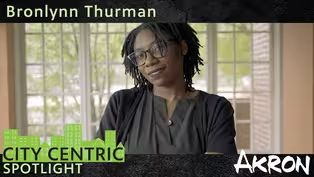
Clip: 9/1/2023 | 4m 29s | Hear from Akron-centric Bronlynn Thurman, philanthropic developer and artist. (4m 29s)
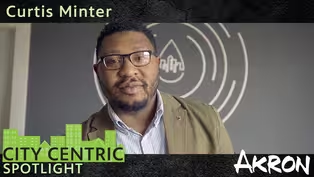
Clip: 9/1/2023 | 4m 21s | Hear from Akron-centric Curtis Minter, director of operations at The Well CDC. (4m 21s)
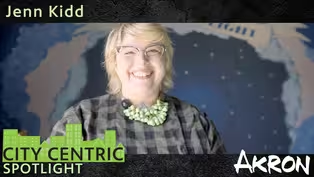
Clip: 9/1/2023 | 4m 5s | Hear from Akron-centric Jenn Kidd, executive director of The Nightlight movie theater. (4m 5s)
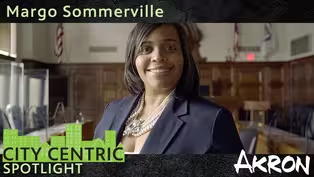
Clip: 9/1/2023 | 4m 20s | Hear from Akron-centric Margo Sommerville, Akron City Council president. (4m 20s)
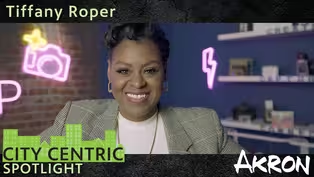
Clip: 9/1/2023 | 4m 14s | Hear from Akron-centric Tiffany Roper, CEO of Eat Speak Love and OH SNAP Photo Lab. (4m 14s)
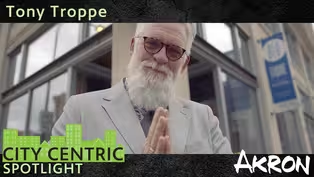
Clip: 9/1/2023 | 4m 12s | Hear from Akron-centric Tony Troppe, economic developer. (4m 12s)
Preview: 9/1/2023 | 30s | Learn about a city with a rich history and a bright future. (30s)
Providing Support for PBS.org
Learn Moreabout PBS online sponsorship
- News and Public Affairs

Top journalists deliver compelling original analysis of the hour's headlines.

- News and Public Affairs

FRONTLINE is investigative journalism that questions, explains and changes our world.












Support for PBS provided by:
City Centric is a local public television program presented by PBS Western Reserve