
Al Strong | Podcast Interview
Special | 57m 8sVideo has Closed Captions
Jazz trumpeter Al Strong explores community, heritage and music as social connection.
Jazz trumpeter and educator Al Strong shares his path from D.C.’s arts programs and global youth orchestras to Durham’s vibrant jazz scene. He also discusses improvisation, cultural heritage and crafting new compositions rooted in social connection. Hosted by PBS NC’s James Mieczkowski.
Problems playing video? | Closed Captioning Feedback
Problems playing video? | Closed Captioning Feedback
Shaped by Sound is a local public television program presented by PBS NC
Made possible through support from Come Hear NC, a program of the N.C. Arts Council within the N.C. Department of Natural and Cultural Resources.
Al Strong | Podcast Interview
Special | 57m 8sVideo has Closed Captions
Jazz trumpeter and educator Al Strong shares his path from D.C.’s arts programs and global youth orchestras to Durham’s vibrant jazz scene. He also discusses improvisation, cultural heritage and crafting new compositions rooted in social connection. Hosted by PBS NC’s James Mieczkowski.
Problems playing video? | Closed Captioning Feedback
Where to Watch Shaped by Sound
Shaped by Sound is available to stream on pbs.org and the PBS app.
Explore Shaped by Sound
Dive deeper into Shaped by Sound. Explore the standout artists from Seasons 1 and 2, meet the show and podcast host, James Mieczkowski, and discover more ways to watch and listen.Providing Support for PBS.org
Learn Moreabout PBS online sponsorshipThe Shaped by Sound podcast is made possible through support from Come Hear and See, a program of the North Carolina Arts Council within the North Carolina Department of Natural and Cultural Resources.
Al Strong from Durham, North Carolina, right?
Originally from Washington, D.C., but I've been in Durham since the late '90s, if you will.
Yeah.
So I feel like you're a Durhamite.
Yeah, definitely.
If Durham will have me, then yeah, totally.
I think that they have.
Yeah, I think they've welcomed you in with wide open arms there.
I'm grateful, yeah.
Can you talk to us a little bit about what it was like growing up in D.C.?
Oh, wow.
Yeah.
D.C.
was a very cultural, I think, relevant place at the time.
Of course, we had the very popular mayor, Marion Barry.
But aside from his supposed scandals, he actually did a lot for providing summer jobs for children like myself.
From the time I believe you were like 15 or 16, you could actually work during the summer and earn money.
And many of those programs were arts-based programs.
And so we were exposed to various styles of music, various instruments.
And then, of course, as you get older, you're then able to serve as sort of like camp counselors.
And so in that experience, I was able to actually spend a lot of time playing steel drums from Trinidad and Tobago.
Whoa, cool.
One of my fifth grade reading teachers, her sister, Dr.
Gladys Bray, ran a nonprofit called the East of the River Boys and Girls Steel Band.
And her mission was, of course, to target at-risk youth and give them alternatives to essentially doing nefarious things on the weekends or even during the week we would rehearse.
But giving them alternatives that, aside from just hanging out with friends and just being idle, if you will.
So in that program, we would rehearse a couple times a week.
And also we had a cultural exchange with boys and girls in Trinidad and Tobago.
So every other year, we would go to Trinidad and Tobago for about 10 days and do joint concerts and visit different villages and cities and towns.
And every other year, we would bring them to DC and do the same thing.
We would show them around DC, the East Coast, and we would do various concerts, joint concerts with them.
Yeah.
What an opportunity to see the world through music.
Yeah, totally.
What was that like as a young person to really have that new worldview on what else could be out there and what else is possible?
Definitely eye-opening in terms of just being able to see how other people live, whether or not they're living with less or more than what we had in the States.
It I think really highlighted the humanity in all of us.
What many of my friends would do on the weekends, my music friends, actually would be to participate in DC Youth Orchestra.
And then they had various jazz programs as well for the high-flyer students.
But steel band kind of became my alternative to that.
And so I really, at the same time, I was starting to take trumpet seriously.
And I auditioned and was accepted into Duke Ellison School of the Arts, where I was able to do even more traveling.
So the top jazz band there played the Montreux Jazz Festival in Switzerland and the North Sea Jazz Festival in Amsterdam.
And the orchestral program performed in France and London.
All these things are happening.
And I'm really just-- I guess I was always really interested in music just as a hobby, just fun because kids, we do other things.
We did other things than just play basketball.
We would go to maybe one of my friends' house where his brother had a go-go band or something.
And they would rehearse.
And we would just sit in and kind of hang out.
And whenever they would take a break, we'd jump on the keyboard and try to learn.
Like Mary J. Blige's "Real Love" or something like that on keys.
And so all of these things were just really bit of hobby activities for me.
But once I got to Duke Ellington and we traveled to Europe, we run into all of our jazz heroes, if you would, like Herbie Hancock and Wynton Marsalis.
Just really randomly, we're in the hotel lobby for a call before we go to the stage or something to soundcheck.
And Wynton walks by.
And we're like, "Hey, Wynton."
And he's like, "Oh, what's up, guys?"
And he comes over because coincidentally, we just saw him a couple of weeks ago because he was at the Kennedy Center and he came by the school.
And this was like that for so many of what we consider like the jazz greats, Terrence Blanchard.
Yeah.
Yeah, so many.
Wow.
Like, it's kind of blowing my mind with that, Al.
What an incredible public works program that you were able to be a part of.
What was it that made you sort of gravitate toward the trumpet?
At what point was that?
Yeah.
I began, I would say, fiddling around with the trumpet at about 10 years old.
Again, DC's music programs or band programs at the time were really robust in the sense where we were graduated through instruments.
Everyone began on violin, some sort of string instrument.
And then once you got a certain age, you were able to choose a wind instrument or some percussion instrument or what have you.
Was the goal sort of just to teach you how to read music?
Yeah, yeah.
And teach you togetherness and how to blend and all of those things.
And also because holding a trombone for a nine-year-old is not an easy feat, right?
So you have to-- they want to give you time, I think, to kind of grow and develop.
The practical elements of playing some of those instruments can be a little bit difficult.
Yeah, totally, totally.
And so, yeah, I chose the trumpet.
I always say this.
I think primarily because Louis Armstrong was still a kind of mainstay on TV.
You hear his name.
Of course, he's what we consider like pops.
He's the father of jazz, if you will.
And so, yeah, and I think that just stuck with me.
Like, Armstrong, strong, yeah, I want to play trumpet.
Like, let's see what's going on.
My uncle and also my-- I want to say my dad probably played around with trumpet a little when they were in grade school.
And so there was one at home.
So I knew what it looked like.
I kind of knew how it worked.
But I didn't really start to experiment with the trumpet until band classes at about 10 years old.
Yeah, wow.
Yeah.
And then you stuck with it.
Yeah.
I mean, again, it was a hobby for a while, just something that I was happy to do.
Marching bands were a big thing in DC also when I was growing up.
So even the middle schools had really great marching bands.
And so a lot of that, I guess, discipline and leadership, if you will, competitiveness in the music.
I was one of those kids.
I was trying to challenge the upperclassmen for their seats.
You get those points in the school year.
So you're practicing more and more.
Yeah, exactly.
Yeah.
And you just want to essentially, of course, be the best if you can in your school or what have you.
And so my band director at the time, Mr.
Reddick, was a French horn player.
And he kind of taught me a bit about etiquette as well.
He said, "Yeah, Albert, I know you want to be section leader, but let Charles finish out his sixth grade year."
Just like calm down a little bit.
Yeah, just relax a little.
I said, "All right, Mr.
Reddick."
So yeah, man, it's been a great, great time.
I'm interested to know a little bit more about, it seems like you were really embedded in that scene as a high schooler in DC.
But from what I've come to understand is that you make this transition to North Carolina, go to school at NC Central, where you're now a professor.
So what was that transition like to go from DC to come down to Durham and to North Carolina?
Yeah.
My grandmother was a big influence in my life.
I stayed with her and my grandfather for years and off and on.
And so eventually she just got kind of like fed up with DC, if you will.
She said, "I'm moving back to Carolina."
So she was from Carolina.
And I would always come down for family reunions and everything during the summers.
And also a lot of my teachers were from Carolina as well.
And so when my grandmother transitioned back to North Carolina, one of my teacher's sisters, Dr.
Gladys Braid, the woman I mentioned, actually sort of adopted me.
She said, "I want you to finish your schooling in DC and I'm going to talk to your grandmother and you can stay with me and we'll make sure that you're taken care of and that you finish and everything."
She was also an alum of North Carolina Central University, I mean, from back in the day.
So she knew Dr.
Ira Wiggins and his family, who was at the time the jazz director at North Carolina Central.
We did some college tours and I visited other HBCUs, Clark and Morehouse and everything.
And NCCU just really spoke to me.
Aside from that, actually my, I want to say, junior year of high school on one of those European tours that the band would do.
North Carolina Central was actually at Montreux Jazz Festival performing as well.
So Dr.
Wiggins got to see us play and he recruited maybe like half the band to come down on scholarship.
So that was a year before I came down.
Many of my friends arrived a year before and they reported back, "Oh man, it's great down here.
There's so many great players.
We're looking forward to you coming."
So it just sealed the deal.
As a musician, what was it like to come into Durham at that time?
I feel like there's such a rich history of music in Durham.
What was it like to be a young man and sort of participate in that history?
During my time in DC, I wasn't necessarily allowed to kind of go out late night very often and even visit jazz clubs or jam sessions and things of that nature.
My godmother really was intentional in keeping me occupied as much as possible.
And I guess in a way, somewhat overprotective and just not wanting me to be around various things.
I mean, substance abuse was a huge issue, of course, in DC during that time.
And I think through her guidance in that, I was able to kind of survive DC, if you will, during that time.
But at the same time, I didn't really get to experience the jazz environment outside of school.
And so coming down this way was great because we still had Brother Yusef in the area, leading jam sessions and performing.
He had a show on PBS.
Yeah, exactly, which I learned about recently, when we did his tribute a few years ago.
And then tremendous vocalists like Eve Cornelius, they were performing together.
Chip Crawford, who was at the time, I think they were married, and he's a fantastic pianist.
Actually, we're like birthday twins.
We have the same birthday.
And Ledbetter was a bassist, of course, legendary bassist in this area, but also a scientist.
So we had that and tremendous musicians like Brian Miller and saxophonists were playing in these various spots.
So at the time, Durham maybe only had about two or three places where you can hear music, and especially jazz.
So we had like Jamaica, Jamaica, right.
And then whereas what is now North Hills, there was Capper's, it was a jazz club, kind of a supper club there.
And then in Durham, we had kind of a juke joint place called Talk of the Town.
That kind of like the crowd that is now at Blue Note Grill, built that kind of community, even back then.
So man, I was just really grateful to at least have like the experience of art.
I'm finally in college, I'm on my own.
I get to chase the music at my pace.
So much of this is about really like you have to submerge yourself, or I'm sorry, immerse yourself into anything, whether it's learning a new language or foreign language or anything.
And so music is just definitely no different than that.
And especially jazz, if you will.
And I think that this became a bit of an incubator for me.
And I'm grateful for that.
And you just kind of mentioned you were sort of ready and primed to chase the music.
Where did that end up taking you?
How were you doing that?
Where did you end up going with that?
I think back to maybe my first year at Duke Ellington and being given a stack of CDs by one of my trumpet studio colleagues and saying, "Hey man, I hear that you're really serious about this and check these out."
So he gave me a CD of Clifford Brown, Lee Morgan, Art Blakey, and all these things.
And that was one of those things that let me know, wow, you can really have a distinctive sound on trumpet.
And so these are the things that I think that all instrumentalists kind of aim for is to have kind of a sound of your own.
And of course, some of the things that I've described, I think, is that how we kind of move ourselves towards that direction by really studying great players, immersing yourself in the music through active listening, and of course, in communities that foster great talent.
And so I've been fortunate.
I've been, of course, released a couple albums, four albums so far, and gotten quite a bit of radio play and some streams and had a chance to collaborate with some really great artists.
Of course, traveled the world.
Actually just did like a 10-day tour of towns and cities in Alaska through South Arts Grant.
With a group out of New York, a group led by singer Svetlana, who is just a really great band leader.
She has great arrangements and she's a huge connector of different worlds and brings people together.
And so, yeah, that was definitely an experience, man.
Oh, I bet.
Yeah.
Alaska's massive.
Yeah, it's massive.
You think it's big and you're like, "No, it could be its own country."
Half of the United States almost.
It's huge.
Agreed.
Yeah, totally.
And, I mean, yeah, waking up with a moose chomping down on some bushes right outside your window is definitely an experience.
Yeah.
And yeah, it's great.
I think it really speaks to how much the music, I think, serves a need in people that even if they're not jazz listeners or that they didn't know that they needed in their existence, if you will.
Yeah.
I want to kind of take a step back and maybe sort of center us in Durham again.
In your opinion, what makes sort of this Durham scene unique?
What is it?
What's special about it?
I feel like you're such a huge part of it even still.
Yeah, what makes it such a vibrant, small little place?
Sure.
Yeah.
I think the obvious things are that there are a number of universities in the area, in a small concentrated area, right?
That's maybe different than some other places where there may only be one university with a music program or what have you.
But here we're fortunate.
And so we have that and we have all of these great music students coming out and then their creativity is really high level and so they're writing music.
They are modeling after, I guess, the generations that came before them, such as myself, where we're actively writing music and we want people to hear it.
And we're kind of using our gigs as a testing ground for the music and the vibes that we create.
And I think it's just perpetual will that we're fortunate to have here.
Perpetual will.
I feel like that is such a great descriptor of jazz music.
Would you say that sort of, when we think about perpetual will and jazz, it's because it's... At one point, I feel like jazz is constantly evolving, but also at the other part of it, there's this deep rooted history where it's based in the standards and there's certain foundational elements that people don't want to change.
Do you think that's sort of the case and what's happening with what you're doing within the genre?
Yeah.
Well, I think that with any field of study, there are going to be fundamentals that any journeyman needs to learn, so to speak.
And it's a means, I think it's a catalyst for musicians, young musicians, to then sort of begin to explore their own approaches and learn how to break rules within context.
We have these conversations quite often, myself and my older colleagues, about the direction of music education, jazz education, and how some instances we wish that we could be a part of the revamping of it and how it could really more so speak to current, present day.
If we're all preparing students to be either performers or educators, then what other avenues are there?
Because I think that unfortunately, there aren't enough jobs to facilitate either one of those things.
And so there, but then there are avenues where you could be a presenter, you could be a curator.
I myself have been fortunate that I'm currently the director of creative arts and schools for the Durham Arts Council.
And it just kind of ties right into my, I think, overall vision from the music of being able to generate more work for musicians and create opportunities and at least keep a part of the music elevated to the point where maybe other businesses see the value in that and then they want to bring in some students or what have you to begin to create kind of a different atmosphere in their particular venues or restaurants or what have you.
I think it's all valid.
And I see the music as being, of course, in one instance, art, but overall, a music that we should consider to be social music.
From the perspective of, I think we talked about this a little earlier, I did a couple fundraisers on the main stage at Carolina Theater recently in front of live audiences.
And they, of course, enjoyed what we did.
But in addition to playing larger concert venues, I also, I personally enjoy playing certain bar situations, maybe certain restaurant situations, maybe not as much anymore, but because I think I understand the need for the music to kind of be in front of people in different instances and being presented on a certain level that businesses see as viable and audiences see as worthwhile of supporting.
Right.
Yeah.
You mentioned that you think that jazz is sort of a social, that there's a social thing that's happening to social music.
What do you mean by that?
Yeah.
Well, I mean, whether it's a concert venue, you have people coming together to, I guess, actively listen.
And perhaps they're not, of course, like what we call a listening room.
It's like there's no talking necessarily, right?
Unless you're interacting with the performer at a certain time.
That's one aspect of socializing through music.
And then, of course, there are the bar atmospheres where people are coming together to co-mingle.
And maybe the music is more of a backdrop in those situations.
But I, myself, as a performer, I'm always kind of actively scanning the room to see even like how the slightest note or tempo change affects the mood of the audience or their attention.
And even though if they're having conversations with one another, if I'm seeing feet tapping, if I'm seeing heads bobbing, I know that our energy, our vibrations are feeding into their mood and their general disposition and enjoyment of that particular situation.
And again, they're coming together to socialize.
And at the same time, it creates a situation for, I think, musicians to experiment with their approach and maybe not be what we talked about earlier, so locked in into demonstrating their fundamentals or the traditions of the music in a super strict fashion.
I think it's an opportunity to branch out and experiment with how to evolve from that.
Yeah.
And I kind of want to continue to go down that path because you've talked about how jazz is sort of, it can become a dialogue.
It seems like what you're saying is that when you're playing in this sort of whatever social scene that you're a part of at the time, this dialogue is really you putting out something and sort of generating energy or generating some sort of inspiration.
Is that what you would say?
Is that what you mean by that?
Yeah.
Is that what a dialogue?
Yeah.
I love the way you put that, James.
Yeah, exactly.
And those musicians who have pushback with social music scenes, I totally can get where they're coming from because the truth is that when we're performing, whether it's two people or a full five-piece quintet, the conversation is the music, right?
I want to continue to kind of talk about this element of social music, especially that you can sort of read a room and what you're doing is directly influencing that room.
So it seems like when you talk about music as dialogue, it's really sort of not just between the players, but also between everybody that's involved in the room.
Yes, totally.
Yeah.
Again, the conversation is happening on stage and then there are conversations possibly happening in the room.
The energy that I think I'm speaking to is one that I often experiment with is like, "Okay, what song can we place?
What songs can we place in order that will actually bring people more into the experience that's happening on stage and make them actually maybe not want to leave their conversations, but actually begin to kind of make the music a part of their rhythm on how they're actually interacting with their people?"
There are times where we actually will purposely play like an hour and a half, two hour sets just to not only just stretch ourselves, but to see, "Okay, how much can the room take?
How much of this... Who's really listening?"
If we go chaotic right here in this moment for about five minutes, what effect does that have on the room?
What happens?
Yeah, yeah.
Who are the real riders out there?
And who's just really here to hear things that they recognize?
I mean, I appreciate it all, but if we're on stage, we might as well have fun with it too and experiment.
Totally.
And that's another thing I want to ask you about.
Mostly within jazz, a large part of it is experimentation, improvisation.
What is it like for you to do that?
To go into a room with some other folks, other players, and jump off the cliff with them?
Yeah.
Oh man, you know, so much of this music, the music that we play, is commonly referred to as jazz, but I think it's a lot deeper than that.
And it's been kind of popping up on my algorithm lately.
I don't know if AI is reading my mind, but the more I think about the music that we play being referred to as jazz, the more I get a little uncomfortable.
Because it's a marketing thing.
I think in one instance, it's okay, because this is how we're being marketed, and people can recognize what it is and kind of have an idea of what to expect before they come.
We're dealing in a lot of trust on stage.
So that means I don't always need to count off a song.
And a lot of great players do this, especially like the legendary Roy Hargrove, who I got to see quite a bit live.
Good friend of mine played bass with him for years, Amin Saleem.
And you can play one or two notes, and the band knows where your time is.
It's like a cue for the song, so I can go, "Do do do do do do do."
And then the band knows where I am.
That's part of the conversation I think that we're talking about.
And so even with that, we take that a step further.
And oftentimes, we do these things where we're trying to create an atmosphere collectively.
So I may start, drums may start with a cymbal roll, any instrument can begin, and we just all coalesce on this train ride that's about to happen.
And then from there, I personally like to, if we're in a certain key, maybe I might begin to hear a melody that is an original song that we can go into, or perhaps a recognizable cover is speaking to me in that particular key.
I know lately, we've been doing "Living for the Love of You" in different styles.
And so we've been stuck in D major forever.
And I'm like, "Well, this is a key that I personally want to work on."
It's not a super common key that any of the jazz standards are being played in.
If we're creating this ambiance, this atmosphere out of thin air, and I begin playing parts of that melody, the band will shift and go with me.
Yeah.
Yeah, it's something.
There must be so much trust there between you all.
What's that like to just be in this moment where you're floating together?
There's something so atmospheric, esoteric about it all.
And then all of a sudden, boom, you're together, you get it, and you trust each other.
Yes.
Yeah, totally.
What's that like?
Oh, man.
It's really tough to describe.
I would say there's no feeling like that, having that kind of trust in the people who you're on stage with.
Again, it speaks to that I trust that if I play a certain harmonic sound, that someone in the band will compliment that sound, and then vice versa.
I think that if the drummer begins to hear time, like a pulse in a certain spot, and he begins to play that pulse, then his trust has to be that he's not going to be left out to dry.
Right.
The band is going to shift towards what he's doing.
Yeah.
Yeah, it's almost like those tests where people are like... They fall back and I catch you.
A trust fall?
A trust fall, is that what it's called?
Yeah.
So that's kind of happening all the time.
It's just a bunch of trust falls over and over and over again.
Exactly.
Yeah.
Even if we're playing music that we know.
Yeah.
I mean, I'm of course a big fan of Miles.
I mean, it's hard not to be, but some people will get off that Miles train at a certain period, because he was such a impactful and evolutionary artist.
But I like to follow his journey all the way from the beginning.
And so a lot of what I think even we do today, meaning we as in all artists in this genre that we call jazz, are modeling things after what Miles and his band did with Herbie Hancock and then Keith Jarrett.
Just a lot of conversation within the music, a lot of interaction.
And again, tons of trust.
And if I'm not articulating it well enough, go listen to Miles.
It would definitely hopefully start to reveal itself.
Yeah.
I'm curious, since you've mentioned it, and I feel like there's such a really cool spectrum of where Miles Davis was in his career, right?
What do you find yourself gravitating most toward?
Is it kind of blue, sort of the modal jazz, or is it sort of that heavy, experimental, like mid-70s sort of Miles Davis?
Yeah.
Especially as a trumpet player, right?
Yeah, exactly.
I think that certain periods are good for certain instances.
Lately it's been the 70s period for me.
As I begin to add more devices to my effects rig, if you will, and just really searching for new sounds and textures and ways to be in dialogue with my band members.
And then it's funny, because we were on a gig a couple weeks ago, and we were into all our stuff, and 90% of the room was digging it.
And there was this one guy that was like, "Hey, man, do you guys know Green Dolphin Street?"
And I'm like, "Yeah, sure we do."
And some of it is politeness, but I'm like, "That's a great call."
Actually I would love to kind of snap it back into something familiar.
And so we played Green Dolphin Street, probably similar to how Miles would play it.
I put in the Harmon Mute, and it went over really well.
It was a great way to contrast.
So again, the music is so vast, and it speaks to so many different experiences for people.
And I think different periods of the music also bring up different memories for people.
So if I'm performing, we did a Harlem Renaissance tribute, I want to say earlier this year.
And with my eight-piece swing band, and just playing some of those Cab Calloway tunes and like stuff from Ella Fitzgerald and Duke Ellington, man, there's still a market for that music live, that people again come together to socialize around.
They're dancing, they're eating, they're being entertained.
And it's creating, again, work for musicians.
It also speaks to a little bit of the living heritage of jazz, and how that just can continue on no matter what decade it is.
The same way that they were reacting to it back during the Harlem Renaissance is probably maybe a little bit different to how we would react to it now, but at the same time, it resonates with them, which is such a cool thing.
I want to maybe talk a little bit about some of your new songs.
Can you tell us a little bit about what you're trying to do now, and what you're trying to do within this new music?
Sure.
Yeah.
Well, some of the music that we've prepared for our taping here for Shaped by Sound are songs that have been sort of like in my vault, if you will, for like several years.
My creative process is a lot maybe different from some people.
Some people can just write a song and go into the studio and record it.
I've done that before, and it does work.
There are instances.
But for me, what I enjoy most is writing some music, being able to play it live, really kind of get a vibe with the group.
And then, of course, I'm taking voice memos, or kind of recording it on the side as we're going.
And over time allowing those songs to kind of develop into something that I think will, you know, will sound like a finished product, if you will.
Or even, you know, have legs to kind of grow into something else, but at least be able to be presented in a fashion that is digestible and still speaks to the art of the music.
And so, yeah, I think we pulled together what maybe four new tunes for this.
One of those called "Just Hang On" is one that was written shortly after quarantine ended.
One of our first gigs out in public, we were playing Bond Brothers in Cary, and myself and Butler Knowles.
Again, we began experimenting on stage.
He began playing a bass line, and then I began layering a melody on top of it.
And that just happened to be captured.
And then it became a song that I later, you know, more recently actually developed with Lance Scott and Skeena Lee.
Lance is a great bass player, but he also features on his own projects as a singer.
And Tyler Lee, they're kind of a writing duo, plays guitar, but he's also a great producer.
So I developed these ideas with them in the studio.
And "Love is Complicated" is kind of one of those things.
I wrote it to be kind of like, it speaks to like the church tradition in a way.
There's a lot of triad movement, but also it was something I originally wrote for an art installation in Dubai.
Several years ago, a friend of mine was living in Dubai and curating for an art gallery.
And she was doing this installation where she asked different artists to write original music to accompany the pieces that were going to be sold.
And so that was one of the tunes that I wrote for that.
And since then, I've played it live a few times, even did like a demo with one of my brass band projects.
And yeah, it just resurfaced it.
I'm like, I think it's time to actually, you know, try to put some finishing touches on this.
I think it's a great song.
And it's like, it's funny, me and the band, we kind of joke about it because it's called Love is Complicated, but the song is kind of complicated as well.
I mean, we can hear it in 4/4, but there's this like 9/8 undertone again, because I was trying to capture like the spirit of maybe a traditional hymn within that song as well.
That's kind of underlying and it makes the execution of it just, it makes the musicians kind of pay attention a little more to what's happening than just kind of being bored with it just being 4/4.
And hopefully the listeners will feel that way as well.
And then Shavona Antoinette is singing on that as well.
And she's a pleasure to work with.
She actually featured on my last album.
We did a cover of Erykah Badu's Out My Mind.
And she laid some really great vocals, wrote some great original lyrics for that as well, our interpolation of that song.
Then we have Say What You Want, which began as a tune I titled Seven Ways to Love.
We would play it as like an instrumental.
And I called it Seven Ways to Love, but it was like one of the first songs I ever wrote that was in 7/8.
And so yeah, you know, been experimenting with this song for some time.
And I'm grateful for this opportunity because it gave me kind of the kick in the pants that I needed to move towards finalizing some of these songs that I think that people need to hear.
Yeah.
You've been workshopping them for a while.
Yeah.
Yeah, exactly.
Exactly.
Which is, again-- And now they need to sort of land somewhere, at least for the record.
Yeah.
Hopefully in the playlist of many, many people worldwide.
And yeah, that's just, again, part of my creative process that I-- maybe I move a little slower in that regard, whereas I feel better about playing my original music a little more often in experimenting with it and allowing it to kind of evolve based on the voices of the great musicians that I try to assemble.
And hearing their musical input kind of come together in a way that I feel like, OK, yeah, I can fashion this, and we can make this something great that speaks to people.
Yeah.
Also, "Who's House," that's a new one as well, right?
Yeah, it is.
It is.
Can you speak about that one a little bit?
Yeah, sure, sure.
Again, it came from playing a live gig.
Yeah.
We were sometimes in music situations-- I guess I want to say bar situations, or these are like bars that have music quite often.
So it reminds me-- the thing I love about Durham is that it's kind of like miniature New Orleans in a way.
And hopefully we'll get one day to that foot traffic where there's music door to door to door to door, and businesses can thrive in that regard.
But not to get too distracted, so sometimes we're playing these venues, and they might be expecting jazz, meaning swinging jazz, but they're playing house music on our breaks.
Yeah.
So it's like, OK, well, we get on stage after the break, and they haven't turned the music off, and so we just start vibing with whatever's playing.
It could be whatever.
And so in this instance, it was like-- I guess it was, yeah, maybe a house music song.
And as I'm turning off the music, the band is starting, they're already playing.
And then I get back on stage, and they're looking at me, I'm like, "Yeah, let's keep going.
I'm down, let's do it."
So I flip on the effects pedal, and I start creating a melody, and I just happened to have the video running, my camera running, and so captured that and took it back home and just kind of worked it out.
Yeah.
How cool.
So it was truly a product of circumstance.
Yeah, totally.
And that happens a lot.
And I think for me, if I'm not focusing on too many other business aspects of running the band, I can be more creative and just kind of really seize those opportunities where like everyone's creativity is going and all the elements come together.
And yeah, we're able to come up with something that's kind of unique and that's still a recognizable and speaks to the mainstream and art at some point.
Since we're kind of going through the songs that you're performing for us, I'd like to kind of tap into some other ones as well, and I'm happy you react to them.
So I'd like to talk about Lullaby for Ancestors, which you were sort of putting together with "At Nimara's Journey", right?
Sure.
Can you speak to that?
Yeah, definitely.
So Lullaby for the Ancestors and At Nimara's Journey were both on my last album, Love Stronger.
And they run concurrently that way on the album.
The album begins with the intro and then goes into At Nimara's.
They're separate tracks though, but that's just how I hear it live.
It seems like the perfect way to kind of segue into At Nimara's Journey, which speaks to another ancestor that we commonly know as Harriet Tubman.
And so her real name was actually Araminta Ross.
So the name Araminta is At Nimara spelled backwards.
And so anyway, it evolved over time.
And the idea is that for the music to kind of depict the imagery of someone escaping slavery or confinement, if you will, and taking that journey with Araminta through the Underground Railroad, through various woods and hiding in floorboards and houses and what have you, and then eventually reaching a point of freedom.
And so you'll hear the bridge of the song kind of bring some more light into the situation where the A section is a little more darker, maybe mysterious, conveying kind of like searching for that light that happens, I think, later on in the song.
Yeah.
Wow.
So you're really trying to like storytell here.
Yes, correct.
But also sort of create a space that's fluid with just sort of general ideas and concepts to kind of understand an atmosphere.
How awesome.
Thank you.
Appreciate it, James.
Yeah.
Can you talk to us about Black Love?
Sure.
Yeah.
Black Love is also on my most recent album.
It features legendary guitarist Mark Whitfield.
And yeah, it's again, tribute to the black community, if you will.
And I think this probably goes to say with just about any community, it's easy to, I think, highlight the negative parts of any community in media, in print, in algorithms.
Its just- what they say, negativity sales or what's there's a term for this.
But aside from that, this tune is meant to highlight, of course, the more positive aspects, the more togetherness of black couples being together, black families thriving and succeeding.
And that's what Black Love is meant to portray.
I initially wrote it as a tribute to my great grandfather, who was Albert Sr.
He was a bit of a farmer and first sharecropper and then a farmer in Rockingham, North Carolina.
And so in the studio, there's a picture of he and I when I was, I think, probably like four or something, four or five.
Yeah.
Yeah, man.
You know, I remember those times where we would come down from D.C.
and visit and it was chickens and goats and other farm animals.
And it was just a lot of love.
You know, in those situations, like, you know, he didn't have much.
He had his home, he had his land, but it was really more about the family.
Yeah.
I want to sort of tap into what you were just saying a little bit as well, where when we were talking with you about the set, you mentioned this idea of having these Polaroids sort of surround you on the set.
Why is that important for you to have while you're playing and while you're with the band?
What was that inspiration for you?
Yeah.
Well, I mean, it came out so great.
Like, I'm still trying to digest it and let it kind of really do what it's supposed to do, meaning like filter into the music and have that impact.
But I wanted the art performance environment for this to feel like anybody's living room where you're able to, you know, maybe occasionally glance at like an old photo of your family and just, you know, just have a smile, have a laugh, you know, have a fond memory of things where or times where, you know, things are more simple.
Yeah.
And we didn't have, you know, all the craziness that's going on in the world.
And I think that just kind of hopefully will push the musicians a little more at ease and myself in terms of like what we're really truly here to do, you know, and that's to just convey our message through music and deliver these new songs in a way that, you know, again, speaks to the art, but also I think that really conveys the kind of emotion that we might have normally in a live performance situation.
But the beauty of the music is that it's just always different.
Yeah.
And I think we all appreciate that.
Yeah.
I just want to sort of leave us with a question that we'd like to ask everyone that comes on the show.
And really it's about when we were thinking about this, like the concept behind the idea of Shaped by Sound as a television show, we wanted to sort of think about how music affects us as people, how it affects us as communities.
And so we try and ask, you know, everyone, you know, how are you shaped by sound?
You know, I thought about this, the song Seven, you know, or Say What You Want, that's now Say What You Want.
And when I originally began composing that song, you know, many people may not know this, but I'm like half Korean and half black.
And so you'll see a picture of my mom and dad in the studio.
But for, you know, most of my life, I only really studied like European classical music and quote unquote jazz or black music, you know, from spirituals and everything.
And only as of recently, meaning like the past five years, I, you know, begin to kind of check out Korean music and not the kind that everybody knows, like the K-pop.
Right.
Which still, that's amazing.
It's a different thing.
You know what I mean?
It's like, but traditional Korean folk music.
And what I began to hear are elements of what we commonly refer to as the blues, right?
Which I think is in a way, like the foundation for all black music, all American music is the blues, like the twanging, the bending of notes, you know, the sliding between notes and all of those things.
And so I began to actually listen to other types of traditional music and found the same thing.
And it's just something that, whether it's rock and roll, whether it's electronic music, whatever it is, I'm always, you know, looking for the sound of the blues in that style of music.
It's what speaks to me.
And I think it actually speaks to most people because everyone has a traditional culture that came through some kind of evolution, some types of struggles that, you know, created situations where those people wanted to produce a type of music that helped lift their people out of their, you know, melancholy from those struggles.
And so I think the blues is a big part of that.
And so, yeah, that's one aspect.
And I think I touched on some things earlier when I spoke to Clifford Brown and Lee Morgan.
You know, one of the things that happens for a lot of music students and I think people in general is that, like, when you're listening to your favorite artist, if you hear them on other records and you begin to, like, notice without reading anything, like, "Oh, that's Clifford Brown.
Oh, that's such and such."
Like, these are things that begin to kind of click for me when I was, you know, in high school and then when I first arrived at NCCU was being able to recognize, like, the sound, the voices of various trumpeters first on various records, like, greats like Donald Byrd and, you know, Freddie Hubbard.
And then that evolved into being able to then recognize, like, my favorite saxophone players on different records without, you know, just simply by hearing, like, a few notes.
And I think that's something that we all as jazz musicians and educators, you know, share, try to impart that approach to our students, especially younger music students.
It's like, that's the kind of level of intentional listening that we want to be on as far as listening to sound.
And then, of course, that graduated into, like, hearing different piano players, being able to recognize their sound from different albums, Red Garland or Wynton Kelly, you know, and even, like, drummers, like, a specific ride cymbal.
I mean, it goes really deep after a while.
For me, it started with trumpet and then it, that, those listening skills helped me kind of be able to identify other instruments, right?
Yeah, it's a fascinating thing because, you know, I think that when you begin to kind of recognize the sound of different players, I think it hopefully helps you move towards your own sound.
Yeah.
And yeah, that's what inspires me.
It's like, almost like hearing an artist's signature on something and then finding a way to kind of create your own.
Yeah, yeah, totally, totally.
I mean, it could be vibrato, you know, it could be the way a person articulates.
For piano players, it could be, like, the type of voicings that they use are really identifiable, their rhythmic, you know, rhythmic vocabulary.
And then, of course, like, the type of language that they play, like a Bud Powell, like, he's kind of someone that you can recognize pretty fast or Art Tatum, you know, mainly because, like, you're listening for speed and you're like, that's got to be the Art Tatum or Bud Powell.
And then you kind of listen to who's the cleanest or whatever, you know.
And I'm not to exclude singers, but I think that for singers, it's a little more easy to recognize, right?
Because we all, you know, the human voice is the first instrument.
And so those are a little more easy to identify, I think, from singer to record, right?
But yeah, from an instrumental perspective, I think it becomes a little more challenging, especially when I, for me, when it comes to, like, bass players.
Like there are a few that I can recognize just about on any record, like a Christian McBride or something like that.
Like, his sound is really recognizable.
But in general, my ears aren't quite tuned to that yet.
I haven't graduated to that.
But many other instruments, some of my favorite players, I think we all have kind of trained ourselves to be able to recognize them.
Yeah.
It's so cool to think about how music and musical identities come from intentional listening.
Totally.
And how deep that can go.
That's really good.
Yeah.
Al, thank you so much for being on this show.
And thank you for sharing all this with us and sharing your music with us.
Yeah.
And I hope you leave us with just, if there's anything else that you'd like to add to this conversation that I didn't get to touch on.
I hope that the music continues to have a place for not just the future generations of music, but of course, like the future generations of musicians.
That listeners and concert attendees or what have you continue finding value and realize, even if they don't, I have to say that, even if they don't, that the music needs their support and should still come out of the house occasionally.
I know things are different now, post-quarantine and everything.
Even I don't go out as much as I do, but I still at my age make it a point to go check out the young musicians, support their jam sessions when I can, things of that nature.
The music needs that.
And if they don't see that kind of support just coming from everyday listeners, then what motivation can they continue to have to pursue the art form that I think we all work so hard to support and create in our own regards?
And so yeah, that's mainly the message I want to leave out there.
Go see live music.
Yes, yes, exactly.
Al, thank you again.
We really appreciate it.
Thank you, James.
It's been great.
Yeah, my pleasure.
Thanks for joining us on the Shaped by Sound podcast.
If you'd like to hear some of the songs we discussed today, you can find them on our website pbsnc.org/shapedbysound.
[MUSIC]
 New Episode
- Arts and Music

Innovative musicians from every genre perform live in the longest-running music series.
 New Episode
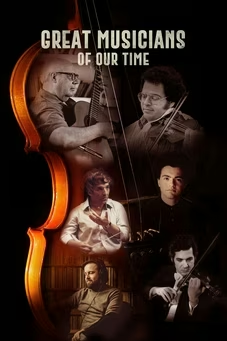
- Arts and Music

Intimate portraits of six of the most influential and celebrated classical music artists.
 New Episode

 New Episode



 New Episode
 New Episode
Support for PBS provided by:
Shaped by Sound is a local public television program presented by PBS NC
Made possible through support from Come Hear NC, a program of the N.C. Arts Council within the N.C. Department of Natural and Cultural Resources.