
Alec Guinness: A Class Act
3/12/2026 | 1h 30m 26sVideo has Closed Captions
This documentary looks at the career of Alec Guinness, a great English actor.
This documentary looks at the career of Alec Guinness, a great English actor, that started in 1934 with a walk-on part in Libel at the Playhouse Theatre, London. Guinness made the transition from Shakespearean theatre to the silver screen with ease. Although he won an Oscar for The Bridge on the River Kwai, he is perhaps best known for his role as Obi-Wan Kenobi in Star Wars.
Problems playing video? | Closed Captioning Feedback
Problems playing video? | Closed Captioning Feedback
ALL ARTS Documentary Selects is a local public television program presented by WLIW PBS
Alec Guinness: A Class Act
3/12/2026 | 1h 30m 26sVideo has Closed Captions
This documentary looks at the career of Alec Guinness, a great English actor, that started in 1934 with a walk-on part in Libel at the Playhouse Theatre, London. Guinness made the transition from Shakespearean theatre to the silver screen with ease. Although he won an Oscar for The Bridge on the River Kwai, he is perhaps best known for his role as Obi-Wan Kenobi in Star Wars.
Problems playing video? | Closed Captioning Feedback
Where to Watch ALL ARTS Documentary Selects
ALL ARTS Documentary Selects is available to stream on pbs.org and the PBS app.
Providing Support for PBS.org
Learn Moreabout PBS online sponsorship[gentle music] [film reel whirring] - Usually Alec would be in his study and you'd be asked to go and greet him.
Go and give your grandfather a kiss.
And inevitably, he would always appear slowly from around the corner.
And it was very exciting because he would, as he walked towards you, you'd gradually, you'd see him sort of imperceptibly change from this, your grandfather, into some character, which was obviously a fun game he sort of did for children, but it was actually terrifying because he would always it was always a, a sort of a bit of menace in the character he became, which was fun and exciting, but also terrifying, and you'd always have to be given a sort of push to go to meet him and greet him.
[gentle jazzy music] ♪ Can I tell you the truth ♪ Let go of the lies ♪ If I confide in you ♪ Will you still be mine?
♪ If I confess to you ♪ All that I've been through ♪ Would you hold me still ♪ Or would you turn around and run a mile from me?
♪ ♪ They say play it cool ♪ They say love has no rules ♪ Don't reveal all your cards ♪ No.
Keep them close to your heart ♪ ♪ If I show to you ♪ All of my difference, I ♪ Would things have to change [suspenseful music] [train whistle blares] [cockatoo squawks] [suspenseful music continues] - Mrs.
Wilberforce?
- Yes?
- I understand you have rooms to let.
- [Alec] My birth certificate registers me as Alec Guinness de Cuffe, born in Marylebone, London, the 2nd of April 1914.
My mother at the time was a Miss Agnes Cuffe.
My father's name is left an intriguing speculative blank.
- He had a dreadful childhood and his mother was awful.
She wouldn't tell him who his father was.
Perhaps she didn't know.
- I know there was a lot written about his relationship with his mother, and that he had been sort of celebrated her death when she died, because it was a difficult relationship.
But my experience was I was one of the few people who were with him at her funeral, and he did cry.
- He lived in 30 different residential hotels in his childhood and was always skipping off without paying the bill.
So it was... And then she married this rather eccentric, rather brutal man.
and so he, you know, he had a sort of textbook, horrible childhood, really.
- [Alec] At 14, I was told, quite casually, that my real name was Guinness, and De Cuffe and Stephen were obliterated.
- Well, as a young mum, he was really upset and cross and worried that I was unmarried.
And I think that stems from him being, you know, his mother being unmarried.
And we had a sort of argument about that being 1914 and 1990 is a very different world.
- In those days class was very important.
And I think, I mean, Alec went to some private schools and his mother changed her name.
Was it from Courcy to de Courcy?
To give a bit of class to her background.
- I think it must have affected him really deeply, because every year after I had children in in the November, he would send a check with a letter saying, turn your heating on and buy your children presents.
And that happened right up until his death.
And I think he must have had some really harsh winters with his mother.
- His first job after school was with an advertising agency writing copy.
A career he was ill-equipped for as his heart was set on becoming a stage actor.
You know, it was very clear from very early on that he was determined to be an actor.
Um, you know, he went to great pains to get a scholarship into acting school.
- If I look back now, I think I always was an actor from, you know, the age of 5 or 6 or or something.
- It was while he was at the Fay Compton School that he got a non-speaking part as a junior counsel in a play called "Libel" at the Playhouse Theatre.
- People would talk about the great theatre actors, and they always only mentioned three, and that was Laurence Olivier, John Gielgud and Ralph Richardson.
But for me, the greatest actor that I thought was Alec Guinness.
- And he'd had quite a tough time, you know, because in the early days, um, as far as I know from friends of his who've talked to me about it, um, he was not respected enough, really.
- Meryl had said Alec had one less layer of skin than ordinary folk.
He was very, very sensitive.
- It was a lunch Gielgud was giving, and Alec, with being a very junior member of the company, was invited and came to the pudding and um... Gielgud said, "Alec, what do you want for pudding?"
And Alec said, "Oh, I'll have vanilla ice."
"There's no R in Vanilla Ice."
- He wasn't recognised enough when he was younger.
He was put down quite a lot, and he worked very, very hard.
And he wasn't that confident.
And I think they were a little bit cruel to him, the great actors that he worked with.
- His relationship with Gielgud was quite a complicated one.
He was ten years Gielgud's junior and he was really great, greatly indebted to Gielgud, who helped him financially, I think, and gave him work.
Then came the day that Gielgud heard [Tom laughs] that Alec was going to be playing Hamlet.
He'd been asked to play Hamlet by Tyrone Guthrie, no less so, uh, "Oh, Alec, I hear you're going to be playing Hamlet."
Alec didn't know where to look, hmm.
"Yes, I don't know why you don't stick to those funny little men that you're so good at."
- There came a point, um, when one of the critics said, um, that the British theatre is not a triumvirate of great actors anymore.
The leaders, which was Richardson and Gielgud and Olivier, it is now, um, a quartet.
- I think when I was a schoolboy, I loved things like "Oliver Twist," "Great Expectations," "David Copperfield" and so on.
And that stayed with me for a few years, and I had a sort of enthusiasm for Dickens.
Spending most of my days in an unoccupied attic I discovered, filling it with rank pipe tobacco smoke while I wrote my stage adaptation of "Great Expectations."
The household was eventually dragooned into hearing me read it aloud, all of us sitting round the dining room table.
- Unknown to Alec in the audience at the Rudolf Steiner Hall for "Great Expectations," was a young film editor named David Lean.
- And he'd done an adaptation of "Great Expectations."
before the war, which, which, uh, David had seen.
- During the war his acting career was put on hold.
In 1942, was put in command of a landing craft which took part in "Operation Husky," which was the Allied invasion of Sicily.
- [Alec] On the afternoon of July the 9th, I received a sealed envelope which had to be pu immediately in the ship's safe.
Our sailing orders for that night.
The envelope was not to be opened until we were at sea, some ten miles from the island.
It was a beastly night.
An hour out from Malta, the wind increased and the sea became unpleasantly rough.
Troop ships, destroyers, cruisers, and an aircraft carrier were converging from places as far apart as Alexandria and Algiers on a position a few miles wes of the southern part of Sicily, where we were to rendezvous, and where each of the LCI's was to embark 200 soldiers.
["Colonel Bogey March" plays] [Walter Goehr's orchestral score plays] - David Lean, and Ronnie Neame was cameraman on "In Which We Serve."
And David Lean was co-director, and they teamed up and they sat down and wrote the script for the "Great Expectations" in about four weeks and took it to, I think it was Rank and got it financed, and that's how they got the film made.
[quirky music] - Mr.
Pip.
- Mr.
Pocket.
- I'll never forget his first entrance in "Great Expectations" on the staircase where he looks up and he looks so young and so slim and so athletic, and it was it was magic.
I'll never forget that, I think that's one of the great moments in cinema, is his first entrance in "Great Expectations."
it's beautiful.
- He described himself as a character actor.
And so he was looking for characters rather than leading man romances, so I think that he also would have steered towards scripts that where he had characters.
- What a night.
Hello.
- It was a great film for Guinness to start on Because he's, he's very good at as Herbert Pocket.
It is rather one of those little parts that you're so good at that, um, John Gielgud patronised him by saying.
- We've done very badly.
- Very badly.
- I think the adjective that calls him to mind as Herbert Pocket is jaunty.
- His Herbert Pocket is again, it's a small miracle, really, because it's radiant.
It's it's open, it's fresh, it's young, it's It's enchanting.
He was able to to... to do these things by...by simply um, thinking it, is what it amounts to.
He didn't need to do what a lot of actors need to do, to do a massive amount of research or to... And I don't even know whether he looked very deeply inside himself, but I think he formed a sort of image of the character and then surrendered to it completely.
- And then, of course, "Oliver Twist."
It was sort of sensational.
"Oliver Twist," wasn't it?
- Sit down, Oliver.
[plate rattles] A great many of them ain't there, my dear.
- Yes, sir.
We just looked 'em out ready for the wash.
[boys laugh] - That's the only time I've ever gone out after a part.
I absolutely, uh, was determined to play that.
And David Lean was wonderful.
I mean, he listened... I mean, my thing to him was at the time "Oh you would never think of... When I heard they were going to do "Oliver Twist," you'd never think of casting me as Fagin."
And he said, "Not in a thousand years."
You know.
And I said, "That's where you're wrong, because you people in films are only interested in types."
So you wanted to get away, my dear?
Did you?
Eh?
Wanted to get assistance?
Call for the police?
- His Fagin, oh!
Underplayed?
[laughs] He was an underplayer, but his Fagin was magnificent.
- I thought it was great.
It was...It was wonderful.
Absolutely.
Again, it was not very long after, "Great expectations."
It seemed impossible that the same person had played the two parts.
I thought it...And it was so inventive and, and what I really loved was the things like, um, the little dance he makes, the little kind of moving around when he's playing with the boys, showing them how to steal handkerchiefs and things.
It's so beautiful, and so... technically so wonderfully well done.
I think it's brilliant.
- It was on the basis of that that the Rank Organisation gave him a contract and that, and it was that contract that made him available to Ealing, because Rank couldn't find much for him to do, because he wasn't a typical handsome young man who could play leading roles like Stewart Granger or Dennis Price for that matter.
- [Alec] On the other hand, to find myself at early breakfast time in the makeup chair in a film studio while someone painted my face, knowing that the scene I was about to act was under-rehearsed or had not been rehearsed at all, that I wasn't much more than a marionette restricted by marks on the floor, and that I was likely to be required to contort myself for the sake of a camera, was as confining to the spirit as the theatre was liberating.
Naturally, there were films or sections of films which I greatly enjoyed doing, and I always had huge admiratin for the painstaking work of camera operators, chippies, busboys and gaffers.
to many of whom I became attached.
But so many of the actors encountered in films were here today and gone tomorrow.
Literally.
[gong crashes] [gentle music] - Oh I see.
Well, I think perhaps I might manage it.
In fact, it might be quite convenient.
- I mean, quite a few people would be willing to chance an arm for half a million.
- Yes.
But how?
How would you get your gold across to the continent?
- Who's talking?
- Oh, it's only General Gordon.
He belonged to my late husband.
- I had four.
- Husbands?
- No, parrots.
And now I've only three parrots.
- And that's where I really got to know him well, because I wasn't much of a one for the movies.
But my mother and I used to love Alec Guinness, so we went to see all those movies.
There must have been 7 or 8 of them, and they were all superb, I thought and, uh, And especially "Kind Hearts and Coronets," of course, is just amazing.
- [Mazzini] There was the Duke.
[upbeat music] There was my employer, Lord Ascoyne D'Ascoyne.
There was Admiral Lord Horatio D'ascoyne.
There was General Lord Rufus D'ascoyne.
[snores] There was Lady Agatha D'ascoyne.
- Ssh.
And in the pulpit, talking interminable nonsense, The Reverend Lord Henry D'ascoyne.
- Of course after "Kind Hearts and Coronets," which came very soon after "Oliver Twist," You had this... You were given this name of the man of a Thousand Faces.
It took you a long time to live that down, didn't it?
- Oh, that was a publicity stunt which has dogged me all my...not all my life, but for so many years.
- I don't think that he liked it, particularly being known as a shape-changer, but he was.
It's what every actor has to try to be, but very few manage it as brilliantly as he did.
- He once explained to me how he gets in... Well, I asked him how he gets into the part and he explained that he started with the feet and if he could get the feet and the position right, then the character would fall into place.
So if he was playing a Charlie Chaplin part, he would put the feet at 10 to 2 as Charlie Chaplin.
If it's a sort of more old man, he would shuffle or.... But he said that was how he got into character would start with the feet.
- I mean, his transformations are astonishing and achieved so economically.
I mean, the minimum of makeup, a minimum of...of external, physical things.
It's all mental power.
I mean, Alec's brain was, was was a phenomenal instrument.
- Very, very shy person.
And I think it was a bit of a torture, acting, but a sort of self-inflicted torture and, and, uh, and also a refuge.
Um, I'm sure he sort of disguised himself in all manner of parts.
- Yes, Pole and Carter, I suppose so.
Knollis limited?
Oh, no.
Redbank and Holland?
You have a friend there, have you not?
- He could do anything.
He could be big and burly and rough or very elegant and thin and athletic.
And that's what he was like.
- If there's nothing better, those will have to do.
These London shops are so far behind Paris.
Parcel them up quickly and we'll take them with us.
charge them to my account.
- Yes, sir.
What is the name?
- Mr.
Ascoyne D'Ascoyne.
- Oh, I think Alec Guinness was brilliant in "Kind Hearts and Coronets."
Of course he should play the eight parts.
He knew he could do it.
It's an egotistical romp.
- Excuse me, isn't that a Thornton Pickard?
- Yes.
Are you a photographer?
- Dabble in it.
- The odd man out, in a way.
The one of the...of the parts that's not a grotesque in any way and doesn't require elaborate makeup.
Is...is Henry.
The inoffensive Henry, the photographer married to Valerie Hobson, who seems, um, kind, nice, inoffensive and it's...it is difficult to realise that the same Alec Guinness is playing that part.
- The fact is, my wife has views about such places, so I never go in them, you understand?
- Naturally.
I wouldn't dream of embarrassing you.
- I knew you were a good fellow.
Suppose we drink on it?
Unless you have views yourself, of course.
None.
Splendid.
What shall it be?
Sherry?
Whiskey?
- But he does it so well.
It's the first time I became aware of him, really, as an actor.
And I just thought it was adorable.
Delicious.
- Used to get a lot of this stuff in the Crimea.
One thing the Russkis do really well.
- Unforgettable, what Alec pulled off in that.
I mean, as I say, he made every character that he ever played totally credible, even if he was playing a woman.
I mean, he was extraordinary.
[people shouting] [gentle orchestral music] - Who wants to talk about Alec's greatest performances?
I mean, there's a vast range to choose from because those Ealing comedies are exquisite.
- It's still a bit luminous.
But it'll wear off.
- Oh, no.
- No?
- No.
- Makes you look like a knight in shining armour.
- And "The Man in the White Suit" is... There's something sublime about that performance, that sort of radiance about it.
Um, he loved comedy and whenever we would talk about what he wanted to do, he would say he wanted to play a clown.
[dramatic music] - Well, The Ladykillers, in a way, is the peak of Ealing, I think.
And it's, it's kind of a dying fall because Ealing didn't do anything of the, of the stature and and skill and depth, if I can put it that way, of "The Ladykillers."
after that.
[money fluttering] Katie Johnson, who is such a, so wonderful and her enchanting collection of women who gather at her house for tea , the genteel women, they somehow represent a certain kind of tenacious old Englishness which is re-asserting itself.
[lively music] - It's all right, Mrs.
Wilberforce.
Everything's under control, goodbye.
- The sort of people who want to redistribute wealth, which is what the gang want to do.
They want to redistribute to themselves.
But, um, there's there's something very evocative about that collision.
The collision between the innocent lady, Katie Johnson and Alec Guinness, the leader of the gang, and then...the her woman friends, who you see only for, I think, one scene, but it's an absolutely memorable scene where they're, uh, entertaining the gang people to tea.
- "The Lavender Hill Mob," for instance, and the other great Ealing comedies, in which he was... He didn't talk with any affection about Michael Balcon or any of those films.
They tried to kill me, you know.
They had no respect for actors.
- They were just pleasant.
And I'm afraid that's not the criteria for films nowadays, but to have an actor who can do all that and amuse you and..and make you feel for him and all that kind of thing.
Very, very, very rare.
- Here we are.
[clears throat] I handed my fedora to a hat-check girl with all that Venus de Milo had got, and then more, and I was admiring them more when I glimpsed something in the back of this frail that set my underwear creeping up on me like it had legs.
- I know that feeling well.
- Well, it was originally a play by Bridget Boland called "The Prisoner."
Um, directed and, uh, by Noel Willman and who played an interrogator in an Eastern European state who brings in a very eminent cardinal and tries to break him down psychologically.
- Try to remember.
Any confession I may be said to have made while in prison will be a lie.
[church organ plays] Or the result of human weakness.
- By touching on all his vulnerable points, like his very poor childhood, his embarrassing mother, his illegitimacy, his faith, all sorts of things, all of which resonated very particularly with Alec.
- You represent a religion which provides an organisation outside the state.
You're a national monument, and that monument must be... - Destroyed?
- Well, the prisoner was based on... on... the case of Cardinal Mindszenty, you know, the Hungarian primate who was imprisoned by the communists.
And it's quite a powerful piece.
- I'm difficult to trap and impossible to persuade.
- He was very good at portraying sort of tormented people.
- Would a confession from a broken body do you much good in an open court.
- We've got to have a confession.
If it has to be from a corpse.
- The more store a man sets by his wits, the sooner he loses them.
- He always referred to the Catholic Church as being... I mean, he was a devout Anglican, but he referred to the Catholic Church as being the crack troops of the Christian religion.
And I think he, um, he liked the strictness Catholic of Catholic teaching.
- He would be the first person to admit that he was not... he didn't always behave very well, Alec, he really didn't.
But he did wrestle with his conscience, and I'm sure he went and confessed about it.
And then very often he made it up to people in other ways.
- He used to stay at the Connaught Hotel.
And opposite the Connaught is the Jesuit church, Farm Street.
And so he'd pop across to confession at Farm Street and Mass.
Um, and that suited him.
- No confession.
[dramatic music] - I've hooked him.
I can hold him for 48 hours.
They must stage the trial within that time.
This must end in tragedy.
Your world now is here.
- God, give me cunning against your skill.
- He was a charming man, but he had a nasty side to him.
He could be very abrupt, rude, cruel even to both his wife and his son.
- One of the things I asked Merula when...a long time ago, was what attracted her to him.
I couldn't resist asking her.
And she said, "He made the most beautiful sandcastles.
How could you resist it?"
He was devoted to Merula and attracted to Merula.
I mean, there were some quite erotic letters from Alec to Merula.
- I remember them being quite kind to each other, mostly.
He would go and make a cup of tea.
Just ordinary, everyday things.
- My grandparents had a really long marriage and were, you know, adored each other and were committed to each other.
But all I know is that at the end of her life, as much as she loved Alec and they had stayed together, the one thing that she said at the right at the end of her life when I was looking after her, is she implored me, whatever you do, don't ever marry an actor.
- He could be very, very, very cutting and very cruel to people, even in his own company when he was doing a play, he could pick on somebody which is not attractive, but, um, I think it was his own, his own torment that...that made him do that.
- And he was conscious of this.
And so he made good use of the confessional.
- And on the whole, he was very, very good.
I think he was a good man, and I don't think he could have been that unhappy either, really.
- [Alec] The summer of 1955 proved a happy one for me.
All days were idyllic, with a sense of expectancy in the air which I couldn't account for.
Then one Saturday afternoon, I got on my bicycle and almost aimlessly pedalled the two miles down to Petersfield and stopped outside the church of Saint Lawrence.
Half formed at the back of my mind was the idea that if I caught a glimpse of the parish priest and like the look of him, I might ask for instruction in the faith.
Father Henry Clarke came round a corner, a tall, gentle, civilized looking man.
The church was empty except for the two of us, and he asked if I was going to confession.
I explained I was an ex Anglicn who thought he wished instruction.
He was kindly, non-pushy and sympathetic, saying he was an ex-Anglican himself.
We arranged for meetings over the following weeks.
- [Voice over] Produced by Sam Spiegel, who gave you, "The African Queen," and, "On the Waterfront," directed by David Lean, who made "Brief Encounter" and "Great Expectations."
[lively music] - I think his best roles undoubtedly were in "The Bridge on the River Kwai," and "Tunes of Glory."
You know, he was brilliant in those two parts.
- I am the commanding officer of this camp.
You British prisoners have been chosen to build a bridge across the River Kwai.
If you work hard, you will be treated well.
- I mean, Guinness is wonderful in "Bridge on River Kwai."
Of course, that is the kind of role that he could play so well.
[dramatic music] - My name is Nicholson, - Give me the book.
- By all means.
You can read English, I take it?
- Do you read Japanese?
- I'm sorry, no.
No, but if it's a matter of precise translation, I'm sure that can be arranged.
- You tend to forget William Holden's even in it, or Jack Hawkins is even in it.
In retrospect, although they have quite a lot of screen time and they have strong billing, they're billed very strongly and they're paid very well.
- You see, the code specifically states that the... [dramatic music] Stand fast, to the right!
Despite the excellent work of William Holden and Jack Hawkins and Sessue Hayakawa Alec's performance was such an outstanding achievement that he was nominated for an Oscar and won it.
- [Alec] Then Merula, Noel and I flew to Cuba together to join up with Carol Reed, Graham Greene, and the rest of the film unit.
It was only 2 or 3 weeks after Castro's forces had taken Havana, and the city was full of excitement and chaos.
Rich American businessmen were withdrawing rapidly and there were no tourists.
- But the most unusual agent of them all was our man in Havana, a very likeable chap in a most unlikely situation.
- Frankly, when they asked me to be their man in Havana, I had no idea of how a spy spies.
But I had reasons for being willing to learn, and they were anxious to teach me.
And the interesting film to me is "Our man in Havana," which seems to me is a sort of catastrophe, because Carol Reed said, "No, just play yourself."
Just play... You know, don't characterize in some strong way.
- [Voiceover] Starring Alec Guinness.
Forced by accidents and design to become our man in Havana.
- You again.
- "Our man in Havana."
I remember, but he was rather annoyed because all the others had rather showier parts, he thought.
I mean, it wasn't Ralph funny in it?
and wasn't Noel Coward in it?
- My name is Hawthorne.
You will come to know me better as 59200.
I'm in charge of the Caribbean network.
- It sounds like the Secret Service.
- Someone's coming, slip into a cabin.
We mustn't be seen together.
- We have been seen together.
- Don't argue, I know the ropes.
- [Alec] An overexcited man rushed in and shouted, "Fidel is here, in the Plaza Mayor!"
And rushed out again.
The cafe emptied immediately, but I continued to sip my bitter black coffee.
A few moments later, a Castro aide entered, pointed at me and said, "Fidel is asking for you."
We followed him out under the black, starless sky to the dimly lit Plaza.
It was deserted except for a knot of about 50 people crowded around a tall central figure, easily identified, who stood head and shoulders above the others.
The continuity girl was breathless with admiration.
- And so it's a complete catastrophe.
Although I've heard it described as a masterpiece by various people.
- All I really remember of Alec at that time was a very unreadable character, a very unreadable person, a person impossible to know.
A shadow figure.
♪ You're a shadow ♪ ♪ I know you'll be in my dreams tonight ♪ ♪ You're a shadow ♪ You're like a flicker of candlelight ♪ ♪ Just when I think I know you well ♪ ♪ You start to talk like someone else ♪ ♪ And when I put my arms around you ♪ ♪ You vanish into thin air - I mean, he adored putting on a mask.
And maybe he liked putting on a mask in life.
I don't know.
I never knew him well enough to know that.
I think we all wear masks.
Um.
And Alec was a very private man.
So maybe his mask was... Thicker than most people's.
- I think Alec Guinness was essentially a very shy person.
He was aware of being a huge celebrity.
And there is this kind of contradiction that obviously when you come in as a very famous person and everybody sort of tenses up because the great Alec Guiness is there or the great star is there.
It isn't... I don't think he enjoyed that as such.
- Alec was a very buttoned up character.
He wore a mask in life, as he did on stage.
- He was easy to work with, easy to be with.
And as I say at times, hilarious.
He could be quite scatological in his humour.
[laughs] Um, but he was great.
- I mean, I was quite nervous about this at first.
You know, Sir Alec Guinness.
I mean, an ex-naval officer, you know, top of his tree actor.
What am I going to talk to him about?
But he made it so easy.
So easy to just chat about everything and anything.
Probably like Michael Jayston and Alec Guinness when they were in that car forever in "Tinker Tailor."
So we used to just chat and he told me some lovely stories.
- We interviewed MacKendrick and I remember him saying, which I think he's on record as having said in other interviews that, uh, at the end of, um, a day's shooting on one of the films, I guess it would have been "The Ladykillers."
He took off his makeup, and MacKendrick said he somehow thought he did a gesture, and he said he thought he would take his face off as well.
That he was such a faceless man.
What was there?
What was the real Guinness underneath?
And he thought, even you peel off different layers and you don't quite know what's there.
- That's what made him such a wonderful, wonderful actor, because he could paint any face onto that mask.
- Oh, thank you, Rico.
Muchas gracias.
- What a place, Henry.
Apparently, you can't even go shopping without getting arrested out of the blue for no reason at all.
- It's absolutely disgraceful.
I only wish I'd been there.
- Well, anything might have happened.
- It might indeed.
I don't think you should risk it again.
The whole place is too picturesque by half.
- Certainly is.
[ships horn blows] - Alec was extraordinarily professional.
Um, I'm sure you've heard this from everyone.
I mean, he came to the set.
ELP, dead letter perfect every time.
And he'd worked out what to do with it.
He obviously had discussed it with the director, um, and he knew what he was going to do, and he did it and of course, it was superb every single time, because we can't get around this.
I know this is an interview, a warts-and-all interview, except I don't know any warts.
- You have dined, I hope.
- I'm afraid not.
- Oh.
- Good evening.
- Oh, good evening, Inspector.
- Oh, it's bad luck about your holiday.
- It is, isn't it?
- He was so disciplined in his acting.
He really knew exactly what to do at every single moment.
I mean, I've watched Laurence Olivier moving items around on top of the...of a desk in, in, in a film we made, of "Dance of Death" of him.
And every time he moved it, the, the dolly grip would move the dolly.
Every time you moved the inkwell or picked up the pen, that would be another cue.
He would do everything perfectly.
But somehow, with Alec, it was germane.
It actually happened like it should happen.
And with Olivier, it was always, for me, a mechanical operation.
- I witnessed after Alec's Uh, Macbeth at, at, at the Royal Court.
I was there the same night as Larry.
And Larry was not being Kind in the interval but afterwards, when we went round, Larry forgot all that and I was quite embarrassed, actually.
And saying "Alec..." because he knew it hadn't been a big success for Alec.
"Alec, I think it's the best thing you've ever done.
[mumbles] With this fag... Oh, [mumbles] thank you, thank you.
Larry and I just fled the room.
- One of the constant refrains in his conversation was his deep suspicion of Laurence Olivier, which stemmed from his personal experience of him uh, when he'd acted in "Hamlet," of course, playing Osric.
When Olivier was playing Hamlet, John Gielgud was his mentor to some extent.
John, John had encouraged him and brought him on and seen great merit in him, and he kind of Idolised John in so many ways.
So John had invited Alec down for the weekend at the same time as Laurence Olivier and Jill Esmond.
Olivier's then wife.
And they'd had a very nice weekend.
But Olivier and Jill Esmond said that they'd leave early on the Sunday night rather than the Monday morning, because Olivier had something to do.
And so Olivier said to Alec, "Alec, we can give you a lift back if you like?"
And Alec had nothing to do on the Monday, so he said, "No, I'm very happy to stay here.
Uh, thank you for that.
If that suits you, John?"
And John said, "Yes, wonderful."
And so the next day they were doing hamlet, and, um, Alec was standing in the wings as Osric ]and Olivier sort of came, crept up behind him and said, "So," he said, "Did John stick his (censored) into you, or did you stick your (censored) into John?"
and Alec whose sexual ambiguity was still present was so angered by it that telling me the story all those years later, half a century later, he shook with anger about Olivier, partly just because of the absolute vulgarity of it and the crassness of it, let alone the fact that he he said, "There was absolutely nothing like that between me and John.
Not at all.
Not for one second.
- But there were things about Alec that weren't known and which emerged in the course of the research, such as his attraction to people of the same sex.
- And he said there was something like that.
But after marriage, all that stopped completely.
- He said, "I'll take you to Bentley's.
Is that all right?"
on this thing?
I thought, yes, I haven't seen you for some time.
I've been trundling on in my own private hell.
I don't know what private hell he went through.
I don't think he was ever basically happy.
He might have had, as Piers Paul Read said, a thing about men, although I never got any inkling or proof whatsoever.
- But he was actually still very attracted to men.
No doubt about it.
And he had crushes on various men.
That's all quite well attested, you know.
But it's really part of the sort of inner furnace inside Alec, which is this extremely demure exterior, and that rather careful smile of his rather careful and confiding smile of his.
Hid just kind of great turmoil, and that's the power of him.
- Alec had sacked this guy, and then they got the second director.
This...this guy had got hold of Alec's Alec's phone number and rang him up and said, "Why have I been given the sack by you?"
And Alec said, "Well, you're very ingenious managing... managing to get hold of my phone number.
I'll tell you why, I investigated you, and I found out that you're a (censored), and I don't like working with (censored).
Will that suffice?"
Put the phone down.
- I know that he was, um, I think he was most proud of his work in "Tunes of Glory."
I've heard that before.
[bagpipes play] - [Voiceover] An Alec Guinness, you have never seen before in the most versatil performance of his entire carer as the hard drinking, hard fighting, fun loving colonel of a famous Highland regiment with a roistering love for the lassies and a riotous way of showing .
[he laughs] [she screams] - Now definitely no.
- [Voiceover] The rough and tender humour of the rugged Scot.
- Does it sound more like an insult, If I say you're a soldier's girl?
- "Tunes of Glory."
He played this alcoholic Scotsman and it was brilliant, I thought.
- [Voiceover] Hair.
Trigger temper that flares into court-martial drama.
- You bloody wee liar.
- Father, I'll explain I can tell you why I'm here.
- You're a liar!
- Sir, It's my fault, sir.
[dramatic music] - You keep your nose out of this.
- Except that he was originally cast for the other part.
For John's part.
Uh, Sir John's part.
- Is that an order?
- If you like to put it that way.
- Now look here, boy.
- Colonel!
I prefer to be addressed as Colonel, if you don't mind.
- Dennis Price, a good actor who had co-starred uh, with him in "Kind Hearts and Coronets," was going through a very low period in his career, and he'd taken a job in a play in New York, but his film career was in the shallows, and Alec bought him out of the New York play so that he could have a good part in "Tunes of Glory."
[people cheering] - Stop the dancing.
- [shouting, indistinct] - Sinclair, do you hear me?
- Sir.
- Shut up!
Sinclair!
- You called me, Colonel?
- I did!
[feet stamping] - I heard I'd got the part as Felicity Rumpers in Habeas Corpus, starring Alec Guinness and written by Alan Bennett, Alec's character, Doctor Wicksteed is lusting after Felicity, right?
and Alec suddenly can't contain himself anymore, and he sort of, how can I put this politely?
goes down on me kissing my leg, and then he says, hello fingers, hello knee, hello, something else or whatever, I'm not quite sure what other hellos there were.
I cannot remember the reviews.
I don't think they were particularly good.
I probably didn't even read them, but nobody really came and he was very, very unhappy.
So was I not having been rehearsed.
Um, but we we did come into town and it had tentative reviews.
They were okay.
They were all right.
Uh, good as good enough for a run.
- He had done a lot of Shakespeare before the war, so it wasn't that he was... It was something new, but it was new for us.
I'd only known him as a comic, really, in the Ealing comedies and a few things here and there.
But now suddenly he's doing "Macbeth."
- And I saw him in "Macbeth" with Simone Signoret.
- So I went to see it on my own one matinée.
It hadn't been well received and it was extraordinary, I thought.
It was, it was on a set at the Royal Court.
Done very much in the style of the Royal Court at the time, which was bright, bright, bright lights.
So you were very lonely on the stage.
There were no props.
There was nothing.
- He was just a very, very good actor.
So he was very good and very original and took the play to himself and made it his own eccentric version.
- I've never heard Shakespeare spoken as well as that.
It was Tynan that said his voice has a whole orchestra in it.
- I'm a great follower of Alec, Sir Alec, and indeed Alan Bennett.
And I went, I don't know whether I was accompanied or I went on my own to the Queen's Theatre to see "The Old Country, with wonderful Sir Alec.
- We're sitting in a, in a nice country house on the verandah of a nice country house.
And oh, here comes here's, here's, here's Alec coming on.
Pottering on.
Trousers.
Shirt, maybe a... I think he had a tie instead of a belt around his waist.
And, um, then gradually the clues are dropped in until you realise that we're not in Surrey.
We're outside Moscow, in a dacha.
- But he'd got it worked out to a T, and it was brilliant.
The greatest actors do have everything worked out to the last thimble.
- And then Alec opens the drawer, he takes out the gun, he looks at it, and suddenly it was as if the Angel of Death entered the theatre.
Just suddenly... some huge cosmic power spread through the theatre as he looked at that gun without moving.
It's not that he did anything spectacular, it's just that he concentrated all his mental forces on that and then put the gun down, and it dissipated.
- One matinee, Um, er.
Goodness me, Ingrid Bergman's in.
So I went around and I said... He said, "Who's in, Nicholas?"
I said, "Ingrid Bergman, Alec" "Oh."
He said, "Oh, dear.
She's a little stupid, you know.
I don't know.
Anyway, ask her round if if you like at the end, if she wants to come.
So, at the interval, I had to entertain guests of that stature.
So in she came, I led her into the into the retiring room.
The Royal Retiring room, as it were, and offered her a drink.
And her first words were to me, knowing what Alec had said, and her first words to me were, "Excuse me, but am I dumb?
What is this all about?"
- "The Old Country" was about spies and espionage.
Possibly Philby, we don't know.
Alan, you know, you never quite know.
A little bit of vapour round Alan.
Uh, and this was before the wonderful "Tinker Tailor Soldier Spy" and "Smiley's People," to which I was addicted.
[sirens wailing] - I'd leave that coat on if I were you, George.
We've got a long way to go.
- Well, you're not me, Peter.
- Yeah.
He did.
He put me up for it.
I know he did.
He wouldn't admit it, though, ever.
- He didn't have casting approval, but we thought it'd be helpful to know if there was anybody, for instance, that he actively didn't want in the company.
And we were talking about Guillam and he said, "I think Michael Jayston might be useful."
Michael, consummate actor, is an actor who gives an awful lot.
He doesn't take it.
He's I mean, the success of that relationship is Michael's generosity.
I mean, as an actor, he gives, gives, which is great acting.
[phone rings] Four o'clock in the morning, you're right.
The telephone rang.
I sat bolt upright.
I'm not thinking that, you know, some emergency, something dire.
And it was Alec, and I said, "Alec, what's the problem?"
He said, "I haven't found him.
I haven't found Smiley."
I said, "Well, you know, I've seen the rushes.
I know you don't need to see the rushes, because you told me you see them long before I do.
I've seen the rushes, and you are Smiley."
He said, "No, I haven't found him.
I can't find him.
I don't think I'm fat enough.
I haven't put enough weight on.
I am drinking lots of Guinness, but I, I haven't, I haven't found him."
I said, "It's four o'clock.
We're on set at seven.
I want to turn over at eight.
I will see you on location and perhaps we can discuss it then.
But I would like, if you don't mind, to get an hour of sleep before I get up!"
And click, I put it down.
I was furious.
So I tried to get to the location.
I told my A.D., keep everybody back.
I said, "Where is he?
Is he here?"
He said "Yes, make-up, yes.
And I saw him at the top of Primrose Hill, um, walking, pacing backwards and forwards.
And I went up the hill and um shouted at him when I was about 20 paces from him, I said, Alec, "This is your start mark.
It's a two shot, no cuts.
It's a tracking shot all the way down the hill.
I hope you know your bloody lines."
And I was furious.
And we never discussed from that moment on, never once again did we ever discuss his, um, embodiment of George Smiley.
- I thought he was... A lot of it was very underplayed, but that was his style.
- We interviewed John le Carré about the Smiley, um, television thing, and he said it was quite extraordinary that Alec would go through the script and say, we can do without that.
I can do that with a facial expression.
And it was true.
He could he could do what was in the dialogue just by a look on his face.
he was masterful in that way.
- Once in a while, he would add a word to the script, like sumptuous, when in that greasy spoon.
- Well, that was sumptuous.
- Ah, that was that was his line.
But in the, in the, um, business, I mean, he was meticulous.
- Patrick Stewart was, um, Carla and Carla being the prisoner was released into a room to meet Smiley.
- Could we take those things off his hands?
- And when he came in, he sat down and Smiley passed him a lighter.
When John Irving saw the rushes, he wasn't happy with Carla's hand because he'd been in prison for a while, and he thought the hand was too... too new.
[laughs] And... so he decided that he'd do it again.
Of course, Patrick Stewart was on for another job, so Lizzie Rowell, who was the makeup lady, did an audition of hands, and I got the part.
- Guard.
- So I had to sit down and take the lighter from Alec.
John Irving, the director, said, "Alec, Alec, you don't have to be in this scene.
It's just a lighter coming across the table."
And then Alec Guinness being Alec, he said, "I'm not going to leave a fellow actor to sit at a table on his own without an eyeline, John, I've got to be here for him."
- I was out in Greenwich performing in Greenwich, which was passing for Russia out there.
We were doing a Tolstoy and they said, well, would you come back into town or would you get on a train and go down to Cornwall and do one scene in a, in a play and then come back and go back to Greenwich again?
I said, I'm not very well.
I've got a cold and I've been dancing barefoot in the snow.
And, and they said, just go down and do this, Sian.
So, you know, it was like, um, not will you do it or will you play this role or anything like that?
Just get on the train.
So they gave me the script and I got on the train and of course I'd read the novel, I loved it.
So then I thought, oh God, it's Alec.
Oh my God.
George!
- She comes out to greet him and he looks up at her.
And the look in his... I mean, I gasped.
The look in his eyes of love, understanding, forgiveness, even, um, desire.
Absolutely extraordinary.
- No, um, Julian, was that his name?
- Jake.
And I was really nervous by the time I got to Cornwall, and, um, I realised what it was.
It was the last scene, I think, of the series of the play, and that's a bit of a trial, but, um, he was lovely.
He was distant, but he was lovely.
I think he had a lot to think about.
He was very, very concentrated.
- He always said to me, I've always been a, uh.
My ability to listen has made me... has given me my reputation.
I'm a reactor, not an actor.
- So we just did it once.
I think we did it twice and that was it.
I was back on the train again.
- Le Carré was overjoyed and very complimentary.
And then he said to me as we were having a drink later, "Well, that's done it."
He said, "I'm halfway through Smiley's People.
I'm now going to have to rewrite it because Alec is smiling.
- I think his performance in "Tinker Tailor Soldier Spy" is brilliant.
Absolutely mesmerizing.
Um, fantastic character.
A lot of it, of course, him.
- But I really enjoyed it, and I think it was the closest out of all of his performances that I recognise him as a person, I would say, out of all the characters he's played.
- But that was the sort of actor he was.
He used himself even though he was a character actor.
He pulled the character into himself, and [stammers] I thought John's work with him was was wonderful.
I mean, really wonderful and a mesmerizing performance.
- He said, uh, "I think maybe I did too little as Smiley.
Just a bit too little."
That's all he ever said.
- He wasn't particularly rich.
Meanwhile, you know, Larry and Ralphie and all the others were making lots of money and suddenly Star Wars.
And he wins the lottery.
- Well, to let it go, it's too far out of range.
- Not for long.
[spaceships roar] - Fighter that size couldn't get this deep into space on its own.
- I suppose his great success in Star Wars, which really came from the fact he had an amazing deal and nobody really knew what sort of money the film was going to make.
And so it made him a very rich man.
But you'd never know that.
- And then we came to the casting, and he'd already got the 3 or 2, the two principals, which were Carrie Fisher and Mark Hamill, and a third part, a rather minor part in the script, Harrison Ford.
It turned out to be the major part because of Harrison Ford's brilliance as an actor.
- This is the weapon of a Jedi Knight, not as clumsy or random as a blaster.‘‘ [lightsabre whirs] - But we had the role of Obi-Wan Kenobi.
And I said to George, "We need somebody who can play the Dalai Lama.
He's got to be able to sit still, and you've got to believe that he has this inner power."
- Remember, a Jedi can feel the force flowing through him.
- You need to control your actions?
- Partially.
- But of course, when we sent the script to the agent who I knew very well, "Peter, this is a piece of comique.
You can't ask Alec Guinness to play in this."
I said, "Well, it's going to be more than that.
It's going to be a special film."
- I felt a great disturbance in the force, as if millions of voices suddenly cried out in terror and were suddenly silenced.
- And his normal rate was £150,000 for a feature role, starring role.
And this was a supporting actor.
And so I said, well, let's see, we'll offer them the double.
So we offered him the double and that started to get interest.
- You must learn the ways of the force if you're to come with me to Alderaan.
- Because like all of us, we have bills to pay and we have to earn a living.
And then there was still some hesitation and George Lucas, who controlled about 50% of the profits of the film, said, "I'll give him 2% of my profits."
And that clinched it.
- As to why he was cast in Star Wars, and I'm sure that some of that was down to the fact that George Lucas will have watched so many of those Ealing comedies when he was young, when he was growing up, because American television played them over and over again, because somebody, a distributor, had taken the rights for a very long period of time and licensed them to broadcasters for very little.
And that's how they became classics.
Those stations who thought, what are we going to put in this sort of two o'clock in the morning slot?
Nobody's going to be watching.
Oh, let's stick one of those Ealing comedies in.
[beeping] - I don't think you boys can help.
I must go alone.
- Whatever you say.
I've done more than I bargained for on this trip already.
- My agent said I've asked for 2% of whatever because we didn't think it would make any... You know, I've never had... I've had a percentage on a film before, and they lose money like mad, if I have a percentage and I said, "Oh, fine.
All right.
2%."
Um, and the day before the film opened in San Francisco, uh, George Lucas phoned me and said, um.
he's very, again, he's like Alan Bennett, he's very diffident and very shy and quiet.
He has a funny little voice.
And he said, um, "I think the movie's kind of going to be all right."
I said, "Oh, I'm glad, George."
And he said, "Yeah, I, the press quite like it."
I said, "Good."
He said, "We're pleased with um, you know, very grateful for little alterations you suggested.
And so we'd like to offer you another half percent by making it two and a half."
I said, "That's marvellous.
Thank you very much."
- I've been waiting for you, Obi-Wan.
We meet again at last.
[lightsabre whirring] The circle is now complete.
- But a matter of a few weeks later, in fact, the day I saw the film.
I've just seen it the once.
The producer, who again, is a charming, delightful chap, I said, "About this little extra something you were kindly offering.
I wonder if we could have something in writing just so that, you know, my agent and so on believes this."
And he said, "Oh, about the quarter per cent.
yes."
[audience laughs] - When he played Shylock at the Chichester Theatre towards the end of his towards the end and it was not a very happy production.
It wasn't too wonderful.
It wasn't too well [stammers] received.
Indeed, Alec's performance wasn't so well received.
I personally thought it was a staggering performance.
- I went to Alec and showed him my first idea and he looked..he looked at it and he said, "Yes, darling, it's wonderful.
But, um, if you just give me a very small door to come through at the side where I can trail my coat.
I always have a big success with trailing."
- I was actually working in television and my agent rang me and said, "Joanna, are you sitting down?"
And I said, "Yes."
And she said, "I just want to tell you that you have been asked to play Portia.
And at Chichester Festival Theatre, it's Patrick Garland's last play of his seasons and several years being there.
And, um, Alec, you know, Alec is Shylock."
- Every year in Venice, there's a Venice carnival.
And what about if the play starts with they're taking down the canopy and the everything that they had for the carnival.
And there is a fountain behind it, which is the beginning of "The Merchant of Venice."
Because if you look up there, um, you'll see my painting, um, of the beginning.
So I thought and I said to Patrick, and he thought it was a brilliant idea, and so did Alec.
- When he walked on stage, I said it at the time, uh, to somebody who agreed with me, it was like he had become a wailing wall.
- At the appropriate time, he came out very, very slowly trailing his coat, and the audience clapped.
- He contained 2000 years of oppression within him.
- I asked Eileen Atkins, whom I know, is it true that you were going to play Portia in "The Merchant of Venice," and you didn't get the part because Alec Guinness thought you were too old?
- And then I heard that, in fact, it was going to be Eileen Atkins.
But that kind of stopped because I think Alec thought that she was possibly not the right age.
- And he asked, Alec asked Patrick who was going to play Portia and Alec Guinness was told it's going to be Eileen Atkins.
And he said, "Oh no, no, no, she's too old.
uh no no, no.
What about Joanna McCallum?"
- I was about 33 at the time, and, um, he had suggested that I played Portia, which I thought, poor Patrick had to say, oh yes, fine.
- Nobody had told Eileen.
Nobody had been in touch with her.
And eventually, um, I think she asked Patrick, is anything happening with, with with "The Merchant of Venice"?
And he said, oh, well, I actually, um, we are going to do it, but you're not going to play Portia.
It's going to be Joanna McCallum.
And I think she was a little bit crisp about that.
And I don't blame her.
- There's a lot of people criticised your choice of Alec Guinness to play an Indian.
Would you...with hindsight, would you do that again?
- I don't think really, it's uh, I think Alec could perfectly well have played an Indian, I think he got scared of it.
- To say that his relationship with Lean was complicated, is to vastly understate.
He admired Lean as a technician uh, enormously.
And as a storyteller very much.
I don't believe that he admired him as a man very much.
I don't think certainly by the time that he did "A Passage to India," he didn't like him as a man at all.
Making that "Passage to India" he was playing the part of Godbully, which was the Indian, sort of, wise man of the film.
- Professor Godbully, We didn't realise you were.
- The sun will soon be driving us all into the shade.
- When I talked to David about it, I said, "You really shouldn't be using a white man to play, however good, to play that."
- There was a falling out with David and Alec on "A Passage to India."
and I think it was a big mistake for, for for Alec to pretend to be Asian.
- I remember him saying to me once.
I think you were asking me to play, give an imitation of Peter Sellers, which in fact I wasn't.
- [Barry] It would have been disastrous, wouldn't it?
- It would rather.
- I was, at the time working with Saeed Jaffrey, who'd played the part in the in the play in in New York.
He'd been in a Passage with it in New York, and with some success.
And I remember one day when we were shooting the launderette, Saeed said, "Look, I can't be here on Tuesday.
I've got to go to the launch of 'A Passage to India.'"
You remember somebody asking Lean, why did you cast Alec Guinness to play this part?
And Lean said in front of Saeed, "I couldn't find anyone good enough to play it."
I mean, he was so insulting and thoughtless and ignorant.
- I cannot say, I was not there.
- No.
- I must not detain you, but I have a private difficulty.
- And David's answer was, "The Indians are too intelligent.
I've got to have a friend in that part.
They're just too intelligent.
And, uh, they'll do something, and I won't be able to control it."
And so on and so forth.
- Lean said, you know, um, uh, that he felt he was absolutely perfect to play Professor Godbully.
Uh, Alec resisted and resisted and resisted, but, um, he said, "I will do it if you allow me to choreograph my own dance."
This famous sequence.
- Life is a wheel with many spokes.
A continuous cycle of life, birth, death and rebirth until we attain nirvana.
- Hmm.
- I have contrived a dance based on this philosophy.
- Alec was in his mid 70s at that time, and, uh, one evening I went to see him rehearsing himself.
No music, of course.
In the dark.
You could just... You could just see the spokes.
And he was hopping from one to the other well hopping, because he was a heavy man by then.
And I felt, this is terrible because I knew the film was going to... that section was the film was going to be cut out, and I said to him, "You know, it's not going to be in the film."
He said.
"It's in the script, and nobody's told me anything else."
- But my religious duties will be claiming my full attention for the next three days.
He's come all this way to find you.
- And and he did indeed send me a card saying that I just saw "A Passage to India" the other day for the first time.
When the lights came up, I vomited.
- So I don't think that was one of his best performances no.
- Then, of course, when I was working with Christopher Hampton on "Dangerous Liaisons," I remember a phone call and Christopher had been writing "Nostromo," [clears throat] and he went to answer the phone and talked to Lean, and when he came back, he said, "Oh, I think I've been sacked."
because Robert Bolt had turned up.
And then after Lean died, I was asked to do Nostromo.
And you read, you read, read the script.
And it was just a man trying to do Lawrence all over again.
- He never mentioned it to me because he was all the way through "Little Dorrit," of course, as William Dorrit.
And we had many conversations, but we never brought that up, ever.
[tense music] - In 1985, we were shooting "Little Dorrit" with Christine, and I was I, um... I had been working with her on the preparation of the film, on the script, on the breakdown, on the schedule, and during the shoot, I was, although very young, I was her assistant and basically the script supervisor.
And this is the context in which I met and worked with Alec Guinness.
He's such a big thing in it.
And I mean, William Dorrit is the centre of the book.
And Alec was, I think to me, the centre of the, of the, of the film in two parts.
Uh, one from the Little Dorrit's point of view and one from Arthur's point of view.
- Not yet, ready for more ham, Nandi?
His last teeth are going.
Poor old boy.
Ah, Tip.
- Tip, dear.
Don't you see?
- More shrimps, Nandi?
- He liked Dickens.
And I think he, he actually thought the part of William Dorrit was something that he really felt close to, in a way.
- I've probably explored unpleasant things in myself and faced up to my own fecklessness and weaknesses and shelving important decisions.
- I know you are disappointed.
- Soul destroying.
- I suppose the Chinese lady's Mandarinesses, if you call them so, of course.
Or perhaps I am the cause myself, it's just as likely.
- No, no, no.
Don't say that.
- Oh, but I must you know, what nonsense not to.
I know I'm not what you expected.
The one that he was playing Um, William Dorrit.
It was hard for him to, to joke because it's not a...it's... there's very little comedy in it.
My character was most of the comedy.
Um, and it was it was a painful role to play.
And I think he didn't want to lark about.
So while the rest of us were having a lot of fun, I'm not sure that he did.
- I mean, when Christine said, you know, they are real people, um, it's very easy to caricature Dickens into a kind of papier-mâché or puppet like characters and great fun to do, but to find the reality in them.
And the reality he must have thought about, um, is quite salutary, I think.
Uh, and once something is real, then you've got to find it in yourself, I think.
- William got very close to the real thing, I think, at times.
He said that I don't know if it's in the interview.
You feel that.
And I let him do it really.
You know, behind it there's also this huge skill.
The timing is unbelievable.
You know, you can place words between knocking an egg with a spoon.
So you always hear what he says.
Where's the... Where's the wasteland?
I mean, where's the framing?
I mean that skill, but it's also knowing how to communicate.
No, it was a very extraordinary experience, really.
- Take that bonnet off.
I don't want any coffee.
I can do without your assistance.
I can look after myself.
He suggested Cyril.
Yeah, and also Alan Bennett, which was a very small part in the Merdle party.
- Ah.
You wish to see my brother?
Come with me.
The idea of playing a brother to Alec Guinness appealed to me very much as well.
- William.
I protest.
- My dear Frederick, what is the matter?
- How dare you!
- My dad.
Cyril Cusack worked with Alec, and think Alec cited him in his autobiography.
He cited Cyril as very flatteringly, as one of the best actors he'd worked with.
- Although we had worked together only on two occasions, one in 1939, in a production of "The Cherry Orchard," which was cancelled with the outbreak of war.
Um, and then much, very much later in more recent years, in a radio version of "King Lear."
- He was sitting there waiting for focus to be pulled or whatever.
And, uh, he said, "Cyril," without looking behind him, "Cyril, what are you doing?"
And Cyril said innocently, "Nothing."
And then Alec said, "Well, do it too well."
[Jeremy laughs] - Yeah, well, Alec obviously had the measure of Cyril, because if you talk to Sinéad, uh, Cyril's daughter, she has many memories of working with Cyril and Cyril being behind you and that's no guarantee of safety.
- Your first visit here, sir?
- Yeah, my first.
You could hardly have been here without my knowledge.
- It very seldom happens that anybody with any pretensions, any pretensions, comes here without being presented to me.
- Alec was aware that Cyril very often upstaged well, anyone.
He certainly upstaged me when we were doing "Three Sisters."
- As many as as many as 40 had presented on one day.
They were, they were both such pros, Cyril and Alec, and they were very fond of each other, I think.
- But they always say that if you want to know if an actor is a good actor, You have to... In the olden days, you had to swing the camera over.
And if he's acting before you swing the camera over, you know he's good because you can see it.
And I think, um, Alec was the person that once he was playing the part of William Dorrit, he was playing, as soon as he was anywhere near the camera, he was playing the part of William Dorrit.
- Have I the honour to conclude, madam, that the direction which Mr.
Sparkler's affections have taken is approved by you?
- I assure you, Mr.
Dorrit, that personally I am charmed.
- But such a talented man.
And you know, nobody would interrupt him when he was sitting on the set.
I mean, they wouldn't go and chat to him just like that.
They...He would kind of, um, give an aura of William Dorrit.
He was literally, once he was on the set, he was the part.
- One thing I was aware of is that he took to the part very, with great sort of, um, sympathy.
And whereas in, say, if you compare "A Passage to India", where, and many of his other films, where he used extensively makeup and himself hiding in a way behind a lot of makeup, doing, disguising himself In the case of "Little Dorrit", he embraced Christine's idea of coming almost as he was, without hardly any makeup and without hiding.
He was himself.
He was more himself in that film than in many other films.
- He, you know, he was iconic, his status as an actor.
I would have cited him as one of the great screen actors.
So when I was offered the opportunity of playing opposite him, playing his wife, I couldn't believe my luck, In "Tales from Hollywood," the Christopher Hampton.
And, um, now Alec told me that I was the only woman to ever give him a screen kiss.
Now, I've never tried to disprove that claim because it's a fantastic claim.
I'm the only woman who gave him a screen kiss.
But he says that I was.
And I suppose that's possible because he tended to be a character actor more than... like Cyril, actually, like my dad, a character actor.
But we had this scene where we had to kiss and the camera circled, so the kiss had to last forever as the camera circled around us.
Um, and that's when he told me that it was the first time it had happened to him.
And he was wonderful to play with, you know, interaction with him.
And I had this terrifying, terrifying, uh, thing to face in "Tales from Hollywood."
I had to enter a room naked.
Now, luckily, um, I was carrying a birthday cake.
A very large birthday cake with a lot of candles, and the lights were dimmed in order to show the candles lit.
So I suppose I was mostly in shadow, but I was absolutely terrified of doing this scene.
I threw up before, and Alec's eyes never wavered from the bridge of my nose.
Everybody else scoping up and down, checking me out.
But Alec was such a gentleman, and he was just a terrific actor to work with.
[door closes] - But there's more to the job than the work.
There are other people to consider.
And frankly... - I worked with him twice.
"Tales from Hollywood" and then Steven Soderbergh's "Kafka."
- We feel your social activities leave a lot to be desired.
- My social activities?
- You're a lone wolf.
You keep too much to yourself.
- The manager of the typists was Alec.
And he, I was summoned in for some meeting.
- And if it makes me uneasy, I can't imagine the impression you make on lesser employees.
- But in order to to finish my work, I have little time.
- You must make the time.
- Alec was there, being lit.
I was in the other side of the desk in the corner doing my crossword, and the director said, right, would you call Jeremy?
To the first assistant.
The first assistant called out to the second assistant.
"Would you call Jeremy?"
And the second assistant called out the third assistant.
And at that point I thought, this is wasting time.
So I said, 'Actually, I'm here."
And no one noticed because I was sort of in the dark, but, you know.
And Alec looked at me and he said, "Such charisma."
- It doesn't matter how well you do your work, it's clear you look on it as something to be gotten through, rather than something to take an active interest in.
Oh, I know you were friendly with that poor fellow.
Oh, what was his name?
Um.
- Eduard Raban?
- Yes, yes, Raban!
- It was quite late, and we were quite tired, and Alec was having huge trouble remembering his lines.
- Even more like you, perhaps, than you are yourself.
In any case, and don't ask me why word has come down, you are to receive the promotion intended for him.
- I mean, we were sort of four foot away from each other.
I could see...I could, I could see him struggling and his eyes would sort of go funny as he was thinking, where am I going from here?
And I became quite hysterical and couldn't stop laughing.
I'm not, I'm a little bit ashamed of my reaction, because one is there to support a fellow actor, and God knows I've been in a situation when I'm having difficulty with the lines, and he had an enormous amount.
Excuse me, sir.
I understand you have Eduard Raban's file.
- I do.
- I wonder if I might look at it for an address for family.
I felt I'd like to write to him.
- No.
No entry for family.
Was there something else?
- He cast a spell of, this is all right.
And he was certainly one of those actors who, when he came onto the screen, your whole body would relax.
Well, this is going to be good.
This is going to be good.
- I think of, um, my good fortune in meeting him early on in my career.
And having his friendship right up until he died.
And it's something I enjoy thinking about him.
How funny he could be, how, you know, contrary.
And how entertaining.
When he was in a good mood.
- He was sorting things out while you were just there.
Do you know what I mean?
And so you didn't interrupt him?
I it's hard to explain, but when you meet someone of such intellect, you let them get on with it.
You know, you can't compete.
So you might as well just, just be there.
- I don't think he was ever overtaken.
I mean, things happened and there were moments.
There were years sometimes when he would have felt out of it a bit.
But everybody feels like that in life, you know, because people come along and they're they're new and exciting.
But he never stopped.
It is an amazing career.
And it was it was a wide career as well.
There was theatre and there was movies and there was television.
So, uh, I mean, he was he was incredibly well known towards the end of his life, he was as famous as he had ever been, more famous.
- I don't think he can be bettered.
Um, I think he's a long line of people from David Garrick.
Macready.
Irving.
Uh.
You know, the great actors that we have produced who have won our hearts.
Um.
And I think there he remains as part of our culture.
- [Alec] In two weeks' time, Merula and I have our diamond wedding anniversary.
So we shall beat the Ravens by 30 years or more.
We have no intention of fallin over and sliding about the plae but who knows when fate may give a shove.
Where is the life that late I led?
Say they.
Why, here it is.
Welcome these pleasant days.
♪ A place in my heart ♪ You'll always have a place in my heart ♪ ♪ Our love right from the start ♪ ♪ Grows stronger when we are apart ♪ ♪ And over your picture, face ♪ and memories dim with age ♪ I want you to know ♪ You'll have a place in my heart ♪ ♪ With each passing day ♪ though you drift far away ♪ My love still burns strong ♪ As the day when you finally came along ♪ ♪ And though your picture fades ♪ ♪ And memory becomes frayed ♪ I want you to know ♪ you'll have a place in my heart.
♪ ♪ Love has a way ♪ of making storm clouds blow away ♪
Alec Guinness: A Class Act: Preview
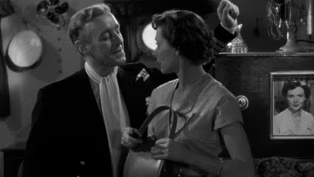
This documentary looks at the career of Alec Guinness, a great English actor. (4m 36s)
Providing Support for PBS.org
Learn Moreabout PBS online sponsorship













Support for PBS provided by:
ALL ARTS Documentary Selects is a local public television program presented by WLIW PBS