State of Affairs with Steve Adubato
Ali A. Houshmand; Staci Berger; Julie Roginsky
Season 7 Episode 28 | 27m 18sVideo has Closed Captions
Ali A. Houshmand; Staci Berger; Julie Roginsky
Rowan University President, Ali A. Houshmand, Ph.D., discusses the importance of keeping physicians in New Jersey; Staci Berger, President & CEO of Housing and Community Development Network of NJ, examines affordability in NJ and the rise in eviction rates. Julie Roginsky provides her perspective on the ongoing conflict between Israel and Hamas, as someone who grew up Jewish in the Soviet Union.
Problems playing video? | Closed Captioning Feedback
Problems playing video? | Closed Captioning Feedback
State of Affairs with Steve Adubato is a local public television program presented by NJ PBS
State of Affairs with Steve Adubato
Ali A. Houshmand; Staci Berger; Julie Roginsky
Season 7 Episode 28 | 27m 18sVideo has Closed Captions
Rowan University President, Ali A. Houshmand, Ph.D., discusses the importance of keeping physicians in New Jersey; Staci Berger, President & CEO of Housing and Community Development Network of NJ, examines affordability in NJ and the rise in eviction rates. Julie Roginsky provides her perspective on the ongoing conflict between Israel and Hamas, as someone who grew up Jewish in the Soviet Union.
Problems playing video? | Closed Captioning Feedback
How to Watch State of Affairs with Steve Adubato
State of Affairs with Steve Adubato is available to stream on pbs.org and the free PBS App, available on iPhone, Apple TV, Android TV, Android smartphones, Amazon Fire TV, Amazon Fire Tablet, Roku, Samsung Smart TV, and Vizio.
Providing Support for PBS.org
Learn Moreabout PBS online sponsorship- [Narrator] Funding for this edition of State of Affairs with Steve Adubato has been provided by Holy Name.
PSE&G, committed to providing safe, reliable energy now and in the future.
Johnson & Johnson.
The Turrell Fund, a foundation serving children.
Horizon Blue Cross Blue Shield of New Jersey.
Here when you need us most.
New Jersey Sharing Network.
New Jersey’s Clean Energy program.
Lighting the way to a clean energy future.
NJ Best, New Jersey’s five-two-nine college savings plan.
And by Wells Fargo.
Promotional support provided by ROI-NJ.
Informing and connecting businesses in New Jersey.
And by New Jersey Monthly.
The magazine of the Garden State, available at newsstands.
[INSPRATIONAL MUSIC] - Hi everyone, Steve Adubato, welcome to a very compelling program.
we welcome the president of Rowan University, one of our longtime higher education colleagues and partners, Dr. Ali Houshmand.
Good to see you, Ali.
- Good to see you Steve as well .
Thank you, sir.
- So hold on one second.
I was teasing you before you came on the air, that you just signed a long-term contract to be the president of Rowan for how long?
- Until 2029.
- And how long have you already been president?
- 12 years I think.
Well, interim president and president, 12 years.
- That's unprecedented.
That does not happen in higher ed.
Well, A, why do you think that's happening?
B, what's the biggest challenge you've faced in 2024?
- Well, it's happening because I think we have assembled a community, I would say, a faculty of a staff of the leadership and of the board especially, that really are in total tune with each other, and they're working for a common good.
And as a result, we have managed to build an institution, and grow it so fast and so extensively, that it's exciting to continue seeing on this success for everybody's sake.
And I really, every morning that I get up, I feel that I have a purpose, and everybody else also has a purpose.
And that's really what I think a good environment for work should be.
- I wanna talk about medical education in a second, but I wanna also clarify something.
When I say Rowan's a higher ed partner, they're an underwriter of our programming.
And along those lines, I wanna follow up on this.
Medical education, huge issue.
There's a shortage of physicians, shortage of nurses, healthcare community, post COVID, whatever post COVID means, lots of changes going on.
You're getting more directly involved in medical education with a hospital in Northern New Jersey.
Holy Name.
Talk about it.
- Well, we need, we are growing our school of osteopathic medicine significantly.
Currently the class size is just under 300, and it can still expand.
And this has made that school the largest medical school in central New Jersey in terms of enrollment.
And in order for us to send these students to do their their third year rotation, we need to have hospital partners throughout the state of New Jersey.
Therefore, we reach out to anybody who is willing to work with us, and provide opportunity for our students to go and get the experiences that they need in order to be a good doctor.
And hopefully stay in this state and practice.
And what is amazing about this (indistinct) medicine is that close to more than 60% of the graduates actually are staying here to do their graduate medical education, and end up actually practicing in state of New Jersey, which is, which is very rare.
And that's really is wonderful.
So that's the reason that we are, we are collaborating not only with, you know, one hospital, but any hospital in North Jersey, throughout the state of New Jersey.
Because we need that as we grow this, the side of the school.
- Lemme go back to the question of being president.
The graphic will come up, "the future of higher education."
We've talked to your colleagues in public institutions, and private institutions, universities, colleges.
The future of higher education.
Big story in the Sunday, New York Times magazine.
I know you read.
Yeah, you're smiling 'cause you saw the cover.
And it really questioned in the cover, whether higher ed is worth it, whether the investment is worth it, whether the loans later on are worth it, whether the savings that parents have to engage in is worth it.
Make the case please, as to why it's worth it.
- I think that there is a, there is a strong point.
This is a perfect storm where the pandemic, and the lack of fit in that what we produce is not necessarily what the industry is who hire them are.
That is one issue.
So there is this disconnect.
And then the cost of education is out of reach for a lot of people.
And a lot of students go and get a degree and end up getting a job that may be totally unrelated to their grad, to their degrees.
So the whole issue of these micro credentials have come about, that big industries are offering them and give a good job to you.
And it makes the parents to wonder whether really higher education is a good investment.
I do believe, Steve, that higher education is gonna go through a massive transformation.
It has to, we have no choice.
There are gonna be losers and there are gonna be winners.
At the end of the day, I hope that the country wins, because what I do believe is this, every 17, 18-year-old has to be able to leave home, and have a safe landing somewhere to grow up and to become a good decision maker.
I call that a college experience.
The mode of delivery, the credential, the living, the learning, and all of that is gonna change.
The whole notion of professors being sage on the stage is gonna change, because the knowledge is everywhere.
AI is going to blow everybody away in- - Okay, but stay on that.
Ali, sorry for interrupting.
- Sure.
- AI it's not gonna play the good or bad game because it is what it is.
Technology isn't just good or bad.
It's how people choose to use it.
The impact of higher ed, excuse me.
The impact of AI on higher ed, is it unimaginable at this point for you?
Or are you excited about it?
- Imaginable.
It's going to be massive.
Let me just put it that way.
So in a few years, AI is gonna be so powerful, that it has probably the entirety of the human knowledge at its disposal.
And that, AI is not available to every citizen around the globe.
Then the question is, who is the professor and who is a student?
Everybody has access to the same knowledge.
The key to the education then becomes, how do you bring these 17, 18 year olds and tell them, "Given that you have all this information, what can you do with it in order to make a good decision?"
That to me is the role of a future professor.
And that professor does not necessarily have to be a PhD.
Could be somebody like Steve Adubato, who wants to actually go in the classroom, and tells about his experiences in life.
But as a retired CEO, as somebody who is, who is working a bank, I think all of those individuals are gonna come and teach our people, guide our people to become good decision makers.
Maybe education becomes that.
But the notion that colleges are gonna go away, I don't think that should ever happen.
Nor should it, nor would it happen.
I think the colleges are necessary.
I think kids need to leave home.
They need to have a soft landing for three or four years, to learn how to become good decision makers, good citizens, and they go out there and be a good citizen.
That's why education is very important.
But the AI is going to change everything.
- And PS, as Ali mentions, let me also disclose a few years ago I did, in fact it was on the faculty at Rowan, excuse me.
I was honored to teach a course in communication and leadership.
Ali, last question on this.
The role of higher education, the role of Rowan as it relates to climate change, environmental responsibility, please.
- Oh, it's monumental.
You know, I'm a strong believer that there is definitely, the human, humankind has really damaged the environment, and we are doing serious damage to it.
And all we have to do is just look at the, what's happening around the globe in terms of heat and everything else.
This past summer, around Middle East was, reached 158 degrees.
I mean, think about that.
People cook at that temperature.
So, the role of environment at the universities are huge.
We need to really, first of all, practice it ourselves in everything that we build.
It starts with ourselves.
Because we have spent massive amount of money to build massive infrastructure that lasts for a hundred years.
And we better really make these things environmentally responsible and in every sense possible.
That's the first thing.
Second thing, we need to encourage everybody in here, as much as possible, go to, you know, the kind of electrical car, electric cars and create parking lots with, with charging systems available so that people are encouraged to do that kind of thing.
We need to really be responsible in the way that we teach our students where does food come from, and how do you keep the environment clean, and getting our students involved in the design, and in the planning of our campuses, so that the future that belongs to them, is developed by them.
And I really think that those are the kind of things that we need to do to teach our students, but more importantly, to practice it, to show that we genuinely are responding to, to these challenges in a, in a very, very positive way.
And if we do that, I think the students will benefit from that hugely.
And the society would.
- That's Dr. Ali Houshmand, the president of Rowan University.
Ali, look forward to our next conversation.
We always learn when we talk to you.
Thanks, my friend.
- Thank you, sir.
- You got it.
Stay with us, we'll be right back.
(grand music) - [Announcer] To watch more State of Affairs with Steve Adubato, find us online and follow us on social media.
- We're now joined by Staci Berger, President & CEO of the Housing and Community Development Network of New Jersey.
The website will be up.
Staci, good to see you again.
- Thanks so much for having me, Steve.
It's great to be with you, as always.
- You got it.
Do we have a "housing crisis," and if so, describe what it looks like, and most importantly, who's impacted?
- So we absolutely have a housing crisis around the country, and here in New Jersey, everyone is impacted, because when folks don't have enough places to live in the community in which they currently reside, or they want their children to move home and live in the same community that they grew up in, there just simply are not enough places that people can afford.
We've seen enormous rent increases, 5% increase in the rate of eviction, and we know that people are struggling to make ends meet, and so when that happens, the pressure on folks, especially people earning at the lowest wages, becomes really critical.
- So I happen to live in a great town, Montclair, New Jersey.
A lot of development going on, a lot of folks coming in from Brooklyn, and I don't mean, Brooklyn shouldn't be in quotes, it's Brooklyn, and the west side of Manhattan.
People with bucks, they're moving into homes, new places, new developments, and I keep asking myself, what happens to the folks who can't afford those places, where do they go?
And I don't just, Montclair is really a metaphor for so many other communities that are doing well financially, a lot of economic development activity, but pricing people simply out of the market.
- There are definitely areas where people who live there cannot afford to purchase a home for themselves, their children, their families.
- People born and raised, spent their whole lives here, now they can't afford to be here.
- Well, whether they came here from somewhere else or they spent their whole lives here, we need to have a strong economy that works for everyone, and that only happens when everyone has a safe, affordable place to live.
So whether it's somebody moving here or somebody coming here from another country or another part of the United States, or folks who've just lived here for a long time maybe their whole lives, we need to have a system that protects people from rent gouging, which we have seen an enormous amount of.
The more folks who are evicted or forced out of the rental market into our homelessness system, which, you know, is doing the best that it can under very difficult circumstances.
We've seen some data very recently that said it's getting a tiny bit better, but we know we can do more for our most vulnerable neighbors, and those things include making sure that we have a cap on what landlords can charge for egregious rent increases.
We're seeing things like 10, 15, 20%, that needs to stop.
We need to make sure that our lending institutions are creating the kind of mortgage products that folks can utilize in the neighborhoods in which those banks take deposits.
So I hope we're gonna talk about the Community Reinvestment Act announcement.
- Yeah, let's talk about it right away.
The Community Reinvestment Act is a federal act that says that banks must be engaged and be supportive of community development efforts, or there are problems for that bank, talk about it.
- Sure, so there was just a, the federal government just released the revised final rule for the Community Reinvestment Act, which as you said, requires lenders, banks, and financial institutions to make loans in the places where they take deposits.
It's a pretty simple and elegant solution, but we think it can be even stronger.
The new rule is of a huge step forward from the original proposal under the former administration, former federal administration.
This rule goes a lot further in making sure that we can hold banks accountable.
We just recently had a major announcement with TD Bank where they're gonna set aside $2 billion, that's billion with a B, to invest in neighborhoods and communities in New Jersey and in low and moderate income renters and homeowners.
So there are some special mortgage products that folks can access if they earn at or below 80% of the area median income, and whether it's TD or it's another lending institution, every bank that does business in the state of New Jersey has to have some kind of program like that, so folks should ask for that.
And they should get HUD certified housing counseling, which is gonna make sure that they're eligible and qualified for a mortgage that they can afford.
- Two things, let's make sure we put up the website for the Housing Community Development Network of New Jersey, website will be up.
Can people get information and help and direction from your organization?
- Absolutely, they can go on our website, and they can also go to Housing Help NJ, which is a project we support with assistance from the Department of Community Affairs and the Pandemic Relief Fund.
That has information about eviction protection as well, and you can get there from our website, so that's fine.
- Staci, talk...
I don't like the word granular, otherwise known as relevant and real in people's lives, when a family is evicted, is the greatest impact on the children of that family?
- That's correct.
I mean, sure, children, in the United States, people assume that if you need housing support, you're going to get it because we have things like food support for people.
We don't have that for housing.
Only 25% of the folks who are actually qualified for and eligible for a housing choice voucher or what folks may refer to as Section 8, actually get that assistance, and in addition, once you've gotten that housing choice voucher, it's very difficult to actually find a place to rent.
So we have people who are holding onto those places because they're so difficult to get, and then we have folks who are trying really hard to make ends meet, many of them essential workers, frontline workers during the pandemic that we all celebrated, and then when push comes to shove and they need a little extra help or a little extra time, their landlords are moving them out very quickly because the rental market is so hot because our home ownership market is so constrained.
So all of those pieces of the rental and housing market are connected, and when someone is evicted and there are children in that family and in that household, it is traumatizing.
Those children are uprooted from their neighborhood.
They're often uprooted, usually from their school system.
Sometimes that's where folks get their food sources from.
We know our school districts are doing a very difficult job feeding and caring for many of the folks in their communities, so when that entire social system is uprooted, whether it's neighbors that look after that child, or teachers who care about that family, or a school that is helping to provide food support, that family goes into crisis, and it's terrifying, and it's scary, and it lasts forever for those children.
- You mentioned the pandemic, so I wanna do this real quick.
The pandemic relief efforts, the pandemic protections, if you will, for renters, is that gone?
- Most of it is gone, much of it is gone.
The key piece of the pandemic that Governor Murphy and the late wonderful Lieutenant Governor, Sheila Oliver, may she rest in peace, one of the things that they did that really put New Jersey above and beyond- - Well excuse me, the lieutenant governor was also head of the Department of Community Affairs- - Right, she was.
- Which regulates housing related issues.
- Correct.
- Go ahead, I'm sorry, Staci.
- No problem, yeah, some of us who've worked in the housing field for a long time just assume everybody knows that the lieutenant governor, former lieutenant governor, late lieutenant governor was also the DCA commissioner, so I apologize for that to your viewers, but yes, she was in charge of the Department of Community Affairs, and they did a tremendous number of great many things to keep people stable and safely housed, and one of the things they did with the legislature was prevent evictions during the height of the pandemic crisis.
And so not having those protections for tenants, especially tenants at risk of eviction as a result of the pandemic, really have put a very deep, they have made a very deep wound in our rental market and families.
- Staci Berger, every time she comes on, she helps us understand the significance of housing related issues and more importantly, those who are disproportionately and severely affected.
Staci is the President and CEO of Housing and Community Development Network of New Jersey.
Good to see you, my friend.
We'll talk soon.
- Thank you for having me.
Thanks a lot - You got it.
Stay with us, we'll be right back.
(grand music) - [Announcer] To watch more State of Affairs with Steve Adubato, find us online and follow us on social media.
- We're joined by our good friend, Julie Roginsky, Democratic strategist and principal at BARO Strategies.
Good to see you, Julie.
- Great to see you, Steve.
We're not here to debate or discuss the Middle East 'cause I don't understand it on so many levels.
I'm just trying to learn like everyone else.
But I will say we need to discuss this.
When you see protests on college campuses, where is the line in your mind between pro-Palestinian rallies versus an anti-Semitic, anti-Israel, dangerous to Jewish students protests?
Where's that line for you?
- Well, you know, much like that old adage about pornography, you kind of know it when you see it.
But I will say this, if you are marching and you're saying, "From the river to the sea, Palestine will be free," I'm gonna say two things about that, either you don't really understand what that means and you're getting caught-- - Explain it.
- Well, what it basically means is that from the river, which is the Jordan River, to the sea, which is the Mediterranean Sea, that land is the state of Israel that is populated by Jews.
And when you're talking about liberating, what used to be known as Palestine, not just the West Bank, and not just the Gaza Strip, but that entire piece of land from the river to the sea, what you're basically talking about is the eradication of the state of Israel.
And what you're talking about is the genocide of Jews from their ancestral homeland.
And the one thing I wanna add about that is, you know, there's this whole phrase about, on college campuses, which really just drives me crazy, about how Jews are some sort of colonial occupier.
That's the other big thing on college campuses, that you see this white colonial occupier.
First of all, 50% of the Jews living in Israel are what's known as Mizrahi Jews, which means that they come from the Middle East.
So if you believe that Palestinian Arabs are not white, neither of these people, they come from places like Iraq and Iran and Egypt and other places that Jews were chased out of, and no longer exist in those countries, despite the fact that they lived in those countries for millennia.
The other thing I wanna talk about is the fact that what kind of occupier are you talking about?
If you know your Bible, you understand that Jews have been in what is now Israel for thousands and thousands of years.
Jesus Christ was a Jew, he lived there.
Even before Jesus Christ obviously, there was a huge Jewish presence there.
So if you think a bunch of Holocaust survivors coming back, bedraggled and on the verge of death, coming back after the war to their ancestral homeland and building something out of the desert that not only bloomed, but prospered and became an incredibly powerful, you know, they call it the startup nation, that's not being a colonial occupier, that's people coming home and-- - Why is this personal for you, Julie?
- It's personal for me... Look, I was born in the Soviet Union.
I'm a Soviet Jew, right?
So I've seen this movie before, and I grew up living in the Soviet Union in the '70s as a Jew.
And I cannot describe to you the horrible discrimination, the horrible, just really state-sanctioned discrimination and aggression towards the Jewish minority in the Soviet Union back then.
I used to see, because it wasn't so long after World War II, people with numbers on their arms, many more than you see here in the States.
I mean, it's Holocaust survivors who somehow made it back alive.
And to me, it's personal because I see how it ends, and it ends as it always does for the Jews, whether this goes back to 80 years with the Holocaust or 800 years, or thousands of years, where you feel very alone, right?
Because you're considered not a minority by people who are screaming about how you're a white colonial occupier.
But yet everybody else considers you as the Charlottesville, you know, as the Charlottesville marchers did about how, you know, "Jews will not replace us."
You're always the other.
And what upset me is the constant contextualization, I guess.
No sooner were these people murdered on October 7th, than on October 8th, people started talking about how the Jews deserved it and how this was some sort of war of retaliation.
Nobody deserves that, nobody deserves that, and that's-- (indistinct) - But Julie, stay on this.
We're taping this on...
This is where it gets tricky because this program will be seen later.
- Right.
- Again, the war is raging between Hamas and Israel.
But to those who argue, as we do this program on the 14th of November, enough, meaning for Palestinian women, children, babies in hospitals, and the suffering going on there, the message has been sent by Israel.
How the heck do you eradicate Hamas, a terrorist organization, without thousands and thousands of innocent Palestinians being killed just by living where they live, Who can't, quote, get out so easily?
There's no question.
But that question really should be posed to Hamas.
Why are they building bunkers underneath hospitals and daycare centers?
- But why can't we pose it both to Netanyahu and Israel and to Hamas?
- You're not gonna get an argument from me about Netanyahu.
He should have been gone, not yesterday.
He should have been gone years ago.
So you're not gonna get an argument from me that part of the reason that there's so much anger at the Israelis right now, is because you have a racist government in place, a really, Jewish supremacist government in place that has been doing everything they can to oppress the Arabs in the West Bank and even those living in Israel, and-- - But what message would you send to those Palestinian Americans and others who say, "Hey, you know what, we're... " Again, October 7th spoke volumes in terms of this horrific massacre of innocent Israelis.
But now you've got this going on in this ongoing situation where thousands and thousands of innocent Palestinians are being killed.
What would you say to those folks right now?
- Well, what I would say is, look, there was a ceasefire in place.
Hamas broke it, right?
So it's not like if we put a ceasefire in place, there's any guarantee that if Hamas remains in the Gaza Strip, it won't be broken again.
- Right.
- I'll also say that Hamas is basically ISIS, right?
You can't be a free person living in the Gaza Strip.
You can't be gay, you can't be a woman walking around the way I'm walking around.
You can't have plurality of religion.
It's basically ISIS.
So I say that because, let's work together to eradicate Hamas slash ISIS.
Get rid of Hamas, and then let's work together to lean on the Israelis to really have a two-state solution that links the West Bank, Gaza, and parts of Jerusalem.
All of us should have a vested interest in this.
None of us wants to see this kind of carnage happening on either side, but it's going to continue to happen until you stop empowering the worst elements of this.
This is... Hamas is funded by Iran.
It is funded by the Russians.
It is funded against the most autocratic regimes in the world for one reason and one reason only.
They want dissent and they wanna sow discord.
These are not people in the community of nations who wanna build something better.
- Before I let you go, Julie, is there any part of you that's optimistic about how this ends?
- I'm optimistic only in one sense.
This was so jarring and so awful, that the only solution to this, from my perspective, and I think from the perspective of probably even many Israelis, is that there's only a two-state solution that's possible after this.
And that was very much stalled.
And as you saw, the Israelis were annexing and annexing and annexing, and they were building more and more settlements in the West Bank.
And the Netanyahu regime was obviously secretly cooperating with Hamas to keep them in place.
So there are no angels on either side here.
I fully acknowledge this.
I'm hopeful that this will finally have the accountability for this right-wing Israeli government that they require, and that somebody more rational comes into place on both sides.
And that includes the Palestinian Authority who's given up the opportunity to have a two-state solution every time it's been presented to them.
I'm hoping that cooler heads will prevail.
And I'm hoping that this is kind of the slap in the face for both sides that both need to finally come to the table and say, "Enough is enough.
We've had 80 years of this, we've gotta stop.
We've gotta work on something better."
- Thank you, Julie.
- Thank you.
- We'll keep talking.
I'm Steve Adubato.
More importantly, Julie Roginsky, see you next time.
- [Narrator] State of Affairs with Steve Adubato Is a production of the Caucus Educational Corporation.
Funding has been provided by Holy Name.
PSE&G, Johnson & Johnson.
The Turrell Fund, a foundation serving children.
Horizon Blue Cross Blue Shield of New Jersey.
New Jersey Sharing Network.
New Jersey’s Clean Energy program.
NJ Best, New Jersey’s five-two-nine college savings plan.
And by Wells Fargo.
Promotional support provided by ROI-NJ.
And by New Jersey Monthly.
- [Announcer] What is your child's dream for the future?
Doctor?
Teacher?
Architect?
Whatever they aspire to be, a college education may realize those dreams and NJ Best can help.
It's the college savings plan specifically designed for New Jersey families.
Start saving today with as little as $25, because now is the time to invest in their future.
To learn about NJ Best 529 college savings plan, its investment objectives, risks and cost, Read the investor handbook available at njbest.com.
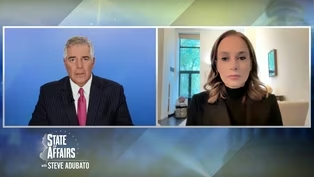
Democratic Strategist Examines Conflict with Israel & Hamas
Video has Closed Captions
Clip: S7 Ep28 | 9m 17s | Democratic Strategist Examines Conflict with Israel & Hamas (9m 17s)
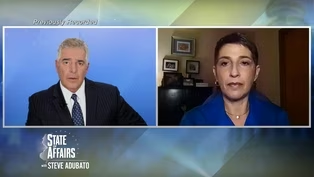
Examining Affordability in NJ and Rising Eviction Rates
Video has Closed Captions
Clip: S7 Ep28 | 9m 6s | Examining Affordability in NJ and Rising Eviction Rates (9m 6s)
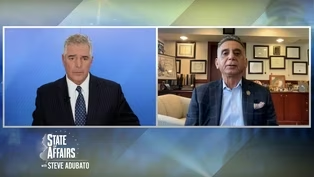
Rowan University President On Keeping Physicians in NJ
Video has Closed Captions
Clip: S7 Ep28 | 9m 41s | Rowan University President On Keeping Physicians in NJ (9m 41s)
Providing Support for PBS.org
Learn Moreabout PBS online sponsorship
- News and Public Affairs

Top journalists deliver compelling original analysis of the hour's headlines.

- News and Public Affairs

FRONTLINE is investigative journalism that questions, explains and changes our world.












Support for PBS provided by:
State of Affairs with Steve Adubato is a local public television program presented by NJ PBS