Connecting the Community
All About Olympians
Season 1 Episode 4 | 58m 46sVideo has Closed Captions
Notable Northwest Florida Olympians Justin Gatlin and Roy Jones, Jr. are featured
Host Rameca Vincent Leary throws a one-two punch with special guests Roy Jones Jr. and Justin Gatlin, notable Olympians from Northwest Florida. Steve Nissim co-hosts this special edition focused on boxing, track and field, each athlete’s path to becoming an Olympic champion, and where they are in their careers and on life’s journey today.
Problems playing video? | Closed Captioning Feedback
Problems playing video? | Closed Captioning Feedback
Connecting the Community is a local public television program presented by WSRE PBS
Connecting the Community
All About Olympians
Season 1 Episode 4 | 58m 46sVideo has Closed Captions
Host Rameca Vincent Leary throws a one-two punch with special guests Roy Jones Jr. and Justin Gatlin, notable Olympians from Northwest Florida. Steve Nissim co-hosts this special edition focused on boxing, track and field, each athlete’s path to becoming an Olympic champion, and where they are in their careers and on life’s journey today.
Problems playing video? | Closed Captioning Feedback
How to Watch Connecting the Community
Connecting the Community is available to stream on pbs.org and the free PBS App, available on iPhone, Apple TV, Android TV, Android smartphones, Amazon Fire TV, Amazon Fire Tablet, Roku, Samsung Smart TV, and Vizio.
Providing Support for PBS.org
Learn Moreabout PBS online sponsorship(emotional music) (upbeat music) - Hello everyone.
I'm Rameca Vincent Leary, and welcome to this addition of Connecting the Community.
What do you get when you have two outstanding Olympians, Justin Gatlin and Roy Jones Jr, on the same show?
Let me help you with that.
A blockbuster event like no other.
If you love track, and field, and boxing, you're definitely in for a treat.
But first, I'm definitely honored to welcome my good friend, Steve Nissim, who is serving as a co-host this evening.
He's the chief storyteller for Studio Community Institute, and you may know him for his 28 years as an award winning sportscaster.
Many of those years were spent at WEAR-TV, right?
- Yeah, I had to had the chance to cover Justin and Roy for many years, so pleasure to be here tonight.
- So glad to have you.
All right, so we're going to introduce our guest, Olympic gold medalist, Justin Gatlin, and he's joined by his parents, Willie and Jeanette Gatlin.
So glad to have all of you here this evening.
And I know that we have a lot of things being displayed right now.
We'll get to those in just a moment.
But Justin, let me start with you.
We're going to take the audience back to your early childhood years.
Was there a certain spark, a tenacity, a drive to achieve that made you the great Olympic personality that you are today?
- I think I wasn't really aware at a young age, but I was doing things that would kind of indicate that I was going to be an athlete.
I was jumping over fire hydrants.
I was racing kids on bike, while I was on foot and they were on bike, so I was always trying to push the boundary of my athleticism.
- [Rameca] Well, Jeanette, I know you have a story or two being that very devoted mother.
I know you can share an instance or two with us as well.
- Well, Justin was obviously too young to really recall, but Justin used to line his trucks up in the hallway of our home, and it had a long hallway, and he would run and jump over these trucks.
And he had to be maybe three.
- [Rameca] Three years old?
- Three years old, running, but see, he was hurdling, but we didn't know what that was.
- [Rameca] But he knew what he was doing, right, Willie?
- [Willie] Right, for sure.
Yes.
- So being the doting dad that you are, I know that you have a military background, did that maybe sort of transition over to your son?
- It did, and I made sure that he needed to be where he needed to be to be exposed to the fledging career he was about to embark upon, you know?
So we made sure he got down to the junior Olympics.
We made sure he got invites to North Carolina, wherever he had to invite.
you know?
- So Steve, we know high school, right?
- Yeah, you started your high school career at Washington, transferred over to Woodham when you were a sophomore to be with Coach Jay Cormier, legendary coach, now late Cormier.
What was the relationship like with him?
How important was he in your development?
- Coach Cormier was so vital to my development.
That was one of the reasons why I went to Woodham.
I was always in the district of Woodham, but my friends went to Washington, and I was at a track meeting.
I remember Jay Cormier said, man, you should be with us.
We can get you so further in life right now, and we see a world class athlete in you.
And I took a summer to think about it, and then next thing I know, when we came back the next year, I was like, I'm gonna take you up on that coach.
And the rest was history.
- Really?
At first it was more in the hurdles that you were doing your thing, and then you kind of started doing some sprinting as well.
Were you thinking more it was hurdles was gonna be your path?
- I only hurdled because all the other sprinters could not hurdle.
So it was all a points thing.
So I was talented in hurdles, so we needed extra points, but I was actually the fastest sprinter out of everybody.
- Your senior year in high school, that was a hallmark year for you.
Why don't you tell us what happened on the track?
- My senior year, I feel like I just found myself, you know?
We went out, we had a great season.
I felt amazing.
We went on to win the state championship by half a point.
- Wow, only half a point?
- Only half a point, only half a point.
And we came back with, we won with only six people.
We didn't have no relay.
We didn't have a four by one.
We had a four by two, we had a thrower, we had a high jumper, and we had two or three sprinters.
- [Steve] Of course you got more than half of those team points.
You won two hurdles events and the 100, just a dominating performance.
Was that the point maybe that you realized just how special a thing you might have?
- Yeah.
You know, not only special because of what I possessed on the track, but the team camaraderie and the leadership that awoken in me when we went to that state championship.
We all stepped up that day to be the best athlete we can be, and that half a point meant everything to us.
- All right, so the colleges obviously were after you.
LSU was the top school at that time in track, they were after you.
So the story goes that, you know, they wanted you badly, but you wanted a meal plan.
They wouldn't give you the meal plan.
So you end up going to Tennessee instead.
How did that go down?
- Steve, you have done your research.
(hosts laughing quickly) - You gotta eat!
- I almost forgot about that part.
Yeah, it was, I had a lot of different colleges that were recruiting me.
I verbally committed to LSU.
I had a great visit.
It was almost the opposite when I went to Tennessee.
But once I left Tennessee, I remember Vince Anderson, who was a coach at that point in time, he looked at me in my eyes and he said, you know, I can't promise you a championship, individually or a team, but I can make you the best athlete possible.
Now, if you think you being by the best athlete you can be, if that's championship caliber, that's what we're gonna bring out of you.
- [Steve] Of course they did, and you did your sophomore year.
You won the 100 and 200 national championship.
Tennessee won the national championship, and you won it at LSU.
How sweet was that?
- It was really sweet.
You know, being able to win an indoor and outdoor championship with that team.
We weren't even on the radar when I got there to be a championship caliber team.
We came together, we believed in each other, and we got the job done.
- Well, Jeanette, I have to ask you, you and your husband have been with your son all the way.
Were you in any way worried when the choice had to be made, of course he made the right decision, but then after a few years he left Tennessee, what were your thoughts?
- My thoughts were he had achieved all he could at Tennessee.
There was absolutely nothing left for him to achieve.
It would have been a repeat.
So once he decided that he was going to go pro, and the offer came into him, I told him, your choice, your decision, but what are you gonna stay here for?
So you may as well go and show the world your talent.
- That's right.
So Willie, 110% support.
Going to the track meets, driving people around.
You never skipped a beat.
- Never skipped a beat.
Coach Cormier told me, he urged me to take him to Kissimmee, Florida, to the Junior Olympics, and said that would show his test if he really want to go on this career as a track and field athlete.
We took him there, and he ran against a lot of college students and stuff.
And his mom got upset and got mad because he filled out the paperwork putting himself in those events against that, trying testing himself to see if he really had what it take.
And she got upset, but she soon got over it after he went to Tennessee, and he started with the track really being honest.
- So then you turn pro, and of course pro's a different animal.
So what was the transition like for you?
Did you change your tactics, change your training regimen when you went to the pro world?
- It was a little bit of change.
Obviously, even physically, I went from University of Tennessee, Knoxville to Raleigh, North Carolina, when I turned pro.
The change was I realized that as a college athlete, everything's handed to you.
You get everything, you know, you make sure your meal is there.
You make sure your recovery's there.
But as a pro, all that is on you.
So make sure that you get the right training that you need.
After you finish training, you gotta make sure you find where you can get the best recovery, the best meals, and then repeat the process every day after that.
- [Rameca] And then we say he does it.
2004.
If I could have a drum roll right now, I certainly would like it, because the Olympics in Athens.
What was your first thought before you found out, okay, I'm going to the Olympics, and then you arrive and then magic happens?
- They always say that is darkest.
What, darkest before the storm?
- [Jeanette] The dawn.
- [Justin] The dawn, yes.
(laughs quickly) - [Steve] Mom knows.
- Mom knows.
In 2003, I got injured.
I turned pro in 2003, I got injured.
I wasn't able to make the world team, but they still took me.
And I think going with the team, it showed me how large a stadium is in a championship, you know, caliber.
So knowing that and seeing that, it gave me an understanding of, in 2004, I wasn't starstruck by how many people were going to watch me.
So when I got on that track in 2004, it felt like home.
I was ready to go.
- Three medals from the 2004 games.
Mommy, I know that you're proud.
We have plenty of pictures of you hugging your son back from 2004.
What was your first thought?
- He did it.
- [Rameca] Oh yeah, he did.
- He did it.
I just, I was not expecting him to do it.
Not that I didn't think he didn't have the talent, but I just felt he was young.
This is his first big major event, and there'll be others.
So I really would've not expected him to do it, and felt like if he didn't, it was okay.
It was okay, you know?
But I have to say that no other American has done it since him.
- [Rameca] All right, all right-- - There is no other American with a gold medal from the Olympics since Justin did it in 2004.
- Well, Willie, I've gotta say.
I mean, big celebration in Pensacola, right, Steve?
- Oh, I remember watching it at Channel Three at the station there, and we were going crazy about it, because, you know, you weren't expected to win necessarily, but, you know, you could see already then you were a money racer.
When it was the big moment, you showed up the biggest.
That continued again the next year.
2005, you won world championship.
So you're on a huge high, best sprinter in the world.
Then you have some adversity, 2006.
There was a failed drug test.
A lot of gray area there, I know, but the end result was a four year ban.
So how devastating was that to you at the time, and how did you try to deal with it?
- You know, it was so devastating for me.
You know, I always believed in myself as being the good guy, being the guy of inspiration, to be able to pass on to not only my peers, but the athletes that are coming behind me.
So for me, sitting out for four years, almost half a decade, it was a gift and a curse because it helped teach me how to be a man.
You know, at that point in time I was very critical with that adversity.
But I think it really made me feel like I was in a dark place, and the only thing that really made me come out of that was coming back home to Pensacola, and really finding, refinding my roots again.
- And to me, what was amazing was when you came back, you came back stronger than ever.
You know, you started ramping back up.
2012, you got the bronze in the Olympics.
2016, you got the silver in the Olympics.
So when you're going through that, and you know, you come off of that and you come back stronger than ever, how much redemption, how good did that feel to show the world that?
- I really believed in the beginning I didn't have a chip on my shoulder, but I look back now, I had a huge chip on my shoulder, but only because I believed in who I am and who I was at that point in time.
And I wanted to change the narrative.
So me coming back, I was on a mission to be able to show the world, show my hometown that I was here and I was here to stay.
- And I would have to say mission accomplished to all of us here.
Fast forward to 2017, the IAFF World Championships in London, and Usain Bolt, take us there.
- Actually, even before we even got there from 16, I rolled my ankle, had a hairline fracture.
So I really didn't get it checked out because I didn't want to waste my time of being recovering for the Olympics.
So I had residual injuries that led all the way up to my hip flexer.
So in 17, I wasn't able to have that firecracker start that I usually have.
So I had to change my whole strategy, and I think it threw off my competitors.
It threw off Usain, and I was able to snatch the victory in that last race.
- 9.92 Seconds.
And of course you and Usain are friends.
How long have you known him?
- I've known him since 2005.
We battled throughout the years.
It's been a long time.
- Of course, that was supposed to be the Swan song.
That was Usain's last race.
He was still the best in the world at that time.
It was supposed to be his coronation.
So I mean, how special, I know you like him, but how special was that to throw that wrench in there and win that one?
- It felt really, really good.
Really good.
Only for the fact because we've been racing for so long, and it was his last race.
It was his last 100 meters.
And we weren't the usual traditional shoulder to shoulder, standing next to each other.
We were so far apart in that race, but the race was still so exciting, so electrifying, and to come across that line, we still showed each other so much camaraderie and so much love.
- And the other thing I wanna throw in about that is you did that at age 35.
I mean, really in sprinting, 30 you're over the hill.
No one has ever done those kind of achievements at that age.
How were you able to be at that high level at what is ancient for a sprinter?
- I embraced it.
I was a dinosaur in our sport, but I looked at myself as more of a T-Rex.
(hosts laughing quickly) - Okay.
(giggles quickly) Look at this shoe right here.
This is one of the shoes that you wore when you beat Usain.
Willie, I know that you love this shoe.
It's a treasured item.
You've gotta be elated?
- Very much so, very much so.
Yes indeed.
I told him when he took him off on the track, I'll keep one and you can keep the other one.
I got to have one, you know?
- All right folks.
Stay right there, because Steve and I are just getting the conversation started with Justin Gatlin and his parents.
Stay with us.
(upbeat music) Hello, everyone.
During this segment, we're continuing our discussion with Olympic gold medalist, Justin Gatlin, and his parents, Willie and Jeanette Gatlin.
What a remarkable family.
Now, Steve, I know you'd like to pick it up where we left off, starting with the 2021 Tokyo Olympics.
- Right, we'll pick up where we left it off.
At 2017, you winning the world championship at age 35, but you weren't done.
I know you were targeting the 2020 Olympics, when you would've been 38, but of course the pandemic happened.
Olympics got delayed by a year, another year on the tires.
2021, you didn't quite make it.
You know, you didn't quite qualify for the Olympics.
Do you feel like that one year kind of maybe robbed you of one last Olympics and maybe medaling again?
- Yeah, yeah.
(laughs quickly) During the pandemic, we couldn't even go to a track, or we couldn't even go to an open field.
We were literally like working out and training next to retention ponds, anywhere we can get like at least a bit of flat grass to run on.
So it was a struggle through the pandemic.
I think it wore me down to know that going into 2021, and then all these different regulations, wearing masks, and taking so many multiple tests in a certain timeframe just to travel.
It didn't feel like the sport that I started with.
- Well, I tell you what, you are definitely a fighter.
Let's fast forward to February 10th of this year.
Retirement on your mind.
But folks, we have something special we want to show you right now.
- [Commentator] Now here is Justin Gatlin.
- The ultimate goal is to be one of the best sprinters in history, and I feel that I can accomplish that.
- [Commentator] Massive night for Justin Gatlin.
- [Narrator] It's gonna be Justin Gatlin!
- [Commentator] A gold medal!
- [Rapper] So many sacrifices.
- [Narrator] At the line, Gatlin with a strong finish.
- [Commentator] The seemingly incomparable Justin Gatlin, fastest man in the world this year.
♪ My girl show me less ♪ ♪ You know, I make sacrifice ♪ - [Narrator] Gatlin is extended.
Gatlin down the back straight.
♪ To get ahead, man ♪ ♪ You gotta make sacrifices ♪ ♪ That's how hungry my appetite is ♪ - I want to go out with a bang.
I wanna say, you know what?
I gave all I could give.
I'm done.
- [Narrator] At the line, Gatlin with a strong finish.
- [Young Woman] It's the American leading the Jamaican at the moment.
Justin Gatlin is the world champion.
- [Commentator] Another incredible support.
- Steve and I definitely congratulate you, Justin.
So what was going through your mind during that retirement ceremony that was held in a large place?
Tell us about that.
- It was held at the Gainbridge Fieldhouse in Indianapolis, Indiana.
It was the Pacers Arena, and it was during one of the half, it was actually at the halftime of one of their games, so.
- Awesome.
Now Nike, your sponsor, gave you something special.
We've got great pictures, and mommy always takes care of her son, doesn't she?
You were there.
I know both of you guys were there-- - We were there.
- Willie, jokingly I found out that you guys were so enthralled that you really didn't take many pictures, is that right?
- That's right.
We didn't get a chance to take a lot of pictures, 'cause we was just caught up in the moment, you know, and just enjoying all the people that came in from across the United States to help congratulate on his retirement.
And we just caught up in the moment.
- We can definitely imagine that, right Steve?
- Yeah, you know, now that you're retired it's time to reflect a little bit.
You are the most decorated 100 meter sprinter of all time, eight medals between the world championships and the Olympics.
You know, when you look back at that, you know, how do you process the amazing accomplishments that you achieved?
- I'm just, it's just hitting me right now to be honest.
Looking back, walking into my trophy room, looking at all my accolades, when I was running and competing, I never gave myself an opportunity to really bask in the glory that I was help creating.
So now I'm looking at all of these things and saying, wow.
It really paid off, my hard work.
- There are several things on the horizon right now.
You would like to start working on a book, a new documentary.
Can you give us a little taste, a little preview.
- We got a lot of, lot of projects in the work right now.
So obviously up and running with my Justin Gatlin Foundation that we're working on with the youth athletes.
What that is going to cater to right now is making sure that there's athletes, not just in Florida or Pensacola, but around the world, in the nation, that they have the necessary equipment to be able to make them the best athletes they can be, and helping a lot of these young athletes obtain scholarships, and get to the next level, and hopefully turn pro as well.
We are working on short doc.
So I'm working on a short doc right now about my viewpoint of my career, which has really never been told.
And I'm working with a program called Protect The Crown, which is backed by the AAU.
We just announced that today.
And we are going to take four to five of the nation's fastest 11 to 10 year olds from around the nation, and we're gonna take 'em internationally all over the world to be able to race against other kids.
- All right, Jeanette.
Grandchildren, because a lot's happened.
Justin recently married, and talk about the grandkids.
- My boys.
- Your boys.
- My boys.
My boys, on my heart, they have completely different personalities.
I don't think that even if they were closer in age, they would be anything alike.
But we have one very much like Justin, laid back, pretty much easygoing, not gonna make too many waves, and we have one, oh boy.
- [Rameca] What are their names?
- We have Jace Alexander Gatlin, and we have Jax Alexander Gatlin.
- And Jace is the older of the two, right?
- Jace is the older of the two.
Jace had, he told me, he calls me yaya.
He had the two best days of his life.
One of them was the day he got four touchdowns in one football game.
- [Rameca] Good for him.
- And the other one was the day he got his COVID shots.
(hosts laughing quickly) - Well, Willie, you are a grandpa.
These boys probably keep you running.
- They do, they do, but I enjoy every moment of it.
It gives me a little birds eye view of some of the things that I didn't recognize with raising Justin.
I mean, I just took them for granted, but now I see them that I have that chance with my two boys, grand boys now, to make the difference.
- Of course, Justin, you're part of an incredible legacy of Pensacola sports athletes.
You know, in this area, we always talk about how amazing the athletes that have come outta here.
Some of those came before you, one of 'em is on the show tonight, Roy Jones Jr coming up a little later.
Of course, Emmitt Smith, Derrick Brooks, Michelle Snow.
How much did did that crew, and their success, and the way they handled it, how they carried themselves, how much did that inspire you?
- So important.
They were the fuel to my fire.
I loved growing up in Pensacola and seeing Emmitt Smith, Derrick Brooks, Roy Jones, Michelle Snow.
All these athletes become somebody in the world, and then still be able to give back to the community that we lived in.
It was so much inspiration for me.
And I said, you know what?
I'm gonna follow in their footsteps.
I'm gonna do this not only for myself, but for the city.
- And we've seen that carried on by so many other athletes, you know, over the years.
Is that something that's important to you, to have that relationship with all the other athletes to try to help foster the ones that that came after you?
- Absolutely.
Now there's so many coming out, it's hard to even keep up with them.
- [Steve] Oh yeah.
- But when they do get recognition and I see them on TV or social media, I immediately reach out to them and give them praise about all the hard work they achieve, and the accolades they have now, and always remember that we're from Pensacola.
- Well, I must say, Jeanette, in 2020, Justin couldn't make it because he was training for the Olympics.
The Gatlin family sponsored the Aims Wiggins Scholarship Banquet held right here at Pensacola State College for minority students.
And it was an awesome time with our president, Dr. Ed Meadows.
You do so much and you're humble.
You don't always talk about it, but you're always moving.
How does that make you feel personally?
- I just think that I'm doing what was done for me.
You know, so many people who had big hearts, they saw something in me, and they lifted me up to where I needed to be, and I handled business.
So I wanna do the same thing for the next ones to come.
- Well said.
You've got some awesome memorabilia out here.
We already talked about the shoe that beat Usain.
You got some other stuff by you over there.
Tell us what you got-- - Talk about it.
- So I have my 2004 Olympic shoe right here.
This is the one that I won the race in, the 100 meter race in.
I have my Olympic 2004 bronze medal, I got my Olympic 2004 silver medal, and I got my Olympic 2004 gold medal.
So I have a complete set all from one Olympics.
And I have my 2019 Doha World Championship medal.
This is very special to me because this is my first and only gold medal in a relay in my whole career.
From high school all the way through my professional career, this was the first time I was able to be on a winning relay team.
- Good for you.
And I see some other items.
Tell us about the crown.
Would you like to put it on?
Probably not, but tell us about it.
- I haven't put this crown on in so long.
Hold on, lemme see what it looks like on me.
(Rameca giggling quickly) Still look kingly, okay.
(Rameca giggling loudly) No, this actually, this crown comes from, they had a challenge, a race challenge in Moscow in 2003.
And it was the biggest jackpot in track and field history.
It was called the million dollar race, and we literally raced for a million dollars.
And then I have this Diamond League trophy right here, which is a standard for excellence in our sport.
If you win a certain amount of races, and you gain a certain amount of points at the end of the year, you are awarded with this trophy.
I'm the only one that, as a male sprinter, to have three consecutive trophies in a row.
- Wow.
- Everyone likes to have their face on a box of Wheaties.
You look good.
- I appreciate it.
I didn't know how big Wheaties was when I was on the box.
We did the promo and Boca Raton.
It was Rolls Royce's and yachts all the place.
I was like, oh, this Wheatie thing's a big deal, okay.
So I've been honored to be on the Wheaties Every time I step into a Publix or grocery store, and I look over to the cereal items like, I was right there, that's where I was.
- And speaking of beautiful memorabilia and beautiful items, you have a watch.
You've come out with a watch now that I know mom is wearing tonight-- - Why don't you put your wrist up?
- [Jeanette] I'm wearing my watch.
- So mom has a watch on, dad has a watch on, and there's a red watch as well.
So each watch is Swiss made with a company out of Denmark, and the watches represent the stages of my career.
So orange is Tennessee, blue is the first part of my career in 2004, and red is the second part of my career going from 15, from 12 all the way through 17.
- [Steve] Incredible.
- We are family.
Steve and I are so grateful to have had you on the show.
We love you so much, we support you 110%.
Thank you so very much.
Now folks, as we head to break, we want to remind you to log on to learn more about Justin Gatlin.
His website is justingatlinfoundation.com.
We'll be back right after this.
(upbeat music) He's a mover, a motivator, and boxing legend.
It's a pleasure to welcome now, folks, get ready for this, Olympian, trainer, rapper, actor, and commentator Roy Jones Jr.
He's joined by his manager, McGee Wright.
Now Roy, I must say you're such a multifaceted person.
Why don't you take us back to your early days training at the Pensacola Boys Club.
- Training at the boys club was some of the better times of my life, because you meet people that you never know what the outcomes of their lives is gonna be, or what their lives are gonna be, but they're really good people.
You share some of the same likes.
You meet friends that some of 'em last a lifetime.
And there are some of the guys I met at that time that I still talk with right now, and it's been a beautiful thing.
So when you get an opportunity to grow with your community like that, it's one of the most beautiful things ever.
- In speaking about people you've met for quite some time, McGee Wright is one of them, because actually, Roy, your dad helped train him.
So McGee, why don't you talk a little bit about that?
- Actually, there was a Pensacola Boys Club when I first met Roy Sr, and then of course Roy was, I think Roy, I was 13 or 14, and Roy's probably eight or nine or something.
But it was on Guns Island Street in Pensacola Boys Club.
So, you know, it's been like 45, 46 years now.
- Hey, but time flies quickly.
Now Roy, Stanley Levin, there's a story, there's a backstory.
So the boxing program was in jeopardy of shutting down, and Stanley Levin, Fred Levin's brother jumps in.
Do you remember the story?
- I don't remember the exact story, but I know he did come in.
Him and my father spoke about it, and somehow they got involved, and it wasn't that it was shutting down.
It actually happened right around when it was time for me to turn professional.
- [Rameca] Oh, all right.
- That's the way I remembered it, so.
- [Rameca] Well, we know that there's been a lot of help in the community.
Many people that believe in boxing, and you, and what you've done over the years, what you stand for, right Steve?
- Yeah, absolutely.
And you already talked about your dad, you know.
Roy Sr, big Roy.
He was your trainer in the early years.
I know he was a tough trainer.
So what, how much did that help make you who you were, and what were the challenges of having your dad train you?
- It helped a lot.
It helped me develop as a person.
It made me the, it gave me the inspiration that I needed, and the desire to succeed that I needed.
My father was one of the people who I felt like was most instrumental because he taught me a great foundation.
Without a foundation, you can't build anything solid.
So most things that are built solidly have to have a strong foundation, and that's what he gave me.
So with him giving me that strong foundation, I was able to take that and take the other things that God added to me, and become something far more special than even I expected to be.
- Did you realize that at the time, or at the time was it kind of tough?
How tough he was on you?
- It was very tough at the time.
I understood what was happening because I had learned and I developed a very close relationship with God at an early age.
So there were times when I had to make a choice.
Do I believe in God or do I end it?
And I stuck with my belief in God, because God would always put it on my heart that if you keep persevering, you gonna make it.
You just gotta keep persevering.
So I kept persevering, and that's why my faith is so strong.
- Of course, we talked about the Levin's already a little bit.
Fred Levin was your manager for a good part of your career.
You know, obviously a legendary guy in this area.
What was your relationship like with him, and how influential was he with you?
- My relationship with Fred was very different.
Me and Stanley were more like friends, because Stanley would talk to me on a friendly level as well as a business level.
He would always, you know, tell me ins and outs and, you know, keep my head focused on the right things.
Fred, on the other hand was a guy who was so fun, and he was like, he was the older brother, but he was like the younger brother.
If I wanna go get in some trouble, let's go.
(hosts laughing quickly) And when I say trouble, it wasn't bad trouble, but they could have told Fred Levin, hey, we'll get Roy 2 million dollars to fight Godzilla.
Yes, he gonna beat him, bring him on!
He didn't care, he believed Roy Jones could beat anybody.
And for me, that was so, it was crazy 'cause he's many years older than I, but he had so much faith in me.
You understand me?
He didn't care who they brought to the table, and he come ask me, do you wanna fight him?
Yes.
You couldn't tell him I ain't gonna beat him, because he knew if I said it, I meant it.
And he believed in my word more than I believed in it, I believed sometimes, you know?
It was the funnest thing to me 'cause Stanley the older brother, I mean the younger brother, was the more serious business brother.
But Fred, the older brother, was more the fun guy be around as far as doing crazy things.
You know what I'm saying?
So a crazy fight came, he wanted me to do it.
Let's go, you know?
- So McGee, you have known Roy for such a long time, but in the early years watching him and his successes, how did that inspire you over the years?
- Well, I mean, I think just to see him getting better and better every day.
You know, you see him one day, he's a kid.
And you know, I remember we were talking with some other trainers, and we were in another city.
I don't remember where.
But there was an old trainer, Billy Cuts, and I remember somebody asking, and Billy said, well, what about Roy Jones Jr. How's he doing?
And Billy said, he's just getting better every day.
And it makes you work.
And then to see him in there, you know, in the gym every day.
You know, the first one there and the last one to leave.
It was just an environment where everybody looked up to probably the youngest fighter there, but he was also at that point still the best fighter.
- All right.
Now let's talk about the one who floats like a butterfly, stings like a bee, Muhammad Ali, and your book collaboration with him called 'Healing'.
Love that book.
So talk a little bit about that, and your relationship with Muhammad Ali.
- Well, it was one of the biggest things that ever happened to me in my life.
I started boxing because of Muhammad Ali.
So to be able to not only meet him, but to bring him and share him with my community was a big thing to me because I felt like I was doing a twofold project.
No other way I thought we would ever get to see Muhammad Ali in Pensacola.
But since I got to accomplish and be all the things that God made me to be, I was capable of bringing him here.
So I was like, wow, to meet him would be one thing, but to allow my people to be able to meet him as well would be even bigger.
So the one thing that always got me very far in life was looking out for other people before I look out for myself.
- And McGee, 1997, the year that Muhammad Ali came, that was huge.
I mean, Fred Levin bused in about 7,600 kids from Escambia county.
I'm sure that you were just enamored by all of that.
- Yeah, it is just amazing.
And Roy and I were just talking about earlier.
Just Pensacola in itself, you know, how many athletes come from just this area, you know?
And for Roy to do it in boxing, and a lot of people don't know there's, you know, in that gym, you know, in that time that Roy was coming up, there was a handful of world champions that come outta that same gym that his daddy started.
And to have Muhammad Ali come, you know, it just motivated, and, you know, you think you could do anything, you know?
- And going back to your younger career, great amateur career.
You won the Junior Olympics.
You won the Golden Gloves as well.
When you were going through those years, the formative years, what was that like as you were kind of honing your craft there?
- They were calling me Little Sugar, and if they call you Little Sugar, you gotta be pretty good.
(Steve laughing quickly) They were referring to Sugar Ray Leonard.
So to call me Little Sugar, it put a mark on my head, but it was not a mark that I couldn't wear.
So the fact that they thought that much of me made me change the way that I thought of myself, because for a whole community of people, all kinds, hundreds of young amateur boxers, and they call one Little Sugar.
Me.
It's a crazy thing.
So if that's not God trying to tell you something, then you're not alive, you're not listening.
- That's right.
And we know that in life we all have obstacles, and we persevere, just as you have been saying.
1988 was somewhat of a bittersweet year, wasn't it?
The Olympics in Seoul, South Korea.
You received a silver medal, but everybody pretty much knows you should have won the gold.
Why don't you talk about that?
- That was a bittersweet year, but it was more sweet than bitter, 'cause once I realized what had occurred, and why it occurred, I became, I embraced it.
You know?
And after that fight that night, I asked the guy, I had an interpreter to ask the guy did he really think he won the fight?
And he said, no, I know I didn't win.
At that point, my conscience was good.
I was good with him.
I was gonna go on now and prove to the world that not only am I the best amateur fighter in the world, but I'm the best fighter in the world, period.
And that's what they gave me motivation to do.
And without that happening to me, I may have not accomplished as much as I accomplished in boxing.
- Did it sting initially though?
'Cause I remember watching, you dominated the fight, obviously everybody in the world knew that you won, and just to stand there and have the other guy's hand raise, how much did that sting in the moment?
- Of course, it stings bad at that moment.
You know, I really wanted to be through with boxing because of the way things went.
And if you win the race and you still can't win the race, what are you racing for?
You know?
So I really was so stung to the point that I really wanted to quit.
When I got back here at the airport right over there, and when your news guys, one of your camera guys was just telling me about, he filmed it when I got back.
- Okay.
- And I saw many, many people, but the people I knew best were the guys I spent time in the gym with every day.
And those guys, a lot of 'em were younger than me, and for them to look at me and believe that I was going to quit?
They just could not see that.
And so when I saw in their eyes, the first thing that hit me in my heart was how are you gonna tell them if things get rough, don't quit, and you about to quit.
So as soon as I laid eyes on them, I knew I had to keep fighting.
- That's spot on, and McGee, seeing his strengths, knowing what he has gone through, I know it's gotta make you feel so good inside.
You all have known each other for quite some time.
- Yeah, it's just, you know, Roy, just an amazing individual.
I mean, you know, when you take the athletic part out of it, and you take, you know, all the accomplishments that he's had, you take that away from him, but he's just the greatest individual, you know?
And like he said, you know, he always puts others before himself.
He's wanting to always improve somebody else, or do something for somebody else.
He feels like giving and that's what he does.
That's what makes him feel good.
And he enjoys it, you know?
And he always has a way with people, and he has been a leader since he was able to walk, probably.
(Rameca laughing quickly) I'm so lucky to be a part of it, and just walk in the gym and get to be a part of that.
You know?
- That spirit of selflessness.
Stay right there, everybody.
As we head to break, Steve and I want to remind you to check out Roy Jones Jr's website, www.royjonesjr.com, which is quite easy to remember.
We'll be back in just a moment (upbeat music) (rap music) During this segment, we're continuing our conversation with boxing sensation, Roy Jones Jr, and his manager, McGee Wright.
Now, Steve, I know you're excited to delve into Roy's professional career.
- Yeah, so you turn pro, Roy, and obviously you come out, you're dominant already.
You've shown your greatness, you've shown your talent.
93, you beat Bernard Hopkins for your first world title, but really was the next year when you were really, really on the map when you fought James Tony.
He was considered the best in the world at that time, and you were the underdog coming into that fight, and you beat him handily.
What did that win?
What did that fight mean to you?
- Basically what it meant was what these guys don't have anymore.
They don't care about being the best at what you do.
For me, if you're not the best at what you do, then what you doing it for?
So God turned a switch on me at the Olympics, and that switch was on for those reasons.
He knew that to make me get the best outta what he gave me, I needed that to happen to me in the Olympics.
And that happened to me and it turned me on.
So now when I turn pro, I want to be not just a world champion, which was my first aspiration was to be a world champion.
But now, because of what they did to me in the Olympics, I wanna prove that I'm the best fighter, pound for pound, period.
Well, to do that, you gotta go through the bullet, who was James Tony at the time.
Because at that time he was probably the best.
If you gonna beat a man, it don't change.
You still gotta beat the man.
So I had to see the man.
And when I went, I saw the man.
- Of course you didn't just beat him.
You had a decade of just unbelievable dominance.
You had a decade where you were almost untouched, you know?
In terms of no one close to you.
So what was it like being at that level, being almost at a spot where no one felt like they had any shot, or people looking said they had no shot against you?
- Actually, now that I look back at it, because when I was doing it, like I heard Justin just said a while on his show that when you're doing it, you don't stop and think about it because you trying to do it.
Once you stop, then you can think about it.
Because if you stop and think about it while it's happening, it'll pass you by.
So what I realized is that God blessed me so much to allow me to be so dominant that even today there was Mayweather after me.
There were a lot of guys that were around me.
There were guys that even got victories over me, but you never hear people say that another fighter in another sport, like the MMA, they don't say this guy's the Floyd Mayweather of the MMA, or this guy's the Antonio Tarver of MMA, or this guy's the Bernard Hopkins of the MMA.
No, they say he the Roy Jones of the MMA.
Why do they say Roy Jones?
Because Roy Jones was different, Roy Jones stood out, Roy Jones stood for something, and Roy Jones dominated for a long time.
And Roy Jones went ducking nothing but punches.
- And you also did some other things that nobody ever did.
I don't know if people maybe may not know, you're a really good basketball player also.
So 1996, you set up this scenario where you played a basketball game in the CBA, a pro game in the morning, and then that night you fought a professional fight and defended your title.
Where'd the idea come to do that, and what did it feel like doing?
- It was United States Basketball League, actually.
USBL.
What happened was I realized Bo Jackson and Deion Sanders both played baseball and football.
And I think, you know, me looking at that, I knew at the time it was so hard for boxers to get any type of promotional deals outside of boxing, or any kind of, I mean, I was first one to get a Michael Jordan, brand Jordan shoe deal in boxing.
Boxers weren't getting this before me.
You understand me?
We weren't getting hardly anything anymore.
So for a boxer to get anything, you had to be different.
I realized that these two guys were different, but nobody would expect that a boxer could do something like this, because most time, most of the time, when you turn a pro, your promoter gonna tell you, you sign a contract, you don't ride motorcycles, you don't play basketball.
Certain things you're just not gonna do because they're worried about your safety, and they're worry about losing their investment over the years.
That's why I didn't go sign with a big time promoter, because two things I was gonna do.
I was gonna play basketball, and I probably was gonna ride a motorcycle.
- Speaking of which, McGee, you've been with him for quite some time.
Funny story about how you became Roy's manager.
Why don't you tell us?
- Like I said, I really had a whole lot of say in it.
I just got a random call from one of Mike Tyson's people inquiring if Roy would be interested in fighting Mike Tyson, and I asked them, I said, why are you calling me?
They said, well, we know you got contact with Roy, or you worked with Roy or whatever.
I said, well, I'll pass it along and I'll ask him, you know?
So I asked Roy, I called him.
I said, I just got off the phone.
I said, I don't know if it's a, you know, who it was or if it's a real call or not, I said, but they wanna know if you were interested, would you fight Mike Tyson?
He says, yeah, of course.
He said, what'd you tell 'em?
I said, I didn't tell them nothing.
He said, call him back.
So I called him back and we talked and we tried, but they didn't do it.
We were trying to do him or Evander Holyfield.
They all turned it down.
They didn't want it at that time.
- Their loss.
Their loss, definitely.
Hey, Roy, back to you.
Many facets of you.
Rapper, your film career.
I saw you in a film, my friend.
You've got some celebrity friends too.
LeBron James, Emmett Smith, Mark Wahlberg, Don king.
Why don't you talk about that side?
I know you're humble, but talk about that side a little bit.
- I don't talk about that side that much because all that means nothing to me, that my celebrity in my life is God.
And if you know God, you know me, you know everybody around me.
If you don't know God, then you're lost, and all those other people don't mean nothing.
So I love the fact that God blessed me to meet people who have been very successful, and other people that he has blessed in life.
But my livelihood is I believe in giving back to the underdog.
I would spend my time with a group of kids who don't know anybody, who not gonna ever meet those guys than spend time with guys who have made it, because I may not have nothing to offer you.
You already know enough.
You successful already, you don't need me.
These kids who have not made it there yet, who are looking for their way, looking, trying to find their lane in life.
I can do them much more better than I can somebody who's already succeeded.
So I never been a guy that was big on big time names.
I just never have, because I felt like if you know God first, that's all you really need.
And that's who I am.
- Staying grounded.
Isn't that right, Steve?
- No doubt about it.
You hit another major milestone, 2003, you move up to the heavyweight level.
Fight John Ruiz in Vegas.
Beat Evander Holyfield, and you beat him, you win the heavyweight title.
First middle former middleweight champion to be a heavyweight champion in 106 years.
What did that history, what did that accomplishment mean to you?
- Well, I owe that to people like Bernard Hopkins, because I beat him.
Then he wouldn't made history if he had more middleweight defenses of anybody then, you know, just stuff like that.
Then Emmitt Smith broke the record for rushing in the NFL.
I'm like, wait a minute.
I gotta go make history some kind of way.
I mean, all these people around me making history.
Let me go see what I can go do to make history.
Then this guy, I really wanted to fight Evander Holyfield, but this guy beat him.
And when I went to fight Evander, I asked him about the fight.
He said, no, he didn't wanna do it.
So after he said no, he didn't wanna do it, this guy beats him.
So I didn't speak to this guy either.
I didn't know nothing about this guy.
And he said, I'll fight Roy Jones.
You do what?
He said, I'll fight Roy Jones.
I say, yes, there he is.
And the rest was history.
But, you know, I'm the type of guy that I always look for a challenge, and if something hasn't been done in over 106 years, there's a reason why it hadn't been done.
But when we back up, like I said, a lot of people do a lot of talking now that it's over with, but I already listen to a lot of people, but sometimes they do aggravate you with the conversation, you know?
So it's like I stop and look at it, and say, how many other fighters right now, today, even before my time that were middleweight champ, that they would've said, hey, he got a possible chance of being heavyweight champ of the world.
None of them, nobody!
Only Roy.
And they thought I was crazy when I did it, but, I mean, some thought I was crazy, but people like George Foreman, George Foreman had already warned them.
George said, no, he can do anything he wants to do.
He hits like a heavyweight now.
So he knew, but most people didn't give me a chance in that.
There hasn't been another champion since then that was a middleweight champ that they could say, oh, we think he has a chance to become heavyweight champion of the world.
It don't happen.
It just doesn't happen like that.
It's by the grace of God that that happens.
So when they say who's the best pound for pound, do I really have to nominate myself?
- No doubt.
- It's really hard to, how can you argue?
I mean, when I say pound for pound, we talking about weight.
We're not talking about weight classes, because some weight classes, there's only three to five pounds differ zone.
So a lot of guys won more title, more weight classes than I did because of the closeness of the weight.
But pound for pound, from 154 to 230, who covered that much weight?
- [Steve] Nobody.
- Nobody.
- So now after that, there was talk of you staying up in the heavyweight, but then you ended up coming back down to light heavyweight.
And that's when there was some issues there with you losing the weight again, and that's when eventually you had your first real loss of your career against Tarver.
Were there any regrets in your mind of making that move back to light heavy?
- No, only regrets I had was that, at that time, had I not had a loss already from disqualification that they just threw on me anyway, I would've retired after the first Tarver fight because I knew my body had had a rough time going up 25 pounds of muscle, somewhere I had never been, then I snatched that 25 pounds of muscle back off.
Now what did happen, the blessing that did come out left for me was a lot of people still to this day talk about fighters being pound for pound this, and pound for pound that.
But the truth of the matter is until you've seen that dog down, you don't know what that dog is.
You understand me?
You don't know if he'll quit under pressure, if he'll keep going under pressure, if he'll get stronger under pressure.
You don't know!
And that first Tarver fight?
Roy had no energy.
Where I won that fight was strictly at heart.
You understand me?
And I know people talk crazy and think different things, but I always grew up on a farm.
I was raised on a farm.
I understand, understood what grit was.
I understood what gameness was.
If you was a true fighter, true warrior, you couldn't have no quitting.
You understand me?
We get away from all those things today, in today's society, but in my time, I grew up when you couldn't have no quit in your heart.
So when I got back after round eight of that fight, I said, I don't know if I can really go anymore.
You know?
Because my energy level was, I was through, I was done before I got in the ring.
But after round eight, I was like, that might have been it.
I sat down in the corner to listen to Coach Merk, and Coach Merk was talking, but I couldn't hear nothing Coach Merk was saying because I had talked to myself.
Said, now you asked to be put in this position.
You asked to make history.
You made history, but you said to complete this, you had to come back and recapture the light heavyweight title.
Now you gonna do what you said you gonna do, or you gonna give up.
And I told Coach Merk right then, give them my peace.
And I went and got that.
You understand me?
The rest of that don't really matter to me, because I saw what I needed to see in me that night.
That's something I had never seen in myself, and nobody else had never seen in me, maybe my dad in the gym.
But that night right there proved something that nobody ever would've known about me had I not put myself under that kind of pressure, or under that kind of extreme distress.
- Such strength, And McGee.
I know that you've traveled quite a bit all across the globe with Roy.
And so when he retired in 2018, and we'll get to you, Roy, for your reaction in just a moment, what was your first thought seeing the strength over the years of this man?
- I just, um, I mean, you know, you know what's coming, you know it's a time where you know you have to have your last fight, and he was still in good health, and still had all his faculties and stuff.
But you know you're gonna miss seeing that.
I mean, he done things that until this day they still can't do it, still don't do it, you know?
Nobody's throwing sixth rate hooks, nobody's knocking people out with body shots and, you know, just having fun.
And that was his thing.
He wasn't regular, he was never a regular fighter.
He was more of an entertainer, and he looked at it that way.
I think he, you know, he was a entertainer first and a fighter second.
He just was really good at both.
And so you miss, you don't get to see, and I think the biggest thing for me is that he's always been a people person, and he's a little crazy.
And what I mean by that, you know, a lot of people, when we walk to the ring, you know, they think he's focusing, doing all stuff, but it's just amazing to see what he's able to do in there.
- And really one of the most amazing things about you, Roy, is how loyal you are to Pensacola.
I know whenever we covered you on the road, big national fights, you always came and did the interview with Pensacola before you went and did the national media.
And I tell this one story, which is remarkable, is the Ruiz fight, we were covering you, and our videographer Marcus Morris, who you know, you know Marcus, the night before had to go to the hospital, appendicitis, so he wasn't there.
I had nobody to shoot the interview, our one on one interview with you.
So I'm trying to find somebody to do this in the post game press conference.
And I find these guys have the same tape format as us, NBC Affiliate in Las Vegas.
And I go up to 'em and I say, you know, a big, huge room, huge national media, everybody there.
And I tell 'em, hey, if I can get Roy to do a one on one, will you guys shoot it, then you guys can use it also?
And they're skeptical.
You're gonna get Roy to do a one on one here with all these national media here?
And I said, yeah, will you do it?
'Cause I knew you.
So they said, yeah.
So you're coming off the stage, crowd of big people.
I get Bill's attention, I tell him what happened.
And he looked over at you.
He says, hey Roy, Pensacola!
Boom, you came right there, did the interview.
And they were like, well, you weren't joking, but that that's a testament to how loyal, how much Pensacola meant to you.
Why was that?
Why has Pensacola been so important, so vital to you over all these years?
- Because people always said that you couldn't make it from a small place like Pensacola in boxing.
And for me, don't tell me that I can't, because I can.
Now, the fact that I have so many people here, like the McGee Wright's of the world that also backed me and supported me, and just thought the most of me, it was like, those people helped get me to where I had to go.
In high school, when I got outta high school, there was a lot of things going on, tough times for a lot of people.
I mean, I grew up with people who did a lot of things that they probably should not have done, but these people loved me so much that had they ever saw me go in that direction, they'd have told me, you don't need this.
You know what I'm saying?
Because they knew and believed in my ability, and they knew that I was going somewhere.
So for that community, for this community that had that kind of support for me, it meant everything.
And what I owe back to my community is the fact that I was hoping to be able to show the young kids that come behind me that you can do anything you want to do.
Don't let nobody tell you what you can't do.
Only God can tell you what you can and can't do.
I needed to be the guy that set that mark.
And by the grace of God, me and Emmitt Smith kinda shared that together.
- Powerful words, right Steve?
- No doubt.
- Amazing to both of you.
And folks, I'd like to thank all of our guests for joining us.
I'm Rameca Vincent Leary.
Remember to keep it locked in right here on WSRE-PBS for the Gulf Coast.
(upbeat music)
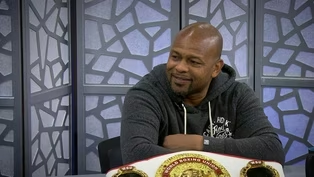
Preview: S1 Ep4 | 1m 3s | Host Dr. Rameca Vincent Leary speaks with athletes from the City of Champions. (1m 3s)
Providing Support for PBS.org
Learn Moreabout PBS online sponsorship













Support for PBS provided by:
Connecting the Community is a local public television program presented by WSRE PBS