
All Species Puppet Parade
3/23/2023 | 26m 46sVideo has Closed Captions
All Species Puppet Parade
On “Saluki Sleuths,” an interesting look at the rich history of homecoming at SIU Carbondale, including the story of an alumnus who brought back a homecoming tradition. Fred Martino interviews Cade Bursell of the All Species Puppet Parade, a Carbondale Earth Day event that raises awareness about the need to care for all species amidst various threats, including climate change.
Problems playing video? | Closed Captioning Feedback
Problems playing video? | Closed Captioning Feedback
Eye on Education is a local public television program presented by WSIU
All Species Puppet Parade
3/23/2023 | 26m 46sVideo has Closed Captions
On “Saluki Sleuths,” an interesting look at the rich history of homecoming at SIU Carbondale, including the story of an alumnus who brought back a homecoming tradition. Fred Martino interviews Cade Bursell of the All Species Puppet Parade, a Carbondale Earth Day event that raises awareness about the need to care for all species amidst various threats, including climate change.
Problems playing video? | Closed Captioning Feedback
How to Watch Eye on Education
Eye on Education is available to stream on pbs.org and the free PBS App, available on iPhone, Apple TV, Android TV, Android smartphones, Amazon Fire TV, Amazon Fire Tablet, Roku, Samsung Smart TV, and Vizio.
Eye on Education
Eye on Education features interviews with people making a difference in all facets of learning. From Pre-K through higher education, we highlight efforts to prepare students to become the world's future leaders in every discipline.Providing Support for PBS.org
Learn Moreabout PBS online sponsorship(upbeat music) (lens clicks and beeps) (dramatic music) - "Eye on Education."
I'm Fred Martino.
Just ahead, workshops and a parade mark Earth Day, with learning about a wide variety of species.
But up front this week, Homecoming is a fall tradition at schools across the country, and SIU Carbondale is no exception.
But a piece of Homecoming history was lost until an alumnus came to the rescue.
WSIU Development Director, Larry Hunter is the proud Saluki I'm talking about.
He's part of this story about many Homecoming memories from Anna Toomey of the SIU Alumni Association.
- [Anna] A raging crowd, (crowd cheering) a good game.
(crowd cheering) The sounds of proud Salukis.
(band instruments playing) No matter how far away they are or how long it's been, Salukis, come back for Homecoming.
- [Alumni] I'm really excited that we get to keep doing this because it's a tradition that we should keep alive, and I think that we will for many, many years to come.
- Hi, my name is Larry Hunter.
I am an alumni of the Marching Saluki.
I was in Marching Salukis from '80 to '84.
- [Anna] Larry is the man behind a Marching Saluki's icon.
Once a year for Homecoming, he rolls out the rhythm on wheels.
- Each year I bring the carts out, I'll bring them to the field again this year, and we'll install the drums on 'em.
The other drummers that come back will help me install 'em.
- [Anna] These carts have had a long journey.
- [Larry] They started using the carts in the early 60s, and they continued that until the early 90s.
So the carts had been kind of disregarded after that.
- [Anna] Larry says the drum carts disappeared completely after they were retired in favor of over the shoulder straps.
- I was in a Homecoming game with some other alums, and we were playing, we were playing these drums that the university had provided us for Homecoming.
And we all had asked, "Where are the drum carts?
Where are the drum carts?"
Nobody seemed to really know.
- [Anna] There was one man who knew, former Marching Saluki's band director, Mike Hanes.
He directed Larry to the woods behind the marching band practice area just past Saluki Stadium.
- Now, this was where I found 'em.
They were covered in branches back here, and trees were growing up in 'em and they were really in bad shape.
It was a cold winter day when I dug these carts out.
You know, I don't mind telling you, it was a little emotional seeing 'em like that.
But I also saw that they could be repaired, and I could help bring those carts back, and we could use 'em, and we'll continue to use 'em for many years at Homecoming.
- [Anna] Larry made this discovery back in the early 2000s.
He was determined that these pieces of marching Saluki history see the light of day again.
- I Was able to pull the carts out, take 'em back home, restore the carts, shine 'em up, put new wheels on 'em.
And unfortunately, the drums that were on the carts originally were all gone, and there was some paint missing.
And they had been painted over the years, a burgundy, maroon color.
So I had to strip all that off.
I had to use a sandblaster with wallet shells and clean all the old paint off and strip the rest that I couldn't.
- [Anna] Larry says it took him six months to find replacement pieces and do the repair work.
- [Larry] And we brought 'em back to Homecoming a few years back, and we've had 'em there ever since.
- [Anna] What Larry didn't know was how much this simple show of Saluki pride would mean to his fellow band mates.
- People that played other horns and instruments in the band, they come to me and they say, "I'm so glad those carts are back."
- [Gary] It has so much history.
It was part of the what I call, "A classic Marching Saluki Band."
- [Anna] Gary Butler is a former saxophone player for the Marching Salukis.
- I live in Atlanta.
I graduated 30 years ago.
Yeah, 30 years ago to this year, class of '92.
My mother and father, both, they were grad students.
- [Anna] Gary returns to Carbondale every year to pull the rehabbed drum carts at Homecoming.
- You know, you're seen out there pulling the cart, and you gotta keep rhythm.
You can't pull it too fast or too slowly.
It's gotta be just right.
So the drummers that are playing behind you can play correctly.
- [Anna] Long before the drum carts are pulled out for the halftime show, the football players have completed their own tradition, touching the pyramid outside Saluki Stadium.
(crowd cheering) - Everybody kind of has that tradition of, they tap the champion's tag or you know, they rub the lion's head or whatever.
And you know, the pyramid has kind of been our deal.
You know, you're on your victory walk into the stadium and you know it's tap it.
- Every time on the walk out to the field before the game, I make sure to touch the pyramid.
- The tradition goes back decades.
But not every player knows the story behind the pyramid.
It was once the final resting place for SIU's first ever live Saluki mascot, King Tut.
When King Tut passed away in the early 1950s, he was buried under this pyramid.
But at the time, it was located at Saluki Football's former home, McAndrew's Stadium, which was up by the Student Center.
When Saluki Stadium was built in 2010, the pyramid was moved to its current location.
But what about King Tut?
It's a Saluki rumor, his bones were excavated and reburied under the new location.
There's one woman that knows for sure, Dede Lingle-Ittner whose father was the founder of the Saluki mascot.
- And let's go under the bricks, and let me tell you that there are no bones because his tenure up on the hill would've meant that they would've all gone to soil and just powdery remains.
So they took some soil and some powdery remains from the top of the hill, the old McAndrew Stadium, and brought it down to the new Saluki Stadium at the south entrance.
- Past players who have came through and touched that pyramid, I think it's big.
It's kind of just the tradition of past and present players going through and touching that pyramid and going out and putting a great effort on the field, and repping the Southern Illinois Saluki name on their chest.
- [Anna] Honoring the past and hopeful for the future embodies the tone of SIU Homecomings.
Alumnus and former Alumni Association Executive Director, Ed Buerger, would know.
He says he hasn't missed a Homecoming in almost 60 years.
- My name is Edward Buerger, and I'm a graduate of Southern Illinois University, class of 1970.
I recall my first Homecoming, it was fall of 1963.
Back then Homecoming was a little more formal in some respects than it is now.
For instance, I remember going to the ballgame on Saturday afternoon, and most of the students had suits on.
- [Anna] Ed was living at House of Troy, and student enrollment was almost 17,000.
- It was an influx of the baby boomers from World War II and so forth.
- [Anna] Many of the same Homecoming traditions we see today were also part of Ed's first SIU Homecoming experience more than 50 years ago - We always had the parade, that was a Saturday morning, led by the Marching Salukis.
Back then in '63, the Marching Salukis, that was an all male band.
- [Anna] In Ed's time, there was a lot going on in the world, including the Vietnam War.
- One of major influxes of students probably was in '67, '68, when the Vietnam men started coming home with their G.I.
Bills, and they were a big part of Homecoming.
They were more mature.
They came in, they provided leadership.
- [Anna] Ed says it was a time of independent thinkers and unrest on campus.
- [Edward] I got here in '63.
By '64 and '65, the country was getting entrenched into Vietnam.
By '65 and '66, some of the students were getting drafted from campus.
I recall a lot of students, we were waiting that night to find out what our draft number was.
Whether we were gonna be drafted away from SIU.
But even through all of that, Homecoming still had great value for the institution.
- [Anna] Ed remembers students in the community going all out with their Homecoming house and window decorations.
Dozens of alumni would arrive in Carbondale via train.
These photos from 1967 show an excited group reuniting for Homecoming.
- When you drove around town, you saw the decorations, you realized that everybody was embracing Southern Illinois University.
It's bigger than winning a football game or going to the NIT and winning a national championship.
(whistles chirping) - [Anna] Ed says Homecoming brings a boost to the entire Southern Illinois region.
- Probably the biggest challenge, and it still is as I recall, but was trying to find places to stay.
I know alumni were staying as far away as Mount Vernon in some of the motels, Paducah, you could not get a room here.
And it really, I think, cemented a lot of the loyalty that some of our alums feel today.
- [Anna] Sean Cooney appreciates that loyalty.
He's a young alum that helps plan entertainment and events for current Homecomings.
- My name is Sean Cooney.
I'm an assistant director in the Office of Student Engagement.
I've been on campus for nine years now and then coming down here it really is a different breed of pride.
I think there's a lot of attachment to the university.
The university is just, being a Saluki is such tied intrinsically to who you are once you've attended the university that you really feel bond within.
That's one of the reason I chose to stay around is 'cause I really felt connected to the area and the community and the university itself.
- [Anna] The biggest Homecoming tradition of all is Saluki pride.
Sometimes it's preserving history, sometimes it's honoring history.
Salukis come home to remember.
- The real message is coming together, coming back for Homecoming and being together as a group again.
- It's about what this institution can do.
How it can take a young man or a young woman, 17, 18 years old, and totally turn their life around.
- Thanks to Anna Toomey of the SIU Alumni Association for that report.
We'll have to wait until the fall for the Homecoming parade.
But Carbondale has a very different parade on Earth Day.
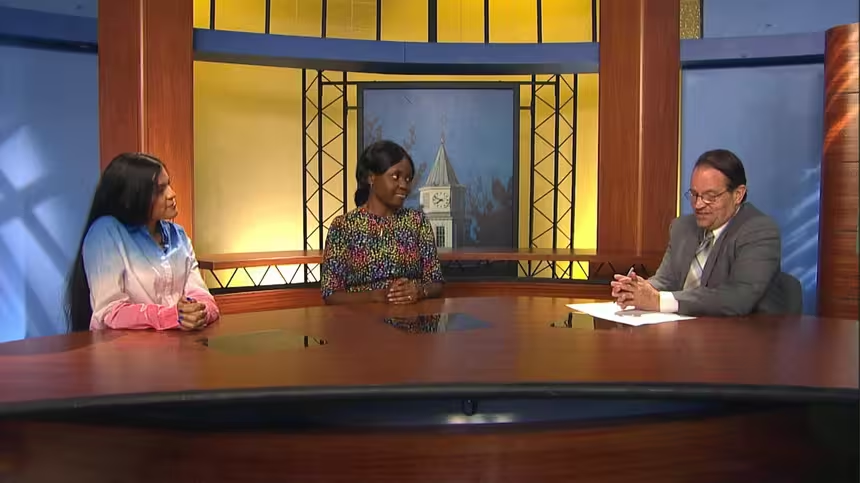
The All Species Puppet Parade is a decade long tradition, and SIU's very own Cade Bursell joins us for a preview.
Thank you so much for being here.
- Oh, thank you for inviting me.
I'm happy to be here.
- I enjoyed just looking at your website.
If people search for All Species Puppet Parade, they'll come upon your website, seeing all of the amazing photos of creations over the years of video.
We're gonna see some photos and video during this segment.
Tell me about how this group came together.
It's such an interesting idea.
- Yeah, well, it was about a decade ago, and a group of us wanted to do something about the issue of fracking.
And there's an organization called SAFE, Southern Illinois Against Fracking Our Environment, and they were having a fundraiser.
And so we thought, "Well, you know, maybe we could use puppets and do a little like theater piece."
And we did that and that was somewhat successful.
And so then we thought, "Well, what's next?
You know, that was fun."
And then I started to think about Earth Day.
There wasn't much going on here at that time around Earth Day.
I had lived in Vermont for 10 years, and that's the home of the Bread and Puppet Theater, which is a really amazing theater group that makes these giant puppets, they're like spectacles and they're political.
They do political theater as well.
And they were founded in 1963 by Peter and Elka Schumann.
And it was very inspirational.
I attended their pageants.
I didn't participate, but it stuck with me.
And I love a parade.
And so I looked online and found the Procession of the Species which is another parade that started in 1994.
And that was more like what I thought we could do, that was Eli Sterling, and that was in Olympia, Washington.
And I thought, "Well, this is something we could do."
And I asked folks to come to a cafe and talk about it, and everybody was enthusiastic about creating a parade for Earth Day that focused on species, celebrating species.
And so we began the process.
And the person who actually helped us, Ron Naversen, he helped us get started with that first theater piece.
He's from the SIU Theater Department.
He's retired now.
His emphasis is mask making.
He's just really talented.
He's been with us since then, he's one of the puppetistas.
Another professor, Johnny Gray, has been with us since that meeting in the cafe.
- And full disclosure, Ron is a member of the WSIU Friends Board.
- [Cade] (laughing) Oh!
- And how about that?
So I wasn't aware of his connection to this.
- Oh, yes, he's so talented.
- So that is amazing.
And that, you know, kind of gets me to the next point that this is a parade, but there's so much more to it.
And I wanna read your mission statement.
- [Cade] Yes, okay.
- Because I really I love the mission statement.
It says, "Through the merging of art with ecology, we hope to cultivate love and care for all species."
Let's talk about that.
Why is art so powerful for sharing this message?
- Yeah.
Well, that's such a good question.
Art communicates in a different way than other media, right?
It engages the senses.
So when someone is working with cardboard it's very tactile.
There's paint, so it's very visual.
And there's some music or some sounds that are made, so it engages this auditory sense as well.
And so, you know, when you're making this particular puppet, and it's based on a particular species, you're working with it for hours.
And so we're hoping that that cultivates a relationship with that species, that eventually there's appreciation, then maybe gratitude, and hopefully action on behalf of that species.
Because as you know, there's, you know, species are the sixth mass extinction.
We're facing extinction of many species, and it's dire.
So this is a way of celebrating those that are you know, species that are still with us.
- And hopefully protecting those species that are still with us.
- Yes, yes.
That action does make a difference.
We're hearing about action that has been taken over the last decade to help save the Monarch butterflies, and we're seeing progress there.
So we can make a difference.
As I said, you have been at this raising awareness for a decade now, and over that time, as you know, support for environmental protection has really grown enormously, not only here, - Right, yeah.
but across the country and the world.
How has this really impacted your work?
- Well, it's interesting because we think of our work as transformative.
It's joyful work, that's sort of an antidote to the hard work that needs to be done that can be somewhat dismaying, right?
When we think about climate change and those intractable issues.
And so, but we do see change in the people that come to our workshops.
So we have, for instance, I'll tell you this story, there was a young woman, maybe 10 years old, and she was creating a polar bear.
That was what she wanted to create.
And so I went up to her to ask her about it.
And it was really interesting because she was able to say a lot about the polar bear and what its habitat, the need for what it needed, but also she was able to say what the issues were, and she's 10.
And in some ways it was poignant.
But I was so happy that she had that knowledge.
And so I'm seeing people come with a lot more knowledge about the issues that we're facing, including the climate crisis, habitat loss, all of those issues.
And so this is one way where we get to sit together and talk about those issues, but also try to find a way to change those and also celebrate those species.
- Absolutely.
You mentioned climate change and of course that is just one issue in terms of environmental protection.
But it's really been at the heart of actions across the world to protect the environment.
- Right.
Yes.
- Give us an idea of a local project that really recognize the need for action on climate change, and how we've gotta take every action we can to slow down this process.
- Yeah.
So I love that question.
On Earth Day, during that celebration, after the parade, there is a Community Climate Conversations event happening.
And so we're inviting people to come and actually tell us what's happening.
What are you doing about climate change?
Things that we may be unaware of.
So the City of Carbondale has a sustainability plan which is really extensive.
Not many people, I was unaware of it, not many people know about it.
And they've done such good work on it.
So they're gonna be talking about the elements of that plan.
There's food autonomy, which has these gardens all around Carbondale.
So food autonomy, that's very, very important when we think about the issues of climate.
There is a wonderful idea, it's controversial, but it's the Shawnee National Park and Climate Preserve, creating a climate preserve here.
Which would be one of the Nation's first climate preserves in the country and that would be served as a model.
So there's all of these ideas, really rich, interesting ideas that, and they're not only ideas, they're people are acting, they're already acting on behalf of trying to address climate change.
So if you come during the day, you'll be able to hear about these things and ask questions.
So people will be speaking about them.
And then it is really about conversation.
So you can sit down with each person who's presented and talk about these ideas and learn more about what's going on, and maybe engage and participate.
- That is wonderful for Earth Day.
Before Earth Day before the parade, you have a lot going on though too.
You prepare folks for the parade through workshops.
- Yes.
Tell me about some of those.
- Okay, so I like to describe this space.
When you walk into the workshops, which are Saturdays 10 to 2 at the Lakeland Centers, Giant City Road, which is part of the Carbondale Park District, who is our partner.
We would not be able to do this without them.
So they're a really important partner.
You walk into the space and there are posters about all these different kinds of species.
And then there are books that reference animals and plants.
And so if you don't know what you wanna make, you can come in and learn something, and like flip through and decide what you wanna make.
And then you begin the making process.
And what we try to do is ask questions about habitat, talk about interdependency, just have fun as well.
And then during those workshops, we're gonna have people come for half an hour and talk about different species.
We have someone talking about mushrooms, someone coming in to talk about reptiles.
We have a musician, Candy Davis, who has written songs about these different species.
She's gonna be there one day.
We have story hours where the little ones can go in another room and hear stories about nature.
And so those happen a couple of this different Saturdays, and that's all posted online.
So it's a space where you come in, and you're invited to be creative.
You can come back the next Saturday and finish your puppets.
We talk together.
It's a really wonderful community space, lot going on in those workshops, which prepare you, hopefully, for the parades.
So the puppets sometimes are on sticks, but sometimes people make masks, and they embody whatever species they're interested in.
Some of them are multiple, like you have a caterpillar, and you might have several people, doing the participating.
- It's the creative process, right?
- Yes, it is exactly!
Diversity.
That's the beauty of it.
- [Cade] Yes, transformation.
And we're using all recycled material.
It's recycled cardboard.
So if you see a bunch of older folks going through the trash, that's probably us.
You know, a lot of our material is gifted.
We went to Joanne Fabrics and recently got a pile of fabric they were gonna throw out.
So all of that comes to us and we, again, try to use it and figure out ways of transforming that into art.
And think about if you were a viewer, and you're just seeing this parade go by your house, what a way to like make your day, right?
- Yeah, right.
- You know, what is that?
- [Fred] And a lot of learning involved there obviously.
- [Cade] Yes, yes.
- But also I would imagine a sense of community being developed amongst folks who care about the environment.
Tell me about the importance of that, that happens in this space.
- Well we have a lot of community partners, and we really rely on them, and so we all work together.
So there's that level, right?
There's the neighborhood food co-op, I could go on listing them.
The public library, SIU Art Education Nation, which are group of students who we love.
They come for the workshops, and they really help out and they make their own puppets.
And they're so much fun to have as puppeteers for that time period.
And then there are folks who are coming from everywhere, from a lot of different places.
They're families, individuals, and we meet new people, right?
We're always meeting new folks.
People come year after year.
So we see the growth, the growth of the puppets.
like let's say the puppets, but also the growth of the individual, usually a child, the next year they come.
Like for instance, one of our puppeteers, beloved puppetistas, she kept bringing her twin girls.
And so then finally she became a beloved puppetistas helping out.
But she's incredibly creative and her girls are.
And so they made these fantastic puppets.
So it's just a really wonderful way to work together.
We're working together on something, and it has to do with this creativity and joyfulness and transformation of materials, which is really important.
You can see that something you thought was trash can become something else, something beautiful, something fun.
- Yeah.
Yeah, so- - And something powerful because you learn by doing, and when you do something, you remember it.
- Yes, right.
- It really is different from just hearing about something but doing something.
Speaking of doing something, you have a long career at SIU and creating film that really touch on these issues.
Tell me about that.
- Well, I came here as an experimental filmmaker.
So much of my work is experimental, and it has to do with place.
I think it's really important that we pay attention to where we live.
And so a lot of that work is poetic.
I mentioned Heron Pond in another conversation with you.
There's a piece about Heron Pond.
It's really more about poetry.
But recently I finished a documentary called "Shawnee Showdown, Keep the Forest Standing."
And that is about the history of protest on the Shawnee National Forest.
So part of a class that I created was to bring students into the Shawnee National Forest and interpret it through the medium of their choice.
So they could use photography, music, video.
And we would go, sometimes we would camp, but we would go to all of the, and it's experiential like you were talking.
It's about doing and it's about learning about this history.
So I had community members talk about this history, and I didn't hear about these protests for years.
And I thought, "Well, this really needs to be preserved."
And so I created a piece about these protests.
And they were protesting logging on the Shawnee.
And it was really interesting because they were able to get a 17 year injunction on logging.
They won that through the courts.
- Another example.
And it sounds like you've given a preview perhaps for another show.
- [Cade] (laughing )I hope so.
- A longer segment.
- Is that an invitation?
(laughs) - It is an invitation.
- Wonderful.
We will have you back.
- Wonderful.
Thank You so much for being with us.
- Thank you so much for inviting me.
- It's been great having you here.
- I hope to see you at the parade.
- At the Earth Day events.
That is "Eye on Education."
Our guest, Cade Bursell, of the All Species Puppet Parade in Carbondale and SIU.
For all of us at WSIU, I'm Fred Martino.
Have a great week.
(dramatic music)













Support for PBS provided by:
Eye on Education is a local public television program presented by WSIU