
Almanac selects their most memorable stories from 2025
Season 2026 Episode 16 | 56m 39sVideo has Closed Captions
Almanac staff looks back at some favorite segments from 2025
Kaomi Lee visits with stakeholders about the future of George Floyd Square, Mary Lahammer highlights the Braver Angels organization, Kate Dicamillo’s yearly visit, Highlighting the YMCA’s Youth in Government Program, A Nur-D Performance, Author of Legacy Lost: Passing Across the Color Line, Sioux Chef Sean Sherman, Minneapolis and St. Paul Mayoral debates
Problems playing video? | Closed Captioning Feedback
Problems playing video? | Closed Captioning Feedback
Almanac is a local public television program presented by Twin Cities PBS
Almanac selects their most memorable stories from 2025
Season 2026 Episode 16 | 56m 39sVideo has Closed Captions
Kaomi Lee visits with stakeholders about the future of George Floyd Square, Mary Lahammer highlights the Braver Angels organization, Kate Dicamillo’s yearly visit, Highlighting the YMCA’s Youth in Government Program, A Nur-D Performance, Author of Legacy Lost: Passing Across the Color Line, Sioux Chef Sean Sherman, Minneapolis and St. Paul Mayoral debates
Problems playing video? | Closed Captioning Feedback
How to Watch Almanac
Almanac is available to stream on pbs.org and the free PBS App, available on iPhone, Apple TV, Android TV, Android smartphones, Amazon Fire TV, Amazon Fire Tablet, Roku, Samsung Smart TV, and Vizio.
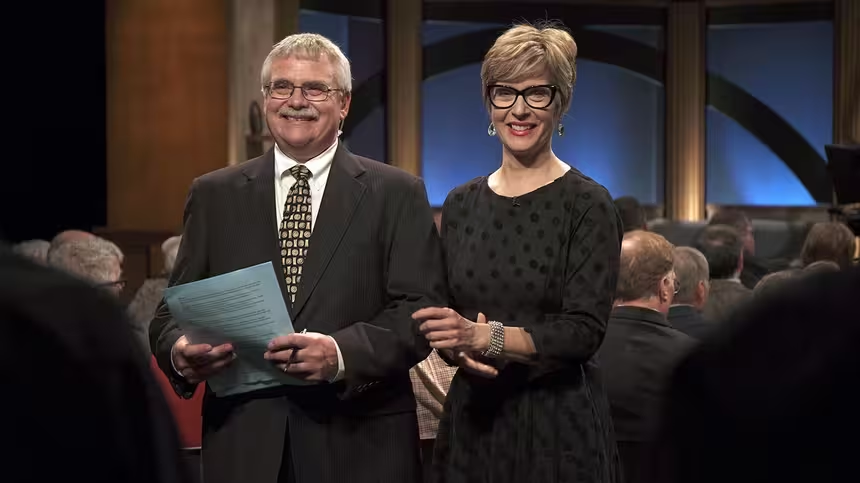
A Minnesota Institution
"Almanac" is a Minnesota institution that has occupied the 7:00 p.m. timeslot on Friday nights for more than 30 years. It is the longest-running primetime TV program ever in the region.Providing Support for PBS.org
Learn Moreabout PBS online sponsorship(gentle music) - [Announcer] "Almanac" is a production of Twin Cities PBS for the stations of Minnesota Public Television Association.
- We have a fun show for you tonight.
We're gonna start the new year with a look back at some of our favorite conversations and stories from 2025.
So, settle in with some eggnog and leftover holiday treats.
A special edition of "Almanac" coming your way.
(gentle music) (gentle music continues) (gentle music continues) - [Announcer] "Almanac" is made possible by members of this public television station.
Support is also provided by Great River Energy, providing wholesale power to 1.7 million people through its member-owner cooperatives and customers.
Delta Dental of Minnesota Foundation, improving oral health and helping communities thrive.
Deltadentalmn.org/tpt.
And, Education Minnesota, the voice for professional educators and students throughout the state.
More at educationminnesota.org.
- We have a special New Year's week show for you.
Cathy and I and the rest of the "Almanac" team, have picked some of our favorite stories from 2025 that we wanna share with you, again.
- Eric and I will be back in a few minutes with our own choices, but we start with a studio conversation selected by one of our producers, Kristoffer Fernandes.
- It's an annual tradition at the YMCA.
Before the start of session, the student-led youth and government program takes up space at the capitol.
About a year ago, we invited a few high school students to join us right in the middle of their multi-day mock session.
Keep a close eye on this one.
You might be looking at a future lawmaker, judge or capital staffer.
- I actually began YIG as an eighth grader.
In my very first year, I was in the Senate and I wrote my bills on environmental policy and all of that got just got me super interested in the legislature and the process of passing bills because it was something I was super passionate about.
- [Interviewer] Yeah.
- So, that passion kind of turned into wanting to become more of a leader and take on the leadership role of running the Senate and that brought me to the presidency in the end.
- Wesley, what's your origin story?
- Well, I found found out about Youth in Government, the Center for Youth Voice branch of the Y that does all this, through a booth at State Fair.
So, Minnesotan through and through.
I had a pamphlet I got as a sixth grader that I held onto for two years before I was able to join.
And, I've just explored and just dove in in that time.
- [Eric] Emi, what about you?
- Well, let me tell you, I've been interested in politics since I was young, but especially when I found out about the courts program there, I knew I found something because I might wanna go to law school in the future, might wanna become a lawyer.
And when I went into trial in district courts, I realized, oh my goodness, this is so interesting.
And, it is so cool to be able to just pretend to be the lawyer, do all the court cases and really just explore a different aspect of the government.
'Cause whenever people think of government, they think of bills, but really the judicial sector is also a huge part of that, right?
- Right.
Now, Eric and I are old political reporters.
We do enjoy the legislature in the process.
And I'm wondering, you know, when we have so much polarization and mistrust and distrust in this country around politics, you guys are really excited, which makes us feel wonderful.
But I'm wondering, what do you think when you see the level of political polarization in this country as a young person?
- Honestly, it is a little bit disheartening to see people being so harsh on each other and really spreading hate instead of kindness.
But being at YIG I think brings me a lot of hope.
Seeing people who have similar like goals for the future of politics where we wanna create like a respectful space where everybody's opinions are heard just like we do in our youth legislature.
- But also we don't have any political parties whatsoever at Youth in Government.
It's solely focused on making sure people get civic education.
So, we don't care if you're a Democrat, left, right, whatever.
We just want you to learn about our processes and learn about how to get civically engaged, whether it's through voting in our systems, and then participating in making those bills because it's polarizing.
- [Eric] How old are you guys?
- I'm 17.
- 17.
- 17.
- How about 17-year-olds voting?
It comes up at the legislature once in a while.
You guys are high information prospective voters, but I wonder, would you think that would work, 16 or 17?
- That's a really interesting question.
Our mission, our motto is democracy must be learned by each generation.
One of our programs that isn't directly related to Youth in Government, this conference, but another program of the Center for Youth Voice is our Students Voting Program.
We had it in almost 500, more than 500 schools across the state.
We had like 200,000 kids vote.
- [Eric] Wow.
- Our goal is to instill the mission of democracy, the idea of democracy, civility as well, in these young people.
Whether or not voting at 17 is a good idea, with us, I think it would be and we need to spread that idea to others.
- What do you guys think?
- Well, something I actually find really interesting about that is that at least once, maybe even two or three times a year, a bill comes up in the legislature that students have written that wants to lower the voting age to, I feel like I've seen 16 is usually the most common age, - [Emi] The lowest is 14 this year.
= Yeah, I was gonna say, I've seen lower.
So, it's something that the youth are passionate about, especially in a program like this.
Like, we wanna have a voice, so- - Are there other issues that the Minnesota legislature should take up that young people are really passionate about?
- Well, I mean, huge one is protection in schools, right?
A lot of people are scared to go to school these days.
They're worried about gun control and all those types of things.
And, I believe there was actually a bill proposed in the legislature of where you could teach self-protection in classes.
And so, it's really interesting to see how people interact with the education system these times.
And also, like, what they think is really important because that's why we pass all the bills and then we create a book from those and then we send those to the actual legislatures.
That way they can see what we're doing and see what we care about and maybe model some of their own bills off of it.
- Just, have you found your career paths already?
- I'm hoping to go into environmental studies or public policy, hopefully a mix of the two.
- [Eric] Wesley?
- My work at Youth in Government, like Emi's, is more logistics, more you know, fundraising, background, social media behind the scenes, working with the state office, the adults at the Y that put that on.
I've gotten to know the Y really well as an organization.
- [Eric] Yeah.
- And that's where I might see myself - Career path, law school sounds like.
- Law school, but also becoming a foreign service officer through that law degree.
So, I'd love to work with getting people visas, green cards, all those things.
As a immigrant child myself, super passionate about that, and YIG has really enabled me to have a voice in these spaces, so I'm really excited.
- What a joy to have you all here.
- I wish I had your futures.
- Thank you.
- Last May marked five years since the police killing of George Floyd.
One of my most memorable reporting experiences of 2025 took place right here at 38th and Chicago, where I spoke to folks who are working to rebuild George Floyd Square and to uplift Black voices.
Here's an excerpt.
Tracy Washington says she had to be at George Floyd Square.
- I lost my son a year ago to police brutality in Florida, and I wanted to be able to contribute to the movement.
- [Kaomi] That's how her exhibit, "Walk a Mile in Our Shoes" was born.
She displayed photos of victims of police brutality or gun violence along with their shoes.
The exhibit was just steps away from where George Floyd died.
- My question still remains.
How did we get here?
Why are we here?
- [Kaomi] Many people have described the Square as an open wound.
Organizers of the events surrounding the five-year anniversary say there was also an emphasis on Black joy.
- It's always okay to feel joy.
I think it's important to remember that grief is processing loss and just because you've lost something doesn't mean that you need to be sad all the time.
Sometimes joy can look like processing loss.
Sometimes silence can look like processing loss.
- [Kaomi] Austin is executive director of a nonprofit that preserves stories of resistance to racial injustice.
- We recognize that the land has a very integral part in this movement for justice, and it holds the energy, it holds the memories, every tear cried, every shout shouted.
- [Kaomi] Lee Coleman has been keeping watch every night for the last five years.
- Protecting the Square, making sure I hold truth to power and make sure everybody knows that there's somebody watching.
- [Kaomi] The Square became a place of resistance and resiliency.
After George Floyd's murder, Coleman, who is Native American, says the police stayed away.
- They refused.
- [Kaomi] Yeah.
- They wouldn't even come within two blocks of here.
We were to fend for ourselves.
We were to help ourselves and protect ourselves, and which we did.
- [Kaomi] Meanwhile, he says officer-involved shootings have continued.
- I don't know if it's improved.
I think it's just a little bit more highlighted, but I don't think it's improved at all.
I think it's just waiting for the next something to happen.
- All week long, many have been coming out to pay their respects at George Floyd Square and to memorialize the man and what happened here.
Still, there are differing opinions on what should be the future of this intersection.
- You still can't do the thing that the council wants to do because it is against the law.
- [Kaomi] The city spent $2 million and 17,000 hours of community engagement to find out what the public wanted.
Minneapolis Mayor Jacob Frey says the majority supported and open, flexible plan.
Moving forward and progress are not always the same thing.
- I think some of the challenges up here is that there's not necessarily a cohesive message or feeling around like where we're headed as a community - [Kaomi] Artist and gallery owner Ace Rice has grown up in the neighborhood.
He says with a dozen Black-owned small businesses in the area, George Floyd Square has potential.
- It's just been a challenge to keep a consistent flow of traffic or consistent customers coming in when, to a lot of people in this city, this is kind of a dark spot that, you know, not a lot of people want to go specifically because I think people like to go where they feel uplifted.
They like to go where they feel safe - [Kaomi] Every day for the last five years, a group of neighbors gathered to start their day talking about racial and social justice.
- [Marcia] George Floyd Square is in the hearts and the minds of the people of the Twin Cities as a historic landmark.
It's this floodline of before and after of racial reckoning.
- [Kaomi] Marcia Howard has lived near 38th and Chicago for more than 25 years.
She stands steps away from the Say Their Name Cemetery, representing victims of racial violence.
She calls their movement an uprising.
- It's not just a physical place.
The fist in the middle of GFS stands at the epicenter of a reckoning where people have to interrogate themselves.
Where do I stand in this?
What does white supremacy mean and move in me?
And, it didn't stop in 2020.
That's why we're still here.
- For nearly a quarter century, award-winning children's author, Kate DiCamillo has made annual visits to the "Almanac" set.
We always have a good time poking fun at each other and talking about her work.
She stopped by this fall to talk about her "Lost Evangeline", the final installment in the "Norendy Tales" trilogy and the 25th anniversary of "Winn-Dixie", the Newbery Honor recipient that brought us together all those years ago.
- How many years is it?
24, I think, yeah.
- [Eric] 24.
- [Cathy] 24.
But, we're not gonna play any old video.
- I really, I love the video.
It just like it You know, the the reason that you should play the video is because it silences me when I see myself.
Yeah, okay.
Don't let me get in the way of your question.
- "Lost Evangeline", okay.
- Yeah.
- Shoemaker finds a tiny girl in a shoe.
She sings, by the way, and she gets sold for some gold nuggets.
Ends up in a bird cage in a traveling curiosity show.
- Yeah.
True.
- With appearances by a talking cat, a talking sparrow, a talking mouse, and the crew ends up aboard a ship.
(Kate laughing) - Your imagination is wonderful for all.
- I'm not gonna hire you to do publicity for me.
You always manage to make me sound strange.
And, you know what?
I guess I am, you know?
And that's true.
Everything that he said is true.
- [Eric] Shows I read the book.
- Yeah, I know.
You did.
- Your imagination is wonderfully fertile.
This is what I say.
- Yeah.
Yeah, although I thought that the easy hit for Eric would be that a tiny little person writing about a tiny little person.
(laughing) - That's good.
I- - Yeah.
Yeah.
I thought that's the angle that you would take.
- You've got 44 million copies of your work.
- Wow.
- Circulating.
- Yeah.
- You've got two Newbery prizes.
Do younger writers ever come up to you and say, "Hey, DiCamillo, take a break, let us get a taste."
Does that ever happen?
- No, what the younger writers come up to me and say is, "I read you when I was a kid."
And so that is- - [Eric] It's a- - Yeah.
Who can complain about that?
It makes me feel old, but it makes me feel like the luckiest person in the world.
Yeah.
"I read you when I was a kid."
Yeah.
- [Cathy] It's like people coming up and saying, "We used to watch you when we were kids," which is- - And that's where we started our conversation behind scenes was that we're old.
- Yeah, we're getting old and rapidly aging here.
- Yeah.
Yeah.
- Say, I'm wondering here about, since so many kids do say that they grew up with you, things are changing, obviously.
Do you worry about kids and screen time instead of getting themselves into books?
- You know, I get this question a lot and I take so much heart from when I am out there with the kids, talking with the kids.
And, this is not just when I'm doing events.
It's when I'm in the neighborhood and we've got a lot of little free libraries.
And, sometimes I'll be coming up and two kids will be standing there talking about, "Oh no, no, you have to read this one."
And, I see a lot of wonderful things on the ground that makes me think that books and kids are gonna be okay.
And, that there's a lot of comfort and light that kids are finding in books.
- I detected a new thing you did in this book.
- I can't wait to hear it.
Yeah.
- It's the lyrics to songs.
- You know what?
You know, I have to say wise you, because this is a thing that has just started to pop up in my work and I wasn't even aware of it, yeah.
- [Eric] How did the rhyming How did you do the rhyming and all that?
- Well, you know, when you're writing two pages a day and you get to write a song, it gets- - [Eric] The margins are pretty wide, by the way.
- Right!
It gets you through those two pages a lot more quickly.
So, it's, oh wait, I'm gonna do more of this.
And, somebody asked me the other day if I have like tunes in my head, I don't.
But it is awfully fun to write the songs.
So, if somebody wants to, can you write music?
You play it.
- I probably can play a little bit.
- Yeah.
- But, if you put these lyrics to music, this is the perfect entree to a movie or a theater musical.
- I would just say that you need to do another musical.
- This is the new property.
You could get a melodist.
- Yeah.
No, I would love that.
- Yeah.
- Are you signing up?
- No, I'm not.
But I bet there'd be some.
And, I love the illustrations in the book.
- Yeah.
- Aren't they incredible?
That Sophie Blackall, who is just divine.
- Tremendous.
- Yeah.
- What can we plug for, anything?
- What can you plug for her?
- [Eric] You!
- For me?
Just my mere existence here does me a lot of favors.
Yeah.
- [Eric] According from your book- - Yeah.
- Clever, courageous, and kind.
- Yeah.
- Kate DiCamillo.
- Now, you've really thrown me off my game because all you've done is compliment me.
How am I supposed to respond?
- He's turning over a new leaf.
- Yeah.
- [Eric] When you got stuff to plug, come back.
- Yeah, thanks.
Thanks for talking to me, y'all.
- [Eric] Always a pleasure.
- It's light.
Light in the darkness to be here.
Thank you.
- [Eric] Thank you, ma'am.
- [Cathy] We love you.
- As a director for "Almanac", I enjoy the creative energy that live music brings to the show.
This next clip is a performance from local hip hop artist, Nur-D.
- What's up TPT?
We gonna do it, ey!
DJ Hayes on the ones and twos.
Let's get it, ah.
(hiphop music) Yeah, yeah, yeah, yeah ♪ From the land where doves cry ♪ ♪ It rains down and purple lies seep into my skin ♪ ♪ And turn alive the funk, I realize ♪ ♪ I'm the next to supply this ♪ And men flow, no I'm one of the nicest ♪ ♪ Took a bite out the gang ♪ Fang bigger than my Wesley Snipes' ♪ ♪ No shows, (indistinct) got bops, set up quicker ♪ ♪ Put in the lightning bolts, ♪ A molt about the funk that make you jump around ♪ ♪ Tell me, does that sound good to you ♪ ♪ Move your body, tell me what you got to lose ♪ ♪ There ain't no promise saying that you got tomorrow ♪ ♪ So baby, go and get your back up off the wall ♪ ♪ Shake that thang, make them melt ♪ ♪ You don't really need hands to go feel yourself ♪ ♪ Make the most of this moment ♪ And own it 'til ain't nothing left ♪ ♪ Right now, we can roll like a red Corvette ♪ ♪ And go golden in my life, purple in the sky ♪ ♪ Got me feeling right, let's go out tonight ♪ ♪ Golden in my life, purple in the sky ♪ ♪ Got me feeling right, let's go out tonight ♪ ♪ This is not your grandma's funk, this that newest stuff ♪ ♪ This is not your daddy's groove, this is dangerous ♪ ♪ This is not a copy paste, this is tailor made.
♪ ♪ This that scrunching up your face ♪ ♪ Make your mama say ♪ Tell them that I'm ready to score, horns up ♪ ♪ And I'm ready to show up with the gold ♪ ♪ As you gotta know this ♪ I mean the coast that been kind of coasting ♪ ♪ And I won't hold them till I'm trying ♪ ♪ To make this whole thing different with minimal misses ♪ ♪ And lyrical gizzes and just a little bit ♪ ♪ Of the Twin Cities for y'all ♪ Let the snow fall ♪ Get the freak on and on and on ♪ ♪ Golden in my life, purple in the sky ♪ ♪ Purple in the ♪ Got me feeling right ♪ Got me feeling ♪ Lets roll out tonight ♪ Golden in my life ♪ Golden in my life ♪ Purple in the sky ♪ Purple in the sky ♪ Got me feeling right, oh yeah ♪ ♪ Let's roll out tonight, oh yes ♪ ♪ Golden in my life ♪ Golden in my life ♪ Purple in the sky, yeah ♪ Got me feeling right, yeah ♪ Let's roll out tonight ♪ Let's go, golden in my life, purple in the sky ♪ ♪ Got me feeling right, let's go out tonight ♪ (festive music) - For many Americans, family history and legacy is something they learned from their parents growing up.
Last summer, we met somebody with a very different experience.
Barbara Hilyer grew up white on the West coast with a very small family.
As an adult, she discovered a vast family and historic legacy that included generations of lawyers on both sides of the color line.
Her family history and research led her to Minnesota.
- I've had a wonderful experience here.
And, I would have to say that the most interesting part of it has been for me, coming from the West coast where my family is white and coming here where I'm clearly ensconced in a very accomplished African American family is a very interesting journey.
- [Dana Ferguson] Yeah.
And not just Minnesota interesting.
- Yes, exactly.
American interesting.
- Let's go back to the kind... Your father had to make an important decision about his heritage, I guess you'd say.
And did the Depression formulate that or- - Well, I would say yes.
My grandfather was a lawyer here and my father and my aunt grew up here.
And, at that time, my grandfather, Gale Pillsbury Hilyer was a very accomplished lawyer, first secretary of the NAACP, first African American to run for a judge in 1925.
He was a rising star in the African American community, but the Depression ruined his career and he had to leave and he left and went to the East coast where he began passing as white in the early 1940s.
The same then for my father.
My father made that decision to leave Minneapolis.
He grew up here, graduated from high school here, left Minneapolis, joined the Merchant Marines and started identifying as white, moved to the West coast where he raised us as white.
Completely cut off from the rest of the family.
But his sister, Hilaine Hale, also grew up here in Minneapolis, graduated from high school, went to the University of Minnesota, couldn't find work here in the 1940s as an African American.
So, she left and ended up being very disillusioned with race on the mainland.
And, she moved to Hawaii where she had a storied political career.
So, the family split across the color line in the '40s where my dad ended up on the white side.
And that's where we were raised, and I didn't know any of this.
- [Dana] And you found out about this later on in life, sort of recently.
How did that come to be?
How did you learn about this bifurcation in your family tree?
- Well, it wasn't so recently now because I'm 70 and I was 33 then.
But, it only unfolded over time.
You know, I only found out a little bit.
In 1988, my stepmother, my dad had been dead for 10 years.
My stepmother told me that my dad was from an African American family in Minneapolis.
And, she told me that he had a sister who was still alive in Hawaii.
So, I immediately needed to go to Hawaii to meet his sister Hilaine Hale at the time.
And, she was quite an accomplished politician there.
She'd been on the cover of "Ebony Magazine" in 1963.
She was the niece of Ralph Bunch.
You know, I don't know, are you familiar with Ralph Bunch?
- [Eric] Sure.
- Okay.
So she was quite a persona.
And, she was very willing to be open with me.
She hadn't talked to my dad in 30 years, but she was very willing to be open and tell me the family story.
And so, I ended up being in her world for about 25 years and knowing what she knew.
And then, after she died I went further to find out where this all went.
- [Eric] Well, do you feel like you missed some of your heritage or?
- Well, you know, that's an interesting story.
I would say yes.
(laughs) But, I'm grateful that I got to capture it in time.
Like, some of it I missed.
I'm sad that I missed knowing my grandfather.
He's buried in Hawaii and because he lived with her at the end of his life and I put flowers on his grave every year.
And I never met him, but he was alive until I was 24.
So, that makes me sad.
But on the other hand, I'm so grateful that I caught Hilaine while I still had 25 years with her, and where it opened up this story.
So, you know, life is about taking the opportunities that you can, and it doesn't do any good to be sorry about the ones that you didn't get.
- How did this change the way that you identify or like you understand yourself?
- That's a great question and I wish I had a good answer.
I take life as it comes, you know?
And, I am who I am.
I'm a sum total of the experiences that I've had and I have a natural sense of optimism and a natural sense of humor.
So, all I can say is it's been a very interesting ride.
- [Eric] You want readers to come away with what point from this?
- I want them to come away with the fact that we need to tell our true stories and history needs to include everyone's story.
And, we need to get beyond this part of our past, which we're now revisiting again, where we isolate who gets to tell the stories and what the truth is.
We need to all be out there and hear everyone's stories.
- Since the horrific assassination of former Speaker Melissa Hortman, we not only focused on her legacy, but also tried to provide some solutions to political polarization.
In this next story, I teamed up with a local couple who was working with Braver Angels and it received one of our biggest responses.
- [Elaine Ambrose] My friend Melissa Hortman was murdered in her house at night.
She was a friend of mine.
And, I was so angry I couldn't stand myself.
I felt like I was going to eat myself up.
- [Bob Ambrose] Toward the end of my career, I had an opportunity to travel with her and a group of legislators to Germany to exchange ideas on renewable energy.
- [Mary] Instead of allowing her anger to consume her, Elaine Ambrose sought solutions.
- She's the only friend that I have that has ever been murdered.
I felt so angry and so frustrated and hopeless that I contacted a couple of friends to kind of help me through this.
And, one of them suggested that I join Braver Angels.
- [Mary] Braver Angels is a national organization whose founder and biggest following is in Minnesota.
They are increasingly in demand to address polarization.
- The level of polarization is the highest since the 1850s.
And, you know what happened then?
We went to war with each other and if we don't do something about it, there's a high degree of, you know, high chance that we're gonna have increased violence.
- [Mary] The vast majority of Americans say violence and polarization are problems.
- The way that we feel about the people on the other side has become so negative that it really keeps us from listening, and it keeps us from working effectively on issues because we dislike each other, we distrust each other so much that we're not willing to work with each other.
We teach people how to listen well, listen with respect, but listen to understand, to bring a sense of curiosity, to really understand what the other side is saying.
And then, in turn, to be able to speak their point of view in ways that it's more likely that they'll be heard.
The way I say it is, we know everyone wants to be listened to, but wouldn't you also like to be able to tell your side of the story?
- [Mary] Elaine discovered she wasn't alone in her anguish after the assassination.
- [Elaine] I couldn't sleep at night, I was so worried.
And, he said, "I feel the same way."
- You as a Democrat was reaching out to the Republican Party Chair and found out you were feeling the same way.
- Yes, yes.
- [Mary] The Republican Party Chair is a Wayzata city council member who attended the seminar, also organized by the Wayzata mayor.
- I actually very proud independent moderate, but I also like to add that I'm a radical optimist that puts me right dead in the middle to help with both sides and try to get some stuff done.
- Are you a former Republican?
- I am.
I'm a recovering Republican.
Polarization is, you know, very prevalent and I call it the echo chambers on each side where we're just talking to each other in these little echo chambers.
Meanwhile, the majority in the middle is getting fed up and dissatisfied with the behavior on both sides.
- We do have aha moments all the time.
I think one of the biggest aha moments is the recognition of commonality.
You know, what are the things that we agree on, especially when you go below the talking points to how did you come to this view?
What's your story?
What are the values that are driving this?
Our starting point is to show individuals that they have agency.
They can act, not just react.
We're so triggered by the high levels of polarization that we tend to just respond, usually in a negative way.
And so, that's the first step is you do have a choice and then teach them skills.
- I was just so proud how many people showed up with a limited amount of promotion and whatnot.
But, that tells me that there's a hunger and a need to change the conversation.
I've known the Ambrose family for a number of years and I consider Elaine as one of the kindest, sweetest, grandma-like figures that I could possibly meet in my entire life.
And, she asked me out for coffee and within minutes, tears were streaming down her face and kind of stopped me in my tracks, what could you be so upset about?
And she said, "You know, look, I have to admit that you know, this political violence and all this is really getting to me and I'm sad and I'm angry and I'm frustrated."
And then she said something, "But I'm part of the problem."
- It was described as a packed room, right?
- Yes.
Oh yes, yes, yes.
- That's exciting today when people show up together for solutions in this environment.
- Oh yes.
Oh yes.
It's obvious to me that there's a great need for this.
You know, since I sort of started telling my story and making myself vulnerable about how upset I was, I've had several heartfelt conversations with people.
- We're no strangers to local celebrities here on "Almanac", But I was especially excited when we had on Sean Sherman, The Sioux Chef.
Sherman and his restaurant, Owamni, has caused a stir in the culinary world, both locally and nationally.
And, I think that his conversation about his latest cookbook, "Turtle Island" really illustrates why his mission has made him so respected and impactful.
Enjoy.
- [Eric] What's the mission statement of the book?
- Really, it's just to bring awareness to all of the indigenous diversity of North America.
'Cause we look at Mexico through Alaska, we're erasing colonial lines and I think it's really relevant, especially today, when people are from Mexico are being dehumanized, you know?
You know, and it's crazy because like, just because they're speaking Spanish, but English is also a foreign language on North America.
And so, we should be thinking about all of the indigenous backbone of what is American culinary and culture and diversity.
- When you did the research and you looked at all these cultures, these indigenous cultures, tell me about the differences you found between your Lakota culture in terms of cuisine and what you found elsewhere.
- Well, so much.
- Widely divergent.
So, the diversity is massive, you know, because Alaska, all the way through Mexico, there's so much diversity.
I mean there's agriculture, it's such a large space of area even including where we are.
But, there's this vast knowledge of wild plants and wild animals, you know, so there's everything from seal and bear and javelina and moose and all sorts of things in this book.
And, so much plant diversity.
You know.
- What'd you think, when you talk about the plant diversity, what did you find that really intrigued you?
- I mean, everything is really cool and, like, we had to grow some of these pieces just because we were trying to like, especially for the photo shoots, you know, just to have them in time for when we were gonna be doing this.
But I mean, there's so much, because there's so many wild foods of Mexico, wild foods of Alaska, wild foods of where we are and everything changes so dramatically everywhere.
- Well that's the interesting part.
There's like a dozen or so regions in North America that you take.
- We did 13 regions because on the back of a turtle shell, since it's "Turtle Island", there's 13 segments exactly, and a lot of communities use that.
Native communities use that as a ceremony because it's also moon calendars.
There's 13 moons.
- Minnesota is in the Great Lakes.
- Yep.
- Region.
And I suppose what, wild rice is our signature, or- - We've got wild rice, we've got maple, we've got venison, we've got moose, we've got all these things that come out of here, you know, and we've had corn culture here for countless generations, too.
So, corns and beans and squash and all sorts of things coming out of this region also.
And so, there's so much to talk about in all the wild foods around us, you know, and you know, if you come to Owamni, you're gonna find a lot of those flavors there in the restaurant and they're just gonna be different than some of the other restaurants.
- So, I'm not a great cook.
Am I able to make any of the of the recipes?
- [Sean] Absolutely.
Some of them are very simple, 'cause some of these foods are really beautiful.
There's something as simple as a wild rice porridge in there with some maple and some seeds and stuff.
And, it's really simple.
And some of them might be a little bit more challenging of trying to find a seal for a seal tartare.
- Right.
- You're headed to the Guthrie where, before every performance, they do a land acknowledgement statement about land taken from the the Native Americans.
Did that come into play here as far as part of your decision making or- - Not really.
We just had a really good relationship with them.
We weren't looking to move, 'cause our space is beautiful at the Waterworks building right on the river.
But this opens up more spaces for us 'cause it doubles the size of our restaurant.
And, we always have been sold out every night for four and a half years straight since we've launched a Owamni.
And, this is just gonna enable us to feed more people, and people won't be stuck on that wait list.
- But you're still, yes then thank you for that.
The wait list is long, which is good for you.
I love that.
- [Sean] Yep.
- You are still on the river, which is super important, in terms of the falls- - [Sean] Blocks down, literally.
- Right.
- [Sean] Yep.
- And so, for folks not familiar with what that area means to Native culture, can you explain?
- Yeah.
So, the restaurant is named for where it's at because the waterfall, which was co-opted St.
Anthony Falls when it was discovered, but indigenous and Dakota people were living there for forever.
And, the Dakota name of that area was Owamniyomni, which place of the falling and swirling water.
And, we took the short name of the waterfall name, which was Owamni.
So, when we named Owamni, we just kind of took back the name space of where it happens to be in front of what used to be that waterfall.
- [Eric] A practical question, you got theater goers that kind of want to grab and go or hit and run.
Does that change the dynamics of how you serve people or- - No, we have a whole plan for that.
So we're gonna have, you know, some bar foods that are just ready to go really fast where people are gonna just grab some snacks before they go to their show.
We're gonna have a fixed price menu where it can move really quickly too, so people can sit down and have a dinner before the show and it can be ready right away.
And, we'll have our typical kind of style of menu where we just have a lot of offerings, but we're gonna have more offerings because it's just a bigger kitchen, it's a bigger restaurant and we're gonna be able to put more entrees on there.
- [Eric] Well, you can watch the chefs work, can't you?
- And, you can watch the chefs work 'cause it's wide open.
It's a beautiful, beautiful space.
We're just gonna tweak it a little bit and indigenize it a little bit and it's gonna be a lot of fun.
- Now, what's the essential dish that a first-time diner should get?
- Well, the one dish that's been on there from day one has been the sweet potatoes with the maple chili oil.
That one's just been on there from day one.
But, we're constantly changing every season, 'cause we usually change the menus around the solstices, you know, and equinoxes 'cause those are very distinct, like, seasonal changes.
And so, but we're getting ready to launch the last menu of that location here pretty soon here.
(mysterious music) - I have been standing by this monitor, delivering pithy monologues for so many years, this is only the second time I've been asked to introduce the favorite essays of the year.
So, this time I get to pick them too, right?
No?
Okay, well, the silence to be deafening and it seems to indicate otherwise.
Maybe I need to renegotiate my contract.
Anyway, here's what somebody picked as the best bits of the year.
Political ideology is an important lens through which we view the world, and it's also the easiest way to hurl bombs across the chasm between otherwise intelligent people.
(sighs) So, I am asking that we disarm, at least in our front yards, for the moment.
It's a tiny step, but maybe tiny steps are the best that we can do right now.
- The work was a welcome calming meditation when, all too often these days, I'm low key unsettled over whatever outrageous headline I just read or the endless mental stream of life logistics.
Working with my hands gave me a simple goal, quiet conversation with one of the people who knows me best, and three generations of nectar sticky fingers basking in the warm, blessedly not humid spring evening.
Thank you for staying to help with the lilacs, mom.
Happy Mother's Day.
- Sun exposure causes skin cancer.
Boom, just like that, I was done.
Threw away all my Coppertone tanning butter, even got rid of my thong bikini.
Or, when some brands of Smuckers peanut butter were recalled because of possible contamination with salmonella, people were shocked, even though Smuckers already sounds like the name of a serious disease.
"Well, your tests are back and I'm afraid-" "You mean?"
"Yes, you have Smuckers."
- When we come to the fair, we all bring different weights of the world.
We're looking for a respite, we're looking for safe harbor for our souls.
And, we find a home here, what the Dakota called (speaking in foreign language), the star of the north.
And, we are its constellation, each star a bit of light in the darkness and each voice, another instrument in the silence.
- [Eric] Kevin Kling, everybody!
(audience cheers and applauds) Thanks, Kevin.
- I've been working on my basketball skills and just in the nick of time too, because our Minnesota Timberwolves, y'all, they need me right now.
They're down 2-0 in the NBA Western Conference Finals against the Oklahoma City Thunder.
And, I could be just the lightning rod that keeps the Wolves from getting swept.
(screams) Yeah, my team needs me.
I'm here.
Let's go.
- Behold the Law Machine from Danger Boat Productions.
- Law Machine?
How does it work?
- Oh, my friend, this marvel of the mechanical age makes lawmaking so simple, even a child could do it.
No lobbyist required, just a couple of quarters is all you need.
- Listen, I'm not telling you this to discourage or depress you.
I'm telling you to remind you to keep going.
Every moment adds up.
If you keep pushing, you will eventually find something new.
It's just a matter of time, determination, and '90s-style haircuts.
So please, keep trying because you never know.
Something new might be right around the corner.
- [David] That looks like a magazine.
Check out my leftovers containers.
They're now glass, which means they're not baked with spaghetti sauce.
They sparkle like diamonds.
I should put the stuff on display.
I mean, seriously.
Don't research interior design, just throw out your plastic and a stylish home will pop into existence automatically.
Look at me, I've achieved style, I've achieved elegance and I've achieved beauty.
(festive music) - One of my favorite things about "Almanac" is all the political debates we've hosted over the past four decades.
We usually focus attention on big statewide races, like Governor or US Senate, but occasionally there are local races that capture the attention of the state or the nation.
And, that was true for the Minneapolis mayor's race last fall.
So, we invited the leading candidates to join us on the couch and the conversation did not disappoint.
Here's a look at part of the debate between incumbent, Mayor Jacob Frey, and his leading challengers.
- I was the first mayor to build out a 24-hour-a-day, seven-day-a-week mental health response in our city.
And, we are just expanding it from there.
We also need more police officers.
We have fewer officers per capita than virtually any city in the whole country, and we are doing the hard work to do the recruitment to bring that back.
From the very beginning, and in the most difficult of moments, I did not go down the route of defunding the police.
Moreover, during some of the most difficult of moments, yeah, I have worked with our chief.
There is not a chief in the country that will work for a mayor that throws him under the bus as soon as something hard happens.
That happened, Senator, and we can't go down that route.
You will not have respect from either the law enforcement professionals that you are charged with both working with and that are charged with keeping people safe.
- Well, that's a cute soundbite, but the reality is that after five years after the murder of George Floyd, the mayor still doesn't have a plan.
- Well, let's make it more than a soundbite.
Let's actually talk about it specifically.
Specifically.
- Specifically, I've brought in $19 million in public safety aid for the city.
- [Mayor] You've said that already.
- You refused and you refused to implement that with the city council.
That shows your failure to work with the city council.
- [Eric] One a time.
- [Omar] You're not a one man government, unfortunately.
- No, I'm not.
No, I'm not.
You work with other people, but, you know, in government you also need to recognize that you work with the chief, you work with other experts.
And, what you said was one, that there was a violation of the Separation Ordinance.
That wasn't true.
Two, you said that you would hold the police chief accountable for that violation.
That didn't happen.
There was no violation at all.
- We're getting a little in the weeds and this is a statewide audience.
Hang on, Mr.
Davis.
- We had ICE email the police chief, saying thank you for your assistance.
You don't have to take my word for it.
- Reverend, let's broaden this out a little bit, too.
ICE coming to Minneapolis.
- Yes.
- National Guard maybe being deployed on crime.
Should MPD be protecting congestion and traffic?
What's the big, broad plan there?
- The broad plan here is, this is where, especially this whole idea about leadership of chief, a leader has to set a vision, has to have a vision, cast that vision and set expectations.
The mayor is the chief's boss, and so you have to set expectations of what you wanna see.
Put your trust in, but here's what I wanna see.
In this case with ICE, for instance, what we heard from the city auditor is that we just have not explicitly laid out the protocols for what the police are allowed to do or not to do.
And so, the point was, clear it up, straighten out, give us some protocols of what you were expecting the police to do so that police would know.
The reason that question came is we didn't know what the police were supposed to be doing and we did not have the information.
And, accountability, it's not saying you are punishing the the police department, but accountability is saying, we wanna know what you did.
What did you see?
What happened?
There were people out there that ICE touched, or Homeland Security touched, put hands on that it got really rowdy.
But, the question is, what was our police doing?
Accountability says- - [Eric] Okay.
- This is what we were told to do.
This is what we ended up doing.
This is what didn't happen.
- Mr.
Hampton.
- ICE went from having an $8 billion budget to having a $28 billion budget.
We've been talking about the lack of resources here.
The last thing we need to do is allocate our officers' time to actively do immigration work.
Here's what we simply want them to do.
We want to better define their expectations with our Separation Ordinance.
Help them understand where they should be standing and what way their boot should be facing.
And, this is what I believe, their boots should be facing in the direction of protecting the residents.
That's their goal, protecting them and their First Amendment rights in that moment.
When I was there, I saw an officer throw someone to the ground, a federal officer, throw someone to the ground and knock them unconscious.
And, I was stepping in between people physically and separating federal officers from the residents that were getting contentious.
That's what I want to empower the Minneapolis Police Department to do as well.
- So, we have among the strongest Separation Ordinances in the entire country, and I support making it even stronger because we stand by our neighbors and specifically, we stand by our undocumented immigrants.
We are doing the work to coordinate with a number of different jurisdictions, including the state.
Just a couple of hours ago, Kristi Noem specifically attacked me by name for our refusal to cooperate with them around immigration enforcement.
- [Candidate] But she misspelled your name.
- And we are doing the right work here to make sure that we are protecting them.
But, here's the thing.
I also deal with these situations in reality, not in hypotheticals.
And, a commitment was made to direct Minneapolis Police to arrest federal agents.
That would be dangerous.
That would be irresponsible.
And, my simple question is, how would our police officers do that?
How would our police officers arrest federal agents when, simply put, they have much bigger guns and it would be illegal?
- Well, our direction was to make sure that MPD does not interact with ICE or any federal agents, period.
And, what we saw on Lake and Bloomington on June 3rd was a clear violation of that.
We saw ICE being assisted by MPD.
- [CEric] Yeah... - What we saw was we saw ICE thanking Chief O'Hara saying, "Thank you for assisting us and escorting us out of this city."
- [Eric] That's a gray area, isn't it, crowd control versus- - And, that's part of the- - But we should actually dig in on the answer to this question because- - No, I wanna respond to this.
- This gets the crux of the issues that we actually deal with.
You committed to arresting federal agents.
My simple question is, how?
- Yeah well, if there's any federal agent that has a mask on, that should not be allowed in our city.
- I agree with that, but how?
How do you arrest them?
- Well, we could work with our state partners, we could work with our attorney general, we could work with cross jurisdictionally, we could work with the city- - But specifically, how would you arrest them?
- The reality is this- - This would put our neighbors in danger.
- The reality is, you put our communities in danger when you refused to update the city council or communities that ICE was present.
Myself, Reverend DeWayne Davis, Jazz Hampton, we found out because of the boots on the ground organizations that told us that ICE was there.
You're the one that failed.
MPD is the one that failed.
- I appreciate that.
But again, the question should be answered because at the crux of this, do we have our Minneapolis Police and are we directing them to arrest federal agents?
I don't give directions that are simply like, "Hey, make sure your boots are in the right direction."
I don't give directions that simply say, "Go and arrest federal agents" without a clear ability to do so.
And how and so- - [Cathy] Quick response.
We're gonna move onto leadership.
- Give clear direction.
And for MPD to not only do crowd control but to assist ICE and federal agents to exit the scene.
- The Minneapolis Mayor's race wasn't the only city election with a longtime incumbent facing multiple challengers.
Saint Paul Mayor Melvin Carter joined his top two opponents on the couch the Friday before the election.
The conversation got heated between he and now Mayor-elect Kaohly Her over several issues.
Take a look.
- ICE doesn't care what local ordinances are.
ICE does care what federal judges say, which is why we've pushed on through the court system.
It's why we've already sued.
We filed three lawsuits against the Trump Administration in court so far.
We've won injunctions in two of them.
Just last month, the federal government, the White House sued us, accusing us of discriminating against ICE agents.
But this is where we can actually challenge them in court in a way that's not just symbolic.
I mean, sure we could pass a an ordinance that would impact our local police, but our local police don't operate in masks anyways.
ICE federal agents aren't bound by city ordinances, which is why we have to take this fight to federal court, which is what Saint Paul is doing.
- But, we're also seeing that this administration does not care about decisions from the federal courts, either.
And so, if you're gonna talk about what is impact and what is not, you should do both.
I mean, the Saint Paul delegation sent a letter to the mayor's office asking to take action, and the mayor's office's response was not to actually support these types of things.
And now, for anything that the city would do in order to address that, passing face masks.
- Mischaracterization of my actions.
- I got the letter, yet there was no actions.
We specifically laid out like five different things that the city could do and the responses back didn't address any one of those things, so- - I'll tell you what we're doing.
We don't allow our police to be ICE agents.
Our police cannot be ICE agents.
They do not enforce the federal immigration policy.
That's why the White House is suing us.
Last week, when we saw a buildup of federal agents, like ICE agents and border patrol agents ahead of Kristi Noem's speech here, we sent out an alert.
We started an Office of Immigrant and Refugee Services that works with the whole cohort of organizations that work with immigrants and refugees in our community to be able to do kind of, who are the ones who do all of that work on the ground- - Let me tell you, he's put $100,000 into that.
- We're closely with all of them.
- He's put $100,000 into, and I was actually in community meetings with his lawyer from this office.
- [Mayor] Oh, I didn't even mention that.
- And in his office who didn't even offer any of this, the office he just talked about or the funds that were available, to people who had impacted individuals.
I was the only one that brought any solutions to them.
So, your lawyer never once mentioned your office of immigration or any funds that were available to them.
- I actually didn't even mention our Legal Defense Fund that we started.
You're talking about the Legal Defense Fund, right?
- And, Ramsey County pulled outta that prtnership because they said it wasn't an effective program 'cause it was $100,000 in there.
That's how much commitment this mayor has to our immigrant communities is $100,000.
- So, it sounds like you think we should do more of the things that we're doing.
- Oh absolutely.
You should actually do something.
- Are you gonna ask us a question about violent crime?
We should talk about violent crime, 'cause it's way down.
- I know crime is going down in Saint Paul.
- I know and there's two shootings today, right in our city.
Two people were killed.
That's right, we should talk about that, yeah.
- [Mayor] Say more.
Say more.
- We should, absolutely.
Because crime is increased on your watch.
And so like when crime has increased tremendously, coming down just a little bit- - [Mayor] Wait, okay, let's tell the truth.
- Yeah.
- Violent crime, every category of violent crime is down double digits in Saint Paul right now.
- That's right.
- Shootings are down 70% in Saitn Paul.
Hold on, you'll finish.
And Shootings are down- - [Eric] One at a time.
- Thank you.
Shootings are down 70% in our city right now.
And, we're on pace for nearly 20-year low in homicides because of the work that we've done with our St.
Paul Police Department this past year.
That's fantastic progress.
Yes, there's still gonna be like events here and there.
- I talked to your police officers.
They did all the work with very little partnership from the mayor's office is what they said to me.
- That's not what they say, but okay.
- That's exactly, that's why you didn't get their endorsement.
- So basically my biggest issue is the violent crime is down, but there is really, do we feel safer, right?
We don't feel safer.
And so, one of the issue, shoplifting, all this nuisance crime actually affect on people's psyche, right?
Because that's why actually I decide to run for city council.
I just feel, I mean, I don't want to watch my back.
I want to feel safe in a community and that there is a community trust that we sort of lost.
We start to feel it's okay to take things away from other people.
And, that's not right.
We need to think about, to figure out the issue from the root cause.
- [Mayor] It's fascinating spin to say that we've focused too heavily- - [Kaohly] But wait, you don't wanna be interrupted on you, but you interrupt her?
- Didn't say that.
I said I really think 'cause that's great.
No, I never say that.
- [Cathy] hang on, hang on.
- I also, I only say that's great.
I am glad that the violent crime is down.
However, do we feel safer?
That's what I said.
- [Cathy] And, do residents feel safer?
I mean, as I say, when you go downtown, you go through those skyways.
There are times that you think, I'm not sure who's behind me.
- And here's and here's the thing, there's people in crisis and lemme tell you, they'll never feel safer if the candidates for mayor keep going around saying the city's, you know, going to hell in a hand basket.
So, we have to be careful how the messages that we share about this city.
Every category, I need to people to hear this.
Every single category of violent crime is down double digits.
If we're gonna be the ones that invite people to invest in our city and build businesses in our city, we have to be able to carry that message.
There are still people in our community who are in crisis.
Our downtown, there's a lot of people in it who don't want my wallet.
They don't want your purse.
But, they're in crisis and it feels unstable.
And let me tell you, when we have 70% less gunfire in a city, our police officers have a lot of time to help focus on some of those quality of life issues.
- And well, what would you do with the quality of life issues?
I'm curious.
- What I would say is that no one has said that the city's going to hell in a hand basket.
And the mayor's the only person who has said that.
What people are saying is that at the door, we've knocked over 40,000 doors.
What people are saying, overwhelming.
It's not the candidates that are saying this.
It's 'cause we've actually knocked doors and they're telling us they don't feel safer.
And so, then to push this back on the candidates and blame it on them, like it's just not living in reality.
I mean, it's gaslighting people and telling them that they're safer and they're telling us they're not safer.
(festive music) - It is fun moderating lively debates.
We look forward to hosting more in the upcoming election season.
We hope you've enjoyed this special look back at some of our favorite moments from 2025.
"Almanac" will return next Friday for our first live show of 2026.
- And as we say goodnight, let's revisit a musical highlight from just a few weeks ago when one of our favorite choral groups stopped by.
Cantus was here to share some sounds of the season with us.
Take a look and listen as we roll the credits.
Thanks For watching and Happy 2026.
(singers harmonizing) ♪ Christmastime is here ♪ Happiness and cheer ♪ Fun for all that children call ♪ ♪ Their favorite time of year ♪ Snowflakes in the air ♪ Carols everywhere ♪ Olden times and ancient rhymes ♪ ♪ Of love and dreams to share ♪ Sleigh bells in the air ♪ Beauty everywhere ♪ Yuletide by the fireside ♪ And joyful memories there ♪ Oh, Christmastime is here ♪ We'll be drawing near ♪ Oh, that we could always see ♪ Such magic through the year ♪ Oh, that we could always see ♪ Such magic through the ♪ Year ♪ Christmastime ♪ Is ♪ Here (singers harmonizing festively) ♪ Do, do, do, do, do (singers harmonizing festively continues) (singers harmonizing festively continues) ♪ Da, da, da, da, da, da, da - [Announcer] "Almanac" is made possible by members of this public television station.
Support is also provided by Great River Energy, providing wholesale power to 1.7 million people through its member-owner cooperatives and customers.
Delta Dental of Minnesota Foundation, improving oral health and helping communities thrive.
Deltadentalmn.org/tpt And, Education Minnesota, the voice for professional educators and students throughout the state.
More at educationminnesota.org "Almanac" is a production of Twin Cities PBS for the Stations of Minnesota Public Television Association.

- News and Public Affairs

Top journalists deliver compelling original analysis of the hour's headlines.

- News and Public Affairs

FRONTLINE is investigative journalism that questions, explains and changes our world.












Support for PBS provided by:
Almanac is a local public television program presented by Twin Cities PBS