One-on-One
Altorice Frazier; Lindsay Schambach; Thomas Bernik, MD
Season 2023 Episode 2637 | 27m 10sVideo has Closed Captions
Altorice Frazier; Lindsay Schambach; Thomas Bernik, MD
Altorice Frazier, Founder of Parents Engaging Parents, highlights his passion for helping families in need and the troubled upbringing that inspires him; Lindsay Schambach, Executive Director of Imagine, talks about normalizing grief and the counseling services that Imagine provides; Chief of Vascular Surgery at Englewood Health, Thomas Bernik, MD talks about the evolution of vascular surgeries.
Problems playing video? | Closed Captioning Feedback
Problems playing video? | Closed Captioning Feedback
One-on-One is a local public television program presented by NJ PBS
One-on-One
Altorice Frazier; Lindsay Schambach; Thomas Bernik, MD
Season 2023 Episode 2637 | 27m 10sVideo has Closed Captions
Altorice Frazier, Founder of Parents Engaging Parents, highlights his passion for helping families in need and the troubled upbringing that inspires him; Lindsay Schambach, Executive Director of Imagine, talks about normalizing grief and the counseling services that Imagine provides; Chief of Vascular Surgery at Englewood Health, Thomas Bernik, MD talks about the evolution of vascular surgeries.
Problems playing video? | Closed Captioning Feedback
How to Watch One-on-One
One-on-One is available to stream on pbs.org and the free PBS App, available on iPhone, Apple TV, Android TV, Android smartphones, Amazon Fire TV, Amazon Fire Tablet, Roku, Samsung Smart TV, and Vizio.
Providing Support for PBS.org
Learn Moreabout PBS online sponsorship- [Narrator] Funding for this edition of One-On-One with Steve Adubato has been provided by The Turrell Fund, supporting Reimagine Childcare.
The Healthcare Foundation of New Jersey.
PSE&G, committed to providing safe, reliable energy now and in the future.
NJM Insurance Group.
Serving New Jersey'’s drivers, homeowners and business owners for more than 100 years.
Horizon Blue Cross Blue Shield of New Jersey.
Here when you need us most.
Rowan University.
Proudly serving New Jersey for 100 years.
The New Jersey Economic Development Authority.
The New Jersey Education Association.
And by PSC.
Where your story is our business.
Promotional support provided by NJ.Com.
Keeping communities informed and connected.
And by NJBIZ.
Providing business news for New Jersey for more than 30 years, online, in print, and in person.
- This is One-On-One.
- I'm an equal American just like you are.
- The way we change Presidents in this country is by voting.
- A quartet is already a jawn, it'’s just The New Jawn.
- January 6th was not some sort of violent, crazy outlier.
- I don't care how good you are or how good you think you are, there is always something to learn.
- I mean what other country sends comedians over to embedded military to make them feel better.
- People call me 'cause they feel nobody's paying attention.
-_ It'’s not all about memorizing and getting information, it'’s what you do with that information.
- (slowly) Start talking right now.
- That's a good question, high five.
(upbeat music) - Hi everyone, Steve Adubato.
We're honored to kick off the program with Mr. Altorice Frazier, who is co-founder of an organization called Parents Engaging Parents, otherwise known as PEP.
The website will be up.
Mr. Frazier, thank you so much for joining.
It's great to have you.
- Thank you, thank you for having me, Mr. Adubato.
How's everything?
- Everything's great.
Tell us about Parents Engaging Parents, the work you do.
- Thank you, thank you for having that.
Parents Engaging Parents, our mission and vision is to promote civic and proactive interests for the parents and community leaders in New Jersey, really focusing on authorizing and building leadership cohorts around our pillars of education, economics, social justice, and health to really give the parents a understanding and a practice of how to engage this space and really become productive citizens.
- Your story matters, your experience matters.
Please share with us, sir.
- Thank you.
Well, I'm blessed to then have the opportunity to really have a story that started with me at two years old, coming out of the foster care system out of Newark, New Jersey, and my mom at the time, in '78, unfortunately, didn't have the resources at her disposal to really take in the three children that she had, so I was taken in '78 and brought to Elizabeth and adopted.
And when I came to Elizabeth, even though I was blessed with the opportunity to be adopted and start a new life, unfortunately, in the '80s, a lot of things happened, and one of 'em was the the war on drugs, the crack epidemic, and the young lady that brought me into her home unfortunately was a victim of that struggle, and I'm blessed that she did have recovery over 13 years and came out of that.
Yet unfortunately, that was a part of the beginning.
So I went from foster care to a world of addiction and crime that I actually became a part of.
And after servicing 13 years' sentence with a five mandatory after dropping outta high school, after really not being able to really move in the space of, in my head space based on a lot of the trauma that I experienced, I wasn't able to make certain decisions that I believe necessary as a young man coming up or a young boy.
- So you served how long in prison?
- I served five years.
- How did it change you?
- It changed me.
It helped me shift my thinking and helped me ground myself on the choices that I wanted to make going forward.
Yes, my situation started as it started, yet what was more important was gonna be the outcome.
So my focus was mostly always what I was going to do to come out, not what, excuse me, what I was gonna do to stay out, not come out.
And that was my focus, to really put a plan together that had like any great chess players, four or five, six moves ahead to reenter back in society.
That's what incarceration did to me.
Physically and mentally, it settled me.
- And creating this organization, co-founding Parents Engaging Parents, how much of that, Altorice, is, if I can call you Altorice?
- Yes.
- How much of starting this organization, co-founding it is a product of what you did and did not have growing up?
- Oh, a huge part of it.
Being a part of the community of parents and community leaders, it allowed me to see what was really taking place even during the times where I was lost in a whole 'nother world.
It gave me a respect to what was really taking place then.
And I wanted to be a part of making sure with going forward, it was gonna be strong.
And because I came from a world that, to be honest, didn't have a lot of rules that society did have, it gave me a skillset to move outside of the norm and traditions to move things forward.
And now I just transferred those skills on a legal, moral, ethical way of behaving and moving, and formulated a movement that parents and community leaders can move productively based on the laws, based on the policies, based on our community, and seeing how that can be a way of living and behaving going forward.
- Let me push a little bit, give me an example, give us an example, Altorice, of a rule if you will, that you didn't have, that you believe deeply is needed for young people, particularly in our communities, in our urban communities.
What kind of rule are we talking about?
- Well, to be honest, I'm gonna start with the grass root rule, and that grass root rule, unfortunately, in a lot of our communities, that our voice didn't matter, that our voice didn't have any leverage.
And that's what I wanted us to see, that as parents, we were the first teachers, that we were the drive of what our children can receive.
Now, how do we do that was to show us how policies are made, how, you know, networking with community leaders and public sector, private sector, and civic sector, making sure that is a synergy there.
And I knew that was possible 'cause I was a part of it, and I wanted to bring that back to the parents.
I currently sit on the board of KIPP New Jersey where I know and see what's going on, so behind you- - You mean the charter school?
- Yes.
- You're talking about the charter school, the KIPP Charter Schools?
- Yes, yes.
- Why do you do that?
Why are you involved with them?
- Because my children go to the school for one, and because my children go to the school, that's my most important investment, especially after the decisions I've made in my life.
So I wanted to be there.
I never met my father in my life, so I wanted to be there.
But in there, I seen what was going on in education, and as far once again, where we sat as parents in this community, excuse me.
- Talk about your, how old are your children?
- So I have two twin boys who are 14 year olds, and then I have a 10 year old who's a sixth grader, and I actually have two older daughters, but they're not school age, yet the three school aged children are 14 and 10 year olds.
- Dare I ask you, father to father, what's it like for you being a dad?
- Oh, man, start with the first thing, Steve.
I didn't have a guide, I didn't have a rule book, I didn't have a model, I didn't have an example, so start with that.
Then when you add to the fact that, like you said, our natural parent instincts does kick in, and it kicked in for me to put me right where I'm at with Parents Engaging Parents, being able to stand on the shoulder of parents across the state to be a leader, 'cause if it wasn't for them, I wouldn't be here.
So that's really where it was important that my children get to see other parents, other community leaders, other children, and building this community where we've seen examples of success.
We've seen examples of stick-to-it-ness in our community that we're building, 'cause unfortunately, we don't get to see this a lot around the state because we are locked into our four block radiuses or the community that we're we're involved in.
I wanna open that up, and that's why Parents Engaging Parents was so important.
- Altorice, could you do this for us real quick?
What are a couple of things parents really need to be the best parents we need to be?
- We need the resources of information, we need to be included, and we need have the public and the private sector understand the diversity of including parents in the discussion that happens in all levels from education to economics, to health, mental or physical, and spiritually, I mean, excuse me, and social justice wise to be able to really move accordingly, 'cause to be honest, Steve, there's a lot of things that even myself as a parent struggle through on a daily basis that, you know, Martin Luther King said there's two Americas, and we really have to respect grassroots and what we have to do to make it be productive and stop struggling, and start striving.
And that's the direction we wanna move as parents in our communities.
- And you know, you mentioned Dr. King, Dr. King's model of the beloved community, a big part of how Parents Engaging Parents started and why it does what it does.
Altorice Frazier, I wanna thank you so much, not just for being with us, but for doing the work you're doing.
Thank you, sir.
- Thank you so much.
Definitely thank you so much.
And I really look forward to anyone who can really bring support to Parents Engaging Parents.
So thank you for this platform, Steve, and I really appreciate it.
- We're doing the easy part.
You're doing the hard part.
Stay with us, we'll be right back.
- [Narrator] To watch more One on One with Steve Adubato find us online and follow us on Social media.
- We're now joined by Lindsay Schambach, who is executive director of an organization called Imagine.
Lindsay, great to have you with us.
- Thanks so much for having me.
- We'll put up the website for Imagine.
Tell everyone what the organization is and who you serve.
- Yeah, thank you, Steve.
Imagine is a free year-round grief support center that supports children as young as three years old, all the way up to 18 and young adults as well as their caregivers, and our families have suffered a loss due to death.
Often it's the loss of a sibling or the death of a parent that bring children and families to us, but sometimes it's a grandparent, another important figure, even a best friend.
- For you this is highly personal.
2018, you lost your husband, Michael.
Talk about that experience and your connection then to Imagine.
- Yeah, I started my career as a teacher in the city of Newark and it was the absolute love of my life.
My family and I threw everything we had into building schools and working with children, and in 2017, my husband, Mike Schambach, was diagnosed with stage IV colon cancer, and although, as a principal in Newark, I had supported many families through losses, it wasn't until I had experienced the devastation of a diagnosis like that, and then eventually the death of my husband...
It helped me understand what grieving children really need.
I had a four-week-old daughter and a four-year-old son at the time, and had to figure out how to put my life back together.
And what grieving families really need is community, and I found that at Imagine.
So in 2018, my four-year-old son and I drove down to Mountainside and started attending group at Mountainside, and it's truly what helped me put my life back together.
- What happens in group?
- Our groups start with opening circle where our young children, where they learn to express the loss that they've experienced, and so in that, they share their name and the name of the person who died.
And we have a very important rule at Imagine, which means that you can always pass, because we know that our children's story is their own.
They never have to talk about their loss, they never have to say it, but often our children find such community and such power in knowing that they're not alone at Imagine and that everyone who is here has experienced the death of someone that means so much to them.
So we start with opening circle and then our kids break into peer support groups.
So our three-to-five-year-olds go with their age groups, our teens go with each other, and then the parents and caregivers go into their own adult support groups.
During that time, they just provide community.
They talk about their losses, they go through activities each week, and it's a space for families to truly grieve, with no judgment, no worries, no concerns, with people who understand what they're going through.
- You know, there's a phrase here, I'm trying to make sense of it, and you'll help us, one of the goals is to, quote, "normalize grieving."
What does that mean?
- In our society, grief is really seen as something that people run away from.
We feel like grief is something that needs to be fixed, that it will happen in stages, but that's just totally not true.
It's not the experience of people who are grieving.
Grief is a lifelong experience and it's not something you get over.
It's something that families have to learn to live with.
And so by normalizing grief, we help people understand that it's okay to grieve.
It's natural and it's normal to experience this, and that what we learn together is that we carry on with our grief.
It's something that we live with every day, and that we don't actually have to forget the person who died or put our grief aside.
Going through the grieving process is natural and normal after someone you love dies.
- Tell us about your children today.
- My son is now nine years old, Cameron, and he is loving life as a karate yellow belt, actually, orange belt, and my daughter, Chloe, is now five years old.
And the amazing thing about watching Chloe is, I've watched the developmental stages of grief really come to life.
She obviously got to spend four weeks with her father, and as a young three-year-old, she often would make up stories about how he died, even though we would regularly tell her the truth.
We at Imagine really believe kids deserve to know the truth, that years later, adults, we have to live by what we told our children.
And so we shared with Chloe the truth about how her father died.
He died of cancer.
But our three-year-olds, they really see death as not permanent.
It's temporary in their minds.
And so they need to be reminded regularly of the truth of what happened.
And my son, who's nine, tells the story beautifully.
I remember he was switching schools as a first-grader and said, "Mom, how am I ever gonna explain cancer to a bunch of seven-year-olds?"
And he really understood it himself.
He knew that some people survive and some people don't, and it doesn't mean we did anything wrong.
And so my son's ability to articulate his feelings, express what's going on in his head, are really a product of the time he spent at Imagine.
- It's interesting how you describe that many people run away from grief, and, hand up, I'm part of that, so, and not proud of it.
Like millions of others, don't handle it well.
That being said, one of the things that strikes me about you, just meeting you here and reading about your background and the work you're doing, is your extraordinarily positive attitude.
Where does that come from?
- I experienced the death of my father when I was 21.
He died of stage IV brain cancer, and I lived through that, and that pain was extraordinary.
But I also, when I was 34 years old and my own husband had the diagnosis, I realized that I had choices I could make throughout that process.
I knew my husband was going to die and I knew that I was gonna have to survive him, I was gonna have to live on after, and that meant that the decisions I made every day needed to be ones that I'd be able to stand by and be proud of.
So I think one of the things in realizing that we've all experienced loss, it's not always due to death, but there's many losses that we go through in our lives, when we look back at those losses and realize the strength that it took to overcome each of those, we carry the lessons from those losses into the newest ones, and I've got kids I've got to carry on for.
- Being the executive director of Imagine is extraordinarily important to you, and also, I wanna thank our friends at the Healthcare Foundation who introduced us to you and to Imagine.
What does that work, not just the title, that's ridiculous, the role of being, the responsibility of being the executive director of Imagine, what does that mean to you?
- I'm now the mom of four bereaved children, so two, Cameron and Chloe, who I gave birth to, and two who I have been lucky enough to bring into my life, Colin and Ryan.
So I have children who are 15, 11, 9, and five, so I see our kids at all stages.
Having been a principal in Newark, I also understand the immense pressure that our principals, our teachers, are under every single day.
And what I saw was just actually how hard it is to make a difference in our kids' lives and how if we work together and we just work as a community, we're more likely to be able to make a larger impact, and so through our- - And that includes, I'm sorry for interrupting, that includes grief education in schools.
- That includes grief education in schools.
And so Imagine, as part of our services, especially in Newark, we work to create grief-informed schools, which means that we work with the administrators to understand the impact of grief on children, and decisions and policies that are within their control, like what we do on Mother's Day and Father's Day, and how we pass information on from a child, or when we reach out to a family after a loss occurred and we say, "How can we support you?
What do you want it to feel like when you come back to school that next day?"
Many of our educators, they have so much on their plates, but once they become aware of what's considered best practice in supporting kids, we know that our educators will do whatever is within their power.
So that work, I find, is, like, bought out of my own personal experience as a mom of grieving children, but then also as an educator.
- Lindsay, thank you.
And I've said this before, but I don't think I've ever been more confident of it, right now, you just helped an awful lot of folks that you'll never get to meet, but they got to meet you.
To you and your colleagues at Imagine, thank you for the work you do every day.
All the best.
- Thank you, Steve.
We appreciate it.
- We appreciate you.
We'll be right back.
- [Narrator] To watch more One on One with Steve Adubato find us online and follow us on Social media.
- We're pleased to be joined by Dr. Thomas Bernik, who's chief vascular surgeon at Englewood Health, to disclose one of the underwriters of our health programming.
Doctor, great to have you with us.
- Thank you for having me, Steve.
- We were just talking before we got on the air.
I will not go through the details of the vascular issues that have been in my family that I've become all too familiar with.
But here's the question, what is vascular disease?
- So, vascular disease is a disease of the arteries in the body, which affect really all the arteries, but primarily the heart, the great vessels, the vessels that lead to the arms and legs in particular, and also the carotid arteries that lead to the brain.
- This area, right?
- Yeah, the carotid arteries run along the front, the anterior border of the neck, and the vertebral arteries run along the back and supply the back of the brain.
- How do we know?
Because everything is going on inside us, how do we know that there's reason to be concerned about potential vascular disease?
- Well, so risk factors are a big part of it, of course.
You know, genetic history, family history, is something that is, you know, that is really very important to identify early on as you age, 40, 50, 60 for certain vascular conditions.
Other vascular conditions, for instance, atherosclerosis, is picked up either when someone is symptomatic, and there's different types of symptoms, mini-strokes, for instance, for carotid artery disease, or pain in the legs when you walk for lower extremities.
And so, you know, you have to break up vascular disease into the narrowing of the arteries.
And also then you have other entities such as aneurysms which is a completely different disease pattern.
- Obesity play a role here?
- Interestingly, yes and no.
I mean, the link between, you know, increased cholesterol and lipid management is clear in vascular disease, but the prevalence of vascular disease in obesity is not what we would think.
The main players for atherosclerotic, narrowing of the artery vascular disease, is really genetics, smoking and diabetes.
- Go back to the atherosclerosis issue.
Are we really talking about plaque?
Because without going too much into the detail about my own family situation, and I'm constantly getting the level of plaque buildup checked.
- Correct.
- The reason for that is not for me, but for anybody, why is that?
- Well, multiple reasons.
Plaque buildup is a buildup of cholesterol, calcium deposits, which builds up within the vessel wall.
It can be anywhere.
And again, if it's in the neck, it can lead to stroke, if it's in a low extremities or in the abdomen, it can lead to narrowing and lack of blood flow.
And the reason it's important is because as the plaque builds up, just like you're looking at a river, if rocks build up in a certain area there's a restriction of flow.
The body needs flow in order to survive.
So a leg needs oxygen and blood.
And so if you have a narrowing somewhere in the pelvis or the upper leg, the leg will have trouble functioning.
And in extreme cases, a lack of blood flow can lead to, you know, to gangrene and potential limb loss.
- Surgeries, meaning, well, not just surgery, medical intervention dealing with vascular disease, how much different is it today, 2023, versus 5, 10, 15 years ago?
- Vastly different.
Most of the major, major surgeries that we do particularly revolving around, let's say, aneurysmal disease, 95% of the aneurysmal disease, and that's basically a weakening in the artery, it's just opposite of what we're talking about.
Atherosclerosis can lead to that.
But aneurysm surgery has completely been turned upside down with endovascular stent grafting where previously patients would stay for five days, more depending, with a fairly significant mortality and morbidity, opening the belly, opening the chest.
Now we can do it with a stent graft overnight.
Similar for atherosclerosis of the legs, where we do majority of endovascular treatments now, which are with catheters, Roto-Rooter type of devices, stents and that sort of thing.
- It's so interesting because, you know, again, genetics play a part of it, but, again without disclosing too much, my dad had a whole range of vascular issues, but also there are other risk factors involved.
And because I knew it, and this is for anybody who has family history, and there are millions of people who do, there are things that we can and should be doing for ourselves.
It doesn't guarantee the outcome, but it does help us.
Does it not doctor?
- It does.
I mean, whatever's in your control as far as risk factor modification is obvious, right?
Smoking cessation, you know, lipid lowering drugs, statins, blood pressure control, control of diabetes.
You can only do so much with diabetes, but obviously control of diabetes, and high blood pressure.
The genetic factors, if they do exist, you know, you can do genetic testing of course.
- Yep.
- And genetic counseling to follow.
That's unfortunately out of your control, but it's gonna be risk factor modification, you know, after that.
- Sorry for sharing so much about my own situation and my family history.
It's just that I've learned that so many others are dealing with this, or may not even be aware of it.
So Doctor, you did a great public service by joining us.
Dr. Thomas Bernik, Chief Vascular Surgeon at Englewood Health.
Thank you, Doctor, for joining us.
We appreciate it.
- Thank you very much.
Have a good day.
- I'm Steve Adubato.
We thank you so much for joining us.
Be well.
See you next time.
- [Narrator] One-On-One with Steve Adubato has been a production of the Caucus Educational Corporation.
Funding has been provided by The Turrell Fund, supporting Reimagine Childcare.
The Healthcare Foundation of New Jersey.
PSE&G, NJM Insurance Group.
Horizon Blue Cross Blue Shield of New Jersey.
Rowan University.
The New Jersey Economic Development Authority.
The New Jersey Education Association.
And by PSC.
Promotional support provided by NJ.Com.
And by NJBIZ.
- At the Turrell Fund, We know childcare creates transformative early learning experiences for young children, and helps families succeed.
Childcare is essential for the economy, driving financial growth and sustainability across all sectors.
The Turrell Fund envisions a New Jersey in which every infant and toddler has access to high quality, affordable childcare In order to grow, develop and thrive.
Our children are our future.
For more information, visit TurrellFund.org.
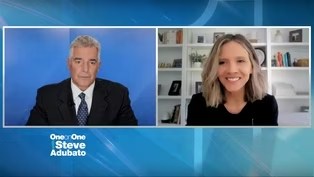
Normalizing Grief Counseling For Our Youth
Video has Closed Captions
Clip: S2023 Ep2637 | 10m 8s | Normalizing Grief Counseling For Our Youth (10m 8s)
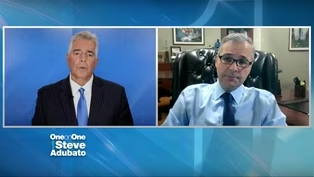
The Significance of Maintaining Your Vascular Health
Video has Closed Captions
Clip: S2023 Ep2637 | 7m 37s | The Significance of Maintaining Your Vascular Health (7m 37s)
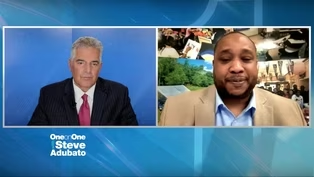
This Entrepreneur is Helping Families in Need
Video has Closed Captions
Clip: S2023 Ep2637 | 9m 51s | This Entrepreneur is Helping Families in Need (9m 51s)
Providing Support for PBS.org
Learn Moreabout PBS online sponsorship
- News and Public Affairs

Top journalists deliver compelling original analysis of the hour's headlines.

- News and Public Affairs

FRONTLINE is investigative journalism that questions, explains and changes our world.












Support for PBS provided by:
One-on-One is a local public television program presented by NJ PBS