One-on-One
Amanda Tibok; Sylvester P. Lukasiewicz
Season 2024 Episode 2730 | 25m 8sVideo has Closed Captions
Amanda Tibok; Sylvester P. Lukasiewicz
Steve Adubato and One-on-One Correspondent Mary Gamba talks with Amanda Tibok, Executive Director of the Sharing Network Foundation, who discusses leadership and relationship building, especially tied to fundraising. Sylvester Lukasiewicz, Editor of SPL Films and Lessons in Leadership, discusses teamwork, collaboration, and the importance of following up and following through.
Problems playing video? | Closed Captioning Feedback
Problems playing video? | Closed Captioning Feedback
One-on-One is a local public television program presented by NJ PBS
One-on-One
Amanda Tibok; Sylvester P. Lukasiewicz
Season 2024 Episode 2730 | 25m 8sVideo has Closed Captions
Steve Adubato and One-on-One Correspondent Mary Gamba talks with Amanda Tibok, Executive Director of the Sharing Network Foundation, who discusses leadership and relationship building, especially tied to fundraising. Sylvester Lukasiewicz, Editor of SPL Films and Lessons in Leadership, discusses teamwork, collaboration, and the importance of following up and following through.
Problems playing video? | Closed Captioning Feedback
How to Watch One-on-One
One-on-One is available to stream on pbs.org and the free PBS App, available on iPhone, Apple TV, Android TV, Android smartphones, Amazon Fire TV, Amazon Fire Tablet, Roku, Samsung Smart TV, and Vizio.
Providing Support for PBS.org
Learn Moreabout PBS online sponsorship- [Narrator] Funding for this edition of One-On-One with Steve Adubato has been provided by Hackensack Meridian Health.
Keep getting better.
The New Jersey Education Association.
Valley Bank.
The Russell Berrie Foundation.
Making a difference.
Horizon Blue Cross Blue Shield of New Jersey.
Here when you need us most.
PSEG Foundation.
Seton Hall University.
Showing the world what great minds can do since 1856.
The Healthcare Foundation of New Jersey.
And by The Turrell Fund, a foundation serving children.
Promotional support provided by BestofNJ.com.
All New Jersey in one place.
And by NJBIZ.
Providing business news for New Jersey for more than 30 years, online, in print, and in person.
- This is One-On-One.
- I'm an equal American just like you are.
- The way we change Presidents in this country is by voting.
- A quartet is already a jawn, it’s just The New Jawn.
- January 6th was not some sort of violent, crazy outlier.
- I don't care how good you are or how good you think you are, there is always something to learn.
- I mean what other country sends comedians over to embedded military to make them feel better.
- People call me 'cause they feel nobody's paying attention.
_ It’s not all about memorizing and getting information, it’s what you do with that information.
- (slowly) Start talking right now.
- That's a good question, high five.
(upbeat music) - Recently, together with my colleague, Mary Gamba, on our series Lessons and Leadership, we had a conversation with Amanda Tibok, who's executive director of the Sharing Network Foundation, an important conversation about organ and tissue donation, an important conversation about passion in the work you do every day, and making a difference in the lives of others.
This is Amanda Tibok.
We're now joined by Amanda Tibok, who's executive director of the Sharing Network Foundation.
Good to see you, Amanda.
- Good morning, Steve, Mary.
So great to see the both of you.
- Great to see you.
The website will be up for the foundation.
Tell us exactly what the Sharing Network Foundation is because it's really important.
- It sure is important, Steve.
The Sharing Network Foundation was created to support the work of New Jersey Sharing Network, who you've been partners with for a long time.
New Jersey Sharing Network is New Jersey's organ recovery agency and simply put, we recover and placed donated organs and tissue for the purpose of transplant for the New Jersey residents who are waiting for that second chance at life.
The foundation's role is to facilitate the gratitude that our families have for the care that they receive, both at the bedside and for transplant recipient families, that second chance at life that they did receive.
And we do that through philanthropic giving.
The funds raised through our foundation support, clinical advancement and research in our state-of-the-art laboratory, family support programs for donor families and transplant recipient families alike, and then most importantly, the public education component.
Educating people about the importance of saying yes to registering to be an organ donor.
And that's what it's all about.
- And the "Say Yes, Save Lives".
That's a campaign, right, Amanda?
- It is.
So we call that a thematic goal.
Here at New Jersey Sharing Network, our senior leadership team works very hard to create these rally cries, if you will, for our staff and our community to rally around.
Our current theme is "Say Yes, Save Lives", as you mentioned, and it has various meanings, say yes in regards to the registry, the importance of registering to be an organ donor.
In fact, that will be the messaging on this year's 5K T-shirt next to our sunflower, which as you know, is a big icon of New Jersey Sharing Network.
But secondly, for our internal staff and our volunteers, it's about saying yes to going above and beyond the job description, going to help your neighbors saying yes to maybe dropping off a copy for a fellow staff member who's on site, supporting families, saying yes to whatever it might be that we can support that next family and ultimately give someone else a second chance at life.
- So, to disclose a couple things.
Number one, Carolyn Welsh, the CEO, is a trustee of the Caucus Educational Corporation and also the Sharing Network, longtime underwriters of what we do in terms of our public awareness programming around organ and tissue donation.
I say yes to Mary Gamba jumping in right here.
- That was a great segue, Steve.
- What a smooth transition.
Amanda, talk a little bit about leadership, partnerships, collaboration.
You and I talked a little bit offline just about how important it is, no money, no missions, Steve and I talk about that all the time, always looking to raise money for our own nonprofit on this end.
How important are the partnerships with your volunteers, your trustees, the donors?
Talk about that connection between leadership and relationship building.
- Sure.
It is so important, Mary, and relationships, partnerships, it's really at the core of what we do here at the Sharing Network Foundation.
You know, when you think about philanthropy, giving, there's really a well-known kind of cycle of how gifts and support is received.
And it always starts with creating an extraordinary experience.
You have that extraordinary experience, you know, you build the relationship with, whether it's a volunteer, a board member, all the way to, you know, accepting their support, whether it's by their time, their financial giving, their support in their community, all the way to stewarding them and saying thank you.
And that's a big part of what we do.
But you know, that creating the extraordinary experience to me is all about the relationship.
It's about how we can kind of bring the mission front and center for those that we serve, but also for our partners thinking what can they get out of this partnership as well?
You know, certainly the mission is why we're all here.
We want to save and enhance lives through the miracle of organ and tissue donation.
But, you know, other than that, what can we do for our partners to get even more out of this partnership for them, whether that be employee engagement, opportunities for more volunteers to come to events like our 5K celebration of life and education.
You know, we love to visit different organizations to do education around organ tissue donation.
- Speaking about partnerships, together with our partner, Jacqui Tricarico, I'll be joining the, the 5K is coming up and we look forward to that every year we'll be doing a series of interviews of all kinds of folks who are connected to the Gift of Life and The Sharing Network.
But Mary and I talk about this all the time, we talk about "strategic relationship building", meaning, for a lot of people, they think relationship building is organic, it just happens.
And in lot of our leadership research and work, we argue," Hey listen, it's not always organic and it just happens.
You have to be consistent, strategic, you have to be persistent about it."
And someone says," Well, then aren't you manipulating a relationship?"
And I'm like," No, because it just doesn't happen by chance."
Where did you learn this relationship building thing?
I'm fascinated by that.
- Yeah, that's an interesting question.
You know, when I think of relationship building, you're absolutely right.
There's a fine line between what's organic and what's innate in someone that makes them a good connector, if you will.
But then there also is the strategy behind it.
How often are you following up with someone how genuine are you being in your interest in what they bring to the table?
- And hold on one second Amanda, or is it just transactional?
I'm trying to get something from you, so that's it.
When I get something from you, we're done.
That's not a relationship that matters.
Go ahead.
- It sure isn't.
And you know, here at New Jersey Sharing Network and specifically within the Foundation, relationships, like I said, it's the heart of what we do.
Philanthropy is all about the give and the take.
And so, when our team focuses on sponsorships and partnerships, it's all about staying connected.
And, you know, having those conversations about what's meaningful to our supporter, whether it's visibility on a T-shirt or whether it's having us come in for, you know, or offering them in for a tour, offering our meeting space.
But other than that, you know, for me it kind of boils down to friendship.
You know, I find myself in being real in and out of the office.
Who I am at home is who I am here at New Jersey Sharing Network and I've always been about connecting.
It's always been something that's kind of innate in me.
- That's you, that's who you are.
- It is.
- I'm from a big Italian family, so you know, it's natural.
- Oh, there you go, you said it.
- Hold on one second.
you went there.
Are you saying Amanda, that those of us who happen to have parents, grandparents, other generations who came from Italy, mostly southern Italy because it was so poor and people were coming to the United States to, because there was no work there.
Are you saying that Italian-Americans are better at relationships?
- Certainly not all I can speak about is- - I dunno where to go from here.
- No, I'm teasing, I'm joking.
- I actually have a very important question to ask.
- Oh, okay.
- If I may jump in saying, how do you like that segue, that transition that- - Amanda, our relationship, Mary basically shuts me down and says, " I'm gonna do something serious right now."
Go ahead, Mary.
- Steve was asking about where your passion came from and sure, the Italian-American background, definitely interesting.
You also shared offline with me just the fact that you had studied dance at college and Steve and I on Lessons and Leadership, often talk about the connection between sports and leadership.
And can you share a little bit about how that dance background, how you apply it to your positive attitude, your grit, your resilience, and just simply your approach as a leader at the Sharing Network Foundation?
- Yes, absolutely.
So, you know, I've been with the Sharing Network for 12 years now.
I started in 2012.
This is actually my 12 year anniversary coming up this month in April.
And before that, you know, I held various roles at the Sharing network.
Our marketing team, I worked very closely with our volunteers.
But prior to that, I was fresh out of college and as you said, Mary, I studied dance.
I can't remember a time when my life didn't include dancing.
It's something I have a passion for.
And as you said, I think it translates so perfectly in thinking about leadership.
There's a lot of team building as you can imagine, that goes into dancing.
And while a lot of my peers at the time were busy studying for midterms and finals, you know, I would do the same for my academic courses, but I would also be rehearsing late at night for our mid and end of year performances.
And so, you know, when you think about performing, I spent a lot of time on stage.
You have the opportunity to connect with not only your fellow dancers, but also with your audience.
And it's a unique opportunity to kind of get to know yourself in a way where you understand, both internal reflection and how others perceive you.
And you mentioned the grit, the perseverance that comes along with it.
Of course, those are all things that are part of it.
But really it comes down to, for me, is authenticity.
And you know, in a leader as a dancer, no one cares if you're perfect.
You know it needs to come from the heart, it needs to be real or you're gonna lose your audience.
And, you know, I feel the same way here about the Foundation, our generous board, our amazing staff, we're all part of a huge team and I think I owe it to them and to myself to just be authentically me, each and every day.
- Amanda, I never thought about the connection between dance, leadership, teamwork, but that's an interesting way to connect things.
And to you and your colleagues and partners at the Sharing Network and Sharing Network Foundation, we look forward to being there.
We're taping this the beginning of April.
So the 5K's coming up, we will be there, we look forward to those interviews because for those who have followed that series that we've been doing, that public awareness effort for so many years, the stories of people who are survivors, family members of those who gave the gift of life, those who received the gift of life, they themselves and family members of those who received the gift of life is extraordinary.
It's beyond all the statistics, the facts, the figures, it's about people's lives.
It is about saving lives.
And so to you and your colleagues, I wanna thank you for the work you're doing every day.
We appreciate it, Amanda.
- Thank you Steve.
We appreciate your partnership and helping us get the message out.
- It's our honor.
We'll be right back right after this.
- [Narrator] To see more One on One with Steve Adubato programs, visit us online at stateofaffairsnj.org.
If you would like to express an opinion, email us at info@caucusnj.org.
Find us on Facebook at facebook.com/steveadubatophd and follow us on Twitter @steveadubato.
- We're now joined by Sylvester Lukasiewicz, who is editor, SPL Films.
Good to see you, Sylvester.
- Good to see you, Steve.
Hi Mary.
By way of background, Sylvester not only has his own, his entire operation and you can check out his website, but he has been the editor of our Lessons and Leadership series from day one.
The theme in many ways of this segment, and one of the biggest reasons we wanted have you on, is teamwork.
It's so many cliches, Sylvester, around, oh, teamwork, we're a great team.
All for one, one for all.
The reality is that's who and what this team is.
Talk about it.
- Yes, I think going back to day one when we started working together, first of all, episode number 14 was my first one, but first one that went over Zoom remotely.
And so it's a very interesting study for me Corporate and cable communications, communications over distance, something that is not tangible but effective.
And so the ability to produce something for almost four years, three months short of four years without meeting someone, I'm talking about team Lessons and Leadership, it has been really something groundbreaking for me.
It really is this sort of connection that you develop over time, whether in school or in the playground or in church or wherever it is you are.
You carry that with you and at one point all these roads merge and say, hey, this is the time, this is the place where we need to create something, and then (imitates fusion) fusion.
And I think that's what happened with Lessons and Leadership.
And I think we've had many projects with Elvin and Scarlyn.
You know, we work during the day in the same place.
It doesn't change.
It's the same kind of connectivity and sort of checks and balances where I know that Elvin has my back and Mary has my back, and if she says, "Hey Syl, can you look for this or change that or double check?"
I got her back as well.
And so it's almost like reigniting all the time, and it's never going pale or stale or boring.
So I think that's what teamwork is about, is always going back and forth, listening to each other and observing.
I mean, the fact that we were able to meet in person back in January, it was so solidifying for me because a handshake or a drink with someone or you know, hugging Steve, hugging Mary, it was so visceral.
So, you know, the first time, you meet someone for the first time, it's like your first date and you automatically, - I never saw it that way, Sylvester.
- we had our, you know.
- But that's fine.
- I did 'cause we got, we went to the great, the High Lawn, right?
We went to the High Lawn.
- Props to the High Lawn, to our friends up there.
Go ahead, Mary.
- Exactly, and Sylvester was there before me, and he was standing at the bar.
I don't even know if he had an alcoholic beverage or not.
It looked like seltzer.
- No, he did not.
- Or maybe there was vodka in it.
He was driving - And then I was there and I was like, "Sylvester?"
(Mary and Steve laughing) Because we were the first two.
- Four years!
- Four years and the funny thing is when people meet me, they're always like, "You're taller than you look in Zoom," right?
Because I am.
I'm pretty tall.
I'm almost 5'8".
So that's usually the first thing that I get.
Or I get some people don't even recognize me in person.
'Cause you do, you look different, you carry yourself different.
So, but yes, categorizing it like a first date was definitely true.
- But you know what's interesting about what Mary just said and what you said, Sylvester, and again, I think about this a lot, I think about chemistry, I think about this thing people, you know, culture or chemistry, I don't wanna play word games with this, but people say it's virtually impossible.
And I use the word virtually on purpose.
It's virtually impossible in a virtual world to have chemistry and a culture and teamwork and collaboration.
But Sylvester, that's not really true because there are people who work together side by side in offices in person, and they have absolutely terrible chemistry, and the culture is not collaborative, is not trusting, as you just said.
It is not all for one, one for all.
As you said, you have each other's backs.
Talk about that, that the remote world doesn't stop us, and not just us.
This isn't about us.
It's about people who choose to be collaborative, respectful, and trusting, please.
- Yes, you're right, and I think the solution to that is, and I think Zoom, what the whole culture of working remotely woke a lot of people up, not just from being on camera and sitting up and you know, making sure the background is, you know, clear or whatever.
It's about listening.
It's about ability to give someone something to say and not just one way and everyone forgot about it, something that will be picked up and carried on with whatever the project we're working on.
Is it just a staff meeting or production meeting or is it just a one-on-one conversation with your doctor?
I mean it's sort of the communication doesn't change.
The chain can be broken by so many things.
I mean it could be, you know, technical issues.
It could be the timing or it does take not maybe practice, but sort of getting used to talking to no one, right?
Because I'm literally talking to you on my phone right now, but I know that there's Mary, there's Steve, there's Elvin and probably three or four other people.
- You don't see?
Hold on a second, sorry for interrupting while you're talking about listening.
So Sylvester, you don't see us right now?
- I see you in the periphery of my vision because I have my camera that I'm looking at.
But I can see your emotions, I can see if you pick up your book or your prop, I can see it, but it's not where I'm looking into the eyes of my listener.
So I think going back to leadership and sort of communication, you have to understand that your message is still continuing even though you're not seeing the people you're speaking to.
- What it takes, Mary, we had a guest earlier, we were taping a long day and let's just say this guest had important things to say and it was powerful except he was challenged by the experience.
I know he was challenged by the experience.
And let's just say Mary, he didn't come across in the way that I'm pretty sure he wanted to.
And a lot of it's about what Sylvester's talking about.
- Totally.
- Practicing this.
We didn't make the rules.
These are the rules.
Go ahead, Mary.
We got a minute left with Sylvester.
- Yeah, definitely, and one other thing that I wanna talk about with Sylvester, and it's something that I have coached my boys who are literally, by the time this airs, they're gonna be 19 and 22 years old and they thank me for this, is literally building trust with people and actually caring about what you're doing for those people, with those people as a team.
And Sylvester, just talk a little bit about that.
As Steve said, we have about a minute left together, but talk about your level of caring.
I mean, from the first time we, and I'm gonna use air quotes, interviewed you, and I do that because we technically didn't.
You came to us from Elvin.
We were like, this guy's it.
He's gonna be great.
But we could tell.
- Elvin Badger, our director - Yes, Elvin our director.
But sure, we could tell that you cared, that you really, you know, did.
So talk a little bit about caring and why that's important in a relationship.
- Absolutely, I think again, like you said when we first spoke with Steve and you on the phone, I automatically right away started picking up on things that I can be an asset, I can contribute with, or if there's something that I need to pick up and learn on because you guys have a particular format of the program or the way you have your deliverables and things like that.
You quickly right away adjust to what you can do, how quickly you can do it.
And that's the kind of arsenal if you, you know, pardon the pun, it is something that you can always jump in with and say, "Hey, I got your back and I care for what we're doing."
And with these things I'll be able to achieve if you miss something or something came in late or whatever the issue might be.
So I think always that sort of safety net first, Murphy's law that everything will go wrong.
So, but in the long run it's caring.
It's about the end product and that everything comes together at the end.
And like Steve says, all the graphics and all the visuals and you say mural, photos, music, sound, all that stuff, it all comes in at the end every week, week after week without taking a break.
So that's sort of, that's how I care in the long run for four years now, that the show continues, the message continues.
Lessons and Leadership don't take summer vacations.
There's no summer school.
(Mary and Sylvester laughing) - No.
- Right?
So I think that's what it is.
It's really just caring about what you do, what you're hired to do, but also feel passionate about, because I do feel passionate about this.
- You know, some folks may wonder why are we taking a segment like this and airing it on our sister series One on One.
Here's the reason, because teamwork.
It isn't just teamwork on our sister series Lessons and Leadership.
It's for all of you who are part of a team.
I'm not gonna get on my soapbox about leadership and teamwork, but we're all on a team.
You may see yourself working in a silo or I'm in my lane.
We don't have that luxury.
So this collaboration was really, is really an effort at us to say, look, there are mistakes, problems happen all the time, but when they do, this team tries to come together as quickly as possible and figure out, hey, how do we deal with it?
How do we fix it?
And what do we learn from it?
And so to our longtime editor from day one on Lessons and Leadership, Sylvester, I wanna say thank you and also thank you to our director once again, Elvin Badger, who brought us together, make our team better.
Thanks Sylvester.
Appreciate it.
He'll be editing this, his own segment, in just a couple weeks.
Thanks, Sylvester.
- Thank you.
- [Narrator] One-On-One with Steve Adubato is a production of the Caucus Educational Corporation.
Celebrating 30 years in public broadcasting.
Funding has been provided by Hackensack Meridian Health.
The New Jersey Education Association.
Valley Bank.
The Russell Berrie Foundation.
Horizon Blue Cross Blue Shield of New Jersey.
PSEG Foundation.
Seton Hall University.
The Healthcare Foundation of New Jersey.
And by The Turrell Fund, a foundation serving children.
Promotional support provided by BestofNJ.com.
And by NJBIZ.
- (Narrator) Life is full of changes.
At Hackensack Meridian Medical Group, we're ready for them.
If you have a cold or chronic illness, our five star doctors can treat any ailment.
Whether you're starting recess or retiring, we're prepared with pediatric and adult specialists.
And if you just moved here, we are in your neighborhood.
You now have access to a health team thousand strong.
So no matter what or when, we're ready.
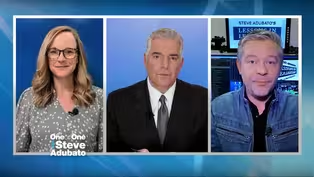
Lessons in Leadership Editor Talks Teamwork & Collaboration
Video has Closed Captions
Clip: S2024 Ep2730 | 11m 20s | Lessons in Leadership Editor Talks Teamwork & Collaboration (11m 20s)
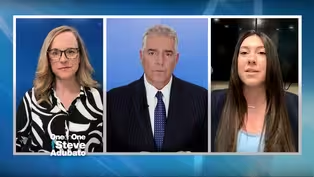
Relationship Building And Its Connection To Fundraising
Video has Closed Captions
Clip: S2024 Ep2730 | 13m 1s | Relationship Building And Its Connection To Fundraising (13m 1s)
Providing Support for PBS.org
Learn Moreabout PBS online sponsorship
- News and Public Affairs

Top journalists deliver compelling original analysis of the hour's headlines.

- News and Public Affairs

FRONTLINE is investigative journalism that questions, explains and changes our world.












Support for PBS provided by:
One-on-One is a local public television program presented by NJ PBS