On Stage at Curtis
Amane Sakaguchi | Shamisen/Composition The Journey
Season 20 Episode 9 | 26m 46sVideo has Closed Captions
Amane Sakaguchi blends Nagauta tradition with Western classical music.
Meet Amane Sakaguchi, a Tokyo-based shamisen performer, pianist, and composer who bridges traditional Japanese Nagauta and Western classical music. Performing under the stage name Kosaburo Kineya IV, she began her professional career at age 14 and carries forward a 200-year family musical legacy. She also performed in a special AAPI Heritage Month program that aired on WHYY.
Problems playing video? | Closed Captioning Feedback
Problems playing video? | Closed Captioning Feedback
On Stage at Curtis is a local public television program presented by WHYY
On Stage at Curtis
Amane Sakaguchi | Shamisen/Composition The Journey
Season 20 Episode 9 | 26m 46sVideo has Closed Captions
Meet Amane Sakaguchi, a Tokyo-based shamisen performer, pianist, and composer who bridges traditional Japanese Nagauta and Western classical music. Performing under the stage name Kosaburo Kineya IV, she began her professional career at age 14 and carries forward a 200-year family musical legacy. She also performed in a special AAPI Heritage Month program that aired on WHYY.
Problems playing video? | Closed Captioning Feedback
Where to Watch On Stage at Curtis
On Stage at Curtis is available to stream on pbs.org and the PBS app.
Providing Support for PBS.org
Learn Moreabout PBS online sponsorshipIn partnership with the Curtis Institute of Music, WHYY presents the following program.
[upbeat music] music My name is Amane Sakaguchi.
music I am a composer, but I also play the shamisen and the piano.
My father and my grandfather have been playing shamisen for generations, so for me it's sort of like lullaby, and I grew up listening to it every day.
For me, traditional Japanese music has been really something natural and something definitely in the core part of my identity in musical language.
Besides Shamisen Story, I started playing the piano when I was four years old, so a little bit earlier than Shamisen actually.
And I have been playing both instruments together my whole life.
(piano music) And I really enjoy playing both instruments.
And I, of course, enjoyed going to both genres of music concerts, so like classical music, orchestra concerts, and traditional music concerts.
[piano plays] Classical music and traditional Japanese music have been sort of co-existed in me very naturally, sort of like a bilingual situation.
That's how I got to dream of becoming a classical musician while being a traditional musician.
Actually, this is kind of interesting because when I was in my previous university in Tokyo, I was measuring in shamisen performance, and all the shamisen measuring students had to take composition class as a mandatory class.
And I was like, I don't even know how to get started, but I literally had never ever composed anything before.
So I was like 18, 19 at that point.
But I somehow managed to compose something and then I submitted and the school picked my piece for the second performance opportunity, which was off campus.
And one of the audience at the concert turned out to be a producer and she got me my very first commission.
I was also interested in composing classical music, even though I had never done that before.
And I just like looked it up on the internet and I found this American composer.
And then I contacted him and he introduced me to my very first teacher.
And then we had Zoom lessons online because I was in Japan.
And that's how I got to start composing classical music.
We're clamoring for representation, but since we don't have a voice, it's so hard to do it.
You know, you get in that mix of not being Korean enough or not being white enough and you don't really know where you fit in.
I very much identify with that.
Sometimes being like, "You don't really belong anywhere."
You know, you're not enough of one.
And I feel like that informs my experience more than anything, is also never having a feeling of belonging.
I feel when I speak English, I'm a different person.
I have different personalities when I speak English.
I found myself actually trying to assimilate more into the U.S.
culture and trying my very best to hide the Filipino part of me because I feel like that's how I would be taken more seriously.
Echoes in the rice field.
It's the first piece that I actually used shamisen in my classical music.
[MUSIC PLAYING] [BELLS RINGING] As a composer, I don't know, once I'm done with composing, it's like basically it's done.
But then-- so I was imagining, before being a composer, I was imagining, oh, so the composer finished composing their pieces, then they're done and, you know, at the concert they would be relaxed, but it was wrong.
And when I was actually at one of the premier concerts at Curtis, I was like so nervous, maybe even more nervous than my performances.
It was more like sending your own child to the world sort of feeling.
And it was a completely different kind of feeling.
And it was very interesting, but I was so nervous and I was curious.
It was more like letting the audience know all of myself, everything about myself.
And I felt very vulnerable.
Thank you so much for coming here tonight for us.
I feel so grateful to be here to be able to share my music with you tonight, played by my amazing friends/musicians.
So the piece I'm going to get premiered tonight is Three Facets of Matcha.
Yes, that matcha that you can get at a cafe.
But the audience liked some of my pieces and that was cool that they could understand what I wanted to say through my music.
The first movement depicts the feelings or emotions of a person who has never ever tried matcha or even heard of the word matcha before.
So it's basically a questioning piece full of curiosity excitement a little bit of nervousness you know all this kind of complex emotions and in the end of the first movement there is this moment when someone you know try actually tries the very first bowl of matcha.
So I hope you enjoy that moment as well.
And in the second movement I try to depict the traditional Japanese tea ceremony.
The reason I picked that topic is my grandma practices tea ceremony so she often took me to some of tea gatherings with her and even as a very young child I was just astonished by you know this beautiful serenity and you know silence there and like you know the appreciation and respect for others during the tea ceremony so I just wanted to depict those things and you know it's the place where you can actually concentrating in you know presence and your own breathing so that's what I wanted to portray and the third movement I wanted to illustrate the motion of grinding tea leaves into the fine powder of matcha.
So I hope you'll enjoy the piece.
You'll explore the journey of matcha and also hope you'll enjoy matcha more after listening to this piece.
So thank you again so much for being here and I'm so excited for the performance.
Thank you so much.
[music] The world of musicians could be really, really competitive, and sometimes that will for sure affect friendship and everything, but it's really cool that they keep it that way.
I feel like I can enjoy composing and also enjoy listening to other composers' pieces and be supportive to each other.
I want to compose an opera that's incorporating the idea of Japanese traditional music and also like symphony or shamisen concerto maybe, but not as in like just using shamisen and with an orchestra.
Like I actually want to put some little essence from Japanese music, not too obviously, and then people would be like oh that's really cool and then the cool thing about it should be something to do with Japanese culture, Japanese traditional music so that's my goal yeah.
One mother's blade will strike Thus, thought I, better that the burden fall to me, "Pace thee," he said, "and do thy work swiftly."
I'm so grateful that I don't have anything that I'm regretting about my childhood, or like that I don't have anything that's like, "Oh, I should have done that," you know, because my parents and my family, my friends, my teachers, let me do whatever I wanted to in music.
So I would say, absorb as many things as possible.
And don't hesitate to get to know new things.
Even though you feel like, oh, I know this, there must be some room of the things that you don't know or you haven't experienced.
So yeah, that would be my advice for my younger self.
And for my future self, I would say never lose curiosity towards things because it's the most important thing to be a composer, you know, for me.
And to enjoy knowing new stuff.
But I want to keep studying here in the States a little bit more.
Maybe artistic diploma or something.
But my future goal is to compose Western classical music that incorporates the idea of Japanese traditional music.
[Music] [Singing] [Music]
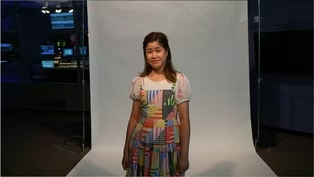
Amane Sakaguchi | Shamisen/Composition The Journey Preview
Preview: S20 Ep9 | 30s | Amane Sakaguchi blends Nagauta tradition with Western classical music. (30s)
Providing Support for PBS.org
Learn Moreabout PBS online sponsorship
- Arts and Music

Innovative musicians from every genre perform live in the longest-running music series.






 New Episode





Support for PBS provided by:
On Stage at Curtis is a local public television program presented by WHYY