One-on-One
Amb. Marie Yovanovitch (Ret.); Robert Battle
Season 2022 Episode 2568 | 26m 30sVideo has Closed Captions
Amb. Marie Yovanovitch (Ret.); Robert Battle
Ambassador Marie Yovanovitch (Ret.), former U.S. Ambassador to Ukraine joins Steve Adubato to discuss her testimony at former President Trump’s first impeachment trial and why Ukraine’s democracy matters; Robert Battle, Artistic Director, Alvin Ailey American Dance Theater, highlights Alvin Ailey’s extraordinary legacy and empowering social justice through the arts.
Problems playing video? | Closed Captioning Feedback
Problems playing video? | Closed Captioning Feedback
One-on-One is a local public television program presented by NJ PBS
One-on-One
Amb. Marie Yovanovitch (Ret.); Robert Battle
Season 2022 Episode 2568 | 26m 30sVideo has Closed Captions
Ambassador Marie Yovanovitch (Ret.), former U.S. Ambassador to Ukraine joins Steve Adubato to discuss her testimony at former President Trump’s first impeachment trial and why Ukraine’s democracy matters; Robert Battle, Artistic Director, Alvin Ailey American Dance Theater, highlights Alvin Ailey’s extraordinary legacy and empowering social justice through the arts.
Problems playing video? | Closed Captioning Feedback
How to Watch One-on-One
One-on-One is available to stream on pbs.org and the free PBS App, available on iPhone, Apple TV, Android TV, Android smartphones, Amazon Fire TV, Amazon Fire Tablet, Roku, Samsung Smart TV, and Vizio.
Providing Support for PBS.org
Learn Moreabout PBS online sponsorship- [Narrator] Funding for this edition of One-On-One with Steve Adubato has been provided by Newark Board of Education.
Prudential Financial.
New Jersey Institute of Technology.
NJIT makes industry ready professionals in all STEM fields.
Hackensack Meridian Health.
Keep getting better.
Summit Health a provider of primary, specialty, and urgent care.
Robert Wood Johnson Foundation.
Working for a more a healthier, more equitable New Jersey.
PSEG Foundation.
Wells Fargo.
And by MD Advantage Insurance Company.
Promotional support provided by BestofNJ.com, all New Jersey in one place.
And by Northjersey.com and Local IQ.
Part of the USA Today Network.
- This is One-On-One.
- I'm an equal American just like you are.
- The way we change presidents in this country is by voting.
- I'’m hopeful that this is the beginning to accountability.
- Life without dance is boring.
- I don't care how good you are or how good you think you are, there is always something to learn.
- I did do the finale, and guess where my trailer was?
A block away from my apartment, it couldn'’t have been better!
- People call me 'cause they feel nobody's paying attention.
-_ It'’s not all about memorizing and getting information, it'’s what you do with that information.
- (slowly) Start talking right now.
- That's a good question, high five.
(upbeat music) Hi everyone.
I'm Steve Adubato.
It is absolutely my honor on behalf of everyone at the Caucus Educational Corporation and our partners in public broadcasting to introduce Marie Yovanovitch who is not just the former US Ambassador to Ukraine but the author of this book, "Lessons from the Edge, a Memoir" Ambassador, thank you so much for joining us.
- Oh, it is such a pleasure to be on with you, Steve.
Thank you.
- I wanna just jump right into this 'cause it's whatever time we have with you I wanna take advantage of.
The date back in November the 15th, 2019.
You're testifying in the first President Donald then President Donald Trump impeachment proceedings inquiry.
Did you ever imagine after 30 years as an ambassador in the State Department as a diplomat, foreign service, that you would be testifying in a presidential inquiry looking to impeach President Trump?
You ever imagine that?
- How could one, you know, and it's honestly the worst place, a public servant, you know, we are all about serving the public good, the American people.
How could I have imagined that I would be caught between and not just me, I mean all of the witnesses, between Republicans and Democrats, between an executive branch and a legislature, and an impeachment inquiry in advance of presidential elections.
I mean, that's not a place that any nonpartisan career, public servant wants to be.
- As I go back and try to piece this together in preparation for the interview, there are a couple things you've said in the book that are important.
You said you were an introvert by nature.
You're a behind-the-scenes person by nature.
You never wanted to be out front.
So you're doing your job in Ukraine.
Why the heck does then President Donald Trump target you?
And why does Rudy Giuliani, his attorney at the time, target you?
And why does Lev Parnas, who was working with Giuliani and others, and a whole range of other oligarchs, if you will, in Ukraine, why do they target you?
- Well, you know, I think I was collateral damage, so to speak.
At least from the US point of view I don't think it was particularly about me.
Although there were some private interests that were interested in doing sweetheart deals in Ukraine and if the US government was strong on anti-corruption and kind of holding the line, that would be more difficult.
But I think it was corrupt interest in the United States.
And by that I don't necessarily mean money changing hands.
I mean people using the public good to, for their private purposes.
So in this case, those around President Donald Trump and then Donald Trump himself using his office to get information that he thought was available in Ukraine about former Vice President Biden who he thought would be his main opponent in the next presidential elections, and his son Hunter.
And those interests in the US found corrupt interests in Ukraine, who did not like the fact that our policy was to support Ukrainians who wanted to fight corruption.
And one of those people was Lutsenko, the prosecutor general.
And I think basically the deal was, I want Yovanovitch out of there and in exchange I will provide you with what you want on the Bidens.
I mean that's... - You mean, dirt on the Bidens.
I'm sorry for interrupting Ambassador.
The key was, or what they were looking for was dirt on the Bidens.
And as I read the book and as people listen to your testimony, you were perceived to be in the way.
- Yeah.
- Ambassador, help us to understand this, the role of an ambassador.
You have argued in the book and said in the book that it's complicated, it's multifaceted, it's not black hats and white hats, good and evil.
It's more complicated.
The different places that you served Ambassador, as ambassador to clarify that for everyone so that people can understand how you get to the Ukraine.
- Yeah.
So, you know, I was a Russian speaker from my days in college and I had spent a year in the Soviet Union as an exchange student.
And then I joined the Foreign Service.
A number of years later, the Soviet Union fell apart.
There were all sorts of opportunities there.
And so I served in Moscow as a relatively junior officer and in various, in a couple of other places as well.
And served in Ukraine as the number two in the beginning of the 2000s.
And then became an ambassador in Kyrgyzstan one of the former republics of the Soviet Union, then Armenia, and then finally Ukraine in 2016.
And yeah, so it was, I'm a regional expert, so to speak.
And you know, it's a fascinating area as we all now know.
- And your family history matters here, does it not?
- It does.
My parents were immigrants to the United States, as am I.
They brought me with them.
Although I grew up in the United States and was educated here.
Each of my parents is half Russian.
My father was a Russian speaker, my mother was not.
And so I did not grow up speaking Russian.
But my parents, having grown up in totalitarian regimes, they understood what it was to be Americans and American citizens and the privilege it is for us to be living in the United States and to worship as we please to say what we wanted to say without fear of being locked up or something like that.
And they taught my brother and I that this was a real privilege and an honor and that we needed to give back.
And so, over time, you know, 'cause everybody I think takes detours in their youth.
I found my way to the foreign service, which was a way of marrying up my passion for history and politics and policy, foreign policy, especially, with serving the American people and giving back.
- Ambassador, when you were testifying that day in November, 2019, what was the main message you wanted to get across to not just the nation but the world?
- Well, primarily, I have to say I was thinking about a domestic audience.
I mean, clearly there were the men and women in front of me in the House of Representatives.
I mean, that was one audience.
But primarily, I was thinking about the broader audience in America that doesn't often, I think, necessarily think about foreign policy or, what does the State Department do?
And I wanted to bring home to Americans what we do as foreign service officers as civil servants in the state department what we do to protect and defend the American people every day.
You know, on the commercial side, negotiating treaties, at trade deals, quotas for various types of imports and exports, protecting American citizens, safeguarding our political interests and so forth.
- Ambassador, I'm sorry for interrupting, but one of the things that that really hit me is that while you're testifying, President Trump is tweeting.
He's saying a whole range of things about you.
All terrible, all negative, all bad.
Others are on the internet saying, calling for your assassination.
There's a noose waiting for you.
A whole range of things that were said about you.
Rudy Giuliani involved as well.
People go back and read about what was said about you.
To what degree, 'cause you said in the book you felt you had to do this.
It wasn't even a choice.
And as we put up the graphic, Democracy at a Crossroads, you write in the book that this has to do with democracy not only at a crossroads, but beyond that potentially.
That our system of small D democratic government is totally at risk.
Talk about that.
You had to do this.
- I felt I had to do this even though I was, it was a frightening time, frankly.
I had already been essentially fired by the President, removed from my post in Ukraine for doing my job.
Just to remind your audience, I know you know this but several weeks before that happened the State Department had asked me to extend my time in Ukraine by a year.
I guess 'cause they thought I was doing an okay job.
And then of course I was removed because I was perceived to be sort of in the way of other plans.
So then fast forward to the perfect phone call between President Zelensky and former President Trump, which happened in July.
But I didn't know about the contents until the end of September.
- President Trump called it a perfect call.
He kept repeating it was a perfect call in quotes.
Go ahead, I'm sorry.
- Yeah, thank you for clarifying that.
So it was, you know, the transcript was released by the White House at the end of September.
And in that, I was shocked to find that two presidents are talking about a mere ambassador and President Trump says, that woman and she's gonna go through some things.
And so for me it was like, well what does he mean by that, 'cause he's already fired me.
But you know, as more and more information was coming out in part because of investigative journalists such as yourself and others.
As more information was being released from the White House and other sources, it just became clear that I needed to testify even though I didn't know what kinds of things I was going to "quote" go through.
And the reason for that is that although both the White House and the State Department put a lot of pressure on potential witnesses not to testify this was a constitutional process.
You know, yes, there is a political element to it but the Congress has a constitutional role to oversee the activity of the executive branch.
There were clearly questions here as to what the executive branch did, and they had a right to investigate and they had a right to call us up.
And it felt like I had, if they needed my information, I needed to go forward and provide that information.
Not as a, I was a fact witness.
I mean, this is what I saw, this is what I know, this is what I can tell you.
Not as somebody to opine as to whether or not this is... - No, there was no conjecture.
It was fact driven.
Could you do this in a minute left that we have?
Ambassador, Ukraine matters because?
- Ukraine matters because this is about our national security.
It's the right thing to do to support a democracy like Ukraine whose rights have been violated, their sovereignty, their territorial integrity, their borders.
But it is also the smart thing to do because it is about our national security interests.
Putin has told us he's gonna keep on going.
If he prevails in Ukraine, we cannot... That will be a place that will be very dangerous for the world and certainly for every American.
We will be less free, less prosperous, and less secure.
- Ambassador, I thank you so much for joining us and sharing your perspective.
This is the book, Marie Yovanovitch and it is called "Lessons from the Edge, A Memoir."
I wish you all the best in your future endeavors and also to your family.
Thank you Ambassador.
- Thank you very much.
- You got it.
Stay with us.
We'll be right back.
- [Narrator] To watch more One on One with Steve Adubato find us online and follow us on Social media.
(upbeat dance music) - We are honored to be joined by Robert Battle, Artistic Director of the Alvin Ailey Dance Theater.
Mr. Battle, great to have you with us again.
- Thank you.
It's great to be with you.
- Yeah, this is part of "The Arts Connection" series.
You'll see the graphic up.
And we just saw a reel, some video from Alvin Ailey.
Your work at this extraordinary, iconic institution, arts institution.
You're only the third artistic director.
There was Alvin Ailey, there was Judith Jamison, and now there's you.
How important is that to you professionally and personally?
- Oh my goodness.
So important.
As a kid who grew up in Miami, Florida, but more importantly, in Liberty City, you know, the success stories are sometimes far and few in between, right?
It's an underserved community.
And getting the chance to see the company live when I was about 12 years old when I was bussed, as many of us are, to Miami Beach to see a performance for young people of the Alvin Ailey American Dance Theater.
I mean, it just blew me away.
It touched my soul, never knowing that someday, I'd go from there to being only the third Artistic Director of the company.
So, it means everything to me professionally, but more so personally that I get to be a part of the legacy.
- For you, as a young man growing up and being in Miami, Alvin Ailey, they come through, they perform.
Be more specific, if you could, for those of us who do not have the skills, the tools, the gift, right?
We don't have, I don't have the arts gift.
This is my art.
That's all there is.
So, what exactly changed or impacted you in such a visceral, spiritual, deep level?
- Well, as a kid who grew up going to church, my mother had a group called the "Afro Americans."
She wanted to be an actress.
And she's actually my cousin.
I was brought up by my great-aunt and uncle, and when my great-aunt passed, their daughter took on the role as mother, and she was the theatrical one.
Into the arts, she played piano for the church that we went to, she had a group called the "Afro Americans" that did poetry and song relating to the Black experience.
She was an English teacher, so I was surrounded by literature and those wonderful artists and poets.
Langston Hughes, Maya Angelou, hearing all of those words when I was really young, and absorbing all of that about my people and their contributions to this country and the world.
And then learning the spirituals that has played such an integral part of our survival as a people.
And then there I am.
I got into dance.
First I was singing, I had a soprano voice.
I played classical music, because my mother got me a teacher that would come every week for about $6.
She'd do a 30-minute lesson with me.
I mean, you can't imagine now.
And what with inflation, forget it.
It'd be 60.
But, and then moving into dance, because I liked to imitate Michael Jackson, my mother loved watching movies with Fred Astaire and Gene Kelly and Ginger Rogers, Bill "Bojangles" Robinson.
So, I was already primed, in the arts, in the notion of what it meant.
And then seeing "Revelations," Alvin Ailey's masterpiece that he created in 1960, a suite of spirituals expressing the experiences of Black people in this country and the role that faith played in overcoming adversity.
Seeing that dance was like seeing a reflection of my life, a reflection of myself, of everything that I knew up until then.
But seeing it dance somehow touched me in the way that words never could.
And so that was the spiritual awakening I had in that theater.
- Robert, let's do this.
You mentioned "Revelation" in 1960.
It was just a few years after the Brown versus Board of Education decision, "separate but equal," right?
The questioning of integration, of segregation, of race relations in this country.
Such an important historical time in our nation.
And as you said, 29 years of age, Alvin Ailey was, 29 years of age, and he creates "Revelations."
I could talk about it, but as a non-artistic non-dancer, I mean, I looked at this and I told our Executive Producer, Georgette, I mean, it moved me in a certain way, and I can't imagine what it did for someone like you who has the gift and feels it.
So, without listening to me any longer, here's "Revelations."
♪ I've been 'buked and I've been scorned ♪ ♪ I've been talked about, show's you're born ♪ ♪ Didn't my Lord deliver Daniel ♪ ♪ Deliver Daniel, deliver Daniel ♪ ♪ Didn't my Lord deliver Daniel ♪ ♪ Then why not a every man?
♪ ♪ Ooh, fix me Jesus ♪ ♪ Ooh, fix me Jesus ♪ ♪ Ooh, fix me Lord ♪ ♪ Fix me Jesus, fix me ♪ (crowd applauding) - Let me ask you, Robert, now, 2022, going into 2023, "Revelations" matters more than ever, does it not?
- It does, you know, I think that the fact that Alvin Ailey created it on the cusp of, during the Civil Rights Movement, everything that was going on in this country and he had the audacity to give us through that dance.
I mean, it starts with the spiritual, "I've been 'buked and I've been scorned," it ends with "Rocka My Soul in the Bosom of Abraham."
He gave us a personal experience but it also turned out to be universal.
But it also, in that time, to have a message of hope.
I think it's so important for us right now.
I mean, we've been dealing with so much, you know, the current climate of our sort of political discord.
You know, it reminds us that there still is hope.
And I think that's so important right now.
You know, during the pandemic when we were trying to figure out what to do because what we do is perform all over the world and certainly all over this country, live performance.
It's about bringing people together.
And so when we couldn't do that, it was really devastating.
But I remembered the quote from Alvin Ailey that says, "Dance comes from the people and should always be delivered back to the people."
And then I thought, in always.
And so instead of saying that we're dancing in spite of the pandemic, we're dancing because of our love of Alvin Ailey, his legacy "Revelations" and what it means to people, and what it meant to a young person like me many years ago, and what it did for me and what it does for so many all over the world.
- So important.
And can I get you real quick on this?
Give me the Newark connection to Alvin Ailey.
- Yes, yes.
It's been a very vibrant connection and certainly to NJPAC.
I mean, we were one of the first companies to perform there when it opened.
And then we also have our arts and education programs specifically thinking about Ailey Camp, which is for underserved young people to have the opportunity to know and feel the power of dance, to change your life and open you to your creativity, your imagination.
And so, it's a very important relationship.
We come there every year.
It's usually on the weekend of Mother's Day, which is very important.
It's fabulous, and the audience is wonderful there, so we love it.
- I got a minute left.
Can you do this for us today, Robert?
With so much upheaval, with so much polarization, we don't seem to be able to connect the way we would hope and pray that that, you know, just because we're political difference is God knows what, the place for the arts, the place for dance and helping people find some, some common ground.
I know it's a big question with the minute left, please.
- Yes.
Well, I think that the quote that I always lean on is one that Maya Angelou used a lot, and it's "I am a human being, and nothing human can be alien to me."
You know, the notion that the arts speak to our common humanity, the notion that you can come to a performance and sometimes have some of the social ills of the world revealed in a different way but also be relieved from that.
And I think that even a dance that has humor like Alvin Ailey's famous "Night Creature" that he created with Duke Ellington, it has humor.
But when you're sitting in a theater and you hear somebody laugh and you laugh at the same thing, there's some communication there that says, "I, too am a human being.
And this is a human experience."
And that to me is so important right now.
- Robert Battle and the artistic director, the third in the history of this extraordinary dance theater.
Third artistic director, Robert Battle, artistic director, Alvin Ailey, American Dance.
I said it at the beginning, I'll say it again.
You honor us by your presence.
We wish you and your colleagues all the best as you continue to make a difference in the lives of others with extraordinary arts.
It's why it's called "The Arts Connection."
Thank you, Mr. Battle.
- Thank you.
- You got it.
I'll see you next time.
I'm Steve Adubato.
That's Robert Battle.
- [Narrator] One-On-One with Steve Adubato has been a production of the Caucus Educational Corporation.
Funding has been provided by Newark Board of Education.
Prudential Financial.
New Jersey Institute of Technology.
Hackensack Meridian Health.
Summit Health Robert Wood Johnson Foundation.
PSEG Foundation.
Wells Fargo.
And by MD Advantage Insurance Company.
Promotional support provided by BestofNJ.com.
And by Northjersey.com and Local IQ.
Part of the USA Today Network.
(hands clapping) (drums banging) (fingers snapping)
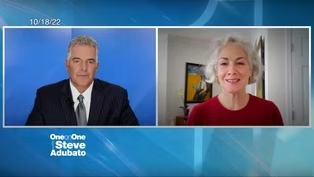
Ambassador Marie Yovanovitch Discusses Democracy in Ukraine
Video has Closed Captions
Clip: S2022 Ep2568 | 13m 16s | Former Ambassador Marie Yovanovitch Discusses Democracy in Ukraine (13m 16s)
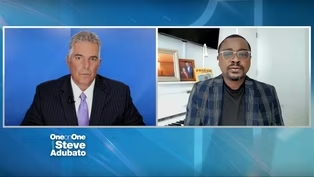
Empowering Social Justice Through the Arts
Video has Closed Captions
Clip: S2022 Ep2568 | 12m 38s | Empowering Social Justice Through the Arts (12m 38s)
Providing Support for PBS.org
Learn Moreabout PBS online sponsorship
- News and Public Affairs

Top journalists deliver compelling original analysis of the hour's headlines.

- News and Public Affairs

FRONTLINE is investigative journalism that questions, explains and changes our world.












Support for PBS provided by:
One-on-One is a local public television program presented by NJ PBS