One-on-One
Ameer Washington; Elizabeth McCarthy; Kathleen Coviello
Season 2023 Episode 2664 | 27m 12sVideo has Closed Captions
Ameer Washington; Elizabeth McCarthy; Kathleen Coviello
Ameer Washington, CEO of Boys & Girls Club of Newark, talks about the health and education services they provide to children and adults; Elizabeth McCarthy, President & CEO of the Community FoodBank of NJ, discusses her goal of reducing food insecurity by 50% by 2030; Kathleen Coviello, Chief Economic Transformation Officer of NJEDA, discusses making NJ a hub for collaboration in all industries.
Problems playing video? | Closed Captioning Feedback
Problems playing video? | Closed Captioning Feedback
One-on-One is a local public television program presented by NJ PBS
One-on-One
Ameer Washington; Elizabeth McCarthy; Kathleen Coviello
Season 2023 Episode 2664 | 27m 12sVideo has Closed Captions
Ameer Washington, CEO of Boys & Girls Club of Newark, talks about the health and education services they provide to children and adults; Elizabeth McCarthy, President & CEO of the Community FoodBank of NJ, discusses her goal of reducing food insecurity by 50% by 2030; Kathleen Coviello, Chief Economic Transformation Officer of NJEDA, discusses making NJ a hub for collaboration in all industries.
Problems playing video? | Closed Captioning Feedback
How to Watch One-on-One
One-on-One is available to stream on pbs.org and the free PBS App, available on iPhone, Apple TV, Android TV, Android smartphones, Amazon Fire TV, Amazon Fire Tablet, Roku, Samsung Smart TV, and Vizio.
Providing Support for PBS.org
Learn Moreabout PBS online sponsorship- [Narrator] Funding for this edition of One-On-One with Steve Adubato has been provided by Horizon Blue Cross Blue Shield of New Jersey.
Here when you need us most.
Valley Bank.
NJM Insurance Group.
Serving New Jersey'’s drivers, homeowners and business owners for more than 100 years.
Prudential Financial.
Kean University.
Where Cougars climb higher.
The Healthcare Foundation of New Jersey.
The Fidelco Group.
Newark Board of Education.
And by PSE&G, committed to providing safe, reliable energy now and in the future.
Promotional support provided by NJBIZ.
Providing business news for New Jersey for more than 30 years, online, in print, and in person.
And by Insider NJ.
- This is One-On-One.
- I'm an equal American just like you are.
- The way we change Presidents in this country is by voting.
- A quartet is already a jawn, it'’s just The New Jawn.
- January 6th was not some sort of violent, crazy outlier.
- I don't care how good you are or how good you think you are, there is always something to learn.
- I mean what other country sends comedians over to embedded military to make them feel better.
- People call me 'cause they feel nobody's paying attention.
-_ It'’s not all about memorizing and getting information, it'’s what you do with that information.
- (slowly) Start talking right now.
- That's a good question, high five.
(upbeat music) - Hi, everyone, Steve Adubato.
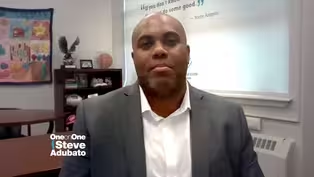
We're honored to welcome Mr. Ameer Washington, CEO, the Chief Executive Officer of a great organization, the Boys and Girls Club of Newark.
Good to see you Ameer.
- Good to see you, Steve.
- Now, I joined the Boys Club when I was six, and it was the Boys Club at the time, right?
- Yeah, absolutely.
- Broadway branch in Newark.
You were six as well.
We were not six at the same time, but you were six years old when you joined.
You didn't have to say no, we already know that.
Where was your branch, same one?
- My branch?
One Avon Avenue, here where my office is.
- Really?
- Yeah.
- Let, for people who don't know the Boys and Girls Club, and again, thank God it was changed to the Boys and Girls Club.
What was it for you at the time, in terms of your life, like, why was it so important to you?
'Cause I know for me I needed to learn how to swim, so go ahead.
- It was super important.
My neighborhood was pretty rough, and my mom was a single parent of four children.
My dad unfortunately passed away at a young age, and it just had great people there who wanted the best for me, the way my mom did.
Just had tons of fun.
- So you started working at the Boys and Girls Clubs at 15, doing what?
- I was tutoring young people for homework for two hours a day, and that's where it began.
- You know what's so interesting here?
I don't think I've ever disclosed this before, but there are always connections.
Not always, but often connections.
My father's father, my late grandfather, Michael Adubato, whom I never knew, he died well before I was born, was the first Executive Director of the Boys Club.
And our family had a long history with the Boys Club.
Do you remember when you got into the Boys Club who brought you there?
Was it a parent, was it a friend?
'Cause that matters, connecting kids to the Boys and Girls Club.
- Oh, absolutely.
I mean, it was my mom, and my brother was already a member.
- They were already there?
- Yeah.
- So, I'm curious about this.
You go from being a six-year-old kid there, right, learning how to do all kinds of things, including, did you learn how to play pool there?
- I did.
- Same here.
So then you work there at 15, and now you're the CEO.
How important is it?
'Cause then all of us who run nonprofits, again, no money, no mission, you've heard me say it a million times.
How much time do you spend and how is that time spent raising money?
- I mean, probably 80% of my time is spent raising money and building relationships.
I mean, it's really about the relationship and people viewing their gift as an investment into what we're doing to help kids reach their full potential.
- Well, why don't we talk about that?
We'll put up the website.
The gift, those dollars, go where?
And also where does, is it individuals, corporations, where does your money come from?
- Individuals, corporations, foundations.
So Prudential is a huge supporter.
The MCJ Amelior Foundation, which you're familiar with, Mr. Ray Chambers, a huge supporter for over 30 years, and we just couldn't do the work that we do without those people investing their time and money into our mission.
- I also know that Horizon, a big supporter of public broadcasting, supports your work as well.
Curious, how do you believe the Boys and Girls Club has shaped you to become the man and the leader that you are today?
- Well, Steve, I view the Boys and Girls Club as my father.
I had no dad growing up.
I don't have a single memory, and I met men and women here, who filled the void of the things I needed to learn to go out into the world, to look you in the eye, other people in the eye, shake hands, to be confident in who I am, to believe in where I come from, right, and that when I have success, to come back and help to continue to strengthen this community, so that the young people who were comin' behind me can have the same or better experience than I had growin' up.
I mean, tough neighborhood, but so much treasure here.
- People think they know because they observe certain media sources, what it's like, and there's no stereotypical, there's no stereotype, if you will, of what every kid, particularly in the South Ward of Newark or the West Ward of Newark, or the Central Ward of Newark.
There are five wards in Newark in the city, and they all are challenged, but some more than others, for particularly an African-American or Latino young man or woman in Newark, describe some of the challenges they're facing.
- They're facing gang violence.
They're facing drug proliferation.
They're facing a lack of belief in who they can become, and so the greatness that's inside of them gets stymied by the belief of others who don't have confidence in what they can accomplish.
And we're here to make sure that kids continue to believe that despite the challenges they face.
I talk about my personal life and how rough my neighborhood was.
We had a police car assigned to the street, but despite that, me and my siblings and many other youth had success because of the Boys and Girls Club.
- COVID has affected, infected, impacted every aspect of our life, our lives.
How has COVID impacted the work of the Boys and Girls Club?
- We saw the challenges already be exacerbated.
We saw kids uncomfortable in an environment they were used to, not able to talk to one another, play like kids.
And we know that their mental health challenges and our staff we're just impacted.
And how we address those needs is so important, and that's why we are advancing the work of trauma-informed care and mental health in our space.
- Well, go back, trauma-informed?
- Trauma-informed care.
- Describe that.
- So that's recognizing that every person has a background.
They have baggage, they have things that they've dealt with, whether it be the loss of a parent, a car crash, their mental health, being bullied, and we meet children where they are to make sure that we can address their needs individually.
- One of the things I learned about the Boys Club or the Boys and Girls Club moving forward is that mentorship has always been at the cornerstone, other than the recreational programs, as I talked about, learning how to swim, learning how to do all kinds of things that were physical, but again, allowed us to be socially connected to others and not feel insecure because you couldn't swim.
And that's a big deal.
For growin' up in Newark, that was a big deal.
There weren't a lotta places where you could learn how to swim.
That being said, I'm curious about mentorship.
What is the role of mentorship in the work of the Boys and Girls Clubs today?
- I mean, mentorship is the central core of what we do.
It's really the relationship that you build with someone that you can trust, a caring adult, a caring peer, who takes you side by side, walks with you on your journey to the place you wanna go and what you wanna become.
I had great mentors, Cynthia Banks, Philip Tarouse and so many others, Bobby Bellsley, who just did a lotta work to make sure that I got what I needed day in and day out.
- Future of the Boys and Girls Clubs the next three years, describe it.
- It's a mental health space for everyone, youth and adults.
We've done tons of work to make sure that we can address the mental health needs of our community.
Horizon is a huge partner in that endeavor, supporting our 5K, supporting our organization.
We've got a dental clinical on site.
We wanna be not only.
- Hold it, you have a dental clinic, sorry to interrupt, you have a dental clinic on site?
Put that website up right now.
- Absolutely.
- Onsite?
- Onsite, full service, three chairs.
- And how does that happen, through what?
- It happens through support from groups like Horizon, Healthcare Foundation of New Jersey, MCJ Amelior Foundation, tons of supporters who wanna make sure that a kid can come into our program, whether they have healthcare or not, and go into that chair, get service twice a year or more, if they need to.
Just critical, just hugely critical.
- Regardless of insurance.
- Regardless.
Regardless of insurance, regardless of income.
- Do me a favor, our producers are pushing this, and they're right, STEM learning, give me a minute or less on STEM learning.
- So STEM, we implement coding, we implement robotics, we implement.
- Science, technology, engineering.
- Science, technology, engineering, math.
- I just broke my rule about no acronyms.
Go ahead, science, technology, engineering, math.
Please, go.
- Absolutely, so STEM is what's leading industry now, and it's gonna continue to lead the world.
I mean, AI is somethin' that kind of felt like it jumped on.
- I just said no acronyms, and you just went with artificial intelligence, and everybody knows that.
- Artificial intelligence.
I'm sorry.
- Even I know that.
Right, go ahead.
- But it's something that people felt like it just happened, but it's been happening for years, and what we wanna do is introduce these concepts and ideas to our members, so that they know where their career is probably gonna end up.
They're not gonna be pushed out of an industry because they don't have the experience and opportunity to do that.
And we're lucky enough to have partnership with Apple to be able to deliver those services across all of our sites.
- Well, the Boys and Girls Clubs of Newark are lucky and fortunate to have a leader like you.
Ameer Washington is the CEO, the CEO, the Chief Executive Officer of the Boys and Girls Clubs of Newark.
Cannot thank you enough, Ameer, and we will be here as a platform for you to talk about the work that you're doing, making a difference every day.
All the best to you and the folks at the Boys and Girls Clubs.
- Thank you so much.
- You got it, stay with us, we'll be right back.
- [Narrator] To watch more One on One with Steve Adubato find us online and follow us on Social media.
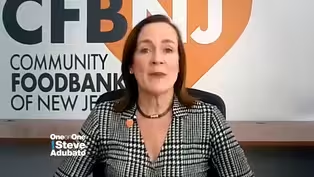
- We're honored to be joined by Elizabeth McCarthy, President and CEO of the Community Food Bank of New Jersey.
Elizabeth, great to have you with us for the first time.
It will not be the last.
Good to have you.
- Thanks so much for having me, Steve.
I appreciate it.
- Well, for those who've been watching us for a while, they know that we're very involved in public awareness around food insecurity issues, and have been working with community food bank for a long time.
Elizabeth, put in perspective the number, I don't even like saying post COVID.
We're doing this in the fall of late in 2023.
It'll be seen after that, post COVID.
I don't know what that means.
Where are we now in terms of how many people are food insecure in the state, but also let's focus on seniors and children, please.
- Yeah, I think not where we expect it to be.
Traditionally, as unemployment has gone down, food insecurity has gone down, and we have not seen that in this, as you're right, post COVID world, however you define that.
There are three quarters of a million people in New Jersey, one of the wealthiest states in the country that are food insecure.
And- - Three quarters?
- Three quarters of a million.
- Go ahead.
- 200,000 of whom are children.
So it is really a dire state.
And what we're seeing is that people are working.
People are coming to food pantries to work with our partners who are working, but cannot make it from paycheck to paycheck.
I know we all, we've all seen in grocery stores, just how much more expensive everything has gotten.
For people on very limited funds, that problem is really exacerbated.
- Describe as the website is up for the community food bank, the work that you do, A, and B, how people can be helpful beyond saying, "Oh, that's terrible."
Which we all will say, because there's also 135,000 plus seniors, age 60 and above who are food insecure.
Disproportionately in Atlantic Cape May, Cumberland County, the southern part of the state.
Beyond saying, "Wow, that's terrible," what can people do as you talk about the work of the food bank, please?
- Hey, first, I'm glad you brought up seniors.
That's actually the largest growing group of food insecure people, which is really just a horrible situation.
There's so many ways to help.
And that's one of the things that's wonderful about the food bank.
We have right on our website, you can find places to volunteer.
We really, really rely on volunteers, who'll come and help us pack food, sort food, who are even children can come and put together food packs for other kids.
It's actually a great volunteer opportunity.
Obviously donating funds also, especially for things like diapers, and period products that people don't necessarily think of as adding to food insecurity.
But when people are making choices about where they spend their money, those are some of the very expensive items that they have to buy.
We have really been focusing on, we give out over a hundred million pounds of food a year, which is an incredible number, but are much more focused on trying to get to the root causes of food insecurity.
So really try, we would love to distribute less, in the fact that we would hope that there would be less demand.
- Okay, let's talk about that.
We focus very often on public policy, or policies, plural, as it relates to communities that are disadvantaged, that are struggling disproportionately.
Are there any, from your perspective, Elizabeth, are there any government public policies that could and should be changed, that would have a positive impact on the food insecurity crisis in this state and nation, please?
- Absolutely.
I mean, the elimination of the tax credit we saw after COVID, doubled child poverty in this country.
- So that right there.
- Talk about that.
I'm sorry for interrupting.
Are you talking about the child tax credit?
- Yes, the child tax credit that was eliminated with doubled child poverty.
There are now about 15% of children in this country are living in poverty, which is just something for, you know, a wealthy nation.
It just, to me feels almost criminal.
So that is something that could definitely be done on the federal level.
We are very lucky in New Jersey that we have a government that is committed to this issue.
So compared to other states, we actually have much more funding going toward food insecurity.
We also have a higher number for supplemental nutrition assistance programs.
SNAP, used to be known as food stamps.
But there are still many people who don't know they're eligible, or who don't know how to apply.
So a big part of our work is sort of getting that word out to families, that this is something that could greatly help them be able to afford food for their families.
- You know, you talked about the food bank being involved in a whole range of services beyond providing food to those who need it, those who are food insecure.
You talked about period products.
What was the other area you talked about?
- Diapers.
- Okay.
So it leads me to the question of the Community Food Bank of New Jersey's longer term, strategic...
Even though long term, I don't know what that means in these days.
Planning ahead, right?
- Yeah.
- I'm sure God laughs.
God laughs when we do that.
That being said.
- Exactly.
- Could you describe as such, the strategic plan of the organization, please?
- Absolutely.
A big part of it, is to try to work on those root causes.
So our overarching goal is to reduce food insecurity in the state of New Jersey by 50% by the year 2030.
It's a very ambitious goal.
By 50%.
We think we can do it.
If we as a society make a commitment to do it, we really think that is an achievable number.
Some of the things we do to help with that, is we do a lot of job training.
We've off, we've done culinary training for a long time, but we've recently started a program for warehouse training program.
Those are actually well-paying jobs in the state of New Jersey.
- Oh, oh, back up a little bit.
- Yeah.
- I'm sorry, Liz.
Back up.
We actually did a feature on the culinary program.
A couple of 'em.
- Yes.
- But what was the second one?
Explain that again.
The warehouse.
- The warehouse training program.
So learning to use a forklift, learning to, you know, stack pallets, a pallet jack, things like that, that you could go get a job at, you know, at Amazon, at Home Depot, that are really much more decent paying jobs, and can get you benefits and those kind of things.
So we've have had three graduating classes, but plan to continue to grow on that path also.
So not everyone wants to work in a kitchen.
This is great to have another option.
We're also doing a lot of, we do some financial training so that families can understand how to make their dollars go further for food.
Things like the SNAP that I talked about, getting more people signed up for SNAP.
So really trying to shorten the line at pantries, to say, not this many people should have to go to food pantries.
It just doesn't seem right.
In this day and age.
- This mission, Elizabeth, this work is not new for you.
Coming to the Community Food Bank of New Jersey is relatively new.
Describe for folks.
Tell folks your background before you came to this position.
- Sure.
I mean, for 25 years I've worked in programs that, in social service programs that work in communities that are plagued by generational poverty and systemic racism.
So it really did feel like a natural extension.
I was very excited.
I've long known about the great work of the food bank, but mostly knew about the food distribution.
I didn't know about all the anti-poverty work, and about really trying to get to those root causes, and that's why I was really excited to join.
It really ties right into much of the work I've done, whether it was through mental health, or early childhood education programs, but really trying to get to those root causes of poverty.
- We will continue here at the Caucus Educational Corporation, along with our partners in public broadcasting, to shine a light is such a cliche.
We will continue to do extensive, important, impactful programming on food insecurity issues, and we're proud to be partners with the Community Food Bank.
Elizabeth McCarthy is in fact the President and CEO of the Community Food Bank of New Jersey.
We thank you so much for joining us.
We appreciate it.
- We really appreciate your support, Steve.
Thank you.
You got it.
Stay with us.
We'll be right back.
- [Narrator] To watch more One on One with Steve Adubato find us online and follow us on Social media.
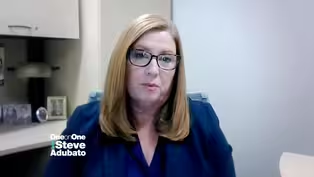
- We are honored to be joined by Kathleen Coviello, who is the Chief Economic Transformation Officer at the New Jersey Economic Development Authority.
Good to see you, Kathleen.
- Likewise, good to be here, Steve.
- Kathleen, we've had several folks on from the EDA talking about economic development issues, innovation, economic development, a whole range of related topics, but we're having you on to talk about, do I have this right?
Place-based economic development strategy; what does place-based mean?
- So what it means is that we're taking a new approach to our innovation economy, and how we focus on strategic sectors with really putting a pin in the map with a physical space.
So, you've heard, Steve, from several of my colleagues about the HELIX in New Brunswick, that's a great example of this.
- Explain what the HELIX is.
Chris Paladino, our friend who's down at DEVCO, has talked to about to us about this a lot.
And we're gonna be doing some programming on the HELIX.
That's an acronym for?
- HELIX is a life science symbol.
- Okay, what is it?
- The HELIX is a place that's bringing together innovation for life sciences.
It's bringing together academia, it's bringing together medical centers, it's bringing together the state and the Economic Development Authority, university partners all under one roof with a common goal of focusing on growing the life science industry in New Jersey.
- That's a place, meaning New Brunswick, the HELIX.
But are we saying, is the EDA, by the way, an underwriter of our programming, is the EDA saying that you want people to go to these places to be more in person?
- Absolutely, absolutely.
That innovation only happens through collaboration, through coincidental meetings in hallways where one, you know, person from Princeton meets somebody from Rutgers, meets somebody from Robert Wood Johnson, and an idea blooms from that.
So we're seeing that play out across a multitude of industries in New Jersey.
- So you got life sciences at the HELIX, but also talk to us about, I'm gonna stay away from offshore wind.
Look at all of our programming on offshore wind, it speaks for itself, you decide for yourself, we're trying to educate people about offshore wind.
Film, what's going on with film, and what's the place?
- Yeah, so film is easy one, right?
We have Netflix who's gonna build a billion dollar studio down in Fort Monmouth.
That place is gonna change the landscape of the film industry in New Jersey.
Marry that with Lionsgate up in Newark, and the Film and Digital Media Tax Credit wrapped around that to incentivize folks to film within the borders of the State of New Jersey.
Again, it puts us on the map.
It puts that pin in the map to say, "This is something New Jersey is serious about, and focusing around."
- So since you mentioned film, actors, writers, we are taping this toward the back end of October, 2023.
It'll be seen later.
Strike impact the work that you're doing, and the work of the Netflix studio, and other related film activity?
- It certainly does, right?
And, you know, having the talent aboard to film and the state is at a pause while we're waiting for the strikes to be resolved, for the Actor's Guild.
Luckily the writers is behind us, but we need the talent in front of the cameras.
- I'm curious about this.
As we do this program, there are a group of folks in Asia, and I know you didn't come on to talk about that, but I know that Governor Murphy, as we do this program back end of October, Governor Murphy is there with, and Choose New Jersey, check out our past programming connected to Choose New Jersey, a private, not-for-profit entity promoting economic development in the state, working closely with the Economic Development Authority.
But I also know that your CEO, Tim Sullivan, is there.
Am I correct?
- You are.
- Is there a connection between that trip with the governor to Asia, and the work we're talking about here?
- Absolutely.
- Talk about it.
- So we started off talking about the HELIX, right?
Our friends at Rutgers University are part of that trip and signed A MOU already there to further- - A Memorandum of Understanding, please.
- Thank you, we talking acronyms in government.
- Oh, I noticed (both laughing) Go ahead.
- To advance some of the scientific research that's happening at Rutgers, right?
And that will, again, bring foreign companies, we believe, to the work physically happening in the HELIX.
Genmab, one of the companies that- - Whoa, whoa, what is it called?
- Genmab.
- Go ahead.
- One of the companies growing in the state of New Jersey is with the governor on that trip.
So you can kind of start to see this building of this cluster of life science companies, and you know, we're really trying to put the spotlight on an international platform now to say, look at what's happening in New Jersey.
Come join us in these various verticals.
Be it life sciences, be it film and digital media, be it offshore wind, be it clean energy.
One of the other physical spaces you've heard us announce last year was the HAX location up in Newark around building decarbonization.
- Whoa, whoa, part of Clean Energy?
- Yes, part of Clean Energy initiatives, yep.
- Explain what decarbonization actually means.
- Sure, happy to.
So one of the largest polluters in the State of New Jersey is buildings, right?
So, or electric or vehicles.
So we are looking at ways to reduce our carbon footprint in the State of New Jersey.
And that's gonna happen through a multitude of different mechanisms.
One of them is our work with HAX, who through a competitive process, chose to locate their accelerator in Newark, New Jersey.
- They're a private company.
- They are a private accelerator, and investment firm, yes.
- What does that mean, an accelerator?
There's a lot of language used in the economic development community.
I don't totally understand, an accelerator of what?
- An accelerator of startup companies.
So they take great ideas from young entrepreneurs, and help put them through a bootcamp of sorts to grow their business in New Jersey, addressing the issue of carbon emissions in the state.
- Interesting stuff, can I get, before I let you go, artificial intelligence?
You have 30 seconds left.
Can we talk about artificial intelligence?
So real quick, it's not even an industry, it's gonna impact all of our lives and have tremendous economic implications, fair to say, in New Jersey.
- Absolutely.
- The country, the world, - Absolutely.
And you saw Governor Murphy just put together a task force headed by our CEO Tim Sullivan around this very issue.
The governor is- - Around AI?
Around artificial intelligence?
- Yes.
- Yeah, sorry to interrupt.
We're actually gonna have Tim Sullivan talking about the work of that task force on artificial intelligence, because the truth is, the more I read about AI and artificial intelligence, the more questions I have, and the more I want to try to understand, and we'll try to understand together.
Kathleen Coviello is the Chief Economic Transformation Officer at the New Jersey EDA, the Economic Development Authority.
Kathleen, thank you so much for joining us.
We appreciate it.
- My pleasure.
- I'm Steve Adubato, we thank you for joining us.
We'll see you next time.
- [Narrator] One-On-One with Steve Adubato has been a production of the Caucus Educational Corporation.
Funding has been provided by Horizon Blue Cross Blue Shield of New Jersey.
Valley Bank.
NJM Insurance Group.
Prudential Financial.
Kean University.
The Healthcare Foundation of New Jersey.
The Fidelco Group.
Newark Board of Education.
And by PSE&G, Promotional support provided by NJBIZ.
And by Insider NJ.
NJM Insurance Group has been serving New Jersey businesses for over a century.
As part of the Garden State, we help companies keep their vehicles on the road, employees on the job and projects on track, working to protect employees from illness and injury, to keep goods and services moving across the state.
We're proud to be part of New Jersey.
NJM, we've got New Jersey covered.
CEO of Community Foodbank of NJ Addresses Food Insecurity
Video has Closed Captions
Preview: S2023 Ep2664 | 8m 30s | CEO of Community Foodbank of NJ Addresses Food Insecurity (8m 30s)
Life-Changing Services That The Boys & Girls Club Provides
Video has Closed Captions
Clip: S2023 Ep2664 | 9m 55s | Life-Changing Services That The Boys & Girls Club Provides (9m 55s)
Reducing New Jersey's Carbon Footprint
Video has Closed Captions
Clip: S2023 Ep2664 | 9m 13s | Reducing New Jersey's Carbon Footprint (9m 13s)
Providing Support for PBS.org
Learn Moreabout PBS online sponsorship
- News and Public Affairs

Top journalists deliver compelling original analysis of the hour's headlines.

- News and Public Affairs

FRONTLINE is investigative journalism that questions, explains and changes our world.












Support for PBS provided by:
One-on-One is a local public television program presented by NJ PBS