
The future of leadership in the church, “Faith in Detroit” | ABJ Full Episode
Season 54 Episode 39 | 26m 46sVideo has Closed Captions
Our “Black Church in Detroit” series examines the future of leadership in the church.
Our “Black Church in Detroit” series examines the future of leadership in the church as fewer people are choosing to become pastors. Plus, we’ll explore the younger generations’ perspective on ministry as a profession, and we’ll feature another installment in the “Faith in Detroit” project.
Problems playing video? | Closed Captioning Feedback
Problems playing video? | Closed Captioning Feedback
American Black Journal is a local public television program presented by Detroit PBS
The future of leadership in the church, “Faith in Detroit” | ABJ Full Episode
Season 54 Episode 39 | 26m 46sVideo has Closed Captions
Our “Black Church in Detroit” series examines the future of leadership in the church as fewer people are choosing to become pastors. Plus, we’ll explore the younger generations’ perspective on ministry as a profession, and we’ll feature another installment in the “Faith in Detroit” project.
Problems playing video? | Closed Captioning Feedback
Where to Watch American Black Journal
American Black Journal is available to stream on pbs.org and the PBS app.
Providing Support for PBS.org
Learn Moreabout PBS online sponsorship- Just ahead on "American Black Journal," our "Black Church in Detroit" series examines the future of leadership in the church as fewer people are becoming pastors.
Plus, we'll explore the younger generation's perspective on ministry as a profession.
You don't want to miss today's show.
"American Black Journal" starts right now.
- [Announcer 1] Across our Masco family of companies, our goal is to deliver better living possibilities and make positive changes in the neighborhoods where we live, work, and do business.
Masco, a Michigan company since 1929.
- [Announcer 2] Support also provided by the Cynthia and Edsel Ford Fund for Journalism at Detroit PBS.
- [Announcer 3] The DTE Foundation is a proud sponsor of Detroit PBS.
Through our giving, we are committed to meeting the needs of the communities we serve statewide to help ensure a bright and thriving future for all.
Learn more at dtefoundation.com.
- [Announcer 4] Also brought to you by Nissan Foundation and viewers like you.
Thank you.
(bright upbeat music) - Welcome to "American Black Journal," I'm your host, Stephen Henderson.
Today, we're continuing our "Black Church in Detroit" series, which is produced in partnership with the Ecumenical Theological Seminary and the Charles H. Wright Museum of African American History.
A recent report in Axios Detroit indicated that seminary enrollment is declining both in Michigan and all over the country.
Meanwhile, younger adults are engaging in religious work, but not as members of clergy in a brick and mortar church.
Joining me now to talk about the state of the pastor pipeline are Rev.
Dr.
Theodore Turman.
He's President of the Ecumenical Theological Seminary, and Minister Mikiah Keener from Triumph Church.
Welcome back to "American Black Journal."
- Good to be with you.
- Thank you.
- Yes, and welcome to the studio.
I think this is the first time we're doing this in person.
- I'm excited.
Thank You for having me.
- Yeah, so I though this report was very interesting and I think it's not surprising necessarily.
I mean, I think if you look at any sort of religious community, you're seeing fewer people grow up and say, "I want to be a pastor."
- Sure.
- But that sort of corollary to that, which is that they're not saying they don't want to minister, they just don't necessarily want to do it in a church.
What should we make of that?
- Big question.
- Yeah.
- A number of answers.
So, the first thing that popped into my mind, I can't remember what the political pundit who said, "It's the economy stupid."
Some of it is just money.
It's still expensive to go to graduate school and when you come out, there are very few churches that can help you pay back that expense.
- Yeah.
- So, the heart, the calling, people are still being drawn towards ministry.
They're just concerned about the financial viability and the cost benefit analysis of seminary and service.
- So, let's stop there for a second.
Give people a sense of how expensive it is and what kind of, you know, degree you have to have before someone would consider making you a pastor in a church.
- Sure.
So, there are different nominations have different requirements of their pastor.
- Sure, yeah.
- Even within the same denominational tradition, there are different varieties.
The traditional seminary degree expected for pastoring has been the Master of Divinity.
In short, we call it the MDiv.
It is historically a three-year full-time, four-year part-time degree.
- Wow.
- It can cost upwards of $50,000 to pay for that degree.
- To get that degree, yeah.
- And so again, then if you are student loan dominant or dependent rather, you're thinking about, how will I pay all of this back given that it won't be just $50,000 on the other side of the diploma?
And oftentimes many of our churches are asking us to be bi-vocational.
And that usually is cold for, I can't pay for you full-time.
And so you're expected to not just get with an MDiv church job, but you have to figure out what can that MDiv get- - You got to have a side hustle, right?
- Outside of that.
And so that becomes a challenge for many seminarians and future graduates as well.
- Yeah, I'm not sure I quite understood that, I'm glad you explained that.
Mikiah, you are kind of in the middle of getting this degree.
Is that the degree that you're pursuing?
- Yes, so right now I'm at Hampton University for my Bachelor's in Religious Studies.
After that, I plan on pursuing my Master's of Theological Studies.
So, I am in the middle of it.
And like pastor said, it can be very expensive.
- It's not cheap, right?
- It is not cheap.
- Yeah.
So, what then for you is the motivation to do it even though it might be, you know, terribly expensive and might require loans and other things?
- Yeah.
I'm 28 years old and I see a lot of people around my age asking the same question.
Why am I here?
What is my purpose?
- Wow.
- Who is God?
Is there more than one God?
How do we know that there's one truth?
So, those number of questions, I believe it motivates me to go deeper in my studies because I believe that it's equipping me to be able to be prepared to lead people, to serve them well, to answer those questions with integrity, with the correct interpretation, with the correct study.
So, yes, it does have a big price tag, but I think that it's absolutely worth the value that you get to be able to be equipped to answer those questions well.
- Yeah, so you're around other young people who are maybe thinking about whether they want to be pastors or whether they want to do pastoral work elsewhere, what do you hear from them about?
- A lot of my friends want to be in ministry.
They don't want to be a pastor.
They do not want to be a pastor.
- They don't want to do it?
- They don't want to do it.
Sometimes I don't know if I want to do it, if I can be completely honest with you.
One thing that I am learning though is that tradition does not have to compete with innovation.
I do believe that those gaps can be, I believe that those bridges can connect.
So, I don't think that tradition is necessarily wrong.
I don't think that there's anything inherently wrong with the traditional way of pastoring.
I just think that there are new ways of ministry that are emerging and that are diversifying.
And I think that pastors that serve now have to be able to disciple young people well so that they are able to tap into their creativity, so that they're able to be engaged, so that they are able to be mentored, so that they can figure out what it is that they want to do in ministry, whether that's pastoring or not.
- So, when you say that there are lots of other ways other than, you know, the traditional pastor route to do the work, what in your mind are you thinking of when you talk about that?
- Absolutely.
So, I believe that there are so many ways to take God into the marketplace.
I believe that people want to take ministry into social issues, they want to take them into volunteering, they want to take them into housing issues.
And so I think the question just becomes, how am I able to use my calling to benefit said marketplace if I don't want to be a traditional pastor?
You don't have to have a microphone in front of you to be able to minister.
You don't have to be standing in a pulpit to be able to minister.
And so I think the question just becomes, what is it that God is calling me to do, and how is he equipping me to do it if I'm not going to be behind the pulpit with a microphone in my hand?
- So, when you think of yourself, if you weren't a pastor, what work would you be doing?
- I think that's a great question that I can't answer just yet.
- You still thinking about it?
- I think it's something that I'm still thinking about, and I think that I'm just trying to steward the opportunity that I have now, which is serving at Triumph Church under Rev.
Solomon W. Kinloch, Jr.
- He's a guy we've heard something.
- Oh, I'm sure so many times.
He's great, he's my mentor.
- Yeah.
- And I'm just really grateful for his mentorship because it's giving me the opportunity to tap into my creativity, to explore, to serve, to engage, to be connected, to work with other young people.
It challenges me.
It makes me ask myself hard questions, tough questions.
It allows me to become more transparent with myself to ask myself, is this something that I really want to do?
And I don't think that everybody gets that opportunity.
So, right now I want to steward that opportunity well.
- Yeah.
- So, one of the things that Mikiah said that I want to respond to is that really is the purpose of seminary.
Is to allow you to go through a season, not just of education, but also discernment of what ministry might look like.
When I went to seminary, I didn't know what I wanted to do.
I was clear on what didn't want to do, but I didn't know what I wanted to do.
Seminary gave me exposure to things I could get paid to do that I didn't know existed.
I knew about military chaplaincy, but I didn't know about healthcare chaplaincy.
Only thing I knew was what I saw on television, which was Catholic priests went and did the last rites.
I didn't know hospitals hired chaplains with MDivs to serve in the hospital.
And so one of the opportunities of seminary is to open seminarians' minds to the possibilities, not only of what exists, but what doesn't yet exist, and maybe you can build something.
The other thing I wanted to respond to was just the way that you framed the question was interesting.
You asked Mikiah about what other young people were thinking about.
The dominant group of seminarians are second career nowadays.
When I, back in my day- - I didn't know that.
- I didn't know that.
- Particularly outside of what we would call mainline Protestantism, okay?
- Right.
- Conservatism, the numbers are fairly similar.
25 years ago or so when I went to seminary, the majority of us were coming straight out of undergrad, okay?
Now, at particularly at Ecumenical Theological Seminary, but across many of our traditional seminaries, these are people who have been in the marketplace and have since the call to ministry and they have the bandwidth finally to sort of turn their attention to their calling.
They're 50, they're 60, they're sometimes 70.
Some of these people have been doing ministry for the last 30 years, but have finally said, you know, I need to get an education to go with the experience that I have.
And so that creates all different kinds of new dynamics, right?
Because we're talking to people who aren't about to, they've been there, right?
And so that creates all different kinds of new language that we have to use, expectations for time and free time.
Because when I was in seminary, I didn't have a spouse and I didn't have children.
And a lot of these people don't just have children to take care of, they're taking care of parents as well because they're right at that middle- - Sandwich generation, yeah.
- And so it creates all different kinds of both challenges and opportunities as we're trying to provide theological education in this season.
- Yeah.
Mikiah, there was something you were saying that reminded me at the risk of sounding like a pastor, which I am definitely not.
It reminds me a little of the Christ story, right?
Jesus didn't have a church and wasn't a pastor in a church.
He went and found people and found their needs- - Absolutely.
- And met them.
So, there's something about this that just kind of, I don't know, rings true, I guess to religious belief.
- Yeah, and I think that the headline was tagged as "The Pipeline is Collapsing for Pastors."
I don't think it's collapsing, I just think that it's changing.
- It's just different.
- It's often been said that the last seven words of a dying church are, we haven't done it that way before.
And so I think the question today is, what new ways can it be done while still maintaining spiritual integrity?
One thing that I always consider, because I'm a very creative person, so I just always ask the question, how can I be geared to the times while still being anchored on a rock?
- Wow, wow.
Tell me more about your decision to be a pastor or some sort of religious figure.
- Absolutely, I think that that goes back to discipleship.
Because I believe that when a person finds out they're called to pastor, they don't really find that out in seminary.
They find that out sometimes under the right leadership, under the right mentor.
That's what happened to me at Triumph Church.
So, I started serving there in my senior year of high school when I was 17 years old.
I didn't go right into ministering.
I joined the intercessory prayer team and I was able to tap into my creativity, tap into my calling, and I was able to engage with other ministers.
And that led me, that pathway is what led me to ministry ultimately.
So, I was able to have the freedom to explore my creativity, which then opened the door to me to find my calling for ministry.
But it started with discipleship.
It started with people taking me under their wing, people that I could trust, pastors that I could trust, mentors that I could trust that ultimately wanted the best for me.
So, it started with discipleship.
- So, is that an answer to what you're seeing in the drop in interest at places like ETS, this idea of people finding their way through others into the work?
- Well, I think.
How old is it?
Remember when that article came out and said the Earth is flat?
- Yeah.
- I think that the church is no longer the dominant voice- - Absolutely.
- In people's spiritual journey.
And when I say the church, I really mean a church.
- A church.
- People are being pastored by a community now.
They go here on Sunday, they listen to this person Sunday night.
They watch these clips on Tuesday and Wednesday and they're on TikTok and Instagram.
So, they're getting a lot of influence.
And when you get a lot of influence, there really is no then dominant voice.
And because there's no dominant voice, there's nobody there to notice gifts.
There's nobody there to say, "I see something in you.
And I think you should explore and I'd like to walk with you through that."
And so because everybody's sort of like equidistant away from the church, it complicates the church's ability to identify the next generation of leaders.
It compromises those leaders' ability to hear clearly from people that they trust that there might be something extra there.
- Yeah, and yet there are still, I think, three or 4,000 churches in Detroit.
So, it's not like people aren't going, right?
- Sure.
- How do we explain that?
- We have a, okay, how do I?
Our city has shrunk, but our churches really haven't.
- No.
- So, our churches are smaller.
- Okay.
- Many of them, not all of them.
Our churches are smaller, which often makes them less capable to do some of those good things like leadership identification.
And also, if a church is smaller, they can't afford a leader who's been trained in leadership identification and development.
And so you have- - So, it's kind of circular- - It's a circular challenge.
- Wow.
- And there's no answer that any church is really, really ready to hear.
- Yeah.
- It is a challenge.
- It is this idea of kind of throwing all of the assumptions out the window and coming up with something new, right?
- When people are free to make choices, they have a tendency to do things differently than when they are saddled with the weight of a church's tradition and the economics of that church, and this person gets paid to be here, these musicians get paid to be here.
The cost of self-worth that comes with my family's been attached to this church.
I was baptized in this building.
And so we're connected to spaces and places and processes that if we were free to create from the ground up, we might build something very different than what we see this coming Sunday.
- Yeah.
Well, I love this conversation and I love that you two were part of it.
Thanks so much for joining us here.
- My pleasure.
- Thank you.
- We have another installment from the Faith in Detroit Project led by Christ Church Cranbrook.
Detroit PBS is one of several partners in that initiative that lifts up stories of faith and resilience.
Today, we hear from Paul Jones, a member of the Church of the Messiah.
He sat down with Faith in Detroit Director Father William Danaher to talk about his faith journey, which began when he was a troubled teenager.
(gentle music) - Paul, thank you so much for being with us.
We're so grateful to have you tell your story.
And I was so impressed with your story of faith when we had dinner the other night.
And the point that I'd like you to talk to a little bit is that experience that you went in your life from having an avowed unbelief to a place of belief in God.
Can you talk a little bit more about that?
- Yeah, so when I was in sixth grade, my mother, well, I sat my mother down and like I said, at dinner, I think she though I was going to come out in some other form or fashion, but I sat her down and I just told her that like, "Hey mom, I'm an atheist."
But really, I don't think I was an atheist.
I think it was really a place of agnostic just simply because I had so many questions about belief and religion and all of those things.
I grew up in a Baptist Church and learned all these things, but I started reading the Bible and I'm just like, "I don't understand this.
I don't understand this at all."
So, I just sat her down and let her know.
But then when I was 15, I was sitting in my room just sobbing, literally sobbing in my room and just so confused, so just really wondering where I'm going to head after this.
And I was selling.
Am I allowed to talk about this?
- Yes.
- But yeah, I started selling weed.
I started selling fake heroin and I'm just like, "How am I going to get through high school when I have so many questions about life?"
And I'm in my room sobbing and saying, "I'm not going to live to 16.
Either I'm going to take myself out or I'm going to pass away due to the streets."
Because living in Detroit, you never know what can happen.
Things have almost happened.
One of my close friends, he had an experience where he was supposed to be doing a deal at some point, but literally the spirit told him like, "Do another route around the block."
And so the dude he was supposed to be meeting in the car, literally he pulled back up around the street after the second time.
He pulled around the block and the car was shot up, empty.
And he's like, "This is a sign that I'm not supposed to be doing this."
But literally I'm in my room at 15 saying I'm not going to lift to 16.
And God came to me, I would say, and said, "You're not alone in this.
You're going to make it through this."
And that was my first experience with God where I was like, "Okay, God is real.
Something is real."
And that's when I really started my faith journey.
- What did that faith journey look like when you're 15 going on 16?
What were the decisions you made?
What was the sense of purpose?
How did God feel in that moment?
- In that moment specifically, it felt like a weight got lifted off of my shoulders.
I felt so heavy.
I felt like I was always walking around with this weight, always walking around with questions, but literally in that moment, I felt like a weight got lifted off of my shoulders and I was able to actually feel love.
And again, my mother was an amazing person and I feel like she was always there for me in those moments, but I feel like that was my first moment in time where I actually felt love going through me.
And I really have to give that to God and Jesus Christ and for saving my life.
And it was an awesome experience, I would say.
And so I just started reading my Bible.
I started talking about God out loud to people in high school and even people who I grew up in middle school with, because a lot of people who went to Bates Academy ended up going to Cass Tech and they knew that I was an atheist.
And so they came to me and they're like, "Weren't you atheists just like a year ago?"
And I'm just like, "I've had a coming to Jesus moment.
I felt God in my life," and I was able to express that out loud and I didn't have any shame in that at all.
- What's powerful about your faith story to me is that you went through that transformation, but then some of the biggest challenges in your life came your way after that transformation when your mom died.
Can you help us through that journey with you?
- Yeah.
I feel, again, I talk about Romans where it talks about how going through rough times really builds you.
And I feel that way completely, that every single time I had a rough experience in life, whether it was, again, that moment at 15 where I felt like I was going to pass, that moment at 17 where my mom passed, 18, 19, 20, where all of my dad's siblings had passed, my aunts and uncles had passed.
Those were truly the transformational moments in my life where I felt like I was growing.
So, I'll say to anyone that it's like, there's something that says this too shall pass.
And I truly believe that.
And I feel that when you're going through those rough times, you'll get that perseverance, you'll get that character and you'll get that hope.
And you realize when you're going through those rough times that this is where character development truly happens.
It's truly a blessing to go through rough times, for me at least.
I felt like every time I was going through those rough times that something better always came on the other end of that.
- One of the things I also hear in your story and your story of faith is you unlocked incredible potential that you have academically in your life.
You were always gifted, but as a result of your faith conversion, as it were, you suddenly were able to unlock all of these gifts.
Can you talk a little bit about that?
- How I was able to unlock my gifts?
I feel like within my, I guess, coming to Jesus moment, I was able to find a sense of purpose almost.
I recognized what I wanted to do.
I recognized that I wanted to be within my community.
- That's going to do it for us this week.
You can find out more about our guests at americanblackjournal.org and you can connect with us anytime on social media.
Take care and we'll see you next week.
(bright upbeat music) - [Announcer 5] This program is made possible in part by Lilly Endowment, in Christ Church Cranbrook.
- [Announcer 1] Across our Masco family of companies, our goal is to deliver better living possibilities and make positive changes in the neighborhoods where we live, work, and do business.
Masco, a Michigan company since 1929.
- [Announcer 2] Support also provided by the Cynthia and Edsel Ford Fund for Journalism at Detroit PBS.
- [Announcer 3] The DTE Foundation is a proud sponsor of Detroit PBS.
Through our giving, we are committed to meeting the needs of the communities we serve statewide to help ensure a bright and thriving future for all.
Learn more at dtefoundation.com.
- [Announcer 4] Also brought to you by Nissan Foundation, and viewers like you.
Thank you.
(gentle music)
 New
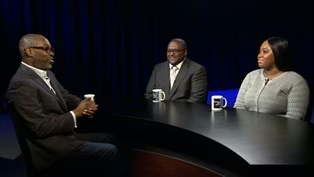
NewThe Black Church in Detroit series examines the future of leadership in the church
Clip: S54 Ep39 | 16m 31s | A recent report in Axios Detroit points to a decline in seminary enrollment in Michigan. (16m 31s)
 New
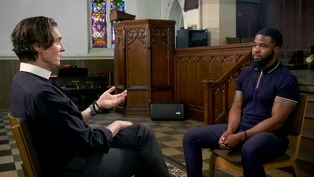
New“Faith in Detroit” features a young man’s journey of faith from nonbeliever to believer
Clip: S54 Ep39 | 7m 47s | Faith in Detroit Executive Director Fr. William Danaher speaks with Paul Jones (7m 47s)
Providing Support for PBS.org
Learn Moreabout PBS online sponsorship New Episode
- News and Public Affairs

Top journalists deliver compelling original analysis of the hour's headlines.
 New Episode
- News and Public Affairs

Today's top journalists discuss Washington's current political events and public affairs.
 New Episode
 New Episode
 New Episode
 New Episode
 New Episode
 New Episode


 New Episode
 New Episode
Support for PBS provided by:
American Black Journal is a local public television program presented by Detroit PBS