
Amy Murtha, MD; Idana Goldberg, PhD; Sean Jackson
1/17/2026 | 27m 52sVideo has Closed Captions
Amy Murtha, MD; Idana Goldberg, PhD; Sean Jackson
Amy Murtha, MD, Dean of Rutgers Robert Wood Johnson Medical School and Founding Dean of the Future Rutgers School of Medicine, discusses fostering compassionate care to train future physicians. Dr. Idana Goldberg, CEO of The Russell Berrie Foundation, marks the organization's 40 years of philanthropy. Sean Jackson, CEO of Isles, Inc., speaks about how they're addressing lead remediation.
Problems playing video? | Closed Captioning Feedback
Problems playing video? | Closed Captioning Feedback
Think Tank with Steve Adubato is a local public television program presented by NJ PBS
Amy Murtha, MD; Idana Goldberg, PhD; Sean Jackson
1/17/2026 | 27m 52sVideo has Closed Captions
Amy Murtha, MD, Dean of Rutgers Robert Wood Johnson Medical School and Founding Dean of the Future Rutgers School of Medicine, discusses fostering compassionate care to train future physicians. Dr. Idana Goldberg, CEO of The Russell Berrie Foundation, marks the organization's 40 years of philanthropy. Sean Jackson, CEO of Isles, Inc., speaks about how they're addressing lead remediation.
Problems playing video? | Closed Captioning Feedback
How to Watch Think Tank with Steve Adubato
Think Tank with Steve Adubato is available to stream on pbs.org and the free PBS App, available on iPhone, Apple TV, Android TV, Android smartphones, Amazon Fire TV, Amazon Fire Tablet, Roku, Samsung Smart TV, and Vizio.
Providing Support for PBS.org
Learn Moreabout PBS online sponsorship- [Narrator] Funding for this edition of Think Tank with Steve Adubato has been provided by NJM Insurance Group.
Serving New Jersey’s drivers, homeowners and business owners for more than 100 years.
EJI, Excellence in Medicine Awards.
A New Jersey health foundation program.
The Fund for New Jersey.
Horizon Blue Cross Blue Shield of New Jersey.
PSEG Foundation.
The Adler Aphasia Center.
The North Ward Center.
New Jersey Board of Public Utilities.
Providing New Jersey residents tools to save money on energy costs.
And by NJ Best, New Jersey’s five-two-nine college savings plan.
Promotional support provided by Meadowlands Chamber.
Building connections, driving business growth.
And by NJBIZ.
Providing business news for New Jersey for more than 30 years, online, in print, and in person.
[MOTIVATIONAL MUSIC] - Hi everyone, Steve Adubato.
We kick off the program talking about tomorrow's physicians, which in fact, is a mini series we've been doing for the last couple of years.
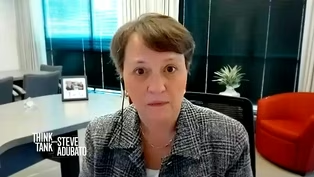
We're joined by Dr.
Amy Murtha, who's Dean of the Rutgers, Robert Wood Johnson Medical School, and founding Dean of the Future Rutgers School of Medicine.
Doctor, it's so good to have you with us.
- Terrific to be here.
Thanks for having me.
- As I said, this is part of our series on tomorrow's physicians.
We're doing in cooperation with the New Jersey Health Foundation.
This is incredibly important, this Future School of Medicine.
I'm gonna read you a quote and then you'll explain it.
You have said that those involved in this initiative have a unique opportunity to build a new medical school from the ground up, that will become a national model for how we can work with community partners to solve health equity challenges for current and future generations.
Explain that and what kind of merger are we talking about to get there, doctor?
- Yeah, so we're really excited to be here and really excited to be able to share some of the things that are happening at Rutgers in the medical school.
So we're in the journey to bring together the Rutgers Robert Wood Johnson Medical School and the Rutgers New Jersey Medical Schools.
Two schools that have been fully accredited independently and have historically always competed with each other for everything are now gonna come together under a single brand, the Rutgers School of Medicine, and a single accreditation.
So that will actually create one of the largest medical schools in the country.
And in, we're gonna leverage this moment to really re-envision how we actually teach and train our students, how we do research, and how we actually engage with our community partners in a really meaningful way to make sure that we're providing the best care for the citizens of New Jersey.
- You know, I'm gonna ask you a little bit, in just a second, Dr.
Murtha, about the tomorrow's physicians, meaning what kind of skills and tools do the physicians of tomorrow need, and how will this medical school, which opens I believe in 2028, if I'm not mistaken?
- First class starts 2028, yeah.
- What's your entry into medicine is very personal for you.
Please talk about that.
- Yeah, so I was actually first a physician's assistant and I chose that path mostly because I didn't think I was smart enough.
I didn't think I had the endurance or the resources to go to medical school.
And I learned during my journey, during my PA training, that maybe I was smart enough and had the endurance and actually applied to, did additional prerequisites, applied to medical schools in a number of places.
Had a tough time getting in, but managed to get into the Medical College of Pennsylvania.
And I will say that I was smart enough.
I did not have the resources actually, and I ended up with the second largest debt in my med school class.
It took me 26 years to pay off.
So I really appreciate the challenges that medical students face in that space too.
- Okay, and also your background is, you're an OBGYN, correct?
- I'm an OBGYN, right.
So I did my specialty training then in OBGYN and Maternal Field of Medicine down at Duke University.
And in that space actually focused in trying to prevent and treat women at risk for preterm birth.
And from Duke, where I was for 26 years, I moved to University of California, San Francisco, where I was the chair of the Department of OBGYN Reproductive Sciences.
- And we have you now in New Jersey.
- And now you got me in New Jersey, right, yeah.
- Yeah.
- I'm home actually, Steve too.
I'm home.
I grew up in Rockland, just over the border in New York.
And yeah, so I'm home and I feel like I'm with my people.
- Got it.
And let me also talk about being home.
For years I've co-hosted, co-emceed the EJI Excellence in Medicine Awards.
Someone might say, well, what does that have to do with this conversation?
And the website will come up for the EJI Excellence in Medicine Awards and we do it in cooperation with our colleague, Patricia Costanti, who helped make that possible.
And why is it relevant?
A significant amount of the proceeds from that annual dinner go to scholarships to top medical students to help defray the cost.
You just heard Dr.
Murtha talk, how many years again did it take you to pay it off?
- 26.
- Help folks understand why those scholarships are so important for the physicians of tomorrow.
- Yeah, so medical school education has gotten increasingly more expensive for us to provide and for students then to actually pay for.
And so students are now graduating with well north of $200,000 in debt and some as high as four or $500,000 in debt.
That takes time to pay off.
It also impacts the students' interest in specialties that don't make as much money, because it takes longer to pay that debt off.
So it's actually contributing to our primary care shortage.
- Going back to, Dr.
Murtha, going back to the quote that I read from you, you mentioned how this new school of medicine opening in 2028 will help improve health equity in our state.
Explain that, please.
- Yeah, so one of the things that we prioritize at Rutgers in both medical schools is really identifying students who have empathy, who have the ability to provide compassionate care.
And then we spend the beginning days, the first three weeks while they're here and then throughout their first couple of years and then also in the clinical time, really fostering that compassionate care focus for our medical students, so that they can actually take care of patients across differences, have a deeper appreciation for what the lived experiences of individuals who come to the healthcare environment and how to make sure we provide the best care possible to them.
- Well said, and also, let me say this.
The Robert Wood Johnson School of Medicine is tied to the larger Robert RWJ Barnabas Health System.
- Correct, correct.
- Long time underwriter of public broadcasting.
So let me just disclose that, but also, let me go back to this, one of the last questions I have.
I'm curious about this.
What do you believe, Dr.
Murtha, the impact has been in the post COVID era?
I mean, we're doing this program at the end of 2025, be seen in 2026.
As in March of 2026, I won't, I cannot believe it will be six years since that Friday, March the 13th, when COVID became so real for the rest of us.
But for you and your colleagues, it was real much sooner than that.
What do you believe the short and long-term impact or the impact is on the those who go into medicine?
- Yeah, yeah, the impact on the healthcare workforce has been enormous and I, that's not just physicians, but I think it's all healthcare professionals.
It's been harder to recruit in some areas.
It's been harder to get docs to do things that are harder specialties.
And so I think that impact of COVID actually has informed how we are training our medical students.
I think just a layer on top of that, it's, significant advances in technology also I think are impacting how our providers provide care.
- How optimistic are you about the physicians of tomorrow?
- Oh my gosh, so I'm incredibly optimistic about what we're doing in New Jersey.
We will be one of the largest medical schools in the country, really.
And we're the public university.
We serve New Jersey.
And that is our goal.
We're in one of the most population dense states in the country.
One of the most diverse states in the country.
We actually are in the state that's got the, almost the highest proportion of physicians over 60.
So we will be working to really fill that gap for the physician workforce shortages that we're anticipating and are experiencing in many instances all across New Jersey.
So I'm optimistic, because what I've seen in the merger of the medical schools is we've been able to bring two independent medical schools together across shared values and shared vision.
And it just creates such a powerful opportunity for the school and, but actually for New Jersey as well.
- Well said.
And I look forward to seeing you at the EJI Excellence in Medicine Awards.
And Dr.
Amy Murtha, who is the Dean of the Rutgers Robert Wood Johnson School of, Med School, excuse medical school, and also the founding dean of the soon to be in 2028, future Rutgers School of Medicine.
Dr.
Murtha, thank you so much for joining us.
We appreciate it.
- Thank you so much.
I appreciate being here.
- You got it.
Stay with us, we'll be right back.
- To watch more Think Tank with Steve Adubato, find us online and follow us on social media.
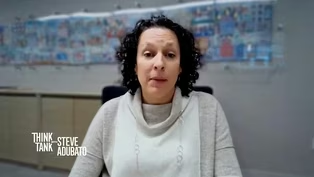
- We are honored to be joined by our good friend, Dr.
Idana Goldberg, who's the Chief Executive Officer of The Russell Berrie Foundation.
Idana, great to have you with us.
- Great to be back.
- We've been partners, collaborators for many years, the Russell Berrie Making a Difference Awards, which is sun setting after it is gonna be 30 years of that, but it's the 40th anniversary of the Russell Berrie Foundation, correct?
- Correct.
- First, can we do why the number 40 itself is significant in the Jewish tradition?
And the Russell Berrie Foundation has significant interest in Israel and to the Jewish people and a whole range of causes that are very important, please, and a longtime underwriter of our programming, please, Idana.
- Sure.
So the number 40 has several meanings in the Jewish history.
Moses is believed to have spent 40 days receiving the ark, the sort of the tablets from God on Mount Sinai.
And then the Jewish people really, they were the Israelites wandered for 40 years in the desert until they were able to enter into the land of Israel.
So this idea that 40 days is a meaningful time of journey, of preparation is something that really resonated for us as we celebrated or marked 40 years of the foundation this year.
The foundation was founded back in 1985 by Russ Berrie and has really grown and evolved over the last 40 years.
- Idana, could you remind everyone who Russ was?
And by the way, we did what I think is a very powerful and important testimonial to Russ Berrie, late Russ Berrie as part of our series Remember Them, those who are in New Jersey or connected to Jersey on one level, but have a statewide national, and in Russ's case, an international impact.
Who was Russ Berrie and why did he still matter so much?
- Russell Berrie started as a salesman, but he was a salesman who had a vision and who could really spot talent and opportunity.
And he grew that ability into a toy company, a gifts company that I think probably many of your viewers would remember, the Russ teddy bears.
The troll dolls came from Russ's sales company.
And he was somebody just with a really big heart who loved people, and he translated that into the foundation and how the foundation thinks about the way we do our philanthropy.
- Which is where the Making a Difference Awards come from.
- Absolutely.
- By the way, I wanna ask you this.
I'm gonna go back to the greatest impact of the 40 years of the Russell Berrie Foundation, but also you spent five weeks in Israel, and during that time, that's when the ceasefire took place and also the release of the hostages, the living hostages obviously.
The greatest message you wanna share with our audience, Dr.
Goldberg, about that experience.
- So I think that being there on the day those hostages was released really felt like a miracle.
And there's a blessing that is in the daily prayers of thanking God for bringing back the dead.
And that's what it felt like.
Everybody in Israel knows somebody is one degree of separation, if not exactly attached to somebody who was taken hostage.
251 hostages were taken on October 7th.
And so the day was one of both relief, a collective sort of breath, and also really mixed with the trauma of the 1200 people who were murdered by Hamas on October 7th, the hostages who did not make it home alive.
And so there was almost like this intermingling of feeling that day of both joy and sort of renewed trauma.
Idana, let me ask you, this 40th anniversary of the Russell Berrie Foundation, most proud of, and this is an unfair question.
- It is not fair.
- Most proud of what?
- I say I'm most proud of how we do our work.
Maybe that's cheating because it really combines a deep knowledge of the fields that we work in, it involves deep relationships with the people that we fund, the organizations that we invest in, and it's sort of about being willing to take risks on entrepreneurial ideas in order to see impact.
So I don't wanna pick a favorite grantee or a favorite brand.
So I'll say that I think it's really that way that we see our work intersecting the way we build and connect dots between the organizations that we fund in order to leave an enduring impact on the areas that we care about.
- Well said, but some of those initiatives are connected to Israel, if I'm not mistaken.
- Sure.
- Correct, right?
- Absolutely.
Someone might say, why are you asking these questions about Israel?
Russ and the foundation, Angelica and everyone, the board, the team care deeply about Israel issues.
Well, I'm gonna put this on the table, issues including the significant rise in antisemitism.
Please talk about it.
- I'll start by saying that yes, the foundation invests in a resilience and an inclusive and a safe Israel.
And that's incredibly important to us and we believe to the Jewish people worldwide.
And of course we're seeing the rise in antisemitism that is coming from both the right and from the left right now.
There's really been an emboldening of, on the one hand, sort of a return to a white nationalism that endangers the Jewish people, and not only the Jewish people, but really any I think minority here in America, and we have to care about that.
And it's also coming from the extreme left, who is singling out Israel as almost like sort of the greatest sinner on the world stage, which has unfortunately bled into the targeting of Jews and especially those Jews who see themselves as Zionists and who support Israel's right to exist as a Jewish state.
- Before I ask, Idana, about this, there's a Gen Z changemakers initiative, I just wanna say this, we will continue our programming, and yes, we're a New Jersey-based media operation, but I believe the second largest population, Jewish population in the country is in New Jersey, the other is in Florida, and there's a large Palestinian population in New Jersey.
These issues matter to all of us.
That being said, help us on this, Making a Difference, Gen Z. We're gonna be doing a panel with terrific Gen Z leaders who are making a difference.
These changemakers, why are they so important, Dr.
Goldberg?
- Because we really need to see the next generation take on leadership, and we do see it.
There are already so many teenagers and young adults who have identified a problem, taking their passion, and are making a difference.
And we thought that it would be so appropriate to sunrise.
We actually call our process a sunrise- - Sunrise.
- because we wanna see What's gonna come out of the foundation spend done.
So even though the program is ending, we believe it sends a really important message of passing the torch to this next generation to take on the leadership, to take on the passion, to say there's a problem and I can do something about it.
- And finally, let me disclose that for every year.
I believe since 1997, Idana, I've been honored to host the Russell Berrie Foundation Making a Difference Awards, and this final event will recognize these Gen Z changemakers.
I look forward to it.
I've met so many extraordinary people.
I believe it's 430 over these last 30 years, people making a difference every day.
And go on the website, nominate someone who you believe deserves to be recognized because they're making a difference.
Idana, thank you so much for joining us.
We appreciate it.
- Thank you, Steve.
Always an interesting conversation.
- Always.
Stay with us, we'll be right back.
- To watch more Think Tank with Steve Adubato, find us online and follow us on social media.
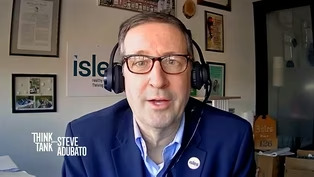
- We're now joined by Sean Jackson, who is the CEO of an organization called Isles.
Their website is up, based in Trenton, and they're doing important work.
Sean, good to see you.
- Great to see you, Steve.
Thanks for having us on today.
- You got it.
Website's up.
Tell everyone what Isles is.
- A word, a organization rooted in Trenton, but with reach across New Jersey that's focused on ensuring that everyone has a healthy community, and environment where they can grow and thrive into the career and life that they wanna have.
And those two things go together.
You know, we can't expect people to succeed and thrive in life if they're living in unhealthy, unsafe, or unsustainable communities.
- Speaking of unsafe, unsustainable communities, talk about the initiative around lead remediation that Isles is a key part of.
- Absolutely.
This is something that we've worked on for years.
Before even all the tumult that came out of Flint, Michigan and the drinking water, we recognized that there was an issue here in Trenton 'cause we were finding the lead in the soil.
And we made the connection that that was coming, in large part, from lead paint on the outside of people's homes and led us to realize there's also a problem with lead paint inside people's homes because you know that young children are especially vulnerable to lead paint and the dust that can be generated from just opening a window that has been painted on the sides with lead.
Kids who are impacted by lead are 30% more likely to fail math and reading by third grade.
They're seven times more likely to drop out of high school and they're six times more likely to end up in the juvenile justice system.
So we know this is really important work that needs to be addressed and we've been proud to work with the Murphy administration as it concludes its time to address this problem with real funding to do cleanups and changing the laws so that we inspect and find lead before kids do.
- Now, Governor Sherrill, we do this as she's taking office on January 20th, this will be seen later as well, here's my question: is there a particular department in state government, I don't wanna get too deep into the weeds, but... - Sure.
- Which is it?
The Department of Community Affairs?
- DCA, yes, Department of Community Affairs quarterbacks this effort and we work with the Department, have been hired by them to help train agencies all over New Jersey.
So we work with Casa Don Pedro there in Newark.
We work with-- - In Newark, a great organization.
- Yeah.
Fabulous folks.
Work with folks up in Bergen, Atlantic City, Monmouth County, Camden County, all across.
- Sean, doing what?
Helping to do what?
- We're helping to train... So we've created a model here at Isles that we've been putting in place for over 10 years to cost effectively clean up and make homes what we call lead safe.
And there's an approach that we've developed that we then, you know, share with these other agencies.
Not that we've got the gospel on how to do everything, but here's a model you can follow, improve on it, build on it, come back and share with us how you do it better and help get more of it out there 'cause we know, Steve that there are 250,000 children living in homes in New Jersey with lead exposure.
We've gotta deal with this problem.
We think it's a critical issue for education and success in life because once you're lead contaminated, there's very little we can do to undo it.
And we've now started to learn, Steve that there's even connection to young girls who are exposed to lead and then when they become pregnant later in life, the lead resurfaces during the pregnancy to cause problems for the mother and the baby.
It's a lifelong crisis that we have to tackle.
- Make sure you go onto the Isles website to find out more about this lead mitigation issue.
- Indeed.
- Real quick on this one, Governor Sherrill taking office on the 20th of January, housing, affordable housing a top priority, translate the jargon around affordable housing to the reality of affordable housing.
- Well, the challenge is really volume and getting more of it.
In some communities like Trenton, actually the affordable rate in the market rate, just because of where the market are, aren't that different.
Our challenge here in Trenton is how do we just get more housing built?
How do we get more developers to come to the city to invest here and to work with the incentives that the state provides.
And that, you know, I certainly trust that Governor Sherrill will continue through the Aspire program to be able to develop more.
- The Aspire program is what, Sean?
- Aspire is a New Jersey Economic Development Authority program that supports the development of market rate housing with some component of it being affordable.
Usually 20 to 30% of it also being affordable housing.
But it provides incentives to developers to come into communities that might be, you know, otherwise not as attractive to a developer normally.
And that's what we need to to do is get more volume built so we can get more supply here in communities like Trenton that have great bones, there's great things here to do.
We've got good trains, we've got, you know, good institutions.
We just need, you know, more housing supply.
- Is the housing issue or affordable and accessible housing issue different in Newark, in Jersey City versus Trenton?
- They're at different stages of development.
You've I'm sure seen this Down Neck, Steve, and even really, frankly across the city.
- Sorry for folks, a little inside.
- Yes, who don't live in Newark.
- Down Neck is the neighborhood that's called the Ironbound, which is right below Penn Station in Newark.
Go ahead.
- The point is- - Where are you gonna build housing Down Neck?
- Well, my point is when you come into Newark, and it's not just in the Ironbound section, it's really spread around the entire city where it's happening organically.
That's the key.
The economy, the pump has been primed, if you will, and housing is starting to happen now in Trenton where it's just developers are coming in on their own and doing it as opposed to a place like Paterson or Trenton where developers are more reluctant to come in and develop.
We need to get the pump primed in these cities so the developers will start coming and develop here the way they do in Newark and New Jersey City and even New Brunswick.
- Can I get a minute or less on this: federal funding cuts as it relates to, do they impact the housing challenge in the state?
- Not so much on the housing side, no.
The federal cuts are impacting on maybe repairs to housing, energy efficiency work, you know, insulation, clean energy.
And also the cuts are impacting us in ways for around AmeriCorps, for example, which provides an important part of our workforce.
- Hold on, so Isles is taking a direct hit from the feds in terms of a direct federal grant to Isles?
- The President has made clear he wants to close down AmeriCorps.
His budget zeroed out AmeriCorps.
We've had a 1.2... - Tell us what AmeriCorps is real quick, Sean.
- AmeriCorps is a service-oriented program geared towards young people, not exclusively, but geared towards young people, typically maybe between high school and college or after college to go and work in a community for a year doing some type of public service.
- How dare they, how dare they wanna help?
And that's ending, that's ending?
- Well, the president proposed, you know, eliminating it in his budget.
Now, as you know, we still don't have a budget for this year.
And that's been part of the challenge of this administration is there's such uncertainty and lack of direction about where things are going.
We stand to lose $1.2 million if the president has his way.
- All of us who lead nonprofits trying to stay in the game every day but Isles is doing a terrific job down in Trenton, impacting across the state.
Sean Jackson's the CEO of Isles and check them out, find out more.
Hey, Sean, thank you, my friend.
We'll talk again in the future.
- Great to see you, Steve.
Be well, take care.
- I'm Steve Adubato, that's Sean Jackson.
We'll see you next time.
- [Narrator] Think Tank with Steve Adubato is a production of the Caucus Educational Corporation.
Funding has been provided by NJM Insurance Group.
EJI, Excellence in Medicine Awards.
A New Jersey health foundation program.
The Fund for New Jersey.
Horizon Blue Cross Blue Shield of New Jersey.
PSEG Foundation.
The Adler Aphasia Center.
The North Ward Center.
New Jersey Board of Public Utilities.
And by NJ Best, New Jersey’s five-two-nine college savings plan.
Promotional support provided by Meadowlands Chamber.
And by NJBIZ.
The North Ward Center continues to expand their services and outreach in Newark, from the childhood years to the golden years, Offering programs like preschool, youth leadership development, Casa Israel Adult Medical Day program our Family Success center, as well as a gymnasium.
And most recently Hope House, a permanent home for adults with autism, supporting and nurturing our autism community with Hope House 2 coming soon.
The North Ward Center.
We’re here when you need us.
CEO of Isles talks about lead remediation in Trenton, NJ
Video has Closed Captions
Clip: 1/17/2026 | 9m 17s | CEO of Isles talks about lead remediation in Trenton, NJ (9m 17s)
CEO of The Russell Berrie Foundation celebrates 40 years
Video has Closed Captions
Clip: 1/17/2026 | 9m 30s | CEO of The Russell Berrie Foundation celebrates 40 years (9m 30s)
Fostering compassionate care to train future physicians
Video has Closed Captions
Clip: 1/17/2026 | 9m 42s | Fostering compassionate care to train future physicians (9m 42s)
Providing Support for PBS.org
Learn Moreabout PBS online sponsorship
- News and Public Affairs

Top journalists deliver compelling original analysis of the hour's headlines.

- News and Public Affairs

FRONTLINE is investigative journalism that questions, explains and changes our world.












Support for PBS provided by:
Think Tank with Steve Adubato is a local public television program presented by NJ PBS