
An Anthem to America: Ken Burns & Florentine Films Celebrate 50 Years
Ken Burns and the filmmaking team look back over five decades of groundbreaking documentaries.
From
An Anthem to America: Ken Burns & Florentine Films Celebrate 50 Years
10/1/2026 | 57m 6sVideo has Closed Captions
Ken Burns and the filmmaking team look back over five decades of groundbreaking documentaries.
Join Ken Burns and the filmmaking team as they look back over five decades of making groundbreaking documentaries. Meet the people who create the films, explore their signature style, and discover how they bring American history to life. The film includes archival video clips from a half-century of films and interviews with Burns and many of his closest collaborators.
From
Problems playing video? | Closed Captioning Feedback
Problems playing video? | Closed Captioning Feedback
An Anthem to America: Ken Burns & Florentine Films Celebrate 50 Years
10/1/2026 | 57m 6sVideo has Closed Captions
Join Ken Burns and the filmmaking team as they look back over five decades of making groundbreaking documentaries. Meet the people who create the films, explore their signature style, and discover how they bring American history to life. The film includes archival video clips from a half-century of films and interviews with Burns and many of his closest collaborators.
From
Problems playing video? | Closed Captioning Feedback
Where to Watch An Anthem to America: Ken Burns & Florentine Films Celebrate 50 Years
An Anthem to America: Ken Burns & Florentine Films Celebrate 50 Years is available to stream on pbs.org and the PBS app.
Providing Support for PBS.org
Learn Moreabout PBS online sponsorship[Jaunty guitar music] - [Narrator] In their groundbreaking documentaries, Ken Burns and Florentine Films have embraced all we are as Americans.
(upbeat music) Our music.
(upbeat music continues) Our sports.
(upbeat music continues) Our literature.
(upbeat music and cymbal) (swoosh) Our wars.
(upbeat music continues) Our icons.
(upbeat music continues) And our tragedies.
(upbeat music continues) And our best ideas.
The most celebrated films in documentary history.
"The Civil War."
"Baseball."
"Jazz."
These films are an anthem to America.
Florentine Films was founded by Ken Burns in the year of our nation's bicentennial.
It was a unique time in American history, and it began a 50-year journey that led to a signature style of storytelling that has come to define excellence in documentary filmmaking.
Ken Burns and his Florentine Films colleagues have created documentaries that deepen our understanding of who we are as Americans.
On the 50th anniversary of Florentine Films, PBS presents a retrospective of America's most celebrated storyteller.
(piano trill) - [Ken] I always had this confidence that we're going to figure out the, the logistics of making films and to do it independently and maintain that.
- [Roger] In a sense, it was a ridiculous idea, 'cause we didn't know what we were doing.
- We had some idea that we wanted to make self-initiated documentary films, whatever that meant.
I mean, what it meant was things we wanted to do, not just a job that we were hired to do, but we had no idea what that was going to be.
- I think one of the things that Ken has done over five decades is try to figure out and understand and tell stories about who we are as a nation, who we are as a people, the things we do well, the things we fail at.
(uptempo music) - [Narrator] With a signature style and perspective, the films of Ken Burns and Florentine Films have elevated our nation's understanding of its triumphs, shortcomings, aspirations and dreams.
And PBS is their only possible home.
(guitar strumming) Join us for "An Anthem to America: Ken Burns and Florentine Films Celebrate 50 Years."
(guitar strumming crescendoes) (music fades) - I wouldn't be here if I hadn't gone to Hampshire College.
I don't recognize the person who entered in September of 1971 and the person who graduated in the spring of '75.
And I had the opportunity to study with great still photographer filmmakers like Elaine Mayes, particularly Jerome Liebling, who became a mentor in every sense of the word.
- [Roger] I met Ken in 1973 in the first photo class I took at Hampshire.
It was the first class I took at Hampshire because I had dropped out of college and come back, found this place, Hampshire College, "What's this place?"
There was Ken and we instantly bonded.
We became great friends.
We ended up being housemates together.
And as we can now really say because of Florentine Films, the rest is history.
- I went to Hampshire College in Amherst, Massachusetts.
When I was there, the kind of top dogs of the film department were Ken Burns and Roger Sherman.
- Elaine Mayes' house became the place everybody hung out.
You just end up there.
And Jerry's also.
So the conversations about the world, about what you're working on, what you're thinking on, never stopped.
It was just this ongoing idea.
And it was magical.
- [Ken] We had good faculty and willing students.
So we created a thing called Hampshire Films.
And we went out and made films at cost for nonprofits in the Pioneer Valley of Western Massachusetts.
I made my equivalent of a final thesis, Division 3 it was called, called "Working in Rural New England" for-- about Old Sturbridge Village.
You know, it was played for years and years.
- [Roger] Old Sturbridge Village in Sturbridge, Massachusetts, is a living history museum.
So Ken made his first history film while he was in college.
It's early 19th century.
So there's cattle and there's sheep and there're weavers and there're people walking around in costume.
I mean, who knows what would Ken Burns have been if he hadn't made the film for Old Sturbridge Village?
(guitar strum) (wood planks clacking) - [Woman] Farming was family work and work was divided according to age and sex.
While men managed the crops and animals, repaired fences and trained the older sons, women performed tasks about the barnyard, in the family garden, in the dairy and behind the spinning wheel and loom.
- [Ken] It's still a pretty good looking film.
The last shot is a pan across a painting.
And the rest are sort of me filming reenactors or what they called interpreters who came each day.
We would go at dawn before the visitors came and watch them sowing the seeds in the crop.
"Broadcasting," as it was originally called, the seeds, before broadcasting had a new name.
Shearing sheep, you know, cutting wood, making cheese, all this sort of stuff.
- [Buddy] I mean, the real story from my perspective is that Ken and Roger had kind of decided they were going to do something.
Uhh, they came to me, I was playing soccer, uh, on the field in Hampshire and said, "Hey, umm... you want to join Florentine Films?"
And Ken's roommate was moving out at this time.
So said, "Do you want to just move in and be my roommate?"
So... literally, that was the start of the company.
- [Ken] And so I think that out of the sense of the possible that Hampshire created for us... And it's interdisciplinary stuff, it wasn't just seeing things from one narrow filmmaking point of view, but a broad humanism that had to also related to all sorts of subjects.
We had the confidence to say, "We're not just going to go to New York City after we're done and apprentice ourselves and work our way up.
We're going to start our own company.
Hadn't we already done that?"
So, Florentine Films is this sort of... comes out of the energy and the possibilities and the confidence that Hampshire instilled in us.
(guitar strum crescendo) (piano music) - [Narrator] In the first Florentine film, "Brooklyn Bridge" not only presented the groundbreaking production elements that would define a Ken Burns film for decades, but it also foreshadowed a few of the topics they would explore in the future.
(piano melody) - [McCullough as Narrator] It took 14 long years to build the bridge from 1869 to 1883.
(locomotive chugging) Years during which Edison invented the light bulb and the phonograph.
Alexander Graham Bell, the telephone.
(locomotive sound fades) The buffalo were exterminated on the Great Plains.
The curve ball and catcher's mask were introduced into baseball.
(wind blowing) President Chester A. Arthur installed plumbing in the White House.
(wind blows softly) In Europe, Marx died and Einstein, Lenin and Picasso were born.
- I walked out one day, I'd had pneumonia for a while, and I came out in my pajamas and bathrobe and said, "I know what our first film is going to be.
It's going to be on the Brooklyn Bridge."
And they kind of looked at me like, "Take his temperature.
Let's just see what's going on."
- And Roger and I were like, "Right, a film about a bridge.
Go back to bed.
Call us when you feel better."
- And Buddy and I look at each other and get up and literally push Ken back into his room and close the door.
(gentle guitar) - But Ken persisted and we went about trying to figure out how to make a film together.
- [Ken] And, you know, five and a half years later, it was broadcast, nominated for an Academy Award, and we sort of looked around at each other and kind of went, "We kind of know what we're doing."
- [McCullough as Narrator] The bridge was half again as big as any built before it.
Its two stone towers were taller than any structure on either shore, taller than anything else on the entire North American continent.
(brass band music) The roadway of the bridge was as spacious as Fifth Avenue.
(band continues) And down the center of the roadway, above the traffic, was an elevated promenade where people could go to enjoy the views of the bay and of the cities as never before.
- Was the funding hard?
I mean, it was so hard.
I looked 12 years old.
I was trying to sell people the Brooklyn Bridge.
They would laugh and say, "This child," literally, "this child is trying to sell me the Brooklyn Bridge."
"No."
And for many, many years, I kept on my desk two three-ring binders, filled with hundreds of rejections, just to remind me of how hard it is to do this and how much perseverance and not necessarily talent are a huge part of this game.
And we'd also, by that time, added my-- first, my girlfriend and editor and writer on the films and later my wife, Amy Stechler.
- [Buddy] I actually worked with Amy Stechler before I worked with Ken.
Ummm...Amy and I did some wonderful video pieces together and eventually we all started working together.
(violin music) - [Narrator] Amy is credited with many of the filmmaking innovations from these early years and helped develop the style of Florentine Films.
(piano and violin music) - When Neil Armstrong landed on the moon, there was an interview published in the New York, one of the New York papers with a woman on Long Island, and they asked her what her response to all this excitement was.
And she said it was very, uh, interesting, but it was nothing compared to the day they opened the Brooklyn Bridge.
She had been there.
- [Buddy] A lot of this was predicated on, uh, discovery of the original Brooklyn Bridge drawings, which had been stored for 75, 100 years underneath one of the anchorages of the Brooklyn Bridge.
So that element of looking at the object itself, the icon, which is what the bridge is, looking at the history that it was made of through these architectural drawings, through these renderings, adding, layering onto that, the historical voices of the people who designed it, made it, created it, fought it, funded it, tried to corrupt it, and then all that in 25 minutes, maybe 30 minutes.
And so the other half of the film is about the symbolism of the bridge and how that all comes together.
So within that less than one-hour-long film is really the DNA of everything we've done since.
(gentle banjo) - The single best moment is I had bothered Arthur Miller for ages to do an interview for, uh, the "Brooklyn Bridge" film because every edition of the play, "A View From the Bridge," had a picture of the Brooklyn Bridge on it.
Clearly he knew about it.
And I guess I bugged him for so long that he finally said, "Sure."
So then I bought a copy of the play when we were on our way up to his Connecticut farm, Buddy and Roger and Amy and me, and, uh... (deep exhalation) I realized there wasn't anything to do with the Brooklyn Bridge.
And I'm now, my heart is pounding out of my chest and I arrive and he's like six-five and he opens the door to the farmhouse and he says, "I don't know a god-- thing about the Brooklyn Bridge."
And I'm going, "Oh, just kill me now."
I mean, just like I thought my ca-- professional life is over before it had begun.
And he-- I must have-- read my face and took pity, said, "Okay, come on."
Now, we expected to, s-- you know, set up for an hour to do this interview in a den or an office or a living room.
He goes around, "We're going to do it outside."
- See, the city is fundamentally a practical utilitarian invention.
It always was.
And suddenly you see this steel poetry sticking there.
It's a shock.
It, uh... it puts everything to shame and it makes you wonder what else we could have done that was so marvelous.
Uh... and so unpresumptuous.
It, it carries its weights.
It does what it's supposed to do.
And yet, I mean, they could have built another Manhattan Bridge, couldn't he?
And he didn't.
He really aspired to do something gorgeous.
So, uh, it makes you feel that maybe you too could add something that would last and be beautiful.
- [Ken] And all of us, Buddy and Roger and Amy and I, just looked at each other like, "Wow... we're so lucky."
Here we were, you know, and I was so responsible.
Th-- the message here is do your homework, you know.
But if I had done my homework, we may not have gotten Arthur Miller and he gave us this great gift that maybe you too could add something that would last and be beautiful.
It doesn't have to be a bridge.
It doesn't have to be a corporation.
It doesn't have to be this.
It could be a garden you tend or the look of love in the eye of a child that you've raised carefully.
That, these are all the human imperatives.
And to get it from, you know, the greatest playwright in American history is just, was a ph- phenomenal gift and I will never, ever forget that moment.
(distant guitar music) - [Narrator] Following the success of Brooklyn Bridge, the next film from Florentine Films was "The Shakers: Hands to Work, Hearts to God," from 1984, examining the 19th century religious sect.
- [McCullough as Narrator] The Shakers were celibate.
They did not marry or bear children.
Yet they are one of the most enduring religious experiments in American history.
Their radical views were so challenging, their way of life so appealing that the world's people, as they called outsiders, flocked to this new American religion.
(uptempo guitar) - [Narrator] And in 1985, Florentine released their first biography film, "Huey Long," about the Louisiana governor and U.S.
Senator.
(guitar strum) - And the only difference that I have found between the Democratic leadership and the Republican leadership was that one of them was skinning from the ankle up and the other from the ear down when I got to Congress.
(laughter and applause) (uptempo guitar) - [Narrator] And that same year, in anticipation of its 100th birthday, Florentine Films released "The Statue of Liberty," earning their second Academy Award nomination.
- [McCullough as Narrator] In the autumn of 1875, on a quiet residential street in Paris where nothing much had ever happened, work began on a statue unlike any ever built before.
(gentle orchestral music) It would be a gift from the people of France to the people of the United States, and it would celebrate an ideal, liberty.
(music crescendos and fades) - So before "The Shakers" was done, um, I started planning and had been approached t-- that we might be interested in a film on the Statue of Liberty.
And I go, "Oh, I don't want to be ta- typecast, but I'm really interested in the Statue of Liberty."
- There's like half a dozen central interviews from Milos Forman to Jerzy Kosinski, David McCullough, to sit with Barbara Jordan, to sit with James Baldwin, one of the most phenomenal three minutes of film we've ever shot in our life.
To hear them talking about what liberty means to them as Black people in America in the 1980s, was a very special place to be.
- Well, I can always quote the um, Declaration, "We hold these truths to be self-evident, that all men are created equal."
And the moment I do that, I'm in trouble again, because, um... obviously I was not included in that um... in that pronouncement.
"That they are endowed by their creator with certain inalienable rights, that among these rights are life, liberty, and the pursuit of happiness."
Ah, what is liberty?
- At one point we realized that we wanted, and, and and as Buddy and I, producing a film on the Statue of Liberty, wanted this editor.
And we wanted a good editor.
We were going to have to edit in New York, and we interviewed 10.
And the first editor was Paul Barnes.
And after that, we just knew.
We knew we needed to meet the other nine who were all great, but we hired Paul.
- I got a call from Buddy, and Buddy said, "Ken, Ken wants to hire you.
Can you start on this day?"
And I said, "Can't we start tomorrow?"
(laughs) So he went in the cutting room, and my assistant was there, and had set up some stuff Ken asked him to put up.
And, uh... Ken sits down and goes, "Okay, we're going to start with the introduction.
Because the introduction to my films are always the most important thing."
And he said, "I want to start with this image of the Statue of Liberty at sunset."
And he had it already up-- my assistant had it on the screen already.
And then, uh, "This guy is going to read the voice of Thomas Jefferson, and this is the voice.
And then right after that, I want to go right to Ellis Island with the immigrants coming in and stock footage from the early turn of the century.
And I want you to start on this shot of this little boy coming off the boat first."
He knew the first shot he wanted, and then he said, "I know the last shot I want, uh.. and you can play around with the shots in between."
I'm sitting there like amazed.
It's like, I have never had a documentary director direct me this way before.
- [Buddy] If you really look at it very closely, it's an incredible piece of sculpture.
It has all kinds of emotion, and we wanted to film it at night.
Ken somehow convinced the National Park Service to let the two of us spend the night on Liberty Island.
So we took a sleeping bag, some Chinese food from Chinatown, ummm took the last ferry out, and camped out at the feet of the Statue of Liberty, waiting until it was completely dark.
And then we were able to film with a lens I had actually gotten to work with Jane Goodall in Africa, a very long, beautiful telephoto lens, all these intricate details of the statue.
And that, placed against Paul Simon's "American Tune" is the opening of the film.
(guitar strumming) - [Paul Simon singing] So far away... from home.
- The first documentary of Ken's that I saw, I was, I went to a screening of "Statue of Liberty" in Washington, D.C., where I was living.
And I remember watching the film and thinking it was fascinating and beautiful and moving.
It was like every little piece fit.
You never had a moment of thinking, "Oh, why did they show me that?"
It just all made sense.
And I thought to myself, "Oh my God, I would love to be able to do that.
I have no idea what's involved."
(guitar music) Several years later, I finally end up with enough experience and I get the job working for Ken.
And then I sat in the edit room and I learned what's involved.
There's a level of precision and craft that is hard to describe.
It's hard to really understand until you've been doing it, but that is the magic.
That is why these films hold our attention.
(whoosh) - [Narrator] After 50 years of working together, Ken, Buddy, and Roger remain fantastic friends.
We wanted to listen in a bit on them reminiscing about the old days among some vintage photos.
- And Buddy, your hair never seemed to go down.
It just kept going out.
- [Buddy] It's, it's, true.
It's true.
I miss those days, y'know.
Yeah, so... - [Ken] Wha- is that from the Daily Hampshire Gazette?
- [Buddy] That's from the Daily Hampshire Gazette.
- [Ken] Whoa.
Oh, that's so great.
Look at Rog-- Roger's always... - [Buddy] Alexander Calder film... - [Ken] Look at that.
He always looks so good with any equipment.
- That's true, I mean... (Roger laughs) - [Ken] And there's Elaine.
Oh, that's great.
Oh, I love this.
I want a copy of this.
-[Buddy] Yeah.
- [Ken] Oh, I love her, and wasn't there some classroom stuff?
There-- this is where we all began.
This is where we all began, right?
This is the classroom down in the basement of the library and we worked really hard and we're very lucky to have had these people, umm, Elaine and J-- Jerry, uh, in our lives.
(gentle guitar) - [Buddy] That- is that, that's your dad?
- [Ken] That's my dad.
Oh my God, I haven't seen that in a long time.
That's so great.
(guitar music) That's wonderful.
My dad had a-- was a brilliant person, had too short of a life for different reasons, but, ummm... - [Roger] The time we went to France.
- [Ken] I know, I know exactly where that is.
Remember when we went and bought San Chinian and fromage and uh... - Had a picnic - Wendy and had a picnic on the... what's the name of the m-- the river?
The Yonnne River.
- Yonne.
- [Ken] Y-O-N-N-E.
- [Buddy] And these little girls?
- [Ken] And these little girls are now the co-director of "Leonardo da Vinci" and producer of "Emily in Paris."
- [Buddy] Yes.
- [Ken] Right, and the us are just schlubs, right?
- [Buddy] If you really look at it, like there's a whole world in here.
- Yeah.
- Like... there's generations, there's, you know, your daughters, there's what we were doing in France, what was that about, you know, there's so much.
- Yep.
- If you-- you're willing to explode it and explore it, and... - That's what we've done.
- That's what we do.
- [Narrator] When we return, we'll revisit the cultural phenomenon of "The Civil War" and we'll meet more of the extremely talented filmmakers that have worked at Florentine Films over the years in, "An Anthem to America: Ken Burns and Florentine Films Celebrate 50 Years."
(cymbal crescendo) - [Narrator] Welcome back to "An Anthem to America: Ken Burns and Florentine Films Celebrate 50 Years."
Coming up, we'll hear from members of the team who are essential to the process.
Directors, producers, writers, editors, and historians, all who have contributed their talents to these fascinating films.
And we'll explore how the Ken Burns effect can help turn a simple photo into a complex story.
But first, let's take a look at the one project perhaps most associated with Ken Burns and Florentine Films, "The Civil War."
- [Roebling as Ballou] If I do not return, my dear Sarah, never forget how much I loved you, nor that when my last breath escapes me on the battlefield, it will whisper your name.
("Ashokan Farewell" plays) Forgive my many faults and the many pains I have caused you.
How thoughtless, how foolish I have sometimes been.
("Ashokan Farewell" continues) But oh Sarah, if the dead can come back to this earth and flit unseen around those they love, I shall always be with you in the brightest day and the darkest night.
Always, always.
("Ashokan Farewell" continues) And when the soft breeze fans your cheek, it shall be my breath or the cool air your throbbing temple.
It shall be my spirit passing by.
("Ashokan Farewell" continues) Sarah, do not mourn me dead.
Think I am gone and wait for me, for we shall meet again.
("Ashokan Farewell" violin melody) - [McCullough as Narrator] Sullivan Ballou was killed a week later at the first Battle of Bull Run.
("Ashokan Farewell" crescendoes and fades) - [Lynn] I don't think I will ever forget the first time they showed me the last reel of the first episode, which ends with the Sullivan Ballou letter.
And this magic just starts pouring out of the machine.
And they turned around and the lights went up and they said, "Well, what do you think?
Is it any good?"
And I just, I couldn't even talk.
So I knew I was in a very special room working with some very talented people.
Seeing how incredibly well it did and what the response was around the country and even around the world was incredibly meaningful, um, to see there is an enormous audience for this type of story told at that level with the kind of meaning that it was infused with by the team that made it.
- [Narrator] When it was released in 1990, "The Civil War" became a national sensation, gracing the covers of magazines and newspapers.
And Johnny Carson sung the praises of "The Civil War" on "The Tonight Show."
- It is a marvelous, marvelous experience done by a fellow by the name of Ken Burns.
It's an 11-hour series on the Civil War where he mixes some of the old recordings.
He mixes uh still pictures with music, background, and it is absolutely fascinating.
- [Ed] It's got the greatest reviews.
- It's got sensational reviews.
and PBS really got about 15 million viewers so, if you've got children, especially, and your children are old enough to understand 10 or 11... sit down with them and watch it.
- [Ed] Yeah - It's a magnificent show.
- The reaction the next day and overnight was just mind-boggling to us because Ken was getting tons of phone calls, tons of messages, you know, uh, from all over the country.
- It's one of our great stories and, and uh, it was astonishing to see the reaction to it.
Just astonishing.
I still, I'm still sort of dazzled by it.
- I was so surprised to see some footage of me at Hampshire College.
It was just a month after "The Civil War" series came out.
So I was like, suddenly, you know, my whole life had changed.
But the list of projects that I was talking about included stuff that I said, "Oh, yeah, we were doing it on that and we were doing it on this."
And it's a wonderful archival piece of footage.
I'm doing history of baseball and I'm also doing a 90 minute film called "Empire of the Air" on radio's early pioneers.
And I hope after which to launch a series of films, not really a series, but a bunch of single films, uh, biographies of both cliched people, well-known people.
These lives have become so cliched that we find we don't know anything about them.
And less well-known Americans.
Thomas Jefferson, Lewis and Clark, uh, Gustav Stickley, John Wesley Powell, Elizabeth Cady Stanton, Sitting Bull.
- There was something obvious about Uh... the kind of effort that he was putting into it that was more extraordinary than anything I'd ever seen.
And so in the end, it's not really surprising that what he did is so great, but we still didn't have any idea until it was all over.
- [Narrator] What all these films over 50 years have in common is the Ken Burns' signature style you expect from Florentine Films.
The consistent use of certain components set Florentine Films apart from other filmmakers.
Their treatment of still photographs to convey a living representation of history became known as the "Ken Burns Effect."
- It's really important to understand that all of our teachers were social documentarists, still photographers first, but also filmmakers.
And they were trying to instill in us a respect for the power of the individual image to convey complex information.
- One of the things which Ken and I came up with was really treating those photographs as if it was a three-dimensional live space.
- [Ken] I could take a photograph and treat it like a master shot with a long, a medium, a close, a tilt, a pan, which is a different way of saying, how do you wake up these past moments?
What are the techniques?
What stylistic integrity do you bring to this process of trying to make the past as real as our present is?
- The way that he thinks about pacing and how to live in a still image, I mean, that's such a signature part of his style, but there's really so much thought behind what the intent of it is.
- My job was to uh...execute what became known after "The Civil War" as the "Ken Burns Effect."
We would put the photos on a stand and I would have my instructions, you know, pan for six seconds, tilt up or zoom in, and that's how it was done.
But it was only in editing that I understood how the "Ken Burns Effect" helped you inhabit the film.
- Sacred places in American history have a central role in our shows.
It's important to go to those places and to think about what happened there.
The live cinematography and the way Buddy brings you to the Frank Lloyd Wright architecture, you see the fields of Monmouth, you go to Yorktown, you see Lexington and Concord.
It is really important to bring the camera to those places.
- And then we've got all these sound effects.
- Sound effects help to give a whole reality to a still photograph.
It suddenly comes alive because there's a mobility and emotion in the sound itself that's carrying you through.
- [Distant voices] Yahh!
- [Coyote as Narrator] After the bison were eliminated and the Native Americans had been driven onto reservations, cattlemen took over in what was called the "beef bonanza."
But severe winters in the 1880s killed off their herds and the bonanza went bust.
- [Sarah Botstein] I think similar to still photography, the first person voices are obviously central to what Ken does.
It's central to bringing people from the past to life.
- [Streep as Warren] I wish to see America boast of empire, of empire not established in the thralldom of nations, but on a more equitable base.
(music cross fades) - [Hanks as McIntosh] A lot of servicemen have been in and they told us where they spent last Christmas overseas.
(mournful piano) But you didn't need to write a story about them.
(piano melody) The story of their happiness about being home was written all over their faces for the world to see.
(piano melody) - [Sarah Botstein] And then we get Peter Coyote or Keith David or whoever the formal narrator is to come in.
- Keith David, we've worked with him on a number of projects in the past and he just has the best voice.
We love him.
- Peter Coyote is a phenomenon.
Peter understands that he is telling a story and it is a, it's a priceless gift that we've, that we've used many times.
- And so the combination of those elements of, of taking a scene and breaking it apart dramatically into different shots.
The voiceover beautifully read by talented actors and the sound effects which is just giving this amazing reality to the past.
And the combination of all that is what really makes the films work so well.
- When you're doing these tilts, these pans, these zooms... slowly, I might point out, you start to feel as you're kind of there.
You might have been there and that's the "Ken Burns Effect."
(guitar strum) - [Narrator] Following the enormous success of "The Civil War" and the 1991 production, "Empire of the Air: The Men Who Made Radio," Florentine Films premiered "Baseball," captivating millions by framing our national pastime as a mirror of American history, exploring race, immigration, labor and popular culture.
- [Riley] It was called American Pastime.
We read about other ballplayers, Ty Cobb, Babe Ruth... When I was a little boy, I read about 'em.
(blues riff) But, uh, as I might say none of these were idols for mine and I don't think not anybody in Negro League because they all knew they could play just as good.
They proved that later.
(jazz riff) - [Narrator] Next up for Florentine Films were biographies of Thomas Jefferson Lewis and Clark, (jaunty jazz riff) Frank Lloyd Wright, (jazz continues) Elizabeth Cady Stanton and Susan B. Anthony.
Then in 2001 the history of jazz music and its world of talented artists was brought to the screen.
- Jazz music celebrates life, human life, the range of it, the absurdity of it, the ignorance of it, the greatness of it, the intelligence of it, the sexuality of it, the profundity of it and it deals with it.
In all of its, it deals with it.
(whoosh) - [Narrator] The sheer number of documentaries produced by Florentine Films during this period required a growing team of accomplished filmmakers.
- After a while Roger and Buddy and I realized we were going in different directions and so we kind of licensed the name to each other and we'd also by that time added Larry Hott who continued to make films under Hott Films and Florentine Films.
- My mom was also a student at Hampshire with my dad and Buddy and Roger and part of that from the beginning.
She took time off when I was a kid.
My sister and I were young and then came back to filmmaking later on.
She was a really brilliant filmmaker in her own right.
It was in my home.
It was around.
I was sort of immersed in it from my earliest memories.
So there's a photograph of me standing on a chair and leaning over a Steenbeck editing machine that was in my house because at that time that's where the editing was happening.
- [David] It was this gothic revival house that was hundreds of years old in this tiny New Hampshire town and I went inside instead of uh, dining rooms and kitchens and bedrooms, it was all edit suites and this house was bustling.
- You know I lived at the house.
(laughs) It was, it was that kind of thing and then we actually had I think we had screenings up here where everybody came and Ken and Amy cooked dinner for us.
- It was great fun and there really was a sense of family and camaraderie with the whole team and, and the consultants and everyone, it was... it was a wonderful group.
- For many of the films, most of the films two-thirds of the films that I've done since then, it's-- they've been written by, Geoffrey C. Ward.
- [Sarah Botstein] He's unbelievably smart.
He is an extraordinary writer and historian.
- The great thing that appeals to me about working on Ken's projects is that I get to weave stories.
- I've been working with Geoff for 44 years.
Buddy for 52.
Lynn Novick for 38.
Sarah Botstein for 30.
Dayton Duncan for more than 38.
What we're saying is that there's something thrilling about the integrity of living and dying by your own talents and I think people have been drawn to that and I've named only a fraction of the people who've stayed multiple decades.
- So I've been part of the Florentine team since 1986.
- He hired me to be an associate producer on the "Jazz" series.
- People were asking me what I wanted to do and I was like, "I don't know I want to tell history.
Maybe I could do documentary films.
Maybe I could work for Ken Burns, who knows?"
- It's hard for me to even imagine how my life would have turned out if I had not been so fortunate to have the opportunity to come to work for Ken on "The Civil War" in 1989.
- They asked me to come on board as another producer.
- [Tricia] I started at Florentine Films as an intern apprentice on "The Statue of Liberty."
- I joined Florentine Films in 1998 as a volunteer.
- I'm a professor of history at Columbia and I got an email I think from somebody who I did not know saying, "Would you be interested in coming down and talking about 'Benjamin Franklin' documentary?"
So, that's kind of how it started.
- [Salimah] That's what's so great about working with Florentine is just a collaborative effort.
Everyone is a researcher.
Everyone is an editor.
Every-- everybody is learning and bouncing off ideas with each other.
- [Dayton] I got to create a film with a guy who's not only my best friend but is the greatest documentary filmmaker certainly of this generation.
- [Ken] It's been this extraordinary journey and experience and I can't believe it's 50 years.
(whoosh) - [Narrator] In 2009 Florentine Films released "The National Parks: America's Best Idea."
Nearly a decade in the making this 12-hour series captures some of nature's most spectacular settings, from Acadia to Yosemite, Yellowstone to the Grand Canyon, the Everglades of Florida to the gates of the Arctic in Alaska.
- [Dayton] I had been appointed by, uh, the Clinton administration to the National Park Foundation and I was thinking, "What might I contribute to this?"
And the epiphany was, "This is a great story."
(guitar fingerpicking) - [Coyote as Narrator] They are a treasure house of nature's superlatives.
(guitar continues) 84 million acres of the most stunning landscapes anyone has ever seen.
(guitar continues) - The previous film that I had done it took me 10 years to convince Ken we should do a fun film about the first car trip across the United States which became "Horatio's Drive."
So I really prepared myself to come in and talk to him about this idea I had about a series about the history of the National Parks and I sat down in his office, started in on it and you know I was on point two of the 25 that I (laughs) probably had prepared, and he goes, "Let's do it."
- [Stetson as Muir] This natural beauty hunger is made manifest in our magnificent National Parks.
(wind blowing) (choral music) Nature's sublime wonderlands, the admiration and joy of the world.
(wind) (orchestral music) John Muir.
- At first I was like, "Hmm, National Parks, I'm not so sure," but then I understood at least the way Dayton and Ken conceived it that it was just yet another way to come in the side door and look at American history.
- [Paul] I think "The National Parks" series is a, a natural outgrowth of Ken doing, you know, a film about the Brooklyn Bridge and the Statue of Liberty and then the parks themselves, because each one is a monument unto itself.
But it does say an awful lot about this American democracy and who we are as a people.
- From a purely selfish, you know, having a great time, there's nothing to beat "National Parks."
To have seven years or so to travel the country and going to the most beautiful places in this country with tremendous access to have a National Park Service bush plane at my disposal in Alaska to be able to hike out onto the Kilauea lava flows... what, what could be better?
- [Dayton] We went down the Colorado River through the Grand Canyon and it was Ken, me, Buddy Squires, Craig Mellish.
I brought my son, Will.
Ken brought his daughter, Sarah.
I can look at those moments though they aren't in the shot but I can remember that morning you know, waking Will up.
I can remember going through those rapids and the spray chilling all of us on the raft.
(roaring rapids) - [Coyote as Narrator] They remain a refuge for human beings seeking to replenish their spirit geographies of memory and hope where countless American families have forged an intimate connection to their land and then passed it along to their children.
(guitar strumming) - [Ken] What's more interesting about any of the films is that each time I've finished a film, most of the films it's been exactly what people wanted at the time they came out.
It just-- I cannot begin to tell you, just felt that with "Civil War," you felt it with "Baseball," with "Jazz," with some of the individual biographies and "National Parks"... my god the attendance just had begun to level off and decline and it just jumped 10 or 15 million people which means a third of the couch potatoes that were watching it got up and went to a National Park which is always really a good thing.
(guitar strum) - [Narrator] When we return, we'll take a closer look at the Florentine films that have explored the wars and influential individuals who have helped shape the identity of a nation in, "An Anthem to America: Ken Burns and Florentine Films Celebrate 50 Years."
(music crescendoes) Welcome back to "An Anthem to America: Ken Burns and Florentine Films Celebrate 50 Years."
Coming up we'll take a look at how all Florentine Films recognize the importance of biography and we'll discuss the lasting legacy of their incredible catalog of history but first let's take a look at how Florentine Films has explored the triumphs and tragedies of wars throughout history.
With the experience of creating "The Civil War" series under their belts, the Florentine Films team was ready to look at other American wars.
(cannon explosion) Each one was a daunting task in ways large and small from lack of photographic source material during the American Revolution to the reticence of combat veterans.
The challenges were great.
The team was deeply affected each time they contemplated the nature of war.
- [Ken] Human beings default to war way too much and yet out of these things are so many incredible moments, so much incredible heroism and courage.
- [Sarah Botstein] World War II is this exceptional beacon because America was on the right side of history without us we wouldn't have won the war.
(baleful music) - [David as Narrator] For the people of Mobile, Alabama, Laverne, Minnesota, Sacramento, California, (music continues) Waterbury, Connecticut, and every other town in America, the War would dictate the rhythm and pace of life in ways they could not have imagined a year before.
(sharp flute music) - Ken had said he didn't want to do any more wars but when he heard that a thousand veterans were dying every day there was a sense that this generation will be slipping away and that their stories will go with them.
- [Sarah Botstein] Thanks to Dayton Duncan we actually had this crazy way of controlling the narrative by picking four American towns.
- [Lynn] And choosing those four towns and the people from those four towns whose wide range of experiences of the War really made this whole epic story come together.
- [Sarah Botstein] You know it was good to celebrate their service but also see the way World War II transformed women's lives, the way women's lives are always changed during wartime and then the things that are harder for us to confront: that we still served in a segregated army.
Japanese internment.
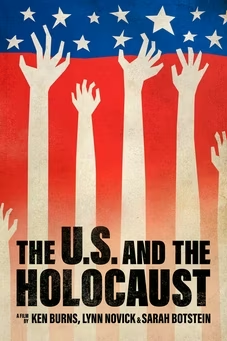
- [Ken] It was interesting for us as filmmakers that as we approached the story of the United States and the Holocaust we had to set the table of where America was from antisemitism and eugenics and xenophobia and so what happens is that when you engage these subjects particularly difficult ones they often resonate with what's going on now.
- [Coyote as Narrator] Some on board the ship wired an appeal to President Roosevelt begging him to intervene.
They did not receive a reply.
(typewriter clacking) Instead the State Department insisted that the passengers would have to wait their turns on the waiting list and qualify for and obtain immigration visas before they may be admissible into the United States.
(ocean sounds fade in) That could take years.
(ocean sounds) Canada wouldn't take them either.
(ocean sounds) The St.
Louis turned back toward Europe.
- [Sarah Botstein] None of us could have imagined how relevant the film would feel to audiences and students and looking squarely at our past to learn lessons from a terrible moment in human history is increasingly important.
- The film for me that encapsulates Florentine Films is probably "Vietnam" in that it's a very, very complicated story.
- [Sarah Botstein] Vietnam is definitely a film that I think about a lot and I think really profoundly changed everyone who worked on it.
- [Paul] We were so grateful to the vets who felt free in a way to finally talk the truth about what happened to them.
(explosion) (distant rock music) - [Musgrave] For the Marines in Northern I Corps and the 3rd Marine Division in the spring and summer of 1967 we called the DMZ the "Dead Marine Zone."
(distant rock music) (distant explosions) - [Coyote as Narrator] Musgrave's First Battalion had already suffered so many casualties in a series of bloody sweeps that it was believed to be a hard luck outfit.
(distant rock music) They were called the Walking Dead.
(rock music) - [Sarah Botstein] One of the ways we can get close to people in the past is to imagine where they walked, where they ate, the land, the people.
- [Lynn] There's the American side, there's the Vietnamese side, but within both of those there's so many different perspectives and by pulling together dozens and dozens of stories and perspectives I, I hope we were able to really elevate the conversation and deepen our understanding of what to me is this unresolved trauma in our national history.
- We were working on our history of the Vietnam War and I suddenly had this "A-ha" moment and I turned to Sarah Botstein and I said, "We're going to do the Revolution next."
- For me to then go back with Ken and David Schmidt and Geoff and our incredible team to the original founding struggle of American history and make "The Revolution" was the apex of that work for all of us.
We worked with 60 incredible actors bringing to life more than 150 people from the past.
(loud gunshot) -[Norton as Fithian] Blood, carnage, fire, Many, many we fear are lost.
Such a dreadful din my ears never before heard.
Philip Fithian.
- "The Revolution" just gave so many new opportunities to figure out a way to do something differently.
(loud explosion) - [Crew] That was awesome!
- [Sarah Botstein] Democracy, innovation, race, class, politics, unity, dissension, those are central themes in American history and they show up in any film we make.
Again, whether it's Prohibition, or Ernest Hemingway, World War II or Vietnam, the seeds are in the American Revolution and that's America.
(gentle music) (whoosh) - [Narrator] No matter their topic, at their essence all Florentine Films contain elements of biography.
- Biography is always a kind of constituent building block of all the films we've done.
Lewis and Clark and Elizabeth Cady Stanton, Susan B. Anthony, Frank Lloyd Wright, Mark Twain and biographies are parts of all the series.
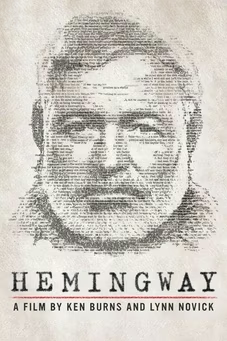
- [Narrator] In 2021, Florentine Films explored one of the 20th century's most fascinating writers, Ernest Hemingway.
- [Ken] As we learn from new scholarship and as new writing is revealed all of a sudden you realize behind the macho exterior was a much more complicated person who's on this trajectory of self-destruction.
- [Coyote as Narrator] He'd once planned to be a professional boxer, he claimed.
He'd fought in the Italian army during the Great War, been wounded seven separate times and been awarded a chest full of medals about which he said he was too modest to speak (distant trumpet) and he'd nearly starved to death in Paris while learning to write.
None of these stories was true.
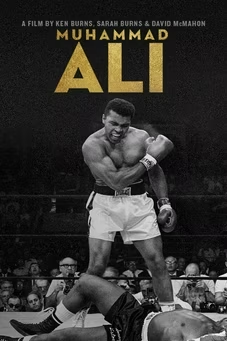
(trumpet continues) - [Narrator] Also in 2021, the Florentine team profiled one of America's most famous and controversial figures in "Muhammad Ali."
- [David as Narrator] He called himself the greatest and then proved it to the entire world.
(funky music) He was a master at what is called the "sweet science," (funky music continues) the brutal and sometimes beautiful art of boxing.
- [Ken] There's lots of documentaries on Muhammad Ali and some of the best documentaries ever made are on Muhammad Ali.
We felt that nothing had done what we like to do which is "soup to nuts."
That is to say like with "Hemingway" that you could begin with the birth and you could travel through all these things.
- [Sarah Burns] You know we want to go beyond the things that people already know even with someone as famous as Muhammad Ali, where lots of people know a lot about him.
They followed his career, they've watched his fights.
- These are people who we're familiar with.
Their stories have been told and it's incumbent on us if we're going to do it to get a little deeper.
- [Narrator] Back in 2005 Florentine Films explored a prominent American boxer with "Unforgivable Blackness: The Rise and Fall of Jack Johnson."
- [David as Narrator] They had come to see their hero, the white ex-heavyweight champion Jim Jeffries take back the title from the first African-American ever to hold it, Jack Johnson.
(ragtime band music) "It was," said the Chicago Tribune, "going to be a contest between the white man's hope and the Black peril."
(ragtime music continues) - I think complication in some ways is the key to Ken's films.
He has a little sign that really does say, "it's complicated," that's in the editing room and it is.
We don't do a lot of simplifying and so Jack Johnson's complexities are in that film.
Franklin Roosevelt's complexities are in the Roosevelt's film and it makes better history.
It also makes better films, I think.
- [Roosevelt] The present reign of terror and international lawlessness.
- [Coyote as Narrator] When the president compared fascist aggression to a spreading disease that needed to be quarantined, pacifists charged Roosevelt was starting America down the slope to war.
(dramatic violin) Isolationist congressmen threatened to impeach him.
The leaders of his own party remained silent.
The president took no action.
"It is a terrible thing," he told an aide, "to look over your shoulder when you are trying to lead and find no one there."
(dramatic violin fades) - It's hard to be covering the waterfront trying to understand all of American history without trying to understand this human being that is so central to the reason why we're here and talking and breathing.
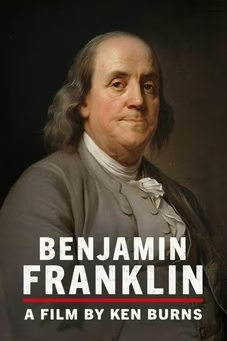
- [Narrator] In 2022, Ken Burns addressed the myths and searched for the true stories of Founding Father Benjamin Franklin.
- He's arguably the greatest American writer of the 18th century.
He's also without a doubt the greatest scientist of the 18th century in the world.
In fact, you could make the argument that there is no one more important to the creation of our country than Benjamin Franklin.
- [Narrator] Ken Burns and Florentine Films have spent 50 years crafting documentaries that explore over 600 years of history with topics as diverse as "Leonardo da Vinci" and "The Central Park Five" to the rich colorful history of "Country Music."
- [Dolly] I think it's just simple ways of telling stories, experiencing and expressing feelings.
(country guitar) You can dance to it, you can cry to it, you can make love to it, you can play it at a funeral, you can, it's just really has something in it for everybody and people relate to it."
- All of the divisions that we artificially create for ourselves, politically, socially, racially, sexually, regionally, musically, don't exist and "Country Music" was a celebration of that.
- [Narrator] Through the lens of Ken Burns and Florentine Films, we ultimately see ourselves and that will surely be a large part of their legacy.
- None of us would be here without Ken and he has a vision for what these films can be and the kind of stories he wants to tell and the level of quality and um, integrity that we put into hopefully every frame and what has been extraordinary for all of us who've been here is the sense of community, of coming together to do this as a collective in a way.
I mean, there's Ken and there's the rest of us and we all work together in a really, I think, unusual way.
- There's a level of dedication and passion and attention to detail, extraordinary judgment, wisdom... they do real history, they do real scholarship.
You really kind of want to be a part of it.
- Making sure that we're telling true stories and sharing them with people in a way that anyone can feel like they're learning more about something, um, that's that's an amazing legacy, I think.
- We really do put our blinders on and shut the door and try to get at good history.
John Lewis always said he wanted to make good trouble and I think we want to make films that are good history.
- We exist within a living history.
We are a part of history and the distant past history informs the present and what we're doing right now is going to inform what happens five years, 50 years from now.
- A teenage girl in a high school writing you a letter and saying, "I was so inspired by Elizabeth Cady, like, Stanton's story that I want to go to law school now.
Um, those kinds of things kept happening all the time for us and I just love the fact that they're just great educational tools for people and that we do open up their interest in a subject in a way that makes them want to listen or read more to something they aren't familiar with.
- The PBS landscape was very much a part of the way we could communicate.
These films came into people's living rooms through PBS on a free channel and that was very powerful.
- The films continue to have a life long past their first uh, public television broadcast.
It puts the bar in a certain place.
They're going to make something that's going to stand the test of time that's still going to communicate something years from now um, about the subject that's going to be useful to people who want to know more about it.
- That's what Ken has carried into every single film he's done to try to make something that is utilitarian, tells us history.
We learn things from it but it's more than that.
It's something that is beautiful and will last.
- The people we admire in the past, they were not flawless.
They were just like us and that means we can do great things and that's why I think history is important.
- We have one sentence that tells us everything you need to know.
"We hold these truths to be self-evident, that all men are created equal, that they are endowed by their creator with certain unalienable rights, that among these are life, liberty, and the pursuit of happiness."
It does not get any better than that and that will be the saving grace in the darkest hour.
We will hold on to that.
We will read those words to our children and our grandchildren on the 4th of July and we will be involved as citizens because that pursuit of happiness meant continuing education so that you would be worthy of the gift of citizenship.
Everybody else had heretofore mostly been, you know, subjects under authoritarian rule and now we have this new thing and if you, if you are going to honor that huge responsibility of citizenship then there's very little that can touch us.
- [Waterston as Lincoln] This nation under God shall have a new birth of freedom (fiddle melody) and that government of the people, by the people, for the people shall not perish from the earth.
(fiddle echoes and fades) - [Narrator] With 50 years of brilliant stories, Ken Burns and Florentine Films have transformed our understanding of America and how we understand ourselves.
Their groundbreaking work brought our history to life.
The next 50 years promise even more amazing discoveries and a deeper understanding of what defines us as a nation.
Thank you for joining us for "An Anthem to America: Ken Burns and Florentine Films Celebrate 50 Years."
(music crescendoes and fades) (uptempo music) (uptempo music) (guitar strumming music) (music crescendoes and fades)
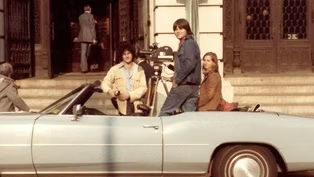
An Anthem to America: Ken Burns & Florentine Films Celebrate 50 Years Preview
Video has Closed Captions
Ken Burns and the filmmaking team look back over five decades of groundbreaking documentaries. (30s)
Providing Support for PBS.org
Learn Moreabout PBS online sponsorship






Support for PBS provided by: