
An Introduction to the Words and Life of Henry David Thoreau
Clip: Episode 1 | 8m 20sVideo has Closed Captions
Henry David Thoreau spent his life experimenting and contemplating on how to live a good life.
Henry David Thoreau was a lecturer, philosopher, pencil-maker, surveyor; a teacher, scientist, and an abolitionist. But, above all, he was a prolific writer who spent was obsessed with answering deep questions like how to live a good life and what it means to be a human being on this planet.
From
Problems playing video? | Closed Captioning Feedback
Problems playing video? | Closed Captioning Feedback
Episodes presented in 4K UHD on supported devices. Major funding for HENRY DAVID THOREAU was provided by The Better Angels Society and its members: The Keith Campbell Foundation for the...
An Introduction to the Words and Life of Henry David Thoreau
Clip: Episode 1 | 8m 20sVideo has Closed Captions
Henry David Thoreau was a lecturer, philosopher, pencil-maker, surveyor; a teacher, scientist, and an abolitionist. But, above all, he was a prolific writer who spent was obsessed with answering deep questions like how to live a good life and what it means to be a human being on this planet.
From
Problems playing video? | Closed Captioning Feedback
How to Watch Henry David Thoreau
Henry David Thoreau is available to stream on pbs.org and the free PBS App, available on iPhone, Apple TV, Android TV, Android smartphones, Amazon Fire TV, Amazon Fire Tablet, Roku, Samsung Smart TV, and Vizio.
♪ Michael Pollan: Every now and then, a sentence, a paragraph, an essay continues to speak to people and has some value in the present.
Kristen Case: There is something incredibly powerful about taking someone else's words inside yourself, and your body is involved in those words, in making those words real.
Sandra Harbert Petrulionis: Words start wars.
They save people, and they convert us from thinking one way to realizing that we're wrong in what we think.
Rebecca Solnit: The stories we tell, the ways we think about the world have huge consequences, and so do our actions.
Ideas shape reality, and they can change the world.
Narrator: His life was a relentless search for truth.
His words have inspired revolutions, social movements, and environmental actions all around the world for more than 150 years.
His name was Henry David Thoreau.
♪ [Birds chirping] ♪ [Crow cawing] Henry David Thoreau: I wanted to live deep and suck out all the marrow of life, to live so sturdily and Spartan-like as to put to rout all that was not life, to drive life into a corner and reduce it to its lowest terms, and, if it proved to be mean, why then to get the whole and genuine meanness of it and publish its meanness to the world; or if it were sublime, to know it by experience, and be able to give a true account of it in my next excursion.
♪ Clay Jenkinson: Most people today would say, "Why am I not happy?"
They realize that the path that they took to happiness has not precisely worked out for them.
Thoreau was trying to make sense of life.
He lived exactly the way he wanted to live, and there was an enormous freedom for him that most people just don't get.
The things he's getting at were mostly ignored then, and they're mostly ignored now, but Thoreau understood that language matters.
♪ [Steam whistle blows] Narrator: Henry David Thoreau wrote about the impact of industrialization on nature and society, the hypocrisy of slavery in a country that declared all men equal, and the mindless pursuit of wealth, which he said led to lives of quiet desperation.
So much of what we spend our lives and our days doing we don't truly care about, and yet, somehow we've found ourselves in the middle of a life with obligations.
[Indistinct chatter] Rebecca Kneale Gould: People don't know where to find meaning, and they don't take the time to try to find it, which Thoreau says is essential.
You can't even ask the deep questions if you don't stop to figure out what the deep questions are.
Michael Pollan: Our lives are overcomplicated.
It's so easy to lose sight of what matters.
His big project as a writer is to wake us up.
Narrator: He spent his time observing, contemplating, and experimenting, including two years in a small house he built near a pond, where he tried to live a simple, spiritual, and intentional existence.
He never stopped asking questions and never settled for easy answers.
"Rather than love, than money, than fame," he wrote, "give me truth."
Clay Jenkinson: The program of his life is to seek other ways of being and of connecting.
It involves distancing yourself from norms until you begin to see things that you could never have seen in any other way, things that most people can't see.
Narrator: Thoreau was a lecturer, philosopher, pencil-maker, and surveyor, a teacher, scientist, and an abolitionist, but above all, he was a prolific writer.
His journal alone was more than 2 million words.
He wrote two timeless manifestos, one on discovering spiritual truths in nature and the other on a citizen's obligation to stand up against injustice, two seemingly different doctrines that Thoreau would prove are profoundly interconnected.
Pico Iyer: I think if 20 people read Thoreau, each one of us will get something different, and yet what they're getting from Thoreau, I think, is very much the same-- a sense of possibility, a new dawn, a reminder to think about the essential facts of life.
There's so many ways in which his work and his life and his ideas and his creativity and his passion and his vulnerability shape our world today.
Narrator: His life was rife with contradictions.
He yearned for solitude but became a public figure.
He believed in the preservation of wild nature, yet knowingly contributed to its destruction.
He was committed to freedom and equality for one race of people but often failed to take action against the inhumane treatment of another.
Ultimately, his life would be reduced to legend and his complex prose to one-liners, and while he rarely traveled far from his hometown of Concord, Massachusetts, he became a man of the world.
Rebecca Solnit: Life can always be endless adventure and discovery, even if you've only traveled widely in Concord, and Thoreau is a genius at packing a thousand miles into a single step in how he writes.
♪ Henry David Thoreau: Man thinks faster and freer than ever before.
He, moreover, moves faster and freer.
He is more restless because he's more independent than ever.
The winds and the waves are not enough for him.
He must ransack the bowels of the earth, that he may make for himself a highway of iron over its surface.
[Clattering, bells ringing] [Birds chirping] Think of our life in nature-- daily to be shown matter, to come in contact with it-- rocks, trees, wind on our cheeks, the solid earth!
the actual world!
The common sense!
Contact!
Contact!
Who are we?
Where are we?
♪ Kristen Case: And he never let those questions settle, and I think that makes him relevant always, in every time, but particularly in a time like ours, where we are really thinking about what it means to be a human being on this planet.
Clay Jenkinson: But you have to open the book, and Thoreau says, "All right.
I've got your attention now.
Keep reading, and I'll help you sort this out."
[Water rippling] [Birds chirping and squawking] ♪
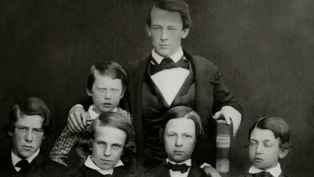 New
NewHenry David Thoreau and Transcendentalism
Video has Closed Captions
Clip: Ep1 | 5m 9s | Thoreau is introduced to Ralph Waldo Emerson and the radical ideas of transcendentalism. (5m 9s)
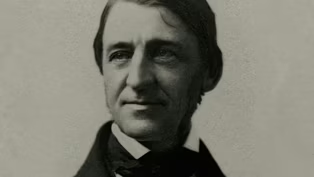 New
NewRalph Waldo Emerson's Mentorship of Henry David Thoreau
Video has Closed Captions
Clip: Ep1 | 9m 9s | Thoreau moves in with Ralph Waldo Emerson's family, but personal tragedy strikes both families. (9m 9s)
Providing Support for PBS.org
Learn Moreabout PBS online sponsorship









Support for PBS provided by:
Episodes presented in 4K UHD on supported devices. Major funding for HENRY DAVID THOREAU was provided by The Better Angels Society and its members: The Keith Campbell Foundation for the...