State of Affairs with Steve Adubato
Analyzing the signs & causes of stroke & its link to aphasia
Clip: Season 10 Episode 7 | 8m 50sVideo has Closed Captions
Analyzing the signs & causes of stroke & its link to aphasia
Steve Adubato is joined by Dr. Colum F. Amory, MPH, Chief of Cerebrovascular Services at Hackensack University Medical Center, to explain the signs and causes of stroke and its link to aphasia.
Problems playing video? | Closed Captioning Feedback
Problems playing video? | Closed Captioning Feedback
State of Affairs with Steve Adubato is a local public television program presented by NJ PBS
State of Affairs with Steve Adubato
Analyzing the signs & causes of stroke & its link to aphasia
Clip: Season 10 Episode 7 | 8m 50sVideo has Closed Captions
Steve Adubato is joined by Dr. Colum F. Amory, MPH, Chief of Cerebrovascular Services at Hackensack University Medical Center, to explain the signs and causes of stroke and its link to aphasia.
Problems playing video? | Closed Captioning Feedback
How to Watch State of Affairs with Steve Adubato
State of Affairs with Steve Adubato is available to stream on pbs.org and the free PBS App, available on iPhone, Apple TV, Android TV, Android smartphones, Amazon Fire TV, Amazon Fire Tablet, Roku, Samsung Smart TV, LG TV, and Vizio.
Providing Support for PBS.org
Learn Moreabout PBS online sponsorship[INSPRATIONAL MUSIC STING] - Hi, everyone.
Steve Adubato.
We kick off the program with Dr.
Colum Amory, who's the chief of cerebrovascular services at Hackensack University Medical Center.
This is part of a series we're doing called "Voices of Aphasia".
And Dr.
Amory, first of all, thank you for joining us.
- Thank you so much for having me on the show, Steve.
- Now we know "Voices of Aphasia".
We know what aphasia is because we're partners with the Adler Aphasia Center.
I've been honored to be involved in their fundraising efforts over the years.
Mike and Elaine Adler established that center.
It's important, but people don't know what aphasia is, but it's also connected many times to stroke, which you know a lot about.
A, what's a stroke?
B, Doctor, what is the connection potentially between having a stroke and then aphasia and what it is?
- Sure.
- It's a lot, I know.
- Yeah, thanks.
So first of all, a stroke happens when blood flow to the brain gets blocked off, usually by a blood clot that comes from somewhere else in the body.
And when that happens, part of the brain gets injured because it doesn't have the blood it needs to survive well.
When this happens, the part of the brain that gets injured is the part that expresses itself in the stroke.
So if the part of the brain where language lives gets affected, then you will have aphasia, which is a difficulty with expressing yourself, understanding, or speaking.
- So here's the thing.
We've worked with the Adler Aphasia Center and met many people dealing with aphasia.
You should go on their website to take... And our website as well.
Take a look at some of those previous interviews.
But here's what I'm struck by.
The issue with a stroke is so... Issue with dealing with a stroke.
The issue's dealing with a stroke that the time that it hits one or it begins and the time one is treated is critical, as I understand it, and you'll explain it a lot better, Doctor, because that time is brain and what happens to the brain in that time before symptoms happen.
And then you're treated could have a very detrimental impact on certain brain functions, including the ability to communicate.
Do I have it right?
- Yeah, that's correct.
So when blood gets blocked from getting into the brain, immediately the brain cells start dying.
And the longer the brain is without blood, the more brain cells get permanently injured.
So it's critically important that if you have, or your loved one has symptoms of a stroke that you get to the hospital as soon as possible because we have treatments that we can give to patients in that early period of time to make a major difference in their outcome, including in their ability to speak, move, walk, and so on.
- Okay, so let's do this and team, if you're gonna... I'm not sure we're gonna do this in post-production, but I'd love to have these letters put up.
It's B-E-F-A-S-T, BEFAST, okay?
Let's do this.
B, balance.
Unable to balance.
These are symptom, signs, that you may be having a stroke.
Real quick on that doctor.
- Yeah.
So B stands for balance.
So if you have difficulty keeping your balance when you're walking all of a sudden, and all of these letters are meant to be taken as a sudden onset of these symptoms.
- So it happens quickly.
- Exactly, in a flash, which is why the name stroke came about 'cause it happens so quickly.
E stands for eyes or vision, so a sudden change in your ability to see.
F is for face, and so that's if this one side of the face becomes droopy.
A is for arm or strength in the arm or legs, so the weakness on one side of the body.
S is for speech, and that's that aphasia or ability to talk or ability to express yourself.
And then the T stands for time, as a reminder to all of us, how really important it's to get to the hospital quickly.
- You know, the other thing about working with the Adler Aphasia Center is on the issue of awareness.
We're involved in a public awareness effort.
I used to struggle with whether I would talk about this or not, but I learned from Mike and Elaine Adler who have passed, but their impact continues in the work of the Adler Aphasia Center.
And Mike had aphasia and Elaine was his caretaker and his advocate, and they advocated together for people dealing with aphasia.
Changed laws throughout the state of New Jersey and the nation and public awareness.
But people who deal with aphasia, it's important that we're aware of that.
So my dad dealt with aphasia.
I didn't talk about that at first, but I thought, this is a guy whose life was talking and when he got sick, we weren't sure what was happening, but he did have aphasia.
Bruce Willis has aphasia.
How important is that Bruce Willis and others who are recognizable, respected in their field, how important is it that they acknowledge that they're dealing with aphasia because they're one of many, many, many people who are?
- Yeah, I agree absolutely.
And it's always a wonderful thing when people are able to talk about what's going on with them.
You know, there is should be no shame associated with this.
This is an unfortunate outcome of various diseases.
Stroke being one of them.
Bruce Willis had a primary progressive aphasia, which is a kind of dementia.
and, you know, hearing these life stories of people who have dealt with this, I think makes it more accepted, more normal, and something that people can therefore be more comfortable working on, and people get better from aphasia.
You can get better from aphasia by working at it.
- We just did an interview interview with Mike Hornbostel.
Hornbostel.
who was a member at the Adler Aphasia Center.
We did an interview with Mike, who was an... Is, was and is an incredible guy who when he had the stroke and he dealt with aphasia, his ability to communicate was challenged on so many levels.
But here's what struck me about Mike.
He worked so hard at the Adler Aphasia Center.
He had so much help there.
What he was, his ability to communicate when he first was diagnosed with aphasia and then he joins us and he's an incredible dynamic guest.
Struggling at times to get the words out, but confident in doing it.
- Yes.
- Is that the norm, Dr.
Amory?
- So, you know, recovery from stroke is different for every individual, and it depends upon a lot of things.
It depends upon how big the stroke is, where the stroke is, how old you are to some degree.
And also, you know, how you were doing before you had the stroke, right?
So if you are a reasonably healthy person ahead of time, it certainly helps with recovery.
But recovery takes time and it takes hard work.
The brain doesn't bounce back in the same way that say, you know, if you cut your skin and it scabs over in a few days, it looks, you know, reasonably good.
The brain takes time.
We usually expect weeks to months of recovery after a stroke.
But everybody can improve to some degree.
- Dr.
Colum Amory, who's the chief of cerebrovascular services at Hackensack University Medical Center.
A part of the larger system, HMH, Hackensack Meridian Health, one of our longtime underwriters.
Dr.
Amory, thank you so much for joining us.
We appreciate it.
- It's my pleasure and thanks so much for having me.
- Yeah, there's more to understand around voices of aphasia.
Stay with us.
We'll be right back.
- [Narrator] State of Affairs with Steve Adubato is a production of the Caucus Educational Corporation.
Funding has been provided by in support of the Adler Aphasia Center.
NJM Insurance Group.
EJI, Excellence in Medicine Awards.
A New Jersey health foundation program.
Valley Bank.
Seton Hall University.
PSE&G.
The Fund for New Jersey.
Delta Dental of New Jersey.
And by New Jersey Sharing Network.
Promotional support provided by CIANJ, and Commerce Magazine.
And by NJBIZ.
Hi, I'm Naomi Gwartz from the Adler Aphasia Center.
Aphasia is a language disorder that usually results from a brain injury such as stroke or a brain tumor.
While aphasia can affect one's ability to speak, understand, read, and write, it does not affect intellect.
Programs offered at our center help improve communication skills as well as confidence and quality of life while surrounded by others who understand aphasia.
If you or a loved one is diagnosed with aphasia, there is hope and community.
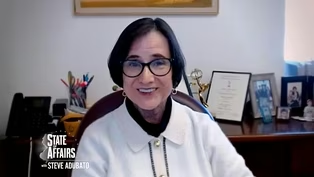 New
NewCelebrating NJ's contributions to America's independence
Video has Closed Captions
Clip: S10 Ep7 | 8m 47s | Celebrating NJ's contributions to America's independence (8m 47s)
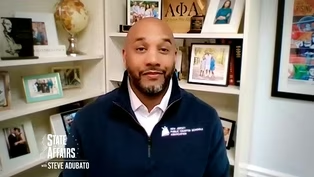 New
NewHow do charter school lottery systems work in New Jersey?
Video has Closed Captions
Clip: S10 Ep7 | 9m 40s | How do charter school lottery systems work in New Jersey? (9m 40s)
Providing Support for PBS.org
Learn Moreabout PBS online sponsorship New Episode
- News and Public Affairs

Top journalists deliver compelling original analysis of the hour's headlines.

- News and Public Affairs

FRONTLINE is investigative journalism that questions, explains and changes our world.

 New Episode
 New Episode
 New Episode

 New Episode
 New Episode
 New Episode
 New Episode
Support for PBS provided by:
State of Affairs with Steve Adubato is a local public television program presented by NJ PBS