
Andrew Scott & Paul Irving on What Aging Means Today
Clip: 5/9/2019 | 15m 50sVideo has Closed Captions
Economist Andrew Scott and aging expert Paul Irving join the program.
It's a rarity to reach 100 years old, but as life expectancies grow longer, what happens when that rarity becomes the norm? Is society prepared for it? Economist Andrew Scott tackled this in his book, "The One Hundred Year Life" and Hari sat down with Scott and aging expert Paul Irving to discuss this in San Diego.
Problems playing video? | Closed Captioning Feedback
Problems playing video? | Closed Captioning Feedback
Andrew Scott & Paul Irving on What Aging Means Today
Clip: 5/9/2019 | 15m 50sVideo has Closed Captions
It's a rarity to reach 100 years old, but as life expectancies grow longer, what happens when that rarity becomes the norm? Is society prepared for it? Economist Andrew Scott tackled this in his book, "The One Hundred Year Life" and Hari sat down with Scott and aging expert Paul Irving to discuss this in San Diego.
Problems playing video? | Closed Captioning Feedback
How to Watch Amanpour and Company
Amanpour and Company is available to stream on pbs.org and the free PBS App, available on iPhone, Apple TV, Android TV, Android smartphones, Amazon Fire TV, Amazon Fire Tablet, Roku, Samsung Smart TV, and Vizio.
Watch Amanpour and Company on PBS
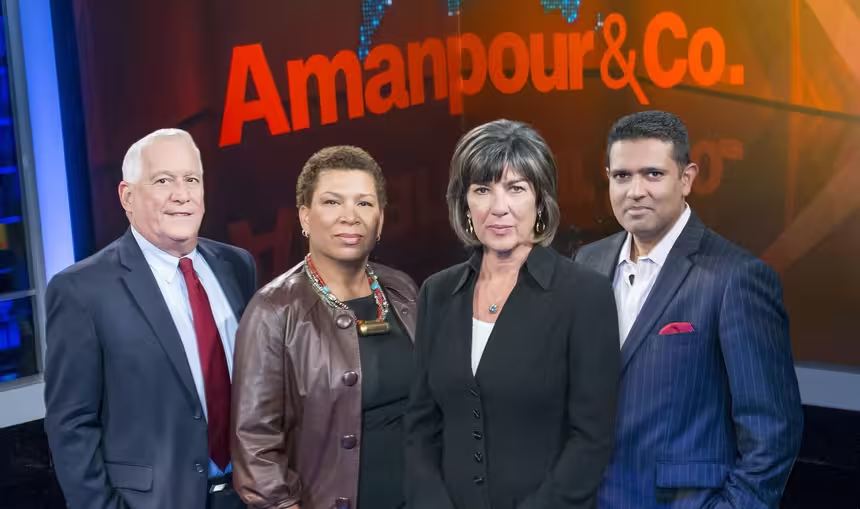
PBS and WNET, in collaboration with CNN, launched Amanpour and Company in September 2018. The series features wide-ranging, in-depth conversations with global thought leaders and cultural influencers on issues impacting the world each day, from politics, business, technology and arts, to science and sports.Providing Support for PBS.org
Learn Moreabout PBS online sponsorshipMy next guest argue a single career path may no longer be enough for us today.
It's a rarity to reach 100 years old.
My own father did make that milestone and we had a great celebration.
But his life expectancies grow longer.
What happens when that rarity becomes the norm?
Is society prepared for it?
The economist Andrew Scott is tackling this topic in his book The 100 Year Life.
And our Hari Sreenivasan sat down with him alongside aging expert Paul Irving.
To explore why 100 your life.
One of the things that when I started digging into the topic was just understanding.
Wow.
Most people aren't aware that if you look at the 20th century every decade, life expectancy increased by two or three years.
So that means that every generation is living almost ten years longer than their parents generation.
But we're still acting in the same way as our parents or even our grandparents.
And most people aren't aware of that.
And if you carry on that trend, it does mean that a lot of children born in the richer countries today have a reasonable chance of living to 100.
In the UK, the government says one in three chance of a child born today living to 100.
So one life was saying, well, actually, you've got a lot more time and you live your life differently.
Okay, so what are the consequences if we live to 100?
Well, it's a paradox.
I mean, you know, science in many ways has done its part.
So we've we've had incredible scientific advances over the last 150 years or so improve in its sanitation.
And as Indra says, lives are, are longer across the world.
But, but in many ways we just don't know what to do with these additional years.
And that's true on an individual level.
It's true, again, on a societal level.
It's true in businesses and communities.
And so we have to change really everything, all institutions to adapt to what's what's going to be a much older world.
That's really, by the way, a product of two things.
It's a product of increasing longevity and lower birth rates.
And across much of the world, people are having children at replacement rate.
That's true in the United States.
It's true in the UK.
It's true in China.
China has reversed the one child policy.
But let me tell you, young couples are still not having the 2.1, 2.2 kids that they would have to have to replace the Chinese population, which is actually likely to be smaller in years to come than it is today.
I mean, if you are thinking that culturally and societally, we're thinking you should be getting out of the workforce, at 65, and if you're living in another 30 years, that's a full third longer.
So you can't I mean, so the way I see what's happening is I mentioned earlier that every ten years life expectancy is growing at two or three years.
That's like the end of every day saying here's another six to 8 hours.
And if you think about what would happen if the day went from 24 to 32 hours, we'd restructure the day.
Now, how we do it, I'm not yet sure.
For me, I would get up early and I'd go to bed later.
I'd have a sleep in the middle of the day and I wouldn't have three meals.
I might have five, hopefully smaller ones.
But basically I would restructure time.
Now, in the 20th century, we introduced some new stages of life.
We invented teenagers and we invented pensioners, retirees.
And we're seeing the same thing happen now because as we stretch life to 85 or 90 or beyond, our existing structures don't work And one challenge is retirement at 65 clearly doesn't work, but neither does just stretching it out to 75 or 80, because there's nothing I think you can learn at 20 that will last year.
80.
So we have to think also about education and thinking about getting more education throughout our life.
But we're already seeing massive changes in society the average age of first marriage in the US is now around 13, not 21 in the UK or more likely as a woman to have a baby over 40 than under 20.
So we're seeing all sorts of changes already happening.
But I think this is just the beginning of a pretty significant rewiring of how we live our life.
And then of course that requires change from our education institutions, our corporate institutions and government policy.
What's retirement anymore?
I mean, what is the idea of retirement itself has to change?
It doesn't.
Right.
I mean, it's not necessarily sort of being on the margins anymore out of the workforce.
You can't keep people at bay for 30 years and it's probably not healthy either.
We know that you know, it's good to be engaged and work is one way of being engaged if the work is good.
So, you know, I think in the, in the 20th century, we invented a three stage life of education, work, retirement, and that just can't be stretched out to 85 90.
So I think we're seeing people having multiple career stages now, a multi stage life with perhaps two or three or even four different careers.
And so one of the questions about retirement, which has already come to an end, is what do I do?
Do I carry on working?
Do I do something different?
Do I do something for charitable purpose?
But is a quest to be engaged throughout her life and how to make that work financially but also not just financially, also in terms of your health, in terms of relationships and in terms of education.
We've got more time ahead of us because we're living for longer.
So we've got to prepare for that differently and invest in the future.
And we too often think of that as just about finances, because if I'm going to work, I'm 70.
How do I keep my job?
What skills do I need?
What about my health and my fitness?
How do I maintain this longer life?
You know, we had one significant shift in productivity increases and labor decreases with automation, and it seems that we're now on the cusp of another one with artificial intelligence.
An employer is going to say, Hey, this is good for business, this is good for me, increases productivity.
I have to pay humans less.
How do you convince businesses that it's worthwhile to bring on a workforce?
Say over 50.
But I think what we've come to realize is that the skills and talents of older people actually beautifully complement the talents of younger people.
Younger people bring curiosity and risk-taking characteristics and imagination to two new jobs, but they also lack the skills that enable them to navigate complex environments, to think in a multisectoral way, to understand how to actually get things done, to move things through a through a corporate system, to deal, if you will, with with the politics of business, which comes from experience, that if they somehow figure out a way to effectively blend the characteristics of these older employees and these younger employees, they can have the best of both and ultimately potentially outperform what would be created by same age teams of any age, young or old.
If you want to have the most creative, most effective teams thinking about your new products, and services, your innovations, you're creating, you're in the Silicon Valley, you're creating a skunkworks project that you want to you want to use to beat the competition, develop something something exciting, put an old person and a young person on the on the team together.
And and by combining their skills and talents, I think you're likely to outperform.
Are there are there companies that you've seen that are doing this?
Well, some are.
And there's a raft of experiments that companies are doing.
But actually, something has been happening because you look over the last 20 years in the US employments increase by 22 million.
But if you look at where those jobs have come from, it's not the sort of Silicon Valley miracle, it's not the hipsters of Brooklyn.
It's been coming from those aged over 55.
20 million of those 22 million jobs have come from people aged over 55 and 16 million I think has come from 55 to 64 and about another five or six from those aged over 65.
So something's happening.
There's a lot more people wanting to work and many of them are being able to work.
There's a lot of challenges but actually that's a pretty big contribution to US GDP growth coming from that increase in employment.
It's not just jobs, it's, it's actually business creation too.
So, so the the expectation is again kind of the cultural biases as you've got to be a computer, a very young computer scientist who probably drops out of Harvard after your freshman year to to create a brilliant business to to make it in America.
But the truth of the matter is, in the United States, more businesses are created by people by people in middle aged and are than are and they're in their twenties.
And that's probably a good thing because they've been bumped around and they've got experience.
How do we change our entire kind of education system?
Because right now it seems that our goal is to get you through 12 years of education, four years of college, and then we're still operating under this assumption that you're going to be what, working at the same company for 40 years for a Rolex, right?
That's not how it's a big challenge.
You're now more responsible as an individual to save for your own pension.
You're also gonna have a lot more responsibility to invest in your own skills throughout life.
So clearly what's going to happen is you're going to go from front loading education to spreading it out.
So there has to be a big increase in adult education and making it more centered and more central.
That's going to lead to some really interesting developments because clearly what you learn when you learn how you learn and he learned from that can change pretty fundamentally.
I don't know if it's going to be that colleges I don't know if it's going to be non-degree space, but this is a hugely interesting area because we've got to prepare people for lifelong learning.
I think what that means is at the beginning of your education, you don't learn things.
You learn how to learn because that's going to be the skill that's going to be really important right the way through the rest of the life.
And that's going to be hard because if you look at our education system, it was developed during the Industrial Revolution and said to people, sit there, there's an authority figure nine to four, take instructions, be used to having your performance measured and then go out and do that in the factory.
But that doesn't seem to be what the workforce of the future needs.
So it's going to be a really big challenge.
It requires all of us to change requires a fundamental cultural shift that that speaks to the way we should talk to our kids and grandkids about education, about it.
Being a lifelong process, about it not being something that you do for a period of your life and then stop.
It should be something that is is an ongoing that continues throughout life, frankly, right to the very end.
It's quite funny because if you ask someone what was your education or how skilled are you there, if, say, I did it a great Oxford 30 years ago, if you said to someone, how fit are you?
And they said, I run a marathon 30 years ago, you know, that doesn't have any sort of resemblance was occurring today.
And I think that's kind of the challenge we see education as an event in the past, but lifelong learning is something we have to do all the time.
So you can sort of see how this longer life and technology means it's going to be quite hard life.
You got to be hustling all the time.
I've got to be developing my skills, looking out for change.
But it is that that proactive nature that I think is going to be really important in this long life with new technologies.
You know, look, I'm watching this as, let's say a Gen Z or it's a God.
Here are these two old guys telling me that the older folks are going to be around even longer you know, I can't get farther ahead in my organization because they're there.
And here you are advocating that we hire them back, right?
I mean, some part of this is also cultural and figuring out when when is the time for companies, agencies, institutions to kind of renew it, to get the best of the next generation that's coming to give them opportunities to grow.
But I don't I don't suggest for for a minute that the fact that we're we're trying to figure out new roles for older people, that older people shouldn't shouldn't invest, invest and support and focus on the elevation of younger people.
To the contrary.
Actually, polling suggests that most most older people are prepared to take pay cuts if they're if they're given respectful roles in which they have that opportunity to mentor and and to and to play some some kind of important part in the future of a company.
So I think the notion that's a zero sum game that that if we keep old people on the job, that by definition young people won't be able to advance is just wrong.
You know, Andrew is the economist.
I mean, some of the same arguments were made about the advancement of women, of women.
40 or 45 years ago, what kind of economies and businesses and communities are elastic.
They the more people who we're involved, the more they grow, the more they prosper and flourish.
And so this notion that somehow this is a competition over this very narrow, narrow, constrained, you know, kind of kind of pie, I think is just a it's just a false narrative.
I think what is very interesting is how as a society, the US and UK got a bit confused about the age.
So for most of human history, people haven't known how old they were.
They didn't know what year they were born, they didn't know what their birthday was.
The song Happy Birthday, the 20th century creation.
So we didn't know how old we were.
And we judge people by really their fitness and their sort of actions and attitudes but we've become very age segregated as a society.
So that, I think, leads into this confusion that, you know, I don't know what young people are like because I don't mix with them.
I don't know what old people like because I don't mix with them.
So we fall into these generational labels of Gen Z and baby boomers to sort of try and fill in the gaps.
But actually just people of people in the more we can try and get that dialog going, I think we're all trying to do the same thing.
We're trying to refashion life that's a lot longer than we previously experienced.
And whether you're in your sixties or in your twenties, you're saying, Hey, I'm not gonna do things the way that we're done in the past because that's not going to work for me.
How do I restructure things?
So in the workplace, I find that whether you are 20, 40 or 60, everyone wants meaningful, flexible, good work.
That's a common aim.
It's not really a sort of zero sum fine.
What's the cost if we don't do this?
Yeah, so I think there's two things happening.
So one is there's more old people as the birth rate falls and people live longer, we see more people and that's the narrative that normally comes out.
But the other thing is that actually how we're aging is changing.
On average, we're aging better.
So we're going to try and make as many people as possible go down that second route to age.
Well, and that's about all of life.
It's about education, it's about health, it's about good work.
It's about the way we balance work and home.
But every one person, we can go down that healthy aging route.
They stay active, they keep producing for the economy.
They pay taxes.
They don't cost so much in terms of health and Social Security.
Every one person who does go down that sort of the aging route doesn't age well is a burden.
So there is an economic cost.
If we don't make the most of this extraordinary development of the 20th century of the potential for longer and healthier lives.
And of course, what we're seeing both in the UK and US, is life expectancy full because of growing health inequality.
And so tackling that I think has to be an incredibly important policy path.
I would just I would add part of the challenge here is not just enabling changing institutions to enable this advantaged group to take advantage of their additional years.
It's democratizing that opportunity.
It's figuring out ways that we can ensure that people in zip codes across town have the same opportunities that those of us who are fortunate enough to have educations and exposure and all the rest do so.
So it's probably a longer conversation.
But as Andrew suggests, we have a very significant challenge in making sure that those opportunities are are spread.
Paul Irving, Andrew Scott, thank you both.
Thank you very much.
Thank you.

- News and Public Affairs

Top journalists deliver compelling original analysis of the hour's headlines.

- News and Public Affairs

FRONTLINE is investigative journalism that questions, explains and changes our world.











Support for PBS provided by: