
Andy Sprenger and Lauren Calkins
2/4/2026 | 59m 3sVideo has Closed Captions
Kevin, Gretchen, and Matt welcome Andy Sprenger and Lauren Calkins to the show.
Kevin, Gretchen, and Matt welcome Andy Sprenger and Lauren Calkins to the show.
Problems playing video? | Closed Captioning Feedback
Problems playing video? | Closed Captioning Feedback
The Four Hundred & Nineteen powered by WGTE is a local public television program presented by WGTE
Andy Sprenger and Lauren Calkins
2/4/2026 | 59m 3sVideo has Closed Captions
Kevin, Gretchen, and Matt welcome Andy Sprenger and Lauren Calkins to the show.
Problems playing video? | Closed Captioning Feedback
How to Watch The Four Hundred & Nineteen powered by WGTE
The Four Hundred & Nineteen powered by WGTE is available to stream on pbs.org and the free PBS App, available on iPhone, Apple TV, Android TV, Android smartphones, Amazon Fire TV, Amazon Fire Tablet, Roku, Samsung Smart TV, and Vizio.
Providing Support for PBS.org
Learn Moreabout PBS online sponsorshipNow the 490 with Gretchen de Bakker.
Might kill them.
And Kevin Mullin up.
Welcome into the 419 powered by GT, presented by Retro Wealth Management.
I'm Kevin Mullen.
Gretchen de Bakker.
I kill them.
We got an exciting wellness Wednesday presented by Work Spring.
Today we're going to be talking.
So at least one of these guests I know, from previous work, we'll we'll get into that.
Andy Springer is a learning development consultant, with work spring.
And then we'll also have Lauren Calkins on as wel as senior wellness consultant.
Matt, wha what are we talking about today?
All kinds of things.
Heart health, I think.
Just general wellness as we are, hopefully about halfway through the summer or winter doldrums here.
So typical work spring and will be, both on a personal note and also from an employer standpoint.
So the a great show.
Excellent.
Sounds good.
Hey, I, we're we're trying something new at home.
And maybe it's not new, but we're trying to get the kids to watch our favorite movies.
Okay.
When we were kids, or, like, maybe the classics.
Yeah.
So, like.
And also when we were kids, but, like, we watched Pitch Perfect.
Oh, sure.
Like them.
And, like, we're working through that.
And the kids love musicals, so like that.
Like, played in.
Well, what was the first one.
To sort of easing into this conceptually was a pitch perfect.
No no no no, it was That's right, that's right.
We would fight club.
It.
Yeah, yeah, yeah.
They're all sleeping in the studio.
Yeah.
That's right.
No, no, we did, the goal.
So we watched a bunch of Adam Sandler like movies, and that was probably the first time we were walking down that road.
And then we realized, like, we're going to create a clear line here, that the kids understand what you hear and see in the movie.
You cannot do at school.
Right.
So when you watch the film, when you watch Billy Madison.
Yeah Like you can't do any of that.
But the overall like, overarchin theme of the movies are great.
Yeah.
So, Danny pick, what is the what is that conversation like?
Yeah, it's one of us throwing out something crazy, and then the kids saying, no, I don't wanna watch that.
And they want to watch.
Yeah, sure.
Then they want to watch the trailer.
Yeah.
And the trailer isn't helpful either.
Yeah.
Princess bride?
Yeah.
Like, there really isn't a trailer, per se, right?
And so the kids are like, absolutely not.
We don't watch this, and we were like, well, then you can go to bed.
So make time.
So watch watch it or punishment.
Yeah.
That's right.
Yeah.
And then they loved it.
When in the week.
When is movie time?
In the evening.
So we'll do.
Like Friday, Saturday or Sunday or.
Yeah.
So it's I mean during the week if we've got the time.
That is, I mean my kids don't stand still.
And so that is where they get like yeah sit do nothing.
Watch this before you go to bed.
Sure.
And so.
That's kind of these becom like the at least in my family, the movie quote and the movies that we all know become like the vernacular for the.
Family better than talking about your feelings.
That's.
Yeah, that's absolutely right.
Yeah.
Elf is maybe the most quoted movie in our household amongst everybody.
And so the number of times that, you know, one of my kids will tell me, like, I smell like beef and cheese o something, and it's like, you.
Should I respond with that?
That's funny.
Because I've never seen the film.
Yeah.
But I respond with where you sit on a throne of lies.
Yeah.
So I love it's great.
I love it.
All right.
So, Frankenstein.
Classic.
Yeah.
All right, so then today, I' talking about movies like this.
All right?
All right.
What was your favorite movie as a kid?
We watched all those young Frankenstei high anxiety that those movies.
We haven't done youn Frankenstein with the kids yet.
Yeah, yeah, yeah.
Boy.
My family is a kid.
Yeah.
A Top Gun.
Okay.
I like that.
All right.
I was probably home alone.
Yeah.
All right.
I like that mostly just because of the violence.
The violence?
That's right.
The thought, the thought of booby trap in my house.
Yeah.
It's really the ambiguity of, Kevin's dad's job.
You know, what does this guy do?
Can you imagine, like, just disappearing and not realizing for about 24 hours and then taking, you know, the better part of a week for you to get home?
Yeah.
All right.
When we come back, well, the dream is alive.
When we come back, we will tal with Annie Springer, a learning and wellness consultant.
Learning and development consultant with Work Spring.
We'll be right back here on the 418.
Support for the 419 comes from we True Wealth Management, where we understand tha your financial path is personal.
Advisory services are offered through Capital Investment Advisory Services LLC, securities offered through Capital Investment Group member Finra and SIPC.
More information at Retro advisors.com.
The 419, powered by CTE is made possible in part by supporters like you.
Thank you.
Introducing the Local Thread, a community news series uniting voices and storytellers from across the region in partnership with La Prensa, the Toledo Free Press, the Sojourner Truth, Toledo Public Schools, and veteran journalist Gerry Anderson.
The Local Thread brings you stories and conversations that connect our community.
Here are weeknights at seven on FM 91 with early access on podcast platforms.
Each morning, the local thread only on GTV.
Welcome back into the 419.
It is a wellness Wednesday presented by Work Spring, and we're joined by another friend of ours from work, Spring, Andy Springer.
Thank you for having me.
Thanks for being here.
You are a learning and developmen consultant for West Spring.
Yes.
What does that mean?
I like to say I'm a gardener of training.
No, I help plant the seed, and then I help, water that seed till it grows.
And, bears fruit.
When it comes to learning.
And I go and I teac professional skill development.
So if it's communications, if it's, Oh, let's see, what else do we teach?
We teach delivery.
So communication skills, as yo can tell, I'm very good at it.
So started I also started the winter.
The gardening was a little fog.
Yeah.
I really was working on the gardening metaphor.
Yeah It did not come out correctly.
We just do it now.
Yeah.
Like, throw some water on it.
Thank you.
Yeah.
Yeah.
We're through all the water.
That's how I got into this thing.
Leadership skill development.
Classes like CPR.
Yeah.
Disc training?
Sure.
Maybe it's, ho to have difficult conversations.
Verbal de-escalation.
Those type classes.
So some people say soft skills.
Simon Sinek says human skills.
I'll go with human skills.
Yeah, that's what I teach on primarily.
You.
You and I met a number of years ago.
Working on a different project to you at the time.
I think we're working at ProMedica.
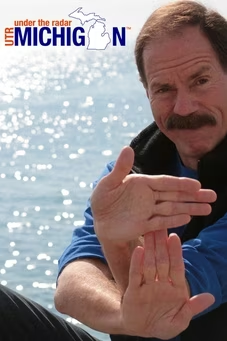
Yes, but you've got a background in martial arts and we met actually, through, justice for Sierra and their Sierra Strong self-defense program.
Yes.
What what was your role in in all of that for folks that that don't know?
I basically I helped write the, self-defense portion.
So the tactics, the moves, maneuvers but I also helped with filming.
So I was the face on the screen.
Andy, where are you from?
Toledo.
Okay.
Right.
419.
What?
What?
Yeah.
Yeah.
Sorry.
Did I just date myself with the what?
Absolutely not.
Yeah.
Aggression.
We were late.
Yeah.
Okay.
There we go.
Yeah.
It's still cool if you want to get them all later.
Absolutely Yeah.
Good.
Good ones.
Really?
Maybe we go to Red Baron.
Yeah the Red Baron.
Yeah.
Shout out!
Yeah, I. Went into town.
So I grew up in the West, South Lido and then moved to Sylvania Township and now live in Sylvania.
So martial arts, this sort of profession.
Walk us through your lineage.
How did you get from little Andy to, to Big Andy?
So I'l get a little personal with it.
My, I got the martial arts when I was seven years old.
Primarily because of my parents.
So I had a really nasty temper.
Okay.
I call them the baby hawk.
Yeah.
This baby hawk inside me.
My baby Bruce.
And, basically, if you looked at me sideways, I would I I'd fight you.
Yeah.
Okay.
You know, an I would just try to do it well.
So my well, my parents got m into it to learn self-control.
And they wanted me to learn how to control it, how to breathe through it.
Basically I mean, like we're talking about stress, for example, inoculate the stress.
Yeah.
Are both of your folks mild mannered?
So they, you know, they had, you know, like, oh, my God.
Or are they, high strung?
I'm not high strung.
You know, my dad's a joker.
Okay.
Like, you know, you were talking about movies earlier, and, Mel Brooks, I grew up on Mel Brooks and Animal House and Caddyshack and you know, the classics when it.
Came to the documentaries.
But my my mom now, my mom is quite feisty.
I probably get my, natural fighting ability.
All right.
And, Yeah, she's a little spitfire.
All right.
Do you remember it starting to work at that young age?
I mean, did you immediately gravitate to the sport?
Yes.
I got very philosophical, and I was very, No.
I was I was one of the by one.
Of my first movies I saw was Karate Kid.
Yeah.
And then, quickly graduated Bloodsport.
I know every eight year old or seven year old should watch Bloodsport.
Absolutely.
Probably not.
Right.
But at the same time, I just loved it.
Yeah.
As soon as I started training, I was just like, yes.
It's amazing how untrusting you are of those actors that you see in the movies still.
Oh, sweet.
The like, I just yeah, that guy is like he's just a terrible creature.
Yeah, he's.
Still a villain forever.
I watched, Wyatt Earp, just a few days ago.
And the the head of the bad kid's dojo is in that.
And he came out I was like, don't trust that guy imprinting in your life forever.
Yeah, but but, Andy from seven yea old progresses into, you know, puberty and post puberty.
What was your sort of professional lineage?
How did you get from that to where you are today?
So I started training with my martial arts instructor when I was 18.
So I started assisting hi with self-defense classes.
Okay.
And then I kind of took off from there when it came to that lineage.
I teach at Saint Ursula, Notre Dame.
Yeah.
Whitmer.
That's where I kind of started.
Was the high schools.
Sure.
And then from there just continued training.
And then I had, of course, you know, as a young adult I was starting to have a family.
Yeah.
Started getting kids, those type of things.
So I started working, like sales jobs.
Yeah.
And on the side, I was still training.
Yeah.
And then I started working for ProMedica, and I was a security educator for ProMedica.
So I trained all the staff when it came to the violence and health care.
Yeah, sure.
Real quick shout out.
I don't know which camera I look at, but, if you know someone that works in health care, I often ask people to do this and give a fist bump or yeah, high five or something.
Yeah, because they work in a volatile industry.
Yeah.
And so I taught them the violence of health care.
So whether the crisis of emotion that people go through.
Yeah.
Those type of things.
Interesting.
We always kind of reflect on the, the whenever you interact with somebody in the health care profession, it is never your best day.
Yeah.
That's right.
Is regularl is the worst day of your life.
Well said.
And so you're not bringing your best self to that.
And so we're just trying to be cognizant of of that.
It's funny you say that my co educator I've had a few of them over the years at ProMedica and he would often say that's patients that would apologize for their behavior to them.
And he'd say, listen, I get it.
I don't see you on your best day.
Yeah, this isn't who you are.
And it just gave that, like, as my wife would say, sprinkle a little grace.
You give some grace.
Yeah.
How'd you meet her?
My wife?
Yeah.
Well, i kind of starts like a bad joke.
Okay.
What do you get when a Protestant and a Catholic, a Jewish camp in marriage, you know?
Yeah, a marriage and three kids.
Yeah.
No, no, we met at a cam at the Jewish Community center.
Sure And we were day camp counselors.
Oh, I love it.
Yeah, yeah, it was a sweet, awesome job.
Yeah.
You got some.
You were paid to play like a kid.
Yeah I love that.
And it was awesome.
So, ProMedica to work spring.
Yes.
Now, in your role, what was it about that, that role.
An opportunity that had you saying this is the next ste I'm going to take in my career?
Well, I started I'm obsessed with like de-escalation, difficult conversations because I also escalate you know, I'm a forever student.
But I love that topic.
And I want to kind of grow that.
And ProMedica is great.
You know, I've met a lot of great people, trained a lot of good people.
And, but work bring gave me more opportunities to expand that to other businesses.
And so it was that communication piece, being able to teach what I know best.
But then I've also learned, how to be a better trainer altogether to various industries.
Is there a static first step in de-escalation?
Literally just a static first step.
Yeah.
Like what's what is usuall is there a tried and true first step in de-escalation?
Is it very.
Well it varies as fa as what type of escalation okay.
So I mean, we've all been escalated, you know, even going into here.
Yeah.
I'm nervous.
Yeah.
You know, I can feel myself every time.
Every time Gretchen talks, get filled with rage with rage.
Yeah.
Okay Yeah.
Let's walk through that.
Yes.
No.
For very first step, I would say is breathe.
I mean, it sounds cheesy.
No.
I'm like, no, no, I'm breathing right now.
But at the same time purposeful breathing.
Sure.
I think is where it's at.
Jefferson Fisher says it really well, let your first word be your first breath.
Oh, interesting.
So someone that's great advice.
You just.
Yeah.
Just slow down now.
Hopefully you don't awkwardly stare into their eyes and soul gaze them.
So much work for me.
I could be awkward.
Yeah, that could be awkward.
How?
How what are the what are typical?
If there are typical situations that require de-escalation in the workplace.
Again, take that first breath, pause, slow down.
So the interaction down, because with escalation, we've all been in arguments before.
And what does an arguer want to win.
To win.
But they also want you to argue back.
But when you don't when you don't play the game, it throws them off.
They might get frustrated.
Absolutely.
But it doesn't mean.
But what happens?
The argument is eventually it just fizzles out.
I've always curious about, if give me a just put you on the spot.
But I mean, you mentioned a family and you have kids.
Know, if you know your wife for a long time, when you guys are having a natural conversation that is escalated, which everyone does.
Is she ever like, I know what you're doing?
Yes.
Yes, sure.
You know, my.
Wif did de-escalate.
That's right.
You know, I mentioned, like sprinkle a little grace.
Yeah.
Just like any good relationship, any good marriage.
I've learned from her just as much.
Sure that she's learned from me.
And what does she do?
She's a teacher.
Yeah, at Saint Ursula, she teaches geometry.
Yeah.
All right, so, you know everyone's favorite subject?
Yeah.
In high.
School, it was my favorite.
Math.
It was my only math.
I did it right on.
There you go.
Yeah.
And no, it's interesting, but her, she's very good at reading people.
She's very goo at reading the situation.
Okay.
And it kind depends.
Like my oldest boy, he's 19, you know, has a pus every one of my buttons.
Yeah.
And so I had a lot of times I call it me escalate.
You have to escalate before you can de-escalate.
Sure.
Yeah.
Yeah.
So I have to calm myself down before I can ever interact with them, because he knows just how to push those.
Yeah, in a natural rub off you have.
Sure.
But my wife can speak his language 100%.
Yeah.
Where?
My middle son.
I speak his language better than she does.
So often times she's like, here you go.
Would you like.
Yeah.
Here's an opportunity to go speak to him.
And I'm like, okay, so but at the same time it's, to de-escalate the situation.
Yes, she does know like my tactics.
Yeah, sure.
And then she goes, you're not my therapist.
You're not.
That's why I mean, they're pissing me.
Yeah, she' I mean, just do fun words.
So.
That's right.
It's a fun We're they're all made up.
Yeah.
Yeah, yeah.
You know wha he's learning and development.
That's right.
Absolutely.
So once you de-escalate and bac to a workplace situation.
Yes.
And you're out of the you're out of the situation with that person.
What are you supposed to do them like where do you put like that sort of energy or acrimony or whateve the feelings that you still have even though you're out of that situation?
Reflection again, there are short term method and there's long term methods.
Short term methods would be, for example, a lot of times when people are upset they want acknowledgment.
They don't want the fix.
They want you to acknowledge their emotions as well.
Said, you know, and just say o that sounds hurt or man that's, that's difficult.
You know what I get where you're coming from.
And then you ask him questions okay.
That's more short term.
Long term I'm a big fan of cognitive behavioral therapy CBT.
And so you and this is for yourself is you kind of go into okay what were my thoughts going into this.
What were my thoughts afterwards.
And then I start to evaluat what I can and cannot control.
Again going back to my martia arts lineage self self-control.
That's all you ca really control as best you can.
So you try to take stock and what can I control.
What versus what can I not control.
And I can really control in the future or my future responses to that person?
I do want to talk in the next segment about training and things of that variety and sort of more clinical, component of it.
But, I, I'm fascinated by, peopl who are practitioners of this, and they have to walk through their everyday lives.
You've got three kids.
How do you coach them or what?
Or do you how are you training them to learn the lessons that you've learned?
Potentially not the hard way, necessarily but over a long period of time.
How do you catch them into being healthier?
A little, I guess I. Get there, no, I was just about to say I get their friends to talk to them for me.
Sure.
Yeah but the kind of like, you know, they never listen to their parents type thing.
But as far as, like, I'll give you a story.
My oldest son, I was buckling and my youngest son, and this is he's he's about 14 an my youngest son, now he's eight.
But this is when he was about three.
I'm trying to buckle him in to his chair or his car seat, and it's not working, and I'm just come on wiring and I'm running late, so I'm already stressed, of course.
And I'm like come on, come on, I'm running.
And my older son looks from th front seat.
He goes, hey, dad.
Dad.
What?
Yeah.
And you know, again, I'm an escalator.
Hi.
My name is Andy.
Yes.
Yeah.
Dad, this is my yeah, this is in our car.
And he goes, but I thought this car felt weird.
But at the same time.
So he says, dad, dad.
And he gets my attention.
And I snapped at him a little bit and he goes, you are a fluffy cloud.
You are a fluffy cloud.
And I start laughing.
Yeah, sure.
Because I, I'm like, oh my gosh.
A 14 year old just escalated into a.
42 year.
Old.
I think I was at the time.
Yeah.
But again, it's they've learned through observation.
I mean, we all do.
You know, how they're how your parent react is what you learn to react to as well.
And there are times I, I dropped the ball.
Of course, you're seeing being.
But at the same time, one thing I try to do is take a breath.
Yeah.
If I need to separate myself from them for a little bit and like your folks.
Your folks, I know a little bit about both of them.
But who is the heavy or anyone that had a particular temper?
You can go second, because I know the answer to.
Yeah, I know, I don't know that either one of them really had to tell me my dad never.
I don't remember my da really ever raising his voice.
Yeah, I'm talking to you or.
Right.
That's right.
Right, right.
I just met it.
I just, I missed.
Hi, dad.
I'm assumin I just about him or something.
Amazon.
Usually.
Right?
Yes.
Right.
But no, no, no.
So, you know, that was like I remember, like, when we would discipline was different when we were kids.
Right.
Sure.
And so I'd get in trouble.
And I think I was grounded for most of my childhood.
Oh, really?
Yeah.
Yeah, I, I earned it, and, and, like, and I was never a bad kid, but I was just like, I would talk back.
Well, your grounding would suggest otherwise.
Yeah, well, my brother, I had three brothers, right?
We would.
We would fight.
Oh, yeah.
Yeah.
And so like, but in terms of, like, the, like, the things you'd consider somebody to be bad, right?
Like, I was, I didn't drink till I was 21.
Right.
Like, I wasn't like actuall committing crimes or anything.
It's just, it's high bar.
Yeah.
Thanks.
That's that's what I want That's where I want to set it.
No.
Oh.
What type of crime.
That's exactly.
That's right.
I remember, several instances where we get in trouble and it was like, oh, we're, you know, dad's going to come hom and dad's going to enforce this.
And we used to love it when that was the case.
Yeah, because it was like, all right, well you're going to get you're going to get paddled when he gets home.
Yeah.
And da like right out of the basement.
Actual paddle.
Well here's the thing.
So the hope my dad get down there, he's like, all right, you know how we do this?
And he was like, you got to sell it.
So.
Oh, yeah, he was in cahoots.
He would clam I love it.
And then we would scream yeah, that was the game.
Yeah.
And as a kid I felt like we would get it.
Now.
Have you been trained as trauma?
No I that's right.
Yeah that's right I love it.
All right.
When we come back, let's talk a little bit.
Let's tal a little bit more about stress.
We'll talk about our health, which certainl I've got a personal interest in.
And, you know, both myself and my father had a story, in that as well.
And so we'll talk more with Andy Springer from work spring.
It's.
Well, this Wednesday presented by works.
Remembe we'll be right back on the 419.
To me, community means connecting to others.
I'm Danny Miller and welcome to the point I last many actions.
We're a community committed to education.
Discover new ideas, dive into exciting subject, and engage with the world around you.
And I would send them personally a t shirt crime doesn't pay in the Old West.
Pass it on.
That's how we cleaned up the neighborhood.
Vision loss for people is not the end.
It's a story.
It's the next chapter.
The DC Public Media invites you to get out and play day.
Monday through Friday.
It's the 419 powered by W GTD with Matt Gillum, Gretchen De Backer I'm Kevin Mullen.
What can people expect on the show?
Give me an hour reminder of why this is a great place to live, work, and play.
Where you come to watch, listen and learn.
Welcome back into the 419, a Wellness Wednesday edition presented by our friends at work.
Spring, Andy Springer is here with us.
We're talking about stress and de-escalation.
We'll talk a little bit about heart health.
But I know, Matt, you want t talk about some of the training.
Yeah.
I wasn't at the end of the segment, and he's going to break this desk in half with his hands.
I am well, my head, yeah.
I'm not using it very much.
Yeah, yeah.
Just the hardest part just because you.
Are a fluffy cloud.
That's right.
It's working.
I can see it is.
Oh, I feel already like.
So at the beginning and we've had, we've asked this question and some other professional has come in, but from a scheduling standpoint, there are ways to make your life not stress, totally absent.
But are there way of sort of programing, your week or scheduling that you d to avoid stress or escalation?
So I have my IT routines are always nice.
So again, you routine gets thrown this early, so you have to be flexible with your routine as well.
One thing I do every morning is, you know, I take supplements, and I kind of use, I grew up, in a nondenominational Christian church, however, like Catholic, rosaries.
So I take my supplements, and I pray every supplement I take, I say a prayer.
Oh, okay.
And one of those prayers is it's a stoic principle of negative visualization.
And it sounds weird.
And so bear with me.
So negative visualization is basically where you, think about the things tha could happen wrong in the day, like the people you might run into, the situations you might run into, those stressors that might occur.
And with those stressors and you own the stressors and you basically say, you know what?
Today I'm going to go through these stressors.
However, I'm going to choos to respond to these stressors.
And usually I use the fruits of the spirit love, joy, peace, patience, kindness, goodness, faithfulness, gentleness, and self-control.
Okay, so you know, although these stressors will happen today, I can't control that.
I can't control how I respond to these stressors with love, joy, peace, patience, kindness.
I keep going.
So interesting.
It's every day.
Every every morning.
Yeah.
Good.
That was I've already, gone against that principle.
I did open up my calendar for the work day, and I was like yeah, there's like two things.
And I to the app, the antithesi of what you've just described.
So I'm already starting down the path of.
Your program in your mind.
Yes.
She said, how do you program?
And so it doesn't work on her.
Of course not.
Sure.
But I try to start my mind off in that way.
I think it's I love that.
I mean, the question you asked Matt was like, how do you program your day to avoid stress?
And I appreciate that.
Any of the answer wasn't like, you avoid it.
You can't avoid it.
You you sort of arm yourself for it, knowing that it's coming and saying, all right, here's the thing that are going to cause stress.
And when they do, yes, here's how I'm real.
Yeah.
Two simple words methamphetamine.
Oh, yeah.
You're words.
Maybe it is my A.D.D.. Yeah, I don't know.
Why, you know, but every time.
Yeah.
But in that respect, too, it's, You mentioned Kevin how we can't control stress.
One of the exercise exercise I do in my de-escalation class, with work spring.
But at the same time, is we acknowledge the stressors like I have you write down or 3 stressors that trigger you.
Yet.
That once that happens, it's going to trigger.
Yes.
There you go.
But then I then I have you write down if you could.
What do you wish you could do if you had no consequence?
What do you wish you could do just on it?
And usually it's like, you know, driving wise, I this morning I saw a guy just weaving in, traffic in a wagon.
Here am I?
Dude, that is not a sports car.
No.
And we stopped at the same re light, like, what are you doing?
Yes.
And I was just kind of getting frustrated, though.
But the one of my favorite, favorite things in life is when somebody, like I literally watched a guy blow through the red light that I was stopped at.
Yeah.
And then we pulled up nex to each other at the same next red light.
Yeah.
And I'm like, you, you ran the last like, why are you not running all of it?
Yeah, sure.
Yeah.
And so I had them write that down.
Then I ask them, okay, but how should you respond to it?
What should you do?
Because most of the time people when it comes to the wish, especially when it comes to driving, they wish they could pull someone over.
They wish they could run them off the road, you know, or whatever it is.
Yeah, of course we can't do that.
So I say, okay, what should you do instead and choose that response.
And then it helps solidif the response you should have to the stressors that trigger you because it's your trigger.
It's not mine.
Yeah.
When it's more it's a more practical way of actually owning it.
Yeah.
It is painful hours in step as it may sound, having to write it down and look at these things and think through it in itself is a valuable process.
And that's one reason I like CBT, is because it.
Got time for that.
Cognitive behavioral therapy.
Okay.
And can you what can you talk us a little bit what that means.
Sure.
There's basically three ways to think of it.
We have thoughts.
Those thoughts influence our feelings.
Our feelings influence our behavior or actions.
And it can go in reverse.
So like if I'm reading, if I'm trying to, if we're talking today like we are right now and I know you really well, but your actions seem off, like your behavior seems off.
Well, you're having feelings.
You'r having you're feeling something.
And maybe I can pinpoint that feeling, but then you're having thoughts.
And what are those thoughts about your feelings?
You know, you see someone and you're like, oh my gosh, here we go again.
Yeah.
Okay.
What are your thoughts about that person that's leading int your feelings of frustration or, anger?
You know, just avoidance.
Maybe.
And you're going to act that way.
So if you're not aware of that, it's kind of a predictable cycle.
And CBT kind of talks about that, in that respect.
So it's just writing it down.
Predictability and acknowledging.
That acknowledgment.
Huge.
It seems like such a simple thing.
I've never I'm going to try that.
But it is process oriented.
Right.
I guess I, you know, forgive me for what it is.
It's really a personal question, but I love.
First of all, how long?
What's your Social Security number?
Know.
What's your credit score?
Yeah, my favorite dog The street I grew up on.
Yeah.
This is a couple rando questions.
Right.
And of course.
Yeah, yeah, yeah.
You know, it's not creepy at all.
Yeah.
Your mother's maiden name?
Yeah.
Are you.
Having sleepers?
Me?
I already said mother's maiden name first.
Don't give her the question.
Did you say brother or mother?
Mother.
Oh, mother, I thought you said brother.
I'm like.
What?
David Springer?
Well you're handsome.
What's your brother's made?
That's great.
Yeah, that's a stretching question.
That's the.
You can see why.
You can understand my.
My rage is valid, right?
It's just a dog.
It's a lovable rage.
So you.
I've never seen lovable rage.
But.
Yeah, I see it now.
Yeah, yeah.
You should predic that you are going to be upset.
Yeah and they acknowledge it.
Sure.
Write it down.
Gretchen.
I have to listen to Andy because I've asked him to come on the show.
I don't have to listen to a syllable that rules out of what I would describe.
Okay?
Just relay what you want me to say to Matt, and then I'll say to Matt.
And Andy Puncher, okay.
Bring it.
Bring us home here.
Andy, talk to me about.
So how does all of this relate then to heart health.
So again heart health stress.
What's the first thing that changes when you get stressed when you get escalated?
Heart rate, heart rate.
You know, and there's only so much we can take.
And so when you're in that' why I love training is training.
Training is a stress inoculation.
When you train like CP you might be nervous with CPR, but when you train it you get less nervous about it.
You know, a great exampl is my middle son, random story.
I know, when the plane, I promise, my middle son, he used to be terrified of storms.
Like when he was a really young kid.
He's 17 now, but when he was, like, six.
So, I mean, he would get.
He would shake.
He would get so scared at storms.
So we basically challenged him, learn about it.
And now he loves the weather.
Like he.
You're kidding me.
Ear to ear, grinning when storms come.
And he wants to be a storm chaser.
That's what he wants to do.
Yeah, but he trained himself to get there.
He.
He educated himself.
He educated himself together.
And when he educated himself, when he trained, he became less stress about.
Sure.
And so it changed his heart health, his overall health.
This is this is a bit of a stretch, admittedly, but that was, I think, Mark Twain' conversation about Indian racism and all these other things is travel is much more difficult to discoun or think poorly of individuals if you live amongst them or visited.
So I think having the more you know.
Right.
I think that's the old, from our youth, that's the public.
Servants of the generations.
Yeah.
The reason so so yeah.
But being able to commit yourself to that and to do the work and the steps along the way to say, hey, I want to avoid this bi catastrophic thing at the end.
And so the way to start is to, you know, find the steps or find the triggers that lead down that road and try to and I'll.
I'll bring it back full circle as well as take a breath, take the time again.
The stress doesn't go away, but you can manage it.
What are the other things that you can do the or do you train people, through your job at wor spring to do to reduce stress.
I mean, active things that you can do other than breathing and the de-escalation techniques.
Is it eating better?
Exercising?
What?
What other sort of lifestyle things do you train people about?
It's all of the above.
Yeah.
Everything you mentioned.
Again, if you have that nagging feeling of what, you know, you should do.
Okay?
You're you're speaking to yourself.
Yeah.
And it's mean.
I should I should eat healthier.
Okay.
Starts off, I mean start, and I think, Alyssa said it.
One of my coworkers at wor spring as well, is micro habits.
It's it's start slow.
Take it take time.
The stress is going to be there.
Okay.
So when the stress hits my system, what can I do.
What can I control?
How do I respond to this.
And then, you know, as far as it's the classics, eat healthy exercise those type of things.
Have you found, we're all, sounds like in the proximity of ages.
How much are our phones and technology in that way?
Is that changed?
Is that part of your training?
I mean, there is stress and people doom scroll, you know, is ther part of the training component or a conversation piece in terms of just breathing?
Just put your phone down.
How much is just taking a moment of, zen or can you touch a little bit about that?
I mean, we're all no matter how much we tried to blame or say that young people are glued to these things, that we are just as bad, if not worse.
Right.
So what is technolog adding to what I would describe as a more rabid.
Technology, I mean, can be a blessing.
I mean, you look at like the app calm.
Yeah, right.
Meditative apps, music.
I love listening to music.
It's one of my these stressors.
Okay.
What do you listen to?
To me?
Well, name the emotion.
Yeah, yeah.
No, but I'm I'm a I'm an emotional listener.
Okay.
So where I'm, I'm at, that tends to be where I try to listen to.
But if I'm in like a, a sad mood.
Yeah.
For example, if you listen to sad music, you're going to perpetuate the sad cycle.
And I like to.
But at the same time but at the same time, if, and I, I read this study years ag where, it was on music therapy.
And let's say your go to is heavy metal death thrash.
I know you love heavy metal and I gosh.
You know.
I've seen you the mosh pits.
100% bowing down.
So yeah.
But at the same time you can't ask someone who listens to that type of music to listen to Enya.
Yeah, easily.
It'll take them off.
They won't like it.
That's going to cure them.
This this article said start slow, reduce it.
Meaning if you listen to heavy rock, listen to rock.
Yeah.
If you listen to rock, listen to soft rock, you're listening to soft rock.
Listen and go in small increments of, bring yourself down.
You are a martial arts, expert.
You are an expert.
In multitude.
What was the most difficult thing for yo to indoctrinate into your life?
Or the hardest thing you've done in what?
So, I mean, the martial arts training or, learning de-escalation?
How what was the most difficult thing to do?
The program yourself to.
The the thing that you fought away the most.
Being a parent.
Sure.
Yeah.
Kids, I've I've learned more from my kids.
And I've taught them.
Yeah, sure of that.
And it's just, I never realize how much your thoughts are on their lives.
100%.
And how muc you want them to succeed.
Yeah.
And when you see them going down a path that you're like, don't do that and you can't control it, it can hurt.
Yeah.
Because you wish you could help them along.
In that fix everything.
So I would say long stor short, sorry, I'm kind of going no, no, that's rabbit hole there.
Parenting is one of the biggest life lessons I've experience and one of the hardest things.
All right, let's do this.
It's time for Gretchen's wacky queries.
Matt you did what?
Want to spin that?
I was just taking you in and you just said.
You're just.
Breathing.
That's right.
All right, four rapid fire questions for me.
Take a deep breath.
Okay.
Gretchen is going to give you I ask you for your favorite thing in the region, and then Matt's got the hard one.
You have to describe Toledo o the area in exactly nine words.
I'll walk you through it.
Oh, my goodness.
Okay, we'll do it together.
Okay.
All right.
Question number one what is happiness mean to you?
What is happiness mean to me?
Being a little being able to smile when life is hard.
If you could instantly become an expert in something, what would it be?
Oh, this was just posed to me.
I battle two things.
One word.
Working.
Two.
Singer.
I wish I could sing.
All right.
Favorite spot to see the sunset beach?
Like, name of beach.
I love watching the sunset on the beach.
If you could win an Olympic gold medal.
Olympics is right around the corner when I have a gold medal.
What would you want it to be?
In judo or taekwondo?
But judo probably What's your number one favorite?
Or what you consider to be the best thing about Toledo?
Community.
I heard you say Metroparks.
All right, in.
Metro.
Park.
That's right.
All right, nine words for this Go the think about the region.
You said the people.
I'll take ball away.
Yep.
Oh.
Gosh.
Family.
Family love it.
The zoo.
Zoo.
Good Metroparks.
Love it.
We'll give you two for that.
Okay.
Schools, kids got to like it.
Get schools, the schools.
Right?
Yeah.
Wow.
It's like you're in my brain.
That's right.
It's the planet that.
Sorry.
I'm having I totally was prepping for this.
That's right.
I'm just like, don't like this.
Breathe.
Actually, I just said thank you.
Coworkers.
It's good.
Oh my goodness.
Yeah.
You got a great crew.
Yes.
The walleye.
Oh, walleye.
All right, number one.
You got one more, brother?
Oh, yes.
What's your favorite fuzzy?
What's my favorite place?
Inside the five.
Inside the five.
Nine.
Let it go, my man.
Awesome crush to.
80 Springer from spring.
Yes.
Right.
Andy.
We broke him.
Yeah.
Oh, I love it.
No.
If people are looking to lear more about work, spring training opportunities, de-escalation tactics.
What?
What's the website wher they can find more information.
Work spring.org.
So w o r k speaker I n g.org.
Andy Springer thank you so much for coming back.
Appreciate we come back Lauren Caulkins from work.
Spring will join us.
We'll talk a little bit more about heart health.
Stay with us.
It's Wellness Wednesday presented by Work Spring on the 419.
Support for the 419 comes from we Trow wealth management, where we understand that your financial path is personal.
Advisory services are offered through Capital Investment Advisory Services LLC, securities offered through Capital Investment Group member Finra and SIPC.
More information at Retro Advisors.
Dot com works bring HR issues and employee well-being.
Go hand in hand.
Work spring supports employers through compliance, training and wellness because healthy workplaces don't happen by accidents.
Learn more at work.
Springborg Toledo Refining Company, a subsidiary of PDF Energy Toledo Refining Company, is a supplier of fuels that keep our region moving.
Located in Oregon, Ohio the refinery processes crude oil into gasoline, diesel, jet fuel and other petroleum products.
And today, celebrating its 55th year of connecting Northwest Ohioans to their community.
More information@tada.com.
Welcome back into the 419 It's Wellness Wednesday, presented by Work Sprint.
We're joined now by another of our friends from work, spring Lauren Caulkins.
Lauren, you are a senior wellness consultant.
Yeah.
What does that.
Mean?
Well, also, more importantly, we ran over with Andy.
So you are going to have to break the desk with your head or the hands at the end of your segment.
I'm sorry.
It's okay.
I'll get right to it.
Yeah.
Take your time.
Yeah.
Yep.
I don't know what warm up for that looks like, but I'm.
Ready.
For it.
Not for now.
Yeah, that's all right.
Yeah.
Thanks for having me.
Senior consultant.
So I've been with Work Spring for about eight years.
Came in as well as consultant and just have been able t expand some of the other things that I do within the organization.
So, like Alyssa, we service organizations all over the state of Ohio just helping to implement, wellness programs and deliver wellness services to help their employees be their best selves.
What's that typical kind of first conversation with somebody?
Right?
They pick up the phone, they call you.
What are they calling for?
Yeah, well, the question is always, how can we help our employees be healthier?
We need happy, healthy, productive employees, right?
So how can you help us do that?
And that's when we step in.
And we've worked with organizations, for years now all over the state and helping to do just that.
So first we need to get a pulse check.
Tell us about your organization.
Tell us about your people.
We've worked with industries all across the board.
What.
Are the spectrums and that no one specifically.
What's up with that?
But, what what is the largest range of different agencies or industries that you work with?
Anything you can think of.
So I've got groups who are in the construction, trucking, farming business all the way up to, you know, finance, higher ed.
You know, banking, any anything that you can think of in anything in between.
So we've, we've worked with the group, if they have an industry.
So, we're able to kind of become those subject matter experts by having that kind of hands on, interaction with all those different groups.
So we know kind of what, what works in some places may not work in other places.
So it's there has to be, you know, this isn't meant to be like t shirt or coffee mug material, but I bet that there's more similarities in each place than people would think.
Oh, you got it.
Yeah, absolutely.
Which is my favorite part of the job, is working directl with the employees individually, because we absolutely have that common need to be seen.
We want to be treated as human and we want to do our best work because that's what brings us joy and value.
You know, our wor doesn't have to be everything.
But, as everyone else has mentioned, we spen so much of our time in our jobs, we should not hate it at the very least.
Right?
Not a high bar, but still to.
Yeah, we gotta start somewhere.
Lauren, what brought you to this career path?
Have you always been, an empath or, how did you how did you get here?
I think the human piece is there for sure, but, I health and wellness has always been in my background, so I have a degree, and, family studies and nutrition is my undergrad from Central Michigan.
And then, I did grad school at Indiana University.
Go to graduate.
Thank you.
Yeah.
Thank you.
In public health promotion.
So coming out of that, my first job was a health advisor for, an employer wellness company.
So I worked with employer groups all over the country.
And, that was my first taste in to employee wellness.
So I never thought necessarily employee wellness.
I didn't even know what employee wellness was.
But of course, it's grown so much over the years because it has to.
It mean we have such a need for it.
And, you know, certainly no we can make the case for that.
But, just the hands on interaction with the employees that I wor with has been the driving force.
It absolutely keeps me doing what I do in.
You might not have a specific answer to this, and that certainly would be understandable, but did you have a particular moment in your career early?
You're saying this is absolutely what I want to do, or a success story that you were like, I've made a difference here and I want to make a career of this.
Oh, absolutely.
I've got stories for days.
I think back to my first position right out of grad school, to health advisors talking to somebody who had just gone through kind of a rough time.
Personally.
This is at a time where we wer doing, some telephonic coaching and this person, had expressed some, you know, needs for additional support in the stress management.
Kind of department.
And, you know, I was sort of still new at this and I gave him some resources.
We we stuck it through.
And I, I think the big piece that drove me to want to continue, this position is that he wanted to come back every week and have these conversations because we would end these conversations with, you know, have the expectations be what you want them to be.
It's not my expectation for you.
It's your expectations.
And I'm just here to help.
So, you know, I can't do it all for you.
A coach is not someone who tells you exactly what to do and how to do it, but we need to find your way.
I mean, that's the big piece of it.
Why do you do anything that you do?
Why do you wake up in the morning?
Why do you go to your job?
Why is it that you do anything that you do?
That's that purpose piece.
And so for me, that clicked when he kind of had made this 360, realization that, oh, I know why I need to do this.
He told me all of his whys, and he was able to start making changes from ther because behavior change is hard it for me was that was the, fruit that I needed to see as this is me making a difference, that it worked.
So it was it was fulfilling for me to to.
Do that, I bet.
So, yeah.
Yeah, it's February, Valentine' Day is right around the corner.
So people are talking about, you know love and hearts are everywhere.
And we think about, you know, heart health and stress.
Is it that important that you love your job?
Gosh I think love is a strong word.
I don't know that you need to love your job.
I mean, I think we said said that low bar was like, don't hate it, but you should enjoy being with the people that you work with.
You should find purpose in what you're doing.
So it doesn't have to be, you know, regardles of your role, your organization, you bring something to the team that's necessary.
So knowing that you're par of that big team, hopefully that that gives you that sense of, participation.
And, you know, we're we're all working towards a common purpose where we can do this as one.
I think that's I think love is a strong word, but you should you should really lik and believe in the the purpose that the mission that you're helping to serve.
So I think if you have that, think you're a pretty good spot.
And this isn't a defeatist, anecdote or comment, I guess.
But there has to be also a healthy component of what you're feeling means.
And maybe this is not a good fit.
Right?
Or to your point, are sometimes, things, you know, age out.
You worked in place for a decade or 20 years and things change, or you change.
Is there a process or, a check down?
I don't mean to sound impersonal, but sometimes people just need to change.
What is that?
How does coaching work in that dynamic as well?
Absolutely I think that's a great question.
I think we all hav probably been faced with that.
And I think at the end of the day, and I can only speak personally, is, for instance, when things change and things get hard, as any organizatio will have that come up, right, no matter where you work.
You know, you have to decide, am I in it for the mission?
I keep kind of going back to that.
Like, what is our common goal?
And what do I bring to the team?
Am I bringing value to the team?
Because at the end of the day, I need to bring that value so I can have that kind of self-confidence.
I need that, for my own well-being.
Because if I feel like I'm ineffective and that's not good for me or the company or for anyone.
So I need to be into something where at least I've got.
At the very least, I know that I'm making a difference towards this mission.
So if it's time to cut ties, then it's time to cut ties.
But of course you have to have a game plan.
You need to know why and what's the good reason why you're doing it.
Is there a new, mission that you were ready to serve?
And I think that's I think that's a very reasonable reason, you know, to, decide that you need to part ways.
But, a team having a good, solid team, I think is everything my tea that I worked with for, again, I've been at work spring for eight years.
My wellness team is just the best, and all we do is talk about how great we are, pat ourselves back.
But it's because we'v cultivated this, it's a culture, well that we talk about and putting into place in other organizations.
We cultivate that on our own team, and I think that's everything.
So with my team is in it.
I'm in it.
Yeah.
You know, so.
Is there a tactical thing that you guys do that helps to to build that let you know somebody watching this or listening to this and they go, oh man, I can adopt that practice or we could do that with our team to help build that culture.
Oh, you got it.
And it's a it's a longer than a podcast conversation right.
Of course.
But it's it's starting with, respect.
You have to respect the people that you work with and you want respect in return.
How do you do that?
I need to give grace to get grace.
We talked about you know, assuming the best of intent of people.
I want others to assume the best and tend to me when I have a day where I don't bring my best self.
Sure.
And when my team doesn't bring my their best self, I want to know, how can I help you?
You know, and trul working in that team function?
I think that's at a bare minimum, treating others as human.
We'll all have human moments.
You'll have hard times in your personal lives.
You bring that into work.
If if that's ignored, if that's, you know, not considered you're not going to last long.
You know, you need something that helps support both.
So when you can be your best self, you can be your best self as an employee, you know, so, so tactically speaking is starting there.
You know, open up conversation, open up dialog.
Allow people to talk about how are you doing today.
You know, we a weekly check ins, weekly huddles.
Everybody how's everyone feeling.
And and creating an environment where you can be open and honest about that is everything.
What's your message for when you go into to companies and, you do your assessment you know, and you realize that, the problem is the management.
The problem i maybe even with ownership, like, they're not seeing it, they're not getting it.
How how poor health or, lack of wellness of their employees could be contributing to the problem that they're having.
Maybe it's the bottom line problem.
Maybe it's just morale.
Whatever.
What's your message to the employer about what to do and why?
Why it's important.
That's a great question.
And we've seen that.
And, my best assumption has to be if you've invited us in to come take a good look and take an assessment of how things are looking, allow me to have an open conversation with you and be direct that we feel like some changes need to occur, but it's not attacking.
You know sometimes people don't realize, you know, what they're bringing to the table is of, you know, and sometimes it just starts with, you know we can kind of have a more open conversation about here' what makes up a great workplace, kind of reflect and think, d I check these boxes, you know, and then also really driving home the point, not just ROI, which is absolutely there for, for a wellness program, but the value on investment.
Do you want your employees to show up performing at their best?
Yeah.
The answer is always yes.
What will it take to get them there?
Well, if we've got an unhealthy cultur or we've got a toxic workplace, maybe that's where we need to start.
So you can put it out into categories and say, you know, biometric results.
We can look at aggregate reporting and say, okay, everyone's blood pressure is high.
That's one piece of it.
And we certainly do that.
That's a big part of our programing.
Right.
But not just those statistics for other specifics of let's get some surveys out, you know, what are people thinking and allow them to be open and honest about it.
If you want to close it behind doors, how are you going to make any improvements?
You don't know what you don't know.
So, it allows us to come in knowing that we come in with the best intent because we're here to help you, and that's our job.
I mean, the thought of checking the blood pressur of all of the employees, like, I think about some of the places that I've worked.
And it's like, man, that would have been an early indicator that like something to Mark.
Yeah.
There you go.
I mean, I've had I think we've all.
Had where monitors in the meeting.
That's it.
Have a score like a running scoreboard.
I'm not going to lie to you, I think add that to the service list for work springs.
Everybody gets to put one of these on.
And we're just going to check the average blood pressure of the room.
And as it rises nicely.
On the clinical sense, do I know people wear the ring that are there things like that that are not necessary the forefront?
Because I know they've been around for a little while, but are there things that you either use personally or recommend people doing?
For me, you are in charge of putting your mask on first, right?
That saying is.
True.
Absolutely.
You can't pour from an empty cup.
Yeah, right.
And you've got to.
Yeah.
Put to put the mask on first.
So what I have a Fitbit.
Right.
And I, it tells me my heart rate and things like that too.
But other people who are more into the data, they could wear a glucose monitor, right?
Even if they're not diabetic.
That's kind of a trend right now.
I would say, too, but, practically speaking, like for an organization, we've had groups where they've gotten everyone a Fitbit or some other tracking device, right, where they want to just track step steps and activity minutes, because maybe it's a sedentary position, a sedentary job where it's like, we just need to get some competition going.
We need some camaraderie in in doing this together.
And so they'll do that.
So I've had companies do that.
Another cool thin is, yeah, the biometric events, you know, if we see that there's these trends where.
Yeah, follow the meetings.
I mean, it's not to that poin if you had more frequently, but, watch, watch blood pressure you know, each of these events or is it going up.
Is it going down.
Where are we where where are the areas of opportunity that we need to focus on?
So, as far as other tracking.
Yeah, it's like surveys and things like that.
How many steps are we supposed to be getting in a day.
Now.
If I made a Fitbit will tell you 10,000.
10,000 is pretty muc the standard you'll hear.
Yeah.
All right.
I know again that's not the the number one thing people talk about anymore.
But I heard 15,000 and I wa like I really am dragging here.
Yeah.
Yeah I don't know that I want to look at mine because I have days when I'll put, you know, 20, 26,000 steps on and not think about it.
And then there's days when I'm at 2600.
Yeah a week.
Yeah.
Week.
And you're like, oh 4300.
That was.
That.
Yeah.
That's right.
And Lauren, thank you so much for joining us.
If people want more information, on the the offerings and services that well that work spring provides, where do they find it.
Work Springborg, you can find us.
We have our partnership with Men Mutual for our wellness program, but we also do independent, consulting as well too.
So i your organization is not in that typical standard that we have with our men mutual groups, please do reach out.
We've done a lot of cool things with groups to help, you know create that culture of wellness.
That's the goal.
Awesome.
Lauren, thank you so much.
When we come back, we will wrap up this Wednesday edition Wellness Wednesday edition of the 419.
We'll be right back.
Every day when you land with us, you learned with us a neighbor.
We made sure your childhood with special memories that could only be provided by PBS and you.
For generations, we've given you programs that made a difference.
Programs that entertain, inform, and inspired.
And today is no different.
This is public media in Toledo.
It's where you belong.
Introducing the Local Thread, a community news series uniting voices and storytellers from across the region in partnership with La Prensa, the Toledo Free Press, the Sojourner Truth, Toledo Public Schools, and veteran journalist Jerry Anderson.
The Local Thread brings you stories and conversations that connect our community.
Here at weeknights at seven on FM 91, with early access on podcast platforms.
Each morning the local thread only on HGTV.
Welcome back into the 419 as we wrap up this Wellness Wednesday edition.
I always enjoy getting a chance to meet, new, new friend and catch up with some old ones.
But certainly two new friends from work.
Sprin joining us on the program today.
They have a great team there.
Yeah, man.
I know that we were, we are sort of pushing into heart health, but that whole industry feels like a cold way to describe it.
But, the conversations, both tactical and really more practical, like having a human being to talk about their everyday lives and lessons they've learned or how they got into these roles.
It's always interesting to me.
And and helpful.
Yeah.
I appreciate kind of Andy's advice of like, you know, how do you avoid stress?
And the answer is you don't.
Yeah.
You you prepare for it and you train for it.
And I think that idea of knowing that it's coming and putting yourself in a position to where, when that trigger, when that stressor kind of shows up for that first step.
Breathe.
Yeah.
And I that was sincere.
We said, well, this is how I should start your day.
And I was like, well, I've already not done that.
That's no, that was a true story.
Like I already looked at my calendar and I looked at a couple things.
Like.
I know that my days are better when my phone is not the first thing I look at.
Yeah, but.
It's so hard to break that habit.
And you, like, I've got this you know, somewhat like a self god complex that, like, my work matters more than it really does.
And so it's like, it' just such.
A fine line, right?
Because I mean, that's what lives are, you know, at stak or involved in yours, Gretchen.
And more immediate, obviously, but that is als what fuels you to be effective.
I don't think anyone's ever described me as being effective, but yeah, I want to care.
I mean, when I was a busboy, I thought I was like, keeping the whole place together myself.
Yeah.
You know.
All right.
On tomorrow's program, we look ahead to the weekend.
John, I guess, joins us.
We take a look at our key account.
Health.
Just slowing down to just take a deep breath.
John.
He's so excitable.
Yeah, I like it.
And then also, the Village players will join us as well.
An exciting show tomorrow as we take a look at our toledo.com community calendar driven by Tada!
Three opportunities to enjoy the show.
7 a.m.
on YouTube, 3 p.m.
on FM 91 and 6 p.m.
on Connect's channel 30.4.
It's the 419 powered by ZTE and presented by we TRO Wealth Management.
We'll see you back tomorrow.
The 419 powered by GTD is made possible in part by.
Supporters.
Like you.
Thank you.













Support for PBS provided by:
The Four Hundred & Nineteen powered by WGTE is a local public television program presented by WGTE