One-on-One
Angelica Berrie & Rev. Stephen Rozelle
Season 2021 Episode 2387 | 29m 7sVideo has Closed Captions
Angelica Berrie & Rev. Stephen Rozelle
Angelica Berrie talks about the purpose of the Making A Difference Awards and reflects on four specific honorees who each made a life-changing impact in each of their communities; Stephen Rozzelle shares the ways his ministry has been impacted by these uncertain times, and the importance of being a 1997 Russ Berrie Making a Difference Award honoree.
Problems playing video? | Closed Captioning Feedback
Problems playing video? | Closed Captioning Feedback
One-on-One is a local public television program presented by NJ PBS
One-on-One
Angelica Berrie & Rev. Stephen Rozelle
Season 2021 Episode 2387 | 29m 7sVideo has Closed Captions
Angelica Berrie talks about the purpose of the Making A Difference Awards and reflects on four specific honorees who each made a life-changing impact in each of their communities; Stephen Rozzelle shares the ways his ministry has been impacted by these uncertain times, and the importance of being a 1997 Russ Berrie Making a Difference Award honoree.
Problems playing video? | Closed Captioning Feedback
How to Watch One-on-One
One-on-One is available to stream on pbs.org and the free PBS App, available on iPhone, Apple TV, Android TV, Android smartphones, Amazon Fire TV, Amazon Fire Tablet, Roku, Samsung Smart TV, and Vizio.
Providing Support for PBS.org
Learn Moreabout PBS online sponsorship- [Narrator] Funding for this edition of One-On-One with Steve Adubato has been provided by Holy Name Medical Center.
This place is different.
New Jersey Sharing Network.
Horizon Blue Cross Blue Shield of New Jersey.
The Robert Wood Johnson Foundation.
The Turrell Fund, supporting Reimagine Childcare.
Valley Bank.
United Airlines.
Rutgers University Newark.
And by Fedway Associates, Inc.
Promotional support provided by New Jersey Monthly, the magazine of the Garden State.
Available at newsstands.
And by The New Jersey Business & Industry Association.
- This is One-On-One.
- I'm an equal American just like you are.
- The jobs of tomorrow are not the jobs of yesterday.
- Look at this.
You get this?
- Life without dance is boring.
- I don't care how good you are or how good you think you are, there is always something to learn.
- Do you enjoy talking politics?
- No.
- People call me 'cause they feel nobody's paying attention.
- Our culture, I don't think has ever been tested in the way it's being tested right now.
- That's a good question, high five.
(upbeat music) - Hi, I'm Steve Adubato, welcome to a very, very special program.
It's simply called "25 for Twenty-Five".
You may ask, "What does that mean, 25 what?"
Well, it's 25 awards, very special awards, the Russ Berrie Making a Difference Awards.
Over 25 years I've been honored to be a part of this extraordinary event where people, unsung heroes make a difference in the lives of others.
It is my honor to introduce the president of the Russell Berrie Foundation Board of Trustees, Angelica Berrie.
Angelica, how are you doing today?
- I have to think before I say fine, you know this is a time Steve, where no one could possibly be fine.
You know, millions of people unemployed, lost their loved ones and a lot of empty seats that are going to be at almost every holiday table.
So fine doesn't cover it.
- And to your point though, Angelica we are taping this program at the end of 2020.
It will be seen for a long time throughout 2021.
And we talk about COVID, and we talk about the impact that COVID has had on not-for-profit organizations.
Many of the people you're gonna meet today, lead not-for-profit organizations.
They've been devastated like millions of others because of the pandemic.
But Angelica help people understand what the Russ Berrie Awards for Making a Difference are, why they were started, and why this program is so special.
About to introduce a young lady by the name of Fraidy Reiss who's doing extraordinary work.
But let's set it up, what are the awards and why do they matter?
- My husband wanted to thank in a tangible way people who did something extraordinary but this were ordinary people who didn't have the kind of PR machineries and a lot of resources.
So, the idea was to give them monetary awards as a way to reinforce a culture of giving, and giving selflessly.
And I think that it has been really successful for 25 years, and this is the purpose of celebrating what we've accomplished in 25 years.
And, you know, Fraidy, let's introduce Fraidy Reiss.
Fraidy Reiss is the founder and executive director of an organization called Unchained At last.
I'm not even gonna try to set this up, I'm gonna ask you to watch it.
Angelica and I will respond and react to it, and I have a feeling that you'll be reacting to it as well, and remember, as you watch these, the website of these not-for-profits will be up there, you can make a difference.
You also can nominate someone to be a winner of the Russ Berrie, Making a Difference Award.
Someone who's making a huge difference, a significant difference.
And so without further ado, Angelica and I will be back (clears throat) right after you meet an extraordinary young woman, her name is Fraidy Reese.
- Unchained At Last is the only organization that is dedicated to ending forced and child marriage in the United States.
And we do that through both direct services and advocacy.
- You have a very personal connection, share please.
- Yeah, so I founded Unchained out of my own traumatic experience.
I, myself, am forced marriage survivor.
Grew up in a very insular religious community where that's just how it works, your parents marry you off whether you like it or not to a stranger.
And in my case, the stranger turned out to be violent.
And when I finally managed to escape after 15 years with my two daughters, my family and community shunned me, they consider me dead.
So that's why I founded Unchained because I know that there are others right here in the US who are dealing with the same nightmare that I escaped from.
It's really shocking that in the United States there are very few laws to address forced marriage to acknowledge it, to prevent it, to punish it after it happens, punish the perpetrators.
And in terms of child marriage, when we first started advocating for policy and legislative change in 2015 at Unchained At Last.
Child marriage was legal in all 50 States, every US territory and district, and while marriage age laws are set, unfortunately, it's been pretty well established that those are set by the state and not by the federal government.
The federal government as well has laws in place that not only allow but even encourage child marriage, that's still true today.
- You and I have seen that video, I was there doing it.
Why is it so important to recognize Fraidy and Unchained At last.
- It's unimaginable that something like human slavery still exists and out of 50 States?
We've only had two States and I'm very proud that New Jersey is one of them.
And I just wanna say that she's fearless, you know, to get out of a marriage knowing you have no safety net, it's unimaginable, I don't think I'd have the courage.
So when I put myself in her shoes, I say, "We must listen.
We must find people to advocate for child brides."
- Let's put this in perspective before we introduce our good friend Pino Rodriguez from down in Camden, New Jersey.
Over the past, since 1997 a total of 366, New Jerseyans, extraordinary New Jerseyans have been recognized by the Russ Berrie Making A Difference Awards, $3.5 million in cash awards.
Angelica by the way, the website of the Berrie foundation will be up right there.
You can see this throughout this program.
If people want to nominate someone because they believe that person's making a significant difference, Angelica how do they do it, and why does that matter?
- You go on BerrieAwards.Ramapo.edu and this is where you can nominate an unsung hero.
- And here's the thing about Angelica that I've known for many years as we've worked together and I've hosted this event.
And by the way, it has gotta be, it is particularly in the time of COVID for me, not just as a broadcaster as a person to be renewed by being around people who care so much about others.
It's an extraordinary thing and that's the point of doing this.
And so as you meet Pino Rodriguez who's the founder and director of the Block Supporter Initiative in Camden, New Jersey one of the poorest cities, not just in New Jersey but in the United States of America.
Angelica and I will talk a little bit about the impact in urban communities that the Berrie awards had continues to make.
But let's take a look at Pino right now.
Describe for folks what the initiative is, and why you care so much about the city you love and I see it on your hat, the " I Love Camden" hat.
Tell folks all about it.
- Well, the Block Supporter Initiative was born out of waiting for positive things to happen as a result of the 1972 riots in Camden.
- That's right.
- I think that was the year, we've been faced with, to date 49 years of waiting for a positive difference to happen in these areas where people usually riot and burn out their own neighborhoods and things like that.
So, the Block Supporter Initiative got tired of waiting, we saw all these negative things and my children weren't able to stay home with me overnight, things like that.
So, I had to find a way to address the problems so that my children come home and we can create a positive difference and create and change the culture of our residents.
This was started by creating flower boxes and working with the residents of positive, direct, immediate impact right in front of their homes.
So it creates pride, respect, responsibility with the longterm accountability.
- Wow, I went down to Camden and I'll actually make it clear that we've had a long standing collaboration with the Berrie foundation to feature not-for-profit organizations, to feature the winners of the Russ Berrie Making A Difference Awards.
When you see Pino, what's your reaction?
- Why is he a hero in this time of a pandemic?
When you need to uplift your spirits, When your community needs that morale boost, you know, beauty has the power to transform neighborhoods.
And it tells a story about who we are.
And I think the pride that a community has, in seeing something uplifting, something empowering and a place where the kids can run around and feel like it's safe.
It sends that signal that it's a safe neighborhood, it's not run down, it's not scary looking and flowers can do that, gardens can do that.
And he's really a hero for doing that more so, in this time when we really need it.
- Why is the Berrie Foundation so committed to leaders of not-for-profits who are suffering financially and otherwise because of COVID.
Why is that a priority for the organization?
- Even more so again, this year in a pandemic year and pandemic damage to come.
Economically, people losing their homes, people going hungry.
This is a time you need heroes, and everybody needs to be a hero.
No one person can do it alone, and non-profits are our safety net, they lift everyone.
And having a network of non-profits, this is the investment we've made that is beginning to take fruit 25 years from now.
And thank God in this pandemic there's really a lot of these winners.
- Yeah and just as Angelica says that we introduce Chief Vincent Mann from the Turtle Clan Ramapough Lunaape nation, extraordinary gentleman who I got to meet through the Berrie awards.
The one thing I found is there's a sense of family around these 366 winners of the awards.
They get to meet each other, be around each other.
And you're just seeing 25 in this series called, "25 for Twenty-Five"".
But again, as you see the website, I'm not gonna turn this into a telethon.
But the reality is the Berrie foundation... We need to recognize others, as hard as their staff works as hard as we work to feature people, you know people in the community making a difference, unsung heroes.
So in that spirit, I'm gonna introduce Chief Vincent Mann who tells a powerful story about not just the Ramapough Lunaape nation but a horrific environmental crisis that they are facing in addition to COVID that is making people sick in their community.
- The Ramapough Lunaape nation are the descendants from the original inhabitants of New Jersey.
Northern New Jersey, Southern New York, Western Connecticut, the Munsee speaking people.
Today, we have about 5,000 enrolled tribal members.
And as we look forward to 2021, the Turtle Clan itself is still struggling with residing in a Federal Superfund site.
- You know, Chief, people hear Superfund site and causes whole range of medical and health issues.
- A Federal Superfund site, there was a law created called CERCLA.
And that was to hold accountable those corporations who dumped toxic waste.
And in our case, Ford Motor Corporation dumped toxic waste for seven years, on open ground and mine shafts with new approval and support of the town of Ringwood, and as well as the state of New Jersey, you know, issuing a permit for a year for them, for the toxic waste to be disposed up there.
This all sits above the Wanaque reservoir and as recharge areas for that.
That actually feeds four to 6 million people.
- Hey Chief has the site been cleaned up?.
- Absolutely not.
So it's gonna forever be a toxic waste dump, our people 46 homes, about 300 or so people are actively still living there, actively still paying taxes on their homes that have no value, actively playing and hunting around the general area.
And there seems to be 56 years later, you would think that somebody somewhere would hear that call and come to bring that help to the people.
- What message did you take away from listening to him?
Not just then, but now.
- You know, we're more aware of what happens to Native American sacred lands today than we ever were 45 years ago when this problem started here, right in our backyard in Ramapo New Jersey.
And I think that we understand now that so many Native American tribes have this environmental damage, simply because they've been displaced by governments, they've been moved out of sacred lands, and now they face environmental damage to add insult to injury.
We have a lot of making up to doing and it affects us, ultimately, because environmental damage trickles down, to people in that, in our own community whether we're the part of that tribe or not.
- Go on our website at SteveAdubato.org and checkout "25 for Twenty-Five", and you will see 25 of 366 Berrie award winners who are just extraordinary.
Don't take it from me, don't take it from Angelica, watch them, listen to them, look at the work and the impact they're having, and in that spirit I wanna introduce an extraordinary young woman who we've gotten to know through the Berrie Foundation, who one day is going to be recognized by a lot of others.
She is A'Dorian Murray-Thomas.
She's the head of an organization called SHE Wins.
And wow, well talk about overcoming personal tragedy, she took that tragedy of losing her father in a tragic violent way to make a difference in the lives of other young women, A'Dorian Murray-Thomas - When I created, SHE Wins, I wanted to create a space for young women who shared my story of being affected by violence.
Our goal at SHE Wins is to really create an ecosystem where young women, regardless of their stories, zip code, or circumstance are empowered to win.
And so we have three core tenants, sisterhood, service, and self-actualization.
And then our goal is to really kind of create this space where young women in the city of Newark are able to use their stories to help catalyze change.
And so when I think about the Russ Berrie family, which is committed to honoring leaders and change makers in the state of New Jersey.
A lot of the work we do at SHE wins, is quite similar to that, with specifically working with young women in the city of Newark, who've experienced some form of trauma but are using those stories to overcome and actually create change in their communities.
And so it was an honor to not only get the award and obviously have the type of support that it aids our organization, but to bring my girls there, I had about six or eight of our girls - I remember.
- that came with me, on the day you, that's right, 'cause you were there and we talked that you met some of them.
And so it was such a beautiful experience to be a part of the Russ Berrie family.
- You said, when it comes to young people they know what's going on.
"It's the bleeding, not the wound," what do you mean?
- And so when I say it's the bleeding, not the wound, a lot of the unrest, a lot of the discontent is actually symptomatic of these deeper issues that have existed long before March 2020, long before what we are calling the digital divide now.
But frankly, has been an issue for years, right?
Watching her does not get old?
Is that a fair assessment, Angelica Berrie?
- In this time Steve, I'm really struck by the fact that we have to think about African-American non-profits in a very different way.
We've always supported them colorblind, but in this George Floyd moment, you understand why it's so important to support non-profits led by, especially, African-American women who really need a lot of empowerment.
It creates equity, but it's also something that we have to have a special lens nowadays, to think about how our nonprofit work benefits African-American communities by lifting them.
- Angelica, as we wrap up and we put the website up again, remind people why nominating someone who you really believe is making a difference is so important right now, and the opportunity people have watching right now other than to just watch what we're doing for a half an hour, go ahead.
- Every community has heroes, we just can't find them ourselves.
And so we need everyone's help to identify who's been doing great work that you know about that we don't.
And in this time what we need more heroes, we need your help to find them.
And I'm inspired by the words of Greta Thunberg who said, "No one's too small to make a difference."
And in all communities, these kinds of efforts are largely unrecognized, and we want to shine a spotlight on all these heroes - As do we, and it has been our honor as broadcasters to feature these winners representative of 366 winners over all these years, since 1997.
Angelica I cannot thank you enough for being with us for this time.
Angelica, you know I'm about to introduce the last part of this show is a gentleman by the name of Reverend Stephen Rozzelle.
A 1997 winner of the Russ Berrie Award for Making A Difference.
He was a winner of an organization called, "Curbing Hunger", and that was in fact, one of the earliest winners.
Angelica Berrie, thank you so much, thanks to the Berrie Foundation.
And most of all, I'm gonna remind you as you see the website, one more time, nominate someone who's making a difference, nominate someone who cares about others, particularly, in these most challenging and difficult times in the age of COVID who you believe should be recognized.
I'm Steve Adubato that's Angelica, this is Reverend Stephen Rozzelle.
- [Narrator] To watch more One on One with Steve Adubato find us online and follow us on Social media.
- It is now our honor to welcome Reverend Stephen Rozzelle who is the 1997 Russ Berrie Making a Difference awardee and an Episcopal priest.
Good to have you with us Reverend.
- Thank you very much.
- All the way back in 1997 you were a winner that was the first year of the awards the Russ Berrie Awards for Making a Difference.
Do you remember that?
- You know what I had forgotten about it completely until they formed the group of all the winners and then I kind of remembered 'cause I've got memorabilia from it.
- Yeah.
And it's also the organization that you are working with, Curbing Hunger.
What was the organization and the mission 'cause it still exists today?
- Well, it was to provide food for the community by collecting via our recycling crew.
And it was only in the month of June with a theme Hunger Doesn't Take a Vacation.
So it all started with an idea that I had at breakfast table with my family.
I was president of the food bank at the time in the recycling center and Somerset County was the next building.
So I'm having breakfast.
It was a Monday morning and the recyclers came and I'd just got the idea, oh my goodness why couldn't we put some food out with our recycling and have the recyclers just drop it off on their way to the recycling plant.
And so I went to the freeholders and they loved the idea but you can't mix food with garbage they said, but we love the idea so much we'll be happy to provide a truck to follow the recyclers to pick up food.
And so first year we collected 80,000 pounds of food which is more than they get the rest of the year put together.
And that started it off.
It was so exciting.
- And the Russ Berrie folks, the foundation the very foundation recognized you that first year.
Did you have any idea?
I mean, literally we're just about we're getting close to 25 year anniversary which is why this series is called 25 for 25.
The idea that millions of dollars have been awarded to folks like yourself and not-for-profit organizations.
Well over 300 close to 400 people have been recognized as winners of the Russ Berrie Making a Difference Award.
From your perspective as a man who is dedicated as a leader who's dedicated himself to making a difference in the lives of others, the idea that there are so many people making a difference and that the foundation recognizes them, what do you think that says?
- I have a theme that we find what we look for and so that you can look for what's wrong or you can look for, you know, what's wonderful.
And that's a great way of perpetuating, you know, the idea of bringing hunger to the forefront of people's minds and consciousness so they can contribute, you know one of the things that made this go, I don't think too many people like being accosted at the Shoprite you know, would please hunger, but this is a very convenient way of giving food to the hungry.
And I think it's like, wow that you got recognized for it.
It was beyond my comprehension what would happen after that.
- Yeah, so let me ask you this Reverend the work you're doing today, nearly 25 years after we met at the Russ Berrie Making a Difference Awards you focus a fair amount on grief helping people deal with grief.
And as it relates to COVID 19 and grief what in particular makes dealing with grief so difficult right now?
- Well, one of the things I do about grief is I always have families create a project that captures the goodness of the person they're grieving for.
So they're not left with a past but that there's as a result of the awfulness and the grief that a project is created that brings life somewhere else.
That's the way I do things.
- How do you do that Reverend?
How do you do that Reverend?
- Well I'll give you an example.
Three years ago, a woman came to me who had grown up in this church with her son.
They lived in Florida and he died tragically in his early 30s.
And I said to her Dory, the mother, tell me about your son.
And she said, well, my favorite story about Jeffrey is a couple of years ago he was driving on the highway in Florida and he came across this heron that had been clipped and it was fluttering all over and cars were going crazy around it.
Jeffrey stopped the car so that no one could hit the heron and put the heron in the trunk drove it to the bird sanctuary.
And six months bird sanctuary called and said the heron had healed.
And they put him back into the wild.
So I said oh, there Dory.
That sounds Jeffrey was very kind and compassionate.
She said, those are the exact words that I would use.
So with a lot of (audio glitch) they both went to high school in Butler for the last three (audio glitch) have presented to Jeffrey Keenan Kindness and Compassionate Award, $500 gift certificate.
And I said to Dory, Dory it'll be a parent's proudest moment.
You know we do sports at graduation, we do smarts but we don't do your heart.
I found out last year, the kids at Butler High School are actually competing for the award, is that fabulous?
You've got hundreds of kids competing to be kind and compassionate and the mother got a little sparkle back to her and that's what I do.
I take the awfulness and create life somewhere else.
And that's one of my favorite examples.
And the mother Dory is like so excited.
You know, she gets phone calls from the award winners, but she is (glitch) somewhere else as a result of the tragedy of her grief.
- But you know, Reverend that's powerful on so many levels.
But the other question in terms of COVID, I'm curious how has it impacted your ministry?
- Well from the beginning, this is just my way of doing things.
You can be focused on what's wrong or you can be focused on what's possible.
And so the church services inside have been minimal you know, for obvious reasons.
But as a result of doing Facebook services we have 600 people watching the service instead of 150 people on Sundays.
I started a meditation every Sunday which is like a middle like a small sermon but it's like, I don't dwell in the past where grief is.
It's like, let's take the awfulness of something again, create something.
And so I've met more people walking in my neighborhood than ever before.
And so it's like, yes, there's awful but I don't focus on awful.
I focus on what's possible.
- How did you get to be such a positive person?
- Well maybe through education you don't learn that in seminary.
In fact, everything in seminary is about your head.
Oh, it's just been a long process along the way.
And it's what I preach about all the time is listening for what's possible, not what's wrong.
- Say that quote again, don't focus on what is wrong focus on what is possible, right?
- What is possible, yes.
And so you can be focused on your own grief and isn't it awful and all of that, or you can be on the lookout for others who are grieving and be a source of support for them create a relationship.
- Well, Reverend Stephen Rozelle I'm pretty confident and very confident you just helping off a lot of people just sharing our perspective.
1997, Russ Berrie Making a Difference awardee and Episcopal priest.
I wanna thank you Reverend for joining us.
We appreciate it.
- Thank you very much.
- I'm Steve Adubato.
Thank you so much for watching.
We'll see you next time.
- [Narrator] One-On-One with Steve Adubato has been a production of the Caucus Educational Corporation.
Funding has been provided by Holy Name Medical Center.
New Jersey Sharing Network.
Horizon Blue Cross Blue Shield of New Jersey.
The Robert Wood Johnson Foundation.
The Turrell Fund, supporting Reimagine Childcare.
Valley Bank.
United Airlines.
Rutgers University Newark.
And by Fedway Associates, Inc.
Promotional support provided by New Jersey Monthly, And by The New Jersey Business & Industry Association.
- Data shows that many patients have avoided seeking critical health care in the wake of COVID-19 for fear of contracting the virus.
Delaying medical care can have serious consequences, so you should never second guess or ignore your symptoms.
At Holy Name Medical Center we have measures in place to prevent infectious disease from spreading, we're clean, we're open and we're safe for all your health care needs.
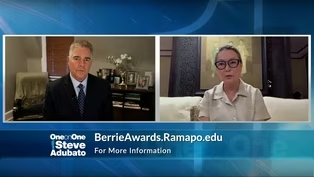
Celebrating 25 Years of Those Who Are Making a Difference
Video has Closed Captions
Clip: S2021 Ep2387 | 19m 49s | Celebrating 25 Years of Those Who Are Making a Difference (19m 49s)
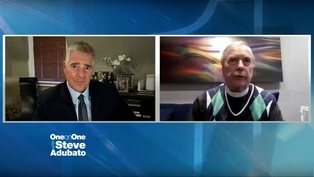
Helping Those In Need During Uncertain Times
Video has Closed Captions
Clip: S2021 Ep2387 | 9m 10s | Helping Those In Need During Uncertain Times (9m 10s)
Providing Support for PBS.org
Learn Moreabout PBS online sponsorship
- News and Public Affairs

Top journalists deliver compelling original analysis of the hour's headlines.

- News and Public Affairs

FRONTLINE is investigative journalism that questions, explains and changes our world.












Support for PBS provided by:
One-on-One is a local public television program presented by NJ PBS