
Angelo Valente; Irvin Moreno-Rodriguez; Nico Bocour
8/1/2026 | 27m 7sVideo has Closed Captions
Angelo Valente; Irvin Moreno-Rodriguez; Nico Bocour
Angelo Valente, Exec. Director of Drug-Free NJ, examines how to address opioid drug deaths through advocacy and alternatives. Irvin Moreno-Rodriguez, Director of The Sara * Sam Schoffer Holocaust Resource Center at Stockton U, explores their dedication to remembering the Holocaust. Nico Bocour, VP of State Affairs at GIFFORDS, discusses how gun safety laws play a key role in preventing violence.
Problems playing video? | Closed Captioning Feedback
Problems playing video? | Closed Captioning Feedback
Think Tank with Steve Adubato is a local public television program presented by NJ PBS
Angelo Valente; Irvin Moreno-Rodriguez; Nico Bocour
8/1/2026 | 27m 7sVideo has Closed Captions
Angelo Valente, Exec. Director of Drug-Free NJ, examines how to address opioid drug deaths through advocacy and alternatives. Irvin Moreno-Rodriguez, Director of The Sara * Sam Schoffer Holocaust Resource Center at Stockton U, explores their dedication to remembering the Holocaust. Nico Bocour, VP of State Affairs at GIFFORDS, discusses how gun safety laws play a key role in preventing violence.
Problems playing video? | Closed Captioning Feedback
Where to Watch Think Tank with Steve Adubato
Think Tank with Steve Adubato is available to stream on pbs.org and the PBS app.
Providing Support for PBS.org
Learn Moreabout PBS online sponsorship- [Narrator] Funding for this edition of Think Tank with Steve Adubato has been provided by RWJBarnabas Health.
Learn More at RWJBH.org.
PSEG Foundation.
Horizon Blue Cross Blue Shield of New Jersey.
NJ Transit.
NJM Insurance Group.
Serving New Jersey’s drivers, homeowners and business owners for more than 100 years.
The Center for Autism Myron and Elaine Adler private foundation, in support of the Adler Aphasia Center.
EJI, Excellence in Medicine Awards.
A New Jersey health foundation program.
And by New Jersey Sharing Network.
Promotional support provided by ROI-NJ.
Informing and connecting businesses in New Jersey.
And by New Jersey Globe.
[MOTIVATIONAL MUSIC] - Hey, everyone.
Steve Adubato.
We kick off the program with a conversation with Angelo Valente, Executive Director of the Partnership for a Drug-Free New Jersey.
The website is up.
Angelo, good to see you again.
- You as well, Steve.
Thank you for having me.
- The website is up.
Let everybody know what the partnership is.
- Sure.
So the partnership for a Drug-Free New Jersey's main mission is to share information for families on how to protect themselves from the dangers and scourges of drug use.
In New Jersey, what we've seen is that we've really made a great effort in educating New Jersey residents about how to protect themselves and their families.
- Talk about where we are in terms of opioid deaths from overdose.
My information is we're down.
Not my information, the information is we're down, but it's more complex than that.
Is it not, Angelo?
- Steve, we have some real good news to share.
Over the last five years, we've seen a steady decline in overdose deaths in New Jersey.
However, we're still at a staggering number of individuals and families that are losing a loved one to this epidemic.
So in no way is that, we're at a situation where we can declare victory.
Certainly we like what we see.
We like the idea that more and more people are getting the messages that we're delivering, are looking at ways to be able to look at alternatives to opiates when they're faced with that decision.
And this is particularly true with young people.
We've seen a real shift over the last half number of years on how people react when they're offered an opiate, looking at an alternative and having that discussion with their doctor.
- What about seniors and opioids?
- Well, that's another story.
I mean, what we've seen over the last several years is that seniors have become the most vulnerable population and are being impacted more so than some of the other age groups.
In fact, those individuals in New Jersey, 55 and older, were the largest segment of individuals that were affected by drug overdoses over the last several years.
And part of the reason for that is that seniors are more likely to be exposed to opiates, to be given an opiate because of a injury, because of postoperative care.
And in many cases, they're mixing those drugs with other drugs as well, with alcohol, and it's causing real serious problems in New Jersey and throughout the country.
- So Angelo, let's talk about this because we've had so many conversations on the air and offline about these issues.
But what I'm curious about is, and there's been so much work that the partnership has done in engaging healthcare professionals, clinicians.
When you talk about seniors who are getting opioids prescribed, and full disclosure, I have as well after a surgery or whatever it is, and in my mind, I'm like, I'm going to do everything I can to avoid it.
Don't always.
But I'm always worried about mostly because of our conversations, trust me, there's a point here, Angelo, that I could potentially become addicted.
That being said, to what degree has the medical community as it relates to seniors and the prescribing of opioids been involved, engaged, and actively participating in what needs to be done?
Because there are alternatives that we should talk about.
- Absolutely.
New Jersey has really been in the forefront.
We were the first state in the nation to establish a law that required a conversation to take place between a prescriber, a doctor, a dentist and a patient.
And that conversation we think has really made tremendous strides in bringing awareness about the potential for dependency in addiction, which it only takes five days for dependency to set in.
So any one of us, it could easily become dependent on opiates with a very short prescription or very short number of days being prescribed these opiates.
So I think what we're seeing is that the medical community over, at least over the last decade, has really made strides as well in looking at alternatives and looking at ways to be able to help protect people.
But we still have a ways to go before we get to a level where we feel that every medical professional is on board and has the same kind of opinion about opioid alternatives.
- Angelo, let's talk about this, the $1.3 billion, the opioid settlement, the money from pharmaceutical companies, right, who manufacture opioids.
$1.3 billion through 2038 from opioid manufacturers, distributors, retailers.
Where is that money now and where do you believe it should be going?
- So currently the money's being distributed, really at two levels at the state level and at the county level.
And at the county level, what's happening currently is many counties are looking and evaluating where to most effectively spend these funds.
The state is doing a similar, has a similar process.
It's established a commission to look at where these monies should be spent.
As far as the partnership for a drug-free New Jersey, we've always been advocates of using these funds for multiple purposes.
First and foremost to support those individuals that have been impacted by the opioid epidemic, whether that be long-term support services for those individuals, certainly looking at treatment and making treatment accessible.
We also believe that there should be a set aside for prevention because unless we continue to prevent people from going down that path, there's not going to be enough money in the whole universe to be able to deal with the consequences of individuals and families.
- Angelo, I'm sorry for interrupting.
Back up.
Money go for prevention.
Be more specific.
What are we talking about?
Public awareness, education?
- I think it's a combination of education in our schools.
Certainly we need to be able to have messaging that the general public is receiving.
I think Steve, if we look at what we've done in the state over the last decade.
The public awareness has been a big part of the reason- - It has.
- Of the success we have.
I mean, we, if you are a parent and you go into an emergency room with a child for a sports injury, you're a lot more aware today than you were 10 years ago- - Absolutely.
- About the dangers of an opiate being prescribed to that child.
If you go into a dentist's office for a wisdom tooth extraction, parents are now much more willing to have that discussion and look at ways to be able to deal with that acute pain without getting an opiate for their child.
So, so that's a big part, I think, of how we're going to be able to address this, not only currently, but going into the future.
- Before I let you go, Angelo, the, you folks at the, at your organization, at the partnership had a New Jersey Healthy Aging Summit.
Real quick, what was that and was it very much connected to the opioid addiction issue?
- Yes.
The Healthy Aging Summit was a focus on individuals in New Jersey, 55 and older.
As I mentioned a little bit earlier, that's the group that's most vulnerable at this point.
And what we did is we looked at being able to bring a very specific message to that individual, those individuals.
We talked about the fact that whether or not you're 16 or 65, you still are very vulnerable to becoming dependent in only a short period of time from an opiate.
So look at alternatives, whatever your age is.
- Angelo Valente, Executive Director.
Partnership for a Drug-Free New Jersey doing important work every day.
Angelo, thank you, my friend.
We'll talk soon.
- Thank you very much.
- You got it.
Steve Adubato here.
That's Angelo Valente.
We'll be right back after this.
- To watch more Think Tank with Steve Adubato, find us online and follow us on social media.
- We are honored to be joined by Irvin Moreno-Rodriguez who's director of the Sara & Sam Schoffer Holocaust Research Center at Stockton University, one of our higher ed partners.
Good to see you, Irvin.
- Thank you for having me, Steve.
It's an honor and a pleasure.
- Well, it's mutual.
The website's up.
Tell everyone what the center is and why it's so significant.
- Absolutely.
The Sara & Sam Schoffer Holocaust Resource Center is the most active Holocaust resource center in the State of New Jersey.
Every year, we host over 400 different programs, events, and activities where we focus on the philosophy of town and gown.
And what does that mean?
It means that our education should extend beyond the university walls where we have community members, faculty, staff, students learning together about the Holocaust and other genocides so that we can make this world a better place for all.
- Irvin, your personal story is fascinating to me.
You did your graduate work at Stockton in the field of Holocaust and genocide studies.
You're the first Latino to ever head a Holocaust resource center in the entire country.
Why the fascination and the concern about the Holocaust?
- Well, it's really a passion, and I understand how important- - That's a better word than mine.
Thank you.
- It's an important education.
It's an important history.
And it actually started in seventh grade.
And I want to just remember my good friend, Betty Grebenshikoff, who was the first Holocaust survivor that I met in seventh grade at Ventnor Middle School.
And although at that point, I didn't remember much about her story, I do remember her talking about being a new American, learning a new language, a new culture.
And this, I empathized with her because as a new American, you know, I'm a child of immigrants, immigrants from Mexico.
I finally, at seventh grade, realized that there was someone out there that understood what I was going through, the challenges and obstacles of being a new American.
- By the way, Betty reunited with her childhood best friend, Ana María, after decades of believing that the other one was dead.
Explain Betty's connection to the Holocaust.
- Absolutely.
So Betty was a young Jewish girl in Berlin, Germany who had a best friend.
After Kristallnacht, her family, her parents found refuge in a place known as Shanghai.
At that point, it was occupied by Japan, and Shanghai was offering visas to Jews trying to flee Germany.
In Shanghai, they found this refuge, they found this safety, and then they were able to finally, after the war, immigrate to Australia and then from Australia, the United States.
But as a young girl in Berlin, Betty had a best friend, Anna Marie.
And for a long time, as she lectured to thousands, to tens of thousands of students, she would always end her presentation by asking the students, "If you know of an Anna Marie, let me know because that could be my best friend."
And for years, for decades, Betty and others in the field thought that Anna Marie was just a victim of the Holocaust, unfortunately.
- Right.
- But they reunited in 2021 for the first time, not Anna Marie, but Ana María who found safety and refuge in the country of Chile.
- You know, by the way, go on our website.
It's up right now at SteveAdubato.org.
Check out the interview we did with Maud Dahme.
Maud, you're smiling 'cause you know who Maud is.
Maud- - Absolutely.
- a child of the Holocaust.
I believe she was seven years of age with her younger sister who I think was five.
Check out Maud's story, so many others.
We do the best we can, Irvin, to try to share stories with... There are very few Holocaust survivors still alive.
Why is the work... And by the way, tell everyone who Sara and Sam Schoffer, who they are and why they matter because without them, this wouldn't exist at Stockton.
- Absolutely.
So our center was founded in October 2nd of 1990.
And that's an interesting story in itself because it was the Holocaust survivors of Southern New Jersey that approached our then president of Stockton, President Vera King Farris, who was the first African American woman to lead a college or university in New Jersey.
But in 2007, the center was rededicated to Sara and Sam Schoffer, who were Holocaust survivors from Vilna, at that point, Poland, now Lithuania, who actually escaped through the sewer system from the ghetto to join this partisan fighting unit in the forest and survive the Holocaust.
They, again, survived.
They immigrated to Atlantic County where they actually owned multiple poultry farms in our area.
- And by the way, check out our interview with President Joe.
And he still goes by President Joe, right?
The president at Stockton.
- Yes.
- A very engaging leader in higher education.
Check out that interview.
But I'm curious about this.
What the heck is the connection, Irvin, between the Holocaust, Holocaust survivors who wind up in South Jersey?
- Absolutely, Steve.
First and foremost, what I like to remind our students and our community is that the story of Holocaust survivors in Southern New Jersey is very much a story of immigration.
And believe it or not, we have a Holocaust Survivors of South Jersey Project where we have been documenting all of the Holocaust survivors that lived here in Southern New Jersey, and over 70% of them, over 70% of Holocaust survivors owned and operated a poultry farm here in our area.
And the question always becomes, when we interview Holocaust survivors, "Why did you go into poultry farming, into chicken farming?"
And they always like to tell the joke, and the joke is, "Well, what languages do chickens speak?"
And the reality is, you didn't need to know English to start and operate a poultry farm.
Eventually, the survivors did, but poultry farming offered an independent way of life away from the big city, the terrible living and working conditions.
And raising a family here in Southern New Jersey was important to them, that fresh air, that independent way of life, and also giving their children an opportunity to go to college.
- Before I let you go, what has been the greatest impact for you, not just academically, scholarly, professionally, but also personally?
- Well, Steve, what I like to tell our educators, our community members, is we're all planting seeds to a forest that we may never see.
And the true purpose of teaching the lessons and legacies of the Holocaust is not simply to prevent another, but it is to instill the lessons to our students that one person can make a difference and to empower them and to let them know that that person can most definitely be you.
That is how we make this world a better place for all.
And often what I say, during atrocities and genocides, it's often the ordinary that becomes extraordinary during times of crisis.
- Irvin, I want to thank you and our partners again in higher ed down at Stockton University for doing important work.
Irvin, thank you very much.
We'll have you back again.
- Thank you.
- You got it.
I'm Steve Adubato.
That's Irvin Moreno-Rodriguez down at Stockton University.
We'll be right back.
- To watch more Think Tank with Steve Adubato, find us online and follow us on social media.
- We're now joined by Nico Bocour who is Vice President of State Affairs at GIFFORDS.
Good to see you, Nico.
- Good to see you too, Steve.
- Website's up.
Tell everyone what GIFFORDS is.
- Yeah, GIFFORDS is a gun safety organization.
We were founded by former Congresswoman Gabby Giffords.
She started this organization because she is a gun owner who's been impacted by gun violence herself and really cares about this issue and wanted to make sure that voices like hers were a part of this conversation because frankly, there has not been enough change in this country and we need to see something done to address gun violence.
And so very proud to be here and we are doing what we can to save lives across the country every single day.
- So if people don't know this, Congresswoman GIFFORDS was... There was an attempted assassination against her.
- Yeah.
- She was speaking at an event.
- Yeah, she was a Congress- - Open public situation.
Go ahead, I'm sorry.
- Oh, no sorry, go ahead.
- No, and someone... I mean, I still can't believe that happened.
She's also married to a very prominent United States senator.
Mark Kelly of Arizona.
Let me ask you this.
The mission of the organization, we were just talking about this before we got on the air, it's not to stop... It's not anti-Second Amendment, correct?
- Correct.
- Because Congresswoman, former Congresswoman Giffords owns weapons, firearms.
- Yep.
- Okay.
- She's a gun owner.
- What is the primary goal as it relates to the organization here in New Jersey?
Because New Jersey has in the eyes of some, many, some of the strictest gun laws in the nation.
But what does that actually mean and what needs to be done beyond that, Nico?
- Yeah.
In New Jersey, like in all the states where we work, our goal is to pass laws that make sense for that state that we have seen have an impact that will save lives in that state while also ensuring that responsible gun owners are able to buy, purchase, use their firearms in safe and responsible manners, whether it's for hunting or sports shooting or self-defense.
Certainly New Jersey has many, many gun owners.
They also have strong gun laws, as you mentioned.
And those strong gun laws have helped to protect New Jerseyans in many ways.
New Jersey has some of the lowest per capita gun death rates.
As you know, we're a very densely populated state and we've seen the impact that strong laws can have on gun violence in a state.
And so that's why we are here in New Jersey as well as states across the country.
We are trying to pass sensible gun safety laws, laws that are supported by the public, by gun owners themselves that will save lives.
- So to be clear, over 46,000 people die from gun violence every year in the United States.
128 Americans are killed with a gun every day.
So here's the thing.
Let's be specific.
GIFFORDS, your organization argues for universal background checks.
We don't have that, do we?
- We don't have universal background checks- - Nationally.
- Nationally, yes, that's correct.
Yeah, nationally.
- What is a red flag law?
We don't have that nationally.
What is that?
- Correct.
Nationally, we don't have that.
In New Jersey, we do have one.
A red flag law is a law that allows for people who are closest to somebody who may be experiencing some sort of crisis or have a reason that they shouldn't have a firearm.
What it allows people to do is to go and seek a protective order to temporarily remove firearms from that individual.
This is a court-ordered process overseen by a judge.
It requires evidence be presented and it results generally in a temporary order that allows for those firearms to be removed while there is considered to be a current threat or reason to remove those firearms.
It's not a permanent order.
And those individuals, when the danger is considered to be no longer present, or generally it's actually after the termination of the timeframe, which is usually about a year, those firearms can be returned.
So what it really does is it helps to make sure that the most lethal form of, a incredibly lethal form of a weapon is not accessible to somebody at a time when they could pose a danger to themselves.
- Okay, so let's be clear.
The gun lobby, National Rifle Association, primarily, they're against it.
On what grounds?
- Tends to be an argument that they make of some sort of slippery slope, but I think what we've seen time and time again.
Sorry.
- By the way, it's not fair for me to ask you to explain their position, but their position is consistent.
- Their position is consistent.
- If you change one of these laws, if you make it harder in a certain situation, whether it's a red flag law you talked about, or the universal background checks, whatever it is, even if they were to argue that that individual change in gun laws made sense, the slippery slope argument is it would move toward the elimination of the Second Amendment, which allows Americans to bear arms.
Do you, does GIFFORDS have any interest in banning the Second Amendment to the United States Constitution?
- No, we do not.
- That's unequivocal.
That is not the goal.
- Yeah.
- Well, here's what I'm curious about.
Why hasn't Congress, whether the Republicans who are in control right now of both houses and the White House, or when the Democrats were in control, why have such in the eyes of many sensible common sense gun laws been passed?
- That's a great question.
I think that unfortunately right now it's difficult to get a lot of things done in Congress.
So gun safety- - But when Democrats were in control before and it didn't get done.
- Yeah.
When Democrats were in control, we were able to pass the first gun safety law at the federal level in 30 years.
It certainly didn't do everything that we call for or that we think should be done.
- What about universal background checks?
That wasn't done.
Democrats controlled the lower house, the United States Senate, and the presidency.
Didn't get done.
- Yeah, I mean- - That means some Democrats were not for it.
- We've seen incredibly strong support both from the public and also from lawmakers on both sides of the aisle, including Democrats.
In Congress right now, it can still be incredibly difficult to get things done in part just because of the structure and nature of how Congress operates.
And so we have been able to make some progress.
When then President Joe Biden was in the White House, were able to pass the Bipartisan Safer Communities Act.
Again, that was a bipartisan piece of legislation.
And so we were able to strengthen background checks through that legislation as well as do a couple of other things, strengthen our domestic violence laws, create some trafficking penalties, and also to ensure funding for the implementation of those red flag laws we were talking about earlier as well as community violence intervention programs.
So that was some progress that was very much needed, long overdue, and we certainly need to build on that and continue to build on that.
And that's why at GIFFORDS, we engage in- - Hold on, Nico.
- Yeah.
- I hate when I have to do this.
We just don't have any more time.
- No problem.
- So we'll make sure we have you back and you can share more thoughts.
That's Nico Bocour, Vice President of State Affairs at GIFFORDS.
Nico, thank you so much for joining us.
- Of course.
Thank you so much.
- You got it.
I'm Steve Adubato.
We thank you so much for being with us.
We'll see you next time.
- [Narrator] Think Tank with Steve Adubato is a production of the Caucus Educational Corporation.
Funding has been provided by RWJBarnabas Health.
Learn More at RWJBH.org.
PSEG Foundation.
Horizon Blue Cross Blue Shield of New Jersey.
NJ Transit.
NJM Insurance Group.
The Center for Autism The Adler Aphasia Center.
EJI, Excellence in Medicine Awards.
A New Jersey health foundation program.
And by New Jersey Sharing Network.
Promotional support provided by ROI-NJ.
And by New Jersey Globe.
- NJM Insurance Group has been serving New Jersey businesses for over a century.
As part of the Garden State, we help companies keep their vehicles on the road, employees on the job and projects on track, working to protect employees from illness and injury, to keep goods and services moving across the state.
We're proud to be part of New Jersey.
NJM, we've got New Jersey covered.
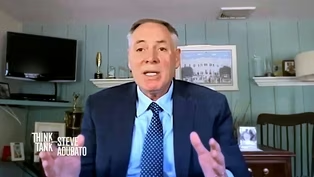
Addressing opioid deaths through advocacy and alternatives
Video has Closed Captions
Addressing opioid deaths through advocacy and alternatives (9m 4s)
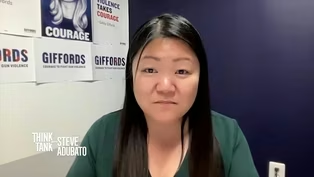
GIFFORDS explains how gun safety prevents gun violence
Video has Closed Captions
GIFFORDS explains how gun safety prevents gun violence (9m 37s)
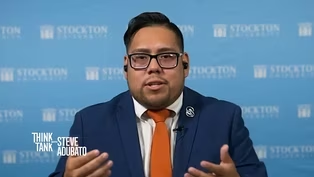
How Stockton is preserving the memory of the holocaust
Video has Closed Captions
How Stockton is preserving the memory of the holocaust (9m 8s)
Providing Support for PBS.org
Learn Moreabout PBS online sponsorship New Episode
- News and Public Affairs

Top journalists deliver compelling original analysis of the hour's headlines.
 New Episode
- News and Public Affairs

Today's top journalists discuss Washington's current political events and public affairs.


 New Episode
 New Episode
 New Episode
 New Episode
 New Episode
 New Episode
 New Episode
 New Episode
Support for PBS provided by:
Think Tank with Steve Adubato is a local public television program presented by NJ PBS