Hello, Mr. Chuck!
Animals
Season 3 Episode 2 | 27m 45sVideo has Closed Captions
Mr. Chuck teaches about animals and how they make our lives better.
Mr. Chuck teaches about animals and how they make our lives better.
Problems playing video? | Closed Captioning Feedback
Problems playing video? | Closed Captioning Feedback
Hello, Mr. Chuck! is a local public television program presented by WKNO
Support for WKNO programming is made possible by viewers like you. Thank you!
Hello, Mr. Chuck!
Animals
Season 3 Episode 2 | 27m 45sVideo has Closed Captions
Mr. Chuck teaches about animals and how they make our lives better.
Problems playing video? | Closed Captioning Feedback
How to Watch Hello, Mr. Chuck!
Hello, Mr. Chuck! is available to stream on pbs.org and the free PBS App, available on iPhone, Apple TV, Android TV, Android smartphones, Amazon Fire TV, Amazon Fire Tablet, Roku, Samsung Smart TV, and Vizio.
Providing Support for PBS.org
Learn Moreabout PBS online sponsorship[birds chirping] [doorbell ringing] (children) ♪Hello!
Hello!♪ ♪Won't you be my friend?♪ ♪Hello!
Hello!♪ ♪Let's say it again.♪ ♪Hello!
Hello!♪ ♪Won't you be my friend?♪ ♪Hello!
Hello!♪ ♪Now you are my friend.♪ ♪♪♪ ♪H-E-L-L-O♪ ♪That's a word we all should know.♪ ♪H-EL-L-O♪ ♪You can say it.♪ ♪Just say hello.♪ ♪♪♪ Hey!
There's Mr. Chuck!
Well, hello, friend!
Hello, Mr. Chuck!
Hello, Mr. Chuck!
Well, hello, Mr. Thomas!
♪Oh, what a beautiful morning!♪ ♪Oh what a beautiful day!♪ Hello, friends!
Today, we're going to talk about animals and how they help make our lives better.
Some animals live in the wild, like rabbits or frogs or snakes.
They're part of the natural world and help us in many ways.
Other animals are pets and when we take care of them the right way and give them lots of love, they give us love and loyalty in return.
And did you know that many animals work for a living?
Sure they do.
Take dogs for example.
Some dogs are specially trained to help people who are blind.
They're called seeing eye dogs, and part of their job is to walk along beside a person who is blind and help them cross streets and watch out for holes and obstacles in the sidewalk.
Other dogs help out on the farm.
Sheepdogs for example.
They help herd sheep.
In fact, there are lots of animals on the farm that help us by providing food and other useful things.
I've got a friend who has a farm.
♪Old MacDonald had a farm.♪ ♪e-i-e-i-o♪ ♪And on his farm he had a dog.♪ ♪e-i-e-i-o♪ ♪There was a ruff ruff here and a ruff ruff there.♪ ♪Here a ruff, there a ruff, everywhere a ruff, ruff.♪ ♪Old MacDonald had a farm.♪ ♪e-i-e-i-o♪ ♪And on his farm he had a chicken.♪ ♪e-i-e-i-o♪ ♪There was a cluck cluck here and a cluck cluck there.♪ ♪Here a cluck, there a cluck, everywhere a cluck, cluck.♪ ♪Old MacDonald had a farm.♪ ♪e-i-e-i-o♪ ♪And on his farm he had a pig.♪ ♪e-i-e-i-o♪ ♪There was an oink, oink here and an oink, oink there.♪ ♪Here an oink, there an oink, everywhere an oink, oink.♪ ♪Old MacDonald had a farm.♪ ♪e-i-e-i-o♪ ♪And on his farm he had a cow.♪ ♪e-i-e-i-o♪ ♪There was a moo moo here and a moo moo there.♪ ♪Here a moo, there a moo, everywhere a moo moo.♪ ♪Old MacDonald had a farm.♪ ♪e-i-e-i-o♪ When we drive from home out of our parking lot, we drive all the way down and then we stop and seen all the cows.
I think there was about a thousand of them.
A thousand of them.
Every time we drive by there daddy stops the car and he says, "Mommy, look.
There are cows.
The cows are out."
And then I look.
And I just say, "There's a lot of cows out today."
And she says, "uh-huh."
(male #1) Do you know where milk comes from?
The milk we drink comes from cows.
Uh?
Cows?
That's right, cows!
But how does the milk get from the cow to the glass.
Milk cows are raised on a dairy farm like this one.
The cows are herded into a big building where they will be milked.
First, the cows get a shower to make sure they are clean.
♪♪♪ Then, the cows go through a narrow chute into a stall where each cow is hooked up to a milking machine.
♪♪♪ It doesn't hurt the cows, and it lets the farmers milk many cows at one time.
The cows get milked twice a day.
The milk from the cows goes into a big tank.
Then a truck comes to the farm and takes the milk to the processing plant or dairy.
The milk travels from the truck, down a long pipe, into a machine where it is homogenized.
That means that the fat in the milk gets broken down and mixed back into the milk to make it smooth and creamy.
Then, the milk travels to another machine so that it can be pasteurized.
That means the milk is heated for a short time to kill any germs.
The milk is tested to make sure it's healthy and ready to drink.
And then it's put into plastic jugs and cartons.
♪♪♪ Then it's taken to the grocery store where you can buy it and have a nice cold glass of milk.
The cows makes the milk and then the farmer comes and gets it and takes it to the store.
For the, I mean the milk truck comes and gets the milk and takes it to the store.
And then all the people come and buy it.
And then the cow makes some more and more.
(male #2) Are you sure?
I am correct.
Now, how many chickens are in this picture?
[chickens clucking] Four chickens.
♪♪♪ Now, that's a funky chicken.
(children) Hmmm.
♪♪♪ Oh!
Red, red.
N, C Alligator.
No!
Animals!
Animals!
Many of the animals you see at the zoo are mammals.
Do you know what a mammal is?
You're a mammal.
So am I.
So is this leopard.
But what does it mean to be a mammal?
Well, take your hand and feel right in the middle of your back.
Do you feel something hard?
That's your backbone.
A mammal is an animal with a backbone.
Okay, put your hand on your head and feel your hair.
All mammals have hair at one time or another in their lifetime.
Mammals also nurse their babies.
That is, they feed them on mother's milk, like this mother cheetah is doing.
Mammals are also warm blooded.
That means our bodies stay the same temperature all of the time unless we're sick.
So, if it's cold outside, our bodies stay the same temperature.
If it's hot outside, .
Our bodies stay the same temperature.
The next time you come to the zoo, see how many mammals you can find.
Like these.
♪♪♪ < I'm a mammal, too, (Mr. Chuck) Do you know what this snake, this crocodile, and this tortoise have in common?
How are they alike?
They certainly don't look alike, do they?
Well, they're reptiles.
That's another kind of animal.
So, how are reptiles alike?
Remember, I said mammals are warm blooded.
Well, reptiles are cold blooded.
That means their body temperature changes as the temperature of their surroundings changes.
For example, if a crocodile gets into a cool river or pond, it's body temperature will adjust to the temperature of the water.
If it gets out the water and lays in the hot sun, it's body temperature will rise and get warmer.
The skin of a reptile is made up of scales.
Lizards and snakes have a single sheet of overlapping scales.
Turtles and crocodiles have individual scales called plates.
Many reptiles shed their skin several times a year.
The new skin grows underneath the old skin and when it's ready, the snake just wiggles and crawls right out of the old skin.
[jungle noises] Have you ever seen a frog?
Maybe in your back yard or at the park near a pond or a lake?
Frogs are a kind of animal called amphibians.
So are salamanders.
Amphibians are at home in the water and on land.
Frogs are good swimmers and very good jumpers.
Like reptiles, amphibians are cold blooded animals.
But unlike reptiles, they have smooth skin with no scales.
On the land, in the air, or in the water, animals are all around us.
And the zoo is a great place to learn more about them.
[galloping] [jungle noises] It's time for... (Mr. Chuck) Today, friends, we're going to take a look at the rhinoceros.
Now these, these are white rhinos.
Oh, rhino is short for rhinoceros.
The white rhino is the largest of the five rhino species that have survived.
The rhino is a vanishing animal - that means there aren't many left in the wild.
The rhino has a large square lip which it uses to eat short grasses.
Rhinos have a good sense of hearing and a good sense of smell, but they can't see very well.
They're mild tempered animals that spend much of the day wallowing in the mud.
They do this to cool off and keep the bugs from biting them.
Rhinos come from the southern part of Africa, but you know, you can learn more about them when you visit the zoo.
Or you might want to check a book out of the library and read more about rhinos.
(Mr. Chuck) What animal makes this sound?
[dog barking] That's a doggie.
[cat meowing] A kitty cat!
[duck quacking] A duck!
[cow mooing] A cow!
[frog croaking] That's a froggie!
[rooster crowing] Rooster!
Now, that's using your ears.
♪♪♪ Clap your hands and get the rhythm of the song, okay.
♪Let's go to the farm.♪ (no audio) ♪And we'll look around.♪ (no audio) ♪Look there goes a horse.♪ (no audio) ♪How does a horse sound?♪ Okay, let's make a horse sound.
Neigh!
Neigh!
Neigh!
Neigh!
♪Animals on the farm.♪ ♪Animals on the farm.♪ ♪These are the animals on the farm.♪ ♪Animals on the farm.♪ ♪Animals on the farm.♪ ♪These are the animals on the farm.♪ ♪Let's go to the farm.♪ (no audio) ♪And we'll look around.♪ ♪Look there goes a cow!♪ ♪How does a cow sound?♪ Moo!
Moo!
Moo!
♪Animals on the farm.♪ ♪Animals on the farm.♪ ♪These are the animals on the farm.♪ ♪Hey!
Animals on the farm.♪ ♪Animals on the farm.♪ ♪These are the animals on the farm.♪ ♪Let's go to the farm.♪ ♪And we'll look around.♪ ♪Look there goes a pig.♪ ♪How does a pig sound?♪ ♪oink, oink, oink, oink, oink, oink, oink.♪ ♪Animals on the farm.♪ ♪Animals on the farm.♪ ♪These are the animals on the farm.♪ ♪Hey!
Animals on the farm.♪ ♪Animals on the farm.♪ ♪These are the animals on the farm.♪ ♪Let's go to the farm.♪ (no audio) ♪And we'll look around.♪ (no audio) ♪Look there goes a chicken!♪ ♪How does a chicken sound?♪ ♪brock, brock, brock, brock, brock.♪ ♪Animals on the farm.♪ ♪Animals on the farm.♪ ♪These are the animals on the farm.♪ ♪Animals on the farm.♪ ♪Animals on the farm.♪ ♪These are the animals on the farm.♪ ♪Let's go to the farm.♪ ♪And we'll look around.♪ ♪Look there goes a duck.♪ ♪Make the duck's sound.♪ ♪Quack, quack, quack, quack, quack, quack♪ ♪Animals on the farm.♪ ♪Animals on the farm.♪ ♪These are the animals on the farm.♪ ♪Hey!
Animals on the farm.♪ ♪Animals on the farm.♪ ♪These are the animals on the farm.♪ ♪One more time.♪ ♪Animals on the farm.♪ ♪Animals on the farm.♪ ♪These are the animals on the farm.♪ ♪Hey!
Animals on the farm!♪ ♪Animals on the farm.♪ ♪These are the animals on the farm.♪ Hey!
Oh, that's fun.
As we've seen, some animals work for a living while others are pets.
Some pets like dogs can be lots of fun.
Oh, they can run and play, even fetch a stick if you train them to do it.
Cats are good pets.
They don't like to be treated roughly.
Oh, they do like to play, though.
They'll run and jump and tumble around chasing a toy mouse or a piece of paper tied to the end of the string.
Cats are also good for quiet times.
Some like to sit next to you or lay in your lap while you pet them.
There are lots of other animals that people like to have as pets too, but no matter what kind of pet you have it's important to remember that animals are not things or toys.
They're living creatures and need many of the same things people do.
That's why having a pet is a big responsibility.
Pets need food and water.
Some need to be brushed each day to keep their fur clean and free of tangles.
Some need to get exercise by walking or playing outdoors each day.
Oh, they have to go to the doctor for immunizations and check ups just like people, just like you.
Most of all, pets need love and attention.
Pets can't be ignored or put away in a closet like a toy you don't want to play with anymore.
No.
They have to be taken care of everyday.
If you're ready for that kind of responsibility, then maybe, just maybe, you're ready for a pet.
(children) Hmmm.
♪♪♪ Pets!
Well, this is my picture, and it's me and my dog.
My name is April and this is my dog, Lady, that I drew right here.
There's a sun, clouds, and it has the grassy field.
This is my yard, and that is the field behind my house and I'm playing with my dog, petting her.
She's a German Shepherd mixed with Labrador.
[dog barking] She likes to play soccer, and I like to play with her, like tug of war.
And I like running back there and rolling down the grass and then she'll start playing and taking my hat and stuff when I roll down the hill.
And that's what my picture is about.
♪♪♪ Pets can be lots of fun.
They can also be lots of work.
So, how do you decide when your child is ready for the responsibility of having a pet?
How do you select the right pet?
Well, that's what we're going to find out today here on Parent's Corner.
Here's Shelly Goforth with the Humane Society to tell us more.
The Humane Society strongly encourages you to be a responsible pet owner.
A very important part of this is to avoid making impulsive decisions when choosing an animal for your family.
Make sure that all members of your family are ready for this increased responsibility, because remember, in most cases a new animal is a 10 to 15 year commitment.
In fact, you can even make it a family project.
Make an appointment with your local veterinarian to take your children in to learn all that it takes to keep an animal healthy and happy.
And then take a trip to your local library to look up as many books as you can on different breeds and to choose the right breed for your family and maybe even the right combination of breeds for your family.
Always take a child's age into account when choosing a family pet.
In fact, you also want to avoid getting an animal that is fragile, maybe a puppy or a kitten, with a child who is too young to handle that responsibility and could possibly harm the animal while playing.
Always, always supervise.
Once you get a family animal, you want to make sure that it gets all the vaccinations that it needs, and to have it spayed or neutered before the age of six months.
This will help you avoid unwanted litters and will also help avoid adding to the animal overpopulation problem.
Doggone it!
Once again, we're out of time.
I hope you've had as much fun as I've had learning about animals.
Working animals, pets, and animals in the wild - all animals help us in many ways.
They make our lives easier, give us love, and provide beauty.
They make the world a better place for us, so let's try to take care of our animal friends and make the world a better place for them.
Well, as I've said, that's all we have time for right now.
So, till next time, see you later, alligator.
♪♪♪
Video has Closed Captions
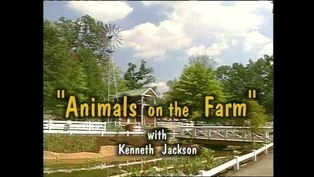
Clip: S3 Ep2 | 3m 38s | Kenneth Jackson sings a song about animals on the farm. (3m 38s)
Providing Support for PBS.org
Learn Moreabout PBS online sponsorship















Support for PBS provided by:
Hello, Mr. Chuck! is a local public television program presented by WKNO
Support for WKNO programming is made possible by viewers like you. Thank you!