
Anti-Asian Hate: From Vincent Chin to Today
Clip: Season 4 Episode 42 | 15m 12sVideo has Closed Captions
Anti-Asian Hate: From Vincent Chin to Today | Episode 442/Segment 1
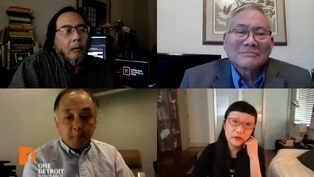
One Detroit’s Bill Kubota talks with Roland Hwang, Jim Shimoura, two attorneys that were key in the fight for justice that united Asian Americans in the 1980s and author, Paula Yoo, who’s written a new book, “From a Whisper to a Rallying Cry: The Killing of Vincent Chin and the Trial that Galvanized the Asian American Movement.” Episode 442/Segment 1
Problems playing video? | Closed Captioning Feedback
Problems playing video? | Closed Captioning Feedback
One Detroit is a local public television program presented by Detroit PBS
Anti-Asian Hate: From Vincent Chin to Today
Clip: Season 4 Episode 42 | 15m 12sVideo has Closed Captions
One Detroit’s Bill Kubota talks with Roland Hwang, Jim Shimoura, two attorneys that were key in the fight for justice that united Asian Americans in the 1980s and author, Paula Yoo, who’s written a new book, “From a Whisper to a Rallying Cry: The Killing of Vincent Chin and the Trial that Galvanized the Asian American Movement.” Episode 442/Segment 1
Problems playing video? | Closed Captioning Feedback
Where to Watch One Detroit
One Detroit is available to stream on pbs.org and the PBS app.
Providing Support for PBS.org
Learn Moreabout PBS online sponsorship- Justice for Vincent Chin!
(somber music) - A week before his wedding, he was out with his buddies at a bar in Detroit.
- [Male Newsreader] Inside the bar, 43 year old Ronald Ebens a foreman at a Chrysler Auto Plant, and his 23 year old stepson, Michael Nitz, taunted Chin, mistaking him for Japanese, and accusing him for the economic downfall of the US Auto Industry.
- [Male Narrator] The fight ends up outside, where the assailants hunt down Chin and his friends.
- [Male Newsreader] According to witnesses, Ebens took this bat out of the trunk of his car, and repeatedly used it to hammer and crush Chin's skill.
As his friends held him, his last words were, "it isn't fair.
It isn't fair."
- [Male Narrator] Vincent's killers plead guilty to manslaughter and face 15 years in prison.
But Judge Charles Kaufman sentences them to three years probation, and a $3,000 fine.
He says, "these aren't the kind of men you send to prison."
(somber piano music) - I think the Vincent Chin murder was shocking to a lot of Asian-Americans, not because it represented something new, but that it actually represented something old, that reminded Asian-Americans that progress hadn't really been made.
- [Helen Zia] In 1882, you could kill a quote, "China man," and get off paying a dollar.
In 1982, you can kill an Asian-American and get off paying $3,000.
This was not justice, but there wasn't an organization that existed to stand up and say, this is wrong.
(somber music) - What began out of that, was meetings that started with four people, 10 people, 20 people, a 100 people, and people were talking about what can we do?
What can we do?
What can we do?
I raised my hand and I said, "the world wants to know how the Asian-American Community feels about this."
- We want justice!
We want justice!
- [Male Newsreader] In-depth, Vincent Chin inspired protest marches, rallies, dinners, banquets.
(applause) - Justice for Vincent Chin!
- The killing of Vincent Chin is probably the most tragic example of the kind of violence that's being committed against Asians.
- For Asian-Americans, Vincent Chin's murder symbolized an extreme example of the kind of discrimination that they'd face.
It becomes a rallying point for Asian-Americans to be able to say, "that's me too."
- I was a freshmen in college when I heard about Vincent Chin and the impact on the Asian-American community.
And it was the first time that I felt like my experience, as a Hmong refugee, as a Southeast Asian, was connected to the experience of other Asian-Americans.
I am finally a piece of the puzzle that completes the picture, and it was so liberating.
(applause) - [Helen Zia] Civil rights organizations of every kind came forward, as well as individuals.
- We have been drawn together by death.
An unplanned family reunion.
Our hearts are made heavy by a mother who sits here with us, whose son was brutally killed just because he was.
What can we do in the aftermath?
Those who live, we must redefine America.
So everybody knows everybody.
Fits in the rainbow somewhere.
(applause) (somber music) - Mrs.
Chin was the inspirational and spiritual leader of this movement.
Many of the ways that she's been seen as to remember her as a grieving mother, but to know her, she was a strong, outspoken woman.
- You know how they killed my son.
(crying) - Kill my son, looks like they kill an animal.
- As like, like they'd kill an animal, yes ma'am.
- This made me very angry.
- Yes ma'am.
- Lily Chin's husband had just died, six months before Vincent was attacked and killed.
Her son had already been shopping and looking for a house that would have a room for his mother to live in.
And there was nothing more that Mrs.
Chin wanted than to have grandchildren.
(applause) - [Helen Zia] Even through her pain, she was standing up, speaking up, organizing.
- I don't want any other mother to suffer like me.
- [Helen Zia] We began to look at the different civil rights laws.
There were constitutional law professors who came out and said civil rights laws are only meant to protect African-Americans.
We had to talk to them and say, no, that's not true.
As an Asian-American, he was being isolated and targeted and scapegoated because of his race in this climate of hate.
So of course civil rights laws should apply.
- [Male Narrator] Under mounting pressure, the Justice Department agrees to bring charges.
This is the first hate crime prosecution involving an Asian-American.
Ronald Ebens is found guilty of violating Vincent's civil rights, and is sentenced to 25 years in prison.
But his conviction is overturned on appeal.
Neither he nor his stepson will ever serve a day in prison for Vincent's murder.
- I wanted justice for my son.
This is not fair.
- All the things that went wrong, didn't give justice to Vincent's mom.
But what it did do, was it invited Asian-Americans to search our voices and demand that we are seen beyond being the perpetual foreigner, but that we actually belong.
This is our country.
- [Helen Zia] Vincent Chin's case has a legacy that affects all Americans, even to this day.
(somber piano music) - One Detroit senior producer, Bill Kubota moderated the town hall.
And he talked with Roland Wong and Jim Shimoura.
They are two attorneys key in the fight for justice that united Asian-Americans back in the 1980s.
And he also spoke with Author Paula Yoo, who has was a new book called, "From a Whisper to a Rallying Cry: The Killing of Vincent Chin and the Trial that Galvanized the Asian-American Movement."
- I will say that I'm a gen X-er, I just turned 52 this year, and I first heard of Vincent Chin when I was in college, that was when "Who Killed Vincent Chin?"
had come out.
And I really started thinking about Vincent Chin in 1993 when I was writing for the Seattle Times, and I got a job offer to come to the Detroit News.
And I remember the first thing I thought of, as did many of my Asian-American journalist friends, was it's a great opportunity, but what about Vincent Chin?
Is Detroit not the best place for an Asian-American to be in because Vincent Chin had just been killed barely a decade earlier?
So the reason why I decided to write this book and aim it towards the young adult, high school audience is because I believe that this history needs to be taught.
- What was it like then in the '80s, things have changed a lot since then, what was it like being an Asian American in Detroit back then?
And then how was it, how hard was it to rally the folks on the all of this regarding the killing of Vincent Chin?
- Well, back in the '80s, the Detroit community was quite small.
I believe the census showed we had about 35,000 people in the Southeast Michigan area, which is microscopic, if you think about an area which has almost 4 million people living.
Add to that, we were in the middle of a crisis with the auto industry, deep recession.
- [Male Newsreader] Industry's pulling up stakes faster than you could say, single business tax.
- I've had enough of '82.
It has to get better.
- [Male Newsreader] And so it must be.
For Detroit, 1982 was the year the recession became depression by proclamation of Mayor Young.
- Now, back then was called Japan bashing, but quite frankly, if you're Asian in appearance, it doesn't matter who you are.
You could be Korean, Chinese, Japanese, Filipino, Vietnamese, we're all the same.
- [Female Newsreader] But many of their verbal bullets aimed at the Japanese government and car makers have strayed off course and are hitting home instead.
- I've been followed down the road by hostile people, screaming out the window of their car, brandishing weapons in the window and everything else.
And I've come very close, on several occasions, to having a serious confrontation where someone probably would've got hurt.
- We got (beep) Japs, Chinese, (beep), any goddamn guy in the world working on an auto line.
It don't bother us one bit.
And they had all the Japanese cars.
This is not a prejudice situation.
- Which in some ways is very scary because even though as bad as it was back in 1982/83, it's even worse now.
We didn't have this large proliferation of attacks back then, it was more isolated, but now it's become a national epidemic.
When I see the video, the kind of outrage, I think fervor, that it raised in the Asian-American Community, not just locally, but nationally, it's deja vu all over again.
We were seeing the same kind of dynamic now in 2021.
And for me, it's very disturbing because I thought after 40 years things would have changed.
But again, it's the same, if not worse.
And as I've told many people before, it's gonna get a lot worse before it gets better with the current political environment.
- Well, part of the key would, Jim you're Japanese-American, Roland, Chinese-American, getting together kind of a, sort of a big deal back then.
- Well we certainly had cooperation between organizations, the Japanese-American Citizens League, The Association of Chinese-Americans, the Chapter of OCA.
The Vincent Chin case really galvanized the Asian-American Community, you know, along civil rights lines, the civil justice lines and so the importance of the case is paramount.
- Justice for Vincent Chin!
- [Roland Hwang] It's a key case for the history of the US and, you know, Detroit history.
- There was a group started the American Citizens for Justice.
I'd like you guys to talk a little bit about that.
- It started with a small group of people, including Helen Zia, the journalist, Jim and myself, and a couple of other lawyers, including Lisa Chan, and really a handful of people around a dinner table at a restaurant.
And then it grew exponentially.
After each meeting, there was about a hundred people that congregated in on Leon Paul in Detroit's Chinatown.
And then we had a next meeting at Third World headquarters with about 300 people there.
And yet we didn't have access to the people we wanted to talk to, like the prosecutor.
We had to enlist people in the civil rights community, the ADL, NAACP, Detroit Association of Black Organizations, to help us, you know, coalition, to wedge the door open, so we could have an audience with the UAW, with the prosecutor and with the judge, that sort of thing.
So it was really a momentous occasion of coalition building then, and that continues now in the current environment.
- So this organization was quite remarkable.
And when I think back and look at it because of the fact we were able to coalesce all these different, three different groups and bring them under one roof in order to be able to carry the fight.
And I think to all of us who are working on the back then, it's one of the proudest things that we've ever done.
(applause) - There's still a lot of that goodwill, even to this very day, and I think for, I know talking to Roland over the years, we really happy that the fact that we were able to, at least, feel that part of it.
- And what do we need to do to kind of get more awareness of general Asian-American history for everybody?
- Bottom line, it's education.
I mean, the fact that Illinois just announced that they're having a mandate where you have to teach Asian-American history in depth in high school.
And there's a State Senator in New York who's also trying to.
There's been a move now to try to get this into schools.
- I think the Vincent Chin case should be part of the curriculum because it is such a complex case, where many elements of law can be discussed, whether it's equal protection, a fair use of the civil rights laws affecting all people of color on all populations, as opposed to just the black white paradigm.
And the idea of coalition building in the Vincent Chin case is something that can be replicated in other cases.
And so I think it's a case that deserves study, both in K-12 and you know, in college.
And really part of the invisibility of the case is also the invisibility of the Asian-American, AAPI Community.
And that's something that we have to work on, you know, in K-12 curriculum.
- We're heading towards a multi-racial, multi-ethnic polar society, where people of color will be the majority over the next 25 years, and education at every level, the core of this is the fact that we are targets of anti-Asian violence.
It's come in many different forms, many different ways over the last century and a half, but the fact is that this has gotta be part of core curriculum.
My mother was in Topaz concentration camp during World War II, and if you look at books, even now, you might get one paragraph about Japanese American incarceration.
Well, that's just fine, but that's lip service of the worst kind, and it minimizes that.
It's really like anything else, it's like Emmett Till or these other historic events.
It has to be preserved as part of maintain.
And especially for young adults going through school.
And this is part of our history, you can't ignore it because it is, I mean, we're gonna repeat it and what's going on now, folks, it's a repeat, it's 1982 all over again.
Asian Americans in Metro Detroit: Rising to be Heard
Video has Closed Captions
Clip: S4 Ep42 | 6m 1s | Asian Americans in Metro Detroit: Rising to be heard | Episode 442 (6m 1s)
Providing Support for PBS.org
Learn Moreabout PBS online sponsorship New Episode
- News and Public Affairs

Top journalists deliver compelling original analysis of the hour's headlines.

- News and Public Affairs

FRONTLINE is investigative journalism that questions, explains and changes our world.

 New Episode
 New Episode
 New Episode
 New Episode
 New Episode
 New Episode
 New Episode
 New Episode
Support for PBS provided by:
One Detroit is a local public television program presented by Detroit PBS